
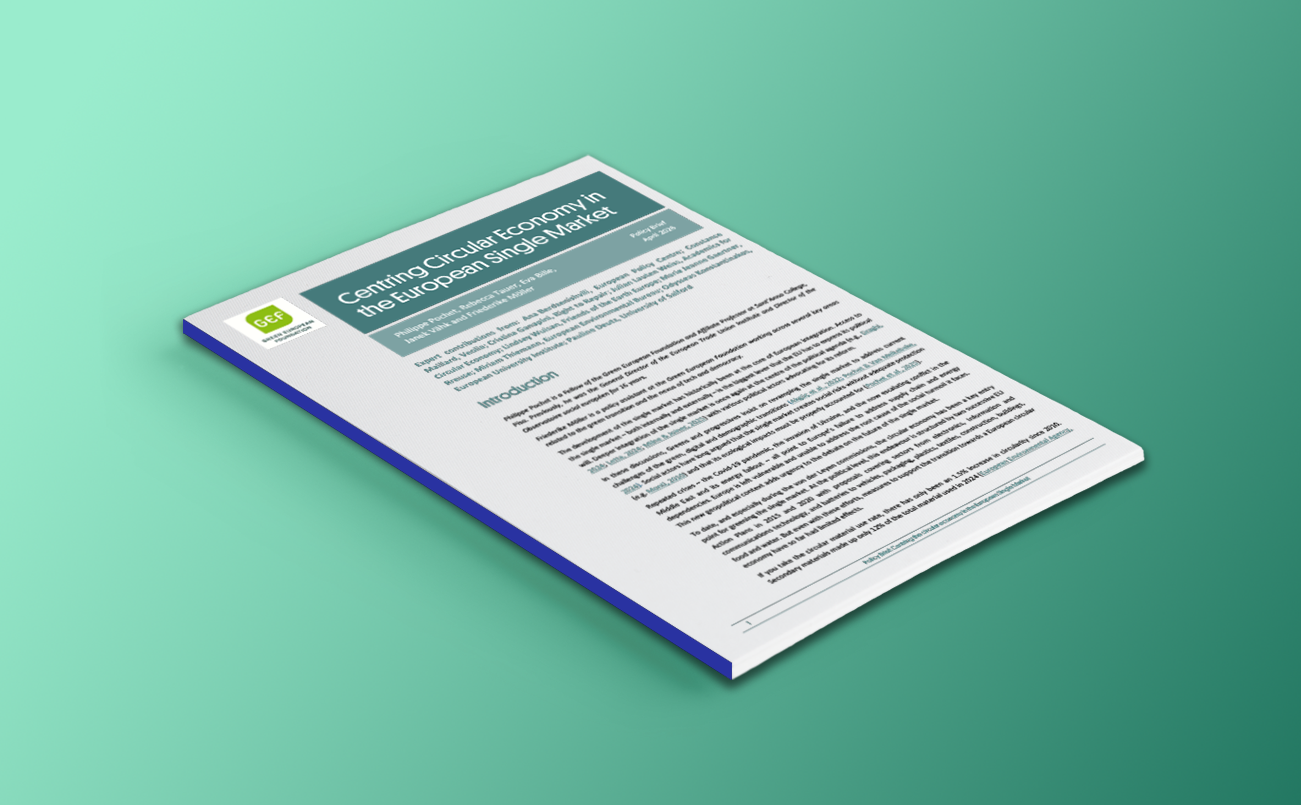
The circular economy is already a key entry point for greening the single market, but it could be so much more. With the potential to transform production models and recalibrate our dependencies, the circular economy could be the basis for a political project that connects resources, work and fairness, provided we seize this opportunity with the required ambition. Ahead of the upcoming Circular Economy Act, this brief makes the case for centring the circular economy as an engine for the single market’s transformation and points to the road ahead.
About
The development of the single market has historically been at the core of European integration. Access to the single market – both internally and externally – is the biggest lever that the EU has to express its political will. With the European economy under stress, the single market is once again in the spotlight.
This brief calls for an ambitious vision for Europe’s circular economy based on the following starting points:
- While the circular economy is often considered a mere technical feat, we need to broaden the frame of reference. Only by considering the social distribution of resource consumption can we build a politically salient offer for economic, social, and environmental resilience around the circular economy.
- From this vantage point, a circular single market is an economic agenda to transition towards a European Union that charts its own course towards autonomy and sovereignty.
- Building on Europe’s strengths, the circular economy is a means to provide quality through the single market – quality of life, quality of goods and quality of jobs.
The authors of this brief explore the transformative potential and diversity of possible solutions along the “9 R chain” in three chapters, highlighting the power of circularity for economic, social and environmental resilience and outlining political and policy proposals that can untap this potential.
The EU is entering a decisive moment for climate, economic and social policymaking. While the debate is ongoing, this publication presents common threads to pull in the short and long term.
Authors
- Philippe Pochet is a Fellow of the Green European Foundation, Affiliate Professor at Sant’Anna College, Pisa and the former General Director of the European Trade Union Institute (ETUI). Before joining ETUI in 2008, he was director of the Observatoire social européen for 16 years.
- Rebecca Tauer leads the circular economy team within the business & markets department at WWF Germany, where she implements projects that advance a circular and resource-efficient economy.
- Eva Bille is in charge of the European Environmental Bureau’s activities on circular economy policy, leading the team and co-chairing the working group across rethink, refuse, re-use, recycling, all the way to waste. This work includes both technical and political involvement in performance and information criteria across different policy areas related to circularity.
- Janek Vähk is a circular economy and sustainability expert working to accelerate Europe’s transition to a zero-waste society. He is the Zero Pollution Policy Manager at Zero Waste Europe, where he focuses on landfills and waste incineration, and on the interlinkages between climate and waste policies.
- Friederike Möller, Policy Assistant at the Green European Foundation, works across several key areas related to the green transition and the nexus of tech and democracy.
Published by the Green European Foundation with the financial support of the European Parliament to the Green European Foundation. The European Parliament is not responsible for the content of this publication. The views expressed in this publication are solely those of the authors and contributors and do not necessarily reflect the views of the European Parliament.
Format: 21x29.7cm
Number of pages: 31
Publication date: 2026, April 28
Type: Policy Briefs