Digital Commons in Warsaw

By

Context

The commons are driven by citizens’ initiatives, including an increasing amount of digital opportunities as well as new technologies which have the power to transform democracy. This topic will be addressed in the upcoming workshop in Warsaw hosted together with Strefa Zieleni. The event is a part of our ongoing project Reclaim the Commons which aims to explore the transformative power of the commons, whilst involving the Greens and a wider audience around this topic. This event will focus on democracy and participation, and how digital tools can and should be utilised to facilitate the involvement of citizens and to guarantee transparency.

Programme

15:15 Barcelona – E-democracy with Decidim (Xabier E. Barandiaran, Barcelona En Comú, via Skype)
16:00 Barcelona and agglomeration – what’s new thanks to Barcelona En Comu? (Sergi Alegre Calero, Barcelona En Comú)
16:45 Break
17:00 „Fearless cities” the first International Municipalist Summit, Barcelona 9-11 June 2017- lessons learned (Weronika Śmigielska, Miasto Wspólne, Justyna Kościńska, MJN, Natalia Malek, City of Warsaw)
17:45 Are digital technologies a chance or a difficulty for local democracy and governance? – debate (Xabier E. Barandiaran, Sergi Alegre, Weronika Śmigielska, Justyna Kościńska, Natalia Malek)
18:45 Conclusions and closing (Ewa Sufin-Jacquemart)
19:00 End of the conference

Time, Venue & Registration

The event will take place at Dom Towarowy Bracia Jabłkowscy in Warsaw on Saturday, 04 November 2017, from 15h00 to 19h00.  To register, please send an email to Ewa Sufin at ewa.sufin@strefazieleni.org. The event will be live-streamed in Polish and more information is also available on the Facebook event page.
“Digital Cooperative Platforms” in Brussels

By

Context

The commons are driven by citizens’ initiatives, including an increasing amount of digital opportunities as well as new technologies which have the power to transform democracy. This topic will be addressed in the upcoming workshop in Brussels hosted together with Etopia. The event is a part of our ongoing project Reclaim the Commons which aims to explore the transformative power of the commons, whilst involving the Greens and a wider audience around this topic.

Workshop in Brussels

This event will have a special focus on the role of digital platforms in the context of commons and their impact on the economy. Digital platforms are affecting the relationship between suppliers and customers, as well as forcing certain sectors to reposition themselves or even to disappear. Competition rules also become more harsh and pose many social problems, with the examples of Uber and AirBnB. Faced with these pressures, we observe new dynamics developing around the models of cooperative platforms. The contribution of the commons can represent a new element energising these structures, making them more flexible and more resilient. What are the models emerging in this way? And how do we organise these platforms?

Such relevant questions will be discussed by the following speakers:

  • Stéphane Boulanger from Febecoop (Brussels)
  • Jean-Philippe Lens  from Topino (Gembloux)
  • Alexandre Ségura & Kevin Poperl from Coopcycle (Paris)

Time & Venue

The workshop will be hosted on Thursday, 12 October 2017, from 11h00 to 13h00 in the premises of Etopia in Brussels (Place des Barricades 1, 4th floor).

Registration

Please sign up by sending an email to jonathan.piron@etopia.be.

(W)E-Democracy – Will Parliament survive the digital era?

By

This event is part of our ongoing transnational project Reclaim the Commons which this year has a special focus on digital commons under the title (W)E-Democracy. More specifically, this year we foster  the understanding of the possibilities that emerge in the digital age for citizens to organise themselves in innovative ways and to generate influence and even co-create policy decisions that affect their lives.

The 21st century democracy in Europe is in dire straits. Citizens feel disconnected with politics, and a growing distrust has led to the lowest participation in European elections ever in 2014. According to the latest Eurobarometer, a staggering 54% of citizens thinks that their voice doesn’t count in the EU. Democracy seems overdue for a profound upgrade. How can we reverse the erosion?

Our digitising society forms a fertile breeding ground for citizens to get organized in innovative ways, and gain more power to influence and even co-create policy decisions that affect their lives. Digital initiatives like online knowledge centres and participation platforms are popping up all over Europe. What is the potential of these technologies to transform and rethink democracy? What are the threats? And how can local governments anticipate to this growing tendency?


#WEdemocracy

(W)E-Democracy takes a look from different angles at promising (citizen) initiatives who employ digital tools to strengthen democracy. We invited Lina Dencik from Cardiff University to talk about citizen rights in a digitised society. We then discussed two successful online platforms: CitizenLab, introduced to us by founder Wietse Van Ransbeeck and DemocracyOS France, presented by its President Caroline Corbal. Next, Xabier E. Barandiaran and Arnau Monterde from Decidim Barcelona shared their experiences with open democracy on city level. Last but not least, Imade Annouri, Green Member of Flemish Parliament, and Dóra Björt Guðjónsdóttir, Chair of the Young Pirates in Iceland, reflected on the possibilities of e-democracy for political parties.


Programme:

13:00h:  Introduction (Dirk Holemans, Coordinator of Oikos and Coordinator of the GEF transnational project Reclaim the Commons)

13:20h: Young Europeans fighting surveillance (Lea Caillere)

13:40h: Citizen rights in a digital era (Lina Dencik)

14:25h: – Digital participation: CitizenLab (Wietse Van Ransbeeck) 

– Digital commons: DemocracyOS (Caroline Corbal)

15:20h:  break

15:35h:  E-democratic cities (Arnau Monterde and Xabier E. Barandiaran)

16:05h:  Digital parties – closing panel (Dóra Björt Guðjónsdóttir and Imade Annouri)

17:00h:  closing drink

More information on the key speakers can be found on the Oikos website.


Location & Date:

THE VENUE OF THE THINKING DAY HAS BEEN CHANGED!

The event will take place at L42, Rue de la Loi 42, on Friday, the 26 May, from 13h onwards.


Registration:

The event is free of charge. Please register here.


Not able to attend the event in Brussels?

The event will be livestreamed by our partner foundations Fondation de l’Écologie Politique (Paris, France), Fundacja Strefa Zieleni (Warsaw, Poland) as well as the Cooperation and Development Network Eastern Europe (Belgrade, Serbia).


Digitised Security – How to Read the Surveillance Discourse and Fight it!

By

The seminar took place from 24th – 30th April in Bosnia. It was inspired by a digital [x] webinar that looked at the political reactions sparked by the terrorist attacks in Paris and how the tension between security and freedom was framed by agenda setters. A year later, censorship and mass surveillance are becoming the norm, and we want to fight this: we want to change the discourse to achieve better policy and give everyone the tools to protect their freedom, even in hostile environments.

The programme was based on the principles of non-formal education and intercultural learning. We strove for active, inclusive and direct communication and transfer of knowledge. The sessions were balanced between theoretical inputs, workshops, role-plays, debates, discussions, reflection and other interactive methods of learning.

The seminar aspired to:

  • Explore how recent events have led to fear being instrumentalised to restrict our online freedoms;
  • Analyse how online censorship and mass surveillance are justified by governing bodies and why these policies are ineffective at increasing security;
  • See how they harm personal freedoms and democracy;
  • Look at why anonymity and privacy is important for oppressed and minority groups to avoid persecution and harassment;
  • Develop skills to use software that protects us from surveillance and overcomes censorship.

During the week-long event, 40 young people from all over Europe came together and aimed at creating a vibrant environment to produce sustainable and long lasting collaboration to fight for common digital rights!

The event reported can be downloaded here.

More information

Date: 24 – 30 April 2017
Location: (close to) Sarajevo, Bosnia and Herzegovina
Duration: 6 working days
Working language:
English
Number of participants: 40

Call for applications closed!

Call for Participants
Project Description
AGENDA

This project was supported by the Youth Department of the Council of Europe, Green Forum (Sweden), Green European Foundation and Terry Reintke (Member of the European Parliament, The Greens/EFA).

Youth Conference “Digital Commons” in Belgrade

By

This three-days conference included talks and panel discussions with a focus on the theme of “Internet as a Commons and the New Politics / New Economy of Commoning”. The aim of the event was to provide space for a European debate on how to re-decentralise and reclaim the Internet as a Commons, which also leaves it open to commercial opportunities.

In terms of the programme, the first day provided insights into relevant themes, such as The Copernican Revolution of Copyright Regulation, Digital Commons in New EU Copyright Law, Social Networks as a Commons and more.

The second day consisted of many panel discussions, along with talks related to Knowledge as a Commons – Innovation & Creativity through Open Access, Transformative Power of the Commons and Open Innovation.

During the last day of the conference, the participants analysed Trust & Distrust in Internet Governance, Data PPPs, Selfgoverned Commons, in addition to other relevant topics.

“Commons and Resource Sharing” Workshop in Brussels

By

This workshop is a part of the Reclaim the Commons project, which in 2016 has a special focus on two themes – the relation between the commons and policy, and the impact of commons as a governance model on the public services. In the scope of this transnational project, the Green European Foundation and Etopia will implement three events in Belgium throughout this year, with this workshop as the first.

Themes of the Workshop:

From economic platforms to waste and energy management cooperatives, the question of communal structures is becoming more and more salient. Linked to the question of resource management, these new structures offer a range of new and innovative opportunities and projects. Trust between partners, savings made as well as original forms of co-management and coordination provide pathways to new alternatives.

What are the means and frameworks to be put in place? Towards which objectives? And how does the sharing of communal resources represent an ecological and social alternative. These are some of the questions we tackled during this event with our speakers.

Speakers:

  • The Gérard Fourré and Marc Moura from the Comptoir des ressources créatives and Dynamo;
  • Bertrand Merckx from Ecores.

Time and Location:

Date TBC, at the premises of Etopia in Brussels (Place des barricades, 1 – 4th floor).

“Commons and Public Partnership” Workshop in Brussels

By

This event is a part of our Reclaim the Commons project, which this year aspires to provide relevant insights to the relation between the commons and policy, and the impact of the commons as a governance model on the public services.

Themes of the Workshop:

How do we build relationships between the collective initiatives, which focus on the new transitions around the commons, and the public authorities? What places are the commons claiming and how are sharing and diversity perceived by the public authorities? And how to move forward by overcoming obstacles and building new models? These questions will be addressed during the workshop with the help of our speakers:

  • Jean-Claude Englebert, First alderman in charge of urban planning and communal properties in Forest, Brussels;
  • Loïc Géronnez, Commons Josaphat, Brussels.

Time and Location: Wednesday, the 29th of June, from 11h00 to 13h00, at the premises of Etopia in Brussels (Place des barricades, 1 – 4è étage).

Urban Commons – Commoning the City

By

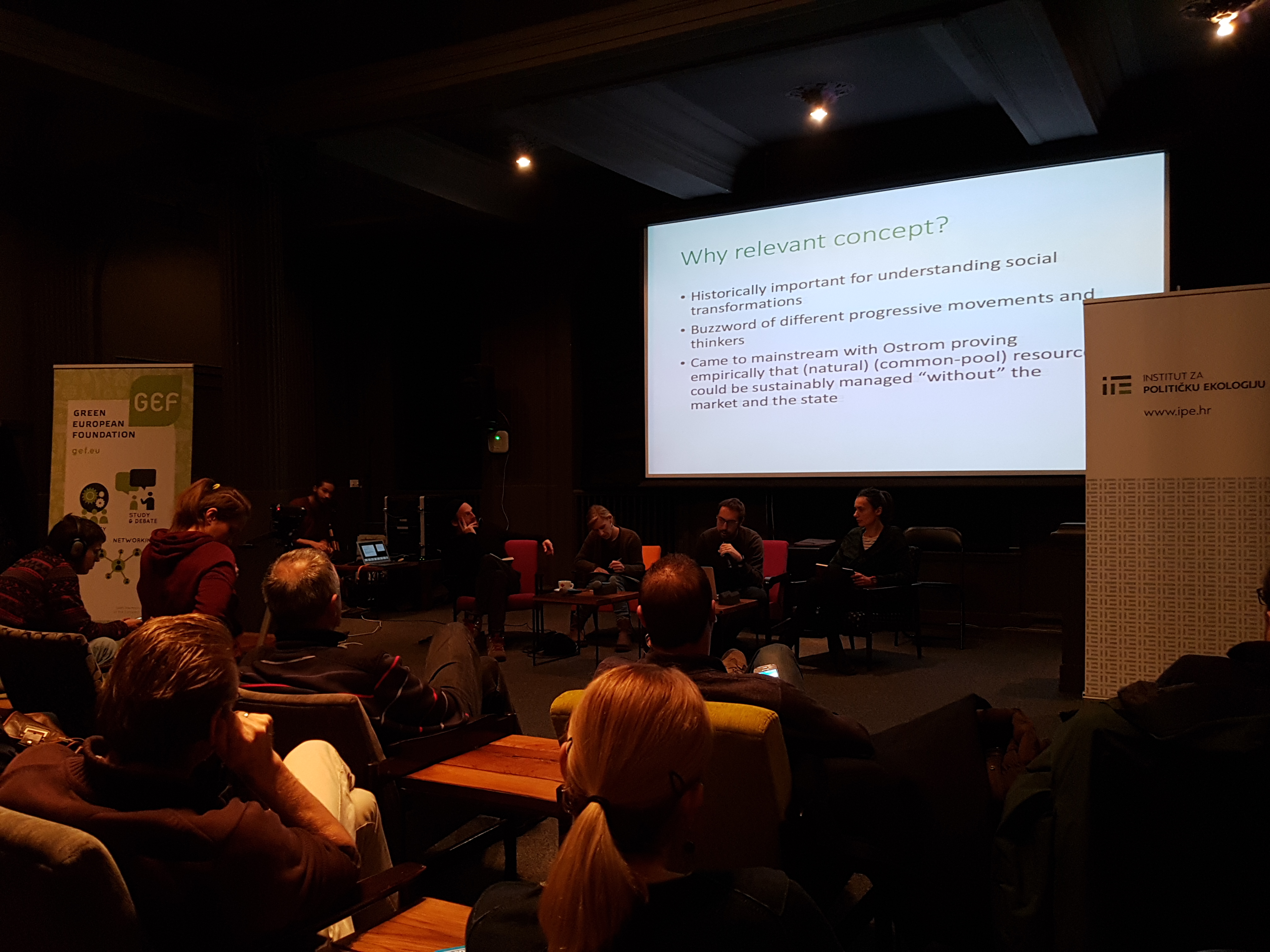
Commons as a concept and practice entered into mainstream after Elinor Ostrom received in 2009 Nobel Award in Economics for empirically proving that communities can sustainably manage natural resources without direct influence of the state and the market. Concept of commons was extended for also human-made resources and even immaterial resources and for different contexts including the urban. More radical and critical approaches of commons emerged especially in the context of various urban social movements fighting against privatisation, commodification and commercialisation of cities. Practices of self-governance and community governance of urban resources were introduced or reintroduced in cities all around Europe. In Athens there is a network of solidarity commoning practices providing food, housing and even health service to people who are left behind after years of austerity politics. In Bologna the local government even adopted regulation so communities can engage in collaboration to produce and regenerate urban commons. In Barcelona citizen platform called “Barcelona in Common” won the local elections and is trying to establish framework for urban commons governance in different sectors.

This seminar presented examples of urban commoning in cities of Madrid, Berlin, Maribor, Belgrade and Zagreb. It provided forum for exchange on various inspirational urban commons practices as well as confrontational tactics against the enclosure of the urban commons and privatisation of the urban public goods. Seminar aimed to tackle the debate among participants on how can urban commons and self-governance models be enhanced, supported and protected in cities of the region.

PROGRAMME: 

  • 10h00 – 10h30 Introduction to theory of the commons – Tomislav Tomašević (Institute for Political Ecology)
  • 10h30 – 11h30 Urban commons practices in Madrid and Berlin – Lucia Lois (El Patio Maravillas) and Marco Clausen (Nachbar¬schafts¬akademie)
  • 11h30 – 12h00 Discussion
  • 12:h0 – 12h45 Lunch 
  • 12h45 – 13h45 Commoning the city in Belgrade and Maribor – Iva Ćukić (Ministarstvo prostora) and Matic Primc (Iniciativa mestni zbor)
  • 13h45 – 15h30 – Discussion
  • 15h30 – 16h00 – Break
  • 16h00 – 17h30 – How to enhance the urban commons in local context? (open roundtable) – Iva Marčetić, Mislav Žitko, Alma Midžić, Teodor Celakoski, Emina Višnić, Enes Ćerimagić, Dušica Radojčić, Nikola Zdunić, Cvjeta Bišćević, Svibor Jančić

This event is a part of our transnational project “Reclaim the Commons”, which revives the debate around the commons as a fundamental part of the Green political ideology across Europe.

This event was open to public and free of charge.

Launch of the new edition of the Green European Journal

By

A panel will discuss the diverse understandings of the commons and examine their transformative potential. The debate will feature relevant speakers, such as MEP Molly Scott Cato, lawyer and social geographer Daniela Festa, founder of the Peer-to-Peer Foundation Michel Bauwens, and Professor of Sociology Christian Laval.

An investigation into the commons reveals the wide-ranging spectrum of definitions and applications of this concept that exist across Europe. From urban public spaces to natural ecosystems and the virtual world – the concept of the commons seems to be giving rise to new forms of organisation, collaboration, and management of resources. Yet from the numerous local initiatives, social movements and governance models associated with this term – is it possible to identify the outline of a commons-based approach that could form the basis of a broad cross-societal response to the failures of the current system?

Join us for a discussion with MEP and economist Molly Scott Cato,  founder of the Peer-to-Peer Foundation Michel Bauwens, lawyer and social geographer Daniela Festa, and expert on the far-reaching social impacts of neoliberalism Christian Laval. The debate will be moderated by Oikos coordinator and author Dirk Holemans. The event is organised by the Green European Foundation with the support of Oikos think tank and Etopia.


Please register for the event, by clicking here, join the facebook group here.

Information about the speakers:

Molly Scott Cato is the first Green MEP for the South West of England and Gibraltar, elected in May 2014. She is a leading member of Green House think tank, and formerly professor of strategy and sustainability at the University of Roehampton. She has written several books including Green Economics (2009), Environment and Economy (2011) and The Bioregional Economy (2012) as well as numerous academic papers.

Michel Bauwens is a peer-to-peer theorist, writer, and the founder of the P2P (Peer-to-Peer) Foundation, a global network of researchers, activists, and citizens monitoring and promoting actions geared towards a transition to a Commons-based society.

Daniela Festa is a lawyer, social geographer, and activist. She has a PhD degree in urban and social geography and Post-Doctoral Fellowship in social sciences (EHESS), Paris. She recently joined an European Research Council project at Sciences Po (Paris) on “inclusive properties”. Her main research themes are urban movements and projects, active citizenship and participatory democracy.

Christian Laval is currently Professor of Sociology at the Université de Paris Ouest Nanterre La Défense. His books include The New Way of the World: On Neoliberal Society (with Pierre Dardot); Jeremy Bentham, les artifices du capitalism; L’École n’est pas une entreprise: Le néo-libéralisme à l’assaut de l’enseignement public; and L’Homme économique: Essai sur les racines du néolibéralisme.

Moderator: Dirk Holemans, coordinator of the Belgian Green think-tank Oikos and a member of the board of the Green European Foundation. His most recent book is ‘Vrijheid & Zekerheid’.

The commons: (co)managing commonly owned resources

By Uncategorized

The term “commons” is gaining increasing currency in political debates today, as thinkers and activists look for alternatives to what appears to be the failing model of the market economy. While many people have a broad idea of what the commons are – a means of co-managing a resource for the community as a whole – what does it mean in practice? And where and when can the idea of a commons be applied?

Many of these issues were discussed at the GEF seminar earlier this year. Since the idea of the commons was reintroduced to the public debate by the likes of Elinor Ostrom, many new forms of commons have become viable. An example discussed at the seminar was the idea of genetics and DNA as a type of commons.