Alexander Langer peacebuilder : Lessons and Legacies for Europe Today

By

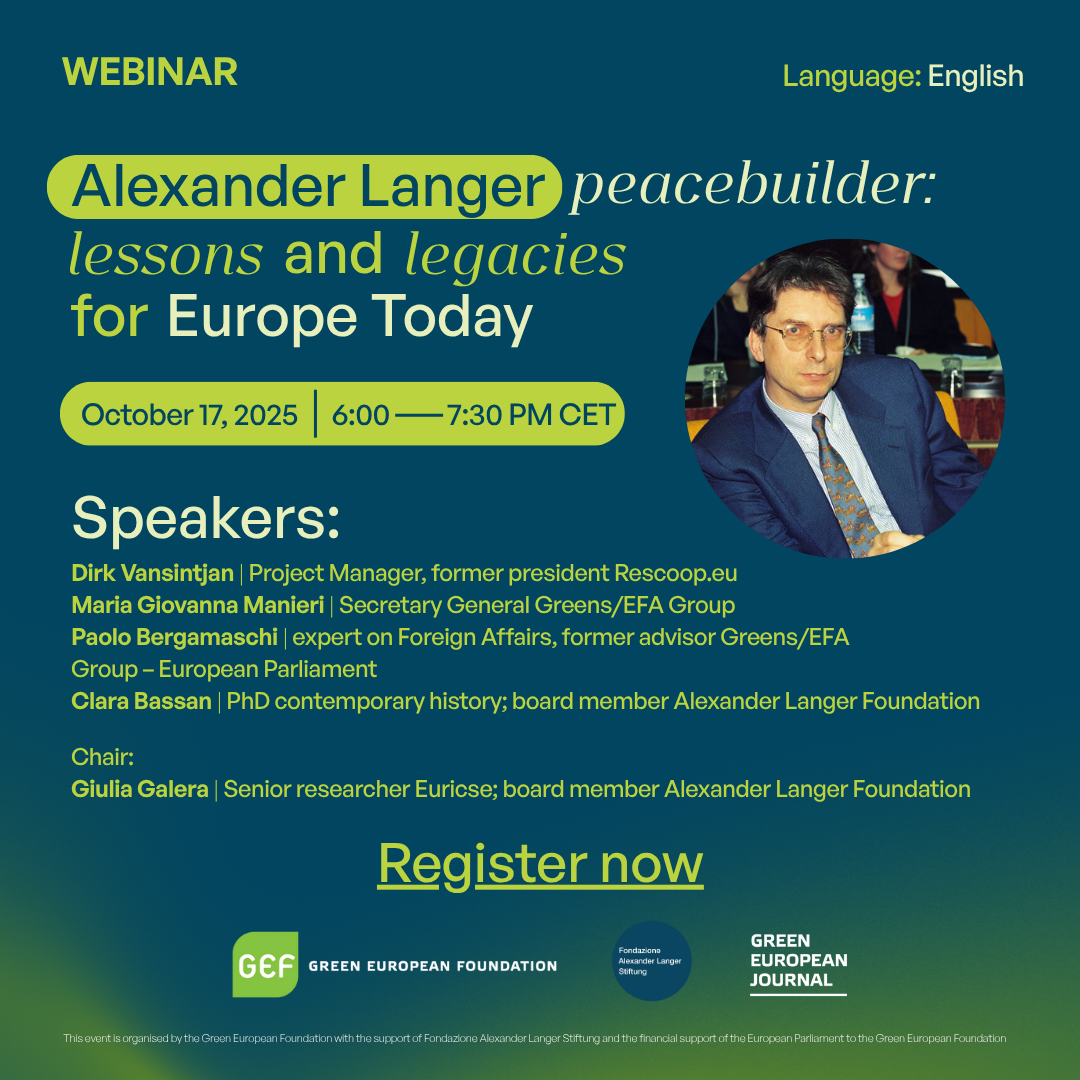
Join us this October for a special GEF Webinar: a gathering of experts and Green thinkers to reflect on the legacy of Alexander Langer. Together, we’ll explore what lessons his experiences offer for today’s turbulent times and how they can inspire the future of the Green movement.

About the event

On October 17th at 6:00 PM, we invite you to join the webinar “Alexander Langer Peacebuilder: Lessons and Legacies for Europe Today”, organized with the support of the Alexander Langer Foundation.

Marking the 30th anniversary of Langer’s passing, this event pays tribute to one of Europe’s most influential Green voices: a bridge-builder between communities, movements, and ideas. His message of peace and ecological responsibility remains highly relevant today. At this occasion, the Green European Journal recently published an article titled Alexander Langer, peacebuilder, revisiting his life, work, and passionate commitment to dialogue and reconciliation.

Building on this article, the webinar will explore Langer’s legacy and reflect on how his ideas and concrete actions can be applied today to promote ecological transition and peace in the context of contemporary Europe.

Speakers:

  • Dirk Vansintjan (Project Manager, former president Rescoop.eu)
  • Maria Giovanna Manieri (Secretary General Greens/EFA Group)
  • Paolo Bergamaschi (expert on Foreign Affairs, former advisor Greens/EFA Group – European Parliament)
  • Clara Bassan (PhD contemporary history; board member Alexander Langer Foundation)

 Chair: Giulia Galera (Senior researcher Euricse; board member Alexander Langer Foundation)

Practicalities

Date: Friday, October 17, 2025 – 6:00 PM
Language: English
Registration link


This event is organised by the Green European Foundation with the support of Fondazione Alexander Langer Stiftung and the financial support of the European Parliament to the Green European Foundation.

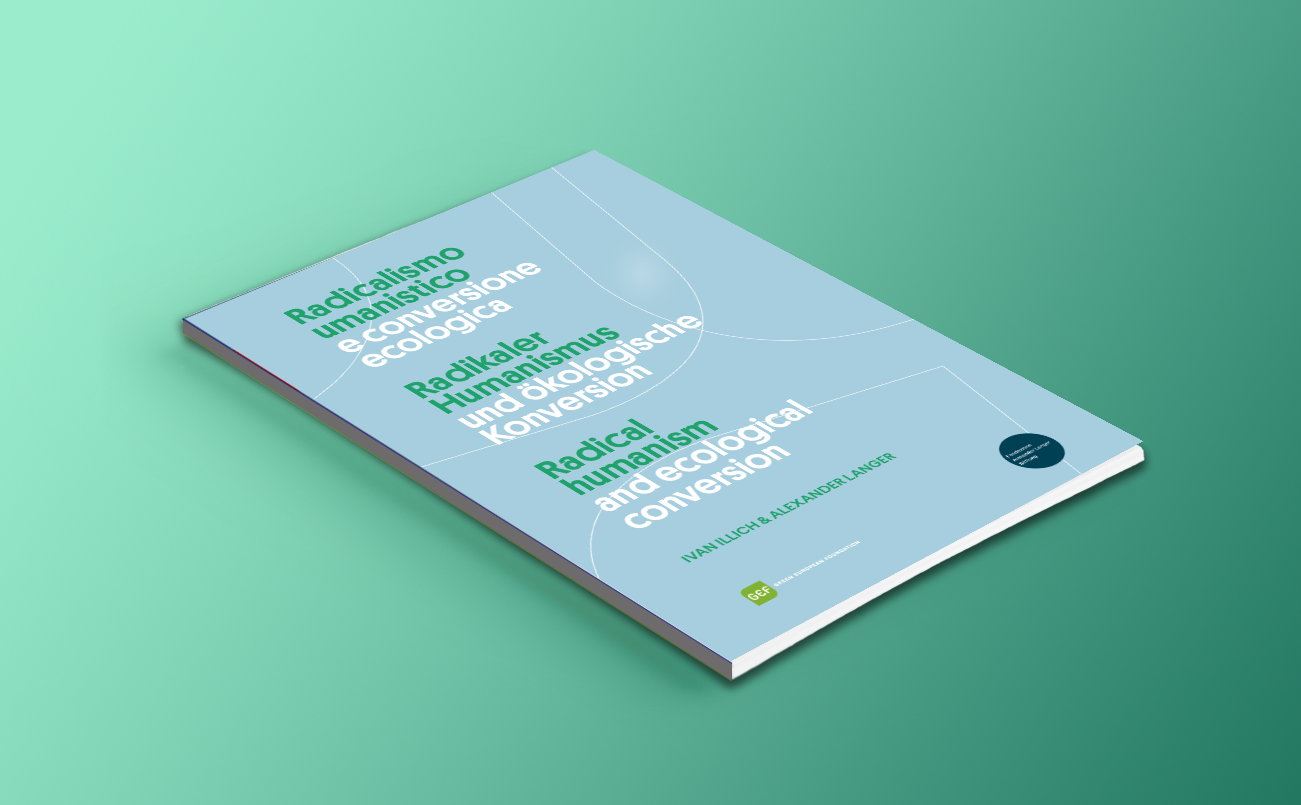
Radical Humanism and Ecological Conversion

By Uncategorized

Context

Is Europe ready for the ecological conversion that scientific evidence stresses on us?

Ivan Illich and Alexander Langer are influential interpreters of the economic critique of consumer society. Their work and practice offer many stimuli for reflection and action in the contemporary context.

Back in October 2021, we held a conference that offered the opportunity to compare Illich’s and Langer’s views and critical aspects. The conference aimed at fostering the translation of theoretical thinking into practical choices as they emerge from the different programs and practices of the Green political sphere, to design and develop new humanistic approaches and environmental strategies.
The reflections that emerged from the reports of the conference are of great relevance if read from a European perspective. They can, in fact, stimulate the current debate on the direction the Ecological Transition should take or in applying the resources of the “NextGenerationEU” funds.


Available Translations

Spanish


This publication has been realised with the support of the Alexander Langer Foundation and the financial support of the European Parliament to the Green European Foundation. The European Parliament is not responsible for the content of this publication.

Radical Humanism and Ecological Conversion: Ivan Illich and Alexander Langer

By

About the Event

Is Europe ready for the ecological conversion that scientific evidence stresses on us?

Ivan Illich and Alexander Langer are influential interpreters of the economic critique of consumer society. Their work and practice offer many stimuli for reflection and action in the contemporary context.

This conference will offer the opportunity to compare Illich’s and Langer’s views and proposals, and to examine not only their freshness and relevance but also their critical aspects.

The seminar will dedicate sessions to the translation of theoretical thinking into practical choices as they emerge from the different programs and practices of the Green political sphere, in order to design and develop new humanistic approaches and environmental strategies.

Context

Ivan Illich and Alexander Langer are two of the most authoritative interpreters of a critique of the consumer society based on the theory of market self-regulation.

Illich’s importance in representing a critical voice towards the Western social model, by now of global dimension, is well known. We aim to venture further and discuss the personal trajectory and new message that he wanted to propose without coming to terms with the corruptive logics of a consumerist society, and how can this apply to the present generations.

Langer spoke of the social desirability of an ecological conversion even before Pope Francis did so in his Encyclical. This can only succeed when it is socially desirable. What we need is a ritual passage which has the allure of solemnity: an “ecological constituent,” and a widespread commitment to reconsider our ways of living, producing, consuming in order to make our life-styles compatible with the limited amount of resources the world can provide.

The various conference contributions will study the religious aspects, those linked to agricultural and territorial choices, the theme of the frontier, and the economic and political aspects measured by the real goods and needs of the civil communities throughout Europe.


Programme and Speakers

Friday, 22/10 

17:00 Conference opening 

  • Mauro Bozzetti & Franz Tutzer 

17:30 “In the sign of the flying fish:” Ivan and Alexander 

  • Barbara Duden, Hannover University 

Saturday, 23/10 

9:00 It is not enough to be indignant. The concrete utopia of Illich and Langer. 

  • Mauro Bozzetti, University of Urbino 

10:00 Interculturality: from Illich to Langer 

  • Fabio Milana  

11:30 When the frontiers fall, all is the same – the disappearance of the ability-to-be-different 

  • Marianne Gronemeyer  

14:30 Not developing the production of goods, but the art of life 

  • Peter Kamerer  

15:30 The regeneration of the common good as an integral revolution 

  • Giannozzo Pucci  

17:00 Wolfgang Sachs: Memories, impressions, analysis 

  • Wuppertal Institute for Climate 

18:00 Brief interventions and reflections 

  • Fridays for Future, Lupus in Fabula, … 

Evening: eco-acoustic intervention by David Monacchi  

Sunday, 24/10 

9:00 Rethinking along with Alexander Langer and Ivan Illich 

  • Franz Tutzer 

9:45 Round table: Towards a European ecological conversion 

  • Moderated by Franz Tutzer & Mauro Bozzetti 

12:00 Conclusion 


Practicalities

Dates: 22-24 October 

Location: Monastery of Montebello, Italy 

Language: Italian (some sessions in German with guiding translation) 

Registration and further information: info@alexanderlanger.net (deadline – October 15th) 

Audience: The event is addressed both to persons interested in the work in Illich and Langer and more broadly to citizens with an interest in climate change and ecological policies, to students, scholars, and activists.

A brochure containing the conference contributions will be made available after the event, which will be beneficial in promoting, design and developing new humanistic approaches and environmental strategies for a desirable future, a “futuro amico”.


This conference is organised by the Green European Foundation with the support of Fondazione Alexander Langer and the financial support of the European Parliament to the Green European Foundation.  

 

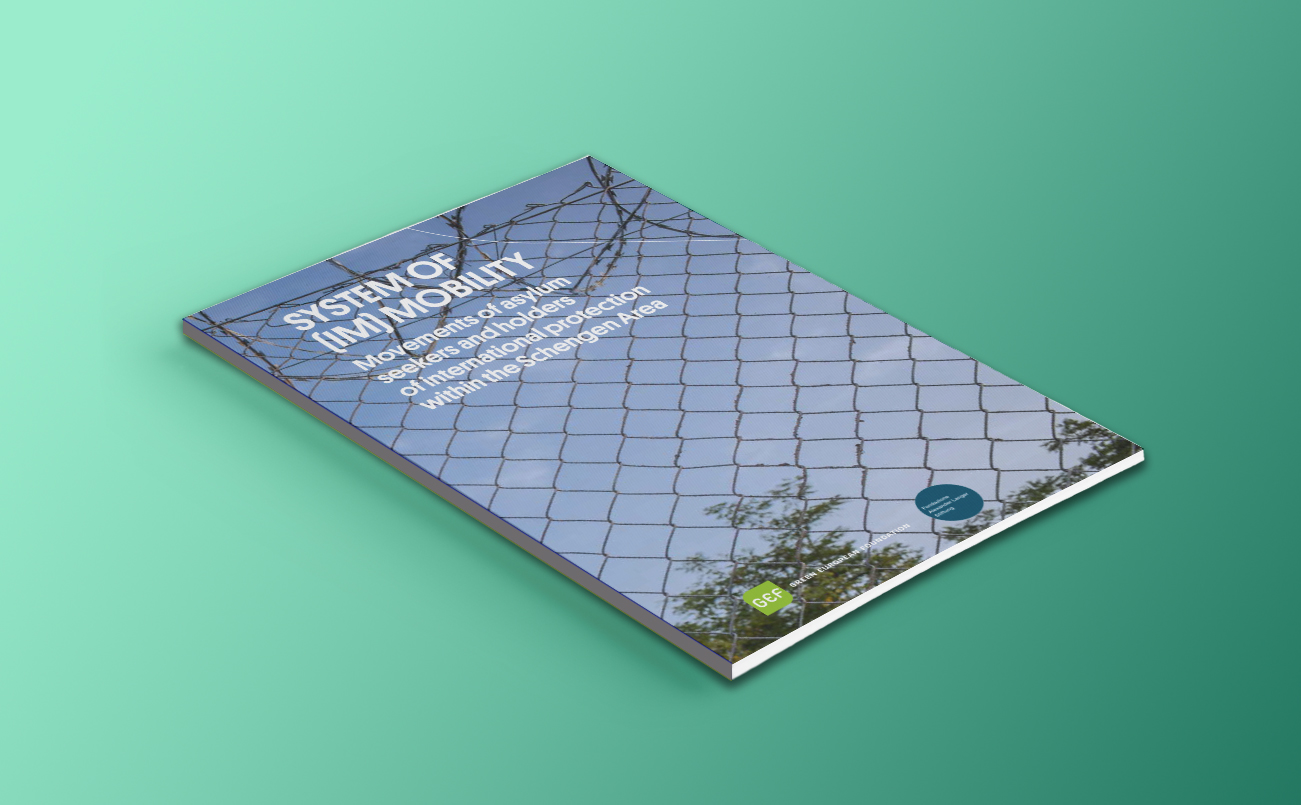
System of (Im)Mobility – Movements of Asylum Seekers and Holders of International Protection Within the Schengen Area

By Uncategorized

The contributions contained in this booklet are dedicated to analysing current European legislation, as well as the possibilities of reforming it, with reference both to the entry of non-EU citizens into the Schengen Area, and to their opportunities to move around by themselves or to be joined by family members.

They have been presented by the authors at a conference in Milan on 2nd December 2019, organised by GEF and with support of its partner organisations.

This publication has been realised by the Green European Foundation with the support of those partners Alexander Langer Foundation, Associazione per gli Studi Giuridici sull’Immigrazione and Open Society Foundations.

Please find the Italian version of this publication available to read here.