
Fair allocation of energy network costs

By Featured, Publications

About 

As Europe electrifies, it will need to invest massively in its grid. Grid investment is paid for through network tariffs, a component of energy bills. A surge in investment means a surge in network tariffs. But how should these costs be fairly allocated in the context of a just transition for all and an ongoing cost-of-living crisis across Europe? 

Well-designed grid tariffs can reward household flexibility that eases pressure on grids while protecting vulnerable consumers. This brief calls on the European Commission to provide stronger guidance for national regulators on designing network tariffs that encourage those who can to flex their electricity demand while protecting vulnerable consumers and working to reduce energy poverty.  

This policy brief is one in a series of briefs developed by a Knowledge Community of approximately 30 experts in energy and social policy from industry, the EU institutions, civil society and think tanks. The group met several times over half a year to discuss how to foster participation and inclusion in the energy transition. To write the briefs, the authors used a collaborative method where they presented each draft during Knowledge Community meetings, then led a dedicated discussion, drawing ideas from the expertise in the group to develop their work. 

You can access the publication here, also available in Catalan.

Authors

  • Tom Lewis is Energy Policy Coordinator at Climate Action Network Europe 
  • Christophe Jost is Energy Policy Coordinator at Climate Action Network Europe 

The other briefs in this series are: 

We encourage you to explore the two policy briefs featured above or access the complete collection below:


This policy brief is published by the Green European Foundation with the financial support of the European Parliament to the Green European Foundation. The European Parliament is not responsible for the content of this publication. The views expressed in this publication are solely those of the authors and contributors and do not necessarily reflect the views of the European Parliament or the Green European Foundation.

Published with the support of the Heinrich-Böll-Stiftung European Union| Global Dialogue. The analysis and opinions expressed in this report reflect the views of the authors, and do not necessarily reflect the views of the Heinrich-Böll-Stiftung European Union | Global Dialogue.

Increasing benefit sharing of renewable energy projects

By Featured, Publications

About 

The practice of benefit sharing of renewable energy projects is a win-win situation. It can make the energy transition fairer for local communities, help developers speed up project deployment and accelerate the EU’s renewable rollout. Project developers consult with local citizens and municipalities, and come to an agreement on sharing some of the benefits of the project, whether that be through local investment, in-kind benefits, or local part-ownership. Involving the local community can reduce local opposition and speed up permitting, and make projects more competitive.  

Despite its many advantages, the practice is still relatively limited. This brief calls for the EU to help widen and standardise benefit sharing by providing guidelines and setting out key principles that can be implemented across the EU. It calls on the European Commission to include benefit sharing in its Citizens Energy Package, look at making benefit sharing mandatory and include it in assessment criteria for permitting applications.  

This policy brief is one in a series of briefs developed by a Knowledge Community of approximately 30 experts in energy and social policy from industry, the EU institutions, civil society and think tanks. The group met several times over half a year to discuss how to foster participation and inclusion in the energy transition. To write the briefs, the authors used a collaborative method where they presented each draft during Knowledge Community meetings, then led a dedicated discussion, drawing ideas from the expertise in the group to develop their work. 

You can access the publication here, also available in Catalan.

Author 

  • Etienne Charbit is Europe Policy Officer at French NGO réseau Cler 


The other briefs in this series are: 

We encourage you to explore the two policy briefs featured above or access the complete collection below:


This policy brief is published by the Green European Foundation with the financial support of the European Parliament to the Green European Foundation. The European Parliament is not responsible for the content of this publication. The views expressed in this publication are solely those of the authors and contributors and do not necessarily reflect the views of the European Parliament or the Green European Foundation.

Published with the support of the Heinrich-Böll-Stiftung European Union| Global Dialogue. The analysis and opinions expressed in this report reflect the views of the authors, and do not necessarily reflect the views of the Heinrich-Böll-Stiftung European Union | Global Dialogue.

The beauty of what already exists: The contribution of renovation and repurposing to affordable energy-efficient homes

By Featured, Publications

About 

Political pressure is high to deal with Europe’s housing crisis. This policy brief calls on policymakers to resist the temptation for short-term fixes, arguing rather for a holistic understanding of housing affordability that looks beyond paying rent or mortgage to also account for the cost of living in a home. Quality housing can save energy, protect occupants’ health and resist extreme weather impacts. The policy brief makes the case that investing further in renovation and repurposing of existing buildings should be central to any response to the housing crisis.  

This policy brief is one in a series of briefs developed by a Knowledge Community of approximately 30 experts in energy and social policy from industry, the EU institutions, civil society and think tanks. The group met several times over half a year to discuss how to foster participation and inclusion in the energy transition. To write the briefs, the authors used a collaborative method where they presented each draft during Knowledge Community meetings, then led a dedicated discussion, drawing ideas from the expertise in the group to develop their work. 

You can access the publication here.

This brief is also available in Catalan.

Author

  • Emily Bankert is Researcher for Carbon and Energy in the Built Environment at Buildings Performance Institute Europe 
  • Hélène Sibileau is Senior Policy Advisor at Buildings Performance Institute Europe 

The other briefs in this series are: 

We encourage you to explore the two policy briefs featured above or access the complete collection below:


This policy brief is published by the Green European Foundation with the financial support of the European Parliament to the Green European Foundation. The European Parliament is not responsible for the content of this publication. The views expressed in this publication are solely those of the authors and contributors and do not necessarily reflect the views of the European Parliament or the Green European Foundation.

Published with the support of the Heinrich-Böll-Stiftung European Union | Global Dialogue. The analysis and opinions expressed in this report reflect the views of the authors, and do not necessarily reflect the views of the Heinrich-Böll-Stiftung European Union | Global Dialogue.
Ecologia: La Revolució del Segle XXI

By Uncategorized

Context

‘Ecology as the revolution of the 21st century’ takes the contributions of experts and authors as well as previously published Green European Journal pieces, to provide an overview of the formative green visions for Europe. The publication language is Catalan.

La crisi climàtica és una emergència glo bal que tan sols podrem superar des dels grans acords internacionals que ens permetin gover nar les interdependències que genera la globalització.

“The climate crisis is a global emergency that can only be overcome from the great international agreements that allow us to govern the interdependencies generated by globalization.”

Objectives

This issue of the Nous Horizons Magazine features insightful reflections on the state of the green movement and its relationship with the world of work, adding a European and global perspective to contextualize what is happening in the world we live in. It also aims to provide the right tools for political environmentalism to become the political paradigm of the 21st century.


This publication has been realized with the support of Nous Horitzons and the financial support of the European Parliament. The European Parliament is not responsible for the content of this publication.

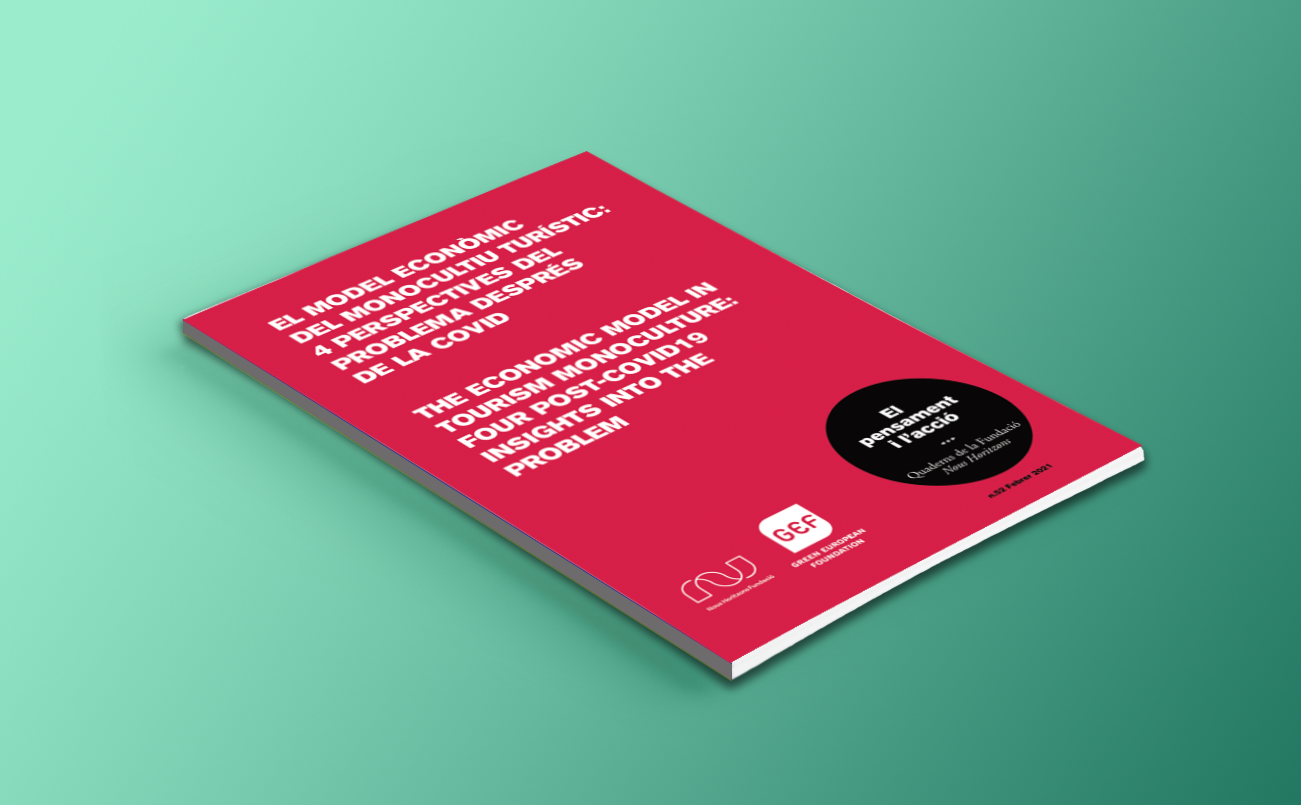
The Economic Model in Tourism Monoculture

By Uncategorized

EL MODEL ECONÒMIC DEL MONOCULTIU TURÍSTIC


As this project developed in 2020, COVID-19 wrestled hold of Europe and devastated tourism industries across the continent. With the streets and beaches empty, people and governments have been forced to look at the economic sustainability and the environmental impact of the sector; our project has been holding up a magnifying glass, allowing them to look more closely.

In this publication (EN/CAT) we analyse the sun and beach tourism model, and draw conclusions that may help  us find alternatives.


This publication is a summary of the workshop “The economic model of monoculture tourism: 4 perspectives of the problem after COVID” that took place on 3 December 2020 in the frame of the GEF (Green European Foundation) project “Fair and Carbon Free Tourism”. Different green foundations collaborate in this transnational project that will work for three years on different aspects of sustainable tourism.

More information: Fair and Carbon Free Tourism