Uncategorized9

Connect the Dots

By Uncategorized

Coffee and Networking 


Saturday, 25 April

09:30 – 10:00 

Room: Salle de Guichets 

You’re in the same room as changemakers from across Europe and beyond. Use this half-hour well. Connect the Dots is a structured speed networking session designed to spark real conversations, not small talk. In a few quick rounds, you’ll swap stories, find unexpected common ground, and leave with at least one new connection worth keeping. Come with curiosity. No agenda required. Coffee provided.


Facilitator: Eliza Popper, facilitator, trainer and consultant.

Eliza Popper is an experienced facilitator, trainer, and consultant based in Brussels, who has worked at capacity-building events in over 40 countries. She has extensive experience in the youth and education sector, with a focus on organisational development, youth policy, and youth work. Eliza used to be Ad-Interim Deputy Director of the Green European Foundation, and is the co-founder of the Good Enough Company.

Networking Dinner & Performance

By Uncategorized

Dinner & Performance


Saturday, 25 April

18:30 – 20:45 

Room: Salle de Guichets 

The dinner will start at 18:30 until 19:30 and will be followed by a performance by Mahour, Iranian singer-songwriter, and dancer Mahsa Bagheri, starting at 19:45 until 20:45.

Performers


Mahour is an Iranian singer-songwriter based in Belgium, blending Persian poetry with pop/rock, flamenco, and electronic elements. Since the 2022 “Woman, Life, Freedom” movement, his work has become closely tied to political and social issues in Iran and the Middle East, reflecting themes of resistance, freedom, and human rights.

Mahsa Bagheri: Coordinator at oosterweelverbinding project (ROCO), Persian classic and miniature dancer.

Where Do We Go From Here? Shaping AI, Shaping Ourselves

By Uncategorized

Shaping AI, Shaping Ourselves: Thinking Together with Shannon Vallor


Saturday, 25 April

16:30 – 17:15 

Room: Salle de Guichets

As the programme comes to a close, this session invites participants to step back and reflect on a deeper question: what does AI reveal about us, and what kind of societies do we want to build in response? Drawing on the ideas of The AI Mirror, Shannon Vallor will explore how AI not only shapes our world but also reflects our values, assumptions, and inequalities back to us. Moving from reflection to action, the conversation will consider how these technologies are reshaping human agency, democratic participation, and political responsibility- and where space still exists to resist, rethink, and redirect their trajectory. The session will be open and interactive, leaving room for collective reflection and audience exchange.

Prof. Shannon Vallor, Co-Director, Centre for Technomoral Futures, author The AI Mirror: How to Reclaim Our Humanity in an Age of Machine Thinking

Prof. Shannon Vallor is the Baillie Gifford Chair of the Ethics of Data and Artificial Intelligence at the University of Edinburgh, where she serves as Co-Director of the Centre for Technomoral Futures and the UKRI BRAID (Bridging Responsible AI Divides) programme. Professor Vallor’s research explores how AI and robotics reshape human character and capabilities. She is a former AI Ethicist at Google, a standing member of Stanford University’s 100-Year Study of Artificial Intelligence, and the 2026 recipient of the Barwise Prize from the American Philosophical Association. Her most recent book is The AI Mirror: How to Reclaim Our Humanity in an Age of Machine Thinking (Oxford University Press 2024).

Moderator: Seden AnlarJournalist, Climate Communicator

Seden Anlar is a Brussels-based multimedia journalist, moderator, and podcast producer focused on human rights and holding power to account through storytelling. Over the past eight years, she has produced more than a dozen podcasts on climate, migration, social, and tech justice—reaching over 200,000 listeners across Europe and beyond, combining rigorous reporting with audience-centred storytelling to connect the dots between borders, histories, and movements.

The Days of La La Land Are Over

By Uncategorized

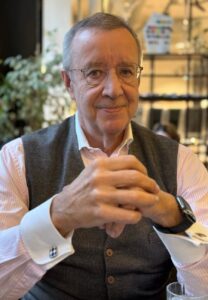
Toomas Hendrik Ilves

Interview with Toomas Hendrik Ilves by Maiko Mathiesen and Imre Treufeld,

6 December, 2025

The Baltic countries have no choice but to chart a neo-idealist course in geopolitics, says the former president of Estonia. He doesn’t mince words about “realist” politicians who want to appease Russia.

Maiko Mathiesen and Imre Treufeld: President Ilves, in a 2023 interview with the Dutch weekly De Groene Amsterdammer, you identify with neo-idealism in foreign policy. You said that we, as Baltic countries, pursue moralistic, neo-idealist geopolitics. What does neo-idealism mean to you?

Toomas Hendrik Ilves: At the time, it was a new term, coined by Benjamin Tallis, that I had just read about. It stands for a values-based foreign policy, but highlights even more strongly the contrast to the realist, transactional foreign policy that has gained ground in the last decades in the West. That trend must be criticised, because realist foreign policy actually isn’t very realistic.

Take Germany’s approach towards Russia, for example. Ever since the end of the Cold War, Germany’s need for cheap energy has led the country to compromise on fundamental moral issues. From memos that were only recently released, we learn that chancellor Helmut Kohl didn’t even want the independence of the Baltic states because it might upset Soviet leader Mikhail Gorbachev. After we regained statehood in 1991, Germany tried to stymie our accession to the European Union and NATO. This was based on a primitive, transactional, economically motivated realism, in which fundamental principles – such as the right to self-determination and to choose alliances – were ignored just to make more money. You can now see where this has gotten us with Russia.

In the Baltics, we have no choice but to chart a neo-idealist course. From a realist point of view, we are irrelevant. Realism assumes that the strong do what they want and the weak suffer what they must. So when you’re a small country with an aggressive neighbour like Russia, you either give in – “Just take us over and kill us all” – or you stand up for your rights under international law. Small countries have a much greater interest in the international rule of law than large countries. That’s why we are such strong supporters of Ukraine.

The occupation and annexation of the Baltic countries by the Soviet Union in 1940 was not recognised by the West, largely because of pressure by the United States. The United Nations Charter of 1945 elevated this position to a principle: “All Members shall refrain in their international relations from the threat or use of force against the territorial integrity or political independence of any state.” We saw this principle being acted upon after Iraq’s invasion of Kuwait in 1990. A US-led coalition drove out Iraqi forces and restored Kuwaiti independence because you cannot annex a country. It’s a fundamentally moral position, but it’s under pressure because of Russia’s aggression against its neighbours. If the United States, for example, were to recognise the annexation of Crimea, they would wipe out the whole basis of their foreign policy after the Second World War.

Which politicians or thinkers do you consider to be figureheads of neo-idealism?

Well, geopolitical analyst Benjamin Tallis is the one who came up with the term. Václav Havel, with his classic essay The Power of the Powerless, was a very important precursor. Kaja Kallas certainly has been the most vocal proponent of neo-idealism over the last years. I think we should also count Carl Bildt, the former Swedish prime minister, among the neo-idealists. In German foreign policy, I would say, only Joschka Fischer and Annalena Baerbock have been prominent proponents of the neo-idealist worldview.

Personally, I don’t use the term that often. I prefer to talk about “the approach of the Eastern Europeans” or “post-WW2 liberal foreign policy” as pursued by the US after 1945 – though not always consistently. The bottom line is that if you want to prevent war, you must stand up for fundamental values. And this policy only works if you back it up with force. Otherwise, it all just sounds good and you end up with the foreign policy of Western Europe and the US since 2008, when they let Russia get away with the invasion of Georgia.

Is it possible to build bridges between neo-idealism – or liberal foreign policy – and anti-colonialism?

If there is one area in the world that has been exploited for colonial gain by great powers, it’s Eastern Europe. Our countries have never been colonisers themselves. The EU, of which we are now a part, is not colonising anyone either. Yes, some of the EU’s member states were colonial powers. The formerly colonised should turn to these countries to resolve their issues. There is no reason to call Eastern Europe to account for colonialism. The refusal of so many practitioners of post-colonial studies to treat the Soviet Union’s and Russia’s actions in Eastern Europe – in the past and present – as imperialism and colonialism makes me not take them seriously.

Much of the Global South has discredited itself by not taking a moral stance on the Russian invasion of Ukraine. I don’t see why I must care about your issues if you don’t care about ours. Ukraine has probably been more murderously exploited than almost any country, maybe except for the Congo under Belgian and Namibia under German rule. If you look at the Ukrainians’ colonial experience and don’t care about what is going on right now, why the hell should I care about what the Belgians were doing in the late 19th century in the Congo?

How can Europe stop Russian imperialism?

Europe won’t be able to build an efficient defence unless it implements a bunch of reforms. The European Union has been unwilling to take any serious steps, such as unified capital markets and mutualised debt. This prevents it from growing and having an effective tech sector. Without decisive reforms, this place is going to turn into a museum. Well, unless the Russians invade, in which case it will all look sort of like the Donbas.

In addition to economic revitalisation, a common defence policy is a necessity. For that to happen, we first need to resolve the problem with Hungary and Slovakia. These countries seem to be acting like eager agents of Russia; they’re allowing themselves to be bought. The rule of law is being undermined and corruption abounds. Hungary’s government has killed the independent press. Withholding EU funding is not enough to make Hungary comply with European values. The Hungarian government should be stripped of its voting rights.

Europe is increasing its defence spending. Is it possible to avoid a negative impact on policies that protect our broader security and social services?

I don’t believe that controversial budget cuts can be avoided if we want to bolster our defence. One of the few other options is to borrow money, but this is hard for a lot of countries because they’ve already maxed out on borrowing.

We must realise that the days of La La Land are over. We’re no longer in this post-Cold War era which gave us the peace dividend. During the Cold War, defence spending was between 5 and 6 per cent of GDP. Europe finds itself in a similar threat environment again. Perhaps even worse, because the Soviet Union throughout the Cold War never invaded an independent country – with Afghanistan being the one exception. At the time, East Germany, Hungary, and Czechoslovakia weren’t really independent, as satellite states of the Soviet Union, so the Soviet army’s interventions to quell uprisings were considered domestic affairs. In short, we need to return to a level of defence spending comparable to that during the Cold War. This will require painful measures.

What about taxing the wealthy in order to finance defence?

We’ll have to see if that is feasible. But the alternative is being invaded. In Estonia, people are whining about the new motor vehicle tax. What do they think will be left of their car after the Russians have gone on a rampage like they did in the Ukrainian city of Bucha?

Small countries such as the Baltic states have a great interest in European solidarity. How do we build it?

The problem is that only people in the frontline countries understand the existential nature of the Russian threat. On the other hand, just to be fair, our part of Europe doesn’t fully understand the legitimate security concerns of the EU countries bordering the Mediterranean. This partly explains their reluctance to do anything about Russia. The North of Europe must show greater solidarity with the South when it comes to their concerns about immigration from Africa and the Middle East.

You can make the case that what Russia did in Syria led to the migration crisis of 2015, that it was even meant to burden Europe with refugees. I would like to say to Europeans: that was 1.5 million refugees, and you went ballistic. Now think about the fact that there are some 35 million Ukrainians in Ukraine. 7 million have left since 2022. How many people are going to stay there if Russia gets its way and subjugates the country? Not many, I think. Maybe 4 or 5 million will stay behind, take their chances. Let’s say that 30 million people will try to escape from Ukraine. Where are they going to go? They will come to Europe.

Toomas Hendrik Ilves was President of Estonia from 2006 until 2016. Before that, he worked as a journalist and diplomat, served as Minister of Foreign Affairs, led the Social Democratic Party, and was a Member of the European Parliament. Ilves is now a member of Volt.

Maiko Mathiesen and Imre Treufeld are members of Degrowth Estonia (Tasaarengu Eesti).
We are Proving That Ukraine Is Not a Buffer Zone

By Uncategorized

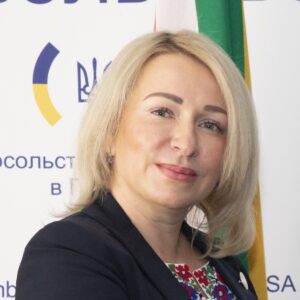
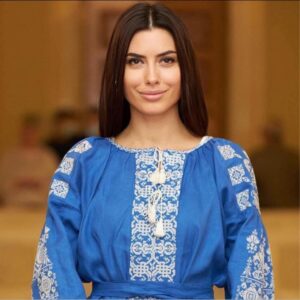
Mariia Mezentseva. Photo by Elke Wetzig. CC BY-SA 4.0

Interview with Mariia Mezentseva by Sofiia Shevchuk,

11 June, 2025

A country that is attacked by a larger neighbour cannot do without allies and partners. We discuss Ukraine’s diplomatic outreach with Mariia Mezentseva, a Ukrainian Member of Parliament who heads Ukraine’s delegation to the Parliamentary Assembly of the Council of Europe. She is actively engaged in strengthening Ukraine’s ties with Europe and beyond.

Diplomatic efforts are more crucial than ever as global support for Ukraine shows signs of erosion. In February 2025, the UN General Assembly adopted the resolution Advancing a comprehensive, just and lasting peace in Ukraine, which passed with 93 votes in favour, 18 against, and 65 abstentions – a  significant decline from previous votes such as in February 2023, when 141 countries supported a similar resolution. Meanwhile, Russia continues to strengthen ties across Africa, Asia, and Latin America and to exploit sanctions evasion mechanisms. Ukraine’s diplomatic strategy, championed by politicians like Mezentseva, aims to counter these trends, rebuild consensus, and position the war as a broader global struggle for sovereignty, justice, and international law.

Sofiia Shevchuk: In light of Russia’s full-scale invasion, how have the EU and NATO security visions evolved from your perspective, and what role can Ukraine as a candidate country and a frontline democracy play in shaping the future architecture of European security?

Mariia Mezentseva: I think Ukraine has definitely helped to reduce bureaucratic hurdles within the EU and NATO. Take the example of the SWIFT sanctions. After the first Russian invasion of Ukraine, in 2014, I was targeting the audience of the European Parliament and the European Commission, together with like-minded colleagues from NGOs – so not just the government of Ukraine – to push for the expulsion of all Russian banks from the international SWIFT payment system. That didn’t happen at the time. But once the full-scale aggression occurred, in 2022, one of the first suggestions was to return to the idea of expelling Russia from SWIFT – and this time it did happen. Now we are approaching the 18th package of sanctions against Russia by the EU, and many things that once seemed unfeasible are now realistic and functioning. And I will be the toughest defender of the fact that sanctions are working – they are effective, they are damaging Russia. So I think point number one in which the EU changed its approach is: less bureaucracy.

The second point is the EU’s historic decision to provide lethal military assistance to Ukraine through the European Peace Facility (EPF). As of mid-2025, over 11 billion euros have been allocated to Ukraine under this mechanism for military equipment, training, and logistics. This marks a major shift in EU foreign policy, as the EPF had not previously been used on such a scale for a non-EU state.

Military aid, logistics and strategy for Ukraine are coordinated on a broader scale in the Ramstein format, officially known as the Ukraine Defence Contact Group (UDCG). Launched in April 2022 at the Ramstein Air Base in Germany, the format brings together over 50 countries, both NATO and non-NATO states. It meets regularly to streamline support and respond rapidly to Ukraine’s evolving defence needs. Ukraine’s active participation and initiative in shaping such multilateral forums demonstrate its emerging leadership in rethinking security cooperation beyond traditional institutional boundaries.

Until recently, the EU lacked a military security component. Maybe it’s time to revisit the idea from 1952 – from the founding fathers – that there should be a European army. Security and defence at the core of the European project, we might now see a return to that vision.

Even within NATO, there are positive developments despite the fact the US currently is against formal Ukrainian membership. NATO’s most recent enlargement happened because of the Russian aggression against Ukraine. Countries that never saw themselves joining NATO – Finland and Sweden – have now done so. We lobbied Turkey for them when Turkey was blocking their accession.

So it’s very interesting how Ukraine has stepped onto the global stage not as a victim, but as a decisive, solid partner. Ukraine is also a country that will, I’m 100% sure, lead in the future of warfare: drones, anti-drone systems, surveillance. We only need to look at the recent operations carried out by Ukrainian security forces.

In general, I see this all very positively. Extremely unbelievable things have started to happen. Not by breaking the rules, but by accelerating processes that have been in motion over the past 11 years of war.

Does Ukraine’s diplomacy embody the ‘neo-idealism‘ that security analyst Benjamin Tallis sees emerging in Central and Eastern Europe? An approach to geopolitics grounded in the power of values such as democracy, human rights, and the right to self-determination, by his definition.

The dialogue that’s been ongoing around idealism emphasises that the rules should be changed. The EU can’t keep using the same methods that have been in place for over 75 years of this project’s existence. For instance, enlargement policy, neighbourhood policy, and security and defence policies are falling into the trap of unanimity. It’s time to reconsider that.

We’ve seen that both the European Commission and the European Parliament are aware of this. They have found ways to stand up for European values by allocating fewer funds to offenders – and the financial language is often understood much better than the institutional rules. Of course, I am referring to Hungary.

So yes, I do believe that idealism in international relations is still winning over realpolitik. Because otherwise, we wouldn’t even be having this conversation – we would probably all be abroad, involved in exile activities.

I remember one of our first trips to the Parliamentary Assembly of the Council of Europe (PACE) – nine women MPs arrived in Strasbourg. We voted to expel Russia from the Council and passed a very strong resolution addressing human rights, accountability, and aggression. Our partners there offered us apartments and offices because they assumed we were staying. They were shocked we were going back to Ukraine. That shows the difference in our perspective – our sense of duty and responsibility to our country. This, I think, is something the EU and other partners can learn from Ukraine: it’s not just about courage and bravery as empty words – it’s bravery rooted in our capacity and our actions.

In many Western policy circles, Ukraine was historically viewed through a realist lens: as a buffer state rather than an agent of change. What has Ukraine done to challenge this view?

We’re still doing our homework – the work that has not been done for decades. In the context of the 20th and 21st centuries, there are so many untold stories and tragedies. Take the Holodomor, for example – a word that many of our partners had never heard before. When I became a member of PACE, I made it a personal mission to raise awareness.

I had made a promise to my great-grandmother, who survived all waves of the Holodomor, that I would do something about it. I was only five, six, seven years old at the time, and didn’t know what it would be. But last year I managed to get a resolution passed in PACE to commemorate the 90th anniversary of the Holodomor. This resolution was an act of historical justice. It meant so much to hear colleagues from Canada, Israel, Morocco, and Mexico – countries far from our own – speak about our tragedy. It is important to stress that similar tragedies are happening or have happened elsewhere: in parts of Africa, in the Middle East.

And then there’s the issue of food security – the way Russia has stolen our grain, relabelled it, and tricked global markets. This is about ensuring basic provisions for children, families. It’s part of the same conversation.

So when I talk about “homework”, I mean it’s our mission to make people rediscover Ukraine. We can’t expect someone in Texas to know that the first written constitution in the 18th century was created by Ukrainians – unless we tell them. Now, thanks to efforts by Timothy Snyder and others, Ukrainian studies are taught in major American universities. And we need native speakers of all languages – Spanish, Chinese, Arabic – to help share this story.

The cultural effort is just as important. There’s the Culture Forces initiative, made up of former wounded soldiers, who are now sharing Ukrainian music, poetry, and tradition with the world.

I was in Vienna when Austria was opposing our candidate status because they were focused on the Balkans. So I brought up some historical trivia. “Do you know the coffee you drink in Vienna was introduced by a Ukrainian Kozak? That monument you walk past every day is dedicated to him.” They were surprised. These little stories, these connections, they matter.

This rediscovery of Ukraine isn’t just for others; it’s for us too. We’re rediscovering our true history and place in the world. We’re proving that we’re not a buffer zone, not just a transfer route, not just a gas pipeline crossing. We’re the largest country in Europe. We have resources. We have people, and those people are now filling workforce gaps across Europe and beyond.

This is why I think it’s crucial to explain ourselves. In every training I attend, whether organised by European, American, or Australian partners, the question always comes up: Who are we? What’s our national motto? What’s our mission? What’s our vision for the next 30 years?

These are existential questions. We need a plan. Many partners are asking us for that plan. In 2023 and 2024, the pressure was intense. “What’s the plan for victory?”, they asked. “What’s your roadmap?” And of course, there’s the 10-point peace plan from President Zelenskyy. But it’s often criticised. Why can’t this be the victory plan? No one gives a clear answer – maybe because it’s too idealistic, too aligned with international law, which Russia cannot and will not fulfil.

So yes, we still have a big gap to fill. But I don’t see it as the world accusing us: “How come we didn’t know?” It’s about mutual learning. How much do we know about, say, the indigenous peoples of different continents? About the genocides committed against them?

To conclude: we must continue proving that we are not a buffer state, not a periphery to Russia. Thankfully, that perception is already fading. People now understand that Ukraine is not ‘somewhere near Russia’. That narrative is gone. And while it’s tragic that it took a war of aggression to make the world rediscover Ukraine – it’s also our opportunity.

Now moving beyond Europe and turning to the Global South, how do you, in your work with European and international parliamentary institutions, respond to criticism from actors in the South who perceive the West’s support for Ukraine as selective or even hypocritical, given their own histories of neglected crises? And what role has Ukraine played in building more inclusive international solidarity?

First of all, if we want to even begin approaching partners in what we call the “Global South”, we need to stop calling them that. The issue isn’t just geographical – sometimes these countries are in the North, not the South. It’s about denying diversity and distinctiveness. Many countries rightly object to being lumped together in one category.

This reflects deeper post-colonial attitudes that we need to acknowledge and challenge. Let me give you a personal example. I was recently at a stylish French restaurant in Kyiv, just grabbing a coffee, and I noticed a decorative lamp held by a statue of an African woman. It was deeply disturbing to me. I would never put something like that in my own home or office, yet here it was, in the capital of a country at war for freedom and dignity.

These symbols of coloniality still surround us. Just a few decades ago, in the 1950s, there were human zoos in Brussels where African people were exhibited in cages. This was the heart of what is now the European Union. So if we want to engage in meaningful solidarity, we must first acknowledge these colonial legacies. For instance, we’ve never shied away from speaking openly about Belgium’s atrocities in Congo – the exploitation, the genocide. Iconic Belgian palaces were built with revenue from Congolese resources.

Ukraine’s approach is not to lecture, but to connect. We build bridges by recognising shared experiences. In Indonesia, for instance, we spoke about the indigenous Crimean Tatars, Karaims, and Krymchaks – recognised as indigenous peoples both under Ukrainian and international law. By explaining how Russia’s war began with the attempted annexation of Crimea – and what that meant for these communities: deportations, loss of language and education, imprisonment – we were able to foster understanding from our Indonesian counterparts. Suddenly, our war wasn’t distant; it resonated with their own struggles.

We’re also actively cooperating with countries like South Africa. Despite being attacked, Ukraine has been advocating for green humanitarian corridors in Africa and the Middle East. This wasn’t just talk; it was action.

Before the full-scale invasion, Ukraine was already building real international connections. Kharkiv alone – just one city – hosted 88,000 international students, many from Africa and Asia. These students became our informal ambassadors, bringing their experience of Ukraine home. It was true people-to-people diplomacy. And now, we’ve lost much of that – and we feel it.

The key is: every partnership must be context-specific. You can’t just walk into a meeting and push your agenda. That’s not diplomacy; it’s arrogance. I think our Ministry of Foreign Affairs and our parliamentary diplomacy has understood that. We’re reopening embassies across Asia, Africa, and Latin America.

I was recently in Berlin, where I met representatives from South America. Their world is vastly different, and deeply inspiring. I’m now in regular contact with ambassadors from Brazil, Mexico, and Argentina. We’re building ties through events, cultural exchanges, and thematic cooperation. Maybe they can’t openly support everything, but almost no one can oppose the safe return of Ukrainian children illegally deported by Russia. These are shared humanitarian values.

And we have to go further – not just in policy, but in cultural literacy. In Indonesia, our Crimean Tatar colleague helped us explain how Russia is destroying churches, mosques, and cultural heritage. Talking about Muslim heritage in a Muslim-majority country matters. And during our visit, we even saw local activists wearing vyshyvankas, Ukrainian embroidered shirts. That’s cultural diplomacy at its best – storytelling that leaves a trace.

It’s through these stories, these human connections, that I now receive messages from people all over the world when Ukraine is under attack. That kind of solidarity is priceless. And it shows how much we’ve lost by previously ignoring these regions. It’s time to rebalance.

What could the EU learn from Ukraine’s approach in this regard?

One example I often share relates to discussions around Russia’s internal colonisation. Ukraine has long called out the oppression of indigenous peoples within Russia – like the peoples of Ichkeria or Bashkortostan. When we included the word “decolonisation” in a parliamentary document, some European partners – including members of the British Parliament – were uncomfortable. But we stood by it. A British Lord, an international lawyer, objected at first, but ultimately couldn’t oppose it because it was a human rights issue. The amendment passed in PACE.

This shows the importance of naming things clearly. Russia wants to “invite us home”, as if Ukraine belongs in its imperial framework. That’s precisely what we must reject. And by framing Russia as a neo-imperial power, we help others – especially those who’ve experienced colonisation – understand our position.

Ukraine, I believe, offers a model of how to engage with history responsibly, without being provocative or self-righteous. We don’t walk into meetings with French or British colleagues and say, “Remember what you did in your colonies?” That would be unproductive. What matters now is that these countries aren’t trying to impose power. Russia is. That’s the difference.

As Ukraine rebuilds, there’s growing international interest in a recovery process that integrates environmental resilience, social justice, and security. Based on your experience, what can Greens and other progressive forces in Western Europe learn from Ukraine’s approach?

That’s a big and important question, and I’d say the key is justice through accessibility. How do we rebuild our country in a way that doesn’t just replicate old systems? How do we make our recovery inclusive, socially just, and ecologically resilient, while still recognizing that we need an army, we need defence, we need security?

And that, I think, is the Ukrainian lesson for many progressive actors in Europe: these aren’t opposing goals. You don’t have to choose between tanks and trees, between social welfare and national defence. You can – and must – pursue all of them together.

Mariia Mezentseva has been a Member of the Verkhovna Rada (Ukrainian parliament) for the ‘Servant of the People Party’ since 2019. She is Deputy Chairperson of the Committee on Ukraine’s Integration into the European Union and Chairperson of the Ukrainian delegation to the Parliamentary Assembly of the Council of Europe.

Sofiia Shevchuk is a Ukrainian researcher based in Brussels, founder of educational and consultancy platform VONA.

It’s Better to Speak About Shared Trauma Than About Colonialism

By Uncategorized

Ambassador Liubov Abravitova. Photo by US Embassy South Africa, 2022. CC BY 2.0

Interview with Liubov Abravitova by Sofiia Shevchuk,

24 June, 2025

Ukraine’s ambassador in South Africa outlines how Ukraine is redefining its role globally, pushing back against Russian influence, and contributing to a new model of international solidarity rooted in mutual respect and shared opportunities.

As global support for Ukraine weakens and Russia deepens its foothold across Africa, Ukraine’s diplomatic efforts are turning toward building genuine, strategic partnerships beyond Europe. Ambassador Liubov Abravitova, who until July 2025 serves as Ukraine’s envoy to South Africa and the wider region, offers a bold vision in which Ukraine presents itself not as a recipient of help, but as a capable partner – on security, energy, food systems, and democratic cooperation.

Sofiia Shevchuk: How has Ukraine’s foreign policy toward Africa – and South Africa in particular – evolved since the full-scale Russian invasion in 2022? What are the priorities and key challenges in building stronger ties with countries on the continent?

Liubov Abravitova: “In 2022, Ukraine’s diplomatic and economic presence in Africa was uneven and varied significantly from country to country. You cannot speak of Ukraine’s relationship with Africa as a whole; rather, you must assess it on a regional or even country-by-country basis. Historically, Ukraine had long-standing and stable ties with many African states, dating back to its support for liberation movements and educational exchanges during the Soviet period and continuing through Ukraine’s independence. In fact, by 2022, around 9,000 African students were studying in Ukraine.

However, since 2013–2014, when the war with Russia began, there has been a stagnation in Ukraine’s relations with many African countries. In the case of South Africa, this meant a significant drop in trade and a general political disengagement. There was a notable pause in bilateral relations, which resulted in a generational shift – political actors started to forget or even misunderstand the importance of the Ukraine–South Africa partnership.

Having served in South Africa since 2017, I witnessed first-hand the hesitation from both the political establishment and media when it came to building dialogue with Ukraine. Many were simply waiting for the Ukraine–Russia situation to resolve itself. Then came 2022, and South Africa found itself at a difficult crossroads: international law was clearly violated, democracy came under threat, and the Russian invasion triggered ripple effects such as food insecurity, which affected the entire region.

As a regional leader, South Africa is particularly impacted by crises in neighbouring countries – many of which face environmental stress due to droughts or floods exacerbated by climate change. The war created further instability, fuelling migration to South Africa. All this made the war in Ukraine not only a European issue, but a regional security concern for Africa as well.

For Ukraine, this presented a crucial moment – not just to be loud and visible, but to speak with its own voice. We needed to revitalise, or as some of our politicians say, “renaissance” our ties with Africa. This has been a process. From 2022 to now, we have seen a growing number of engagements – not just among politicians, but also among think tanks, civil society, and media. You may have seen that a new delegation of African journalists recently visited Ukraine. There has also been increased documentation of our historic ties with various African states – real stories, not myths like the claims of 50-year-old ties between Botswana and Russia, which are historically questionable.

But telling our story requires capacity, and ours is limited. This brings us to why supporting Ukraine is not just about military or economic aid or integration into the European family. It’s also about helping Ukraine establish its presence in regions like Africa and Latin America. While the EU has robust platforms and development projects across Africa, Ukraine needs support to plug into them. We could be a valuable gateway for these initiatives, but building our own infrastructure from scratch would take too long.

Since 2022, we have seen an evolution – it’s like a snowball that must keep rolling. For that, Ukraine needs a stronger presence: diplomatic, economic, and institutional. We also need funding – not only from Ukraine, but from partners, and, crucially, coordination. We need clarity on what we are doing, what we hope to achieve, and by when. Our priorities are growing alongside our engagements, and we are working on building a reliable legal foundation for our partnerships, one that reflects the realities of today’s world, including digitalisation and artificial intelligence. This adaptability is essential. That is where we stand today.

When you talked about EU support for Ukraine and the existing platforms, do you still see Ukraine primarily as a recipient in that collaboration process? Or is Ukraine already able to be a platform-setter itself – offering its own perspective and contributions? Also, are you working with EU country embassies or EU delegations on the ground on some of these initiatives? Or are they a bit more hesitant, possibly too busy to actively collaborate with the Ukrainian embassy?

Definitely, I don’t see Ukraine as a recipient – we moved past that stage a long time ago. Ukraine is fully capable of having its own platforms. At the same time, we are responsible enough to consider not only our national goals but also those of the broader European family. That means any support coming from our partners is not charity; it is an investment in their own security and shared future, just as they invest in their own embassies.

We work closely with all EU member states and the EU delegations in every country where Ukraine is represented. Our embassy in South Africa now covers eight countries in the region, including newly opened missions in Botswana and Mozambique. However, due to limited staff, countries like Namibia, Zambia, Zimbabwe, Lesotho, Mauritius, and Madagascar are still under the responsibility of our South African mission. That’s why we rely on cooperation with EU embassies – not just for coordination, but to ensure we don’t miss valuable opportunities available in the region.

We are no longer passive recipients of help. If we collaborate with a country like Lithuania, and they offer a platform to discuss issues such as constitutionalism, multilateralism, or the abduction of Ukrainian children by Russia, we ensure that this is presented as a joint Ukraine–Lithuania initiative. Two flags, one message – this partnership is visible, and relevant to South Africa too.

We have outgrown the recipient role. Just as Ukraine is the frontline of Europe’s security against totalitarianism, we also have a role to play in Africa – albeit from a different angle. Ironically, when Russia invaded Ukraine, it placed Ukraine on Africa’s geopolitical map. The invasion exposed Moscow’s false narratives and made many African countries realise Ukraine’s importance. As a result, Ukraine is now increasingly perceived as a leader in food and energy security. For example, today I’m meeting the South African Deputy Minister of Energy – she’s coming to me, not the other way around.

Ukraine has proven its strength and resilience. We should be proud of that, and our European partners should recognise that Ukraine can be their gateway to Africa. I do not like to use the word ‘investment’ – perhaps it’s a language thing – but Europe must contribute to this joint effort if it wants it to grow.

Moreover, Russia’s invasion catalysed new civil society collaborations between South Africa and Ukraine. South Africa’s peacebuilding skills and experience in conflict resolution can be applied alongside Ukraine’s and Europe’s to promote peace globally. If we want to move toward real multilateralism, and we all know the UN is struggling, we must create new, effective platforms for peace.

Europe must leverage Ukraine’s new image in Africa. For example, no one in Africa blames European or Belarusian companies for the fertiliser shortage. They say, “Russia invaded Ukraine, and now Ukraine cannot supply us.” Ukraine has become the brand. Europe should use that rather than try to build something from scratch.

So yes, there are countless ideas and opportunities. The key takeaway from our conversation today should be that the EU must identify clear directions and coordinate them with both Ukraine and Africa. Only then can we make meaningful progress. Africa needs strong support to become self-sufficient, and if we fail to help, it will have consequences for Europe’s own security.

South Africa has taken a nuanced stance on the war in Ukraine. How would you describe Ukraine’s current diplomatic relationship with the Republic of South Africa, and what steps are being taken to strengthen mutual understanding? And since you cover eight countries, are others more open to collaboration with Ukraine?

It’s a good question, and you’re right to point out that every country is different. It’s difficult to generalise, and it would take a long time to speak about each one in detail. But I can say that countries like Zambia, which recently visited Ukraine with a group of leaders and continued political dialogue with us afterward, have shown a deeper understanding of what engagement with Ukraine can look like. In countries where we have less engagement, we clearly need to work more, in order to identify shared interests and build trust.

South Africa has learned the importance of diversifying its partnerships. Still, I’ve found that in societies like South Africa, it’s best not to speak too directly about partnerships or comparisons – especially not in a competitive tone. Even though we are under aggression and Russia is our enemy, I deliberately avoid saying “we can do better than Russia” or pushing Ukraine as a replacement. Since 2022, I’ve learned that our best tool is soft power – showcasing what Ukraine has to offer, then letting our partners make the choice for themselves.

In the end, numbers speak for themselves. When African countries look at trade statistics, Russia doesn’t even make the top ten in many cases. And due to the consequences of its war against Ukraine, Russia simply doesn’t have the capacity to offer much today. African countries know this, we do not need to push the message hard.

Instead, they are looking for sustainable, predictable partnerships. And that’s where we come in. Many African countries are watching Ukraine to see what we are transforming into. Our goal is to rebuild a strong, democratic, self-sufficient country with the same democratic values many African nations share. There is a place for African partners in that journey.

If they’re ready, they have the chance to be proactive and engage. Even if they’re not in a position to collaborate right now or if their business sector isn’t state-run – which can be a good thing –, economic activity can lead the government in the right direction once opportunities arise.

How does Ukraine’s postcolonial experience and its current struggle for sovereignty resonate in Africa? Can Ukraine leverage this shared history to build trust and solidarity with African nations?

That’s quite a philosophical question, and one I have thought about a lot, especially at the beginning of the full-scale invasion. We had to find ways to make our historical trauma understandable to our partners in Africa.

I found it difficult to frame that story in terms of colonialism, because Africa owns that narrative. It is theirs. When other parts of the world, like Asia or the former USSR, also try to claim a colonial experience, it’s not always received well.

Instead, I’ve found that it’s more effective to speak about trauma and how we address it. When we talk about our shared experience of trauma, without needing to define or label it, we start to connect. This is the approach that could work best, especially through civil society organisations.

What’s missing right now are structured platforms to support this kind of exchange. We need institutions, like the Ukraine Institute or Ukraine House, to exist in South Africa, and vice versa. We’ve both reached the point where our countries are ready for meaningful cultural collaboration.

We know Ukrainian filmmakers are winning awards, and Nigeria has one of the biggest film industries in the world. But no one has thought to bring those communities together. And yet, the potential is right there. It’s through these cultural and creative exchanges that we can address difficult histories.

Take the diamond issue, for example. That conversation was changed globally because of a single film about blood diamonds. If it worked once, it could work again. Now, we’re seeing feedback from African countries that are ready to engage but they may be concerned about lacking the resources.

That’s where we need to step up to show that it’s not so hard, that it’s doable. But Ukraine will also need European support in making these initiatives happen. That said, the change is already underway. African countries are now turning toward Ukraine. At the very least, they are ready to listen.

I remember back in 2018, during the incident in the Azov Sea [in which Russia attacked and captured three ships of the Ukrainian navy – SoSh], we tried to hold a press conference in South Africa about Russia’s violations of maritime law. Maybe three people came, and not a single article was published. No one was interested. But now? The entire story has changed.

Could you tell me more about the actual engagements happening between civil society, the business sector, and local communities?

When President Zelensky visited South Africa, he was asking practical questions: “Do we need to sign another agreement? We keep signing things, but they often don’t work. Maybe we need to focus on more practical cooperation.”

That is why I believe that legal frameworks and government-supported platforms are essential. These provide a safer and more stable environment for civil society, business, and political engagement. For example, even though our trade turnover with South Africa is relatively modest – about $113 million a year – it is still higher than with some EU countries. We import more than we export, which shows that South Africa is still trading with Ukraine despite the war. That’s already a success story.

We are also thinking strategically. President Zelensky has talked about creating fertiliser hubs in South Africa to help address climate challenges. But for that, we will need broader partnerships. The idea is to do good not just for Ukraine, but for sustainability in Africa as well.

There are also ongoing conversations around establishing grain hubs and scientific collaborations. Ukraine’s expertise with drones for agriculture and border security presents huge opportunities. Even in education, our partnerships are still active – they just need redirection. For some countries, it’s less about “digitalisation” and more about optimising processes. We want to share Ukraine’s experience and apply it to African development.

We recently signed a memorandum of collaboration during the First Lady’s visit to South Africa to establish Ukrainian Studies at local universities. This is not about learning facts about Ukraine but learning from our lived experiences. That’s a powerful instrument, and I hope it continues.

We also need to grow our diplomatic presence. It’s not just about political dialogue anymore. Diplomats are now also facilitators for scientific and economic processes. When Ukrainians themselves speak in African countries, it changes the perception. It prevents us from being seen as proxies of someone else.

There are many cultural projects underway. We’re even on the verge of establishing a think tank between our countries. When I arrived in South Africa in 2017, there were almost no platforms where I could speak about Ukraine. Even Eastern Europe was largely absent from public discourse.

But there is still a huge gap to fill, and the embassy can only show the direction. The actual development of these collaborations is beyond our formal responsibilities, but we fully support and encourage it.

Liubov Abravitova is Ukraine’s Ambassador to the Republic of South Africa (until July 2025), also covering several countries across the Southern African region. A seasoned career diplomat, she previously served as Ukraine’s Chargée d’Affaires in South Africa and has held posts at Ukraine’s Mission to the United Nations in Geneva.

Sofiia Shevchuk is a Ukrainian researcher based in Brussels. She is the founder of educational and consultancy platform VONA.

GEF in the Media

By Uncategorized

GEF strives to mainstream discussions on European policies and politics both within and beyond the Green political family. It works to create a common Green vision for Europe and to communicate it to the wider public. 

Press

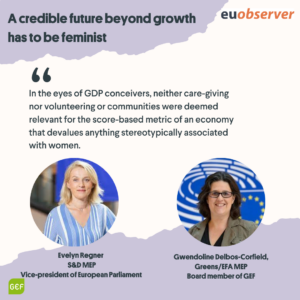
A credible future beyond growth has to be feminist THE BRUSSELS TIMES

The Covid-19 pandemic and Russia’s invasion of Ukraine brought extraordinary suffering but also triggered unprecedented waves of solidarity in European societies. The selfless work of volunteers combined with political decisions that contravened the profit-maximising principles of the market have saved lives and helped avert many disaster scenarios. Still, the GDP numbers failed to reflect any of this.

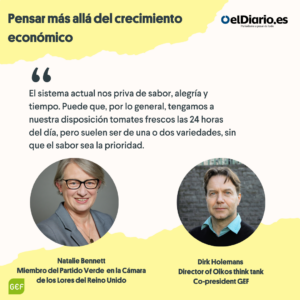
Pensar más allá del crecimiento económico ELDIARIO.ES

(Thinking Beyond economic growth)

Hace no mucho, fila tras fila, las estanterías de los supermercados del Reino Unido –normalmente repletas de alimentos frescos– quedaron vacías. Fue  un recordatorio de las “cosas” de nuestra economía no caen del cielo. Exigen mano de obra (explotada), energía y recursos físicos, además de contaminar el planeta. Un cambio de paragima no significa un empeoramiento de nuestro nivel de vida, si exploramos cómo es realmente una vida sana y de calidad.

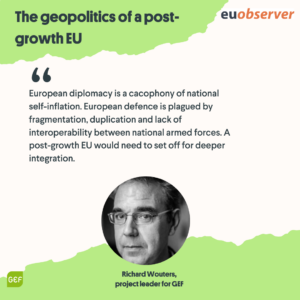
The geopolitics of a post-growth EU  EUOBSERVER 

A post-growth EU would gain in resilience. It is better to manage the end of growth through democratic deliberation than to have it imposed on us by ecological breakdown or resource conflicts. Will a post-growth EU be able to defend itself, its allies, democracy, human rights and a rules-based international order against attacks by the likes of Russia or China?

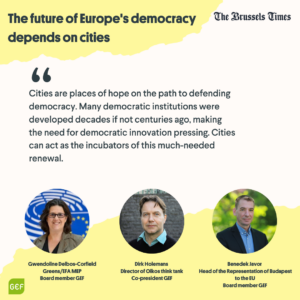
The future of Europe depends on cities THE BRUSSELS TIMES

Ambitious policies are only possible in healthy democracies that respect the rule of law and give public debate and civil society the necessary space. But in some countries, the erosion of the rule of law prevents cities from acting as frontrunners in the transition to a more sustainable society. The European Union and its European Green Deal should not therefore be seen merely as negotiation between nation-states but parts of a multilevel system that depends on a vibrant local level.

Radio

The future of Tourism in the Mediterranean – Vedran Horvat  

Vedran Horvat, managing director of Institute for Political Ecology and GEF´s Board Member, analyses the future of tourism in the Mediterranean in the podcast The Price of Paradise 

Looking back: Beyond Growth Conference

By Uncategorized

As it stands, the unceasing pursuit of GDP growth very literally kills humanity and the planet. There can be no respect of the scientifically agreed-upon planetary boundaries in the pursuit of such growth. Likewise, GDP growth alone has not proven a great yardstick to measure–let alone to improve–happiness, wellbeing or security.

Our work at the Green European Foundation is to provide a space for political education, debate and forward-looking ideas to the European citizens and for Europe as a whole. We wholeheartedly supported the organization of the Beyond Growth Conference this year as a foundation as it is one of the most significant ways to make a forward-looking debate enter the European institutions; and for citizens and actors engaged on these topics to get an insight into the institutional perspective. At the heart of our conception of democracy, the back-and-forth conversation between the time of politics and the changes in our societies is of utmost importance. As the Green European Foundation we supported this conference and will support others around the question of surpassing the old model of GDP-growth-only, and we will do so via our partners all around Europe and through the lenses of different thematic priorities we pursue.

Beyond growth is a matter of thinking and designing the future of the very fabric of our European societies. Some illegal, unethical or other destructive economic activities may bring GDP growth, but they also bring pollution, social unrest, and even conflict… and with them additional costs for taxpayers and our welfare states. At GEF, we think Post-Growth is an essential topic that cuts across priorities, all the way from the vivid and complex security and geopolitical discussion in Europe to the need to rethink our industrial and social model. The Beyond Growth Conference clearly put the topic on the political map. GEF will continue to support the debate for Europe and for its citizens.

Laurent Standaert, political director


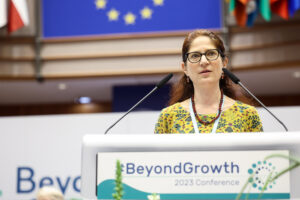
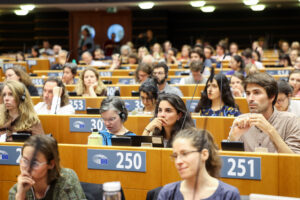
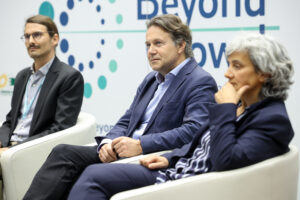
(1,2,3) Beyond Growth 2023 Conference – Pathways towards Sustainable Prosperity in the EU – Plenary 4 – Understanding the biophysical limits to growth to build an economy that respects planetary boundaries. (3) Focus panel 9 – Building an energy sector compatible with ecological limits


About

From 15-17 May, over 4000 people participated in the sessions held in the context of the “Beyond Growth 2023” Conference, surpassing all expectations. The multistakeholder event took place in the European Parliament and was organised by Members of the European Parliament from different political groups, together with more than 60 partner organisations-including The Green European Foundation. This cross-party initiative followed the success of the Post-Growth 2018 conference, and offered an opportunity for discussion across institutional boundaries and with European citizens.

The three-day conference brought together top-level EU decision-makers and experts from different backgrounds to provide feasible options for a society based on resilience, meaning, fairness and sustainability. The event focused on the interlinkages between environmental, social and economic issues. With this conference, the organisers aimed to challenge conventional policy-making in the EU and redefine social objectives, moving away from the paradigm of economic growth as the sole basis of progress.


Our role

The Green European Foundation supports innovative approaches to economic sustainability in Europe and, together with its European and national partners, aspires to contribute to the transition towards societies that enable a good life for all within planetary boundaries.

Economic transformation has been a core area of work for GEF since its beginning. Today the foundation is active in fostering the reflection on the creation of a society and the functioning of an economy beyond GDP growth. GEF also  aims to be at the forefront of the critique of economic growth and the existing economic model by supporting the coming to light of alternative models and ideas. In this context, the foundation actively supported the organisation of the Beyond Growth Conference from the very beginning.


Towards a Post-Growth Europe

In the run-up to the Beyond Growth Conference, GEF wanted to bring an intersectional approach to the concept of Degrowth and asked some of its partner organizations to give an insight on and how it relates to their respective fields of work.  Here’s the result!


Degrowth Open Letter

There is no empirical basis indicating that it is possible to globally and sufficiently decouple economic growth from environmental pressures.

The Green European foundation co-signed alongside over 400 experts and organisations an open letter for a post-growth wellbeing economy. GEF was represented by co-president and coordinator of partner foundation Oikos Think Tank (Belgium) Dirk Holemans, board member and Head of the Institute for Political Ecology (Croatia) Vedran Horvat, and GEF’s political director Laurent Standaert.

Read here


GEF in the Media

In the context of the Beyond Growth conference, GEF published several op-eds across different European media outlets.

EU Observer

By Richard Wouters (Project Manager at GEF’s partner foundation Wetenschappelijk Bureau GroenLinks and leader of the Geopolitics of a Post-Growth Europe Project).

https://twitter.com/GEF_Europe/status/1656643702020886530

By Gwendoline Delbos-Corfield (GEF board member & MEP Greens/EFA)  and Evelyn Regner (MEP S&D).


ElDiario.es

By Natalie Bennett (Green party member of the House of Lords and former leader of the Green party of England and Wales) and Dirk Holemans (GEF’s co-president and coordinator of partner foundation Oikos Think Tank).

https://twitter.com/GEF_Europe/status/1658104670773026821


Related reading

Beyond Growth focus page  (Green European Journal)

Beyond Growth

Beyond growth:  Pathways towards sustainable prosperity in the EU (European Parliament-EPRS) 


GEF Summer Schools 2022

By Uncategorized

As part of our Capacity Building programme, we aim to promote education and training and provide networking opportunities amongst Green actors across Europe.

Like every year, GEF is hosting a series of Summer Schools in partnership with different organisations to raise awareness among citizens about Green solutions to the challenges Europe faces and allow green-minded individuals to come together, take stock and shape the future of the movement.

More details to follow, watch this space!


Future of Eastern Europe Conference (Riga)

When: 6-7 June

Organised with the support of Cooperation and Development Network Eastern Europe.

Read more here.


We are the Future, but we are here NOW (Riga)
When: 8-12 June

Organised with the support of Cooperation and Development Network Eastern Europe

Read more here.


Ecotransformation Summer School (Litomyšl)
When: 14-17 July

Organised with the support of Institute for Active Citizenship

Read more here.


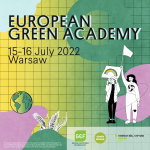
European Green Academy (Warsaw)

When: 15-16 July

Organised with Fundacja Strefa Zieleni and HBS Warsaw

Read more here.


This Oppressive System and Our Mental Health – summer school sessions (France)


When: 27 July

Organised with the support of FYEG

Read more here.


Green Academy: Archipelagos in Movement (Croatia)

When: 27-31 August

Organised with the Institute for Political Ecology


This events are organised by the Green European Foundation, with the support of the aforementioned organisations and the support of the European Parliament to the Green European Foundation.