
About
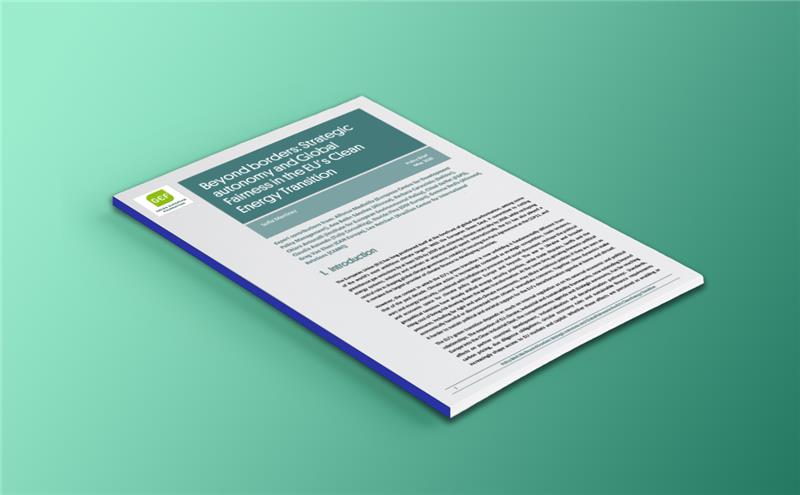
The EU’s green transition is dependent as much on internal regulation as on its external economic and political relationships. Europe’s internal market, while large, cannot sustain the scale up of clean industries, and the EU lacks sufficient domestic resources and workforce capacity to meet the demands of electrification, renewables and industrial decarbonisation. As a result, its ambition for “strategic autonomy” is inseparable from global interdependence.
This brief argues that the EU must embed its energy transition within a broader vision that integrates security, human rights, economic resilience and social stability within and beyond its borders. Global fairness is not an ethical add-on but a condition for effective delivery. Measures that constrain policy space, overlook capacity constraints or externalise environmental and social costs risk rebounding on Europe through supply disruptions, political resistance, trade tensions and weakened alliances. By contrast, fairness, understood as reciprocal value creation, shared risk and co-ownership, can strengthen competitiveness, resilience and geopolitical influence.
This author of the brief argues that the transition will ultimately depend on partnerships that align climate, trade and industrial goals with equitable engagement, making global fairness and energy security mutually reinforcing priorities.
“ Investing in global fairness is an investment in the EU’s own future. It ensures that the European Green Deal and the Clean Industrial Deal are not only ambitious but deliverable, not only competitive but legitimate, and not only autonomous but connected to a broader system of cooperation. By moving decisively away from extractive models toward genuine partnerships, the EU can position itself as a stabilising force in the global transition.”
Author
- Sofía Martínez is a climate and energy policy expert currently working in International Relations at Spain’s Institute for Energy Diversification and Saving (IDAE), under the Ministry for the Ecological Transition. She has extensive experience across the public and private sectors, including working with the European Commission and the United Nations, and is a fellow of the Green European Foundation.
Published by the Green European Foundation with the financial support of the European Parliament to the Green European Foundation. The European Parliament is not responsible for the content of this publication. The views expressed in this publication are solely those of the authors and contributors and do not necessarily reflect the views of the European Parliament.
Format: 21x29.7cm
Number of pages: 20
Publication date: 2026, May 7
Type: Policy Briefs