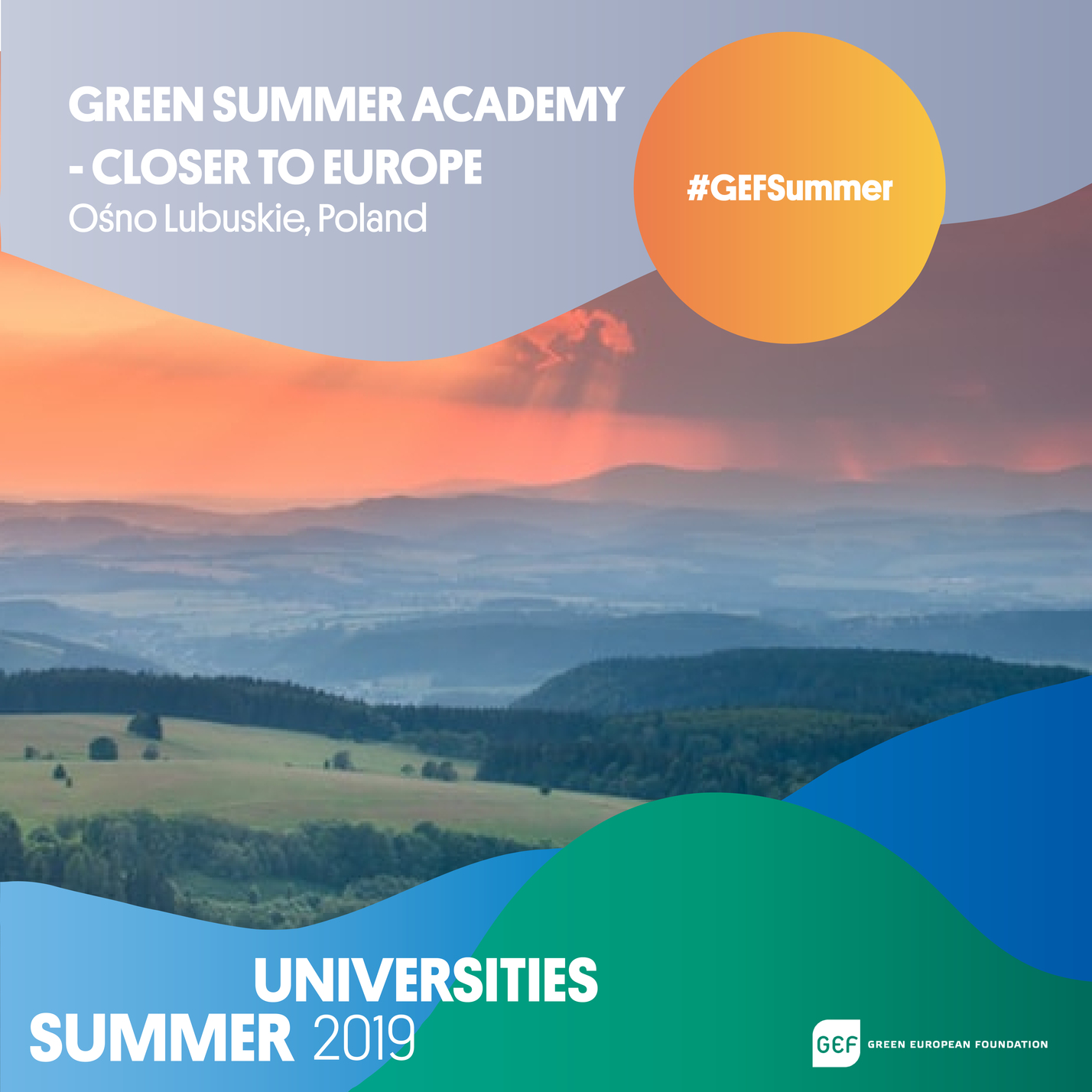
Green Summer Academy – Closer to Europe (Ośno Lubuskie)

By

About the Event

The fifth Green Summer Academy in Poland will take place 20km from the Odra River, a  natural border between Poland and Germany, near the two towns on the both sides of the river: Słubice in Poland and Frankfurt / Oder in Germany.

The Academy is set against the new political reality following the European Parliament elections, in which the Greens became the fourth largest force in the Parliament. At the same time, right-wing and conservative, authoritarian forces were highly successful in Poland and Hungary.

In Poland, pro-democracy and European opposition are preparing for national parliamentary elections in October. On a global context, we are facing crises in the form of climate change, biodiversity extinction, natural resource depletion, pollution, growing inequalities and rising nationalism.

On the other end of the spectrum, we are seeing citizens mobilising across the world, with initiatives at every level rising to meet these crises. Now more than ever Poland and the rest of Europe needs a strong, coordinated Green movement.

This Academy will bring together activists, experts and politicians to exchange and discuss these pivotal issues and how to empower those wanting to enact change.

Programme

The details of the following programme are still to be confirmed. Please check back later for more information.

Information on the event in Polish can be found here. 


11th of July 2019 – Thursday

14:00 PM- 16:00 – Arrival of participants and allocation in rooms or setting up tents

17:00 – 19:00 – Green Ośno Lubuskie, presentation of the Circle of the Greens and the specificity of the transborder city and region, including a meeting with Michael Kurzwelly, founder of the association and „city” Słubfurt and of Polish-German “state” New America  (Zespół Szkół Ekonomicznych, Rzepińska 8)

16:30 – 18:30 – meeting of young people from climate movements and young Greens from Ostra Zieleń association with the international youth camp of the Association of Friends of Korczakowo (transfer by cars or by bu,  departure at 16:15)

20:00 – diner of integration and presentation of the program and participating organizations (Zespół Szkół Ekonomicznych, ul. Rzepińska 8)

Possibility in the afternoon: nature expeditions: Owczary ecological station by the Club of Naturalists.


12th of July 2019 – Friday   /plenary debates and lecture/

5:30 – 8:30 AM – Nature expeditions: Owczary ecological station by the Club of Naturalists.

8:00 – 9:00 – Breakfast

9:00 – 9:30Official Oppening of the Green Summer Academy – Ewa Sufin-Jacquemart (GEF / Strefa Zieleni ) and Irene Hahn-Fuhr (HBS Warsaw)
PART ITHE FUTURE OF EUROPE
9:30 – 11:30“Does the Green Wave in the European Parliament give hope for facing a climate crisis, reduce inequalities and improve democracy in the EU?” – debate

[As part of the seminar “Towards Europe, democracy, ecology” in partnership with the Heinrich Boell Foundation in Warsaw]

Participants: Małgorzata Tracz (Partia Zieloni), Sergey Lagodinsky (MEP), Zuzana Pavelková (FYEG), Miriam Kennet (Green Economics Institute), Jamie Kendrick (Green European Journal).

Moderation: Maciej Słobodzian and Miłosława Stępień (Partia Zieloni)

Participants that did not confirmed yet: Edwin Bendyk (Collegium Civitas), Alena Karaschinski (90/Grunen in Frankfurt/Oder, Christine Chemnitz (HBS).

11:30 – 11:45Coffee Break
PART IICLIMATE CRISIS AND ENERGY TRANSITION
11:45 – 13:30Saving the climate: energy transition necessary but not sufficient”- debate.

Participants: Krystyna Boczkowska (ex-CEO Bosch Polska, Partia Zieloni), Radosław Gawlik (Eko-Unia, Partia Zieloni), Tomasz Wojciechowski (IGOZ, Partia Zieloni),  Maciej Wereszczyński (Extinction Rebellion).

Moderation: Piotr Trzaskowski (HBS Warsaw) and Urszula Zielińska (Partia Zieloni)

Participants that did not confirmed yet: Michael Cramer (ex-MEP), Stefan Schönfelder (HBS Dresden), prof. Jan Popczyk (Silesian University of Technology) , Monika Sadkowska (RT-ON)

13:30 – 14:30Lunch
PART IIIBIODIVERSITY AND POLITICS
14:30 – 16:156. Great Extinction – can Europe prevent it?” – debate

Introduction: “Political protection of biodiversity in the world and in the EU

Participants: prof. Piotr Skubała (Silesian University), Radosław Ślusarczyk (Association Workshop for All Beings), Marcin Kostrzyński (journalist, naturalist), Iwona Krępic (Oder Delta Safaris/ Save Rivers Coalition), Artur Furdyna ( TPRIiG Association/ Save Rivers Coalition), prof. Grzegorz Gabryś (Univ. of Zielona Góra)

Moderation: Marta Jermaczek-Sitak and Krzysztof Wychowałek

Participant that did not confirmed yet: Zenon Kruczyński (Niech Żyją!)

16:15 – 16:30Coffee break
PART IVFAIR AND HEALTHY FOOD
16:30 – 18:15From the Common Agricultural Policy to the Common Food Policy” – debate

[debate within the international GEF project “Fair and Healthy Food”]

Introduction: Olivier de Schutter

Participants: Andrzej Nowakowski (expert GGEP), Katarzyna Jagiełło (Greenpeace), Ewa Jakubowska-Lorenz (HBS Warsaw), Dorota Metera (IFOAM/ Forum of Organic Farming), Francesco Ajena (IPES-Food, Skype], Agnieszka Makowska (Living Earth Coalition and Nyeleni), Aleksandar Gjorgijevski (Sunrise, Macedonia).

Moderation: Ewa Sufin-Jacquemart

18:15– 19:30Diner
20:00 – 21:30Passive and ecological architecture” – lecture of Jarosław Malicki, Green architect
20:00 – 21:30

(salka debat)

Delta of the Odra River, threteaned natural tresure” – lecture of Iwona Krępic [partnership: Save Rivers Coalition]

16:30 – 18:00 – Marta Jermaczek-Sitak – ecological workshop for children and families (in Owczary nature station)

19:00 – 22:00 PM – Nature expeditions: Owczary ecological station by the Club of Naturalists

22:00 PM – Film or documentary screening (Afrikamera, Przemysław Stępień) + „Human Energy” ENG

Possibility of ad-hoc exchanges of knowledge and experiences in groups during the day.


13th of July 2019 – Saturday  /parallel workshops/trainings/round-tables/debates/

6:00 – 9:00 – Nature expeditions: Owczary ecological station by the Club of Naturalists

7:45  – 9:00 – Breakfast

AuditoriumLanguages roomWorkshops roomDebates room
9:00 – 9:45

Odra and the World Bank – press conf.

9:30 – 11:00

Platform of e-learning GEF – training

9:30 – 11:00

Ekofeminism – roundtable

9:30 – 11:00

Citizens’ Panel – lecture

9:45 – 11:00

The Greens in the EU – Q/A

11:15 – 13:00

Nuclear Energy – lecture


11:15 – 13:00

Hunting – roundtable

11:15 – 13:00

E-learning for climate movements – workshop

11:15 – 13:00

Mobilty inside the UE – witnesses

14:00 – 15:45

Ekonomy of sustainable development – panel

14:00 – 15:45

Education – panel


14:00 – 15:45

Electoral campaigning- training

14:00 – 15:45

Water in a city  – lectures/workshops

16:00 – 17:45

Green city – roundtable


16:00 – 17:45

Platforms and coalitions – roundtable

16:00 – 17:45

Young climatic and green activism  –workshop

16:00 – 17:45

Security policy -panel

  1. [Biodiversity] roundtable “Is hunting necessary and / or acceptable in times of the 6th Great Extinction?”  – Niech Żyją! Coalition and Living Earth Coalition
  2. [Climate] workshop „Who are the new climate movements, how can the Greens support them? – [the concept of GEF e-learning for climate movements as incentive for green activists], led by Urszula Sadłowska, GEF
  3. [Water, rivers, wetlands]: Save the Rivers Coalition: “River in the city” – Roman Konieczny and arch. Anna Januchta-Szostak PhD. Eng. (Faculty of Architecture at the Poznan University of Technology). Led by: Izabela Zygmunt
  4. [Rivers] „The Oder River and the of World Bank to protect Kotlina Kłodzka from floods”(press conference, Save the Rivers Coalition) – Radek Gawlik, Ewa Leś, Sascha Maier/BUND
  5. [Gender] “Will ecofeminism change the world?” – workshop – led by Magdalena Galkiewicz (Partia Zieloni/Gals4Gals) and Aleksandra Kołeczek (Partia Zieloni/Ostra Zieleń)

[As part of the seminar “Towards Europe, democracy, ecology” in partnership with the Heinrich Boell Foundation in Warsaw]

  1. [Economy] What does classic economics not include and how to compensate for sustainable development?” – debate

Dr Ewa Rumińska-Zimny (the Warsaw School of Economics / Congress of Women),                 dr Ewa Jastrzębska (SGH),  Jamie Kendrick (Green European Journal), prof), prof. Bożena Ryszawska (University of Economy, Wrocław)

Moderation: Justyna Szambelan

To read: https://www.greeneuropeanjournal.eu/from-global-tax-dodging-to-worldwide-wellbeing/

  1. [Green city] “How to develop Green cities in a conservative-nationalist region / country?” – workshop, led by: Paweł Pomian (Partia Zieloni Wrocław) and Aleksandra Zienkiewicz (miastoDrzew, Wrocław).
  2. [Civil democracy] “How to organize effective coalitions, platforms and movements? How to make them cooperate for achieving common goals?”- with representatives of the Coalition Living Earth (KŻZ) – Maria Staniszewska, Justyna Zwolińska, Save the Rivers Coalition – Izabela Zygmunt, Ewa Leś, coalition Niech Żyją! – Tomasz Zdrojewski, Krzysztof Wychowałek, young climate movements. Led by Ewa Sufin-Jacquemart
[As part of the seminar “Towards Europe, democracy, ecology” in partnership with the Heinrich Boell Foundation in Warsaw]

  1. [Climate/ young in politics] “How to attract young people to Green activism?” – workshop with Ostra Zieleń –Joanna Górska, Igor Skórzybut, and participants from young climate movements (Alina Pogoda and Maciej Wereszczyński from Extinction Rebellion and others). Led by: Artur Wieczorek and Aleksandra Kołeczek (Partia Zieloni)
  2. [security] “What should be Europe’s and Poland’s security policy in today’s unstable world?” – panel

Participants: Tadeusz Nowak (Partia Zieloni), Piotr Niemczyk, Weronika Grzebalska (Polish Academy of Science). Led by: Maciej Józefowicz (Partia Zieloni)

  1. [education ] “How to educate people in rapidly changing times full of challenges?” – panel

Piotr Działak (Center for education Tvind, Danmark), Krystyna Boczkowska (Partia Zieloni), Urszula Sadłowska (GEF). Led by Aleksandra Kretkowska (Partia Zieloni)

  1. [mobility in EU] „How to move to another country in the EU and actively participate in public life?” – panel : Joanna Kamińska, Ecolo, Brussels and Anna Czechowska, Agit-Polska, Berlin, led by: Urszula Zielińska (Partia Zieloni)

Expert lectures / training sessions:

  1. [civil democracy] “European citizens’ panel – utopia or the necessary evolution of direct democracy?” – Marcin Gerwin
  2. [Energy] “Why the Greens don’t see nuclear power as a climatic hope?” – Marcin Harembski (SMA) and video of experts of the GGEP: Yan Dupas, David Drui, Michel Raquet.
  3. [Green methods] „Green electoral campaign”– Maciej Słobodzian
  4. [Green tools] We get to know the green e-learning platform https://www.mygreenlearning.eu/ – GEF
  5. [Green family] Questions and answers on the European Parliament and the European Greens – Benedetta de Marte, political councillor in the Greens/EFA group in the EP.

11:15 – 13:00 – Marcin Kostrzyński – Meeting with nature (for children and families) (tbc.)

18:00 – 19:00  – Marcin Kostrzyński – Meetings with nature (for the participants of the GSA) (tbc.)

19:00  – Dinner

19:30 – 22:30 PM – Nature expeditions: Odra river and/or National Parc Dolina Ujście Warty

Possibility of ad-hoc exchanges of knowledge and experiences in groups during the day.

22:00 PM – Film or documentary screening (Afrikamera, Przemysław Stępień) + „Human Energy”


14th of July 2019 – Sunday

6:00 – 9:00 AM – Nature trip

9:00  – 10:00 – breakfast

10:00  – departure of the bus to Warsaw, on the way : River happaning „Big Jump” (International Day of Action)


Practicalities

Accommodation:
Accommodation partly subsidised (reduction included in the participation fee):
• Double and triple rooms: Hotel Dolina Leśnna, ul. Dolina Leśna 1, Ośno Lubuskie (for 70 people)
• Single and double rooms: Hotel Malinowy Dworek, ul. Gronowska 6a (for 14 people)
• 4-bed rooms with bunk beds: dormitory of Zespół Szkół Ekonomicznych ul. Rzepińska 8 (10 rooms for 40 people, each room shares the bathroom with residents of one tent)
• Space for 10 tents: the green area of Zespół Szkół Ekonomicznych ul. Rzepińska 8

Please note that the deadline for securing subsidised accomodation is 7th July.

Other possibilities:
Other options of accommodation in Ośno Lubuskie: camping, agrotourism, hotels.
There are more accommodation options in Frankfurt (Oder).

Participation Fees:

The full fee of PLN 500 should be paid by bank transfer to the account of Fundacja Strefa Zieleni. Transport to and from the event from Warsaw is also available for an extra PLN 100.

66 1020 1097 0000 7602 0237 0450, title: ‘Green Summer Academy participation fee’
(from abroad: IBAN: PL66 1020 1097 0000 7602 0237 0450, Swift/BIC: BPKOPLPW)

To make the event accessible to everyone, a lower participation fee is possible in certain circumstances. To enquire about this possibility, please contact Ewa Sufin-Jacquemart: +48-664673700 ewa.sufin@strefazieleni.org

Food:
Vegetarian and vegan meals (partly subsidized, reduction included in the participation fee): in the dining room of Zespół Szkół Ekonomicznych, ul. Rzepińska 8
In hostels there is a possibility to buy breakfast on your own (PLN 20).

Transport:
Collective transfer by autocar from Warsaw (departure on Thursday, 11.07 at 9:30 AM from the Palace of Culture and Science, return on Sunday, 14.07 at approx. 4:00 PM at Palace of Culture and Science), price: 50 PLN / person for one direction.

Train: The nearest railway stations: Rzepin 14 km (we will organize a transfer), Frankfurt (Oder) 30 km (we will organize a transfer), but there is also a possibility of travel by bus through Słubice.

Plane: Berlin airports, then by train to Rzepin or Frankfurt / Oder
From other cities in Poland, we will cross-link people who will arrive by car with people who are looking for transport.
People with accommodation in hotels: bikes would be useful (we recommend to get by train to Rzepin and then by bicycle to Ośno Lubuskie; a few bikes could be probably transported from Warsaw; some bikes will be made available to participants by local participants).

Registration

Please register for this event via the form found here (in Polish).
To register your interest in taking part in this event in English, please contact:

GEF project coordinator Urszula Sadlowska +32 (0)2 234 65 70  urszula.sadlowska@gef.eu

Event partner Ewa Sufin-Jacquemart +48-664673700 ewa.sufin@strefazieleni.org

The Green Summer Academy “Closer to Europe” is organized by the Green European Foundation with the support of the Fundacja Strefa Zieleni, with the financial support of the European Parliament to the Green European Foundation.
The seminar Towards Europe, democracy, ecology” is organized in cooperation and with the finantial support of the Heinrich Boell Foundation in Warsaw.
Debate on transition of cities towards the Commons is organized as a part of international project “Creating Socio-Ecological Societies through Urban Commons Transition” by the Green European Foundation with the support of the Fundacja Strefa Zieleni, with the financial support of the European Parliament to the Green European Foundation.

Call for Participants: Summer School – Youth and the City: Young People for Fair and Green Cities (Prague)

By

About the Event

Green European Foudnation partner Cooperation and Development Network Eastern, alongside Alternative Urbanisation Working Group, are announcing a call for Participants for the summer school “Youth and the City: Young People for Fair and Green Cities”.

The Summer School aims to conceptualise and promote the model of sustainable and democratic cities among active young people in the Central and Eastern Europe and provide them with tools for reclaiming their cities.

The aims and objectives of the project are:

  • To create a space for youth to discuss the concept and role of Alternative Urbanisation in shaping the future of the cities;
  • To empower young people to use the city as a platform for doing local, Green and alternative politics;
  • To create a toolkit of positive practices and methods of influencing politics on a very local level.

Who should apply?

We are looking for 20 young people aged 16-35, residing in Central and Eastern Europe (Albania, Armenia, Azerbaijan, Belarus, Bosnia and Herzegovina, Bulgaria, Croatia, Czech Republic, Cyprus, Estonia, Georgia, Greece, Hungary, Kosovo*, Latvia, Lithuania, Moldova, Montenegro, North Macedonia, Poland, Russia, Serbia, Slovakia, Slovenia, Turkey, Ukraine).

We encourage applications reflecting diversity in all forms; therefore we welcome applications from those who identify as women, LGBTQIA+, POC, migration background, or with a different ability.

Participants who have activism experience in working on the rights for the city and/or urban planning and policy making and with relevant knowledge or high motivation to learn about the topic are highly encouraged to apply.

Practicalities

The event will take place from 5th to 9th of August in Prague ( 4th and 10th are travel dates to and from Prague.)

Language: The main language of this activity will be English. But not being comfortable interacting in English should not prevent you from applying, the majority at the event will be non-native speakers and the group will be able to help out if there is some term you might not know!

Costs: The full cost of working materials, visa and lodging (accommodation in multi-bed rooms, vegetarian food, and refreshments) during the event will be covered by the organizers. In exchange, we ask for a participation fee of 20 EUR for participants coming from non-EU countries and 30 EUR for participants coming from EU countries.

Accommodation, food, working space, travel and visa costs for participants will be fully covered. For selection of travel means we encourage participants to combine the most economic and environmentally friendly way (lowest price + travel time + CO2 emissions).

DEADLINE for submitting online applications: 9th of June 2019 at Midnight CET. You will be informed about the results of the selection within two weeks after the deadline.

APPLY HERE.


*All references to Kosovo, whether to the territory, institutions or population, in this text shall be understood in full compliance with the United Nations Security Council Resolutions 1244 and without prejudice to the status of Kosovo.

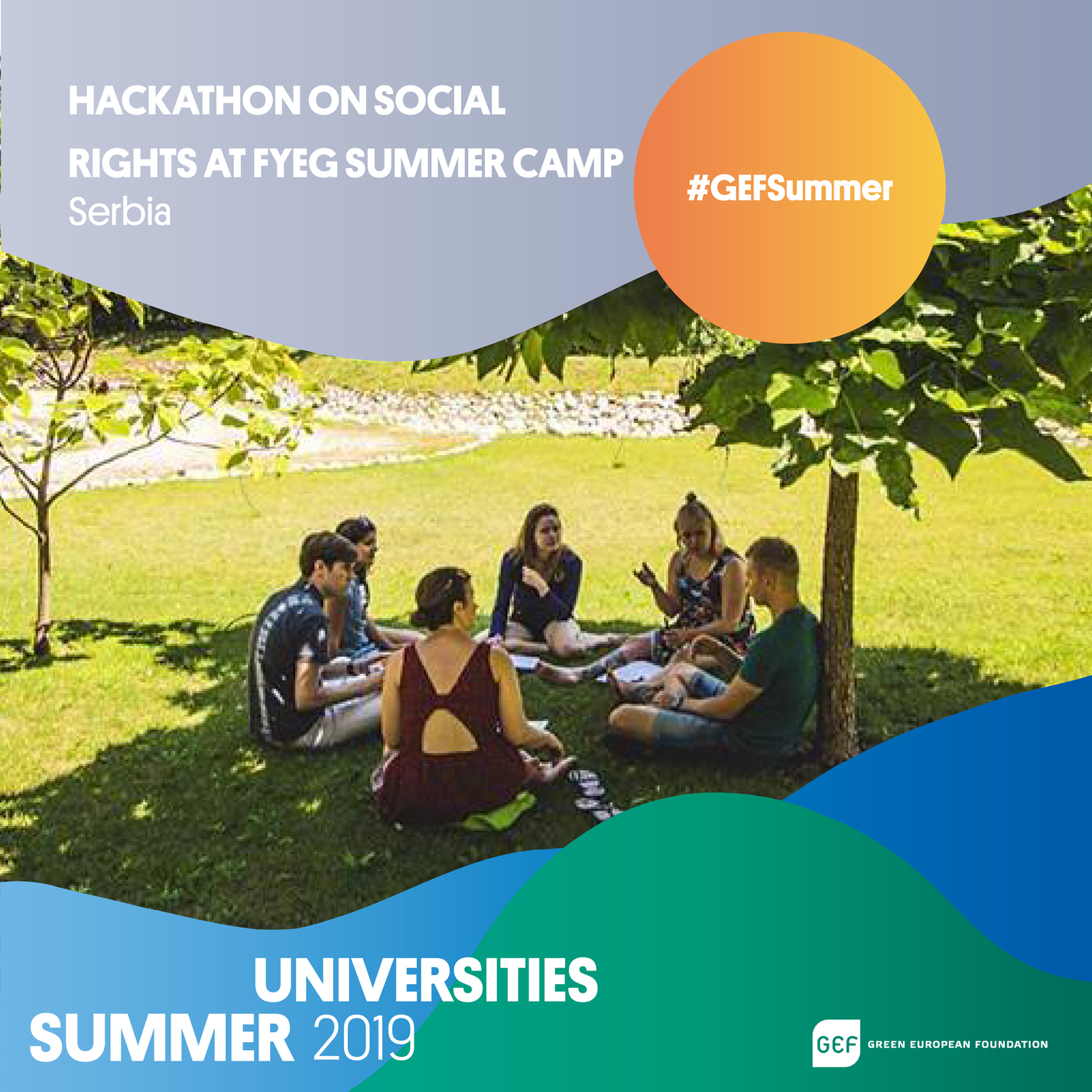
Hackathon on Social Rights at FYEG Summer Camp (Serbia)

By

Event Background

Summer Camp & GEF Hackathon

Green European Foundation partner Federation of Young European Greens is organising the Summer Camp “Our Social Rights – Our Future!” that will take place from 22 – 28 July 2019 in Serbia. GEF will support the Summer Camp and organise a hackathon that will take place on 25 and 26 July.

The summer camp will consist of five full days exploring different tools and platforms Young Greens can use to campaign and advocate for social rights. Participants will leave the summer camp with practical skills to use and share in their local contexts and on European level.

The aims of the summer camp are:

  • To understand how social rights apply to specific topics – including regional specificities, a just transition towards a sustainable society, and gender aspects.
  • To determine which tools to use for a campaign/advocacy depending on the cause and context, and how to apply these tools with limited resources.
  • To equip participants with the skills needed to carry out hackathons in their local regions.

About the Event

Hackathon – an intense, sprint-like, goal-oriented, small teamwork-based activity. Hackathon is a period of 36h when participants can plan, design and carry out their own mini-projects in small teams. The teams will be composed of young people – participants and guests – with different skills and backgrounds: activists, young advocates, lawyers, and programmers.

Programme

The programme will be based on the principles of non-formal education and intercultural learning. We strive for an active, inclusive environment for direct communication and sharing of knowledge. The summer camp will balance the dynamism of the hackathon with interactive discussions and reflections for participants to develop their practical and theoretical knowledge of social rights in an supportive and informal environment.

Participants will already be familiar with social rights and issues facing young people through the other activities of the summer camp.

The participants will identify their particular interests and choose one problem that they want to find a solution for. Forming teams of three-four, they will spend the next 40 hours designing an innovative solution to their chosen problem.

The session will start with a small teambuilding and sharing expectations excercise, as well as determining routine and agreeing breaks amongst the teams.

The hackathon will be participant-led, with monitoring from the prep-team who can offer guidance where needed.

The goal of the hackathon is to not necessarily have a concrete solution to the challenge posed, but to have developed ideas in how to approach the issues and work collectively and creatively towards solutions. Partiticipants will hone their practical skills by putting their ideas into reality.

Practicalities:

Language: The main language of this activity will be English.


Successful applicants to the FYEG Summer Camp will be notified by 5 June. Stay tuned for more information on the Summer Camp coming soon. 

Preparation Meeting for Brussels Study Trip (Prague)

By

Event Background

The European Green Activists Training (EGAT) consists of training sessions for young Green activists in three phases. 

The first phase is the completion of the free online course Impact Europe. Then, in the second phase, the trainees participate national training sessions in their respective countries on domestic politics, as well as a session on European politics and institutions. The final stage is the study trip, which brings all of the trainees from across Europe together in Brussels. 

The EGAT project aims to Europeanise existing training programmes for Green activists in several European countries by incoporating more pan-European content and to make these programmes more cooperative by enabling young activists to meet and network. 

About the Event

This training is a closed event for EGAT participants, who were chosen in fall 2018 though a call for participants. During this preparation meeting prior to the Brussels Study Trip the participants will learn for example about the practicalities of travelling to Brussels and visiting European Parliament and also have a chance to view their expectations, as well as reflect on the online course Impact Europe. The aim is also to reduce the possible cultural shock and prepare the participant for their of a life time, as well as go deeper in the themes of lobbying and rule of law.

Programme:

Friday 22 February

18:00 – 19:15 Dinner

19:15 – 20:30 Presentation of the Brussels Study Trip

20:30 – 21:00 Cultural shock

Saturday 22 February

8:30 – 9:30 Breakfast

9:30 – 10:30 Impact Europe – debriefing and discussion

Break

10:45 – 12:15 Good Lobbying in Czech contextby Věnek Bohuš, analyst from Rekonstrukce státu”

12:15 – 14:00 Lunch

14:00 – 15:30 Law in the system change by Karel Suda, lawyer

Break

15:45 – 17:15 Plenary meeting

Break

17:30 – 18:30 Working groups

18:30 – 19:00 Closing


Documentary on Youth (Brno)

By

Event Background

In the framework of the Idea Challenge, the Green European Foundation invited young people aged 16 – 24 from Croatia, Czechia and Portugal to submit their ideas which aims to make their own neighborhood or a local community more open, democratic, inclusive, and ultimately European. 3 winner ideas from the three countries were selected and are now on the way of implementing their projects.

About the event

Monika – 19 years old high school student is set to film a short documentary, based on a case study from Czechia. She, together with her cinematographer friend Radek would like to explore young people’s awareness and attitudes towards European Union and see how it correlates with the awareness related to climate and environmental issues.


For updates on the the activity, follow our Facebook and Instagram accounts.

Aquarium Inauguration (Porto)

By

Event Background

In the framework of the Idea Challenge, the Green European Foundation invited young people aged 16 – 24 from Croatia, Czechia and Portugal to submit their ideas which aim to make their own neighborhood or local community more open, democratic, inclusive, and ultimately European. Three winning ideas from the three countries were selected and are now in the process of implementing their projects.

About the event

This project by João – 23 years old Aquatic Science student from Porto, pulls together technological, social and environmental dimensions, as he will build an aquarium integrated with a floating island at the Porto Escola Básica Augusto Gil high school .

The installation of the aquarium will involve Marine and Biotechnology Science students and the students of the high school. The aquarium intends to raise awareness about freshwater ecosytems, which are particularly vulnerable to climate change: many species within these fragmented habitats have limited abilities to disperse as the environment changes;  water temperature and availability are climate-dependent;  many systems are already exposed to numerous anthropogenic stressors.

The aquarium will be inaugurated over June 5th & 6th, on World Environment Day and in the run-up to World Oceans Day. Students will receive presentations on climate change and Portuguese freshwater fish, presented by João and Dr. Cristina Calheiros.  The students will also have the opportunity to help in the installation of plants in the aquarium and learn more about how it works.


For updates on the the activity, follow our Facebook and Instagram accounts.

Treasure Hunt (Varaždin)

By

Event Background

In the framework of the Idea Challenge, the Green European Foundation invited young people aged 16 – 24 from Croatia, Czechia and Portugal to submit their ideas which aims to make their own neighborhood or a local community more open, democratic, inclusive, and ultimately European. 3 winner ideas from the three countries were selected and are now on the way of implementing their projects.

About the event

Matej and Katja are students at the Varaždin high school. They are organising a treasure hunt for young residents of the city – connecting various landmarks with European topics, as well as embedding interesting facts about the EU, within the context of Varaždin history and culture. Varaždin is preparing to be the candidate city for the European Youth Capital 2022.


For updates on the the activity, follow our Facebook and Instagram accounts.

Heinrich Böll Foundation – After Europe goes to the polls: Where is the European Union headed? (Berlin)

By

Event Background

The European election will be a litmus test for the European democratic project and further reveal and demonstrate what has been a trend in many European countries in recent years – the increasing success of right-wing populist and extremist forces. In regions where they are gaining more and more ground, they have already managed to influence the political discourse to a large degree and thus changed the direction and
impetus of the European election campaigns.

About the Event

The Heinrich Böll Foundation is therefore committed to bringing its European partners and European actors fighting against right-wing populism in Europe together to provide a platform for networking and the exchange of ideas, best practices and lessons learned.

At the conference “After Europe goes to the polls: Where is the European Union headed?”, the election results will be analysed, to examine the causes of voting behaviour in the individual EU member states, and discuss with European experts how the new majorities will impact the European Parliament’s ability to act, the interaction between the EU institutions, and the orientation of future EU policy.

The networking event – as part of the Conference – aims to connect and support progressive forces that promote liberal democracy within the EU.

Held with the cooperation of the Green European Foundation.

Programme

Monday, June 3rd, 2019

10.45: Registration
11.00: Welcome
13.00: Lunch
14.00: Welcome address and introduction
Dr. Ellen Ueberschär, President, Heinrich Böll Foundation, Berlin

Keynote
What challenges await the European Union after the European elections?
Ivan Krastev, Chair of the Centre for Liberal Strategies and Fellow at the Institute for Human Sciences, Sofia/Vienna

Discussion with:
Anne Gellinek*, Chief of the ZDF Television Office Brussels, Second German Television,
Brussels

15.00: Break
15.30: Panel – Analysis of the election results

· Motives and background: What are the key election results?
· What kind of EU have the voters elected?
· What were the motives behind electing parties sceptical about the EU and
integration?
· Do the election results vary by certain regions or groups of countries?
· What impact will the election results have on the EU policy of individual member
states?
Piotr Buras, Head of the Warsaw Office, European Council on Foreign Relations, Warsaw
Prof. Dr. Sylvie Strudel, Professor of Political Science, Université de Paris 2, Paris
Prof. Dr. Uwe Jun, Professor of Political Science, Trier University, Trier
Prof. Dr. Lina Papadopoulou, Associate Professor of Constitutional Law, Aristotle University Thessaloniki

17.00: Break
17.30: Panel – Where is the EU headed after Europe goes to the polls?

· What effect will the new majorities have on the European Parliament’s ability to act?
· New parliamentary groups – new alliances: How must the progressive forces now
position themselves?
· How much support does the European Union still have? How can it build further
trust? And how can it find a capacity to act?
· What consequences will the election results have for future EU policy?
· What common projects will now take priority?
Reinhard Bütikofer, MEP, Chair of the European Green Party, Brussels
Dr. Rui Tavares*, Politician and former MEP, The Greens/EFA, Young Policy Leader Fellow at European University Institute, Florence
Edit Zgut*, Analyst, Polish Academy of Sciences, Warsaw/Budapest
Prof. Dr. Teresa Pullano, Assistant Professor of European Global Studies, University of
Basel

19.00: End
19.30: Dinner

*Speakers listed above have been invited, but have not necessarily confirmed their participation.

Tuesday, June 4th, 2019
09.30: Registration
10.00: Welcome address and introduction
Keynote
Civil society and the future of Europe

  • Dr. Sergey Lagodinsky, Candidate for the European Parliament, The Greens/EFA and
    Head of the European Union/North America Department, Heinrich Böll Foundation, Berlin
  • Flavia Kleiner, Co-President, Operation Libero, Bern

10.30: Exchange
How European elections have affected and affect the political landscape for civil
society and civil action

  • Inputs from partner organizations from different countries

Discussion

12.30: Lunch
13.30: Exchange
Capacity to act for civil society in times of shrinking spaces

  • Inputs from partner organizations from different countries

Discussion

15.00: Break
15.30: What comes next?
Feedback
16.00: End

Practicalities

Entry is free, but registration is required. Please register with the form found on the  Heinrich Böll Foundation website here. 

Transport connection
Bus 147 Deutsches Theater
S-Bahn S1, 2, 25, 5, 7, 75, 9 Friedrichstraße
U-Bahn U6, Oranienburger Tor
Tram M1, M6, 12 Oranienburger Tor
from central station (DB), Bus 147 > Ostbahnhof bis Deutsches Theater

Conference languages
The international conference will be translated simultaneously German/English.
The network meeting will take place in English only.


Call for Applications: Congress of Young Europeans 2019 (Marseille)

By

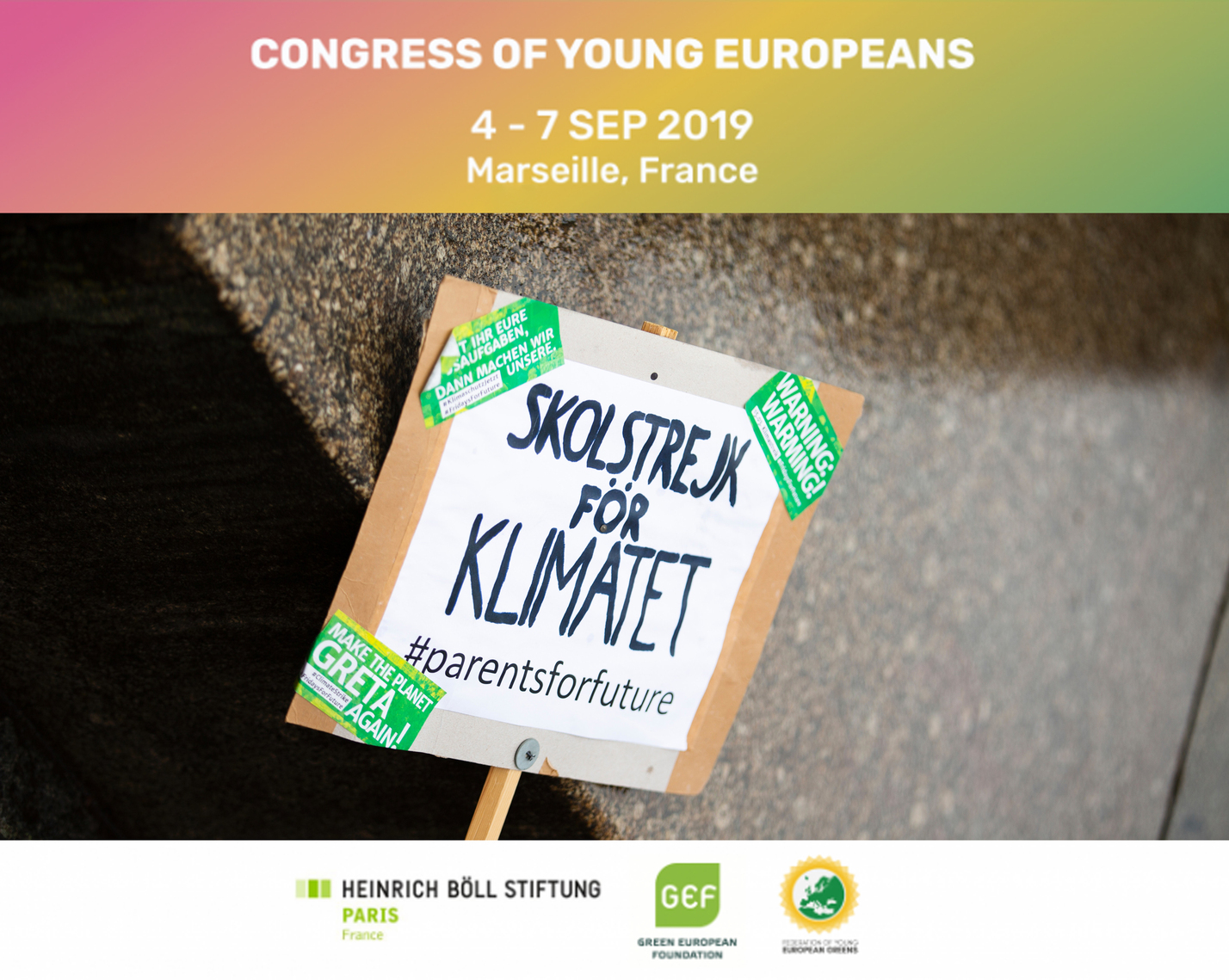
The Heinrich Böll Foundation, the Green European Foundation and the Federation of Young European Greens (FYEG) are calling for applications to participate in the 7th Congress of Young Europeans! The Congress will take place in Marseille, France, from 4th to 7th September 2019.

The main theme of this year’s Congress is “How to fight for climate and democracy”. How can young people with ideas and ideals at hand contribute to social and political change? What can we learn from movements like Fridays for Future? Which tools do successful activists use? How can we build and connect a movement?

During the three-day Congress, selected participants will have the opportunity to come together and participate in different panels and workshops focusing on these questions.

How to Apply

  • Are you already involved in a movement, NGO, or similar activity?
  • Are you interested in sharing and expanding your vision, knowledge and ideas?
  • Are you between 18 and 30 years old?
  • Are you interested in sharing and discussing ideas in a transnational environment?

Apply now to the Congress of Young Europeans and become part of a young and innovative European network!

The organisers will cover the the travel and accomodation costs for all selected participants of the Marseille Congress of Young Europeans.

The number of available spaces is limited.

The working language of the Congress is English.

Please apply via the application form found here: APPLY!

DEADLINE EXTENSION: 21st June


Green Learning: 10+ New Courses!

By

Green Learning – 10+ New Courses!

For all keen and green learners who want to supercharge their knowledge on the hot topics in Europe today, Green Learning has over 10 brand new courses for you to get stuck into!

Dive into the pivotal issues facing the European Union today, including:

  • How Can We Fight Climate Change?
  • Food & Agriculture
  • How Can We Achieve a Social European Union
  • How Can We Realise Tax Justice?
  • Empower the Youth!
  • Brexit
  • Towards a Transparent EU
  • Towards Sustainable Transport & Mobility
  • Fighting Terrorism and Ensuring Security
  • Towards Human Migration & Asylum Policies
  • How Can We Protect Our Fundamental Rights?
  • Combatting Hate Speech
  • Hate Speech Widersprechen (DE)

The courses will guide learners through these often-complicated topics with fun and dynamic content that break down the key information, facts and figures to give insights into the important issues at play. Then, learners will also explore the potential solutions to these problems to discover how to enact change for the better!

How to Start Learning

Create your account for free at www.mygreenlearning.eu and start learning now!

To start learning, create your account, click on “My Account” and find the desired course under “Library”.

These courses are part of the Green Learning platform of the Green European Foundation, which provides free online courses for learners to build their knowledge and develop their skills. Discover all the courses on offer at www.mygreenlearning.eu/about


Promotion

If you would like to promote the new Green Learning courses on your own website and/or social media, you can use the promotion pack found here.

A pack specific to courses relevant to the youth climate movements can be found here. 

A pack for the course Fast track: Green Issues from A to Z can be found here.

The promotion packs features text & visuals for you to use and share among your networks and beyond!