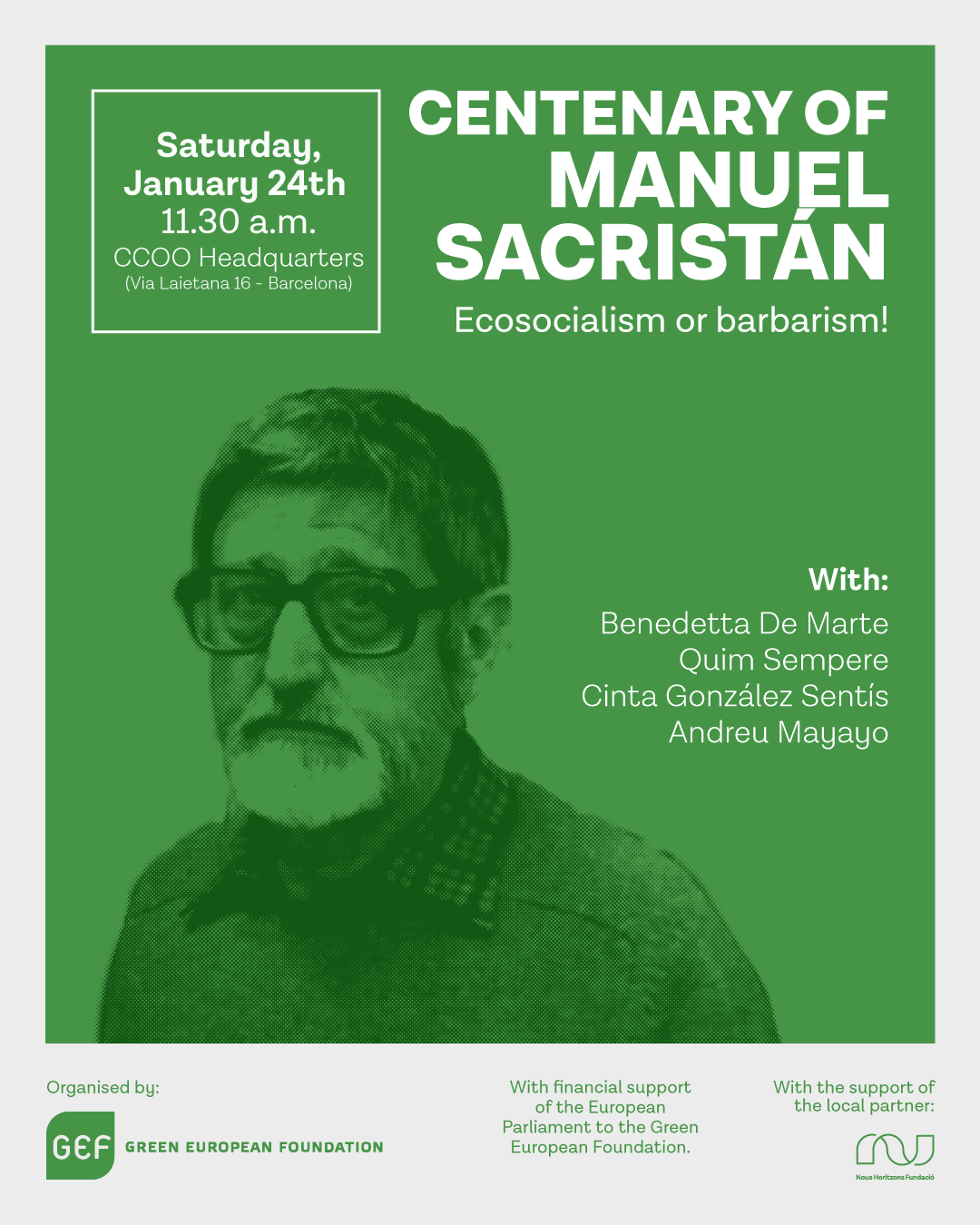
Centenary of Manuel Sacristán: Ecosocialism or barbarism!

By

Join us for a Green Red Dialogue to honour the legacy of one of the most influential critical thinkers of the 20th century while asking what kind of future Europe chooses to build.

About the Event

In 2025, we commemorated the centenary of the birth of Manuel Sacristán, a key figure in critical thought and an indisputable reference for ecosocialism in Catalonia and across Spain. This event is conceived as a meaningful tribute for all those committed to social transformation, ecological justice, and the defence of democratic values.

At a moment of profound global crisis – marked by ecological collapse, social inequality, and the erosion of fundamental rights -Sacristán’s legacy is more relevant and necessary than ever. His work continues to inspire critical reflection and collective action at the intersection of Marxism, ecology, and ethics. What might these ideas offer to Europe today? How can they help guide social movements and political actors in confronting ecological limits, democratic regression, and growing inequality? And what would it mean to place ethical responsibility and social emancipation at the heart of Europe’s political future?

It is in response to these questions that we bring together leading voices from the Green movement, feminism, youth activism, and critical political thought – to debate, inspire, and collectively explore pathways toward social justice, ecological responsibility, and democratic renewal in Europe.

Speakers

  • Benedetta Di Marte, Secretary General, European Green Party
  • Quim Sempere, Doctor of Philosophy and disciple of Manuel Sacristán
  • Cinta González Sentís, Secretary General, Federation of Young European Greens
  • Moderator: Andreu Mayayo, Professor of History

Before the dialogue begins, participants are warmly invited to share an informal networking moment together over a cup of hot chocolate.

Project Background

The Green Red Dialogues, organised by the Green European Foundation (GEF) with the support of Fundació Nous Horitzons, provide a space to address the defining social and ecological challenges of our time from a Southern European perspective. From the rise of the far right to feminist struggles, from war and authoritarianism to the historical roots of ecosocialist thought, these dialogues bring together diverse voices to connect the red and the green – bridging social and environmental justice in Europe.

This dialogue continues that mission by revisiting the intellectual foundations of ecosocialism through the work of Manuel Sacristán, while encouraging open, critical debate capable of confronting silence, resignation, and inaction in the face of today’s crises.

Speakers

  • Benedetta De Marte, Secretary General, European Green Party
  • Quim Sempere, Doctor of Philosophy and disciple of Manuel Sacristan
  • Cinta González Sentís, Secretary General, Federation of Young European Greens
  • Andreu Mayayo, Professor of History

Practicalities

Date: 24 January 2025
Time: 11:30-13:30 CET
Format: In-person
Address: CCOO Headquarters, Via Laietana, 16, Ciutat Vella, 08003 Barcelona, Spain

Registration: Please register your attendace via this link.  


This event is organised by the Green European Foundation (GEF) with the support of Fundació Nous Horitzons and with the financial support of the European Parliament to the Green European Foundation.
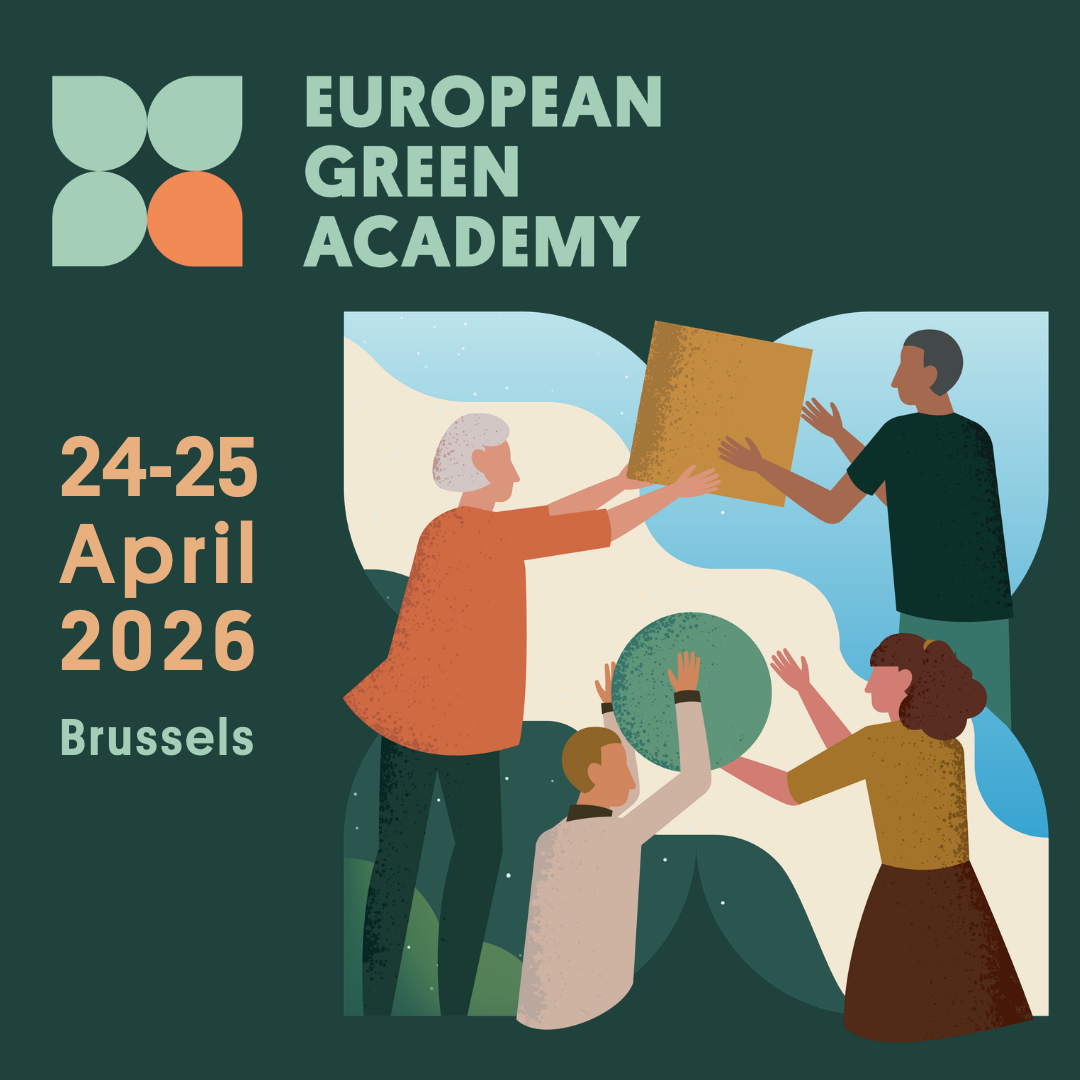


European Green Academy 2026

By

The 2026 edition of the European Green Academy (EGA) in Brussels, opens its doors this coming April, creating an inspiring learning space that brings together Green thinkers, political actors, civil society organisations, and engaged activists from across and beyond Europe. This year’s Academy is crucial – unfolding at a moment when democracy across Europe is under an intensifying attack, and urgent questions of resilience, autonomy and collective action demand fresh thinking and alliances.

About the event

Europe enters 2026 facing a stark political reality. Democratic backsliding, shrinking civic space, geopolitical instability, and the rise of hybrid and technological threats are reshaping the political landscape towards fear, rollback, and polarisation. Civil society is being systematically constrained: its autonomy reduced, its legitimacy attacked, and its role in democratic life eroded. At the same time, rapidly evolving technologies are transforming how citizens access information and participate in public life, creating new vulnerabilities that authoritarian actors are quick to exploit. 

Against this backdrop, Greens and progressives face mounting challenges in organising, building alliances, and collectively envisioning alternatives. EGA 2026 meets this moment head-on: creating a space to deepen understanding, strengthen transnational exchange and connections, and develop fresh ideas to defend democracy and rebuild resilience – through stronger participation, a reimagined and holistic approach to security and protection, and ambitious ecosocial transformation. 

Over 1.5 days, and through a dynamic mix of plenaries, workshops, debates, targeted training sessions and creative formats, EGA offers an inspiring learning environment where participants can engage with diverse actors and forward-looking ideas. With a strong focus on political education and tailored methodologies, EGA aims to equip participants with fresh insights, practical skills, and forward-looking perspectives to navigate today’s key challenges. It is a space for learning, building resilience, and mapping pathways for collective alliances in turbulent political times – as we work towards a just, ecological, and democratic Europe. 

Read more about last years’ edition here.  


Programme 

At the heart of the EGA 2026 programme lies a central question: how can we build resilient, autonomous, and vibrant societies amid technological capture, geopolitical instability, and deep ecological crisis?

Thematic pillars:

  • Democracy under pressure  
  • Digital sovereignty and democracy   
  • Autonomy & resilience 

Across the Academy, participants will engage in: 

  • Plenaries with leading voices from politics, academia, activism, and civil society 
  • Workshops and training sessions offering practical tools, skills, and methodologies 
  • Debates and roundtables exploring forward-looking Green ideas 
  • Networking spaces to foster collaboration and transnational exchange 
  • Creative and artistic interventions 

Meet the Speakers

  • Nika Kovač, Activist, My Voice My Choice
  • Agnese Lāce, Latvia Minister of Culture; co-chair of PROGRESĪVIE
  • Rosa Martínez, Secretary of State for Social Rights, Spain 
  • Tarik Abou-Chadi, Professor of European Politics, Oxford University
  • Nicolae Ștefănuță, Vice President of the European Parliament, MEP, Greens/EFA
  • Dominika Lasota, co-founder of the Wschód (“Sunrise”) Initiative, member of Fridays for Future Poland
  • Renata Ávila Pinto, CEO, Open Knowledge Foundation 
  • Justyna Wydrzyńska, Abortion Dream Team
  • Zoya Miari, Palestinian-Ukrainian Storyteller, Peace Ambassador
  • Tomas Tomilinas, MP Democrats for Lithuania
  • Gabriela Svárovská, MP, Co-Chair, Zelení
  • Atte Harjanne, MP, Vihreä liitto (Finnish Greens)
  • Jean Cattan, Head of the National Initiative, Café IA; former Secretary General of Artificial Intelligence and Digital Technology Council
  • Richard Wouters, Project Lead, Wetenschappelijk Bureau GroenLinks
  • Adam Reichardt, Editor-in-Chief, New Eastern Europe
  • Karen Boers, FARI, the Brussels AI Institute for the Common Good
  • Ariane Giraneza Birekeraho, Antwerp City Councillor, Groen 
  • Lorenzo Marsili, Director, Casa dei Tre Oci
  • Shannon Vallor, Co-Director, Centre for Technomoral Futures, author The AI Mirror: How to Reclaim Our Humanity in an Age of Machine Thinking 
  • Alice Stollmeyer, Executive Director, Defend Democracy 
  • …more to be confirmed!

Friday 24 April

Time Session 
13:00-14:00 Networking Lunch 
14:00-14:15 Official Opening & Welcome 
14:15-14:45 KEYNOTE  
15:00-16:30 PARALLEL WORKSHOPS 
16:30-17:00 Break 
 17:00-17:30 Setting the Scene: Where are we? – and What Next?   
17:30-19:00  PLENARY: Civil Society & Democracy   
19:00-20:00 Networking Dinner 
20:00-21:30 Cultural programme 

Saturday 25 April

TimeSession 
09:30- 10:00 Coffee & Speed Networking 
10:00-11:30 PLENARY: System Reset: Technology for a Democratic Europe  
11:30-13:00 PARALLEL WORKSHOPS 
13:00-14:30 Networking Lunch 
14:30-16:00 PARALLEL WORKSHOPS 
 16:00-16:30 Break  
16:30-17:15 Thought Leader Spotlight  
17:15-17:45 KEYNOTE 
17:45-18:30 Academy Closing 
18:30-22:00 Networking Dinner & Cultural Performance 

Featuring parallel workshops on: 

  • Civil society and democracy under pressure 
  • Digital sovereignty and democracy 
  • Building resilience through values 
  • Democratic resilience: civil society and youth 
  • Gender, democracy, and civil society mobilisation 
  • …more to be confirmed! 

Registration  

We have just 150 spots available. We encourage those interested to express their interest early via the preliminary registration form. 

Registration is in two steps:

  1. Complete the initial registration form via the link above. 
  2. If you are selected to participate, you will receive a link and confirmation form to confirm your spot at the Academy. 

Deadline: Both step 1 & step 2 must be completed by or before 20 March 2026.

Please note that your registration is only complete once you have completed both steps and paid your participation fee (if applicable). 

Participation Fee 

All participants of the European Green Academy are invited to pay a participation fee, which helps cover essential event-related costs. GEF covers all catering expenses during the programme, and no profit is derived from participation fees. If this fee represents a financial barrier, you may indicate this in your registration form once registrations will be open – fee waivers may be granted for individuals from lower-income or under-resourced backgrounds. Please find full information here.

Practical Information

  • Date & Time:  24 April 2026 (13:00-22:00)25 April 2026 (09:30-22:00)
  • Location: Brussels Information Point (BIP), Rue Royale 2-4 Koningsstraat, 1000 Brussels 
    Language & Format:
      English, in-person participation only
  • Registration: Please complete this form to apply for participation. 
  • Deadline: registration steps 1 & 2 must bcomplete by or before20 March 2026. 
  • Accessibility & safe spaces: GEF remains committed to ensuring an inclusive and respectful environment for all participants. A safe spaces policy will apply throughout the event. 
  • Contact: For any questions regarding the European Green Academy 2026, please contact events@gef.eu. 


This event is
organised by the Green European Foundation with the financial support of the European Parliament to the Green European Foundation.
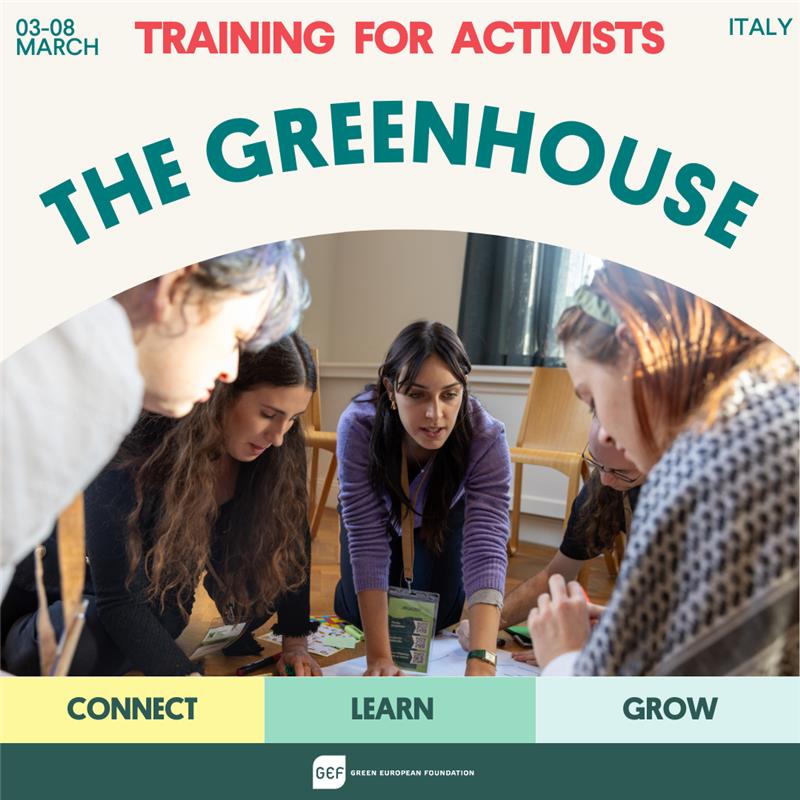
The Greenhouse Training for Activists 2026: Applications Closed

By

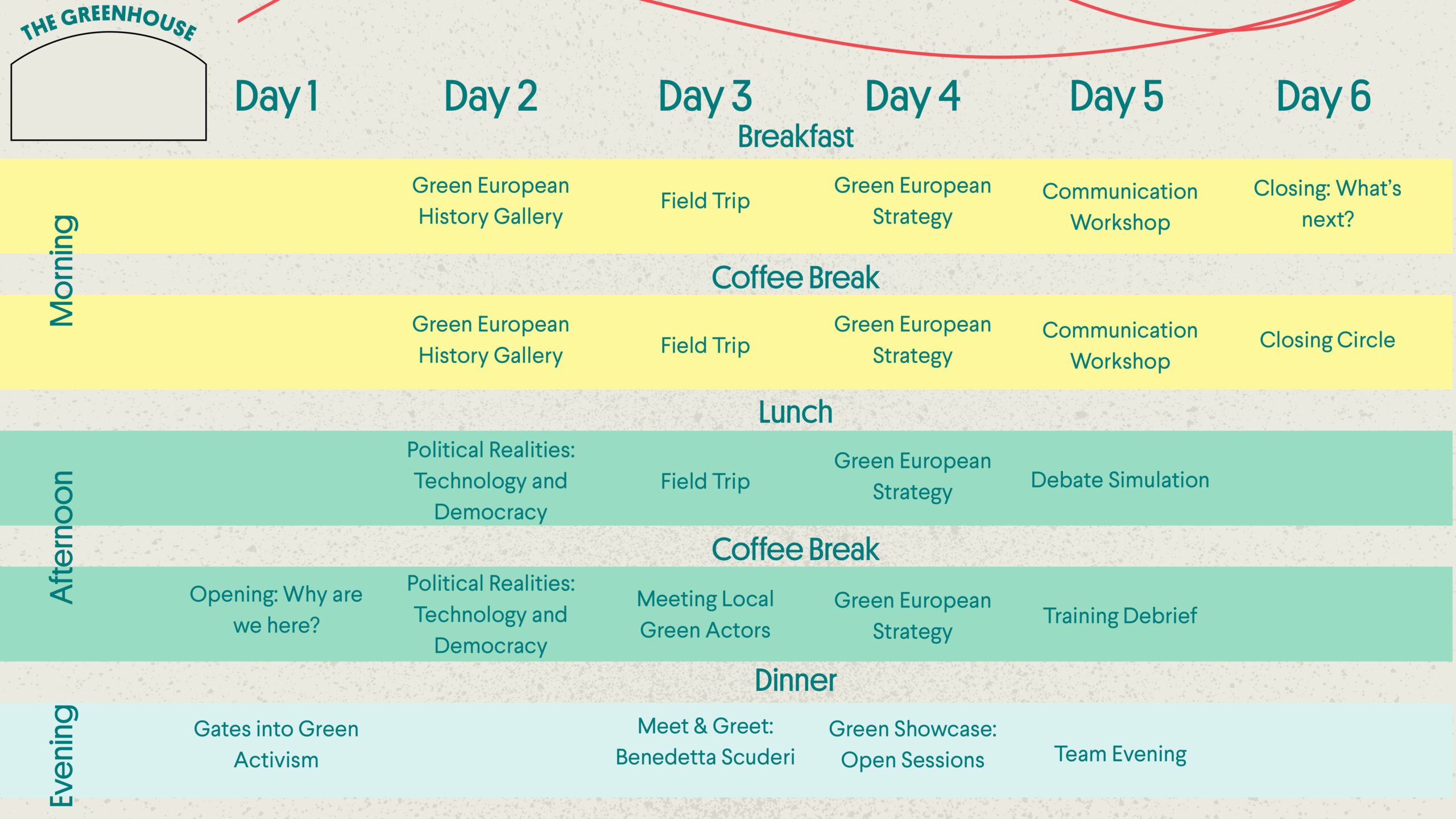
The Greenhouse: Training for Activists is a unique opportunity to connect, learn and grow as part of a new generation of green and green-minded Europeans leading change in their communities. Taking place in Reggello, Tuscany from 03.03.2026-08.03.2026, the training will bring together 30 young Europeans committed to building a more just and sustainable Europe to further build their political skillset through practical training, transnational exchange, and political ecology education. 

Please note that applications for this event are now closed.

About The Greenhouse: Training for Activists 

The Greenhouse Training is a five-day intensive for activists, thinkers, organisers, and anyone committed to shaping a vibrant, sustainable, and democratic Europe. 

Rooted in political ecology education, the training combines participatory methods, expert-led workshops and debates, and community-building activities.  During the training, participants will deepen their understanding of the roots and trajectories of the green movement, explore pressing societal challenges through a European lens, and strengthen their competences in areas like rhetoric and debating. The March 2026 edition of The Greenhouse centres around the timely theme of “Technology and Democracy”.  

At GEF, we believe that the European green movement is strongest when it is diverse, inclusive, and interconnected. This training is designed to foster lasting relationships and build a resilient cohort of green Europeans ready to lead change in their own communities. 


The training includes:  

  • Political Ecology Sessions exploring the roots and trajectories of the European Green movements, connecting past struggles to current political challenges
  • Deep dive into the theme “Technology and Democracy”
  • Practical skill-building in argumentation and political debate
  • A strong focus on collaboration, peer learning, and European perspectives 
  • Guidance and mentorship from expert facilitators and insights from leading voices in the European Green movement 
  • Networking with fellow European activists and local political actors to foster lasting relationships across borders
  • Introduction into the Greenhouse Community – opening further opportunities for training, mentorship, and networking


Programme:


Next to the five-day training 03-08 March, The Greenhouse: Training for Activists includes three online sessions 

  • Greenhouse pre-training session (24.02.2026 – 17:00 – 18:30) 
  • Greenhouse post-training Session #1 (07.04.2026 – 17:00 – 18:30) 
  • Greenhouse post-training Session #2 (05.05.2026 – 17:00 – 18:30) 

These sessions are an integral part of the training. Your availability during these timeslots is conditional for your application to be considered. 


Expert speakers and Trainers  

Edouard Gaudot – Historian and Political Scientist; Expert on Political Ecology, expert speaker

Benedetta Scuderi – MEP (Italy), Greens/EFA, expert speaker

Benedetta de Marte – Secretary General, European Green Party, expert speaker

Eliza Popper – Co-founder, The Good Enough Company, trainer

Sebastian Huehne – Network & Training Assistant, Green European Foundation, trainer

Local Italian Green Movement Actors (names tbc)

Participation fees and financial considerations 

Successful applicants will be asked to contribute a €75–120 participation fee (sliding scale) to confirm their spot. This contribution supports the Green European Foundation’s co-financing efforts, helping to make the training sustainable and accessible for future generations of activists. We will cover all other costs related to the training, including participant accommodation, catering, and a full travel reimbursement for journeys to and from Italy.

Our aim is to ensure that financial barriers do not prevent committed young activists from taking part in this unique learning experience. No profit is incurred. If the participation fee presents a barrier to your participation, please indicate this in your application – we are committed to finding a solution together.


Participant Profile  

The ideal candidate for The Greenhouse: Training for Activists is: 

  • a young (18–30 years old) green or green-minded activist, academic, community organiser, trainer, journalist, civil society/political actor actively engaged in shaping a more just, sustainable, and democratic society 
  • anchored in local green and progressive movements and/or organisations 
  • motivated to deepen their understanding of political ecology, strengthen their advocacy and debate skills, and interested in exploring the political debates at the intersection of Technology and Democracy. 
  • ready to engage at the transnational level and connect with a diverse network of green-minded peers from across Europe 
  • ready to bring their learning back to their local context through concrete actions and initiatives 
  • eager to join a growing European community of young green leaders and remain actively engaged beyond the training


Project Background

The Greenhouse is the Green European Foundation’s activist training initiative dedicated to offering political education on Europe, capacity building for the green movement at large, and fostering engagement and participation of young leaders and activists across the continent – to support a strong and vibrant European democracy.   

Joining The Greenhouse Training opens doors for continued networking, mentoring, and training as part of the Greenhouse Community – such as facilitated sessions with the biggest thinkers and doers in the European green movement and the opportunity to join our summer trainings, where we delve deeper into the core principles and practices of green leadership and political organising. 

Across its different formats, The Greenhouse nurtures the foundations of collective action and cultivates the routes forward for young European citizens to shape systemic change in their local communities.  


Practicalities 

Date and Time: 03 – 08 March 2026

Location: Reggello (Tuscany), Italy – around one hour south of Florence

Language:   Fluency in both written and spoken English is required to participate in the training 

Participants: 25 activists aged 18 – 30 years from across Europe (EU and non-EU countries) 

Application: Applications for this training are now closed.

If you have any questions about the training, contact training@gef.eu


This event is organised by the Green European Foundation with the financial support of the European Parliament to the Green European Foundation.
Alexander Langer peacebuilder : Lessons and Legacies for Europe Today

By

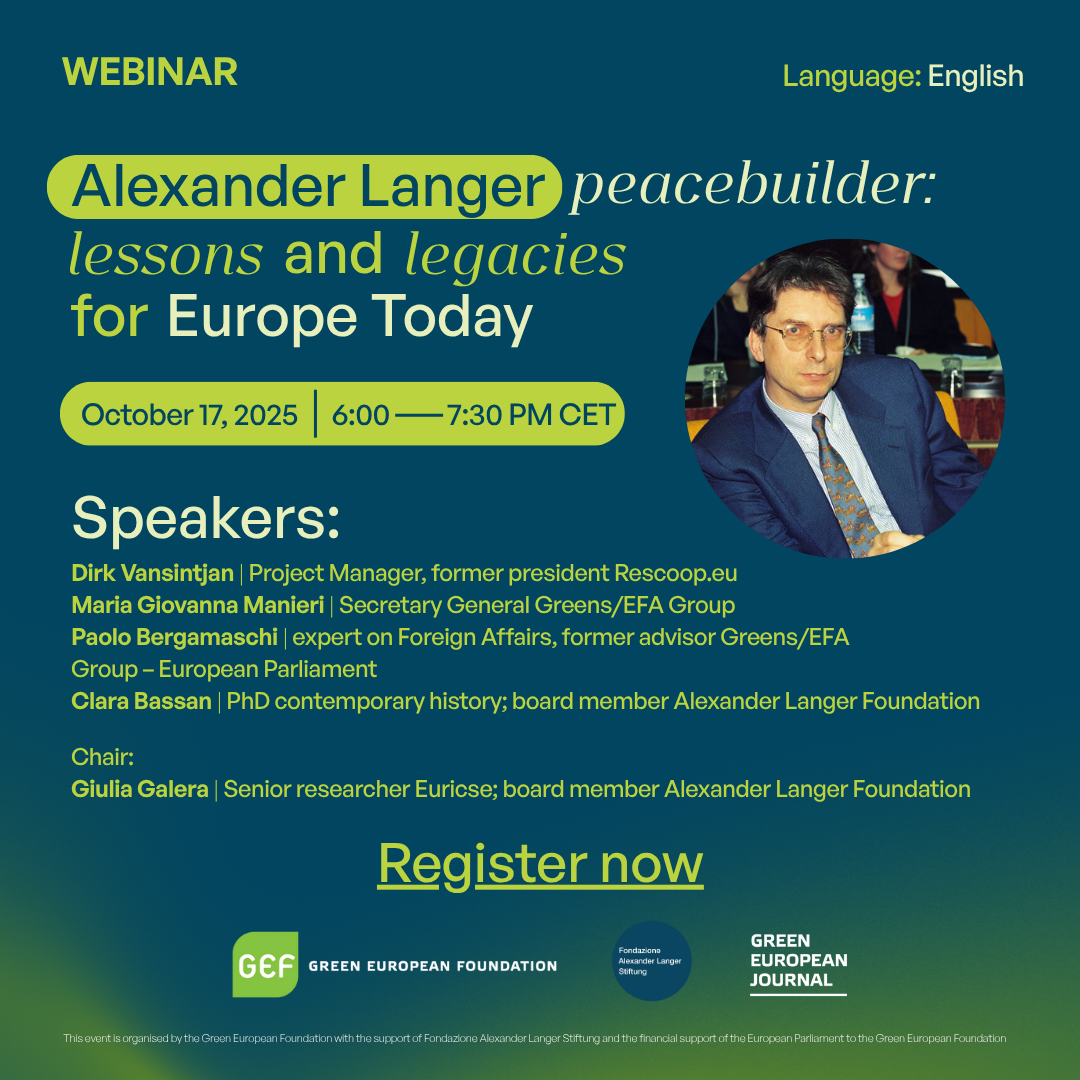
Join us this October for a special GEF Webinar: a gathering of experts and Green thinkers to reflect on the legacy of Alexander Langer. Together, we’ll explore what lessons his experiences offer for today’s turbulent times and how they can inspire the future of the Green movement.

About the event

On October 17th at 6:00 PM, we invite you to join the webinar “Alexander Langer Peacebuilder: Lessons and Legacies for Europe Today”, organized with the support of the Alexander Langer Foundation.

Marking the 30th anniversary of Langer’s passing, this event pays tribute to one of Europe’s most influential Green voices: a bridge-builder between communities, movements, and ideas. His message of peace and ecological responsibility remains highly relevant today. At this occasion, the Green European Journal recently published an article titled Alexander Langer, peacebuilder, revisiting his life, work, and passionate commitment to dialogue and reconciliation.

Building on this article, the webinar will explore Langer’s legacy and reflect on how his ideas and concrete actions can be applied today to promote ecological transition and peace in the context of contemporary Europe.

Speakers:

  • Dirk Vansintjan (Project Manager, former president Rescoop.eu)
  • Maria Giovanna Manieri (Secretary General Greens/EFA Group)
  • Paolo Bergamaschi (expert on Foreign Affairs, former advisor Greens/EFA Group – European Parliament)
  • Clara Bassan (PhD contemporary history; board member Alexander Langer Foundation)

 Chair: Giulia Galera (Senior researcher Euricse; board member Alexander Langer Foundation)

Practicalities

Date: Friday, October 17, 2025 – 6:00 PM
Language: English
Registration link


This event is organised by the Green European Foundation with the support of Fondazione Alexander Langer Stiftung and the financial support of the European Parliament to the Green European Foundation.

Green Horizons Academy – Good for Nature (Belgrade)

By

About the Event

The Green Horizons Academy (GHA) is an annual space for discussion and idea development around the future of environmental and social policies in Europe. This year’s edition, Good for Nature, will focus on advocating for strong biodiversity protection policies and empowering civic engagement in environmental efforts. 

In 2025, nature protection activists and green minded individuals in general face mounting challenges. The EU’s Biodiversity Strategy 2030 is under pressure, environmental laws are threatened by corporate lobbying, and civic movements face increasing repression amid a growing trend of authoritarianism. Meanwhile, in Serbia and across the Balkans, local movements struggle to protect ecosystems from extractivist industries, such as lithium mining and hydropower projects. In this context, GHA: Good for Nature will bring together civil society representatives, grassroots activists, EU policy experts, and decision-makers to strategize and build knowledge on defending nature and strengthening environmental democracy. 

The two-day conference will feature a public panel debate, a field trip to explore local environmental challenges, workshops, and networking opportunities. 

Project Background

GHA: Good for Nature is part of the Green European Foundation’s broader mission to promote a sustainable and socially just future. This year’s edition follows the 2024 discussions on extractivism and the European Green Deal’s external impacts, shifting the focus toward biodiversity and nature restoration as central pillars of Europe’s green transition, as well as avoiding the clashes that can happen between the fight for biodiversity and the development of sustainable energies. 

Programme

DAY 1: PUBLIC EVENT – no pre-registration needed

16:00 Arrival of the participants and public
17:00 Panel 1:  Biodiversity and consistency in EU policies

  • Igor Kalaba – Center for Environment, (Bosnia and Herzegovina)
  • Belma Šestović – Wildlife Montenegro
  • Nataša Đereg – National Convention on European Union in Serbia (NCEU)
  • Vanja Jakšić – WWF Adria (Belgrade)

Moderator: Žaklina Živković, Polekol

18:30 Panel 2: Ecosystems, local communities and decarbonisation

  • Ivan Milosavljević – Rangers of East Serbia
  • Aleksandar Dragićević – Eco activist, Montenegro
  • Milja Vuković – Blue and Green initiative
  • Andrey Ralev – Bankwatch SEE
  • Marko Mirč – Institute for Biological Research “Siniša Stanković”

Moderator: Iva Marković, Polekol

20:00 Dinner for the participants and speakers – at the venue

DAY 2: CLOSED DOOR – only selected applicant

09:00 Workshop 1: Sandra Jovanović – Biodiversity Expert – EU policies for the people!
10:30 Workshop 2: Discussions around case studies with the participants and lessons learned from the day before’s panel discussions
12:00 Field trip to Bara Reva, Lunch
14:00 Ana Džakić, NGO Bela Čaplja (White Heron) – Presentation about the local struggle, Networking opportunities
18:00 Trip back to Belgrade
19:00 Dinner & Goodbyes


Practicalities

Date: 28-29 March 2025
Location: Belgrade, Serbia / online live retransmission on our partner’s instagram channel
Venue: KC Grad, Braće Krsmanović 4, Belgrade, Serbia
Language: English
Costs coverage: We will provide catering during the event and cover any travel costs within Serbia. Accommodation and international travel costs will be assessed on a case-by-case basis and as funds allow. We however would really like to mention that this should not be a barrier to apply ! Please indicate your needs in the application form.

Who Should Apply?

We are looking for participants who are: 
Environmental activists, civil society representatives, students, researchers, or decision-makers 
Passionate about biodiversity, climate justice, and civic engagement 
Interested in networking and collaborating with green-minded individuals from Serbia and beyond

Limited spots available – apply now to this link! Applications will be reviewed on a rolling basis. To better mitigate the travel cost, the deadline for international application is 14th of March, the deadline for Serbian application is the 19th of March.
APPLICATIONS ARE NOW CLOSED

If you have any question, please reach out to anthony.msika@gef.eu


This event is organized by the Green European Foundation with the support of  Polekol and the financial support of the European Parliament to the Green European Foundation. The European Parliament is not responsible for the content of this publication.
Gender at the Heart of the EU Energy Transition: Key learnings from the French case

By Publications

About

The policy brief “Gender at the Heart of the EU Energy Transition” identifies the energy transition’s potential for gender equality. The publication exposes the gendered nature of our relationships to energy and the link between the fossil-based energy systems and gender inequalities. It examines gender-based disparities within the three key roles that define our relationships with energy: as consumer, producer, and governance actor.

The energy transition has the potential to tackle these inequalities. But to effectively counter these traditional dynamics, intentional policy is required. Using examples from France, the brief showcases that, while gender has entered the energy transition policy discourse here and there, more needs to be done to avoid repeating inequalities of the past. We argue that gender mainstreaming and active participation of all genders across demand, supply and decision-making spaces within the transition are critical and that EU policymakers must – and can – lead the way.


Authors

  • Barbara Nicoloso, Director of the French NGO Virage Énergie,
  • Taube van Melkebeke, Head of Policy at the Green European Foundation. For further information, contact her at taube.vanmelkebeke@gef.eu.

Published by the Green European Foundation with the financial support of the European Parliament to the Green European Foundation. The European Parliament is not responsible for the content of this publication. The views expressed in this publication are solely those of the authors and contributors and do not necessarily reflect the views of the European Parliament. 


Geopolitics of a Post-Growth Europe (Sofia)

By

About the event:

GEF is hosting a festive launch event in Sofia to spotlight the Bulgarian edition of our publication “Geopolitics of a Post-Growth Europe.” This will be followed by an expert roundtable delving deeper into the policy dilemmas and potential synergies of Europe’s ecological and geopolitical security. Both events will bring together green activists, experts, researchers, policymakers, and civil society representatives, including inputs and interventions from other parts of Europe.

Project background:

In the project “Geopolitics of a Post-Growth Europe”, the Green European Foundation and its partners explored the tensions between degrowth/post-growth and geopolitics. The project worked to ignite a conversation between critics of economic growth and progressive thinkers on foreign and security policy, who now often operate in separate circuits. Find out more about the project and its findings at geopoliticspostgrowth.eu.

Programme and speakers:

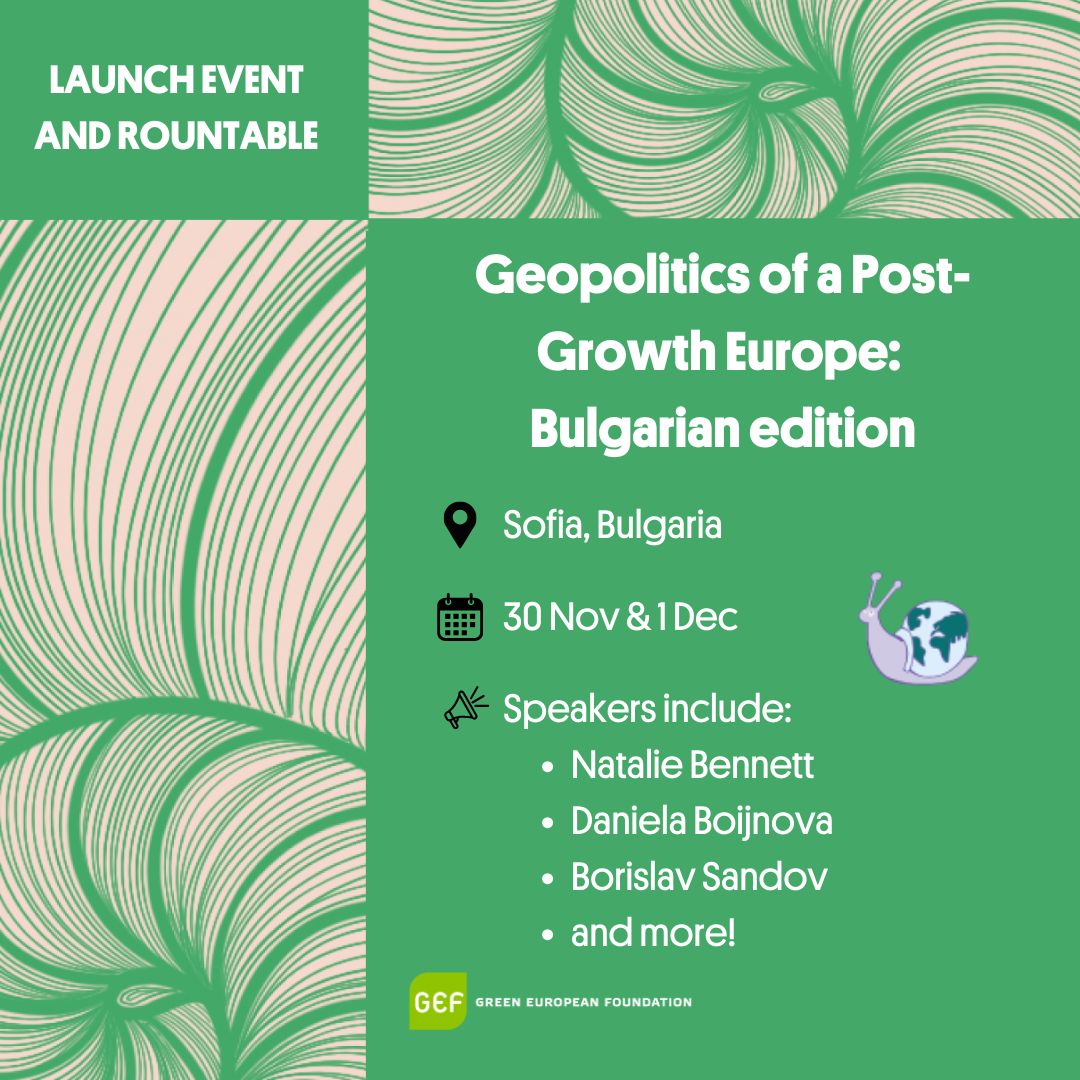
Festive book launch and reception (Saturday, 30 November, 13:00 – 14:30)
With speeches and interventions by:

  • Natalie Bennett, Green member of the UK House of Lords and member of the editorial board of the Green European Journal
  • Carlos Teixeira, co-president of Instituto José Tengarrinha, Portugal
  • Daniela Bojinova, Direct Participation Expert and Democracy International Board Member, Co-Chair, Bulgarian Green Movement

Expert roundtable: Geopolitical versus Ecological Security? Green policy dilemmas at a time of wars and pressure against European democratic values (Sunday, 1 December, 9:00 – 10:30)

  • Keynote presentation by Richard Wouters (Wetenschappelijk Bureau GroenLinks)
  • Moderated by Pavel Antonov (BlueLink)
  • Discussants include: Daniela Bojinova (Direct Participation Expert and Democracy International Board Member, Co-Chair of the Bulgarian Green Movement), Borislav Sandov (former Deputy Prime Minister, Climate Policies), Magdalena Maleeva (Founder, Gorichka.bg), Dimitar Sabev (Green Economist, Bulgarian Academy of Sciences), Assen Nenov (Degrowth/Postgrowth Expert, Climate Fresc and Circular Economy Institute)

Practicalities:

Date and Time: November 30th (13:00-14:30) & December 1st (9:00-10:30)

Location: Krasno Selo Culture House, Sofia

Language: The event will take place primarily in Bulgarian, with some interventions in English. Whisper translation will be provided where necessary.

Registration: Both events are open to the general public, but you can register in advance via this link.


This event is organised by the Green European Foundation with the support of BlueLink and with the financial support of the European Parliament to the Green European Foundation.

Crisis Cascades: Green Responses to Europe’s Polycrisis (Vilnius)

By

About the event:

The term polycrisis has become a central feature of the European public debate. From pandemic and supply chain disruptions to war, cost-of-living, and climate breakdown, today’s compounding crises feed insecurity, instability, and distrust, with significant repercussions for EU integration and democracy. This is felt particularly acutely on Europe’s Eastern flank.

By discussing and connecting (in)security in all its facets – including social, ecological, and geopolitical – this event aims to confront the crisis cascades with equally multiplying solutions. What are the (green) tools and visions that can bolster security and resilience? What does crisis preparedness look like in practice, at local, national, and European level? And what lessons do the Baltic states hold for the rest of Europe in this regard?

We are gathering civil society, academics, activists and others from Lithuania and beyond to exchange on these questions and ideas in a series of lectures, panel debates, and discussion moments. Join us in Vilnius or online to contribute to this effort!

Project background:

Since 2022, GEF has used its unique connector position within and beyond the green movement to feed and define conversations on peace and security in Europe, and to bring diverse and multifaceted angles to the (geopolitical) discussion table. This conference continues those efforts, seeking to develop future-proof politics and policies for a more just, sustainable, and resilient Europe.

Programme and speakers:

Monday, November 11th

10:00 – 10:30    Welcome and opening remarks

with Laurent Standaert (GEF) and Eglė Radišauskienė (Institute of Democracy)

10:30 – 10:45     (Social) Security and Crisis Response: The EU’s Role and Responsibilities

with Julie Pascoet (European Network Against Racism)

10:45 – 11:15       Keynote lecture with Q&A: Putting the “Social” Back in Security

with Prof. Boguslavas Gruževskis (Vilnius University)

11:15 – 12:30     Panel debate: Social Safety in Times of Crisis – Lessons and Impact of the Pandemic and War in Ukraine

with Prof. Boguslavas Gruževskis (Vilnius University), Aistė Adomavičienė (National Network of Poverty Reduction Organizations), Jekaterina Rojaka (DSVL), moderated by Linas Kukuraitis (DSVL) 

12:30 – 14:00     Lunch and networking

14:00 – 14:30    Keynote lecture with Q&A: Balancing Security and Freedom – The Role of Democracy in Crisis Response

with Vytautas Valentinavičius (Kaunas University of Technology)

14:30 – 16:00    Regional panorama: Geopolitical Greens? Providing Credible yet Critical Responses in Times of Security Crisis

with Elina Pinto (Progresīvie), Klaudia Jachira (Zieloni), Lukas Savickas (DSVL), Michelle Haas (UGent), Indre Vareikyte (communications and gender equality expert, previously at EESC), moderated by Laurent Standaert (GEF)

16:00 – 20:00   Break

20:00 – 21:00   Building Resilience: Tomas Tomilinas and Elina Pinto on Green Lessons from the Baltics

Tuesday, November 12th

10:00 – 10:30    Keynote lecture with Q&A: Geopolitics of a Post-Growth Europe

with Richard Wouters (Wetenschappelijk Bureau GroenLinks)

10:30 – 12:00    Panel debate: Security and the Climate Crisis – Common Agendas or Clashing Priorities?

with Karolina Eklow (climate and security expert), Yuliia Melnyk (Ekoltava), Dominika Lasota (climate justice activist), Richard Wouters (Wetenschappelijk Bureau GroenLinks), moderated by Tomas Tomilinas (DSVL),

12:00 – 13:30     Break

13:30 – 16:30    Optional cultural programme: Gediminas castle visit

Practicalities:

Date: 11-12 November, 2024

Location: National Library of Lithuania – Gedimino pr. 51, Vilnius, Lithuania. Please arrive on time!

Language: The main language of the conference will be English, but some sessions or interventions may be in Lithuanian as well. In that case, simultaneous translation will be provided.   

Participation: This is a hybrid event, so participation is possible both in person and online. Please register in advance via this link. If you have any questions, please email sien.hasker@gef.eu.

_______________________________________

This conference is organised by the Green European Foundation, with the support of the Institute of Democracy and the financial support of the European Parliament to the Green European Foundation.

Green-Red Dialogues: The European Green Deal, At Risk

By

About the event:

The European Green Deal is facing major hurdles due to economic pressures, political tensions, and competing industrial interests, threatening the EU’s climate goals. This event will examine how to overcome these obstacles and secure a just and green future for Europe. Targeted at individuals passionate about climate policy, sustainability, and social justice, the event aims to foster a dialogue between experts from various fields. The format includes panel discussions, audience engagement, and hybrid participation to maximize involvement. The objective is to identify actionable strategies to protect and advance the European Green Deal in a time of crisis.

Project background:

GEF’s Green Red Dialogues, organised with the support of Fundació Nous Horitzons, aim to tackle pressing issues of our time and the challenges Europe faces with an explicit social and green lens. From COVID-19 to the war in Ukraine, far right resurgence to feminist struggles – these issues tend to reverberate across multiple countries and domains. Through the dialogues, we connect the red and the green and highlight Southern European perspectives on crucial topics and developments across the continent.

Speakers:

  • María Rosa Martínez Rodríguez, Secretary of State for Social Rights
  • Xan López, Sustainability Expert
  • Mariano Sanz, CCOO
  • Taube Van Melkebeke, GEF Policy Manager

Programme:

  • 18:30: Welcome and introduction by Marc Rius, president of the Fundació Nous Horitzons (Moderator)
  • 18:45: First round of questions to panelists (5 minutes per speaker)
  • 19:10: Collective discussion on the future of the European Green Deal
  • 19:30: Open floor for audience questions
  • 19:50: Closing remarks and wrap-up

Practicalities:

Date and Time: 1st October, 18:30 – 19:50

Location: Espai Assemblea de Comisiones Obreras (Via Laietana 16, Barcelona), with hybrid participation

Language:  The session will be in Catalan, Spanish, and English. While most speakers will present in Spanish, the event will primarily be hosted in Catalan. Translation services will be provided for all attendees.

Registration: Please register in advance here. You can also join the Zoom call directly via this link.


This event is organised by the Green European Foundation with the support of Fundacio Nous Horitzons and the financial support of the European Parliament to the Green European Foundation.

Next Generation – Summer Academy (Siófok)

By

About the event:

Young people today are faced with a plethora of (bad) news and complex challenges, and it can be difficult to see the forest for the trees. How do local water struggles connect to the EU’s green agenda? What can health system failures tell us about rethinking care ahead of the next pandemic? And what is the role of education in building a society that is ready for a green and just transition?

With interactive sessions and expert inputs, this summer academy tries to combat skepticism and misinformation with vibrant discussions and ideas for change. Join us to think and work with others who are equally committed to a green future, and learn more about potential levers of change – in Hungary and across Europe.


Project background:

GEF’s Next Generation summer academy builds on several years of training young green activists in Hungary and beyond, offering tools, knowledge, and skills to counter disengagement and Euroscepticism in times of crisis.


Speakers:

  • Gergely Karácsony – Mayor of Budapest
  • Miklós Sebők – Research Professor at Centre for Social Sciences
  • Lili Aschenbrenner – Fridays for Future
  • István Bart – Energiaklub
  • Mia Machac-Tóth – United Forum of Students
  • Rebeka Szabó – Párbeszéd (Dialogue)
  • Eliza Popper – Green European Foundation
  • László Szilágyi – Progressive Hungary Foundation

And many more!


Programme:

Please note that the exact programme and timings remain subject to change. Registered participants will be informed accordingly.

Saturday, 14 September

13:00 – 13:30    Welcome speeches and icebreaker

13:30 – 14:15     Book talk: “The Beginning of the World”

14:15 – 15:00     Green Europe 2030: what comes next?

15:00 – 15:45    Future of the Green Deal following the European elections

15:45 – 17:00    BREAK

17:00 – 18:00    Fight against climate change: is adaptation really our last chance?

18:00 – 19:00    Next Generation of Green Europe: a conversation with the Mayor of Budapest

19:00                   Dinner, campfire, and party

Sunday, 15 September

09:20 – 10:00  Book talk: “Handbook for Revolutionaries”

10:00 – 10:45   U.S. presidential election and the future of global climate policies

10:45 – 11:00    BREAK

11:00 – 11:45     From silence to action: where is the future of education?

11:00 – 12:00    Sustainable healthcare on the brink of climate change

12:45 – 13:30    LUNCH and closing


Practicalities:

Date and Time: Saturday, 14 September (13:00) – Sunday, 15 September (14:00)

Location: Siófok Youth Hotel, Balaton, Hungary

Language: Hungarian

Registration: Please register in advance via this link. Meals and accommodation are provided free of charge, you just need to cover your own travel. Spots are limited, so do register as quickly as possible!


This summer academy is organised by the Green European Foundation with the support of the Progressive Hungary Foundation (MMAA) and the financial support of the European parliament to the Green European Foundation.

EGAT Lithuania: 2023-2024 edition

By

About the event

Join us for an insightful exploration into the workings of the Lithuanian national government and the European Parliament. We’ll delve into pressing issues like threats to democracy in Europe, embracing green values, advancing the feminism movement, championing social justice, and nurturing our planet’s well-being. Let’s come together to discuss how each of us can contribute to a brighter future for all!

50 participants will be part of the national trainings and out of those, 20 people will be selected to go to Brussels for the EGAT Study trip!

The national event will take place over 3 days during which the organisers  will take care of the food and accommodation. The participants selected visit the Seimas will be charged a participation fee of 15 euros (in case a participant is unable to cover this fee, we are committed to finding a solution that works for everyone involved).


Practicalities

Application 

Interested? complete the form below before October 27th by submitting this form.

For more detailed information, you can contact Greta Tilvikaitė at info@jaunejidemokratai.


This project is organised by the Green European Foundation with the support of Union of Young Democrats and with the financial support of the European Parliament to the Green European Foundation.
The Challenges of Metropolitan Sustainable Mobility

By

About the event

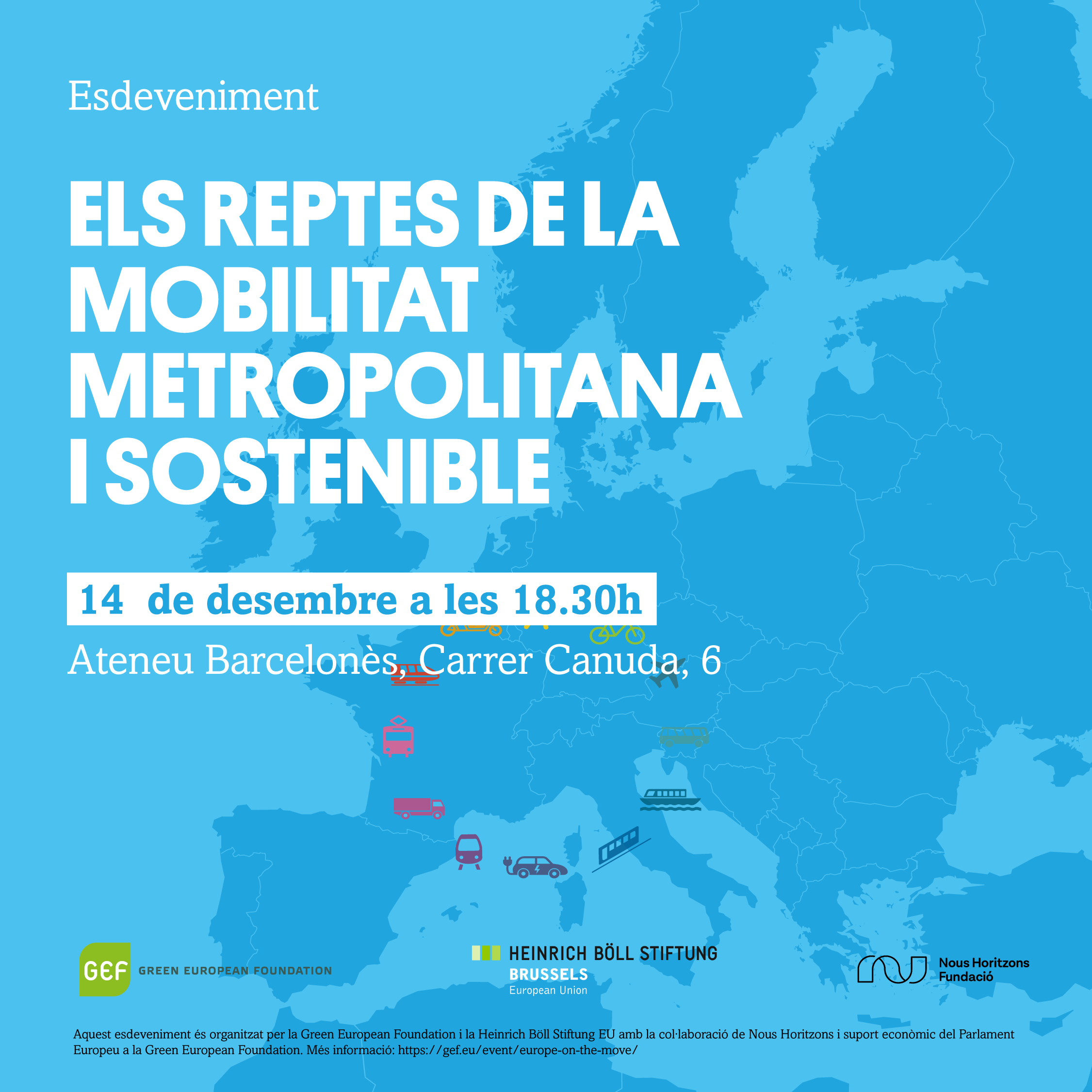
Sustainable mobility is a particular priority in metropolitan areas because of its impact on air quality, on the daily lives of millions of people and economic actors, and as an instrument of territorial cohesion. Public transport, cycling and walking are at the heart of a model that guarantees the right to sustainable mobility.

The Barcelona metropolitan area, with its population exceeding 3.5 million inhabitants, is a paradigmatic case in this debate, as it is an area that risks being sanctioned by the EU due to its poor air quality.

Within this context, what are the examples of good and bad practices of mobility? What are the challenges that lie ahead? Can we find successful sustainable urban mobility practices in other European cities?

These questions and possible answers will be the subject of this dynamic debate, bringing together diverse experts, academics, and local government actors.


Project background

This event is part of a series of debates entitled “Europe on the Move: Shaping the Future of Sustainable Mobility in the Iberian Peninsula” organised by the Green European Foundation and Heinrich Böll Stiftung EU with the support of Transición Verde, Instituto José Tengarrinha, Fundació Nous Horitzons, EcoPolítica and the financial support of the European Parliament to the Green European Foundation.

This series of debates aims to foster debate in Portugal and Spain around the future of mobility, bringing together relevant stakeholders from civil society, academia and politics to analyse and explore challenges and opportunities for the future of mobility and the Green Deal in Europe.


Speakers

  • Guille Lopez, Barcelona City Councillor and Promoter of the Eixample Breathe platform
  • Carme Miralles, Professor of Urban Geography at the UAB
  • Laura Campos, Montcada I Reixac City Councillor
  • Zeeger Ernsting, Amsterdam City Councillor


Practicalities

Date and Time: 14th December, 6:30pm CET

Location: Ateneu Barcelones, Carrer Canuda, 6

Registration: Prior registration is required – please register here.

Language:  Catalan with English simultaneous translation

Recommended reading: European Mobility Atlas


This event is organized by the Green European Foundation and Heinrich Böll Stiftung EU with the support of Fundació Nous Horitzons and the financial support of the European Parliament to the Green European Foundation.

Beyond Electrification: Social and Geopolitical Costs of Lithium

By

About the event

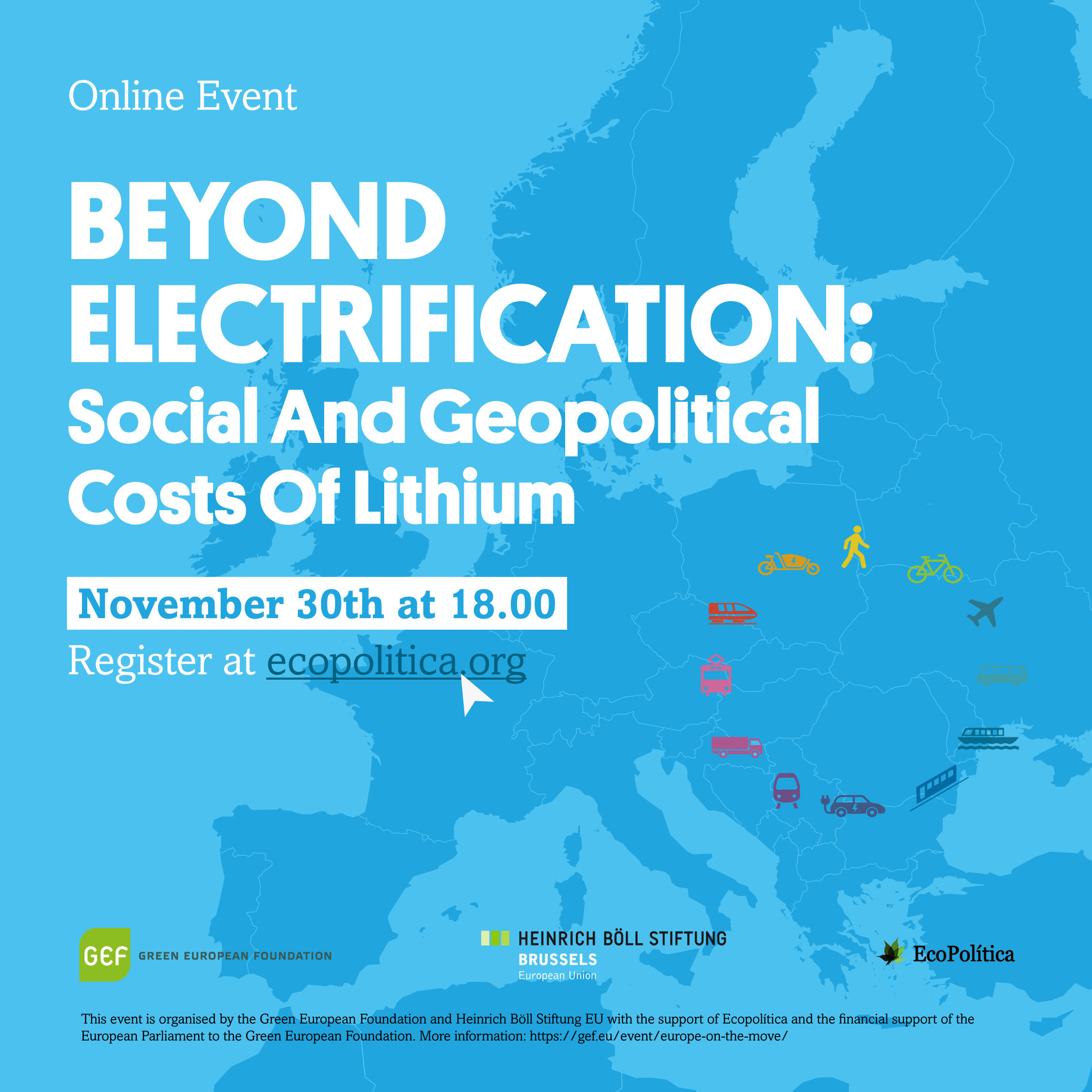
The growing demand for electrification does not come without its own costs. Environmental, social and ethical considerations arise when taking into account the impact on local communities. To obtain the necessary resources, huge extractivist industries threaten to devastate entire regions. How can we resist them? Furthermore, electrification also poses some serious global issues. Can we move beyond our outdated electricity and mobility model without compromising social justice and the exploitation of the Global South?

This session will bring together voices and expertise from politics and civil society to expose the flaws and limitations of the current model of electrification at local, national and European levels. The aim of the event is to create a dynamic space for debate where we can explore ways to ensure a more sustainable and socially just electrified future.


Project background

This event is part of a series of debates entitled “Europe on the Move: Shaping the Future of Sustainable Mobility in the Iberian Peninsula” organised by the Green European Foundation and Heinrich Böll Stiftung EU with the support of Transición Verde, Instituto José Tengarrinha, Fundació Nous Horitzons, EcoPolítica and the financial support of the European Parliament to the Green European Foundation.

This series of debates aims to foster debate in Portugal and Spain around the future of mobility, bringing together relevant stakeholders from civil society, academia and politics to analyse and explore challenges and opportunities for the future of mobility and the Green Deal in Europe.


Speakers

  • Catalina Abell (moderator), EcoPolitica, expert in political communication and political processes.
  • Florent Marcellesi, former-MEP. Federal Co-Spokesperson of Verdes Equo.
  • Adriana Espinosa, Amigas de la Tierra (Friends of the Earth Spain). Responsible for the Area of Natural resources and Waste. Author of the next AdT inform on “Materials for the energetic and digital transition”.
  • Catarina Scarrott, Associação Unidos em Defesa de Covas do Barroso (UDCB) movement. Covas de Barroso is being targeted as a ‘sacrifice zone’ for lithium mining, and the local population, represented by the UDCB, is opposed.
  • Diego MarinPolicy Officer for Raw Materials and Resource Justice, European Environmental Bureau


Practicalities

Date and Time: 30th November, 6pm-7:30pm CEST

Location: Online

Language: The main languages of the event will be Spanish and English, with simultaneous interpretation provided EN<>SP.

Registration: Prior registration is required – Please register in advance here.

Recommended reading:


This debates series is organised by the Green European Foundation and Heinrich Böll Stiftung EU with the support of, EcoPolítica and the financial support of the European Parliament to the Green European Foundation.

New Mobility: Economy and Employment

By

About the event

The decarbonisation of mobility is one of the great challenges of the European Union. The transformation it entails is complex and not without its difficulties, but it can be an opportunity to reactivate the economy and generate employment. The latter is a particularly relevant aspect in maintaining social stability, especially at a time when populism and the extreme right are on the rise in Europe.

In this event, we seek to analyse the challenges and opportunities of zero-emission mobility in terms of the economy and employment in Spain, paying special attention to the bicycle sector from a gender perspective.

The event is a roundtable open to all those interested in mobility, especially members of organisations and platforms working on the issue, government officials, politicians, academia, and civil society associations. Our aim is to raise awareness of the employment opportunities associated with zero-emission transport and to promote the shift towards more sustainable mobility.

The event will be held via zoom platform, requiring prior registration.


Project background

This event is part of a series of debates entitled “Europe on the Move: Shaping the Future of Sustainable Mobility in the Iberian Peninsula” organised by the Green European Foundation and Heinrich Böll Stiftung EU with the support of Transición Verde, Instituto José Tengarrinha, Fundació Nous Horitzons, EcoPolítica and the financial support of the European Parliament to the Green European Foundation.

This series of debates aims to foster debate in Portugal and Spain around the future of mobility, bringing together relevant stakeholders from civil society, academia and politics to analyse and explore challenges and opportunities for the future of mobility and the Green Deal in Europe.


Speakers

  • Albert Vilallonga, geographer and mobility technician at ISTAS (Union Institute for Labour, Environment and Health). Author of the report on Zero-emission mobility.
  • Iria Vázquez, equity coordinator at ConBici, professor of sociology at the University of Vigo and expert in gender studies.
  • Philipp Cerny,Transport Policy Consultant. Chief Executive Editor of the EU Mobility Atlas.
  • Moderation: Pilar Calvo, board member of Transición Verde and expert in operational security and transportation


Practicalities

Date and Time: 11th December, 5:30pm – 7pm CET

Location: Online, via zoom.

Registration: Prior registration is required – please register here. The session will be recorded and made available on YouTube.

Language:  The main languages of the event will be Spanish.

Recommended reading: European Mobility Atlas


This event is organized by the Green European Foundation and Heinrich Böll Stiftung EU with the support of Fundación Transición Verde and the financial support of the European Parliament to the Green European Foundation.

Far from the Center: Mobility in the Ultra-Periphery (Ponta Delgada)

By

About

Mobility plays a crucial role in shaping the quality of people’s lives by influencing multiple aspects. To name a few examples, it determines which jobs people can apply to, how often they can see relatives and friends, and the amount of free time they have. It can also amplify prejudice and inequality, namely those regarding gender, race and others. The way people move has a huge impact on the environment that should always be taken into consideration.

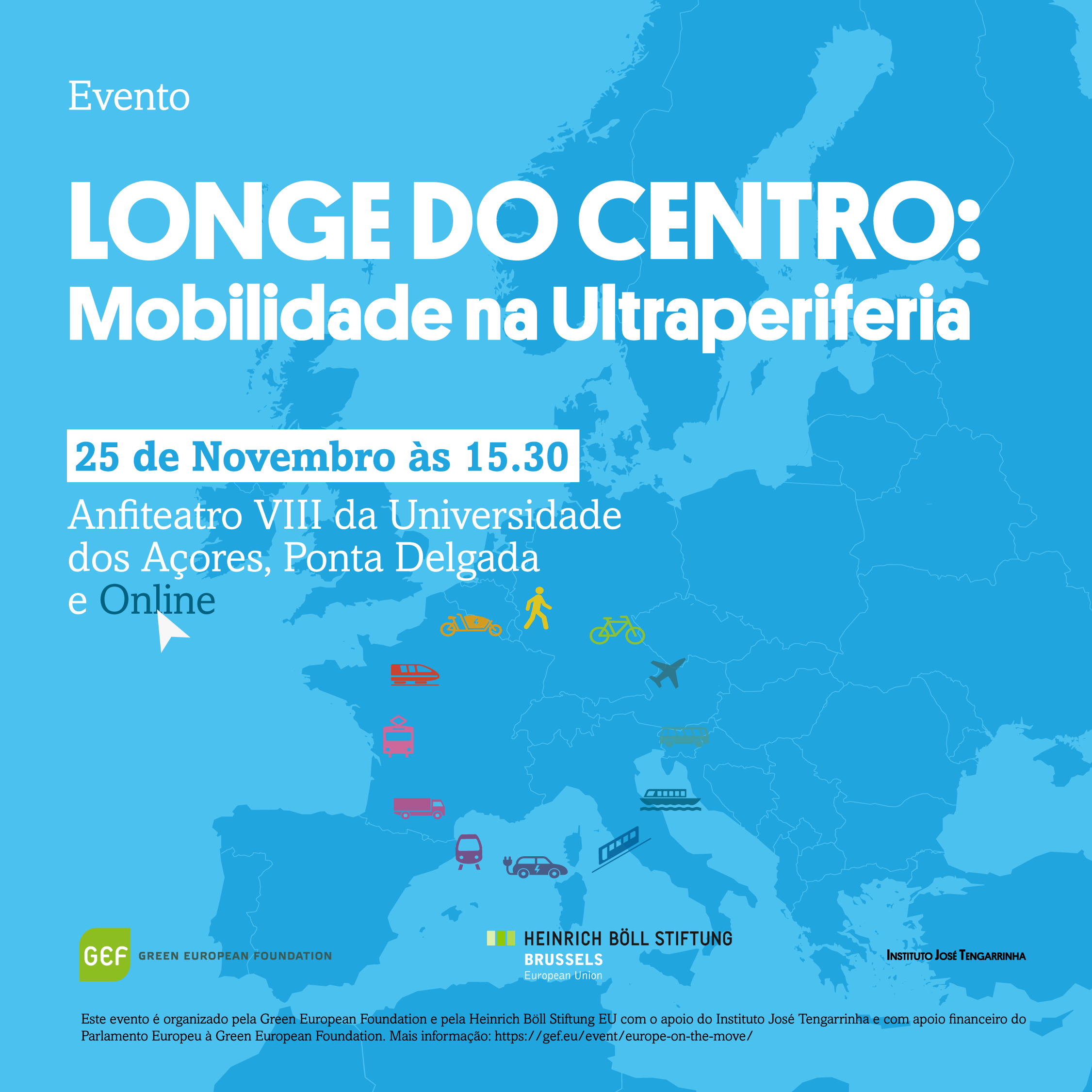
With both wonderful but challenging geography, the Azores is a good place to discuss these problems as there is much work to be done towards sustainable mobility that works for all. Far from mainland Portugal, travelling to or from Azores is not affordable to everyone’s pockets; there are inequalities between the islands in the archipelago, with some having much better connections than others. In this debate, we seek to address the pressing issues connected to mobility in the ultra-periphery with multiple analytical and geographical lenses. We will bring together diverse perspectives to analyse the challenges and opportunities for mobility on island and in ultra-peripheral contexts, the impacts of tourism on mobility and how mobility is also a gender issue. Besides the Azorean perspective, we welcome an international panel with insights from Greece, Croatia and Spain.


Project background

This event is part of “Europe On the Move: Shaping the Future of Sustainable Mobility in the Iberian Peninsula”, which aims to nurture the debate in Portugal and Spain around the future of mobility and the Green Deal, with a particular eye for the challenges and opportunities for sustainable mobility and how they relate to Iberian realities.


Speakers

o            Filipe Roque (moderator) – Councillor of Ponta Delgada, Portugal

o            Henar Martín – Consultant of Sustainable Mobility in Canarias, Spain

o            Nikolina Rajkovic – Institute for Political Ecology, Croatia

o            Rosa Simas – Universidade dos Açores e Universidade Nova de Lisboa, Portugal

o            Theocharis Tsoutsos – Technical University of Crete, Greece


Programme

  • Introduction and presentation of the speakers

Filipe Roque (moderator) – Councillor of Ponta Delgada, Portugal

  • Mobility on the island: the Azorean case

Nikolina Rajkovic – Institute for Political Ecology, Croatia

  • The impact of tourism on mobility

Theocharis Tsoutsos – Technical University of Crete, Greece

  • Sustainable mobility in and between islands

Rosa Simas – Universidade dos Açores e Universidade Nova de Lisboa, Portugal

  • A gender perspective on mobility in Azores and its links with sustainability

Henar Martín – Consultant of Sustainable Mobility in Canarias, Spain

  • Mobility in the ultra-periphery, the example of Canarias and connection with sustainable mobility
  • Moderated discussion followed by Q&A


Practicalities

Date and Time: 25th November, 15:30pm-17:30pm GMT-1

Location: Anfiteatro VIII, Universidade dos Açores and Online (streamed on GEF Youtube).

Language:  The main languages of the event will be Portuguese and English, with simultaneous interpretation provided EN<>PT.

Registration: This is public event; no prior registration is required.

Social media event page: Longe do Centro: Mobilidade na Ultraperiferia | Facebook

Recommended reading: European Mobility Atlas


This event is organised by the Green European Foundation and Heinrich Böll Stiftung EU with the support of Instituto José Tengarrinha and the financial support of the European Parliament to the Green European Foundation

EGAT Poland: 2023-2024 edition

By

About the event

The European Green Activist Training (EGAT) is an international training program for young activists interested in political ecology. This program, which is one of GEF’s flagship initiatives, has been implemented for several years in numerous European countries in cooperation with green organisations active in the region.

This year, the programme will take place in Poland for the fourth time, kicking off in Katowice, Zielona Góra and Białystok!

The EGAT workshops aim to support young activists through education and training in practical skills, but also by connecting with other like-minded individuals!

Read more about the programme here.

Participants profile

We invite people aged 16-21 interested in green topics, activism, social projects, democracy and human rights to participate. Young activists with little experience and from minority groups are particularly encouraged to apply!

Programme

This year, the first phase of training will happen in three cities in cooperation with activists and local organizations. Each workshop will last for one day and will take place on a Saturday.

Katowice – October 21, 2023

Zielona Góra – October 28, 2023

Białystok – November 4, 2023

Participants will then take part in nationwide workshops, which will take place in early 2024 in Warsaw. During the second part, participants will connect with people from various regions of Poland to learn about the green movement and find ways to support each other in common struggles.

People participating in the national workshops in March 2024 will be able to continue their journey by joining the international stage of the project, which will take place in Brussels. During the trip, we will attend different seminars and trainings with people participating in the same programme in other countries. As a part of the trip, we’ll visit the European Parliament, engage with politicians about their paths, and discover the opportunities that may await us.


Practicalities

Cost

Participation in the program is free of charge. Transport costs to the workshop site for commuters will be covered by the organizers.

Application 

If you are interested in the workshop, please send the completed form by the following dates:


If you have any questions or doubts, please send an email to: katarzyna.zakliczynska@pl.boell.org.


This project is organised by the Green European Foundation with the support of Heinrich Böll Stiftung Warsaw  and with the financial support of the European Parliament to the Green European Foundation.

Congress of Young Europeans 2023

By

About the event

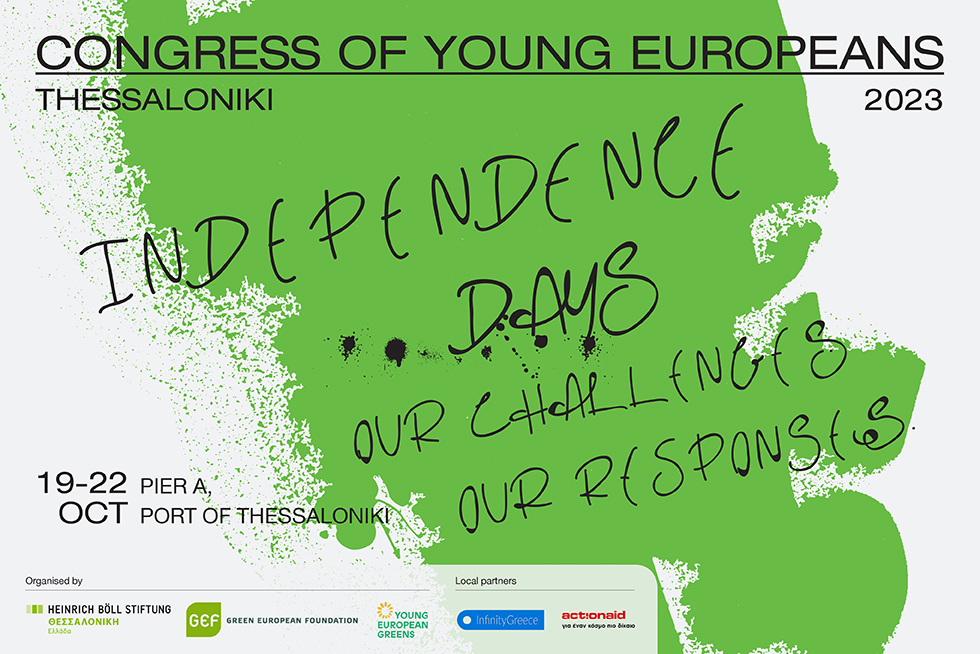
During this Congress, selected participants from all over Europe will have a chance to come together in Thessaloniki, a vibrant and culturally rich city to work together, voice their concerns and put forward their own solutions for a more just Europe, ahead of the 2024 European elections.

The main theme of this year’s Congress of Young Europeans is independent living a defining struggle and battle of this generation that ranges from chasing for basic care and mental health to affordable housing, from gender rights and to good working conditions, from equality all the way to political underrepresentation. A young person has the right to all of these things, to afford building a life for themselves, independently.

The Congress, entitled “Independence Days”, will focus on the role of youth in shaping their future in Europe. Selected participants will reflect on widespread reality for young people all over Europe, explore the interlinking challenges across different regions, and propose forward-thinking solutions that reflect young European’s needs in the political debate.

Participants will take part in hands-on workshops with high-level speakers discussing topics such as the cost of living, youth mobilization and resilience. Beyond the topical sessions, participants are invited to use this event as a platform to facilitate their own session, by presenting their own initiatives related to the topics.


Practicalities

Date: 19 -22 October 2023

Location: Thessaloniki, Greece.

Language:  English

Format: In-person event

Please note that applications for this event are now closed.


This event is organised by the Heinrich Böll Foundation – Thessaloniki Office, Young European Greens (FYEG) and the Green European Foundation (GEF) with the financial support of the European Parliament to Green European Foundation.

EGAT Finland: 2023-2024 edition

By

About the event

If you are eager to learn about green politics and changemaking, this course is made for you! Prior experience or membership of the Young Greens is not needed – on the contrary, we want to get participants who could learn the most out of this course! We are looking for applicants from diverse backgrounds – youth aged 15-25 from all across Finland – and the most important thing we are looking for is motivation.

During the European Green Activist Training, you will be introduced to green values and activity from the local level to the national, EU and international level. As a course participant, you will hear from politicians and other professionals of the field, discover how politics are made, get a backstage pass to civil society organisations, and discuss changemaking from an individual’s perspective. This course will give you the knowledge, skills and support network you need to become a changemaker. You will find your own way to be an activist, gain new friends and valuable experience.

Programme

  • 1st meeting, 7.–8.10.2023 in Kuopio

Welcome to the training! Introduction to green politics and ABC of changemaking

During the first meeting we will get to know each other and have an introduction to the Green Party and Young Greens. At this meeting we will discuss green politics and activism at various levels – including local, national, and international levels. This meeting will be held at the same time as Väentapaaminen, an annual national event by Young Greens of Finland. (This meeting is fully funded by the Green Youth and Students of Finland, although it is situated within the context of the Green European Foundation’s EGAT programme).

  • 2nd meeting, 1.-2.12.2023 in Helsinki
    Peek from local level politics to Brussels

Over the second meeting, we will learn about politics in both the European and global context. We will get familiar with the structures of the European Union and the work of the European Parliament and how the green movement operates on the European level. The second meeting will prepare participants for the course trip to Brussels.


  • 3rd meeting, 19.–20.1.2024 in Helsinki
    Feminist politics, media and non-governmental organizations as changemakers for the environment

During the third meeting we will first discuss human rights and equality and how to advocate for them.We will learn about how the media can be used as a tool for change and how it is operated by progressive forces in Finland and the European Union. In addition, we will focus on environmental and climate politics as well as find out more about different NGOs and grassroot movements and their work in different environmental fields.


  • Study trip to Brussels in spring 2024

In addition, there will be the traditional Brussels Study Trip in March 2024 (Date TBC). Participants from other European Green Activist Trainings which are simultaneously taking place also in Croatia, Spain, the Czech Republic, Poland, Lithuania and Latvia, will join us for a one-week excursion in Brussels to share knowledge from our national trainings and take a look behind the scenes at the activities of the institutions of the European Union. We will visit the European Parliament and meet people who work in various positions in Brussels.

Practicalities

The Brussels Study Trip will cost 150 euros per participant, which will cover all travel and accommodation expenses for the travels to and from Brussels. Meal expenses for the travel to and from Brussels are not included in the participant fee, but will be charged afterwards to those who attend the Brussels Study Trip. Accommodation and meal expenses in Brussels will be covered by the organizers. If a participant needs financial help, they may ask for a discount or exemption from the fee.

Apply by sending completing form by Friday 20.9.

For more information please get in touch with Laura Haikonen (0451393999) laura.haikonen@vihreatnuoret.fi


This EGAT programme is organised by the Green European Foundation with the support of Visio and with the financial support of the European Parliament to the Green European Foundation.

EGAT Croatia: 2023-2024 edition

By

About the event

The European Green Activists Training (EGAT) is a project organized by the Green European Foundation in cooperation with the association Forum for Sustainable Development Green Window. The project is being held in Croatia for the seventh year in a row, and more than 120 young high school students, students and young professionals from all parts of Croatia have participated in the project.

The aim of the project is to familiarise participants with green topics (climate change, biodiversity and environment protection, human rights and democracy, feminism, active citizenship…), green policies and sustainable development policies, as well as the EU institutions. Through various sessions and discussions involving representatives of international organizations and the European Union, the goal is to explore possibilities of active and professional involvement in building a greener and more just society.

Many previous participants remained active in the fields of sustainable development and green policies, while some even had the opportunity to pursue their career through internships or regular employment opportunities in the institutions of the EU.

Apart from Croatia, participating countries include Finland, Greece, Hungary, Catalonia, Poland and the Czech Republic.


Programme

The project consists of two national trainings and one study visit to the institutions of the European Union in Brussels:

    1. The first national training (Red Cross House in Sljemen) – November 25-26, 2023.
    2. Second national training (Home of the Red Cross in Sljemen) – January 27-28, 2024.
    3. Study visit to Brussels – planned for March 2024 (exact date to be announced


Practicalities

This programme is for Croatian nationals aged 18-25 . Applications from those who do not have previous experience in the mentioned areas are very welcome! After the selection process, 20 project participants are selected. Participants are required to participate in all meetings and national training sessions, as well as the study trip in Brussels.

Please apply via this form before September 22.


Cost

The one-time registration fee (participation fee) for participating in the project is EUR 40, while the costs of accommodation and food for all national trainings, as well as the costs of the study trip to Brussels, are fully covered by the organizers. For participants outside Zagreb, possible travel expenses for participation in national trainings are covered.

For all additional questions, please reach out to info@zeleniprozor.hr.

Handling of personal data, collected in the scope of this application, will be carried out in accordance to the legislation of the European Union (EU Directive 95/46/EC). For additional information, please visit https://gef.eu/privacy-policy/.


This project is organised by the Green European Foundation with the support of Sustainable Development Forum Green Window and with the financial support of the European Parliament to the Green European Foundation.

EGAT Catalonia: 2023-2024 edition

By

About the event

We are looking for 15 young people (18-25 years old) who want to be agents of change towards a more sustainable, supportive and fair society.

We are offering an opportunity for you to participate in a training program for young European green activists, or aspiring ones. As part of this training we will deal with the pillars of political ecology, European values and the possibilities that European institutions offer in terms of green  policies for the European community.

This edition is focused on rethinking our life models and exploring the alternatives promoted by European green political ecology under the title “An(other) way of living”.

You will learn how European institutions work and how things can be changed from politics, from values of social, ecological and feminist justice. You will also meet other activists, with whom you will share your struggles and experiences. You will be able to go to Brussels to meet key actors from European institutions and civil society as well as the other participating people from 6 other countries (Croatia, Hungary, Poland, Czech Republic, Greece and Finland).

Programme

The training consists of two training seminars, lasting one weekend (Saturday morning to Sunday afternoon). Each of the seminars will have a specific theme based on the values of European green policy and intercommunity social justice.

We will engage with people who fight for the planet from a political background, and expert people who will offer their vision. In small groups, you will delve deeper into the concepts and techniques to achieve the change we want.

When will it take place?

November 4-5, 2023  (Barcelona)

First seminar

2-3 December 2023 (Barcelona)

Second seminar

January 2023 (Online)

Online meeting with activists from other countries

March 2023 (Brussels)

Trip to Brussels

Practicalities

If you are between 18 and 25 years old and fit the profile we are looking for, send us an email and tell us why you are interested in participating. From there we will tell you what the next steps are. You have until September 20 to do it!

Cost of the training

The activity has a solidarity fee of 40 euros for the two seminars and the trip to Brussels. However, if you can afford the cost, tell us in your email and we will find a solution for you to participate. For any doubts contact us at egat@noushoritzons.cat


This project is organised by the Green European Foundation with the support of Fundació Nous Horitzons and with the financial support of the European Parliament to the Green European Foundation.