At a time when many people have lost their jobs and the economic outlook is uncertain, an unconditional basic income (UBI) sounds tempting. In November, with the support of FREDA and the Green Future Academy Austria, GEF invited Barbara Prainsack to discuss her new book on an Unconditional Basic Income “Vom Wert des Menschen.”
To build further on that discussion, we are inviting new perspectives to the table. Bishop Benno Elbs brings in the perspective of Christian social teaching, Markus Koza brings in the trade union point of view, and Barb Jacobson will provide a European perspective with her precise knowledge of the international discussion.
Together, they will address key questions like: Is basic income a contemporary solution to our social and economic problems? Do national trials make sense or is European cooperation necessary? And can we even afford it?
Context
After gathering comprehensive expertise and setting up transnational networks through a three-year long project on universal basic income, GEF and its partners continue building on the outputs and successes of this work on the topic.
The transnational project ‘Change of Mindset – UBI, Climate and Social Change’ seeks to spark a stronger civil society dialogue to bring about the change of mindset needed to raise acceptance of universal basic income among the public and to deepen the debate on our conceptions of productivity and work. Together, we dive into the exploration of UBI as a tool of the urgently needed ecological transition and part of social security in a (post-)pandemic, climate change world.
Speakers
Barbara Prainsack – Professor of Political Science, University of Vienna, author
Benno Elbs – Bishop of the Diocese of Feldkirch
Barb Jacobson – Welfare Advisor, London
Markus Koza – green social speaker with union background
Moderation by Eva Häfele, social scientist
Practicalities:
This event will take place on Zoom and will be primarily in German, with some English consecutive translation. Please register in advance via this link.
Destruction of primary and old growth forests is an issue not just in tropical forests but also on the European continent. The question of how to stop illegal logging and protect the remaining forests on national but also European levels calls for decisive and orchestrated action – as ecosystem loss and the climate crisis are closely interconnected and their worsening impacts are not blocked by any national boarder.
About the Event:
This is the launch of the Green European Foundation’s Deforestation Project, featuring stakeholders from all over Europe with a focus on Romania. We’ll be looking at solutions for saving our European forests, with breakout rooms and group discussions to tackle the issue together. Our goal is to use our collective knowledge and problem solving to face down the challenges.
Upcoming opinion pieces to feed into the conversation:
The natural forests of Europe are vanishing: focal point Romania
The EU Biodiversity Strategy 2030: Ecological change in the forest sector?
Solutions for – forest protection and restoration
Speakers:
Thomas Waitz, MEP, European Parliament
Matthias Schickhofer, Conservationist, book author, photographer
Ioana Banach, Managing Director, Green European Foundation
Alexander von Bismarck, Executive Director, Environmental Investigation Agency
Catalina Radulescu, lawyer
Ewelina Tylec-Bakalarz, Client Earth
Luke Chamberlain, EuroNatur, Agent Green & EU Policy Director PFPI
Gabriel Paun, President of Agent Green
Susanne Winter, WWF Germany
Programme:
16:30 – 17:00 Arrivals and technical check-in
17:00 – 17:15Event Opening
Moderator: Ioana Banach (Managing Director, Green European Foundation)
Speaker: Matthias Schickhofer, Conservationist, book author, photographer
2. Where is the problem?
Who is driving illegal logging in old growth/ primary forests? Who are the beneficiaries?
Speaker: Alexander von Bismarck, Executive Director, Environmental Investigation Agency
2. What legal options are there and where are the difficulties to enforce / strengthen legal protection of old growth forests?
Speaker: Catalina Radulescu, lawyer
3. What is the role of forest management in the current “forest crisis”? How can ecologically destructive forest management and forest protection be improved?
Speaker: Gabriel Paun, President of Agent Green
3. What is already being done to save the forests and where are the shortcomings?
EU Legislations
Speaker: Thomas Waitz, MEP, European Parliament
18:00 – 18:10Break
18:10 – 18:45Part II: Restoring Europe’s Forests
Breakout sessions split into 3 working groups – In this session we will deep-dive into solutions-oriented discussions.
Our three speakers will give a short intro to each parallel session, focusing on:
We will use the Zoom video conferencing platform. It is recommended to join the webinar via a PC. You do not need to install additional software. However, for the best user experience and full participation features, you can install the free Zoom Desktop App.
Language: the main language is English with simultaneous translation to German
This event is organised by the Green European Foundation with the support of FREDA – Die Grüne Zukunftsakademie and with the financial support of the European Parliament to the Green European Foundation.
Spatial statistics of European harvested forest area
Source: Ceccherini, G., Duveiller, G., Grassi, G. et al. Abrupt increase in harvested forest area over Europe after 2015. Nature583, 72–77 (2020). https://doi.org/10.1038/s41586-020-2438-y
Barbara Prainsack’s new book on an Unconditional Basic Income “Vom Wert des Menschen” has received a lot of attention in recent weeks. At a time when many people have lost their jobs and the economic outlook is uncertain, an unconditional basic income (UBI) sounds tempting. The Green European Foundation, with the support of its Austria partner FREDA, has invited Barbara Prainsack to discuss her thoughts and basic theses with us.
In order to delve even deeper into the topic, we want to bring further perspectives to the table: Sabine Jungwirth (Federal Spokesperson Green Economy) brings her economic expertise and Barbara Huemer (Green Spokesperson for Women, Work, Employment, Human Resources, Science, Research & Development) shares her experiences.
European perspectives will be provided by Antje Schrupp from Germany, who has been dealing with the feminist aspects of a UBI for years, and by Francois Denuit, researcher and staff member of the European Parliament with a focus on an EU-wide UBI.
Context:
After gathering comprehensive expertise and setting up transnational networks through a three-year long project on universal basic income, GEF and its partners continue building on the outputs and successes of this work on the topic.
The transnational project ‘Change of Mindset – UBI, Climate and Social Change’ seeks to spark a stronger civil society dialogue to bring about the change of mindset needed to raise acceptance of universal basic income among the public and to deepen the debate on our conceptions of productivity and work. Together, we dive
into the exploration of UBI as a tool of the urgently needed ecological transition and part of social security in a (post-)pandemic, climate change world.
Speakers:
Barbara Prainsack – author of “Vom Wert des Menschen” (Austria)
Sabine Jungwirth – Federal Spokesperson Green Economy (Austria)
Barbara Huemer – Green Spokesperson for Women, Work, Employment, Human Resources, Science, Research & Development (Austria)
Antje Schrupp – journalist and political scientist (Germany)
Francois Denuit – researcher and staff member at the European Parliament (Belgium)
Moderation by Carlotta Weber (Strategy Manager at the Green European Foundation)
Programme:
19:00 – 19:10 Onboarding & Welcome (00:10)
19:10 – 19:20 Reading/Presentation by Barbara Prainsack (00:10)
19:20 – 20:10 Panel discussion
20:10 – 20:20 Input by Francois Denuit
20:20 – 20:30 Panel discussion
20:30 – 20:45 Audience Q&A (optional)
Practicalities:
This event will take place primarily in German.
The event will be streamed live on YouTube, please tune in here.
As part of its thematic priority on food and agriculture, the Green European Foundation wants to bring together different actors of the food system to find alternative solutions to our current food supply which has negative impacts not only on us humans but more so on our environment. Furthermore, GEF’s activities aim to highlight and to support alternative proposals to the Common Agricultural Policy of the European Union.
About the event
As part of a two-day symposium on urban agriculture with a particular focus on Vienna, GEF is organising, with the support of Grüne Bildungswerkstatt, a conference focusing on the political dimensions while fostering the exchange of best practices by inviting highlight projects from all over Europe to share their experiences with alternative urban food supply.
The objective is to get inspiration from each other as well as to formulate concrete recommendations for local politicians as well as citizens on how to ensure urban food supply of the future.
Programme
Friday, 18th October
10:00 Welcome and introduction – Rüdiger Maresch
10:30 – 12:30 European highlight projects of urban food policy
Dirk Holemans: Gent en Garde, Belgium
Emma Peyron: Copenhagen Food House, Denmark
tbc: Janet Sanz Cid: Barcelona, Catalonia-Spain
Q&A
12:30 – 13:15 Lunch break
13:15 – 14:45 Workshops: The political dimension of food
Workshop 1: Nutrition and social policies
Thomas Barborik: Food saving in Vienna
Melanie Oßberger, FIAN Austria: Human rights violation hunger – political causes, false solutions, and the right to food
Discussion in groups: How can the city contribute to improve the situation?
Workshop 2: Nutrition and environment
tbc, Global 2000: Environmental destruction through agriculture
Thomas Putzgruber, Verein RespekTiere: Insight the stables of the farmer next door
Discussion in groups: How can the city contribute to improve the situation?
Following the workshops, participants exchange in plenary and share input.
14:45 – 15:00 Coffee break
15:00 – 16:15 Panel debate: Urban food of the future – visions and demands for a modern food supply in Vienna
With: Felix Münster (Ernährungsrat Vienna), Marta Lopez Cifuentes, tbc, (University of Natural Resources and Life Sciences Vienna, department for sustainable agriculture), Martina Pluda (Vier Pfoten Austria), moderated by Dagmar Tutschek (Director Grüne Bildungswerkstatt)
17:00 – 19:00 Evening workshops
3 stations of interactive workshops, among others at the city farm Augarten
Saturday, 19th October
On Saturday, 19th October, the symposium is continued with at Nationalparkhaus Lobau in Vienna with a specific focus on the situation in Vienna, looking at the current food supply in Vienna and inspiring initiatives for alternative (self-)supply. The day will be completed with excursions that will bring participants together with urban farmers, beekeepers, food cooperatives and more. As of 20:00 the evening will be concluded with a joint dinner at Kleine Stadtfarm.
To register, please send an email to anmeldung@gbw.at.
As part of our transnational project Basic Income – European Public Debate, which has been implemented across Europe since 2017, GEF is holding a two-fold event in Austria to explore different positions on universal basic income (UBI) across Europe.
About the event
Following a one-day conference bringing together green actors with proponents and experts of UBI from Austria and other parts of Europe, organised by GEF with the support of Grüne Bildungswerkstatt and Bildungszentrum St. Bernhard, a public debate will be organised to invite citizens to engage with the topic of UBI. Together, the attendees will explore if a UBI can be a component to tranform our economy and society in order to fight climate change.
Programme
19:00 Welcome: Positioning and synthesis of the conference during the day
19:30 Fishbowl discussions (30 minutes each) between experts, politicians and audience on three thematic strands:
UBI, social and economic inclusion
UBI, financing and alternative economic models
UBI from a feminist perspective
21:00 Perspectives, possibilities and conclusion
To find out more about the registration and programme, please contact buero@gbw.at.
The event will be held in German and English with interpretation.
The public debate is preceeded by an internal conference from 10h30 to 18h. More information can be found here.
As part of our transnational project Basic Income – European Public Debate, which has been implemented across Europe since 2017, GEF is holding a two-fold event in Austria to explore different positions on universal basic income (UBI) across Europe.
About the event
As it is clear that our planet calls for a different, new climate, GEF will, with the support of Grüne Bildungswerkstatt and Bildungszentrum St. Bernhard, open the space for green actors and proponents of a UBI to discuss how such a policy instrument could contribute to new policies for economy, society and the environment.
Programme
10:00 Registration
10:30 Welcome and introduction to the GEF transnational project on UBI
11:30 Input on 3 themes of the day
UBI, social and economic inclusion
Kim Fredericq-Evangelista, policy advisor Ecolo (BE)
UBI, financing and alternative economic models
Helmo Pape, founder of Generation Grundeinkommen (AT)
UBI from a feminist perspective
Barb Jacobsen, coordinator of Basic Income UK and member of Universal Basic Income Europe (UBIE) network (UK)
Margit Appel, researcher on feminist economic policy and universal basic income (AT)
12:30 Discussion: Connecting the threads to green climate policies
13:00 Lunch break
14:00 Open Space
Deepening of the 3 themes highlighted in the morning and exploring of further questions on UBI
16:45 Harvesting and synthesis
18:00 Networking drinks and snacks
Speakers
Margit Appel – researcher on feminist economic policy/universal basic income in Austria.
Kim Fredericq-Evangelista – Policy advisor for the Belgium Green Party, Ecolo. His “Youth UBI” was added to the last election programme.
Barb Jacobsen – Universal Basic Income Europe (UBIE) Network, Co-ordinator of Basic Income UK.
Helmo Pape – Founder of Generation Grundeinkommen, Austria.
Practicalities
Language
The conference will be in German with English whispered interpreting.
Participation fee
Solidarity fee / voluntary donation for the organization and food. Participation in the evening event is free of charge.
Registration
To register for this event, please contact buero@gbw.at.
Registration deadline: 14 October
For more information in German, please visit our partner’s webpage here.
The internal conference will be followed by a public debate reflecting on the key insights of the day and discussing the (political) steps forward as of 19h. More information can be found here.
The Alps and the Carpathians mountain ranges that cover half of Europe are a critical part of climate protection, as they serve as an early warning system for the negative effects of climate change on Europe. The issues that climate change brings to these areas demonstrate what the rest of Europe must prepare for.
About the Event
The summit will feature a range of keynote speeches, workshops and excursions, conducted by experts who will offer attendees opportunities to learn more about climate change and how it specifically affects the alpine environment.
Programme
Thursday 20th June
17:00 – Opening
18:00 – The climate and ecosystem crisis –
Matthias Schickhofer, author of “Schwarzbuch Alpen – Why we have to save our mountains”.
Christoph Matulla, climatologist, ZAMG Vienna. Comment Leonore Gewessler, Global 2000.
Comment by Regina Hrbek.
20:00 – Dinner
21:00 – Climate change at all levels! Fish bowl discussion, with experts and politicians on the local and European level alternatively taking the ‘hot seat’.
Werner Kogler (Head of the Austrian Greens), Tom Waitz (MEP, Austria), Hannah Pfalzgraf ( youngest Cantonal Counselor of Switzerland), Gisela Sengl (Member of the Landtag, Bayern/Germany), Ingrid Felipe (Deputy Governor, Tyrol/Austria), Eva Lichtenberger (former MEP, Austria), Ewa Dziedzic (Federal Counselor, Austria), Helga Krismer (Member of the Landtag, Lower Austria), Norbert Lantschner (Member of the Landtag, Upper Adige/Italy), Johann Döller (Mayor Reichenau/Austria), et al.
Friday 21st June
09:30 – Workshops
Workshop 1: Climate Change, Economy and Environment With experts and international initiatives.
Workshop 2: Climate Change and Us – Politics and Society
Best practices and new ways of cooperation.
12:30– Climate change is system change. Synthesis and political mission.
14:00 Lunch buffet and graduation.
Supporting program (optional) for those who want to celebrate the longest day of the year with vision:
Afternoon trip by cable car to the Rax
In the evening, bonfires and festivities at the Biohof Babiol, Edlach / Rax.
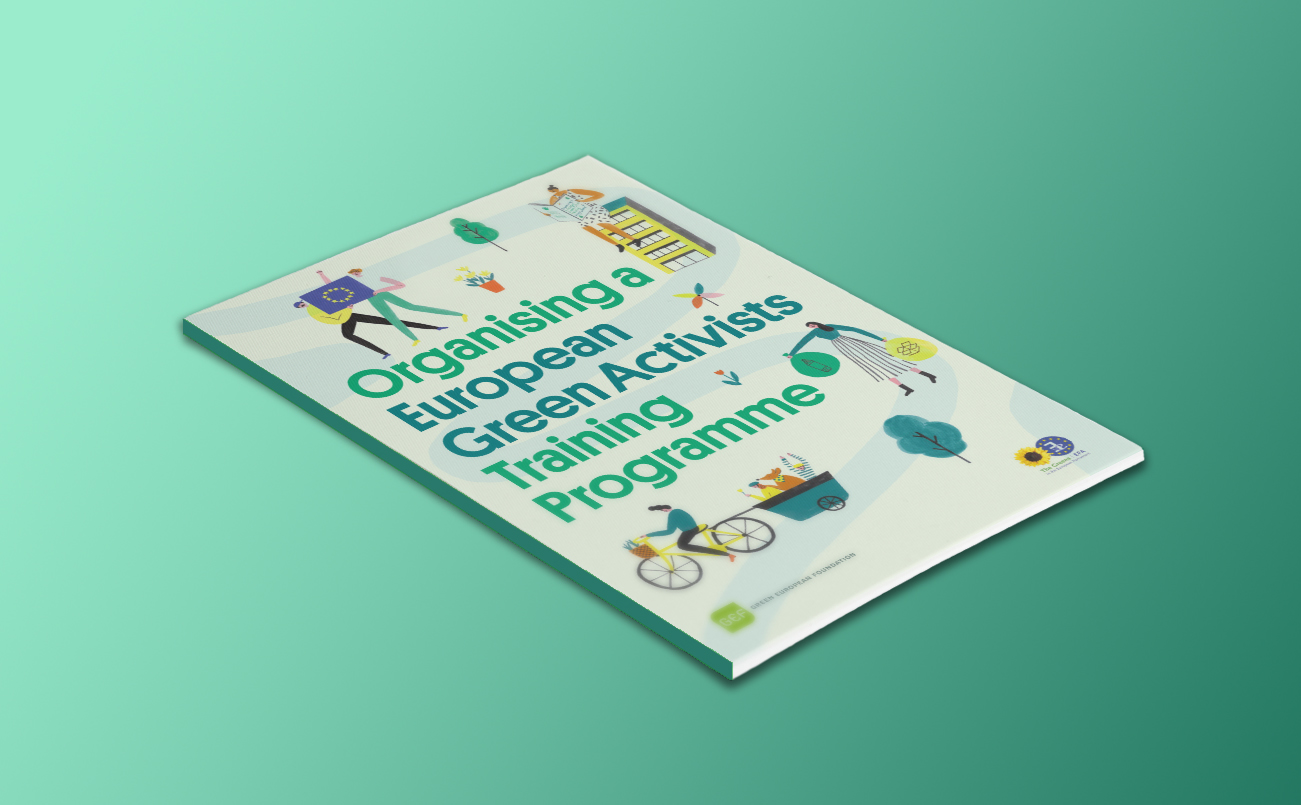
In 2015, GEF and its partner Green foundations from Hungary, Austria, Czech Republic and Finland organised for the first time a project entitled “European Green Activists Training”. In the course of the project, the five partner organisations planned and organised trainings which explored the history, functioning and institutions of the European Union in a Green context. The training programme at the national level was complemented by a common European study tour to Brussels in spring 2016.
Considering the unique character of the European Green Activists Training programme, the project coordinators have decided to develop this handbook, disseminating good practice for future editions of the training within their own foundations, as well as among other organisations interested in training programmes for young activists. This publication is aimed at all organisations involved in educational activities for Green actors, such as Green foundations, Green parties, Green youth organisations and Green study centres in European countries, who are interested in discovering practical tools and tips on organising trainings which empower young people with the ambition to change Europe for the better.
The handbook has been updated in 2018, with a new design, and now features testimonials from previous participants on their experiences. It also includes tips from course coordinators on how to keep participants engaged after the training and on developing an alumni network to exchange ideas and knowledge.
Through this instrument, we mainly address those organisations which have little or no prior experience of organising European activist trainings, but we think that more experienced organisations can also find useful tips and tricks that may inspire their future educational projects.
Following the loss of the Austrian Green party during the national elections in 2017, the entire Austrian Green movement is at a crossroads. ‘Green Repositioning’ aims to start a process of re-organising the Green movement and to come up with a new Green narrative that links ecological and social concerns and lays out how to master the Great Transformation based on solidarity and resilience. A clear positioning and a joint understanding of socio-ecological politics based on Political Ecology will become a cornerstone in reinventing the Austrian Green movement. This ‘Green Repositioning’ project consists of several different events throughout the year all over Austria.
Within this framework, GEF will organise a Summer Academy with the support of Grüne Bildungswerkstatt.
About the event
Three key areas – six workshops – one Green identity. Following this motto, the Summer Academy will function as a laboratory within the ‘Green Repositioning’ project currently implemented by the Austrian green foundation Grüne Bildungswerkstatt.
Following the Regional Ideas Lab, organised by the Greens/EFA Group in the European Parliament and the European Green Party on the days before the Summer Academy, the event will continue lively debates with change makers and pulse generators from all over Europe.
The aim is to develop working theses for the following three key areas that were identified:
Environment & Ecology
Democracy & Media
Economy & Future of Work
The project ‘Green Repositioning’, including the GEF Summer Academy, aims to contribute to a new Green narrative that answers the question ‘Where will the Green movement be in 2030, and how can it contribute to a better future?’.
Three workshops will be organised in English. The detailed programme will be available on this website soon.
Registration
Register now for the GEF Summer Academy in Graz by following this link.
The participation fee for the event is 60 Euro (including catering during the event). For further questions, send an email to sommerakademie(at)gbw.at.
This year’s Summer Lab looked into the state of democracy on the local, national, European and global level while identifying different dimensions of decline that societies are facing. In this framework, GEF hosted an international workshop in English on progressive alliances in Europe between social movements, the Greens and local initiatives from different countries. This included the analysis of responses by governing parties as well as by the right-wing opposition to facets of decline and seek to formulate Green alternatives for the future of European democracies and a united European democracy.
Different formats to create lively debates
To engage all participants, different methods of training were used and as many slots as possible for open debates, such as ‘sessions of larger groups’ as well as ‘Open Space’ and free planning sessions, were provided. By combining the training soft skills such as campaigning, network analysis, communication, moderation methods with policy and the party programme, the Summer Lab aimed to generate ideas, new networks and new collaborations between and among Green party members and politicians, activists and different actors of civil society. Gathering around 100 participants in the idyllic scenery of Kapfenberg in Austria, its aim was to formulate Green responses to the interplay between social and economic tendencies of decline, symptoms of crisis and how to strengthen our democracies.
Parallel workshops around ‘Change’
The hands-on training were done in four ‘in-depth workshops‘, with one specific focus each, which were organised in three phases spread across the two days of the Summer Lab:
a) How to democratise and restructure the Green party, 30 years after its foundation, in order to carry forward its objectives and regain its sociopolitical role.
b) Cities as lively spaces of political contestation: Discussing questions of the public space, commercialisation of cities and common goods.
c) What challenges does the current world of employment generate for the mobilisation of citizen’s and how can contribute to a democratisation of the production of wealth?
d) Narratives for change: How can we create alliances of different forces in Europe, which oppose the Status Quo while disassociating from the far right at the same time. This workshop will be organised by the Green European Foundation with the support of Grüne Akademie Steiermark and the financial support of the European Parliament to the Green European Foundation.
The ‘Big Picture’
The ‘Big Picture’ panel debate helped frame the political and societal context and will give, alongside the workshops and other forms of discussions, further food for thought.
The panelists will be:
Dr Gael Brustier, Political scientist and political activist, France
MA Carina Altreiter, Institute of Sociology, University of Vienna, Austria
Prof Dr Andreas Fisahn, Faculty of Law, University of Bielefeld, Germany
MA Gabu Heindl, Architect and City Planner, Austria
MA Hanna Lichtenberger, Institute for International Politics, University of Vienna, Austria
Prof em. Dr Klaus Offe, Hertie School of Governance, Berlin, Germany
It is hoped that through the Summer Lab, individual projects by participants on the basis of those new networks and alliances will be initiated, and discussions on a progressive future of Europe, strategies to fight the far right, and on progressive populism in Europe will be continued afterwards, while integrating local and national initiatives with European struggles and future European activities.
For the full programme (available in German only), please click here.
Registration: closed since 31 May. Stay tuned for the outcomes of the event!
This video was produced in 2016 during the study trip to Brussels, which represents the final part of our European Green Activist Training project. This transnational project offers educational opportunities for young people interested in politics and activism. After a series of training in their respective countries, organised together with our national partners, this joint study trip enables the young participants to meet and exchange in Brussels with other Green-minded people from all over Europe. Furthermore, it provides them with a first-hand opportunity to gain knowledge of European politics during their visits to the European Parliament and other European institutions.
Find out what the organisers, coordinators and some of the participants from Finland, Hungary, Czech Republic and Austria, have to say about this experience and receive an impression of their study trip to Brussels in the video below.