
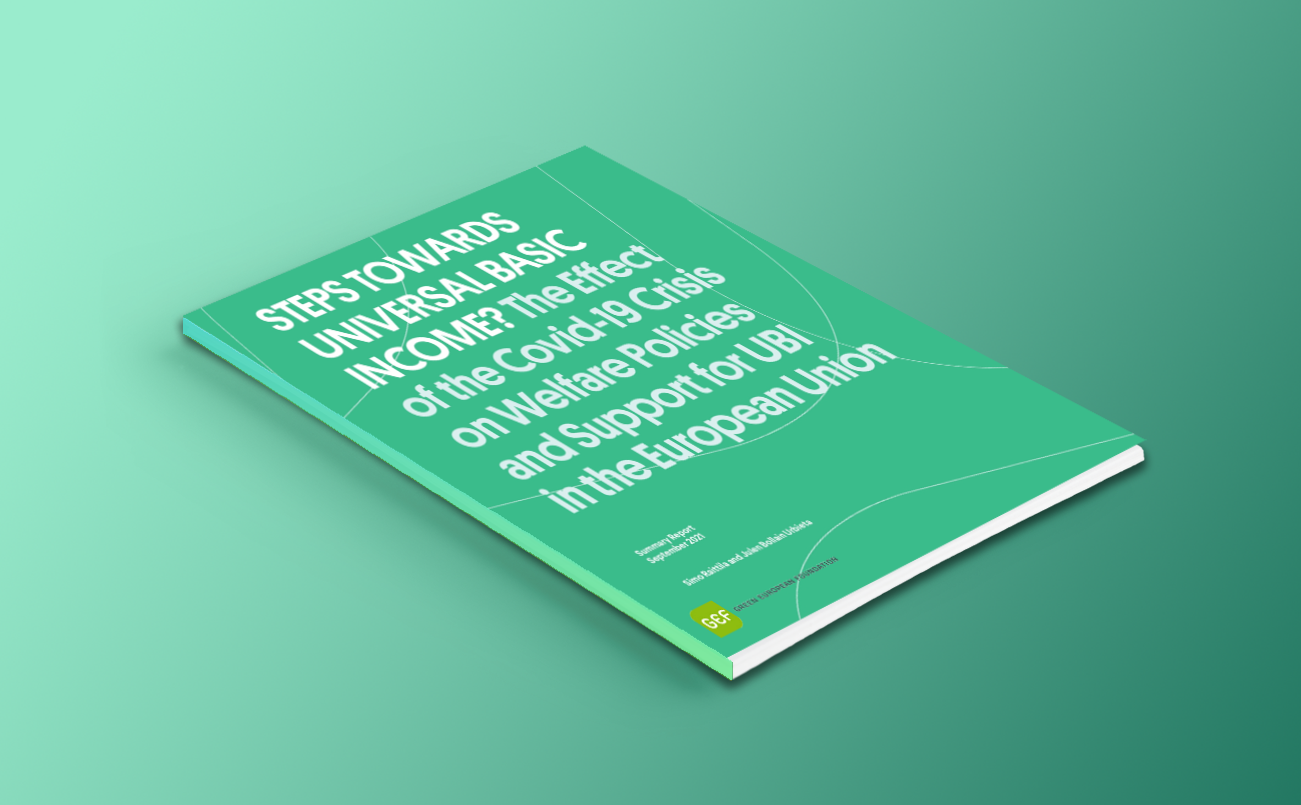
Steps Towards Universal Basic Income? The Effect of the Covid-19 Crisis on Welfare Policies and Support for UBI in the European Union

By Uncategorized

Context

When the Covid-19 pandemic hit Europe, it put an enormous strain on the lives and livelihoods of millions. Amid lockdowns and quarantines, many countries responded by (temporarily) broadening their social security policies and providing additional support to those at risk of falling through the cracks. Yet as we slowly emerge from this crisis, there are already others looming. Society will continue to feel the effects of COVID-19 for a decade or more without an urgent public policy overhaul. We need to re-examine our social security approaches and implement bold measures to make societies more resilient to change and crisis. One such proposal is the Universal Basic Income.

There is no place for narrow views or short-sighted policies aimed at continuing to patch up a wound that is gradually – although more and more rapidly – bleeding us dry. Nor is there any point in trying to face the challenges of the 21st century with policies from the last century that have already proved to be unsuccessful.

Objectives

This report examines the social policy reactions to the Covid-19 crisis in a dozen different European countries. Drawing on survey and qualitative data, we explore how these expanded support measures relate to the vision of Universal Basic Income. To what extent do they represent a step towards UBI, despite government hesitancy? And what do they say about the (in)ability of our existing social security systems to deal with crises? The report also investigates the popularity of UBI among Europe’s citizens. Has the pandemic made an impact on the way people talk and think of UBI?

Experts and stakeholders across Europe contributed data for this publication, and shared their insights and reflections as part of our project “Change of Mindset–Civil Society Dialogue around UBI, Social Justice, and Climate Impact.” As the debate continues, we too would be interested in expanding our analysis to include new information and additional countries.

If you wish to:

  • Submit a survey response;
  • Provide details or resources on countries not featured in this analysis;
  • Send us your feedback;

Please get in touch! GEF’s work on UBI continues–read more here.


This publication has been realised with the support of Visio and Fundació Nous Horitzons and the financial support of the European Parliament to the Green European Foundation. The European Parliament is not responsible for the content of this publication.
Social Dividends as a Form of Basic Income

By

About the Event:

The COVID-19 pandemic has more than ever provoked the debate around Universal Basic Income as a potential policy solution to a host of challenges. Yet just as there is a diversity of arguments in support of basic income, there is a proliferation in models and pathways to implementation – each with its specific intricacies and consequences.

This one-hour webinar will explore some of these paths towards a basic income at the European level. Specifically, M.Soc.Sci Johanna Perkiö will present on social dividends as a potential form of basic income, based on her 2020 report for Vasemmistofoorumi (The Left Forum). Perkiö’s larger work has been on the history of discussions about UBI in Finnish society.

After the presentation, Lukas Korpelainen will comment on Perkiö’s findings and reflect further on the topic, followed by audience questions.

Context:

After gathering comprehensive expertise and setting up transnational networks through a three-year long project on universal basic income, GEF and its partners continue building on the outputs and successes of this work on the topic.

The transnational project ‘Change of Mindset – UBI, Climate and Social Change’ seeks to spark a stronger civil society dialogue to bring about the change of mindset needed to raise acceptance of universal basic income among the public and to deepen the debate on our conceptions of productivity and work. Together, we dive into the exploration of UBI as a tool of the urgently needed ecological transition and part of social security in a (post-)pandemic, climate change world.

Speakers:

Johanna Perkiö – project researcher at the University of Tampere and former chairperson of BIEN Finland

Comments by: Lukas Korpelainen – chairperson of the Finnish Greens’ social security working group and author of the GEF publication Basic Social Security 2030.

Practicalities:

This webinar will take place in English, and will be livestreamed to Facebook and YouTube. Participants can leave comments or questions via the chat. Register here to receive a reminder email.

UBI

European Positions on Unconditional Basic Income II

By

About the Event

At a time when many people have lost their jobs and the economic outlook is uncertain, an unconditional basic income (UBI) sounds tempting. In November, with the support of FREDA and the Green Future Academy Austria, GEF invited Barbara Prainsack to discuss her new book on an Unconditional Basic Income “Vom Wert des Menschen.”

To build further on that discussion, we are inviting new perspectives to the table. Bishop Benno Elbs brings in the perspective of Christian social teaching, Markus Koza brings in the trade union point of view, and Barb Jacobson will provide a European perspective with her precise knowledge of the international discussion.

Together, they will address key questions like: Is basic income a contemporary solution to our social and economic problems? Do national trials make sense or is European cooperation necessary? And can we even afford it?

Context

After gathering comprehensive expertise and setting up transnational networks through a three-year long project on universal basic income, GEF and its partners continue building on the outputs and successes of this work on the topic.

The transnational project ‘Change of Mindset – UBI, Climate and Social Change’ seeks to spark a stronger civil society dialogue to bring about the change of mindset needed to raise acceptance of universal basic income among the public and to deepen the debate on our conceptions of productivity and work. Together, we dive into the exploration of UBI as a tool of the urgently needed ecological transition and part of social security in a (post-)pandemic, climate change world.

Speakers

  • Barbara Prainsack – Professor of Political Science, University of Vienna, author
  • Benno Elbs – Bishop of the Diocese of Feldkirch
  • Barb Jacobson – Welfare Advisor, London
  • Markus Koza – green social speaker with union background

Moderation by Eva Häfele, social scientist

Practicalities:

This event will take place on Zoom and will be primarily in German, with some English consecutive translation. Please register in advance via this link.


UBI

European Positions on Unconditional Basic Income

By

About the Event:

Barbara Prainsack’s new book on an Unconditional Basic Income “Vom Wert des Menschen” has received a lot of attention in recent weeks. At a time when many people have lost their jobs and the economic outlook is uncertain, an unconditional basic income (UBI) sounds tempting. The Green European Foundation, with the support of its Austria partner FREDA, has invited Barbara Prainsack to discuss her thoughts and basic theses with us.

In order to delve even deeper into the topic, we want to bring further perspectives to the table: Sabine Jungwirth (Federal Spokesperson Green Economy) brings her economic expertise and Barbara Huemer (Green Spokesperson for Women, Work, Employment, Human Resources, Science, Research & Development) shares her experiences.

European perspectives will be provided by Antje Schrupp from Germany, who has been dealing with the feminist aspects of a UBI for years, and by Francois Denuit, researcher and staff member of the European Parliament with a focus on an EU-wide UBI.

Context:

After gathering comprehensive expertise and setting up transnational networks through a three-year long project on universal basic income, GEF and its partners continue building on the outputs and successes of this work on the topic.

The transnational project ‘Change of Mindset – UBI, Climate and Social Change’ seeks to spark a stronger civil society dialogue to bring about the change of mindset needed to raise acceptance of universal basic income among the public and to deepen the debate on our conceptions of productivity and work. Together, we dive

into the exploration of UBI as a tool of the urgently needed ecological transition and part of social security in a (post-)pandemic, climate change world.

Speakers:

  • Barbara Prainsack – author of “Vom Wert des Menschen” (Austria)
  • Sabine Jungwirth – Federal Spokesperson Green Economy (Austria)
  • Barbara Huemer – Green Spokesperson for Women, Work, Employment, Human Resources, Science, Research & Development (Austria)
  • Antje Schrupp – journalist and political scientist (Germany)
  • Francois Denuit – researcher and staff member at the European Parliament (Belgium)

Moderation by Carlotta Weber (Strategy Manager at the Green European Foundation)

Programme:

19:00 – 19:10 Onboarding & Welcome (00:10)

19:10 – 19:20 Reading/Presentation by Barbara Prainsack (00:10)

19:20 – 20:10 Panel discussion

20:10 – 20:20 Input by Francois Denuit

20:20 – 20:30 Panel discussion

20:30 – 20:45 Audience Q&A (optional)

Practicalities:

This event will take place primarily in German.

The event will be streamed live on YouTube, please tune in here.

UBI

Basic Income as Part of the Green Recovery? (Warsaw)

By

About the Event:

In this fifth and last event of our UBI series, tackling both international and Polish questions and dimensions of the topic, we discuss whether and how Universal Basic Income has a part to play in plans for a Green Recovery. The event will be taking place in a hybrid format, with some participants and speakers in person and others joining online.

Context:

The Green European Foundation has been working and researching the topic of UBI for a few years as part of a transnational project involving many countries. This year, the project is entitled“ CHANGE OF MINDSET. Civil society dialogue around UBI, social justice and climate impact”. The Polish Green Foundation “Strefa Zieleni” joined the project, recognising that it was time to start a public debate on this in Poland as well – not only on UBI itself but as part of a broader conversation: what social security system is best adapted to the needs and expectations of Polish society in times of great instability and turmoil? This event series aims to foster that debate.

Speakers:

  • Paweł Szypulski – Greenpeace Polska (TBC)
  • Aleksander Temkin – “Europe, a Patient” initiative
  • Natalie Benett – former leader of the Green Party of England and Wales, Member of the House of Lords (online)
  • Alviina Alametsä – Finnish MEP, Greens/EFA (online)
  • Julen Bollain – economist, UBI researcher, member of the Basque Parliament in Spain (online)
  • Moderation and comments by Ewa Sufin-Jacquemart and Wojciech Kłosowski.

Practicalities:

This event will take place primarily in Polish. There is limited space for in person participants at Galeria BWA, so please register in advance here. The event starts at 18:00.

The event will also be streamed live on Youtube, please check the Facebook event page for a link.

How to Finance Universal Basic Income

By

About the Event:

In this fourth edition of our UBI webinar series, tackling both international and Polish questions and dimensions of the topic, we delve deeper into the question of how to finance a Universal Basic Income. What models exist, how do they differ, and what is the financial feasibility of this idea?

Context:

The Green European Foundation has been working and researching the topic of UBI for a few years as part of a transnational project involving many countries. This year, the project is entitled “CHANGE OF MINDSET. Civil society dialogue around UBI, social justice and climate impact”. The Polish Green Foundation “Strefa Zieleni” joined the project, recognising that it was time to start a public debate on this in Poland as well – not only on UBI itself but as part of a broader conversation: what social security system is best adapted to the needs and expectations of Polish society in times of great instability and turmoil?

This webinar series aims to foster that debate. We began with international webinars introducing the general concept of UBI, the European UBI, and the achievements of the GEF in promoting this debate, and we discussed UBI pilots in Europe and elsewhere. Then we narrowed down on the Polish perspective and prospects for implementation, which continues with this webinar on financing.

Speakers:

Prof. Monika Kostera – Professor of economy at the Jagiellonian University in Krakow

Rafał Woś – Economic journalist and opinion leader

Moderation and comments by Ewa Sufin-Jacquemart and Wojciech Kłosowski.

Practicalities:

This webinar will take place in Polish. It is open to anyone, but please register and join using this link. 

We will use the Zoom video conferencing platform. It is recommended to join the webinar via a PC. You do not need to install additional software. However, for the best user experience and full participation features, we recommend installing the Zoom Desktop App, which is free.

UBI

Polish Views on Unconditional Basic Income (Webinar)

By

About the Event:

After earlier webinars introducing the general concept of UBI, the European UBI, and the achievements of the GEF in promoting this debate, we discussed UBI pilots in Europe and elsewhere.

This time, in partnership with the Polish Basic Income Network, we will present UBI and similar concepts that are discussed in Poland and the prospects for implementing them in the country.

Context:

The Green European Foundation has been working and researching the topic of UBI for a few years as part of a transnational project involving many countries. This year, the project is entitled “CHANGE OF MINDSET. Civil society dialogue around UBI, social justice and climate impact”. The Polish Green Foundation “Strefa Zieleni” joined the project, recognising that it was time to start a public debate on this in Poland as well – not only on UBI itself but as part of a broader conversation: what social security system is best adapted to the needs and expectations of Polish society in times of great instability and turmoil?

On May 26th, the webinar “With UBI we would be less afraid of coronavirus” opened a series of four online meetings on this topic, organised by GEF with the support of Strefa Zieleni. Participants of the first webinar chose the topics of subsequent meetings, the third of which is an overview of the Polish perspectives on UBI and prospects for implementation.

Speakers:

  • Dr hab. Ryszard Szarfenberg – Political scientist, professor at the Faculty of Political Science and International Studies at the University of Warsaw. Leader of the Polish Basic Income Network and active populariser of the concept of Unconditional Basic Income in Poland.
  • Dr Jacek Warda – Political scientist, an expert in public management in local governments and author of the first Polish scientific article on the UBI: “Potential consequences of the implementation of a negative tax for the state’s social system” (2008). Member of the Polish Basic Income Network.
  • Dr Maciej Szlinder – doctor of humanities in the field of philosophy, sociologist, economist. Member of the Polish Basic Income Network, Basic Income Earth Network, Red Renta Básica. Author of the book “Unconditional basic income. A revolutionary reform of the society of the 21st century” (PWN, 2018).

Moderation and comments by Ewa Sufin-Jacquemart and Wojciech Kłosowski.

We regret that the guest speakers of this particular webinar are all men, as unfortunately, the Polish Basic Income Network is an entirely male initiative. GEF and Strefa Zieleni are committed to hosting diverse and balanced events and have ensured that the next webinar in this series will be dominated by excellent female speakers.

Programme:

The webinar will start at 18:00 CEST with a short video produced by the UBI transnational project partners.

Practicalities:

This webinar will take place in Polish for a Polish audience. It is open to anyone, but please register using this link: https://us02web.zoom.us/webinar/register/WN_ecc1VTOBS0WdsayiiuGCag

We will use the Zoom video conferencing platform. It is recommended to join the webinar via a PC. You do not need to install additional software. However, for the best user experience and full participation features, we recommend installing the Zoom Desktop App, which is free.

Between Theory and Practice – Experiments of Basic Income (Webinar)

By

About the Event:

Reflections and specific experiments have been ongoing for many years in the search for systemic solutions to provide people with the opportunity to meet basic life needs in times of instability, exacerbated amid junk contracts, rapid climate change and structural inequalities. Unconditional basic income is one such form, tested by certain public authorities, but also by non-governmental and research organisations, both in so-called developed countries as well as some countries of the global South.

This webinar focuses on the experiences of basic income in several countries – their goals and results, but also the political context of each case. A more general academic comparative view will complete a political and activist approach. We invited a European university researcher examining UBI experiments, their political and social context and overtones, but also a Kenyan Green politician from a so-called developing country where innovative social policies have been pursued both by the authorities and through the experiments of social aid and research organisations.

Context:

The Green European Foundation has been working and conducting research on the topic of UBI for a few years as part of a transnational project involving many countries. This year, the project is entitled “CHANGE OF MINDSET. Civil society dialogue around UBI, social justice and climate impact”.

On May 26th, the webinar “With UBI we would be less afraid of coronavirus” opened a series of four meetings on this topic, organised by GEF and with the support of Strefa Zieleni. Participants of the first webinar chose the topics of subsequent meetings, the first of which is an exploration of unconditional basic income experiments and derived social policy solutions in various countries.

Speakers:

  • Jurgen De Wispelaere – policy fellow at the Institute for Policy Research (University of Bath) and a visiting scholar at the Stockholm School of Economics in Riga.
  • Martin Ogindo – Party leader of the Green Congress of Kenya.
  • Moderation and comments by Ewa Sufin-Jacquemart and Wojciech Kłosowski.

Practicalities:

This is an open event accessible to an international audience. English-Polish translation will be provided.

We will use the Zoom video conferencing platform. It is recommended to join the webinar via a PC. You don’t need to install additional software. However, for the best user experience and full participation features, we recommend to install the Zoom Desktop App, which is free.

Please register and join the webinar via this link: https://us02web.zoom.us/webinar/register/WN_rM7YcboBRNmUC3brggoaAg

UBI

With UBI, We Would Be Less Afraid of the Coronavirus Crisis (Webinar)

By

About the Event:

We would like to invite you to the first edition of a series of four webinars on the topic of universal basic income (UBI). This event series is organised for by the Green European Foundation, with the support of Fundacja Strefa Zieleni, and a grassroots initiative of Polish activists: “Community of Ideas”. It consists of two Polish and two international webinars.

One feature of our current unsustainable system is the massive, and rapidly growing, increase in inequalities – emphasizing feelings of insecurity and material instability for a growing share of the population, and especially among young people.

Even in the “old Europe” countries, with some of the most caring welfare state systems in the world, the growing trends of precarious work and increasing workforce poverty have grown too much to be thought of as marginal. The overwhelming feeling of social injustice often leads either to social unrest, like with the yellow vest movement in France, or to the development of populism and political authoritarianism, which we can observe, among other places, in Poland.

The past few years have seen research and some practical experiments in search of systemic answers to enable people to meet their basic needs – in times of structural inequalities and instability, due in part to this spread of precarious work and the destructive consequences of rapid climate change. The universal basic income (UBI) is one of the solutions on the table.

In this webinar, we take a look at the existing work GEF has done on UBI, where these ideas come from, and what they are based on. We will also discuss why this is a “green” concept, consistent with “green policy,” have an overview of the UBI reflections and experiments in different countries, and address its critics. Finally, we touch on GEF’s continuing research plans on the topic and go over the present efforts to introduce a pan-European basic income and other social security measures at the EU level.

Context:

The Green European Foundation has been working and conducting research on the topic of UBI for a few years as part of a transnational project involving many countries. This year, the project is entitled “CHANGE OF MINDSET. Civil society dialogue around UBI, social justice and climate impact”. The Polish Green Foundation “Strefa Zieleni” joined the project, recognizing that it was time to start a public debate on this in Poland as well – not only on UBI itself, but as part of a broader conversation: what social security system is best adapted to the needs and expectations of Polish society in times of great instability and turmoil?

Speakers:

François Denuit is an adviser to the Co-President of the Greens/EFA group in the EP Philippe Lamberts and scientific collaborator at the Université libre de Bruxelles. He wrote his PhD dissertation on the idea of a pan-European unconditional basic income.

Susanne Rieger is a Co-President of the GEF Board of Directors and a board member of the Catalan Green foundation, Fundació Nous Horitzons (FNH). Susanne has been working on topics such as political education, capacity building, as well as developing political and public discussions and communication structures on the European level for the past twenty years.

Wojciech Kłosowski is an expert, researcher, activist, author, lecturer and practitioner of social issues, local governance and social policy of cities. Wojciech is a founding member of the Zieloni 2004 party (today: Partia Zieloni).

Moderator : 

Ewa Sufin-Jacquemart is the director of the Fundacja Strefa Zieleni, a member of the GEF Board of Directors and coordinator of the Green Center of the Congress of Women.

Programme:

18:00 – 19:30

  • Welcome
  • Presentation by Susanne Rieger
  • Presentation by François Denuit
  • Summary and comments (in Polish) by Wojciech Kłosowski
  • Discussion

Practicalities:

This is an open event, aimed at an international audience. English-Polish translation will be provided.

Please use the following link to join the webinar (joining the webinar is preceded by registration).

When joining the webinar, you will have to complete a short registration form – so make sure to tune in early!

If you would like to read more about some of GEF’s existing work on UBI, please refer to the following publications:


This project is organised by the Green European Foundation with the support of Fundacja Strefa Zieleni and with the financial support of the European Parliament to the Green European Foundation.

Just transition

It’s Not Just a Transition: Youth in Cities (Postponed)

By

We’re hosting an essential discussion on the role of Universal Basic Income in the just transition towards a carbon-neutral society, with focus on how this could help young people .

GEF, together with FYEG is holding a workshop in Barcelona, entitled ‘It’s Not Just a Transition: Youth in Cities’. The workshop will take place in two parts:

  1. Social justice perspective from each track implemented during the event (transport, urban development, energy). For each track, a vision for the future is previously imagined. In this session we link this vision to the vision for a more just city for the youth.
  2. Discussion on the role of UBI in the transition towards a carbon-neutral society, with focus on how this could help young people (1) realize their dreams/their vision for the future and (2) become more politically active. We will look into the B-Mincome experiment done in Barcelona.

The seminar kicks-off our 6-partner project ‘Change of Mindset – Civil Society dialogue around UBI, Social Justice and Climate impact‘, which aims to spark a stronger civil society dialogue to bring about the change of mindset needed to raise acceptance of universal basic income among the public and to deepen the debate on our conceptions of productivity and work.

Can’t attend the event? Follow us on Facebook and Twitter  to keep up-to-date with the discussions at the workshop.