ECOPRO Seminar in Brussels

By

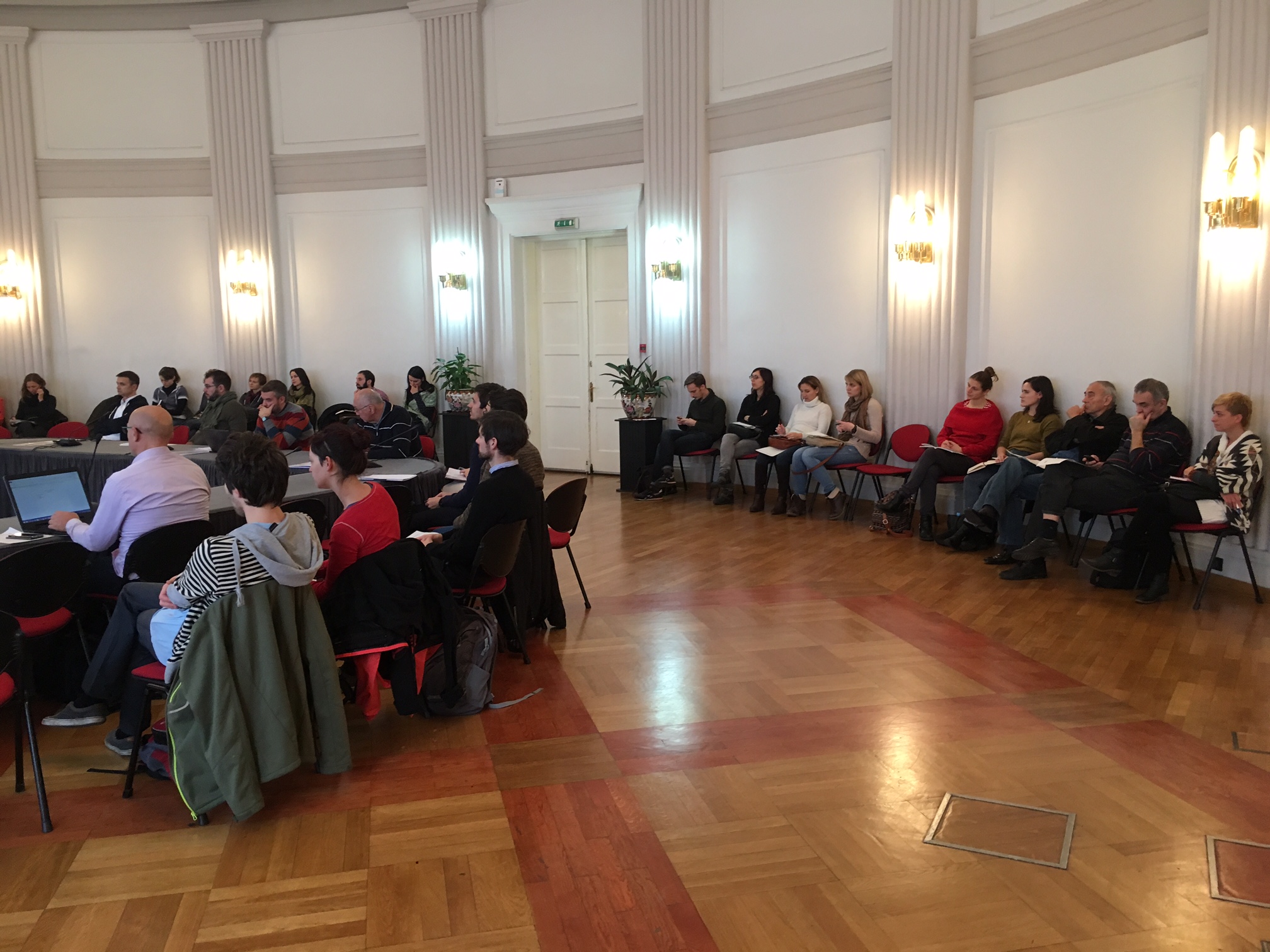
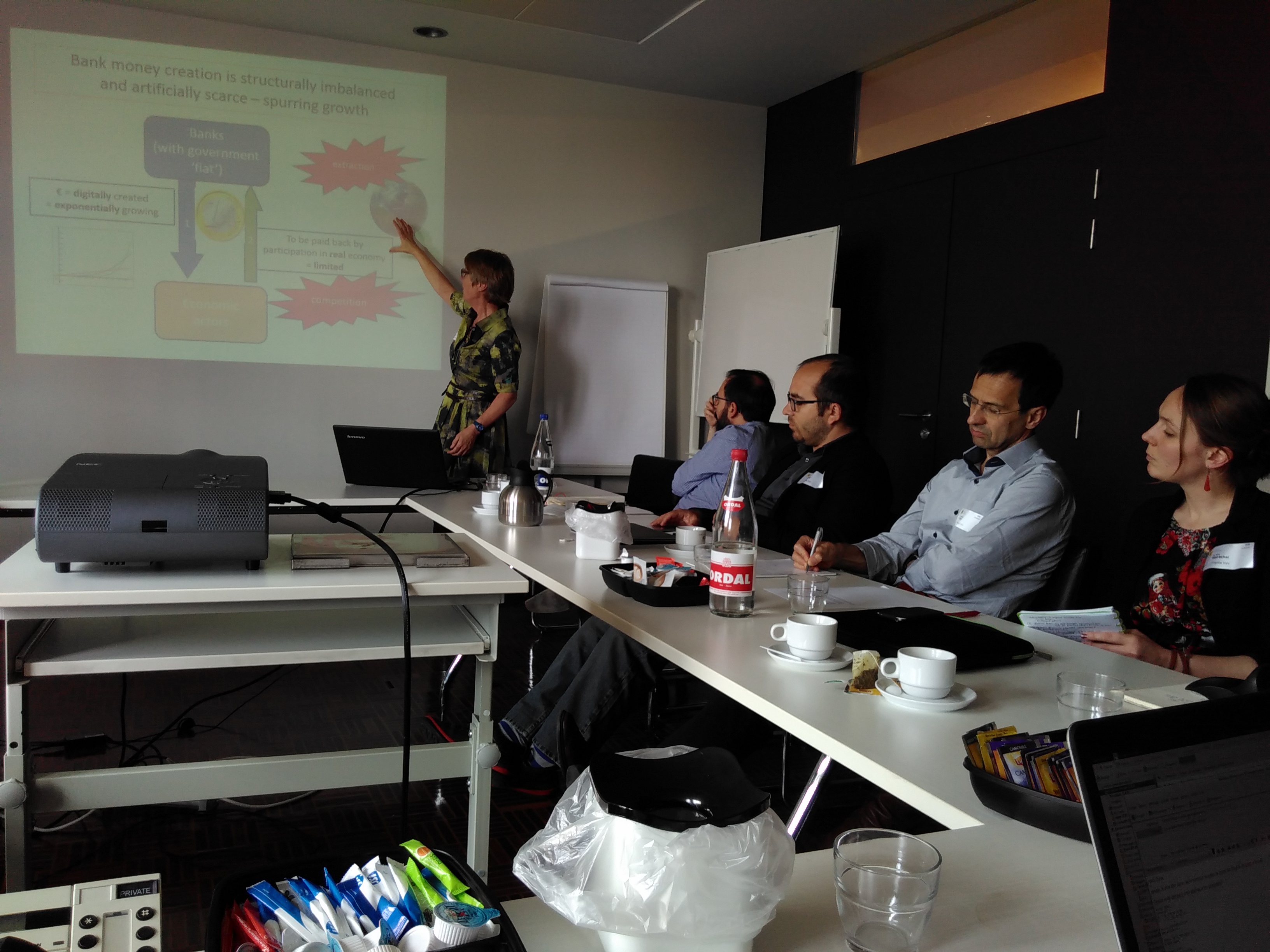
As a part of the ECOPRO project with a focus on the “Sustainable Work for All in a Post-Growth Society”, an inspiring seminar was held in Brussels, as an opportunity to engage with the different participants of the project. Three relevant speakers participated it the seminar with the presentations focusing on the central theme of the new ways of “work”, presented with a variety of perspectives.

The first speaker was Dustin Benton, head of Energy and Resources at Green Alliance, a charity and independent think tank focused on ambitious leadership for the environment. Mr. Benton gave a very interesting presentation about jobs in a circular economy. He participated in a study about the potential of new jobs in a circular economy in Italy, Poland and Germany.

The second speaker was Raimon Roda, director at the Baix Llobregat Agricultural park just outside Barcelona. He used the park as an example of the potentials for the agricultural areas near cities to foster sustainable development and evolution towards local food production.

The last speaker of the day was Anne Snick, expert on gender and social sustainable economy. Her presentation focused on the need of the current economy to serve the basic societal functions –  efficient allocation of resources to the well being of all. Her presentation also highlighted the gender implications of contemporary economic system and possible solutions for such issues.

This seminar ended with a fruitful discussion and a lot of questions from the participants after each presentation.
ECOPRO Seminar in Ireland: “A Community Approach to Sustainable Work in the Circular Economy”

By

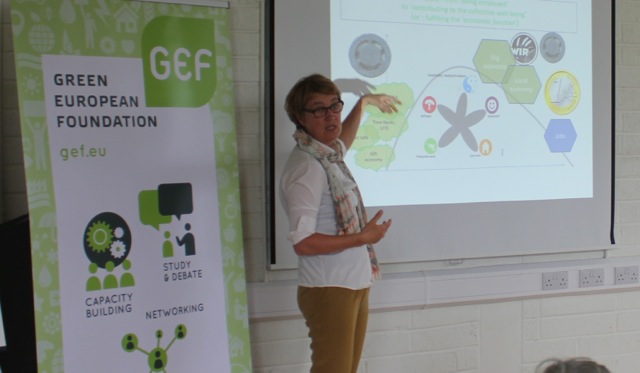
The theme of this seminar was “FULL CIRCLE: A Community Approach to Sustainable Work in the Circular Economy”. With this focus, the seminar in Ireland aspired to reflect further on the current topics of our ECOPRO project.

Therefore, some of the most relevant questions which were addressed during the event were:

  • What role do community groups, co-operatives and local enterprises have in the circular economy? 
  • Under what conditions can the circular economy help us accelerate the transition to a resilient and low carbon society?

This seminar was based on a participatory format, blending presentations with facilitated conversations. The list of speakers included Dr. Anne Snick (KU Leuven, Belgium) and Clare Downey (Community Reuse Network, Ireland).

TIME: Seminar was held between 14h00 and 16h30 on the 10th of June.

LOCATION: WeCreate Workspace, located in Cloughjordan Ecovillage in Tipperary, Ireland.

ECOPRO Debate at Budapest Degrowth Week: Work out of the box! (VIDEO Available)

By

This event was a part of our ECOPRO project, which this year has a special focus on work and its role in the post-growth society.

Theme:

The world has reached the “Limits to Growth” – we are in the status of overshoot, overuse, overconsumption, overpopulation. Our event on the 1st of September will be held 3 weeks after the Overshoot Day 2016 (the 8th of August), we will have used as much from nature as our planet can renew in the whole year. We need a new vision of a post-growth economy that fits again within the planetary boundaries while satisfying real societal needs, guaranteeing well-being and a future for all.

Among many others, we need to rethink our concept of WORK. Can we provide real, meaningful, added-value-generating jobs for all active-age men and women of the over 7 billion inhabitants of the Earth? If yes, how? If not, how shall we redefine and widen the meaning of WORK?

Work is much more than spending time at a job – it includes running a household, caring for children and elderly, helping in the community and other forms of voluntary and political work. To grasp the diversity of work, a green and feminist understanding of work, questioning the gender and international division of labour, is required.

Does work equal money? Equal work, equal pay? Working for a living, or a better life? What is the future of the work – and what is the work of the future?

Speakers:

This debate featured Bernadett Szél (Co-chair of Lehet Más a Politika, Hungary), Beate Littig (Researcher at Institute for Advanced Studies, University of Vienna, Austria), Anne Snick (KU Leuven, Belgium), Dirk Holemans (Coordinator and Editor at tink tank Oikos, Belgium) and Jonathan Essex (Co-founder of the Green House think tank, UK).

Venue: Corvinus University of Budapest – Fôvám tér 8, Budapest, Hungary, 1093

Time: 1st of September, 16h00 – 19h00

VIDEO: Watch this debate in English or Hungarian.

ECOPRO Seminar in Brussels with John Restakis

By

This event is a part of this year’s GEF transnational project ECOPRO (“Ecological Production in a Post-Growth Society”). It featured John Restakis – the director of the British Columbia Co-operative Association (Canada) and an acknowledged researcher of the role of Co-operatives worldwide, especially in relation to a new, socially fair economy, and he is the author of Humanising the Economy. Co-operatives in the Age of Capital. He is currently working together with Michael Bauwens and the P2P Foundation to create synergies between the Commons and the Co-operative movement.

During the seminar, John Restakis illustrated the advantages of co-operative enterprises in the context of this year’s ECOPRO thematic focus – sustainable work in a post-growth society.

ECOPRO Seminar in Zagreb

By

This event is a part of our transnational project ECOPRO (“Ecological Production in a Post-Growth Society”), which this year has a particular focus on the sustainable work. The seminar was entitled “Future of Work in Ecological Transition”, as it provided an analysis of impacts of the ecological transition on work, working conditions and generally transformation of labour that are generated by environmental challenges.

Transition of both economy and industry to (more) ecological, just and sustainable modes of production is already – with more or less success – taking place globally and in Europe. In some cases it takes forms of technological revolution, in other it relates to slower transformatory processes that deserve adaptation of societies, citizens, workers. As this change generates irreversible impacts on work conditions, quality of work, job security, time, education system it is also opportunity for new ecology of work that will improve quality of life, social equity and work conditions. Taking into account new impetus for industrial policy in Croatia, this seminar will aim to present different views on conditions for creating sustainable work in Croatia.

Furthermore, this event had a strong focus on exploring directions in which work conditions can be improved throughout ecological and just transition; ecologists, trade unionists, politicians and experts from different will share their insights and experiences about ways in which work conditions, quality of work and social criteria can be improved alongside with fundamental changes in the systems of production and consumption.

PROGRAMME:

11h30 – 13h00 Introduction

  • Vedran Horvat, Institute for Political Ecology, Zagreb
  • Beate Littig, Institute for Human Sciences, Vienna
  • Toni Vidan, European Economic and Social Committee, Brussels/Green Action/FoE Croatia, Zagreb
  • Ana Maria Boromisa, Institute for Development and International Relations, Zagreb
  • Bojana Percan, Croatian Union of Independent Trade Unions, Croatia

13h00 – 14h00 Lunch break

14h00 – 16h00 Debate

  • Branko Ančić, Institute for Social Research, Zagreb
  • Karolina Leaković,  International Secretary, Socialdemocratic party of Croatia
  • Siniša Vinković, European Trade Union Confederation

This event was open to public and free of charge.

rapport d’événement : ProjetECOPRO – edition Bruxelles

By Uncategorized

TRADUCTION FR
GEF’s ecological production project, ECOPRO, landed in Brussels with a seminar on November 20th, organised alongside our Flemish partners Oikos think tank, debating the transition towards a sustainable, technologically-enhanced society.

The ECOPRO Project, the successor of the GEF’s 2014 project Socioecological Reindustrialisation (SERIND), explores pathways for a transition towards ecological production, as part of a sustainable economy that is low-carbon and fosters an equal society. Nine national foundations from different regions and different member states of the European Union are involved in exploring pathways for ecological production. The project is content-wise coordinated by Dirk Holemans of the Flemish green think tank Oikos.

Can we replace our energy-intensive throwaway economy by a circular economy based on ecological production? This was the central question for the ECOPRO congress on the 20th of november 2015 in Brussels.

The program included:

Introduction – Waste doesn’t exist.

During the introduction the congress was framed in the upcoming climate summit in Paris by Dirk Holemans, coordinator of the Flemish think tank OIKOS. To reach the necessary goals in Paris we have to transform our economic model from a linear to a circular one. The aim of the ECOPRO project was to exchange new ideas about a sustainable circular economy in a European network.

Andreas Novy – How a caterpillar transforms into a butterfly.

Andreas Novy, Professor at the University of Vienna, talked as first speaker about ‘the perspective of sufficiency’. “Why don’t the alarming reports of the IPCC have an impact? People don’t just give up on  power and privileges, and in this world oil is still equal to power. But there is hope: the last few years there has been a consensus in circles of social and ecological thinkers that there is an alternative, for which grassroots initiatives can be the key. We have to get rid of the idea that consumption and growth are necessary.”

Dirk Vansintjan – There’s need for a cooperative economy.

Dirk Vansintjan is founder of Ecopower, a Belgian energy cooperative which invests in renewable energy projects. Dirk Vansintjan was a normal man with a crazy idea. In his twenties he tried to produce energy with a renovated watermill together with some equally minded friends. This young enthusiasm later became the successful energy cooperative Ecopower. Sources of renewable energy are common goods according to Dirk Vansintjan, as they are not state property, so they can be used by everyone. Ecopower formed a federation with other equal European initiatives, which is named REScoop (Renewable Energysources Cooperative). European rules are very important concerning energy.

Miquel Ballester – Fairphone is made for humans.

Miquel Ballester is Product Manager at Fairphone. Fairphone wanted to offer an alternative for the injustice caused by the production of mobile phones. That’s why the company started producing more honest and ecological phones. Fairphone has a policy of open communication about the mistakes they make, they display exact numbers about the traceability of the resources they use and about the possibility to repair a Fairphone. The new version of Fairphone, Fairphone 2, is according to Miquel Ballester “made for humans”. He illustrated this during his lecture by dropping his own Fairphone.

Mia Goetvinck – Ricoh is a market leader. They just don’t make such a fuss about it as other companies do.

Mia Goetvinck is Director Business Excellence at Ricoh Belgium. Ricoh is an international producer of copiers, printers and other electronics. This company proves that big companies can do a lot of effort for the environment. Ricoh takes responsibility for the protection of the environment and does a lot more than what the law tells them to do.

We are pleased to offer you the opportunity to read our interview with Mia Goetvinck.

Wouter Van Besien – Circular economy is like heaven.

Everybody can be enthusiastic about circular economy, but there’s a danger that not everybody has the same definition of circular economy. Circular economy is not the same thing as recycling, the use of new resources needs to be avoided as much as possible. The circles of a circular economy need to be short and run slowly, otherwise it’s not sustainable. The lifecycle of a product shouldn’t go across the earth, with parts that are all produced and assembled in different places. There should be local production, consumption and repair. Slow circles can be realized by sustainable products with a long life cycle.

For more information you can visit the ECOPRO page or the Oikos Event page here. For any other details regarding the event you can send an E-mail to Dirk Holemans: dirk.holemans@oikos.be.

This event was organised with the financial support of the European Parliament to the Green European Foundation.

Files (manually added in wordpress text editor with “add media” button: Mia Goetvinck interview on circular economy