Geopolitics of a Post-Growth Europe (Sofia)

By

About the event:

GEF is hosting a festive launch event in Sofia to spotlight the Bulgarian edition of our publication “Geopolitics of a Post-Growth Europe.” This will be followed by an expert roundtable delving deeper into the policy dilemmas and potential synergies of Europe’s ecological and geopolitical security. Both events will bring together green activists, experts, researchers, policymakers, and civil society representatives, including inputs and interventions from other parts of Europe.

Project background:

In the project “Geopolitics of a Post-Growth Europe”, the Green European Foundation and its partners explored the tensions between degrowth/post-growth and geopolitics. The project worked to ignite a conversation between critics of economic growth and progressive thinkers on foreign and security policy, who now often operate in separate circuits. Find out more about the project and its findings at geopoliticspostgrowth.eu.

Programme and speakers:

Festive book launch and reception (Saturday, 30 November, 13:00 – 14:30)
With speeches and interventions by:

  • Natalie Bennett, Green member of the UK House of Lords and member of the editorial board of the Green European Journal
  • Carlos Teixeira, co-president of Instituto José Tengarrinha, Portugal
  • Daniela Bojinova, Direct Participation Expert and Democracy International Board Member, Co-Chair, Bulgarian Green Movement

Expert roundtable: Geopolitical versus Ecological Security? Green policy dilemmas at a time of wars and pressure against European democratic values (Sunday, 1 December, 9:00 – 10:30)

  • Keynote presentation by Richard Wouters (Wetenschappelijk Bureau GroenLinks)
  • Moderated by Pavel Antonov (BlueLink)
  • Discussants include: Daniela Bojinova (Direct Participation Expert and Democracy International Board Member, Co-Chair of the Bulgarian Green Movement), Borislav Sandov (former Deputy Prime Minister, Climate Policies), Magdalena Maleeva (Founder, Gorichka.bg), Dimitar Sabev (Green Economist, Bulgarian Academy of Sciences), Assen Nenov (Degrowth/Postgrowth Expert, Climate Fresc and Circular Economy Institute)

Practicalities:

Date and Time: November 30th (13:00-14:30) & December 1st (9:00-10:30)

Location: Krasno Selo Culture House, Sofia

Language: The event will take place primarily in Bulgarian, with some interventions in English. Whisper translation will be provided where necessary.

Registration: Both events are open to the general public, but you can register in advance via this link.


This event is organised by the Green European Foundation with the support of BlueLink and with the financial support of the European Parliament to the Green European Foundation.

Materials, (De)Growth and Geopolitics (Utrecht)

By

About the event

European demand for materials has impacts all over the world. Our consumption, far greater than the global average, contributes to the destruction of ecosystems near and far. For some materials and goods, we depend on autocratic regimes. So there is an ecological and a geopolitical need to reduce our resource consumption. To do so, should we abandon the pursuit of economic growth, as advocated by the degrowth movement? Could we still meet everyone’s needs and grow our well-being? 

Many of the materials that we use, including for the energy transition, are extracted in the Global South. There, mining often comes at the expense of the environment, nature and local communities. At the same time, millions of people depend on mining for their livelihoods. Can the EU assist developing countries in earning more with less mining? Can we break with neo-colonial exploitation and build new partnerships with the Global South? After all, we need partners in a time of mounting geopolitical conflicts and a deepening ecological crisis. 

The questions we discuss in this seminar are inspired by GEF’s report Geopolitics of a Post-Growth Europe and a (forthcoming) report by the Dutch Young Climate Movement on what young people need to live sustainably. We will discuss them with experts, in plenary and break-out sessions, and formulate political action points together. 


Programme and Speakers

13:00 Arrivals and registration 

13:30 Welcome by moderator Erika van der Linden (young climate activist) 

13:35 Short introductions 

  • Ecology and geopolitics – Richard Wouters (Wetenschappelijk Bureau GroenLinks) 
  • Resource hunger and the Global South – Marius Troost (Both Ends) 

13:55 Interactive discussion 

14:30 Break 

14:40 Breakout sessions 

  • Circularity and post-growth 
  • Sustainable and just mobility 
  • Resource partnership with the Global South  
  • Technology and geopolitics 

15:40 Break 

16:00 Closing panel with Erika van der Linden, Richard Wouters, Trineke Palm (Wetenschappelijk Instituut ChristenUnie), Tishana Martijn (Jonge Klimaatbeweging), René Kleijn (University Leiden), and others 

17:00 Closing and drinks 


Practicalities

Date and time: Friday, 14 June, from 13:30 to 17:00 CEST 

Location: De Kargadoor, Oudegracht 36, Utrecht 

Language: Dutch 

Registration: This event is open to the general public, but prior registration is required. Please sign up here. 


This project is organised by the Green European Foundation with the support of Wetenschappelijk Bureau GroenLinks and young climate activists, and with the financial support of the European Parliament to the Green European Foundation. The European Parliament is not responsible for the content of this event. 

Green Thinking on Defence and Security (Brussels)

By


About the event

This event will feature the launch of two brand-new GEF publications. We will discuss their content with the authors alongside two expert panels, leaving  ample time for questions and networking.  

LAUNCH: Credible yet Critical? Green Approaches to Defence (upcoming) – with GRIP

In a shifting geopolitical landscape, Greens are grappling with the interplay between their traditional pacifist roots and the post-February 2022 security challenges. This report delves into their evolving stances on key defence issues, from EU military cooperation to disarmament, offering insights into the varied approaches adopted by Green parties from eight EU countries. Expert viewpoints featured throughout provide further feedback and inputs as to what a Green defence policy could (or should) look like. As Europe navigates turbulent waters, the report calls for renewed commitment to progressive and principled approaches to security and defence.

LAUNCH: Geopolitics of a Post-Growth Europe

It is unlikely that we will be able to defuse the climate time bomb, let alone other ecological threats, as long as our economy continues to grow. But what would the end of economic growth mean for geopolitics? Could a European Union that is the first to embrace post-growth still be a global actor? Would it be able to defend itself, its allies, democracy, human rights, and the international rule of law at a time when aggressive autocracies are invading or threatening their democratic neighbours? By igniting a conversation between critics of economic growth and progressive thinkers on foreign and security policy, this report addresses uneasy questions that few have dared to ask.  


Project background

This event is part of the Green European Foundation’s thematic focus on geopolitics, peace, and security. In a complex, fractured, and volatile geopolitical environment, GEF works to bring together CSOs, activists, academics, and other experts for open and multi-faceted discussions on Europe’s security challenges. With a clear eye on the future, the foundation aims to cultivate green thinking and European policy proposals that address not just the crises of today, but can build resilience in a more just and sustainable world.  


Speakers

  • Agatha Verdebout – Groupe de recherche et d’information sur la paix et la sécurité 
  • Antoine Oger – Institute for European Environmental Policy
  • Laëtitia Sédou – European Network Against the Arms Trade 
  • Nicoletta Pirozzi – Istituto Affari Internazionali 
  • Olivia Lazard – Carnegie Europe
  • Richard Wouters – Wetenschappelijk Bureau GroenLinks
  • Roderick Kefferpütz – Heinrich-Böll-Stiftung EU

And more to be announced! 


Programme

15:00 – 15:15 Opening words 

15:15 – 16:30 Presentation and panel discussion on Green Visions on European Security  

16:30 – 16:45 Coffee break 

16:45 – 18:00 Presentation and panel discussion on Geopolitics of a Post-Growth Europe 

18:00 – 19:00 Closing remarks and networking drinks 


Practicalities

Date and Time: Wednesday, March 6th (15:00 – 19:00 CET)

Location: Press Club Brussels Europe

Language: English

Registration: This event is taking place in person with limited spots. Please register in advance via this link.

A coffee break and networking drinks will be provided.   


This launch event is organised by the Green European Foundation with the support of Wetenschappelijk Bureau GroenLinks and Etopia and with the financial support of the European Parliament to the Green European Foundation.   
Post-Growth Geopolitics: Europe at a Crossroads

By


About the event

Our current socio-economic model is leading us to a dead end, that’s widely recognised.  However, concerns abound that a Europe prioritising the abandonment of GDP growth as a policy goal may face potential disadvantages on the complex geopolitical chessboard.

For the past year, GEF – with the support of its partners – has been exploring the possible geopolitical consequences of a post-growth Europe. This launch event will highlight the importance of this topic, delve into some of our main findings and recommendations, and spotlight the Spanish translation of the resulting report. With our panel of experts, we will reflect on the difficult challenge ahead for Europe, standing at the crossroads of navigating a substantial environmental and climate crisis while concurrently surviving in a  progressively intricate geopolitical landscape.


Project background

This event is part of GEF’s project Geopolitics of a Post-Growth Europe, which explores the tensions between degrowth/post-growth and geopolitics. The project aims to ignite a conversation between critics of economic growth and progressive thinkers on foreign and security policy, who now often operate in separate circuits. It aims to find solutions beyond naïve anti-militarism and convenient belief in green growth. Find out more about the project and its findings at geopoliticspostgrowth.eu.


Speakers

  • Gaya Herrington – Research and econometrician. Author of ‘Update to Limits to Growth.’
  • Jesús A. Núñez – Geopolitical expert. Co-director of IECAH (Institute of Studies on Conflicts and Humanitarian Action)
  • Richard Wouters – Think tanker at Wetenschappelijk Bureau GroenLinks. Coordinator and co-author of Geopolitics of a Post-Growth Europe.

Moderated by Lourdes Lucía, lawyer and publisher.


Practicalities

Date and Time: Thursday, February 8th at 17:30 CEST

Language: Spanish and English (simultaneous translation will be provided)

Location: Online, via Zoom.

Registration: Please register in advance via this link in order to receive the Zoom details.


This event is organised by the Green European Foundation with the support of Fundación Transición Verde, and with the financial support of the European Parliament to the Green European Foundation.
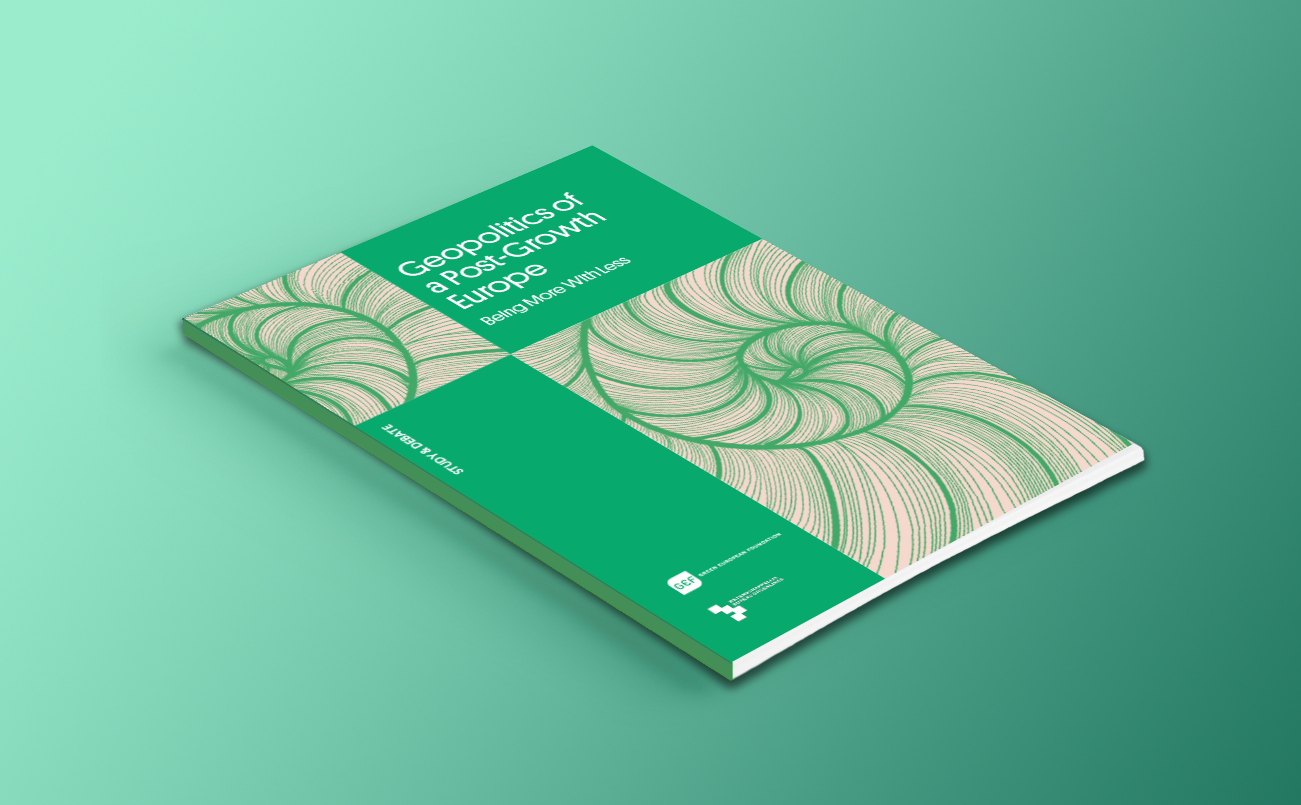
Geopolitics of a Post-Growth Europe

By Uncategorized

Context

As it stands, degrowth fails to resonate with experts in foreign and security policy. It is easy to see why. In geopolitics, many determinants of power – trade, aid, tech nology, defence – are closely linked to GDP. If they do not ignore planetary boundaries altogether, geopolitical pundits trumpet the ‘green growth’ narrative so as to reconcile ecological and geopolitical security. It is this very narrative that degrowthers aim to refute.

It is better to manage the end of growth through democratic deliberation than to have it imposed on us by ecological breakdown.


Objectives

It is unlikely that we will be able to defuse the climate time bomb, let alone other ecological threats, as long as our economy continues to grow. But what would the end of economic growth mean for geopolitics? Could a European Union that is the first to embrace post-growth still be a global actor? Would it be able to defend itself, its allies, democracy, human rights, and the international rule of law at a time when aggressive autocracies are invading or threatening their democratic neighbours? This report addresses uneasy questions that few have dared to ask.


Project Background

This report is produced by the Green European Foundation. It is part of the project Geopolitics of a Post-Growth Europe. The project is led by Wetenschappelijk Bureau GroenLinks (NL) and supported by BlueLink (BG), Center for Green Politics (RS), Etopia (BE), Fondation de l’Écologie Politique (FR), Green House Think Tank (UK), and Transición Verde (ES). Check out www.geopoliticspostgrowth.eu for more interviews, videos, and other project outputs.


Available Translations

Dutch

Spanish

Serbian

French

Bulgarian

Czech

Portuguese


This report has been realised by the Green European Foundation with the support of  Wetenschappelijk Bureau GroenLinks and the financial support of the European Parliament to the Green European Foundation. The European Parliament is not responsible for the content of this publication.
Geopolitics of Degrowth in a Conflicted Europe – Global South’s Perspectives

By

About the event

Green policies that respect planetary boundaries and allow the Global South to develop seem incompatible with unlimited economic growth within the EU. We need a realistic scenario for a future in which we consume more sparingly but live better together. 

Could a post-growth EU that considerably reduces its ecological footprint with the purpose of freeing up natural resources find partners in the Global South? What should these partnerships entail?

To tackle this issue, the Green European Foundation with the support of BlueLink is organising a webinar focusing on the Global South. Participants will have the opportunity to review and reflect upon the outcomes from expert meetings, research and interviews, held across Europe during 2023. 

We invite researchers, activists and policy makers – particularly from the Global South  – with an interest in green policies and geopolitics to present perspectives, experiences, analytical or activity reports and to engage in a discussion around the following questions:

  • How would it be possible to optimize the possibilities that degrowth offers, including for democratic flourishing and a safer Europe and world?
  • Could a post-growth EU considerably reduce its environmental footprint with the express purpose of freeing up natural resources for the Global South?
  • Can the EU hope for strategic partnerships with (democratic) Global South countries, which are vital for greater security and legitimacy?
  • Could a post-growth EU still make a larger contribution to poverty reduction, global public goods, tax justice, legal migration routes, international climate finance, and compensation for climate loss and damage?
  • Could the older EU members come to terms with their colonial pasts, and on what conditions? How important is this for the Global South?
  • Will exports from Global South suffer if a post-growth EU  reduces its overconsumption of global resources?
  • How much EU’s partnership with the Global South depend on technology transfer?
  • What role of technology beyond trade, development, and climate: is it intertwined with geopolitics?

Not every question has a definitive answer and we promote creativity, analytical thinking, and a fresh approaches to the challenge.


Project Background

This event is part of GEF’s project Geopolitics of a Post-Growth Europe, which explores the tensions between degrowth/post-growth and geopolitics. The project aims to ignite a conversation between critics of economic growth and progressive thinkers on foreign and security policy, who now often operate in separate circuits. It aims to find solutions beyond naïve anti-militarism and convenient belief in green growth. Find out more about the project and its findings at geopoliticspostgrowth.eu.


Practicalities

This GEF e-workshop will be held in Zoom by BlueLInk.

Date and time: December 11, 2023 (14:00 UCT / 15:00 CET / 16:00 EET) 

Language: English 

Registration: Open to all interested participants, but please register in advance via this link. Please use the ‘Questions and Comments’ field to specify your scope of interest or proposed intervention. You will receive a confirmation email after registration. 


This event is organized by the Green European Foundation with the support of BlueLink. It will take place online, in partnership with the Association for Progressive Commnunications and its members.

The Geopolitics of Degrowth (London)

By

About the event

Can the UK and the European Union be the first to renounce economic growth but still be global players? What are the tensions, as well as important synergies, in trying to bring about such a transition of our economic systems and international relations at the same time?

This event brings together leading academic and political voices to consider how we might transform our economy away from one predicated on growth, and what this means for our diplomatic and trade relations, as well as defense policy, arms control, and the threats posed by current and future conflicts, including in Ukraine.


Project background

This event is part of GEF’s project Geopolitics of a Post-Growth Europe, which explores the tensions between degrowth/post-growth and geopolitics. The project aims to ignite a conversation between critics of economic growth and progressive thinkers on foreign and security policy, who now often operate in separate circuits. It aims to find solutions beyond naïve anti-militarism and convenient belief in green growth. Find out more about the project and its findings at geopoliticspostgrowth.eu.

Speakers

  • Casper Wits – Lecturer in East Asian Studies, Leiden University
  • Frank Meeussen – Diplomatic Advisor to Belgian Deputy-Prime Minister George Gilkinet, Ecolo
  • Gabriela Cabana-Alvear – Transdisciplinary scholar and degrowth researcher, London School of Economics
  • Marissa Conway – CEO, United Nations Association UK
  • Prof. Peter Newell – Professor of International Relations, University of Sussex


Programme:

15:00 – 15:30    Arrivals and welcome (London venue)

Introductions from UK-UNA, Green House and the Green European Foundation

15:30 – 16:30    Session 1: How will a degrowth agenda impact on international relations?

  • Casper Wits: China-Europe relationships – what will the future look like?
  • Gabriela Cabana-Alvear: The EU-Chile trade agreement – a degrowth perspective
  • Prof: Peter Newell: Steering away from extractivism

Short presentations followed by panel discussion.

16:30 – 16:45    Break

16:45 – 17:45     Session 2: Defence policy in a post-growth world

  • Frank Meeussen: Arms control as a condition for a post-growth world
  • Marissa Conway: Shifting away from Militarism.

Short presentations followed by panel discussion.

17:45 – 18:00    Closing discussion


Practicalities:

Date and Time: October 17th, 15:00 – 18:00 BST (UK time).

Location: This is a hybrid event. You can join online via Zoom or in person at the United Nations Association of the UK – 3 Whitehall Court, London, United Kingdom.

Language:  English

Registration: Please register in advance via this form. Registration is required both for online and in person participants. Spots in the venue are limited, so register quickly and do notify us if you can no longer make it, via events@greenhousethinktank.org.


This event is organised by the Green European Foundation with the support of Green House Think Tank and the financial support of the European Parliament to the Green European Foundation.
Geopolitics of Degrowth in a Conflicted Europe (Leipzig)

By

About the event

Green policies that respect planetary boundaries and allow the Global South to develop seem incompatible with unlimited economic growth in the EU. We need a realistic scenario for a future in which we consume more sparingly but live better together. A scenario that could be possible within a degrowth context.

The war in Ukraine completely changed the geopolitical landscape. Today, the idea of ending GDP growth in the EU encounters new and important impediments, with power and wealth being measured in military capacity. Can a degrowth Europe build strength and resilience in this context?

To tackle this issue, the Green European Foundation with the support of BlueLink is organising a workshop in Leipzig, as part of a series of expert meetings across Europe. The outcomes from these meetings and further research and interviews will feed into a final publication to be launched in the autumn of 2023.

We invite researchers, activists and policy makers – particularly from Central and Eastern Europe and Ukraine – with an interest in green policies and geopolitics to present perspectives, experiences, analytical or activity reports and to engage in a discussion around the following questions:

  • How does degrowth within the EU affect the EU’s ability to achieve geopolitical objectives like providing security, and what are the resulting tensions and synergies?
  • Can such tensions be mitigated? If so, how?
  • How would it be possible to optimize the possibilities that degrowth offers, including for democratic flourishing and a safer Europe and world?

Not every question has a definitive answer and we promote creativity, analytical thinking, and a fresh approaches to the challenge.

Project Background

This event is part of GEF’s project Geopolitics of a Post-Growth Europe, which explores the tensions between degrowth/post-growth and geopolitics. The project aims to ignite a conversation between critics of economic growth and progressive thinkers on foreign and security policy, who now often operate in separate circuits. It aims to find solutions beyond naïve anti-militarism and convenient belief in green growth. Find out more about the project and its findings at geopoliticspostgrowth.eu.

Practicalities

This GEF workshop will take place as part of the International Roundtable 2023 held by the Peaceful Revolution Foundation in Leipzig. You can find out more information about this conference here. 

Date and time: October 11th, 2023 (14:30 CET) 

Location: Leipzig, Germany and online (hybrid event) 

Language: English 

Registration: Open to all interested participants, but please register in advance via this link. Please use the ‘Questions and Comments’ field to specify your scope of interest or proposed intervention. You will receive a confirmation email after registration. 

In case you want to attend the workshop in person in Leipzig, please also email office@bluelink.net by Friday, October 6th 


This event is organized by the Green European Foundation with the support of BlueLink. It will take place as part of the Revolutionale International Round Table 2023 held in Leipzig by the Peaceful Revolution Foundation.  


Geopolitics of a Post-Growth Europe: Rethinking Relations with the Global South?

By

About the event

Rivalries between states or political entities for sovereignty over a territory or a resource are often enough to justify the development of (often commercial) armed forces and alliances. Geopolitics, if it is to mean anything other than the analysis of this interplay of forces and influences, would therefore affirm that no state would voluntarily reduce its economy at the risk of being overpowered by another one not willing to make this sacrifice.

This generality about international relations partly explains the expansion of empires throughout history, and from this point of view, the great European and industrial powers are doing nothing new by colonizing, enslaving, and establishing asymmetrical trade relations.

What’s new, however, is that the intensity of the economic flows of industrial means of production is ravaging ecosystems and climatic balances. In other words, the economic growth of the major powers (exploiting resources extending far beyond their sovereign territories) is unsustainable.

In response, many intellectuals are striving to bring out a convincing macro-economic model of post-growth. These efforts are taking place when economic growth is slowing down, or even stagnating, and producing increasingly irreversible and lethal effects on the environment and people’s health.

Theoretical models of post-growth postulate that it is possible to reduce the intensity of physical and economic flows while maintaining a satisfactory standard of living.  That is to say, maintaining a “good standard of living” (with access for all to education, healthcare, leisure, culture…) without using fossil fuels implies developing a large-scale renewable energy system, which we know very well has a lower energy rate of return and requires large quantities of materials.

In any case, the abandonment of fossil fuels and the development of a decarbonized, non-growthiest economic model holds the seeds of new international relations and new balances of power.

Project background

This event is part of GEF’s project Geopolitics of a Post-Growth Europe, which explores the tensions between degrowth/post-growth and geopolitics. The project aims to ignite a conversation between critics of economic growth and progressive thinkers on foreign and security policy, who now often operate in separate circuits. It aims to find solutions beyond naïve anti-militarism and convenient belief in green growth. Find out more about the project and its findings at geopoliticspostgrowth.eu.   

Practicalities

Date and Time: Friday, July 7th (12:00 – 14:00 CEST) 

Location: Online, via Zoom 

Language: French 

Registration: This is a closed expert meeting. However, if you wish to learn more or receive an invitation, please get in touch with Kévin Puisieux via k.puisieux (at) fondationecolo.org. 


This expert meeting is organised by the Green European Foundation with the support of the Fondation de l’Ecologie Politique and the financial support of the European Parliament to the Green European Foundation. 

Geopolitics of Post-Growth

By

About the event

Scientists increasingly doubt whether we can stop the climate and ecological crises as long as our economy continues to grow. So we had better prepare for a future without GDP growth. In fact, the degrowth movement, which is rapidly gaining popularity among activists and scientists, advocates the deliberate scaling back of overproduction and overconsumption to bring the economy back into balance with the living world, in a way that reduces inequality and improves human well-being.

But what would a farewell to economic growth mean for geopolitics? Can a European Union that is the first to enter the post-growth era remain (or become) a global player? Will it be able to defend itself, its allies, democracy, and the international rule of law against aggressive autocrats? The transition to a post-growth society must be a democratic one. But that is far from obvious at a time when authoritarian regimes are invading or threatening their democratic neighbours.

On the plus side, a post-growth EU might gain resilience. Without economic growth, it will be easier for the EU to reduce its dependence on imported energy and raw materials. This favours strategic autonomy. It also provides an opportunity to move beyond the neo-colonial ‘extractivism’ that burdens relations with the global South.

In this webinar, we will identify points of contention and try to develop commonalities. After some brief introductions, there will be ample time for participants to have their say.

Project background

This event is part of GEF’s project Geopolitics of a Post-Growth Europe, which explores the tensions between degrowth/post-growth and geopolitics. The project aims to ignite a conversation between critics of economic growth and progressive thinkers on foreign and security policy, who now often operate in separate circuits. It aims to find solutions beyond naïve anti-militarism and convenient belief in green growth. Find out more about the project and its findings at geopoliticspostgrowth.eu 

Speakers

  • Sophie Bloemen, co-director Commons Network
  • Roderick Kefferpütz, director of the European Union office of the Heinrich-Böll-Stiftung 
  • Richard Wouters, project leader ‘Geopolitics of a post-growth Europe’ for GEF 

The webinar will be moderated by Judith Sargentini, former MEP for GroenLinks and CEO in the not-for-profit sector.

Practicalities

Date and Time: Friday, 8 September (14:00 – 16:00 CEST) 

Language: English 

Audience: Public event online, via Zoom   

Registration: Please register online via this link. 

In case of further questions, contact project lead Richard Wouters – rwouters (at) groenlinks.nl 


This project is organised by the Green European Foundation with the support of Wetenschappelijk Bureau GroenLinks and with the financial support of the European Parliament to the Green European Foundation. The European Parliament is not responsible for the content of this event. 
How to protect a Post-Growth Europe? (Sofia)

By

About the event

Green policies that respect planetary boundaries and allow the Global South to develop seem incompatible with unlimited economic growth in the EU. We need a realistic scenario for a future in which we consume more sparingly but live better together, a scenario that concepts of degrowth and post-growth can offer.

The war in Ukraine completely changed the global landscape. Today, the idea of ending GDP growth in the EU encounters new and important geopolitical impediments with power and wealth being measured in military capacity. Can a degrowth Europe build strength and resilience in this context?

To tackle this issue, the Green European Foundation is organising a series of expert meetings across Europe, including the present one with the support of BlueLink in Bulgaria. Outcomes from these expert meetings and further research and interviews will feed into a final publication to be launched in autumn 2023.

We invite Bulgarian researchers, activists and policy makers with an interest in green policies and geopolitics to present papers and/or engage in an analytical discussion defined by the following analytical framework:

  • What are the tensions and synergies between managed degrowth within the EU and the EU’s ability to achieve its geopolitical objectives, such as promoting security in a broad sense?
  • Can tension be mitigated? If so, how?
  • How would it be possible to optimize the possibilities that degrowth offer?

Not every question has a definitive answer and we promote creativity, analytical thinking and fresh approaches to the challenge.

Project background

This event is part of GEF’s Geopolitics of Post-Growth project, which explores the tensions between degrowth/post-growth and geopolitics. The project aims to ignite a conversation between critics of economic growth and progressive thinkers on foreign and security policy, who now often operate in separate circuits. It aims to find solutions beyond naïve anti-militarism and convenient belief in green growth. 

Speakers and Programme 

Further details to be announced. 

Practicalities

Date and Time: April 28th, 14:00 – 17:00 CET

Location: House of Europe – 124, 1000 Sofia Center, Sofia, Bulgaria

Language:  The seminar will be held in Bulgarian, but presentations in English are acceptable.

Registration: Researchers, experts, activists or politicians wishing to join the discussion with academic or conceptual contributions, opinions and opinions, or as discussants on the subject, are invited to register for participation via this link. Only registered participants will be admitted to the event.

If you have any further questions or wish to discuss your potential contribution, please reach Pavel Antonov, PhD at tel. 0888 704 661 or by e-mail at office@bluelink.net. 


This expert seminar is organised by the Green European Foundation with the support of BlueLink and the financial support of the European Parliament to the Green European Foundation. The European Parliament is not responsible for the content of this event.
Green Growth vs. Degrowth (Utrecht)

By

About the event

Can our economy continue to grow if we want to respect planetary boundaries and give developing countries room to meet the needs of their inhabitants?  

Yes, say proponents of ‘green growth’. To do so, we need strict climate and environmental policies that drive technological innovation and reduce the most polluting forms of consumption. The drive for green growth underpins the European Green Deal.  

No, say the advocates of ‘de-growth’. Decoupling economic growth from ecological damage is an illusion. Therefore, rich countries must abandon the growth imperative, scale back overproduction and overconsumption and focus on collective well-being. The degrowth movement is gaining popularity among scientists and activists.  

In this seminar, we explore the differences and similarities between ‘green growth’ and ‘degrowth’ with proponents of both schools of thought as well as Green and Labour politicians. What facts and trends do the two movements invoke? What are the underlying visions of society? Is there any overlap between the political agendas? 

Project background

This event is part of GEF’s Geopolitics of Post-Growth project, which explores the tensions between degrowth/post-growth and geopolitics. The project aims to ignite a conversation between critics of economic growth and progressive thinkers on foreign and security policy, who now often operate in separate circuits. It aims to find solutions beyond naïve anti-militarism and convenient belief in green growth.  

The geopolitical ramifications of (de)growth will be discussed in a follow-up seminar. 

Speakers and Programme

14:00 – 14:10 Opening by moderator Suzanne Kröger (MP GroenLinks) 

14:10 – 14:20 Presentation by Diederik Samsom (head of cabinet of European Commission VP Frans Timmermans) 

14:20 – 14:30 Presentation by Karolien van Teijlingen (social geographer Radboud University Nijmegen) 

14:30 – 14:40 Audience Q&A 

14:40 – 14:50 Presentation by Wim Naudé (professor technology & innovation management RWTH Aachen University) 

14:50 – 15:00 Presentation by Hans Stegeman (chief economist Triodos Bank, columnist) 

15:00 – 15:10 Audience Q&A 

15:10 – 15:50 Discussion 

15:50 – 16:00  Closing words 

Practicalities: 

Date and Time: Friday 19 May, from 14:00 to 16:00 CEST

Location: De Kargadoor, Oudegracht 36, Utrecht, Netherlands

Language:  Dutch  

Registration: Participation is free of charge. Registration in advance is required, via this link .

If you have any questions or suggestions, you can contact Richard Wouters – rwouters@groenlinks.nl. 


This event is organised by the Green European Foundation with the support of Wetenschappelijk Bureau GroenLinks and the financial support of the European Parliament to the Green European Foundation.