Metals for a Green and Digital Europe (Stockholm)

By

About the Event

This event will consist of debate between think tanks and academics on the Swedish version of the GEF publication Metals for a Green and Digital Europe – An Agenda for Action.  The debate will involve an open conversation of mineral use with a particular look at the role of the indigenous population in Sweden (Sapmi).

Context

This event is organised as part of the launch of the Swedish translation of the report Metals for a Green and Digital Europe – An Agenda for Action.

Speakers

Speaker: Richard Wouters, Wetenschappelijk Bureau, GroenLinks.

Panelists:

  • Kalle Sundin, policy officer at the think tank KatalysIsadora Wronski, senior strategist Greenpeace
  • Charles Berkow, Cogito
  • May-Britt Öhman, Associate Professor of Environmental History, Uppsala University
  • Maria Sunér, managing director Svemin

Moderator: Henrik Jalalian, Cogito

Practicalities

Date and time: 12 December 18:00 – 19:30 PM

Format: In person event

Audience: This debate will take place in Swedish language and is open to the general public

Registration: Registrations will open shortly


This project is organised by the Green European Foundation with the support of Cogito with the financial support of the European Parliament to the Green European Foundation. The European Parliament is not responsible for the content of this event.

Metals in the Energy Transition

By

About the event

This Dutch-language webinar is for you if you are interested in circularity and the energy transition.

Context

All solar panels, wind turbines, electric cars and power cables contain metals. The energy transition increases the demand for ‘energy metals’, such as lithium, cobalt, neodymium, and copper. These metals have to be dug up from the ground and mining often carries social and geopolitical risks, especially because of metal scarcity.

We can’t keep postponing action against the climate emergency. We need to prevent metal scarcity from slowing down the energy transition while protecting the environment and human rights from destructive mining.

In this webinar, we will discuss several circular strategies and solutions that can contribute to a more sparing use of metals–and may also offer economic opportunities. We will follow the circularity ladder: from refuse via reduce to recycle.

With the help of expert speakers, we will focus on three solutions:

  • Smarter mobility: from private cars to bicycles, public transport and shared e-cars (refuse, rethink)
  • A more efficient use of the (tight) power grid by combining wind and solar energy, putting generation near consumption and making demand more flexible (rethink, reduce).
  • Circular solar panels (reuse, refurbish, re-manufacture, recycle).

How can politicians, from the European to the local level, work on solutions for metal scarcity? Together with speakers and participants, we will map out the political instruments.

Speakers

Pieter van Exter (@pvanexter), lead Circular Industries at Metabolic

Mariet de Haas (@lepus2), co-ordinator Shared Mobility and Mobility Hubs for the City of Rotterdam

Roebyem Anders (@roebyem), co-founder of Sungevity International

Berend Potjer (@berendpotjer), regional minister for Energy, Nature and Biodiversity in the province of Zuid-Holland

Richard Wouters @richardwouters, project leader ‘Metals for a Green and Digital Europe’ for the Green European Foundation and Wetenschappelijk Bureau GroenLinks

Practicalities

Date and time: Friday 7 January, from 14:00 to 16:00 CET

Audience: This webinar will take place in Dutch and is open to the general public.

Registrations: here

This event will be organised through the Zoom platform.

Inspiration: You can prepare for this webinar by reading our publication ‘Metals for a Green and Digital Europe’. Download it for free in English, Dutch, French, Spanish or Czech.


This project is organised by the Green European Foundation with the support of Wetenschappelijk Bureau GroenLinks and with the financial support of the European Parliament to the Green European Foundation. The European Parliament is not responsible for the content of this event.

Mining for Metals in a Post-Cop Intersectional World: Can It Be Fair?

By

PROGRAMME

14.00-14.30 CET Introductory Session 

  • Miriam Kennet (Green Economics Institute) – Introduction to the event
  • Ewa Sufin  (Poland) (Fundacja Strefa Zieleni/GEF Member of the Board) – Introduction to GEF and the Metals for a Green and Digital Europe project

14:30 – 15:30 CET – Session 1: Mining metals for the energy transition – can it be fair? 

The role of the internet in driving social justice in 2022: The Potential for the Internet in Driving Social Justice-Can it be fair- ? Challenges for a Just Transition- an issue for our times

The internet is a powerful tool. The wide potential for democratisation and social justice it holds are evident. However, many online initiatives have failed to develop into real social change. To effectively utilise the power of the internet for social justice, we must navigate these problems and understand how detrimental outcomes materialise. This session will explore the conflicting realities of the nature of the internet and offer solutions for reclaiming it as a tool for social justice.

 Exploring the life cycle (procurement, use and recycling) and the practical situation

Speakers include:

  • Liljana Popovska (North Macedonia ) – Former MEP expert in Mining Issues and impacts
  • Hans Kåre Flø (Norway )Master of science in physics and master of management. Special adviser at Tekna which is a trade union for Engineers and scientists”. -Metals and their importance in European jobs and industry and the transition in Technology and climate challenges: Norway has important rare earths but has not exploited them yet- what are the issues? “Rare earths from Norway and challenges connected to producing them”
  • Rasa Tumaševičiūtė (Lithuania) – Europe’s Recycling of Aluminium, circular economy consultant and government sustainability strategist. Aluminium sector. How critical is situation in Europe?
  • Zaklina Zivkovic, Polekol (Serbia) – Green Economy Expert, Serbia and Executive director of Organization for Political Ecology, Polekol. The mass mobilization of citizens and environmental organizations in Serbia against extractivism that our country is currently facing. On one hand, we are aware of the need for metals for the green transition, but on another planning 40 new mines in the next 15 years in Serbia is nowhere near just the transition that we are also advocating for.

Moderated by: Bianca Madison (Croatia, Italy, Denmark, UK) & Marlyn Hughes (UK)


15:30 – 15:40 CET Short Break

15:40 – 16:10 CET Session 2: Break Out Rooms

In this section we will share knowledge and evidence  about how metals are brought into Europe and the new supply chain realities within the globalisation context.  We’ll also explore new commodity flows and power bases in the global economy and the challenges for the green transition. What should the main priorities be to start to address these challenges?

Moderated by: Liljana Popovska, North Macedonia – Former MEP expert in Mining Issues and impacts

  • Bianca-Madison – Vuleta (Croatia, Italy, Denmark and UK)
  • Hans Kare Flo ( Norway)
  • Rasa Tumaševičiūtė (Lithuania)

16:10-16:40 CET Presentations, feedback and discussions in Plenary 

16:40 -17:40 CET Session 3: Diverse perspectives and issues for different social outcomes.

Since its inception, the internet has been recognised for its potential in driving social justice in a variety of ways. A space to bring together new or marginalised communities despite geographical boundaries; a public sphere for debate and deliberation; a means to spread information and a platform for the organisation and mobilisation of incipient social movements.  In this session we’ll explore perspectives from different groups impacted including indigenous perspectives and views and voices from around Europe and beyond.

  • Ewa Sufin (Fundacja Strefa Zieleni) European Impacts of Metals Mining-No more BAU Energy Efficiency
  • Baghadadi Mahrouz – Berber Indigenous speaker and engineer (Algeria) – intervention in French
  • Professor Alexandra Harrington: (University of Lancaster) Just transitions for mining sector activities and energy transitions in Europe, the SDGs and mining.
  • Asia Mohamed – (Sudan) – IPBES Africa Lead for United Nations Biodiversity. The impact of gold mining on biodiversity (tbc)Moderated by: Bianca Madison – Vuleta – (Croatia, Denmark, Italy and UK) and Marlyn Hughes


17.40 – 18.10 CET – Conclusions : Session 4Mining for metals can it ever be fair?  Can supply chains ever be fair in 2022 in Europe? 

Conclusions from the Metals for a Green and Digital Europe transnational project.

  • Speakers: Richard Wouters, Project leader ‘Metals for a green and digital Europe’ for the Green European Foundation & Weternschappelijk Bureau GroenLinks
  • Miriam Kennet (Green Economics Institute) – Climate change and metals- the implications for social and environmental justice with the work of GEIClimate.org and the latest scientific information from the UNFCCC.


Practicalities

Date and time: 2nd April, 2-6pm.

Audience: This event is open to the general public.

Registration: Please register via this link


Recommended reading

Where We Mine: Resource Politics in Latin America, an article from the Green European Journal.


The following session is organised by the Green European Foundation, supported by the Green Economics Institute and Wetenschappelijk Bureau and with the financial support of the European Parliament to the Green European Foundation.

Metals for a Green and Digital Europe- An Agenda for Action

By Uncategorized

Context

The climate crisis leaves us no choice but to make a swift transition from fossil fuels to renewable energies. However, while energy from renewable sources such as solar and wind is nearly infinite, the resources we need to capture it are not. Solar panels, wind turbines, batteries, and power cables all contain metals. Their various properties, including toughness and conductivity, make metals uniquely suitable for renewable energy technologies. But first they must be extracted from ores that are dug up from the ground. Because of its decentralised nature, a renewable energy system requires far larger quantities of metals than a fossil energy system.


The more energy we harvest from the skies above our heads, the deeper we will have to dig for the metals beneath our feet.


Objectives

Both the energy transition and the digital transition require large quantities of metals, such as lithium, cobalt, and rare earth. As a result, Europe must face up to various types of scarcity. This Agenda for Action sets out how we can achieve the sparing, circular use of metals and the responsible sourcing of the virgin metals that we really need.


Download

Available in Dutch

Available in Spanish

Available in Czech 

Available in French

Available in Polish

Available in Swedish

Available in Serbian

Available in Portuguese


This publication is part of the Metals for a Green and Digital Europe project. The project is led by Wetenschappelijk Bureau GroenLinks and supported by Fundacja Strefa Zieleni, Institut Aktivního Občanství, the Green Economics Institute, Etopia, Visio, and Transición Verde, with Cogito from Sweden providing additional expertise.

Reforming the Finnish Mining Law

By

As part of the Green European Foundation’s Metals for a green and digital Europe transnational project, we will look at how the initiative for reforming the Finnish Mining Act started with the Finnish Parliament’s ratification of the EU-Canada Comprehensive Economic and Trade Agreement (CETA) in 2018. The proposal on the reform, originally intended to be submitted to Parliament in December 2020, has now been postponed by a year as the Ministry chose to include an instrument for the comparison of interests in the reform just as the working group was about to finish its work. During this event we will focus on the background of the reform, examining the content of the draft, and offer suggestions for its improvement. Moreover, we will look at the Metals for a green and digital Europe project outputs and specifically the Agenda for Action document presenting concrete policy recommendations to be published in October 2021. 

You can contribute to this Agenda by joining one of our webinars or by commenting on our draft text, which can be found on www.metalsforeurope.eu

The project is led by the Green European Foundation and Wetenschappelijk Bureau GroenLinks. It is supported by Fundacija Strefa Zieloni, Institut Aktivního Občanství, Green Economics Institute, Etopia, Visio and Transición Verde.


Speakers

  • Richard Wouters, Project leader ‘Metals for a green and digital Europe’ for the Green European Foundation & Weternschappelijk Bureau GroenLinks
  • Juho Heikkilä, student of Economics and Environmental Economics, Author of the ‘Mining operations taxed lightly in Finland’ publication
  • Mari Holopainen, Member of the Finnish Parliament

Moderated by: Simo Raittila, Project Coordinator at Visio


Practicalities

Date and time: Monday, 30th August from 16:00 to 17:30 CET.

Audience: This webinar will take place in English and is open to the general public

Registration: no registration required, please join our LiveStream!

Please note the event will be organised through the StreamYard platform, with Facebook live, and YouTube livestream with a possibility for the audience to ask questions from the speakers.

YouTube live link : Webinar: Reforming the Finnish Mining Law – YouTube

Facebook live link : Ajatuspaja Visio – Posts | Facebook


This project is organised by the Green European Foundation with the support of Visio and with the financial support of the European Parliament to the Green European Foundation. The European Parliament is not responsible for the content of this event.


GEF at the Green Days: On the Way to COP26

By

About the Event: 

The past year has taught us painful but vital lessons about our relation to nature, the importance of often underfunded public services, and other topics which the Greens have been highlighting for years. Yet as the green wave continues rolling, and with pandemic lessons fresh on our mind, now is precisely the time to refocus attention on key challenges like the climate emergency and to ensure that green-minded activists and politicians are ready to take responsibility at all levels.       

The annual Green Days conference is an important moment of learning and exchange for the green movement in Poland and beyond. GEF is hosting several sessions at this event – tackling important topics on the road to COP26. We will address the question of rare-earth metals, a crucial but challenging aspect of the energy and digital transition. We will also ask ourselves what feminist climate and foreign policy looks like, heading to Glasgow, as well as dive into local and regional recovery plans. Finally, we will host a session on agriculture – a sector that is at times particularly hard to reach in our pursuit of a climate emergency economy.

Context: 

These seminars are being organised as part of the transnational projects Climate Emergency Economy, Metals for a Green and Digital EuropeFeminists in the Climate Movementand Cities as Places of HopeFor more information about each of these projects and the other partners involved, please check out their respective project pages on the GEF website.  

Speakers:

The extensive line up of speakers includes:

  • Michael Bloss (MEP, Greens/EFA)
  • Urszula Zielińska (Polish Green Party MP)
  • Iwona Reichardt (New Eastern Europe journal)
  • Tomasz Piątek (investigative journalist, expert on Russia)
  • Joanna Maria Stolarek (Director HBS Warsaw)
  • Thomas Simpson (Green Foundation Ireland)
  • Jakop Dalunde (MEP, Greens/EFA)
  • Jan Popczyk (Silesian University of Technology)
  • Elżbieta Anna Polak (President of the Region of Lubuskie)

And many more!

Programme:  

Friday, August 27th

11:30 – 13:00 “Agriculture friendly for climate, farmers, biodiversity, consumer health, animal welfare and future generations – utopia or necessity?”

15:00 – 16:30 ‘’Green Europe of regions and cities – recovery and climate challenges’’

  • With Jakop Dalunde (Greens/EFA MEP), Przemysław Słowik (Green local councillor from Szczecin), Ada Colaou (Mayor of Barcelona), Elżbieta Anna Polak (President of the Region of Lubuskie), Miłosława (Miłka) Stępień (Akcja Konin/ Bankwatch), and more!


Saturday, August 28th

9:30 – 11:00 “Europe and Poland in the new global geopolitics of recovery, climate and resources’’

  • With Michael Bloss (Greens/EFA MEP), Urszula Zielińska (Polish Green Party MP), Richard Wouters (Wetenschappelijk Bureau GroenLinks, Tomasz Piątek (investigative journalist, expert on Russia), Dariusz Szwed (Green Institute), Joanna Maria Stolarek (Director HBS Warsaw), Małgorzata Kopka (former international policy coordinator at HBS Warsaw), and more!

11:30 – 13:00 – Digital economy and artificial intelligence – ethics, responsibility, human rights

Host: Kim van Sparrentak (MEP, online)

With: Anna Adamowicz (Polish technology philosopher), Sarah Chander (EDRI, online, tbc.), Maciej Józefowicz (Partia Zieloni) oraz Karolina Iwańska (online or video,  Fundacja Panoptykon).

  • Lead by: Ioana Banach (Managing Director, Green European Foundation) and Kuba Bilski (Fundacja Strefa Zieleni Council/Partia Zieloni Council) 


16:15 – 17:15 “Women on the way to Glasgow – climate and feminist diplomacy and foreign policy”

  • With Iwona Reichardt (New Eastern Europe journal), Małgorzata Kopka (former international policy coordinator at the HBS Warsaw), and more!


16:00 – 18:30 ‘Metals for a Green and Digital Europe (workshop – activists and experts will work on regional insights for GEF’s Agenda for Action)

  • With Radosław Gawlik (EKO-UNIA/PZ), Urszula Zielińska (MP), Prof. Jan Popczyk (Silesian University of Technology), Dr. Krzysztof Dudek (Mining and Metallurgy Academy/PZ), Dariusz Szwed (Green Institute), Ewa Sufin-Jacquemart (Strefa Zieleni), and more!

Please note that this programme is provisional and subject to change. Some speakers will be joining online or via video message. You can access the full Green Days schedule – including more speakers and other sessions not organised by GEF – via this link.

Practicalities: 

The summer school will be taking place in person at the junction of three provinces: Wielkopolskie, Zachodniopomorskie and Lubuskie, in the Pestkownica settlement belonging to the Krzyż Wielkopolski commune, in the Drawska Great Forest – 200 km east of Berlin. Most sessions feature simultaneous translation in English and Polish.

There is no registration form in English. International participants and panellists who would like to take part in situ are asked to send the information to fundacja@strefazieleni.org with name(s) of participant(s), time and place of arrival/departure, and the relevant Covid-19 information (see details below).

Livestreaming will not be possible, but some sessions will be recorded in English and in Polish for later online viewing.

Transfers

We will have an autocar from the main rail station in Poznań (Poznań Główny) on the August 26th at 15:45 (we will wait however in any case for the arrival of the train from Warszawa, the planned arrival is 15:28). The same day at 22:00 we will organise a car transfer for a few persons. The nearest station is DOBIEGNIEW (25 km from the site) and we will organise transfers from/to there, case by case.

Price and Payment

The organisers offer all the conference logistics and the content, the participants pay the hotel, food and transport (except organised local transfers). The price of the full stay (2 nights with breakfast + 5 lunches/dinners) is 605 PLN (~ 140 EUR) that the participant will be able to pay directly on site if he/she needs an invoice, or pay by bank transfer before the event to Fundacja Strefa Zieleni, if he/she doesn’t need the invoice:

FUNDACJA STREFA ZIELENI, 01-822 Warszawa, ul. E. Schroegera 28, IBAN:   PL66 1020 1097 0000 7602 0237 0450  //  BIC/SWIFT:    BPKOPLPW, title: „Green Days + name(s) of participant(s)”.

COVID-19

Please inform us of the anticipated vaccination or testing status of each participant upon registration.

  • The participant will be vaccinated with two doses of the Covid-19 vaccine or one dose of the Johnson & Johnson vaccine
  • The participant will be vaccinated with one dose of the COVID-19 vaccine
  • The participant will not be vaccinated, but will have an up-to-date COVID-19 test (RT-PCR or antigens, done less than 72 hours before the arrival)
  • Other situation (please explain)

These summer school sessions are organised by the Green European Foundation, with the support of Strefa Zieleni and the financial support of the European Parliament to the Green European Foundation. 

Mining our way into a climate-neutral future – Metals & climate justice

By

About the event:

This webinar is for you if you are interested in learning more about the international and intersectional approach to climate justice.

Context:

The wind turbines, solar panels and electric vehicles that Europe needs to become climate-neutral require plenty of metals. We usually take for granted that these metals will be available. However, they have to be dug up from the ground and some of them are scarce. The EU countries have largely outsourced metal mining to the Global South. This creates supply risks, but also a responsibility for the social and environmental abuses associated with mining in countries such as the Democratic Republic of Congo (cobalt), Chile (lithium) and China (rare earths).

Do local and indigenous communities in mining regions in the Global South pay the price for our green ambitions? Are women disproportionately affected? Where is the climate justice in that? Do the supply chain due diligence and the recycling initiatives that the EU is promoting represent a break with neo-colonial extractivism? What if developing countries decide to make their own cleantech instead of selling their raw materials to us?

We will tackle these questions in a webinar with experts and activists. The insights gathered at the webinar will be used for the upcoming GEF publication Metals for a green and digital Europe – an Agenda for Action. You can already contribute to this publication by commenting on the online draft: www.metalsforeurope.eu

Speakers include:

Jojo Nem Singh (@jnemsingh), Assistant Professor of International Development, International Institute of Social Studies, The Hague

Shivant Jhagroe, Assistant Professor of Public Administration, Leiden University

Benito Walker (@benito_wlkr), chair of Youth for Climate Netherlands

Richard Wouters (@richardwouters), Project leader ‘Metals for a green and digital Europe’ for the Green European Foundation & Weternschappelijk Bureau GroenLinks

Matlhogonolo Mochware – Provincial coordinator Northern Cape for Women Affected by Mining United in Action (WAMUA), South Africa

Nicola Soekoe – Paralegal and researcher at MACUA WAMUA Advice Office, South Africa

The webinar will be moderated by Kauthar Bouchallikht (@kauthar_), MP for GroenLinks, Netherlands.

Practicalities:

Date and time: Friday 11 June, from 14:00 to 16:00 CEST

Audience: This webinar will take place in English and is open to the general public.

Registrations: Click here

This event will be organised through the Zoom platform.


This project is organised by the Green European Foundation with the support of Wetenschappelijk Bureau GroenLinks and with the financial support of the European Parliament to the Green European Foundation. The European Parliament is not responsible for the content of this event.

The European Green Deal and The Need for Metals

By

About the Event:

This webinar is for you if you are interested in the future of Europe’s metals industry and its legal/social/environmental implications.

Context:

The energy transition has been placed at the top of the European political agenda, with the digital transition closely following suit. But to successfully implement these two priorities, the EU needs to examine and adjust its supply and use of metals.

A renewable energy supply requires far more metals than a fossil one. As to the digital transition, another EU priority, it also relies on a wide array of metals.

It is for this reason that GEF and Wetenschappelijk Bureau GroenLinks will be leading this project, which will deliver a comprehensive Agenda for Action at all political levels, aimed at a sparing, circular use of metals and responsible sourcing of the virgin metals that we really need.

Speakers:

  • Raúl Gómez, Director, Transición Verde – Introduction to the GEF ”Metals for a green and digital Europe” project
  • Guillaume Pitron, Author of the book ”War of the metals”
  • Prof. Joanna Kulczycka from the Institute of Mineral Resources and Energy Management of the Polish Ministry of Defence and Energy and the International Panel on Resources (IRP)
  • Miriam Kenneth, Director CEO, The Green Economics Institute, UK, Global supply chains and the metal supply dependencies
  • Dr Krzysztof Dudek, Mining and Metallurgy Academy

Moderated by: Ewa Sufin-Jacquemart, (Fundacja Strefa Zieleni) & GEF Board member

Programme:

18:00 – 19:30 pm CET

The main goal of this webinar is to answer the following questions/issues:

– what are the optimal solutions concerning the problem of metals?

– what is the direction/are the directions where we should seek solutions that would satisfy both social and climatic interests?

– is the need for metals fully satiated by import, if yes who is the main source?

– the problem of mines in the EU

– global metal connections

– recycling of metals

Practicalities:

Date and time: Thursday, 27th May from 18:00 to 19:30 CET.

Audience: This webinar will take place in English and is open to the general public

Registrations: Click Here

Facebook event: Click Here

This event will be organised through the ZOOM platform.


This project is organised by the Green European Foundation with the support of Fundacja Strefa Zieleni and with the financial support of the European Parliament to the Green European Foundation. The European Parliament is not responsible for the content of this event.

Mining operations taxed lightly in Finland

By Uncategorized

This publication is part of the Green European Foundation’s ‘Metals for a green and digital Europe’ transnational project, where we are spotlighting the needs of the EU to examine and adjust its supply and use of metals. The initiative for reforming the Finnish Mining Act started with the Finnish Parliament’s ratification of the EU-Canada Comprehensive Economic and Trade Agreement (CETA) in 2018. The proposal on the reform, originally intended to be submitted to Parliament in December 2020, has now been postponed by a year as the Ministry chose to include an instrument for the comparison of interests in the reform just as the working group was about to finish its work. Juho Heikkilä, student of Economics and Environmental Economics, explains the background of the reform, examines the content of the draft and offers suggestions for its improvement.

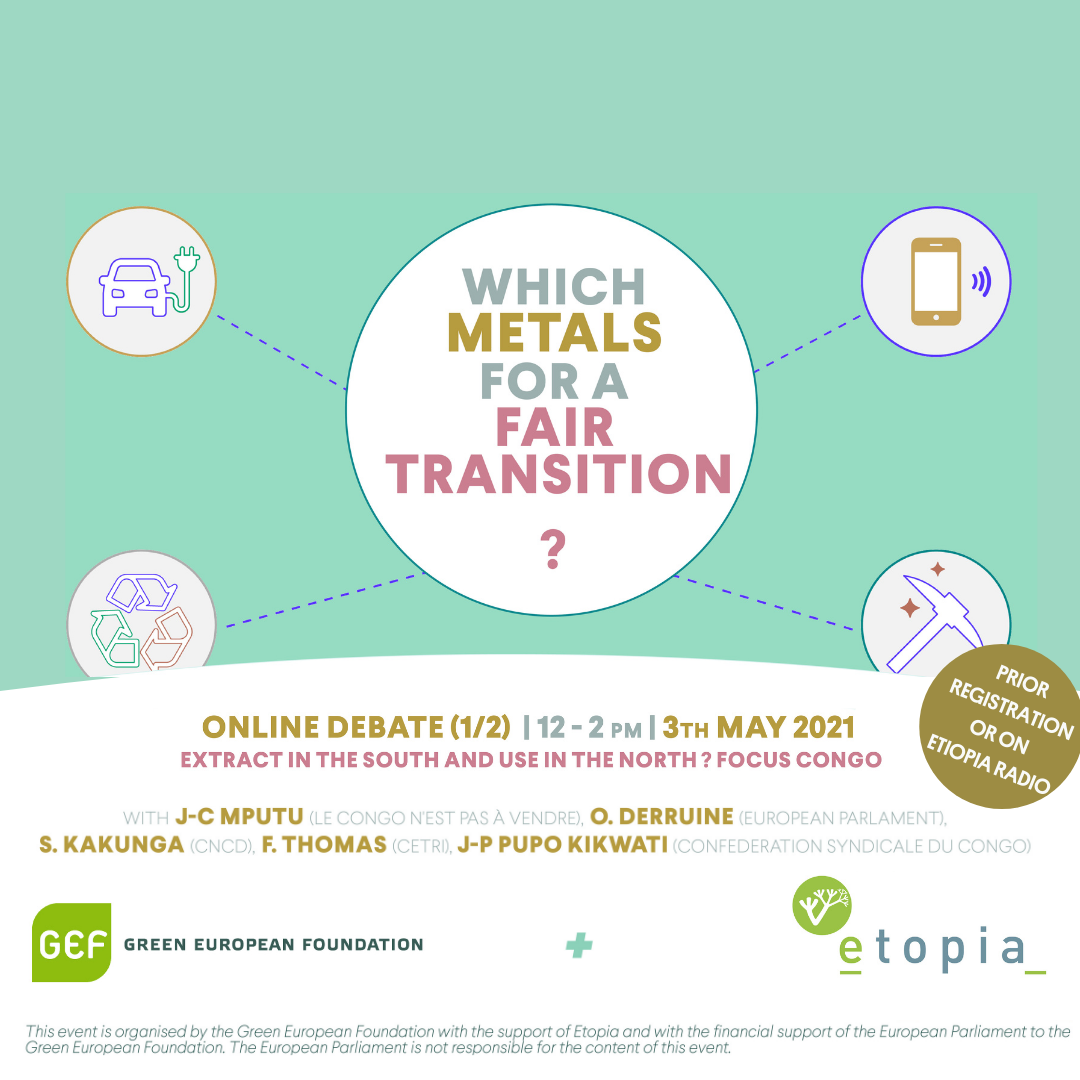
Which metals for a fair transition?

By

About the Event

Which metals for a fair transition?

During May and June, we will organise two webinars revolving around this topic. While the first debate will focus on the extraction aspects in the south (working conditions, regulations, due diligence…), the second will tackle consumption and production in Europe (reopening mines in Europe, lower consumption, circular economy, recycling, technology design, low tech…)

Our main guiding questions will be to:

  • Between the efforts for supply chain responsibility and the development of new technologies, can Europe ensure a fair supply of metals? Can we move beyond extractivism?
  • Can Europe make a more sparing, circular use of metals for its transitions? What would that mean for our lifestyles?

Context

Like all European countries, Belgium imports large quantities of rare metals such as cobalt, germanium, lithium, and coltan through complex and opaque supply chains.
These metals are now the subject of particular attention in European policies. This is for at least two reasons which raise some rather contradictory issues and involve very different actors: it is, on the one hand, to ensure a constant supply to support the growth of the development of renewable energies and digital technologies (solar panels, electric cars, wind turbines, smartphones, smart cities…) and on the other hand to make sure not to contribute to socially and ecologically objectionable forms of mining (work conditions sometimes close to slavery, child labour, destruction of ecosystems in producing countries… ).

The Democratic Republic of Congo, with which Belgium has a tumultuous historical relationship, illustrates the current difficulties in reconciling these two issues. Between neo-colonialism and extractivism, Congo provides 60% of the world’s cobalt and 40% of coltan, and yet remains one of the poorest countries in the world.

How can mining be technically and socially modernised to stop child labour and minimise environmental damage? How to deal with the limits of due diligence in Europe? What is being done today in European and Congolese policies to improve the conditions for metal extraction?
As far as demand is concerned, can the EU limit the need for imported virgin metals while ensuring a rapid energy transition and a responsible digital transition? For example, by stimulating the recycling and substitution of rare metals, re-opening mines within its borders, or reducing the overconsumption of kilowatt-hours and megabytes?


Speakers

– Olivier Derruine, Economist, Parliamentary Assistant to Saskia Bricmont MEP, European Parliament

– Jean-Claude Mputu, Congolese political scientist

– Sabine Kakunga, Central Africa Program Officer (CNCD-11.11.11)

– Frédéric Thomas, Doctor of political sciences, lecturer (CETRI)

-Jean Pierre PUPO KIKWATI, from the “Confédération Syndicale du Congo (CSC)


Practicalities

Date and time: Monday, 3rd May from 12:00 to 14:00 CET.

Audience: This webinar will take place in French and is open to the general public

Registration: Click here

Please note the event will be organised through the ZOOM platform, with Facebook live, Etopia Radio and the local Brussels Radio station.

Zoom Link: Here

RadioEtopia: Here

Facebook Event (FR): Here


This project is organised by the Green European Foundation with the support of Etopia and with the financial support of the European Parliament to the Green European Foundation. The European Parliament is not responsible for the content of this event.

Sustainable Batteries

By

About the Event:

During the event we will reflect on:

Do we have enough raw materials in Europe to produce the required amount of batteries?

Can we mine the necessary rare metals such as lithium, cobalt and rare earth without the risk of major damage of the environment?

Don’t we risk depending on the purchase of precious metals from developing countries or dictatorial regimes, where mining neglects the dignity of workers and excessively devastates nature?

Given the lithium deposits in the Czech Republic, can the production of batteries be an opportunity for Czech companies on the European or world market? Do we have technologies that can recycle metals from obsolete batteries, making the energy storage sector part of the circular economy? Is there room for Czech companies in the field of battery recycling?

These are some of the questions we will address in the presentations and discussion.

Speakers:

  • Ewa Sufin-Jacquemart, Strefa Zieleni Foundation (Poland), Member of the Board of the Green European Foundation – opening the topic: the need for precious metals for energy and digital transition in a European and global context
  • Doc. ing. Tomáš Kazda, Brno University of Technology – raw materials and technologies for battery production, challenges and expected development
  • Alicia Valero, Head of Industrial Ecology at the Research Center for Energy Resources and Consumption (CIRCE Institute), Zaragoza, Spain – Precious metal recycling options and technologies for the production of batteries for the automotive industry
  • RNDr. Petr Kratochvíl, Ecobat – collection and recycling of batteries in the Czech Republic, current state and expected development, opportunities for Czech companies in the field of precious metal recycling
  • Pavel Čmelík, Director of the ČEZ a.s. Development Project Management Department – how a big Czech energy company is considering entering the energy storage and battery production sector, including the provision of the necessary sources of raw materials

The event will be moderated by Martin Ander, Chairman of the Institute.


Practicalities:

Where: Online platform – ZOOM

Date and time: Wednesday, 28th April from 15:00 to 17:00 CET.

Audience: this webinar is open to the general public

Registrations:  Click here

Language: simultaneous interpretation Czech – English will be provided for this event


This event is organised by the Green European Foundation with the support of Institute for Active Citizenship

and with the financial support of the European Parliament to the Green European Foundation. The European Parliament is not responsible for the content of this event.


Mining for metals – can it be fair?

By

About the Event:

The energy transition has been placed at the top of the European political agenda, with the digital transition closely following suit. But to successfully implement these two priorities, the EU needs to examine and adjust its supply and use of metals.

Should we press mining companies to clean up their act and negotiate a fair trade in metals, or is time to nearshore the extraction of metal ores? Is it even possible for Europe or the UK to become self-sufficient in metals, by reviving metal mining within their borders and/or by drastically improving recycling from the urban mine? One thing is clear: the dilemmas around metals make it all the more urgent to rethink our consumption patterns, from mobility to data use.

This is the third of nine public webinars as part of the project ”Metals for a green and digital Europe” organised by GEF with the support of Wetenschappelijk Bureau GroenLinks (Lead partner), Green Economics Institute, Institute for Active Citizenship, Etopia, Transición Verde, Visio, Fundacja Strefa Zieleni.


Speakers:


Miriam Kennet (The Green Economics Institute, UK ) – Director CEO

Richard Wouters (Wetenschappelijk Bureau GroenLinks, NL) – Metals for a green and digital Europe  project leader

Francisco Ruiz and Mark Driver- (Mining in Chile)

Dr Freddie Tshibumbu Shamwana ( DRC)

Sophie Kwizera – Just Transition, Actionaid (NL)

Karen Alvarenga Windham-Bellord, (UK and Brazil) PhD Cantab,Natural Resrouces Law specialist, Doctor of Philosophy from the University of Cambridge

Agneta Granstroem Indigenous Sami and former MP, (Sweden)

Dr Liliana Poposkova-  Macedonia Former MP and specialist in Mining

Professor Peter Yang- USA and China- Renewable Energy. Case University

Michael Oghia from the Sustainable Digital Infrastructure Alliance.

Kim Than (University of Alberta, Canada)

Dr Enkhbaya Shagdar, Erina- (Japan) Senior Research Fellow and COP Climate Expert specialist in energy issues and sustainable development

Baroness Natalie Bennett- UK House of Lords

Coal Mining-Speaker- Ewa Sufin –

Professor Asia Mohammed IPBES (Sudan)


To be confirmed:

Dr Hend Ahmed Saldedin (Egypt) Steel Economics and mining and the environment.


Programme:


9.30-10.00 CEST Introduction

Presentation of the Green European Foundation’s transnational project Metals for a green and digital Europe by project leader Richard Wouters (Wetenschappelijk Bureau GroenLinks, NL).

10.00 -11.20 Session 1 – Mining in the Global South

A) Overview: The extraction of metal ores often causes major damage to nature and the environment, as well as human rights violations, conflicts and corruption.Examples include DRC and Chile. The mining of cobalt and coltan in the Democratic Republic of Congo (DRC) is a case at hand. Is a more responsible sourcing of metals from developing countries possible? Is the European Union on the right track by extending mandatory due diligence in supply chains?

Speaker: Sophie Kwizera – Just Transition, Actionaid (NL)Confirmed,

A) The situation in Africa and the DRC

Speaker: Dr Freddie Tshibumbu Shamwana ( DRC), Confirmed

B) Mining in Latin America

1)Mining in Chile- Speaker: Francisco Ruiz (Chile) Mining in Chile ,Confirmed

2) Stakeholder participation in dam safety plans in the mining sector-

Speaker: Karen Alvarenga Windham-Bellord, (UK and Brazil) PhD Cantab,Natural Resrouces Law specialist, Doctor of Philosophy from the University of Cambridge, . GEI Author and Editor. Confirmed-

She says”“The United Nations’ Awareness and Preparedness for Emergencies at Local Level (APELL) for the mining sector sets a 10-step plan for drafting and implementing actions with stakeholders’ participation at its centre. The APELL places special emphasis on representatives of local communities, making the plan more inclusive and effective in saving lives and the environment. This is because when people participate in the decision-making process from an early stage, they are more likely to implement what is planned. In times of emergency, knowledge of the plan and the will to follow it are crucial to save lives and minimize negative consequences of accidents.”

C) Discussion scene setting and Q and A (20minutes)

11.20-11.30 Short Break

11.30- 12.45 CEST Session 2 – Fair trade in metals: The Situation in Europe : Speaker Debate Panel.

Chair Professor Simon Mouatt, Co-Chair Ewa Sufin, Tech: Marlyn Hughes: Tech Miriam Kennet

The EU is eager to strengthen its industry for energy and digital technology, for

instance by building battery factories. If a developing country restricts the export of

metal ores in because it wants to make and export semi-finished metal products

instead, that might lead to a WTO complaint by the EU, as happened in the case of

Indonesia. Does the EU’s scramble for metal ores undermine the global South’s right

to earn more from their raw materials by building their own industry around it? What

would a fair trade arrangement look like?

A) -Mining in Europe: –

Cases

1) Dr Krzysztof Dudek a presentation on the mining of metals in Poland, especially copper. (Poland)

2) The just transition in Poland -Coal Mining-Speaker GEI UN COP Delegate Ewa Sufin -(Poland)

3) Mining conflicts in Norway- Hans Kare Flo- (Tekna-Technical Trade Union, Norway)


11.55-12.05 Mid session quick break


4) N Macedonia. Speaker: Liljana Popovska (N. Macedonia), Former MP and specialist in Mining, GEI Author.

5) Mining in Serbia: Zaklina Zivkovic, PolEkol (Serbia)

6) Indigenous Perspectives -Mining in Traditional SAMI areas in Sweden

Speaker- Agneta Granstroem Indigenous Sami Gov Councillor and Former MP (Sweden)

Q and A


12.45-13.00 Short Break


B) 13.00-13.15 Exploiting the urban mine

To what extent can a better recycling of metals reduce the need for virgin metals? At

present, it is the rarest metals that are worst recycled. How much research and what

kind of legislation do we need to fully exploit the urban mine? Can some metals that

are critical for green energy and digitalisation, such as the rare earths that we

currently source from China, be substituted by more common materials?

Speaker:

Dr Liljana Popovska-( N Macedonia )Former MP and specialist in Mining. ‘Liljana Popovska: Mining can not be in the neighbourhood of agriculture and tourism, definitely.’

13.00-13.30 CEST Lunch Break and Break Outs


13.30-14.20  Session 2d) Mining and The SDGs

The UN Sustainable Development Goals, impacts and ethics of mining -near shoring -can we justify bringing mining effects into the EU? If not- what is the alternative? (All speakers invited to be confirmed)

14.20-14.30 Short Break

14.30- 15.30 Session 3 –Contemporary Metal mining

A) 14.30-15.15 CEST : By importing most of their metals, both the European Union and the UK shift the burden of environmental damage to poorer countries. Mining in Europe would

probably be less destructive because of our environmental rules. Moreover,

perpetuating Europe’s dependence on metal imports, especially from China, creates

geopolitical risks. Is it time to revive metal mining within Europe’s borders? On what

conditions would that be acceptable to local communities and green activists, if at

all?

B) Sustainable digitalisation 15.10-15.30 20 minutes

Digital technologies can help us make a more sparing use of natural resources – from smart energy grids to sensors and algorithms that sort out metal scrap. However, not all forms of digitalisation are a blessing to the environment. The exploding use of data for online video, gaming, advertising, surveillance and training artificial intelligence requires more and more energy and metals. How can we put the digital transition on a sustainable path?


15.30- 15.45 – CEST Break


15.45 – 16.45  Session 4 –From Glasgow COP21 to Kunmin COP15 – 2021 a watershed year. The importance of mining and how to incorporate its future as a sustainable part of human activity.

At the end of 2021, the global community hopes to gather for the UN Biodiversity onference (COP15) in Kunming, China, and for the UN Climate Change Conference (COP26) in Glasgow, UK. If the coronavirus crisis has not driven home the urgency of protecting natural habitats and respecting planetary boundaries, then what will? However, whereas metal mining might be seen as a curse for biodiversity in Kunming, it may be seen as a blessing for climate solutions in Glasgow. Where metal mining takes place in the remaining habitats of wildlife, the risk of new zoonoses is lurking. But we cannot do without metals for carbon-free energy. How to reconcile the objectives of Kunming and Glasgow?

16.45 -17.00 CEST Break


17.00- 17.45 CEST Session 5–Concluding session- and next steps. Rethinking our hunger for metals

The dilemmas around metals prompt us to question a western way of life that is

consuming more and more kilowatt-hours and megabytes. Should we replace every

fossil fuel car with an electric one, or is it better to share cars and promote cycling?

Can our growing data consumption be justified and do we need an even more

versatile smartphone every two years? Are our politicians willing to confront these

questions, even if it might spook their voters?

Practicalities:

Date and time: Saturday, May 15th from 09:00 to 18:00 CET

Audience: This webinar will be in English and is open to the general public.

Registration: Click Here


Please note all times are Central European Time for this event.


This event is organised by the Green European Foundation with the support of  Green Economics Institute and with the financial support of the European Parliament to the Green European Foundation.
Metals in the Energy and Digital Transition: The EU Facing an Uncertain Scenario

By

[ENG]

 –  Información en español, más abajo.


There is no doubt that the climate crisis makes the energy transition to renewable sources indispensable. The 2015 Paris Agreement was a historic milestone, at least on paper, in terms of reducing emissions and boosting renewable energy. But some issues have not been sufficiently resolved, issues linked to the metals required for the “green” and digital technologies on which the energy transition is based.

In this context, will it be possible to guarantee a sufficient and clean supply of the metals required for a green and digital Europe? What does the EU propose to achieve its strategic autonomy? What are the keys that will allow us to look to the future with optimism?


Context:

The climate crisis makes it necessary and urgent to replace fossil fuels with renewables, but we must not forget one key issue: the “green” and digital technologies that will make this possible are based on non-renewable materials and require many more metals than fossil fuels, metals that are finite and, in many cases, scarce.

The distribution and scarcity of rare metals is altering the global geopolitical order and the European Union will be no stranger to its consequences. In the 21st century, the country that dominates their export and consumption is China, which also has a monopoly on a group of metals known as rare earths.

The West’s dependence on China is not limited to raw materials, but has extended to green and digital technologies, which complicates a situation of which the European Union is fully aware.


Speakers:

Henrike Hahn is a German Member of the European Parliament since 2019. As speaker for industrial policy and member of the European Parliament’s Committee on Industry, Research and Energy (ITRE), she has extensive knowledge of the industry sector. Ms Hahn is the Green Shadow rapporteur for the own initiative report “A European strategy for critical raw materials”. She is a member of the delegations for relations with China and the United States. For many years she worked as strategy consultant for technology-oriented companies in Paris and Munich. Henrike is passionate about greening the industry and the social-ecological transformation of the economy.

Guillaume Pitron is a French journalist (Le Monde Diplomatique, National Geographic, etc.) and documentary maker. In 2018, he published his first book, “The Rare Metals War: The Dark Side Of the Energy Transition and Digitalization”. From Chinese rare earth metals, oil extraction in Alaska, to Sudanese gum arabic and khat trading in Djibouti, he focuses his work on commodities and on the economic, political and environmental issues associated with their use. He has authored around 100 reports, investigations and documentaries across more than 40 countries In 2017 he won the Erik Izraelewicz Prize for best investigative report of the year, awarded by the leading daily newspaper Le Monde, and the award for Best Economic Book of the year in 2018.

Richard Wouters is a researcher at Wetenschappelijk Bureau GroenLinks, the think tank of the Dutch Greens. His main interests are the circular economy, climate policy and technology. He’s leading the Green European Foundation’s project “Metals for a Green and Digital Europe”. Also for the Green European Foundation, he wrote the “Charter for the Smart City.”

The session will be moderated by Cárol García, who is a journalist and political scientist. She is a specialist in international relations and cooperation. She has worked in Senegal and Palestine and is currently communications coordinator at Alianza por la Solidaridad – ActionAid. She is a member of the board of trustees of Fundación Transición Verde.

Practicalities:

Registrations are now open – Próximos eventos: Los metales en la transición energética y digital (transicionverde.es)

Simultaneous interpretation Spanish-English will be provided for this event.

The ZOOM link and technical details will be sent to all registered participants on Monday 15th March. 


This event was organised by the Green European Foundation with the support of Transición Verde and with the financial support of the European Parliament to the Green European Foundation.


[ESP]

Contexto

No hay duda de que la crisis climática hace indispensable la transición energética hacia fuentes renovables. El Acuerdo de París de 2015 supuso un hito histórico, al menos sobre el papel, en cuanto a reducción de emisiones e impulso a las energías renovables. Pero algunas cuestiones no han quedado suficientemente resueltas, cuestiones ligadas a los metales que requieren las tecnologías “verdes” y digitales en que se basa la transición energética.

¿Está garantizado el suministro de metales para hacer posible la transición ecológica? ¿Dónde y cómo se obtienen esos metales?. ¿Qué implicaciones ambientales y sociales tiene su extracción, transformación y posterior retorno como residuo? ¿Hasta qué punto está garantizada la salud y la protección del medio ambiente en las zonas mineras? ¿Cuál será el nuevo marco geopolítico mundial derivado de estas materias primas estratégicas? ¿Qué papel va a jugar la Unión Europea en esta nueva coyuntura? ¿Está dispuesta a cargar con los costes ambientales derivados de la transición energética?

Aunque no es fácil dar respuesta a estas cuestiones, no es menos cierto que el debate sobre cómo debe realizarse la ineludible transición energética no debe ser postergado. Si evitamos hablar o ignoramos los factores negativos que conlleva, volveremos a caer en los errores del pasado y no podremos realizar una auténtica transición verde.

Programa

Para arrojar luz sobre este complejo tema contaremos, durante la Sesión 16 de marzo (centrada en las repercusiones geopolíticas de la dependencia de estos metales y sus implicaciones para la Unión Europea), con los siguientes ponentes:

  • Guillaume Pitron, periodista de investigación y realizador de documentales, En 2018 publicó el libro La guerra de los metales raros: el lado oscuro de la transición energética y la digitalización
  • Henrike Hahn, eurodiputada alemana en el Parlamento Europeo y miembro de la Comisión de Industria, Investigación y Energía (ITRE) y de las delegaciones para las relaciones con China y Estados Unidos.
  • Richard Wouters, investigador en el Wetenschappelijk Bureau GroenLinks, think tank de Los Verdes holandeses. Dirige el proyecto de la Green European Foundation “Metales para una Europa verde y digital”.

La moderación correrá a cargo de Cárol García Toledano, miembro del patronato de Transición Verde. Periodista y politóloga. Coordinadora de comunicación en Alianza por la Solidaridad- ActionAid.


Informaciones prácticas

Inscripciones- https://survey.co1.qualtrics.com/jfe/form/SV_8bQUJSjX71VYArs

Los detalles para la conexión se enviarán por email el 15 de marzo


Estas jornadas están organizadas por la Green European Foundation con la colaboración de Transición Verde y La Casa Encendida.

Metals in the Energy and Digital Transition: Limits and Impacts

By

[ENG]

 – para leer la descripción en ESP, vean más abajo –


There is no doubt that the climate crisis makes the energy transition to renewable sources indispensable. The 2015 Paris Agreement was a historic milestone, at least on paper, in terms of reducing emissions and boosting renewable energy. But some issues have not been sufficiently resolved, issues linked to the metals required for the “green” and digital technologies on which the energy transition is based.

In this session we will talk about the mineral limits of the energy transition and the implications that these limits bring with them. Are we willing to accept the impacts of mining for the benefit of the energy transition? What is the situation of the mining project in Cáceres? Does the current Spanish Mining Law of 1973 guarantee clean and responsible mining?

Context:

The technologies that make the energy transition possible are based on a wide variety of metals and huge quantities of them. Photovoltaic panels, wind turbines or electric cars would not exist without them. Tellurium, cobalt, copper, gallium, indium, lithium, nickel and zinc are some of these essential elements, all of which are at risk of being in short supply in the future, either because they are scarce in nature or because they are controlled by few countries.

Given this fact, a key question is how to supply the metals demand of the energy transition. In addition to diversifying imports, one of the EU’s objectives is to strengthen its strategic autonomy by increasing its internal supply capacity. In Spain alone, in recent years, applications have been submitted for several hundred new mining operations, which have been met with significant social protest. An emblematic case, due to its proximity to the historic centre of Cáceres, a World Heritage Site, and due to the environmental and social impacts that it may entail, is the San José de Valdeflores open-pit mining project for the extraction of lithium.


Speakers:

  • Alicia Valero is a chemical engineer and head of the Industrial Ecology group at the Research Centre for Energy Resources and Consumption (CIRCE Institute).
  • Juantxo López de Uralde is a Member of the Spanish Parliament for Unidas Podemos and president of the Ecological Transition Commission.
  • Santiago Martín-Barajas is a member of Ecologistas en Acción and expert on water, mining, energy, etc.


The session will be moderated by Cárol García, who is a journalist and political scientist. She is a specialist in international relations and cooperation. She has worked in Senegal and Palestine and is currently communications coordinator at Alianza por la Solidaridad – ActionAid. She is a member of the board of trustees of Fundación Transición Verde.


Practicalities:

Registrations are now open – Próximos eventos: Los metales en la transición energética y digital (transicionverde.es)

Simultaneous interpretation Spanish-English will be provided for this event


This event was organised by the Green European Foundation with the support of Transición Verde and with the financial support of the European Parliament to the Green European Foundation.


[ESP]

Contexto

No hay duda de que la crisis climática hace indispensable la transición energética hacia fuentes renovables. El Acuerdo de París de 2015 supuso un hito histórico, al menos sobre el papel, en cuanto a reducción de emisiones e impulso a las energías renovables. Pero algunas cuestiones no han quedado suficientemente resueltas, cuestiones ligadas a los metales que requieren las tecnologías “verdes” y digitales en que se basa la transición energética.

¿Está garantizado el suministro de metales para hacer posible la transición ecológica? ¿Dónde y cómo se obtienen esos metales?. ¿Qué implicaciones ambientales y sociales tiene su extracción, transformación y posterior retorno como residuo? ¿Hasta qué punto está garantizada la salud y la protección del medio ambiente en las zonas mineras? ¿Cuál será el nuevo marco geopolítico mundial derivado de estas materias primas estratégicas? ¿Qué papel va a jugar la Unión Europea en esta nueva coyuntura? ¿Está dispuesta a cargar con los costes ambientales derivados de la transición energética?

Aunque no es fácil dar respuesta a estas cuestiones, no es menos cierto que el debate sobre cómo debe realizarse la ineludible transición energética no debe ser postergado. Si evitamos hablar o ignoramos los factores negativos que conlleva, volveremos a caer en los errores del pasado y no podremos realizar una auténtica transición verde.

Programa

Para arrojar luz sobre este complejo tema contaremos, durante la sesión 7 de abril (centrada en los límites en cuanto a disponibilidad de los metales y en los impactos locales que puede tener la intención de la UE de aumentar su autonomía en materias primas), con los siguientes ponentes:

  •  Alicia Valero, ingeniera química, dirige el grupo de investigación de Ecología Industrial en el Instituto CIRCE y es profesora en la Universidad de Zaragoza
  • Juantxo López de Uralde, diputado de Unidas Podemos en el Congreso. Presidente de la Comisión de Transición Ecológica
  • Santiago Martín Barajas miembro de Ecologistas en Acción y experto en agua, minería, energía, etc.

La moderación correrá a cargo de Cárol García Toledano, miembro del patronato de Transición Verde. Periodista y politóloga. Coordinadora de comunicación en Alianza por la Solidaridad- ActionAid.


Informaciones prácticas

Inscripciones- https://survey.co1.qualtrics.com/jfe/form/SV_8bQUJSjX71VYArs

Habrá interpretación simultánea del inglés al español. Los detalles técnicos segiran por email el 15 de Marzo.


Estas jornadas están organizadas por la Green European Foundation con la colaboración de Transición Verde y La Casa Encendida.