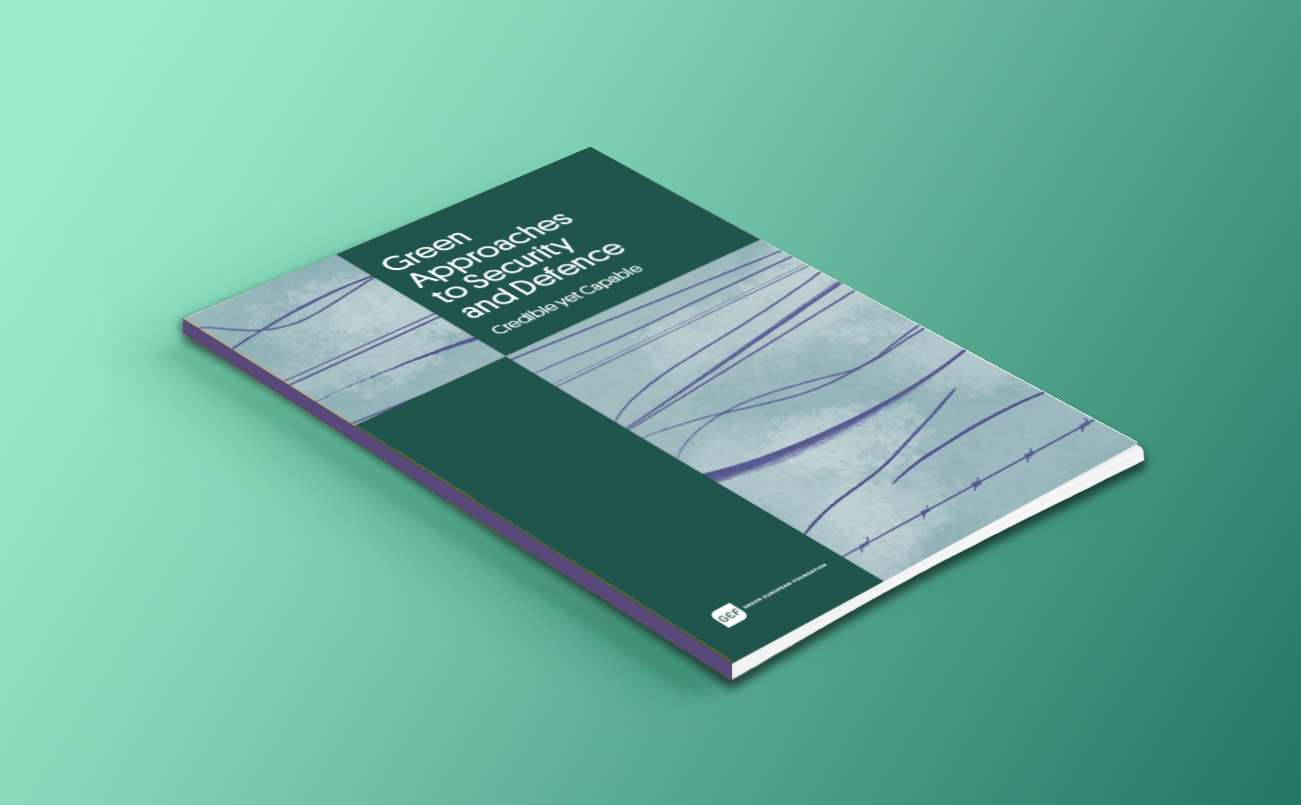
Green Approaches to Security and Defence

By Publications

In a shifting geopolitical landscape, Greens are grappling with the interplay between their traditional pacifist roots and the post-February 2022 security challenges. This report delves into their evolving stances on key defence issues, from EU military cooperation to disarmament, offering insights into the varied approaches adopted by Green parties from eight EU countries. Expert viewpoints featured throughout provide further feedback and inputs as to what a Green defence policy could (or should) look like. As Europe navigates turbulent waters, the report calls for renewed commitment to progressive and principled approaches to security and defence.

The report is structured into five chapters that address important EU military challenges. They portray a nuanced understanding of European security dynamics among Green parties, reflecting varying national contexts, strategic cultures, and historical perspectives. This report thus provides a clear mapping of green defence thinking across Europe, including points of convergence, gaps, and tensions. Complemented by the expert views, it gives a solid basis for further discussion within and beyond the Greens, to strengthen defence and security policy while maintaining a critical and progressive voice, even in uncertain times.

Chapter 1 delves into the complex institutional landscape of security and defence in Europe. It examines the debates surrounding the identity of the EU and looks at the respective roles of the EU and NATO as security providers.

Chapter 2 focuses on military expenditures and budget allocation. It discusses differing perspectives among Green parties on the use of GDP to set defence government budgets and on how these should be allocated.

Chapter 3 explores Green parties’ opinions on defence industrial policies broadly understood. It examines Green positions on grant programs put in place by the EU and shows diverging opinions on the allocation of public funds to industry.

Chapter 4 analyses positions on nuclear deterrence, disarmament, and arms control. Green parties generally continue to oppose the doctrine of nuclear deterrence, but the war in Ukraine has led some to revise their position on its effectiveness.

Chapter 5 delves into the intertwined concepts of civic militarism, civil protection and non-violence; their implications for military involvement in security as well as civilian participation to defence.


This report is a call to action for Green parties to embrace their role as catalysts for progressive security policies. By navigating the complexities of modern security with creativity, Greens can contribute to shaping a peace-oriented, sustainable, and common European security architecture.


About the authors

Agatha Verdebout is a researcher and deputy director at GRIP. Her main area of expertise is international peace and security law.

Anne Xuan Nguyen is a researcher at GRIP. Working more broadly on security and environmental issues, she specializes in conflict-related pollution and its remediation.


This report is also available in:

GreekGerman


This study was conducted by the Green European Foundation with the support of Etopia , Cogito , Cooperation and Development Network Eastern Europe, and Sustainable Development Forum Green Window . The study was commissioned by GEF to the Groupe de recherche et d’information sur la paix et la sécurité (GRIP). It is published with the financial support of the European Parliament to the Green European Foundation. The views expressed in this publication are solely those of the authors and do not necessarily reflect the views of the European Parliament or the Green European Foundation.
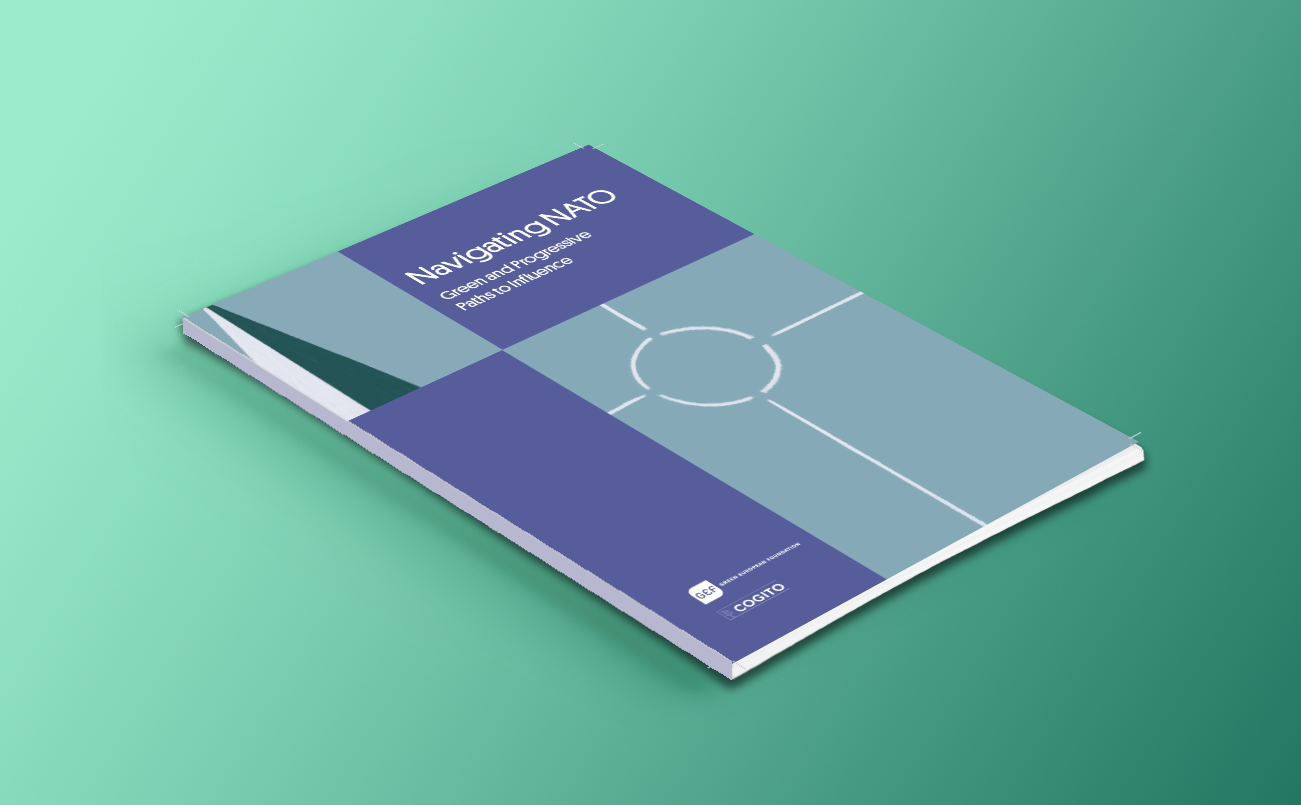
Navigating NATO

By Publications

Green and progressive parties across Europe have historically held a sceptical view towards the military industry and defence alliances such as NATO. Russia’s war of aggression against Ukraine spotlighted existing security vulnerabilities and profoundly shifted the public and political debate. In this context, Greens may have differing attitudes towards NATO, but find themselves in the political reality of not if but how to engage within it. Based on desk research and expert interviews from ten European countries, this report explores different ways that greens and progressives can influence NATO, and the risks and opportunities this entails.


It is important to bring alternative thinking into mainstream and conservative security spaces, and with more Greens in parliaments and governments across the continent, there is both the room and need for greater influence and expertise.


About the author

Sarah Bitamazire

Sarah Bitamazire is a policy expert on international human rights law and foreign policy work in conflict and high-risk environments. She is currently Chief Policy Officer at Lumiera, a boutique advisory firm with policy, tech, and business expertise that equips organisations with responsible AI strategies. Prior to this she was at the heart of the Swedish policy debate on defence and foreign affairs, developing policy ideas for the Swedish Greens. Sarah is specialised in Public International Law and Human Rights Law, and holds a Law Degree from Uppsala University and Leiden University.


This report is also available in:

GreekGerman


This study was conducted by the Green European Foundation with the support of Cogito. It is published with the financial support of the European Parliament to the Green European Foundation. The views expressed in this publication are solely those of the authors and do not necessarily reflect the views of the European Parliament or the Green European Foundation.
How Can Greens and Progressives Influence NATO? (Örebro)

By

About the event

Green and progressive parties across Europe have historically held a sceptical view towards NATO, with many deeming such a military alliance incompatible with disarmament and a shift towards non-military solutions to international conflicts.  

Yet with Sweden next in line to join NATO, there is a need to reckon with and respond to the current political reality, without losing track of the underlying values that guide our peace and security stances. 

To contribute to this crucial European debate, GEF commissioned a report, with the support of Cogito, that maps out stances towards NATO across Europe, but more importantly explores how greens and progressives can influence NATO in line with their own visions and priorities.   

Participants at this seminar will receive copies of the working paper and discuss its findings, guided by insights and reactions from our expert panel. 

Project background

With a focus on the Eastern flank of Europe, the 2022-2023 debates series seeks to enrich green and political ecology discourse. The series aim to provide spaces to hear the voices of green actors, peace and security experts, as well as partners from different regions. With the support of Cogito, GEF is delving specifically into the question of NATO and anchoring the green movement’s debates on this topic within its many historical and geographical dimensions. 

Speakers

  • Bodil Valero – former Green MEP, G100 Global Chair on Security and Defence  
  • Henrik Jalalian – Director of Swedish green think tank Cogito 
  • Jacob Risberg – Green MP and international spokesperson 
  • Sien Hasker – Programme Manager at the Green European Foundation 

Practicalities

Date and Time: November 18th (20:30 – 21:15 CET) 

Location: Olof Palmes Torg 1, 702 22 Örebro. Room: Mältaren 

Language: Swedish (with brief introductory remarks in English)   


This seminar is organised by the Green European Foundation, with the support of Cogito and the financial support of the European Parliament to the Green European Foundation.  

How Can Greens and Progressives Influence NATO?

By

About the event: 

Green and progressive parties across Europe have historically held a sceptical view towards NATO, with many deeming such a military alliance incompatible with disarmament and a shift towards non-military solutions to international conflicts.  

The Russian war of aggression against Ukraine shifted some of these stances, prompting extensive internal and external debates within the green movement, particularly in Western and Northern Europe. These debates have cast a light on the desperate need for a green and progressive policy path within security and defence issues, and revealed gaps that exist within green and progressive parties’ positions on military defence.  

To contribute to this crucial European debate, GEF commissioned a report with the support of Cogito that maps out stances towards NATO across Europe, explores how Greens and progressives can influence NATO, and asks specific questions around topics like nuclear disarmament or focusing on European defence cooperation instead.  

This webinar will present some key findings of the working paper, and discuss these questions further with a panel of interviewees.   

Project background: 

With a focus on the Eastern flank of Europe, the 2022-2023 debates series seeks to enrich green and political ecology discourse. The series aim to provide spaces to hear the voices of green actors, peace and security experts, as well as partners from different regions. With the support of Cogito, GEF is delving specifically into the question of NATO and anchoring the green movement’s debates on this topic within its many historical and geographical dimensions. 

Speakers:

  • Jacob Risberg, Miljöpartiet de gröna 
  • Atte Harjanne, Vihreät  
  • Merle Spellerberg, Bündnis 90/Die Grünen 
  • Andrés Ingi, Píratar 
  • Moderated by Sarah Bitamazire (report author) 

Practicalities: 

Date and Time: November 8th (20:30 – 22:00 CET) 

Language: English   

Registration: This is an online event, please register in advance via this link. 


This webinar is organised by the Green European Foundation, with the support of Cogito and the financial support of the European Parliament to the Green European Foundation. 

Geopolitics of a Post-Growth Europe: Rethinking Relations with the Global South?

By

About the event

Rivalries between states or political entities for sovereignty over a territory or a resource are often enough to justify the development of (often commercial) armed forces and alliances. Geopolitics, if it is to mean anything other than the analysis of this interplay of forces and influences, would therefore affirm that no state would voluntarily reduce its economy at the risk of being overpowered by another one not willing to make this sacrifice.

This generality about international relations partly explains the expansion of empires throughout history, and from this point of view, the great European and industrial powers are doing nothing new by colonizing, enslaving, and establishing asymmetrical trade relations.

What’s new, however, is that the intensity of the economic flows of industrial means of production is ravaging ecosystems and climatic balances. In other words, the economic growth of the major powers (exploiting resources extending far beyond their sovereign territories) is unsustainable.

In response, many intellectuals are striving to bring out a convincing macro-economic model of post-growth. These efforts are taking place when economic growth is slowing down, or even stagnating, and producing increasingly irreversible and lethal effects on the environment and people’s health.

Theoretical models of post-growth postulate that it is possible to reduce the intensity of physical and economic flows while maintaining a satisfactory standard of living.  That is to say, maintaining a “good standard of living” (with access for all to education, healthcare, leisure, culture…) without using fossil fuels implies developing a large-scale renewable energy system, which we know very well has a lower energy rate of return and requires large quantities of materials.

In any case, the abandonment of fossil fuels and the development of a decarbonized, non-growthiest economic model holds the seeds of new international relations and new balances of power.

Project background

This event is part of GEF’s project Geopolitics of a Post-Growth Europe, which explores the tensions between degrowth/post-growth and geopolitics. The project aims to ignite a conversation between critics of economic growth and progressive thinkers on foreign and security policy, who now often operate in separate circuits. It aims to find solutions beyond naïve anti-militarism and convenient belief in green growth. Find out more about the project and its findings at geopoliticspostgrowth.eu.   

Practicalities

Date and Time: Friday, July 7th (12:00 – 14:00 CEST) 

Location: Online, via Zoom 

Language: French 

Registration: This is a closed expert meeting. However, if you wish to learn more or receive an invitation, please get in touch with Kévin Puisieux via k.puisieux (at) fondationecolo.org. 


This expert meeting is organised by the Green European Foundation with the support of the Fondation de l’Ecologie Politique and the financial support of the European Parliament to the Green European Foundation. 

Peace and Security: The future of EU candidate countries

By

About the event

This online event is the third discussion of our Peace and Security Debate series. On this occasion, we will analyse how EU candidate countries have responded to the Russian invasion to Ukraine, more in particular whether their reaction were as expected and how their response affects their candidacy.

Project background

The goal of the Peace & Security Debate Series, organised by the Green European Foundation and Sustainable Development Forum Green Window, is to analyse different perspectives on the current crisis caused by the Russian invasion of Ukraine, and explore more generally the notion of peace and security in Europe.

Speakers

  • Ivan Novosel, House of Human Rights
  • Nataša Beširević, PhD, consultant on EU projects in the Western Balkan and Eastern Neighbourhood regions, evaluator on the Horizon Europe program
  • Gwendoline Delbos-Corfield, Member of the European Parliament, Greens/EFA

The discussion will be moderated  by Marko Popović, expert Adviser at the Ministry of Labour, Pension System, Family and Social Policy, who is also a founder and a member of Sustainable Development Forum Green Window.

Date and Time: December21st, 6pm-7:30pm CET

Location: Zoom

Language: This event will take place in Croatian.


This conference  is organised by the Green European Foundation with the support of  Forum Green Window and the financial support of the European parliament to the Green European Foundation. 

Debate series: Cybersecurity in the EU

By

About the event

This online event is the third discussion of our Peace and Security Debate series. On this occasion, we will analyse the role of cyber security in achieving and maintaining peace and security in the EU. What does cyber security mean? Why is it essential to maintain peace and security in the EU? What were the main events and incidents in 2022? What are the EU’s vision on this issue and future prospects?

Project background

The goal of the Peace & Security Debate Series, organised by the Green European Foundation and Sustainable Development Forum Green Window, is to analyse different perspectives on the current crisis caused by the Russian invasion of Ukraine, and explore more generally the notion of peace and security in Europe.

Speakers

  • Mirko Bilandžić, PhD, professor at The Faculty of Humanities and Social Sciences at the University of Zagreb
  • Zlatan Morić, head of the department for cyber security, Algebra University College
  • Markéta Gregorová, Member of the European Parliament, Greens/EFA

The discussion will be moderated by Kaja Pavlinić, president of Sustainable Development Forum Green Window. 

Practicalities

Date and Time: February 6th, 6pm-7:30pm CET

Location: Zoom

Registration Link: Sign up here.

Language: This event will take place in Croatian.


This conference  is organised by the Green European Foundation with the support of  Forum Green Window and the financial support of the European parliament to the Green European Foundation. 

Debate series: Security and Peace Forum (Zagreb)

By

About the event

The Conference represents the final event of the Peace and Security Debate Series project in Croatia. It aims to focus on the role of politics, civil society and the Green movement in securing peace and security as well as human and women rights as the main victim in establishing peace and security. We will also highlight the how disinformation and fake news influence the public image in the times of political conflict. We will have three panel discussions, followed by a networking reception. We invite all politically interested citizens to join us.

Project background

This conference represents a final event in the scope of the Peace and Security Debate Series project. The main objective is to explore different perspectives of peace and security on the level of the European Union. In the scope of the project, we have organized three online events, and this conference represents a final activity that will push the discourse on the topic even further.

Programme and speakers

09:30 – 10:00 Arrivals and registration

10:00 – 10:15 Opening of the conference

  • Kaja Pavlinić, president of Sustainable Development Forum Green Window
  • Vedran Horvat, Board of Directors of Green European Foundation
  • Gwendoline Delbos-Corfield, Member of the European Parliament, Greens/EFA

10:15-11:45 The role of politics, civil society and the Green movement in securing peace and security

  • Moderator: Marko Popović
  • Introductory keynote: Christina Kessler, Federation of Young European Greens – introductory keynote

Panel speakers

  • Vedran Horvat, Institute for Political Ecology
  • Marta Zorko, Faculty of Political Sciences, University of Zagreb
  • Representative of Croatian Parliament from Možemo! coalition (tbc)
  • Igor Vidačak, Faculty of Political Sciences, University of Zagreb

11:45 – 12:00 Coffee break

12:00 – 13:30 Human and women rights as the main victim in establishing peace and security

  • Moderator: Kaja Pavlinić, president of Sustainable Development Forum Green Window
  •  Introductory keynote: Mélanie Vogel, European Green Party

Panel speakers

  • Ana Gvozdić, Youth Initiative for Human Rights
  • Sanja Sarnavka, Solidarna
  • Lucija Azinović Rebić, Are You Syrious
  • Representative from B.a.B.e (TBC)

13:30 – 15:00 Lunch

15:00 – 16:30 Disinformation and fake news in the times of political conflict

  • Moderator: Kaja Pavlinić, president of Sustainable Development Forum Green Window
  • Introductory keynote: Konrad Bleyer-Simon, Centre for Media Pluralism and Media Freedom

Panel speakers

  •  Ivana Dragičević, N1
  • Hrvoje Krešić, N1
  • Radoslav Dejanović, Anthropos Metron and the author of the Guide for Media Literacy16

16:30 – 16:45 Closing

16:45 – 17:45 Networking with refreshments

Practicalities

Date and Time: February 25 from 09:30 to 17:45

Location: conference hall of the Timeout Heritage hotel in Zagreb (Ilica 16, 10 000 Zagreb). 

Language: Working language of the conference is Croatian, with the exception of some speakers who will join the event in hybrid format and will speak in English.

Registration:

  • Registration is open until February 23. You can register on the following link.
  • For all additional questions, you can contact the organizing team via info@zeleniprozor.hr 
  • Since we have very limited capacity (maximum of 25 participants), registration is obligatory, and all participants will receive a final confirmation of participation 24 hours after registering. In case you are not able to attend, please reach out to us so we can give this spot to someone else.

Additional information: Lunch and refreshments are covered for all participants, and we will additionally send certificates of participation.


This conference  is organised by the Green European Foundation with the support of  Forum Green Window and the financial support of the European parliament to the Green European Foundation. 

The Green movement’s vision for peace & security

By

Context

With a focus on the Eastern flank of Europe, the 2022-2023 debates series seeks to enrich green and political ecology discourse. The series aim to provide spaces to hear the voices of green actors, peace and security experts, as well as partners from different regions. The goal of the Peace & Security Debate Series project, which we are developing in cooperation with the Czech organisation Institute for Active Citizenship, is to analyse the different approached to the crisis caused by Russia’s invasion of Ukraine, as well as other topics related to peace and security at a European level.

About

The discussion during this roundtable will explore how the Czech green movement has approached issues such as security, foreign policy and pacifism and what positions it should advocate for in the future. This event will also touch upon the European Green Charter as a document that frames the basic principles of green politics and will consider improvements in security and pacifism in light of current circumstances.

Speakers

  • Janek Rovenský, Greenpeace CZ
  • AKárníková, Friends of Earth CZ
  • Hana Svačinková – Nesehnutí
  • Irena Hůlová, Amnesty CZ
  • Petr Kutílek – Green Party CZ
  • Josef Patočka – re-set.cz
  • Míla O’Sullivan, Centre for Global Political Economy, Charles University

Moderation by Adéla Jurečková, Head of Office, Heinrich Boell Stiftung Prague

Practicalities

Date and Time: December 12 from 16:00-17:30 CEST

Location: Heinrich Boell Stiftung Prague Office, Jugoslávská 567/16,120 00 Prague 2, Czech Republic

Registration:  This is a closed event


This event is organised by the Green European Foundation with the support of Institute for Active Citizenship and with the financial support of the European Parliament to the Green European Foundation. The Euroapean Parliament is not responsible for the content of this event.

Peace & Security Debate Series: EU Responses to the War

By

Context

With a focus on the Eastern flank of Europe, the 2022-2023 debates series seeks to enrich green and political ecology ideas and actors and provide spaces to hear the voices of green actors, peace and security experts, as well as partners from the region. The goal of the Peace & Security Debate Series project, which we are developing in cooperation with the Croatian organisation Sustainable Development Forum Green Window , is to analyse the current crisis caused by Russia’s invasion of Ukraine, as well as other topics related to peace and security at a European level. The project comprises three online discussions and a one-day conference that will take place in February 2023.

About

The first discussion will focus on the causes of the war outbreak and the course of the conflict itself in the period from February to November 2022. Speakers will discuss the first reactions of the EU member states in the first weeks of the war and how they affected the internal relations between the member states and NATO. Likewise, they will compare the positions of Ukraine and Russia in the conflict and try to assess the consequences for both countries and whether a peaceful future is possible.

Speakers

  • Davor Boban: Faculty of Political Sciences, University of Zagreb
  • Đana Luša: Faculty of Political Sciences, University of Zagreb
  • Senada Šelo Šabić, dr.sc.: The Insitute for International Development and International Relations, Senior Research Associate
    Moderator : Marko Popović


Practicalities

Date and Time: November 17 from 18:00-19:30 CEST

Location: Online via Zoom & Facebook Livestream.

Registration: Please register here.


This event is organised by the Green European Foundation with the support of Green Window and with the financial support of the European Parliament to the Green European Foundation. The Euroapean Parliament is not responsible for the content of this event.