
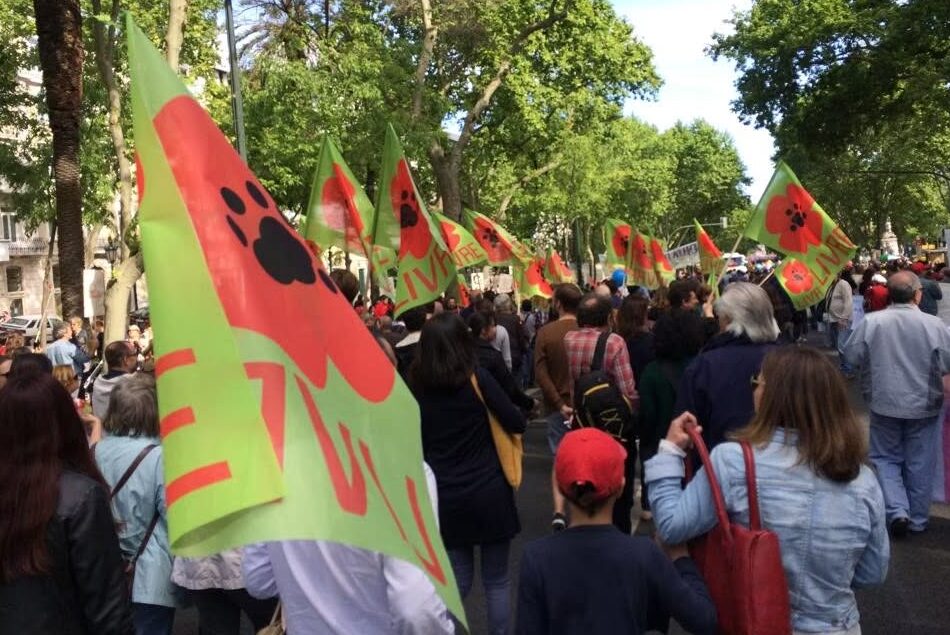
Rui Tavares is a Portuguese writer, historian, and member of the parliament for the left-green-libertarian party LIVRE. He is the author of the documentary film Ulysses: Breaking the Spell of the Crisis to Save Europe. He was formerly an MEP for Greens/EFA.
In this interview by Jamie Kendrick, Rui Tavares talks about the green movement’s place in the turbulent history of democracy in Portugal and brings back memories of these nuances times.
You can watch the interview on our YouTube channel.
Would you like to introduce yourself and tell us how your personal story leads to LIVRE?
I was born in Portugal in 1972, still under the dictatorship. Our democratic revolution was in April 1974, when I was less than two years old. This context is crucial for our conversation because it reveals that Portuguese democracy and green parties in Europe are both children of the early 1970s, today around 50 years old.
Portugal always had a lively ecological movement, but we waited for a long time for a green party with an autonomous strategy. There is a green party, Os Verdes, which is also a member of the European Green Party, but they have always run in coalitions. Part of the reason we founded LIVRE is that, as Portugal was becoming a democratic country in the ‘70s and ‘80s, we looked to the rest of Europe and saw green parties forming and entering parliament – and we longed for that kind of politics here too.
I didn’t want to go into politics; I wanted to be a historian. But like many kids of my generation in Portugal, I was fascinated by politics. We were living through a move from a conservative dictatorship into a dynamic democracy where everybody was discussing politics all the time. Kids played in the street and called each other fascists or communists. Politics was in the air all through the ‘70s before the great normalization in the ‘80s when everything became a bit blander.
A few decades later, Portugal enters its austerity period in the 2010s, and the progressive part of politics seemed to be stuck with no solutions or ideas. LIVRE was founded by a group of people, me among them, who were doing different things and were very reluctant to form a party. But we felt that it was needed. Now 12 years on, we’re happy that we did it and our focus is on building a party that is viable, self-sustaining, and that puts down roots.
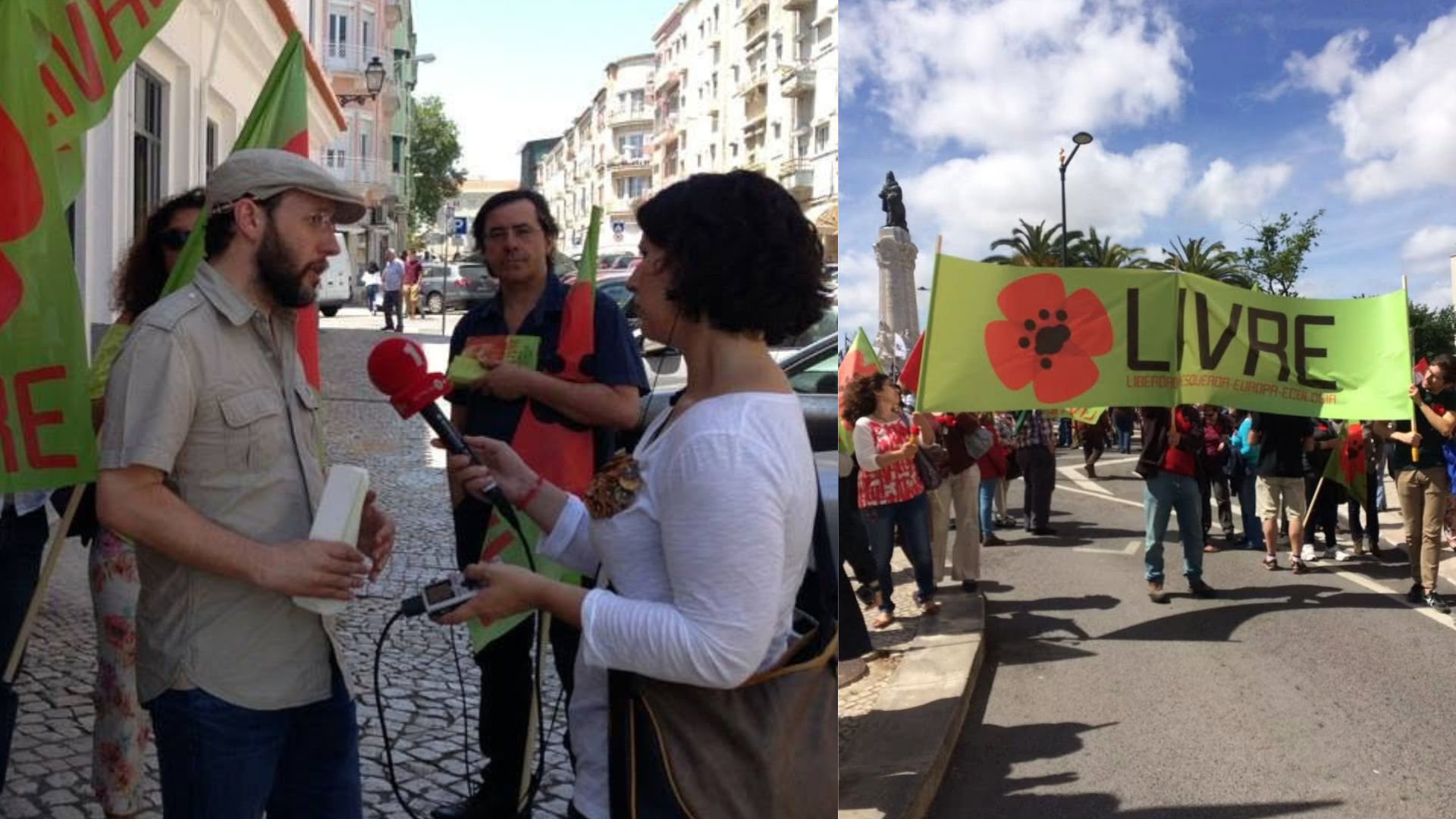
The party is called LIVRE, free. What’s in the name?
Our reasoning was that we should reclaim the idea of freedom that had been usurped by the right wing, by neoliberals, right-wing libertarians, and even authoritarians. And I don’t blame them; I blame us. We let them get away with a certain caricature whereby the Right cares about freedom and the Left cares about equality.
In 2012, even before the party was founded, we published a Manifesto para uma Esquerda Livre (Manifesto for a Free Left). The idea was to put freedom first and foremost and claim freedom as a progressive and left-wing idea. All our values, principles and demands flow from the idea that you should be free, and free in a far richer way than how the right-wing portrays freedom.
The right-wing notion of freedom is at most non-interference from the state (when they are not being completely insincere). The left-wing perspective, which is a multi-tradition blend drawing from anarchism, republicanism, socialism, left liberalism, political ecology and so on, is rather about self-realisation of your potential on one hand and not being dominated on the other.
Philosopher Philip Pettit would describe this as freedom as non-domination: even if you live well and are comfortable, if you depend on the goodwill of someone who can withdraw it at any moment, then you are not free. From a more anarchist point of view, which is my original political tradition, they would say that you cannot be free if your brother is a slave. In other words, you cannot be free on your own. To be free, you must have a society that is, in broad terms, free.
Portugal has a very strong and diverse left-wing tradition with a strong Socialist Party, an influential Communist Party, and a more recent radical-left party BLOCO. Why found LIVRE as an autonomous political force?
The reason is broader than our emphasis on freedom and broader than Portugal. So far in this new century, we have let the right-wing act and then organised the reaction. If they want a smaller state, if they want reformed and more precarious jobs, if they want to extract and industrialise, we progressives are the ones who say no.
The end point is a paradoxical inversion of the political poles whereby the progressives end up as the conservatives, defending the National Health Service in the UK or the Constitution in Portugal. During the austerity period, we recognised that the tables had to be turned. We had to go back to a politics where we could talk about the future and make them react to our proposals.
Creating a force that was creative and different was very historically grounded project in Portugal. The anarchist movement was very powerful at the turn of the 20th century; they ran trade unions, schools, and the third-biggest daily newspaper in the country. Growing up, I would visit the anarchist newspaper every Saturday and be greeted by people in their eighties and nineties who were the children of the anarchist trade unionists and journalists of the 1910s and ‘20s.
These are not our only roots. LIVRE was also formed by environmentalists from NGOs, by pro-Europeans of the Erasmus generation; we do not repudiate the social democratic tradition either. But this half-forgotten anarchist tradition is important to us. To me, it makes sense to recover that older history and reclaim that memory through a form of almost archaeological political work.
Why was this tradition, which today forms part of LIVRE’s heritage and that of political ecology more broadly, neglected?
Portugal’s 20th century is divided by a long dictatorship that lasts 48 years, longer than almost all dictatorships in eastern Europe except for the Soviet Union. Portugal was democratic or at least liberal at the beginning of the 20th century. Throughout the last decade of the monarchy and the first 16 years of the Republic, we had a lively political and social scene; however, with the dictatorship, its protagonists were sent to concentration camps. Some died in Cabo Verde or Angola; others were imprisoned. Their sons and daughters reformed the anarchist movement after the weight of the dictatorship was lifted and LIVRE even had a couple among our founders.
The social space that, in the 19th and 20th centuries, existed in the form of the cooperative movement, the mutual aid and the feminist movement can be seen as a proto-ecologist movement that did not yet have that name. From the late 20th century on, consciously or unconsciously, the green movement and green parties have occupied this social space. When you look at it that way, there are many examples. The magazine published by anarchist Emma Goldman was called Mother Earth. Here in Portugal, there was a Georgist-inspired magazine called Terra Livre or free earth.
How have you translated these ideals and roots into a green politics for a western European country in the 2020s?
In the very beginning, our tactical problem was that the progressive movement in Portugal did not work together. Sectarianism blocked any pragmatism on government formation. This division weakened us during the austerity period when our country was going through every progressive’s nightmare. Every three months, the IMF, the European Commission, the Portuguese central bank and the ECB would tell the country what we could spend and not spend, whether or not we deserved the next tranche of crisis loans. Of course, we had our faults, but the crisis was a Eurozone crisis and we were collateral damage.
At the time, our right-wing government was feeding the European institutions the idea that our problem was our constitution. Because the Portuguese constitution was a latecomer in ‘76, it is very progressive. It not only protects social and employment rights, but it was the first in the world to enshrine environmental rights and treat the environment as a kind of political subject in and of itself. In the 2010s, right-wingers in Portugal tried to trace all our issues from our supposed “backwardness” to our budgetary problems to our constitution. They are still trying to this day.
So, our first job was convincing the Left to work together and overcome the sectarianism that dates back to the enmities of the ‘70s and ‘80s. We spent two years building platforms to help the Left work together and, though LIVRE missed out on Parliament and were not part of it, we ended up as the intellectual force behind the Geringonça or “contraption”, the informal alliance of centre-left and radical-left that took Portugal out of the crisis years.
Not being in government allowed us to grow out of this tactical phase and develop a deeper reflection about our idea of the world, which for LIVRE is strongly cosmopolitan and pro-European. Pro-Europeanism was not easy in Portugal for understandable reasons. Much of the Left was denouncing the European Union as neoliberal and arguing that we should have nothing to do with it. Our position was that the crisis was a tragedy, that the choices that were made and what was done to Greece were grievous injustices, but that the European project is an important project and we need it to get through the very selfish politics that are fuelling tension, instability and conflict everywhere. With Trump’s election, this has only become more apparent.
However, you cannot have a national party only with a philosophy; you must have a national project. You must be part of the narrative that the country invents for itself. Portugal’s economic model is based on mass tourism and low wages. We propose a new development model inspired by the Green New Deal that offers a vision of environmental justice and social justice at the same time.
We insist on fighting prevailing pessimism that only disappoints and demobilises people. That is why we stumbled upon the idea of objects of political desire. What is an object of political desire? It’s something that people should visualize, that if they do visualise, they will strive for. Unlike objects of desire deriving from consumption, an object of political desire is something that to get it, you need to mobilise.
As the unions and feminist movement did throughout the 19th and 20th centuries, we need proposals, like the 8-hour working day or votes for women, that people want and will fight for. This is what made the movements back then so dynamic, lively and strong, even if, scarily, when we compare it with our own situation, they ultimately lost to fascism. Considering the far right’s strength in Europe and the world today, rebuilding progressive civil society is key, and we need to learn fast.
Who are your members, who is voting for you, and who are your allies in civil society?
We are still a young party, 12 years old. If I have been talking about the past, that is because it inspires strategies for the future. We have recently created a green foundation, but there are many ideas from the past that are still to be implemented. I dream of us establishing a cooperative that runs alongside the party and a popular university the likes of which used to exist in Lisbon 100 years ago.
The Portuguese electoral system favours medium-sized parties like ours in urban areas. Of course, many people in rural areas and villages see the world in ways that resonate with us, but for the time being our support is concentrated in the cities. Creating networks to bring together supporters in rural areas is one important task for the future.
We place a lot of importance on being an optimistic and even playful party; you can see that in how we communicate and our graphic design. The left wing tends to be very pessimistic, but criticising the EU and capitalism is not enough; you have to have victories. Victories are essential to convince people to come to you. Being depressing is not a good selling point.
Being happy, optimistic, playful- who does this attract? In the first stages, younger people in urban areas, and this group makes up the core of our members. We are what political scientists would call a voters’ party. LIVRE is not a mass party, nor a technocratic party or a cadre party. We have lots of PhD and Master students among our members and many people who are already active in NGOs and local associations. Many members see LIVRE as a platform where they can do party politics on the side and still go back to what they enjoy most, be it theatre, stand up, protecting the forest.
In the future, and to become a party that has depth, breadth but also longevity, being a LIVRE member needs to bring you something that helps you in what you do every day. Running a cooperative alongside the party could help people access services and goods, be them social or cultural or even vacations. Another dream is to have a network of independent bookshops in our party headquarters across the country. The anarchists knew all about this. A boring party with a staid party headquarters on the second floor of a nondescript office building will not attract people. A headquarters on the ground floor with a nice cafe and bookshop will draw people in.
LIVRE has just under 5000 members, in a country of 10 million people with low levels of civic engagement. We aim to reach 20 or 25,000 members across Portugal and the diaspora. Being a party member should not just to be about proposing amendments and going to meetings but all sorts of cultural activities. Organising a cultural festival or running a network of workers, that is the kind of practical party that we would like to build. We cannot recreate the mass or class-based parties of the past, but we can offer a new vision for a practical and networked party that speaks to people.
LIVRE got its best-ever result at the Portugal parliamentary election in 2025, returning six MPs. What is the plan now? How are you balancing entering the legislative game with this longer-term vision for the party as a social institution?
LIVRE is now in a position where it can aim to get 20 MPs in the future. We need to win votes back from the right and far right and recognise that their supporters are not lost but that they are our neighbours, colleagues and cousins who used to vote for the Left and can be convinced to do so again.
I do not find entering the legislative game very satisfying in and of itself, but there is a taboo that we must break: we want to govern. Governing in Portugal is usually seen as something for the centre-left Socialist Party. They are the reformists, they won the revolution, and they see themselves as the country’s natural party of government. This also means that they are completely lost when they are in opposition. The other left-wing parties, who are now smaller than LIVRE, come from the revolutionary tradition. They always have been and are deeply uncomfortable being in government, supporting one, and even entering negotiations. LIVRE is clear and has been for many years: we want to be in government and not just offer external support. We want to have ministers and secretaries of state. We are confronting this taboo head-on. This has never been done by left-wing parties; it is a huge challenge, but an opportunity may come early in the life cycle of our party.
The local level will be the most creative and interesting part of politics for LIVRE going forward. We now have 60 elected local representatives. Our objects of political desire strategy shines most brightly at the local level. We have for example proposals for urban paths that bring nature back to our streets, and these have proved to be ideas that attract people. The local level is where we are learning the most, and where people are listening the most; it is where we are going to make the greatest difference in the short term.
All the good ideas that people see in and hear about from Berlin, Amsterdam and Paris, LIVRE is carrying those ideas through our elected councillors. In the next cycle, I believe that LIVRE is going to enter local majorities and start competing for mayors.