
Publications26

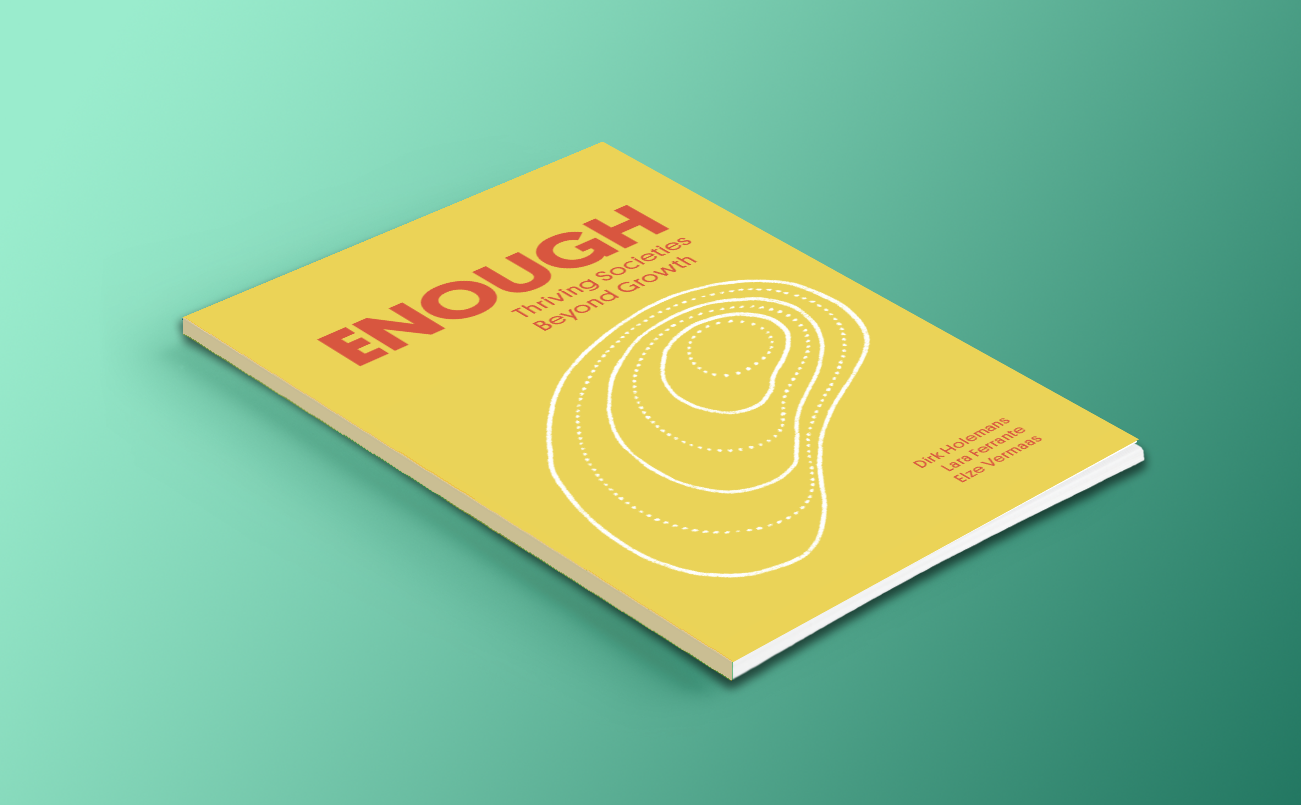
Enough – Thriving Societies Beyond Growth

By Publications

The ecological crisis shows that infinite growth on a finite planet is impossible. Meanwhile, the current economic system fails to secure livelihoods and exacerbates inequalities. There is an alternative to this self-destructive system: an economy of enough, which would provide for everyone’s basic needs while addressing greed and overconsumption.

The EU has the potential to lead the ecological transition. Although the Green Deal was a significant step forward, it remains entrenched in a growth-addicted economy centered on competition within a single market, and it does not sufficiently address social inequality. We need to envision a different European economy, rooted in a new paradigm, before we can build it.

In this essay, the authors build on the work of visionaries, both past and present, recognising that Earth is on loan to us from future generations. They explore how societies can thrive without depending on economic growth. The essay presents a compelling vision: fewer private jets, less inequality, fewer burnouts, and reduced waste, alongside more quality of life, more time for each other, more sustainable products, and a healthier planet. In other words, this essay provides the keys to imagining a different Europe – one that ensures a good life for everyone within the planet’s limits.

The ecological crisis in its entirety, including climate change, biodiversity loss and all its other facets, is without doubt the greatest challenge of our lifetime. […] For this reason, grand projects like the European Green Deal have begun to address social dimensions to guarantee that the transition is a just one.

About the authors

  • Dirk Holemans is director of Think Tank Oikos and former co-president of the Green European Foundation.
  • Lara Ferrante is a staff member at Oikos and wrote a master’s thesis on degrowth.
  • Elze Vermaas is a staff member at Oikos and former vice-chair of the Dutch young green think tank Jong Wetenschappelijk Bureau GroenLinks.


Endorsements

“Have you ever wondered how our social, economic and ecological crises are connected, and what we could do about them? This short and perfect book demonstrates how a ‘Wellbeing Economy For All’ addresses the interconnected crises of our time, and imaginatively motivates us to be part of its realization.” — Julia Steinberger


“For too long, the planetary crisis has loomed as a monstrous inevitability. But what if we dared to imagine otherwise? Enough paints a vibrant picture of a society that has transcended the limitations of endless growth, prioritising ecological well-being and human connection. It takes on the difficult task of envisioning a future where societies can thrive beyond the shackles of constant expansion and in harmony with the natural world.” — Amitav Ghosh


“This book does crucial work in offering vision, delivering hope and providing a way forward from a world where we are trashing the planet while creating miserable societies. It works towards a model for living within the limits of this fragile planet while allowing humans to thrive in a healthy future.” — Natalie Bennett


“Enough is a brilliant combination of imaginative vision, conceptual clarity and concrete proposals. A necessary handbook for an ecological civilisation.” — Roman Krznaric


“Enough challenges us to look beyond the current economic models that form the root cause of the climate crisis. If our human society is to survive this century, fundamental change is inescapable. This means embracing enough, coupled with a profound decolonisation of current world relations and building true democracy.” — Anuna De Wever


Book tour

With book tour events across Belgium, Croatia, Ireland, the UK, Finland, and Sweden, GEF is using this book to spark conversations across the continent on how Europe can reconcile social and ecological justice in a wellbeing project for all. You can watch the recordings here. 


This publication has been realised with the support of Oikos Think Tank and the financial support of the European Parliament to the Green European Foundation. The European Parliament is not responsible for the content of this publication.
A European Green Caring Society: Overcoming Fragmentation

By Publications

About

This policy brief examines the interconnections between care for the climate, biodiversity and the environment on the one hand and care for humans on the other. We argue that the related systems are currently in a twin crisis and advocate for integrated political solutions. As Europe transitions from a legislative term dominated by a pandemic and an escalating ecological emergency, which required significant green and human care policy initiatives, the new mandate presents an opportunity to unify these agendas and strengthen both systems. Adopting a green caring society approach can foster collaboration among decision-makers committed to a sustainable, resilient, and positive European future. Key proposals include extending the Do No Harm principle to encompass both human and environmental care, fostering a green care sector, implementing ecological and progressive tax reforms, establishing a People’s Sovereignty Fund and creating a new Commission Vice-Presidency for Caring Societies. These initiatives aim to bridge policy silos, promote sustainability, and ensure social equity, thus fostering a resilient and inclusive European society. This approach can bring the EU closer to its citizens and enhance overall well-being while respecting the planet’s boundaries. This unified approach of green and care policy strands has the potential to significantly enhance public support for the European project and ensure a sustainable, resilient future for all.


Contributors

  • Céline Charveriat, Core expert of this Knowledge Community, the Founder and Director of Pro(to)topia and Adjunct Professor at PSIA. She is an independent environmentalist and former Executive Director at the Institute for European Environmental Policy (IEEP).
  • Taube Van Melkebeke is Head of Policy at the Green European Foundation (GEF). She leads the different Knowledge Communities of the foundation. For further information, contact her at taube.vanmelkebeke@gef.eu.


This policy brief has been realised by the Green European Foundation with the financial support of the European Parliament to the Green European Foundation. The European Parliament is not responsible for the content of this publication.
The Future of the EU’s Energy Project: Democratic dimension

By Publications

About

This policy brief considers the democratic dimension of the EU’s energy project. It looks at the links between political systems, energy sources and technological systems, as well as the democratic challenges and opportunities created by the need to drastically change our energy production and consumption patterns.

It is the last of four briefs exploring the various dimensions of the EU’s energy project, all based on expert input and discussions among the GEF Knowledge Communities. The other three deal with energy security, the social dimension, and climate and sustainability. 

Energy democracy can be seen as the glue binding all these other dimensions together, since it is relevant across the full spectrum of energy issues: continuity of supply, access, affordability and sustainability. It is therefore critical to the success of the energy project as a whole. To move its agenda forward, we propose a framework based on various governance levels, at which the democratic dimension of energy can be implemented and strengthened.


Contributors

  • Benjamin Denis is a Senior Policy Advisor and Head of Industrial Policy Coordination at IndustriAll Europe.
  • Joanna Maćkowiak-Pandera is the Founder and Head of Forum Energii.
  • Antoine Oger is the Research Director for Global Challenges and SDGs at the Institute for European Environmental Policy (IEEP).
  • Jesse Scott is Adjunct at Hertie School Berlin and Visiting Fellow at DIW Berlin.
  • Taube Van Melkebeke, Head of Policy at the Green European Foundation (GEF). She leads the different Knowledge Communities of the foundation. For further information, contact her at taube.vanmelkebeke@gef.eu.


This policy brief has been realised by the Green European Foundation with the financial support of the European Parliament to the Green European Foundation. The European Parliament is not responsible for the content of this publication.
The Future of the EU’s Energy Project: Climate dimension

By Publications

About

This policy brief considers the climate and sustainability dimension of the EU’s energy project. It identifies several gaps in the current state of the EU’s climate and energy intersection and delves into emerging needs, concerns, priorities, and potential unintended consequences of the green transition policy.

We propose closing existing policy gaps, strengthening the climate dimension of the EU’s energy project from a holistic point of view. This includes focusing on key areas such as:

  • Monitoring and long-term strategic planning of both targets and infrastructure;
  • Renewed European solidarity;
  • The need to look outside of the EU borders.
This is the third out of four briefs that delve into different dimensions of the EU’s energy project. All these briefs are informed by expert insights and discussions within the GEF Knowledge Communities.  The remaining three focus on energy security, social aspects, and democracy.


Contributors

  • Benjamin Denis is a Senior Policy Advisor and Head of Industrial Policy Coordination at IndustriAll Europe.
  • Joanna Maćkowiak-Pandera is the Founder and Head of Forum Energii.
  • Rosa Martínez is the State Secretary for Social Rights in Spain.
  • Antoine Oger is the Research Director for Global Challenges and SDGs at the Institute for European Environmental Policy (IEEP).
  • Jesse Scott is Adjunct at Hertie School Berlin and Visiting Fellow at DIW Berlin.
  • Taube Van Melkebeke, Head of Policy at the Green European Foundation (GEF). She leads the different Knowledge Communities of the foundation. For further information, contact her at taube.vanmelkebeke@gef.eu.


This policy brief has been realised by the Green European Foundation with the financial support of the European Parliament to the Green European Foundation. The European Parliament is not responsible for the content of this publication.
Navigating NATO

By Publications

Green and progressive parties across Europe have historically held a sceptical view towards the military industry and defence alliances such as NATO. Russia’s war of aggression against Ukraine spotlighted existing security vulnerabilities and profoundly shifted the public and political debate. In this context, Greens may have differing attitudes towards NATO, but find themselves in the political reality of not if but how to engage within it. Based on desk research and expert interviews from ten European countries, this report explores different ways that greens and progressives can influence NATO, and the risks and opportunities this entails.


It is important to bring alternative thinking into mainstream and conservative security spaces, and with more Greens in parliaments and governments across the continent, there is both the room and need for greater influence and expertise.


About the author

Sarah Bitamazire

Sarah Bitamazire is a policy expert on international human rights law and foreign policy work in conflict and high-risk environments. She is currently Chief Policy Officer at Lumiera, a boutique advisory firm with policy, tech, and business expertise that equips organisations with responsible AI strategies. Prior to this she was at the heart of the Swedish policy debate on defence and foreign affairs, developing policy ideas for the Swedish Greens. Sarah is specialised in Public International Law and Human Rights Law, and holds a Law Degree from Uppsala University and Leiden University.


This report is also available in:

Greek – German


This study was conducted by the Green European Foundation with the support of Cogito. It is published with the financial support of the European Parliament to the Green European Foundation. The views expressed in this publication are solely those of the authors and do not necessarily reflect the views of the European Parliament or the Green European Foundation.

A European Single Market for the Future

By Publications

About

The Single Market is a key lever to enable and promote the environmental and social transitions, as well as to strengthen the EU’s economic resilience. To achieve this potential, however, a radical shift in focus is required. This policy brief suggests a new social and environmental pact for the Single Market, based on systemic quality: quality of product, of work and of life. This pact can bring together employers interested in quality products, workers and trade unions championing dignified labour conditions and NGOs and citizens advocating for a better quality of life and sustainable climate practices. By piloting the pact in three areas – circular economy, green industrial policy and public procurement – first concrete steps can be taken.

Contributors

  • Philippe Pochet, GEF fellow and core expert to this Knowledge Community. In the past, he held the position of Director of the Observatoire Social Européen (OSE) for over 15 years. From 2008 to 2023, he served as the General Director of the European Trade Union Institute (ETUI). Currently, he is a Professor at the Catholic University of Louvain and a Visiting Professor at the College of Europe in Bruges. He also holds the position of Affiliate Professor at Sant’Anna School of advanced studies, Pisa. Next to the topic of the Single Market, Philippe is also collaborating with GEF on Climate Emergency and Welfare States.
  • Taube Van Melkebeke, Head of Policy at the Green European Foundation (GEF). She leads the different Knowledge Communities of the foundation. For further information, contact her at taube.vanmelkebeke@gef.eu.


This policy brief has been realised by the Green European Foundation with the financial support of the European Parliament to the Green European Foundation. The European Parliament is not responsible for the content of this publication.