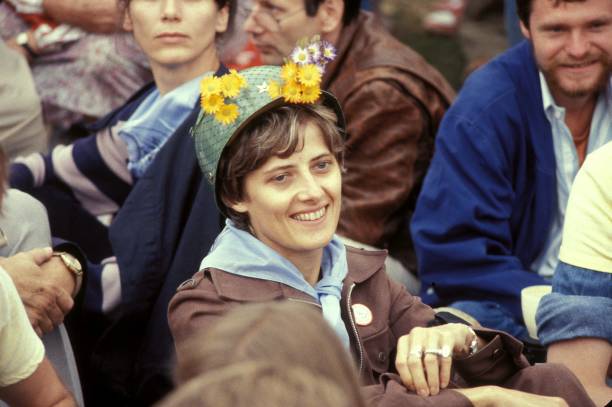
Petra Kelly – 2 September 1983 © Gaby SOMMER/Gamma-Rapho via Getty Images
Authors: Alice Hubbard, Head of Network and Development Unit at GEF, Jamie Kendrick, Head of Policy and Research Unit at GEF, and Laurent Standaert, Director of GEF
This article is the product of a discussion between the authors and Vesna Jusup (former Head of Policy, Strategy, and Capacity Development, European Green Party), and Özgecan Kara (former Secretary General, Federation of Young European Greens).
Can the Greens Chart a Path through the Disorderly 2020s?
The 2020s are a pivotal decade, both for the Greens and the world at large. The Greens really began to feel their feet in the 1990s and early 2000s, back when the “end of history” promise of progress was the spirit of the times. What succeeded it has been at least a decade and a half of disorder. Liberal democracy’s struggle to grapple with populism and right-wing authoritarianism, profound technological change, and growing environmental crisis to which the uncertain energy transition is only a partial answer are central elements of this new disorder.
This same context is also the backdrop for green politics in Europe gaining more political power than ever before. Energised by the global climate awakening, Green parties entered government in 7 EU countries between 2018 and 2021. Their surge pushed the European Commission to put forward its European Green Deal, an ambitious regulatory agenda centred on reaching “net zero” carbon emissions by 2050.
However, success was soon followed by electoral setbacks as citizens turned away when new crises hit. The pandemic, high prices and war took over the political agenda and the far right won big by both fuelling and speaking to this pervasive sense of insecurity. Without a compelling vision of what the green transition would mean for people already bearing the brunt of declining public services and growing inequality, the cost of their policies became a wedge issue for which Green parties paid a heavy price. In some places, that picture was aggravated by an image of Greens as an elite-urban-distant-moralising party.
At the midpoint of these pivotal 2020s, the Greens must take stock of where they stand, tracing their journey to determine where they would like to go. Such an evaluation is essential so the Greens can once again move forward. 50 years of history is enough to see patterns, learn lessons and correct course where the green project may have gone off track.
This paper is a contribution to the Green European Foundation’s strategic work on internal reflection and critical thinking across the Green movement. It is the result of a first brainstorming discussion between the following people: Vesna Jusup, Jamie Kendrick, Özge Kara, Laurent Standaert, and Alice Hubbard. It does not offer definitive answers but rather aims to tell a story about who the Greens are, what they have done in their not-so-short history, and what questions must now be asked. It is a starting point – one perspective among many – intended to feed into ongoing conversations across the movement about the future of green politics in a rapidly changing Europe.
Fifty years into their history, Green parties are now an established political force in Europe. They are the institutional and parliamentary wing of the wider green movement. But not all parts of the movement sit comfortably in the realm of electoral politics and government. Party and movement, movement-party, or just party – this split personality has been a constant dilemma, unfolding in different ways and at different times across countries and regions.
As a modern movement, the Greens can trace their first stirrings back to the 1960s. Rachel Carson’s environmentalist classic Silent Spring was published in 1962. The 60’s counterculture kicked back against the strictures of mass industrial society: work, family, war. Soon, between 1970-1985, the green movement started coming into its own, first as protest parties but gradually becoming more established.
Born at the height of Cold War tensions, this early green politics had anti-nuclear campaigning and pacifism at its core as well as feminism as championed by activist-thinkers such as Gisela Bock and Eva Quistorp. Through this period, the likes of André Gorz, Hans Jonas, and Ulrich Beck further contributed to the emerging green critique of industrial society.
In a landmark moment, forefather of French political ecology Réne Dumont ran for the presidency in 1974. In 1979, the first Green member of parliament was elected in Switzerland. Just two years later, Belgium’s two French and Flemish-speaking Green parties also elected members of parliament. At the 1983 West German elections, 27 Greens members were elected to the federal parliament in Bonn. Always transnational in outlook, in 1983 Green parties began to work together through the European Coordination of Green Parties. The Greens entered national government for the first time in Finland in 1995.
The progress of Green parties was clearest in north-western Europe. In central and eastern Europe, despite the prominent role of environmental concerns in the pro-democracy movements such as the Baltic Way that ultimately led to the fall of communism, Greens remained activist movements first and foremost. Though the Czech and Hungarian Green parties were founded in 1989 and 1993, many green movements did not form parties until much later. Where it was tried, well-meaning attempts to import the western European template of green politics often failed to take root. Elsewhere in the east, notably Latvia, the first incarnations of green politics wedded environmentalism to social conservatism, putting them at odds with the international movement.
With the 2000s, the needle began to swing more clearly though never totally towards the Greens as a party. In the north-west of Europe, parties professionalized and gained influence, notably on energy and climate, peace and LGBT+ rights. In central and eastern Europe, more green parties were created. As the EU accepted new members and stood on the verge of deeper integration, the European Green Party was formed in 2004 and united the movement around a pro-European vision. The rejection of the European Constitution by Dutch and French voters the following year led to the inter-governmental European Union that we have today.
In the post-2008 crisis years, politics exploded across Europe in a backlash against austerity. But despite the potential of democratic impulses in Spain, Italy, Greece and elsewhere, the Greens did not capture this new energy. Only later with the Greta moment and the Green Wave beginning around 2018 did Green parties translate their steady emergence into widespread influence with their entry into government in 7 EU countries.
After these five decades of ups and downs, the Greens can claim to represent a political force that rivals the three dominant traditions of European politics: conservatism, socialism and liberalism. Green politics is the new kid on the block seeking to offer a fresh alternative to the status quo, with socialism being at least 100 years old and liberalism and conservatism both considerably older. Its persistence in carving out a space in the cut-throat political landscape and the world of ideas is an achievement in its own right and reason to warn against doom-mongering about the Greens’ future. Because of that persistence, green politics today has more people, experience, and resources than for most of its history.
Unlike its elder competitors, however, green politics lacks an “ism”. Green politics of course defends certain core values – environmental sustainability, social justice, grassroots democracy, international peace and human rights. But these values do not make up an “-ism”. This is not an intellectual critique but a political problem. Because “-isms” are values grounded in an ideal and a vision of society. It is not the “ism” that matters but the ideal. Political movements fundamentally depend on people fighting and making sacrifices. And people (and certainly mass movements as opposed to activist groups) fight for ideals. The memory of Rosa Luxembourg giving her life for the liberation of the working class stirs the heart of any socialist. Do the Greens have similar ideals and the heroes willing to put themselves on the line? This question should be unsettling for Greens. In the 2020s, Green parties have clear values and still have the resources to organise their political come back. But do they have the ideals around which to build it?
A key Green achievement of recent years, the Green New Deal and the closely linked and much more fundamental energy transition demonstrate this point. The Green New Deal was a great carrying concept that the Greens put forward as a response to the 2008 crisis. In the face of austerity, the idea was to bring the state back in and to build a new green future. Public investment was going to build out renewable energy and green infrastructure. New industries would bring jobs, turning back the tide of deindustrialisation that was fuelling the rise of the far right at the same time as saving the planet.
The Greens campaigned on the Green New Deal and it became the shared project of both the Greens and much of the democratic Left, who also, especially in the United States, contributed much to its strength as a political offer. Without the Green New Deal, the European Green Deal, the EU’s pandemic recovery fund, and the US’s Inflation Reduction Act would have never come to light. At the same time, it is questionable whether Green parties were ever really identified with this programme in the eyes of citizens. After all, what was daily life going to be like in a Green New Deal society? In the United States, Alexandria Ocasio-Cortez’s democratic socialists may have had some ideas, but Green parties for their part never fleshed out what this ideal was going to mean for you, your children, your workplace and so on. This weakness in the Green New Deal project’s underpinnings also explains how it was so easily co-opted into an EU regulatory agenda and a subsidy scheme for corporate America.
The penetration of the energy transition is a crowning recent success for Green parties. After a long struggle by the Greens – both as movement and party – the reality and urgency of the climate crisis are now accepted across the political spectrum. With the Greens acting as the party-political tip of a societal lance extending from the scientific community to street movements, the climate became a key issue in the late 2010s.
However, once almost everyone accepted that something needed to be done, the question remained what exactly. The energy transition became the most consensual part of the answer. Most people now agree that we need hugely expanded renewable energy capacity. But the energy transition is just the first step towards addressing the much deeper climate problem, one that is not just technological but social and political too.
For Green parties, the climate issue was chiefly centred on reducing emissions through setting climate goals. Focusing on “targetology” had two pitfalls: first, the emphasis was on imposed limits that left crucial distributional issues unsettled and, second, citizens were largely not offered a clear idea of why the climate agenda would benefit them in their daily lives or help them through the litany of struggles they already face.
The lack of substantive content behind the notion of “the climate” made it easy for other political forces to greenwash their political offers, articulating it within their wider vision of society. At the same time, it left Green parties cornered, painted as the freedom-hating party of limits and bans, a stereotype they have long strived against. Both in campaigning for the Green New Deal and advocating for a the energy transition, green parties concentrated too much on policy rather than an ideal that could guide a vision of society. While this focus helped cement green influence on policymaking circles in the late 2010s and early 2020s, it held them back from developing tangible and locally rooted political offers that spoke to citizens. With the anti-green pivot of the centre-right and major parts of the business communities since then, Greens need to realise that the years ahead will be dominated by politics not policies.
In the absence of their ideal, the Greens do have their values. But these values are defended as discrete fights, leading to the characterisation of Green parties as an alliance of movements and as a community. But while a community of values can be unifying and empowering, they bring the risk of crystallising around a certain identity, a Green identity. This identity has proved a sticking point for Green parties when it comes to their relationship with power.
The story of a movement that is also a party, but which remains a movement in its “DNA” is one that many Greens will be familiar with and indeed identify with. Green parties entered the arena of parliamentary politics the moment they began running in elections. Elections mean running for office and therefore must entail the desire to take office and ultimately enter government. Here is where the movement-party dilemma poses real challenges.
The movement and the party have different objectives in political struggle. The movement seeks to organise citizens and push for change. The party, whether anchored in a movement or not, seeks to make that change happen and that must also mean through government. The movement aims to move and expand the Overton window, the range of what is politically possible, through mobilisation. The party can lead and campaign to shift the window, but it needs to operate within that space, especially when it approaches power. For Green parties and especially their membership, this gulf between the campaigning politics of an NGO and the realities of the corridors of power brings an aversion to entering governments. Better stick to their radical posture than compromise by governing in an imperfect world.
This ambiguity is also the niche that Green parties play in – a promise that Peter Unfried described as “power and resistance” in reference to the German Greens in the 1990s and early 2000s. Green parties have at times seen constructive opposition as a core part of their identity. In Belgium and France, some Greens even theorised their role as “participopposition”, i.e.. playing the parliamentary game but without aspiring to govern. Between social democracy’s managerial offer to play the political game with the interest of working people at heart, the radical left’s pitch to build in opposition until transformation is possible, and liberal politics’ much greater emphasis on the role of the individual, Green parties sit somewhere in the middle. Their radical identity means that they want to be at the barricades. Their reformist practice means that they are willing to compromise and enter government when possible. All the while, their emphasis on individuals, communities and civil society as the ultimate drivers of change means that they are sceptical about government and using the state as a lever of power.
These competing ideas have played out repeatedly in Green parties whenever the possibility of government has posed itself. After all, the experience of government almost inevitably spells disappointment for a movement-party. Being in government means ministries, bureaucracy, and public tenders, it is politics as the “slow boring of hard boards”. For Green parties still caught in this dilemma, it can be hard to accept. In the 2020s, Green parties need to ask themselves whether they can still afford to oscillate between resistance and responsibility – or is it time to make their intentions for government explicit?
This stance also has roots in the sociology of Green parties and their memberships. While the green identity may be progressive, it does not escape the pitfalls of all identities and identity politics. A tight-knit communities with its origins on the margins of power, Green parties tendentially fear expansion and openness – because opening up risks compromising the integrity of the core. When coupled with the class make-up of many Green parties – largely urban, middle class and highly educated – the result is a movement that struggles to reach people beyond its established circles. The Green parties that have made the most progress when it comes to speaking beyond their core and reaching citizens from across the political and social spectrum such as the German Greens, the Finnish Greens, and Denmark’s Green Left – have almost entirely jettisoned their protest-party legacies. But even in the German case, this shift, let alone the development of a new guiding vision, remains far from complete.
A focus on people may offer Green parties a way out of their identity trap. More than ever before, we live in a society of individuals, each carrying a multitude of different identities and values. Our societies are far more heterogeneous and fragmented than they were just a few decades ago, and the units around which many political understandings and assumptions were shaped are now less valid. In this atomised society, even a political project committed to the collective good needs to address people as individuals.
Speaking to people on an individual and even personal level will require getting out into the streets, building new connections and having conversations about daily lives. Upon entering governments, Green parties have generally opted for portfolios tied to fights closest to their hearts: environment, climate, transport and perhaps equality. To build an offer centred on people and put forward policies that do not limit but enable and guide, they may want to invest more in portfolios with people at the centre such as education, culture, and justice, to name but a few.
Renewing the green vision for the decade to come will also require deeper engagement with the world in the pivotal 2020s. European and global societies are changing profoundly, far faster than most progressive parties have been able to keep up with. Those changes demand a forward-looking offer not based on an uphill battle to green the society as it exists today but a realistic yet desirable vision of how it could be tomorrow. This paper suggests six areas that demand greater attention.
First, care. From kindergartens to retirement homes, the care systems that our ageing societies have long depended on are creaking at the seams. In the growing need for care – understood as a relation rather than any one sector – amid a paradoxical loneliness and mental health epidemic, there is a vision of a society with community and people at the centre to be built.
Today the burden of care is carried mostly by informal and unwaged labour, leading to the second point, work. The world of work has changed dramatically compared to the stable long-term jobs around which many communities, support networks, and social security systems were built. What is the green vision for work that can offer protection against the new insecurities of our times – precarity, technological change and the accelerating impacts of climate and environmental crisis – and their articulation with longstanding gender, racial and class divides?
Third, technology or indeed tech. If the first Trump election was guided to power by a fundamentally reactionary vision of America, the same cannot be said for the future-oriented space politics of the Trump 2.0 crowd. For the time being, European societies are left as spectators, scarcely grasping the logic of techno-authoritarianism as it tightens its hold on information systems and elections. Can Greens build the systems to fulfil tech’s enduring promise and create a common that serves the collective good?
Fourth, the Greens must rebuild their internationalism amid geopolitical chaos. The Greens and the European Union were born under the tenets of Washington Consensus-era global governance: (sustainable) development, free trade and liberal internationalism. With Western decline, a new multipolar disorder is emerging. The task of Green parties must be to reconcile their growing security awareness with an understanding of the world that can look beyond past certainties, remaining grounded in peace, democracy, and ecology amid increasing militarisation and war.
Fifth, the window for investment is open once more. With the return of geopolitical competition, the neoliberal push to hollow out state capacity has reached its limits. Even with the rigid market framework of the European Union, industrial policy has made a comeback. Now states are hiking defence spending which is spilling over into infrastructure investment and industry. Can Greens seize the opportunity of investment to build a credible economic offer speaking to citizens and business alike? For that to happen Greens must also live with and learn to handle the state, its apparatus, and its unique position to lever collective action for the greater number, without relinquishing subsidiarity and internationalism.
Finally, amid all these changes, the Greens must build a project of education. Education is our tool to prepare people for life, and through life. Neglecting it means neglecting the development of people who understand and can navigate the world as it is and will be. Within education lies perhaps the Greens’ greatest hope.
For their part, the Greens must also rediscover how to tap into the deep emotional well of freedom once more. The fiercest political struggles in today’s Europe – Ukraine, Serbia, Turkey – have freedom at their core. If there was one point that united two of the most influential movements in the EU over the past few years, the farmers and the climate strikers, it was that they were asserting their freedom to a future, one that they could envisage but also shape and decided upon. Yet the Greens have somehow allowed themselves to be caught on the wrong side of the freedom debate.
Instead of a force for freedom, they have become the party of transition – of something that you must do, or that will be done to you. While recognising that the world is changing and demanding a societal response has been one of the Greens’ greatest political strengths, it will never be as strong as having someone’s back. After all, the European welfare state is built on the idea of security in transitions. For sickness, there is the hospital. For retirement, there is the pension. For childbirth, there is parental leave. In these protections lie some of our greatest freedoms.
As they emerge from the difficulties of recent years, preparing for what is ahead will require more than simply re-assembling the troops and dusting themselves off. As the paper shows, there are deeper reflections to be had. Faced with a world in flux, the Greens must strive to be the party of security in transition, offering protection and an ideal of life worth fighting for.