
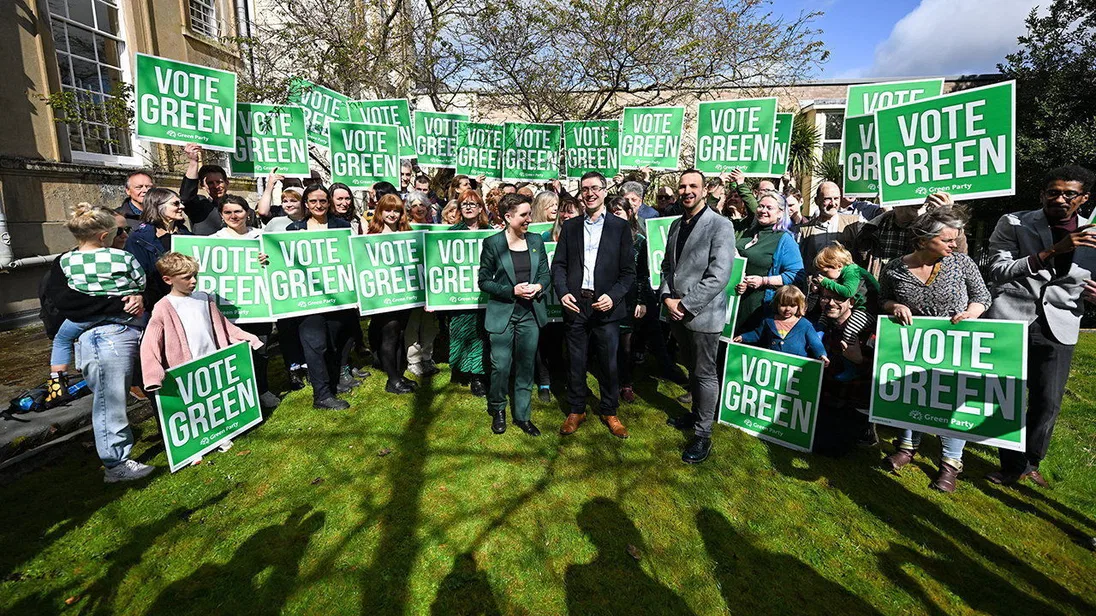
Photograph: Getty Images
Bristol, 9 May, 2024
On the Evolution of Green Politics in the UK and Europe
Natalie Bennett, Baroness Bennett of Manor Castle, is UK Green politician and former journalist. She led the Green Party of England and Wales from 2012 to 2016 and has been a member of the UK House of Lords since 2019. Before entering politics, she was editor of the Guardian Weekly from 2007 to 2012. She also lived in Thailand for five years, where she volunteered with the National Commission on Women’s Affairs.
In this interview by Alice Hubbard, Natalie Bennet reflects on her journey from journalism to Green politics, the lessons behind the party’s electoral breakthroughs, and the role of European cooperation. She explores how Greens can gain political power without losing their movement roots, and why the future of Green politics depends on connecting ecological limits with public health, economic justice, and social wellbeing.
Can you please introduce yourself?
I’m Natalie Bennett, or for formal occasions, Baroness Bennett of Manor Castle. I’m one of two Green Party members of the House of Lords, and I was leader of the party in England and Wales from 2012 to 2016. I’ve written two books, Change Everything: How We Can Rethink, Repair and Rebuild Society and Green Thinking: Unlearning Outdated Ideas in Science, Economics and Politics.
You had a long career in journalism. Why did you make the jump to Green politics? Why did it appeal to you as a space for change?
I can date this precisely to 1 January 2006. I had just finished working nights at the Times newspaper and I looked at the state of the world and said I want to do something to make things better. After 15 years of mostly international journalism, I wanted to not just report the news but change the news. I might have joined War on Want or Greenpeace, but those kinds of NGOs and campaign groups were carefully not touching politics – anything with a big P – and were simply focused on influencing whoever had been elected. I decided that we had to stop electing the wrong people and then lobbying them to do the right things. And so, on that 1 January, I sat down and thought, “Well, where are decisions made?” And decisions are made in councils, in Westminster, or in those days for the UK, in Brussels. So I joined the Green Party to get Greens elected.
There’s no way I would have joined any other party. We know we can’t have infinite growth on a finite planet. That’s not politics, it’s physics. I knew that as an old feminist, the focus on getting more people into paid work really ignored all of the crucial unpaid labour in our society. And I was aware, even then, that the idea that we all have to compete to get ahead ignored the idea of cooperation. And I saw within Green politics not just policies but a culture built on cooperation. That was absolutely crucial to me.
The Green Party emerged at a moment in the 1970s when new economic models, different ways of doing democracy, and talk of ecological limits were beginning to circulate. What did Greens get right about their thinking for the future, and what assumptions from that period have they had to rethink?
The key assumptions in those days were that if we had the right arguments and the right data and the right policies, then we’d just convince everybody that we were right; that arguments and data about the climate emergency, the nature crisis, all the other planetary boundaries we have exceeded could just be presented and people – the whole world – would come over to our side. We didn’t realise that it was actually tactics, number of leaflets delivered and posters put up in windows, and the sophistication of those – that’s what mattered in getting elected. Yes, sometimes we’ll force other parties closer to or even into our positions without getting elected, but that still means the wrong people running the country, who have to be forced into doing the right things, painfully slowly, issue by issue.
Lots of sister Green parties from around Europe and around the world are coming to us to ask how they might replicate our recent successes, and a lot of the answer is getting the practicals of politics right, having data about your voters, knowing how to speak to them, where you can reach them, carefully selecting candidates and preparing them well.
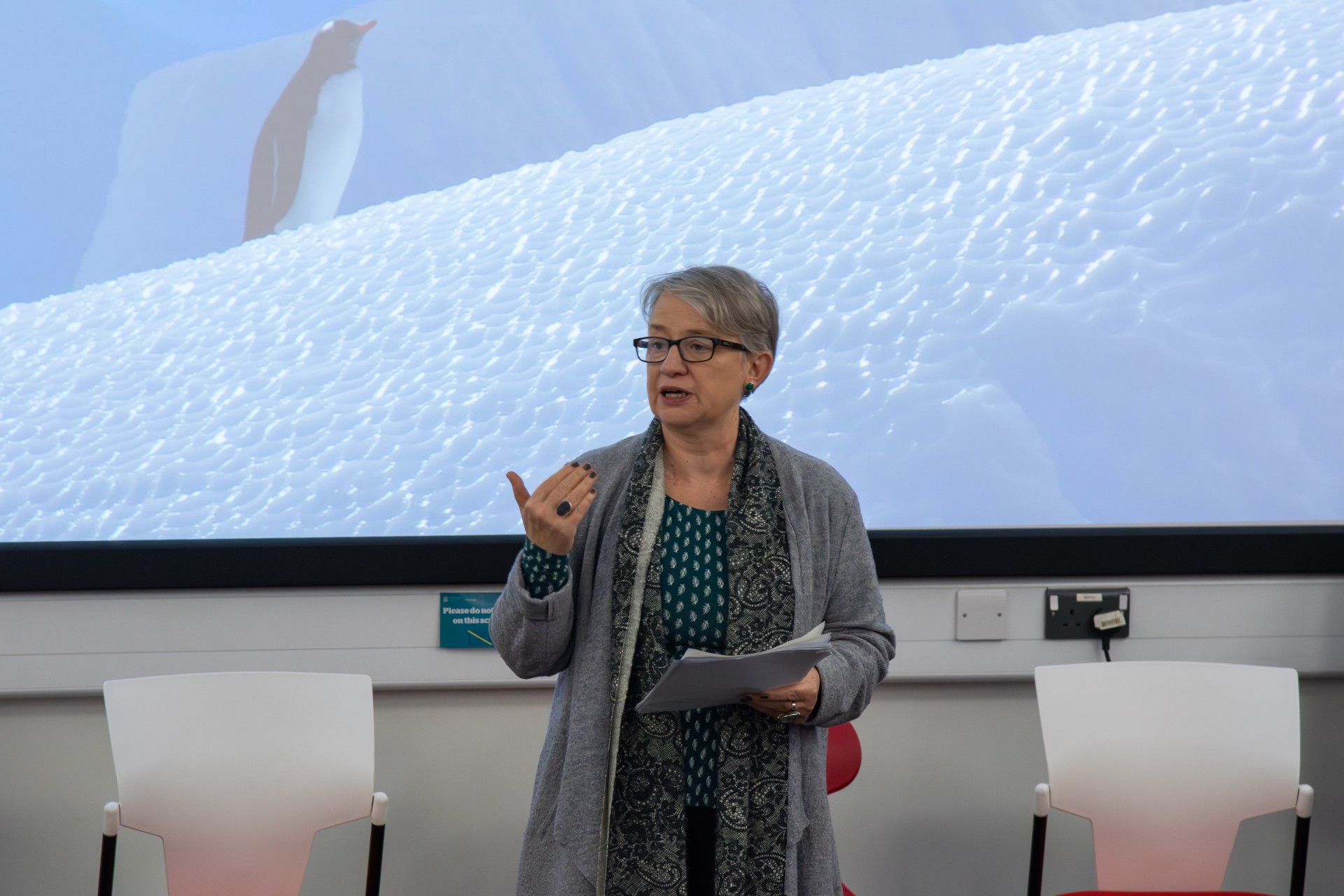
Speaking about my Nature's Rights Private Member's Bill at the global launch of Antarctic Rights (an alliance of individuals and organisations working to build global support for the adoption and implementation of an Antarctica Declaration) in Cambridge, 1 December 2025.
There was a Green Party surge during the austerity years in Britain, particularly around 2014-15, when three MEPs were elected, the party received 1.2 million votes and Caroline Lucas became an MP, and membership soared. How do you look back on the significance of that period, also vis-a-vis today?
We built the foundation of professionalism that was necessary for the next jump. What’s great about this second Green surge is that, like 2015, we’ve quadrupled our membership, this time from 60,000 to about 230,000. Back in 2015 we were starting from such a small base. The other problem was that it was just before the general election, so we had no real time to organise. We did that after the election, as we had the membership income and had built the foundations. It took a couple of years. If you look at the graph of councillors, it’s around 2017 that it starts to rise exponentially. That was built on the foundations of 2015. It’s also a recognition that you have to have the right political environment, because it was partly the rise of Jeremy Corbyn that held us back at that point [2015], even though our anti-austerity message had helped his rise. That’s really a demonstration of how you change the political landscape and shift the balance of politics. If you look at, for example, Nigel Farage, he had a huge influence on British politics during the many years in which he wasn’t an MP. You can very much shift the Overton window, and the shape of what politics looks like, along the way to being elected to parliament.
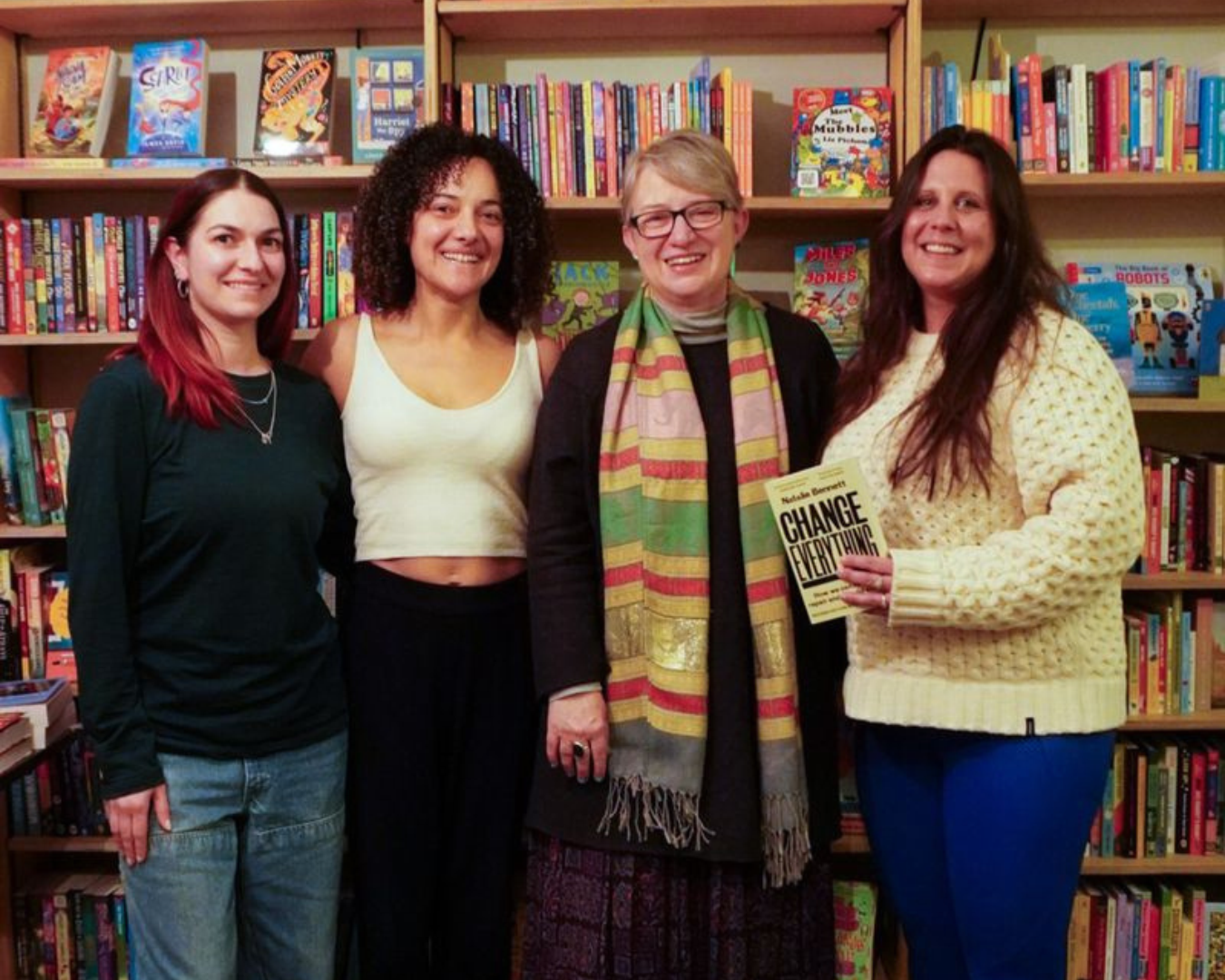
Natalie Bennett with Waltham Forest Greens shortly before their historic breakthrough in the 7 May 2026 local elections. The Green Party went from no councillors to winning 31 of 60 seats, securing an overall majority and taking control of the London Borough of Waltham Forest.
Let’s talk about Europe. The 2014 elections were crucial, but the England and Wales Greens were also a huge part of what became this European Green project. During that 2014 moment, when we got our first three MEPs, what did European cooperation mean to you politically? Was it about strengthening Green parties nationally, or did you see a European Green project emerging at that time?
I’ll start from the personal. I was editor of Guardian Weekly [between 2007 and 2012], and in those days we translated articles from Le Monde. I could never translate anything about Europe from Le Monde, because it assumed a level of understanding about how the European Union worked that an English language audience didn’t have. I would have had to have written a sentence of explanation for every sentence of the original from Le Monde. When I became Green Party leader in 2012, one of the things I was aware of was the need to actually link with Europe. I went quite early to Brussels, to things like meetings of the MEPs. I had the exciting experience of being verbally beaten up by [Daniel] Cohn-Bendit [MEP from 1994 to 2014], who blamed me for Nigel Farage. But I realised how little I knew about how Europe worked and the first job was to inform myself.
I’m always reminded of something Reinhard Bütikofer [MEP from 2009 to 2024] used to say, which was that the UK was always a hokey cokey member of the European Union – one foot in and one foot out, then we change the feet around, but they’re still only one footy. So we were trying to build the relationships and, still from a very small base, build that knowledge of Europe in the British public. In 2014 it wasn’t Europe that got us three MEPs, it was really good local campaigns. Molly Scott Cato [MEP from 2014 to 2020] got elected in the South West by going round saying “We will nationalise the railways”. This has nothing to do with Europe. But it got her elected. The British media did not cover the European election as anything to actually do with Europe or explain anything about European issues; it was purely run as a national election. Of course that was the election where we knocked the Tories into fifth place, which was quite fun, I have to say. But in England and Wales, as well as in the England and Wales Green Party and more broadly, the links to Europe were still pretty tenuous.
What did Brexit ultimately change in terms of the relationship between the England and Wales Greens and the European Green movement? And how do you navigate these transformations in the broader political context?
One of the things that we can and must do is explain to fellow members of the European Green family that Brexit was not about Brussels. I wrote a piece before the vote saying that the “Take back control” slogan, which is what ultimately won it for Farage and his people, was absolutely right for people to say. They’re not in control of their own lives, their own communities in the UK. But the problem is not Brussels, the problem is Westminster. This [vote] was not genuinely a rejection of Europe; it was an expression of frustration and anger. That is particularly important because, just in the last year or so, it has become possible to really talk about Britain rejoining the European Union. It is possible to imagine that in 20 years’ time, people will say, “Well, the people who voted for Brexit were absolutely right because they kicked the whole British political infrastructure, broke it apart, and at the end of that we got a modern functional democratic constitution for the UK. We rejoined the European Union, and we did it with a lot more understanding and knowledge and we knew what we were doing, and maybe we are no longer hokey cokey members but are actually genuinely embedded ones.” I’m not saying that is what the future looks like, but it’s possible. History is not pre-written; it’s made by the actions of people and there are a lot of different potential futures before us. If we’d got the 52-48 vote the other way round, which is what people expected when I went to bed on election referendum night, then it could be that people would say, “Well, look at what a mess British politics is. We’re still in the European Union and we’re still really angry.” I don’t know what that would have looked like but it wouldn’t have been pretty. It’s been an almost necessary transformative cycle.
Let’s talk about movement, party and power. How has the Green movement fundamentally changed as it’s gained power? And what does it need to retain from its movement roots?
It’s important to think about the fact that the Green Party doesn’t whip. Lots of people will say, “Oh well you can’t possibly be part of the government. How can you run councils or be in government without whipping?” But I think this is actually a really important foundation of the kind of democracy and truth and trustworthiness of Greens, that if you see a Green representative, councillor, MP or whatever getting up and saying, “I believe this”, you actually know it’s true. Under the whip system used by other parties, you will very often see a member of the cabinet say – and you can visibly see their arm twisted up behind their back – “Yes, I’ve always believed in this policy.” And that does real damage. Our process, like that of the Scottish Greens, is that if an MP encounters an issue which they feel differently to fellow MPs about, they have a responsibility to identify it, sit down and talk it through, and see what middle ground there is. Or decide that they’re going to have the flu that day and won’t make a fuss about it.
I’ll take a case study. I was very disappointed a couple of years ago when we changed our position on the HS2 high speed rail line. And I said, you know, we’re not a whipped party; I will say this is our position, but then I will say that’s not my view. And that’s fine – that’s all perfectly manageable. It’s setting out a model of a different kind of politics. We need to keep our soul while also eventually being part of, or being, the government. And that’s a challenge, yes. And it’s doing things that, in the British context, have never been done before.
What are the core fights for Green politics in today’s political landscape, in the UK but also in Europe? What do you think the Green movement should be trying to build in response to those challenges?
The first thing is understanding that the whole future of human existence is dependent on the natural world. We are human animals. The economy is a complete subset of the environment. When I first started in politics, even when I was party leader, journalists and the public thought of the environment as one issue here and the economy as one issue there. We’re making progress on joining this all up. We’ve seen the joint intelligence chiefs, who are not known as radical greenies, put out a report saying that the collapse of nature around the world is a threat to Britain’s security, particularly our food security. Those are the kinds of things that we need to bring home to people – that human, environmental and animal health are all intimately interrelated.
Britain is a deeply unhealthy society, so there’s an argument that doing public health is essentially doing Green politics. The public health perspective actually brings together all of the issues that we most care about, that other parties just don’t really understand. There will be a health election in Britain very soon. Traditionally that has meant arguing about how much funding there is for the NHS [National Health Service], or whether it’s privatised or not, but actually, the health election will be about how we create a healthy, flourishing human society within the framework of a healthy, flourishing natural world on these islands, which are in a terrible state both in terms of human health and the health of nature. I’ve just come back from the One Health Congress in Lisbon, and that’s the perspective we need.