The Green Narrative on Peace and Security (Vaxtorp)

By

About the Event

This learning space is designed for young activists (15-35) from across Europe. The two sessions, organised by GEF with the support of FYEG, will facilitate learning about what security is and what it can mean in different regional contexts in Europe, in the light of past conflicts, crises and current trends. The session will be led by carefully selected experts. Following this, space will be given to those directly affected by the recent conflict in Ukraine to share their thoughts, experiences and ideas for moving forward. After the Summer School, participants will be able to talk about security in an informed and holistic way.

Project background:

This event is part of the Summer Camp: Writing the Green Stories. The camp focuses on building the capacity of young people to create their own narratives, turning their personal stories and experiences into activist actions.


Speakers

  • Sofija Todorović, Programme Director of YIHR Serbia
  • Palina Burko, Belarusian environmental activist, Republican Theater of Belarusian Drama
  • Yevheniia Bryhinets, Executive Committee Member of Cooperation and Development Network Eastern Europe (CDN)


Programme

12:00 – 13:00: Security and geopolitics – hand in hand?

  • Sofija Todorović, Programme Director of YIHR Serbia

15:00 – 16:30: Workshop: Security in times of war – Belarusian and Ukrainian perspective

  • Palina Burko, Belarusian environmental activist, Republican Theater of Belarusian Drama
  • Yevheniia Bryhinets, Executive Committee Member of Cooperation and Development Network Eastern Europe (CDN)


Practicalities

Date and Time: 19 July, 12 – 16:30  CEST

Location: Vallåsens Värdshus, Rössjöholmsv. 20, 312 98 Våxtorp (Sweden)

LanguageEnglish.

Format: In person event

Registrations for this event are now closed


These summer school sessions are organised by the Green European Foundation with the support of FYEG and the financial support of the European Parliament to the Green European Foundation.


Putting the New Back In: The Green Deal for a World in Crisis (Copenhagen)

By

About the event

In the face of multiple crises – geopolitical, climate and energy, but also the very erosion of Europe’s social fabric by its outdated economic model – what should the Greens bring to the table to ensure that the European Green Deal (EGD) switches to the next gear into a social EGD or EGD 2.0? When the time comes to act the Greens respond. Looking ahead to the 2030 and 2050 European project, how can Greens set the direction to overcome the challenges of a EGD that was designed in a pre-Covid and pre-conflict world, and one that fails to account for key dimensions of wellbeing or care? 

Speakers: 

  • Kira Peter Hansen, MEP & Vice President of Greens/EFA Group in the European Parliament 
  • Rosa Martínez Rodríguez, former Member of the Spanish Parliament
  • Dirk Holemans, Co-President of the Green European Foundation & Director of Oikos Thinktank 

Moderator: Jamie Kendrick, Editor-In-Chief, Green European Journal 


 Practicalities

Date and Time: Friday 2nd December, 1pm

Location: Christianhavn room at the CPH conference centre (Tietgensgade 65, DK-1704 København).

Audience: This session is open to all participants of the 6th Congress of the European Green Party.


This project is organised by the Green European Foundation with the financial support of the European Parliament to the Green European Foundation. The European Parliament is not responsible for the content of this event.

Greening COP26: an Online Hub for Climate

By

CONTEXT

With the COVID-19 pandemic and particularly the economic recovery of this crisis dominating the public discourse, as well as the postponement of COP26 in Glasgow by a year to November 2021, the need to fight climate change has seemingly lost priority on the political agenda. Although the ongoing pandemic is closely linked to the destruction of our environment and biodiversity, initial declarations by the UK government and others, declaring 2020 as the “year of climate action” have clearly been downscaled which could have dramatic effects for our planet.

The following months will be crucial to ensure public awareness that urgent climate action is needed and that the recovery of our societies and economies must be a green recovery in all its aspects.

The Green European Foundation and the European Green Party are therefore organising “Greening COP26. An online hub for climate” to provide a space for the green ecosystem to keep up the momentum within the movement and to strengthen the connections that were already built – between green actors from different levels as well as between green actors and CSOs.

PROGRAMME

Day 1: Greening COP26 Kick off

Friday, 20 November, 14-17h CET

The first day of the online Green Climate Hub will be held on the day that would have been the original last day of COP26 with a concluding statement/agreement from governments. We will hence use the day to kick off this virtual hub for the green movement to come together and work towards Greening COP26. What are the priorities we will be setting? What do we expect as outcomes of COP26 and what do we realistically expect to happen?

  • 14h00-14h30 Opening of the Climate Hub

Dirk Holemans, GEF Co-President, and Thomas Waitz, EGP Co-Chair and Member of European Parliament

  • 14h30-17h00 Introduction to the hub functionalities and networking


Day 2: The Struggle for Climate Equality

Friday, 27 November, 10-13h CET

Although driven by natural and physical systems that are changing our planet, it is also clear that climate change will bring with it impacts on our social and economic systems as well as exacerbate already existing inequalities. In particular, the gap between the global North and South and the increased negative impacts already being felt by indigenous communities, women and people of color must be addressed. Existing problems, like migration, conflict and wealth inequality will be worsened by the impacts of climate change. Our global private and public finance systems are driving the climate crisis and investing our money in the wrong future. 

How can these problems be addressed? What do we need to consider in our fight for a sustainable and equitable future? How can or will the international climate discussions reflect these issues?

  • 10h00-11h00 Environmental (im)mobility: This workshop will explore the detrimental impacts of climate change and environmental degradation on the movement of people and will discuss different notions of climate migration with Dr Caroline Zickgraf, Deputy Director of the HUGO Observatory for Environment, Migration and Politics.
  • 11h00-12h00 The struggle for Amazonas: We are proud to feature a workshop by the Fridays For Future international youth team SOS Amazonia. In this workshop activists from the Fridays For Future movement give an overview of the situation in the Amazon, the effects the EU-Mercosur free trade agreement would have on it and the solutions that scientists propose to save this crucial ecosystem

Day 3: 5 years after Paris – Walking the Talk?

Friday, 11 December, as of 11h CET

So what is next for us? Marking the 5th anniversary of the Paris Agreement (on the 12th December 2020), and at the same time in the expectation that the European Council (on the 11th December) will make its final decision on the EU climate law, this day marks an important milestone of progress for global and European climate action thus far.

But we know that there is still much work left and time is running out. The impacts of climate change are already being felt, and as we continue to battle the corona crisis, it is more important than ever that we look towards building the sustainable and just future we want to see. Youth movements and activists have not only been leading the push for action now, but as the generation that will bear the brunt of the climate crisis, their vision of the future is more important than ever. We can build on the best practices, innovations, and visions that are already being fought for around the world. Greens, civil society, activists and others must come together to shape a better tomorrow.

  • 11h00-12h00 Networking
  • 12h00-13h30 Panel discussion: Five years after Paris – what’s next?

Speakers: Francois Gemenne, Timothée Parrique, Leonore Gewessler, Mina Tolu, Molly Scott Cato

Moderation: Lisa Tostado, hbs EU Head of International Climate, Energy and Agricultural Policy)

  • As of 14h00: sessions organised with MOCK COP and Glasgow Agreement


The hub will be hosted on GEF’s SpotMe platform. Sign up here.
Capacity Building EGP workshop

Empowering Greens: Training and Capacity Building Ahead of the 2019 European Parliament Elections (Antwerp)

By

Context

Green European Foundation is hosting a workshop at the council meeting of the European Green Party in Antwerp, Belgium.

The workshop aims at:

  • Exchange of information on available trainings across Europe;
  • Building synergies between parties and foundations working on trainings and capacity building;
  • Mapping the needs for training within parties ahead of the 2019 elections to feed into GEF’s offline and online training offer in 2018.

About the event

Stemming from the belief that education and awareness are the first steps towards action, the Green European Foundation provides opportunities for building capacity and encouraging networking amongst Green actors and citizens across Europe.

In this interactive workshop, we will discuss about how we can enhance the ability of activists and Green actors to work on issues with a European dimension, what are the training need and resources available ahead of the 2019 European elections.

This will also be the launch of the beta versions of its three new online courses on Campaigning, European Elections and Fundraising.

Moderator

Ioana Banach works as Deputy Director at the Green European Foundation, which is a political foundation affiliated to but independent from the European Green Party and Green Group in the European Parliament. Previously she worked as European Affairs Manager at the European Association of Communications Agencies and trained in the European Parliament and the United Nations.

She holds a bachelor’s degree in political sciences from Bucharest and Warsaw University, and a master’s degree in European public affairs from Maastricht University. She has worked for 8 years in non-profit and political organisations in Romania, Switzerland, the Netherlands and Belgium, specialising in education and capacity building programmes, as well as health and social policies. For the past 6 years, she has been engaged in developing online courses for training thousands of learners from over 40 countries.

 Stay tuned for updates

Subscribe to our Facebook event, where you will receive reminders and the latest news on content. Follow us on Facebook or Twitter to learn about our other activities.

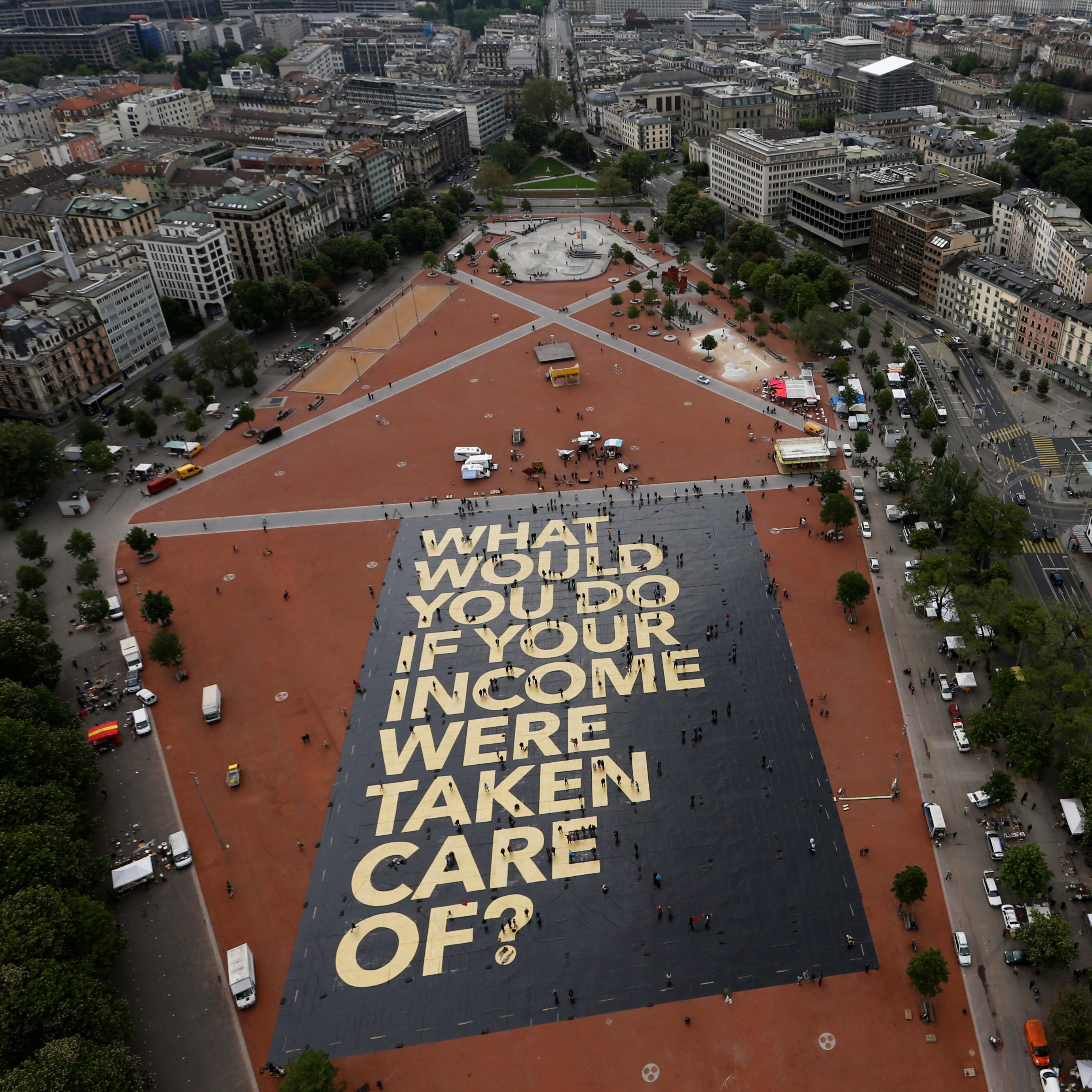
UBI - Basic Income

Universal Basic Income – a Green Answer to the Future Challenges of the Labour Market? (Antwerp)

By

Context

In 2017, the Green European Foundation started, with the support of different national partner foundations a transnational project on basic income with the objective to refine the concepts behind Universal Basic Income and contribute to the Europeanisation of the debate while taking into consideration the huge differences of social security systems across Europe. To this end, we formed a basic income expert group with representatives of Spain, Catalonia, Switzerland, Germany, Serbia, Belgium and Greece. In 2018, the focus of the ‘Basic Income for all EU Citizens?project lies on the financial concepts and on formulating first ideas for a European pilot project on basic income that can deliver comparable results for different European countries.

About the event

During this session, we aim to make the link of those discussions to the broader debate on the future of work and whether basic income can become part of the Green answer to the challenges the labour market is currently facing. At the same time, the session shall serve as an opportunity to exchange on examples and different ideas of Green parties across Europe.

We will organise an interactive session, using the “fish bowl” method: the discussion starts in a semi-circle with one moderator and the three panelists and two empty chairs; after the  first input by the moderator and the three panelists, the audience is invited to fill the empty chairs and take the role of panelists themselves; after the input the chairs have to be left to other participants.

Finally, the workshop will provide an opportunity to present the results of a planned survey we launched on the state of play of the UBI debate within the different Green parties across Europe as well as in the national public discourses.

Moderators

Ville Ylikahri, GEF Board Member, Secretary General in the Green Cultural and Education Centre – Visio in Finland, representative of project expert group for Finland;


Susanne Rieger, GEF Co-President, responsible for European issues and European relations in the Catalan Green foundation Fundació Nous Horitzons (FNH), Project coordinator of the GEF transnational project on Basic Income.


Speakers

  • Wolfgang Strengmann-Kuhn, Member of Parliament, Germany
  • Julen Bollain, Member of the Basque Parliament, economist & researcher specialised in unconditional basic income, Spain
  • Predrag Momcilovic, Executive Committee Member Federation of Young European Greens, journalist, PhD student on political ecology and degrowth, Serbia
  • Irina Studhalter, Local Councillor Lucerne & political campaigner, Switzerland
  • Natalie Bennett, politician and journalist, former leader of Green Party of England and Wales, United Kingdom


Stay tuned for updates

Subscribe to our Facebook event, where you will receive reminders and the latest news on content. Follow us on Facebook or Twitter to learn about our other activities.


Greens in Negotiations, EGP Council Karlstad

By

Join the Green European Foundation and the Heinrich Böll Foundation European Union for a new workshop in their “Greens in government” series!  This event will take place at the upcoming EGP Council in Karlstad, on Saturday, 25 November 18h45-20h30. During this workshop we will dive in the preliminary stage of governing and discuss first-hand insight with Green parties’ representatives who are or have recently been in a negotiation process to enter a coalition government. The participants will get useful insights into relevant questions, such as:

  • What makes a deal (un)acceptable?
  • Should Greens engage with everyone? 
  • What are reasonable conditions for a coalition government? 


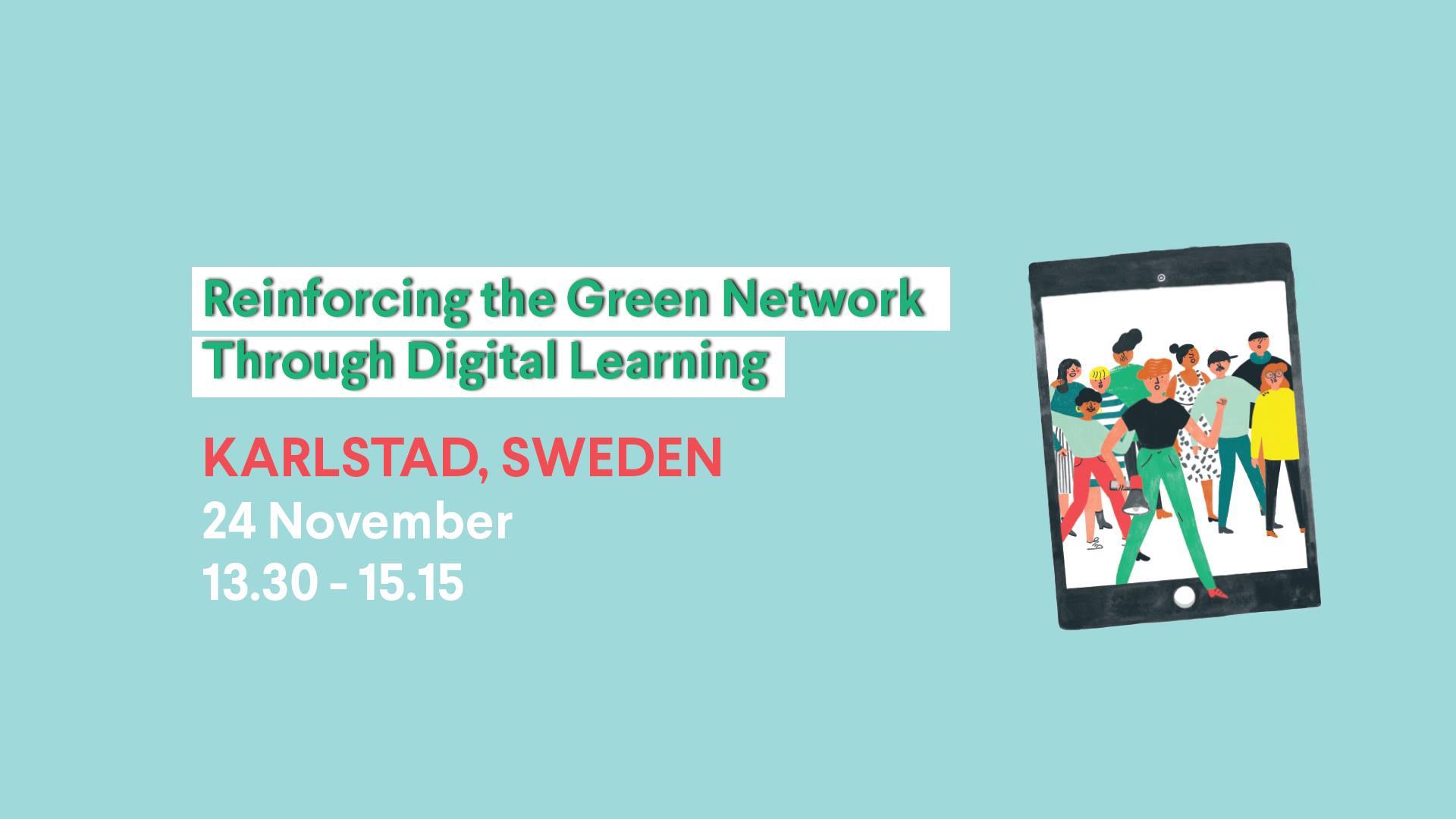
Reinforce the Green Network through Digital Learning, EGP Council Karlstad

By

Context

The Green European Foundation promotes education and training and provides opportunities for building capacity and encouraging networking amongst Green actors across Europe. To this end, we have developed, together with the Greens/EFA Group in the European Parliament, an e-learning programme, which uses information and communication technologies as a platform for sharing best practices and learning activities.

Workshop at EGP Council in Karlstad

This workshop will discuss the potential of online learning programmes as a means to empower green activists, parties, foundations and ultimately citizens. A particular focus will be placed on assessing the resources available and training needs ahead of the 2019 elections. This event will take place on Friday, 24 November, 13h30 – 15h15.

More information available on our Facebook page.

Participants will receive a copy of the GEF & Greens/EFA publication “How to develop an online course”, which is aimed at Green organisations, Green parties, civil society initiatives, educational institutions or any other actors interested in developing online courses as tools for political education.

GOVERNARE GREEN – Conference in Rome

By

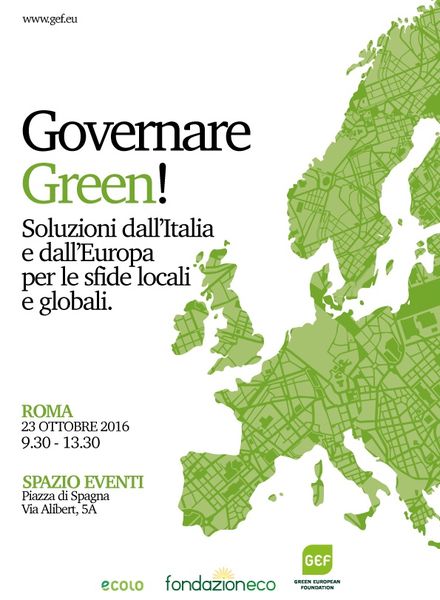
The focus of this conference were the Green approaches to city management as solutions to local and global challenges. The programme especially took into consideration the Commons, water and waste management. This was an occasion to highlight the examples of best practices and case studies in Italy and other European cities.

The event was preceded on the 22nd of October by the Local Councillors Conference ‘Moving ahead: Green Mobility for Healthy Cities’, organised by the European Green Party, where participants shared Green best practices from across Europe in reducing air pollution and enhancing mobility in cities, as well as to strengthen cooperation among green local representatives.

GOVERNARE GREEN consisted out of 3 sessions, each featuring thematic presentations by relevant speakers.

1. Local administration in the time of ZeroWaste  (9h45-10h45)

  • Arnaud Pinxteren: “How can Brussels be a zero-waste European capital? The plans, the policies, the struggles of the most observed and commented city in Europe.”
  • Raffaele del Giudice: “Strategies for Naples vis à vis circular economy and overcoming the difficult process of waste management.”
  • Enrico Fedrighini: “How Milan has become one of Europe’s leading cities in recycling.”
  • Francesco Emilio Borrelli: “The new regional plan for waste management and the choice of a zero waste future for the region Campania.”

2.  8 minutes to narrate green management. How to improve the life of citizens through green management: green experiences and policies as told by their protagonists. (10h45 – 11h45)

  • Flavia Marzano: “How to promote e-government in big cities?”
  • Mónica Oltra Jarque: “Winning against corruption and governing green.”
  • Eivind Trædal: “How to divest your territory from fossil fuels and live happily ever after.”
  • Carmine Maturo: “Naples: Walks for a change. Walking talks on beauty, identity and urban quality of life.”
  • Marco Gaudini: “How to buy back water management company into a public company?”
  • Andrea Costa: “How to set up grass root policies on migration: the example of Rome’s Baobab.”
  • Lucia Coppola: “How to win the Smart City award.”
  • Maria Laura Lorenzini: “How to implement good green policies in the field of heavy infrastructures.”
  • Daniela Filbier: “How to set up a project of direct democracy: the example of Possibile.”

3. Energy to the future: how to move towards zero emissions territories (12h30-13h30)

  • Michele Emiliano: “Past and present of the Italian heart of reneawable energy production.”
  • Bas Eickhout: “Implementing the Paris Agreement: from the global to the local level.”
  • Mónica Oltra Jarque: “Urban and community energy transition.”
  • Gianni Silvestrini: “The new Italian proposal for building retrofitting: beyond the green deal.”


REGISTRATION: This event is open to public and there is no participation fee. To register, send email to Davide Sabbadin (davidesabbadin@gmail.com).

Download the final programme here.

Live stream video from the event is available below.

Migration & Refugees: A New Narrative for Europe

By

The workshop addressed the need to develop a new and positive narrative on migration and refugees to create public interest and counter the anti-immigration and xenophobic rhetoric in European countries. The event was held on Friday, the 2nd of December, between 19h00 and 20h30 at the 25th Council Meeting of the EGP in Glasgow. It featured an insightful debate with relevant speakers, listed here:

  • Noureddine Erradi, Chairman, Integration for All
  • Maria Giovanna Manieri, Advisor on Civil Liberties, Justice and Home Affairs, Greens-EFA Group in the European Parliament
  • Olga Kikou, Director of Green Institute Greece and GEF Board Member

The debate will be moderated by Susanne Rieger, Europe representative, Foundacio Nous Horitzons & GEF Co-President.

BACKGROUND:

In 2016, the majority of European citizens see the “migration crisis” as the biggest threat to the EU, ahead of the threat of terrorism. While the majority of EU citizens are in favor of an EU policy on migration, just above a third of Europeans say that immigration of people from outside the EU evokes a positive feeling while a majority of citizens have negative views. This development in public opinion goes hand-in-hand with the emergence of right-wing populist movements and parties who propose a narrative around migration based on feelings of fear and uncertainty.

Throughout 2016, the Green European Foundation, together with Fondacio Nous Horitzons (Catalonia), Green Foundation Greece, EQUO (Spain), Green Economics Institute (UK) and Institute for Political Ecology (Croatia) developed a project to highlight the local context as a space in which the European and national realities intersect in their impact on the well-being of refugees and asylum seekers. As a result of this project, the need to develop a new narrative on migration was identified as a means to counter the current negative sentiments on the topic.