
Nipped in the bud: How an authoritarian turn threw Hungary’s blossoming Green movement off course
Benedek Jávor is a Hungarian Green activist and politician. Originally a biologist, he was an environmental campaigner before entering politics, founding and leading a major green NGO in Hungary. In 2009, he co-founded the first Hungarian Green Party, Politics Can Be Different (LMP), which entered the country’s parliament the following year. He served a four-year mandate as a member of parliament. In 2014, he was elected to the European Parliament, on behalf of a newly created Green Party – Dialogue for Hungary (PM). He currently heads the representation office of the city of Budapest to the EU.
In this interview by Alice Hubbard, Benedek Jávor traces the development of Hungary’s Green politics over the past decades, from its emergence out of grassroots environmental struggles, to the ideological divisions that lead to a fundamental schism, and the destructive impact of the Orbán years on a promising political movement that was just beginning to bear fruit.
Can you tell us about the origins of the ecological movement in Hungary, particularly around the end of the communist era?
Green movements across Central and Eastern Europe began to emerge in the 1980s as environmental conflicts led to political conflicts with the ruling communist regimes. In Hungary, it was the Gabčíkovo-Nagymaros hydroelectric dam project on the River Danube that led to mass resistance in society. That was the Danube movement. It was a combination of green activism and political resistance. These origins also influenced the ideology and the nature of the green movements in the region. Since they developed from the resistance to a left-wing dictatorship, they were often more conservative or right-leaning than many Western European Green parties.
After the transition years in Hungary, many of the leading figures of the Danube movement were integrated into newly founded democratic parties, and the original momentum of the movement disappeared. On the other hand, from the early 1990s, a flourishing green civil society started to develop with hundreds of new NGOs being founded. These organisations largely focused on traditional environmental issues such as nature protection, and deliberately stayed away from politics. Then, in 2000, when the globalisation-critical movement was at its peak, a different type of green NGOs started to emerge, including Védegylet (Protect the Future!), which I co-founded. We very intentionally and cautiously decided not to stay away from politics.
What was the theory of change that led Védegylet to work towards influencing politics and using democratic tools and channels more directly?
We argued that the decisions influencing what happens to our natural environment are made in politics, so if we want to change them, we need to address politics directly as an NGO, through more open cooperation with political parties, directly targeting parliamentary parties and proposing bills and legal reforms.
Ecopolitics, or political ecology, goes far beyond protecting nature. Nature itself cannot be defended in isolation. We can find solutions to the ecological crisis only if we address the tensions within society. To protect the global environment and ecosystems, ecological politics should aim for the transformation of the entire economic, social, and political system. Our ambition was to come up with very practical proposals that went far beyond traditional green or environmental issues. For example, Védegylet proposed establishing an ombudsman for future generations in Hungary, which was eventually adopted as one of the first institutions of its kind in the world, and still exists today. The Fidesz government later significantly downgraded it, but it was a major achievement, demonstrating that the global environment can be protected through democratic action as well as through environmental activism.
From the beginning, Védegylet was an NGO with the ambition of directly influencing politics, but also of eventually becoming a political actor itself. That happened in 2009 after a couple of years of organisational work. In 2009, a group of activists founded a green party – Politics Can Be Different [Lehet Más a Politika or LMP], which participated in the European elections that year, receiving close to 3 per cent of the vote. This pointed to a political crisis in the Hungarian political landscape, which had previously been very stable. At that time, established parties that had participated in the transition years were disappearing from Hungarian politics. Then in 2010, LMP won 16 seats in the national parliament, which at that time was a major achievement. It was also a big success for the broader green and human rights movement, in which it remained strongly rooted, since most of the party’s MPs, staff, and members came from this movement.
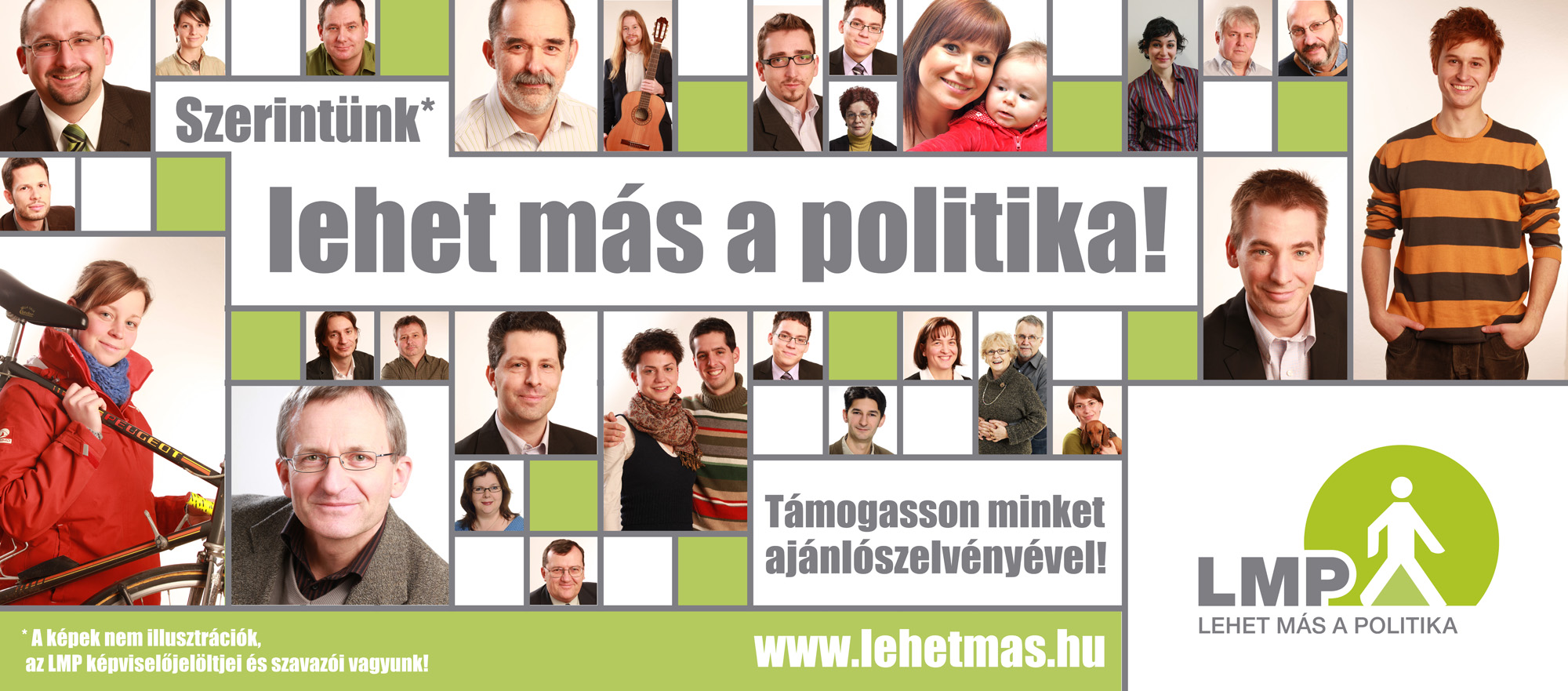
Campaign posters at the 2010 national elections in Hungary
LMP’s emergence was clearly a major milestone, but its 2012 split eventually led to the creation of another party: Dialogue for Hungary (PM). What were the key strategic differences behind that split, and how did it reshape the trajectory of Green politics in Hungary?
When we were elected in 2010, we believed – somewhat naively – that after 20 years of green activism we had finally arrived as a strong Green force in parliament. We enthusiastically got to work trying to influence Hungarian politics in line with green eco-political values, flooding the parliament with hundreds of proposals, bills, and amendments.
Unfortunately, we soon realised that the original mission was no longer valid. Soon after the 2010 elections, Viktor Orbán’s regime began to undermine the democratic system of the country. First came the attacks against the constitutional court and the independent institutions, and then the continuous attacks on media freedom. So within a few months, we realised we’d have to put aside the mission of turning the country green, because Hungary’s constitutional democracy was now at stake.
LMP was deeply divided about how we viewed the nature of the Fidesz government. Half of the party felt it was fundamentally different from anything we’d seen before, and needed to be fought with completely new strategies, tools, and means. The other side viewed it as a bad government, but not much worse than the Socialist government before it. These differences led to two completely different strategical visions. We thought that if the system being built by the Orbán regime was a fundamental threat to democracy, we first had to stop it and get Hungary back on the track of democracy, before we could make the country a greener, more sustainable place. Since the Greens had limited public support, we decided we needed to cooperate with other parties because only a united opposition would have the necessary force to stop the democratic decline of Hungary.
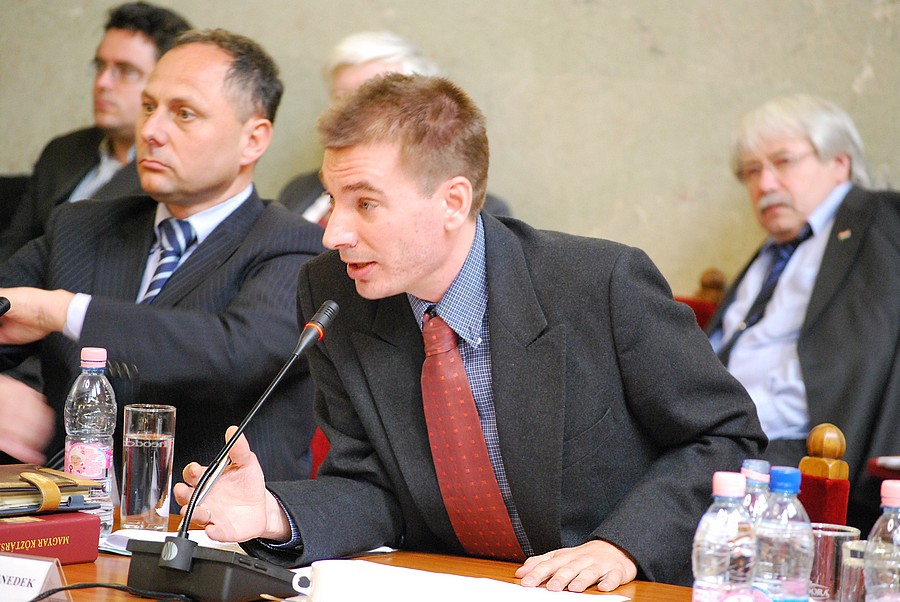
Benedeck charing the first meeting of the HU Parliament's Sustainable Development Committee in 2010, as newly elected green MP
This strategic conflict which arose around whether to cooperate with other opposition parties is, I think, what led to the to the break within the party, because it was a historical moment when there was no middle way. We wouldn’t have been able to cooperate a little bit while trying to create a more progressive platform that could be strong enough to compete with the Socialist Party and be a counterweight to it. So that was a conflict without an easy solution.
Finally, the internal discussions became so bitter and heated that it became impossible to keep the party together. After a vote at LMP’s congress which finally decided, by a very small margin, not to cooperate with other opposition parties, the already existing dialogue platform within the party decided to leave. We started a new party [PM, known today as Dialogue or Párbeszéd], which had eight MPs, so it had considerable political weight in the parliament, and we decided to cooperate with other parties.
Looking back, I believe failure was almost unavoidable. There were no good solutions at that point. The bulldozer of the Orbán regime destroyed everything in its way, and whatever we tried to do, the illiberal state would have eaten us up. But in the end I think both positions were unsuccessful, as all the parties that made up the opposition movement proved unable to stop Orbán’s regime for 16 years, and we needed a completely new political movement in 2026 to capitalise on the crisis of the regime, which began in the early 2020s, and change the government.
As the Fidesz government began to tighten its grip on all aspects of Hungarian politics and society, what was the impact on efforts to introduce policies for more sustainability and environmental justice?
The Orbán regime was extremely hostile towards environmental movements, as well as green policies. Like many far–right populist parties in Europe, they had close ties to traditional industry interests, including fossil fuels, at the local, national, and global levels. Far-right parties in Poland, Germany, and France – which I sometimes call the illiberal international – cooperate very closely with fossil-fuel dictatorships like Russia or some of the Gulf states. This is often hidden behind nationalistic slogans, claiming to be fighting against multinational companies and global capital on behalf of local economic actors.
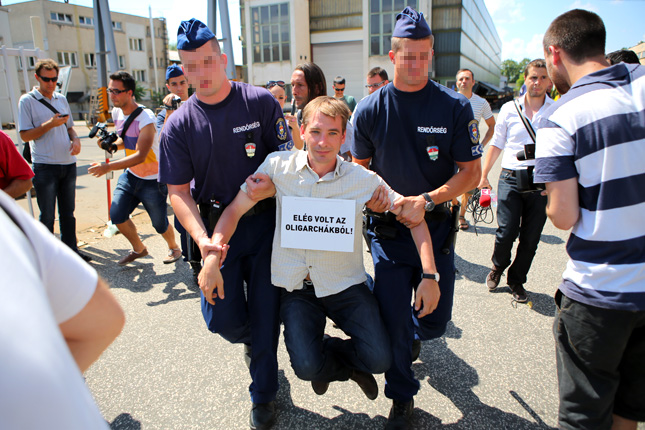
Demonstration against corruption at the HQ of the flagship company of Fidesz oligarch Lajos Simicska (sign:"Enough of oligarchs!")
But what usually happens in practice is not development like in East Asian “Little Tigers” countries – it’s simply a corrupt system which redirects national resources to oligarchic groups, often with businesses in traditional industrial sectors. The Hungarian system was deeply corrupt and redirected national resources to these oligarchic groups, but it also attracted global multinationals. They might have preferred Chinese, Turkish, or Saudi Arabian capital to Western European or American capital, but the methodology was essentially the same as the most neoliberal governments in in Europe: opening the country for these multinational companies to destroy labour and environmental regulation and gain cheap access to the country’s natural resources and labour force. This coalition of the so-called “national bourgeoisie”, which is really an oligarchic system around the illiberal state, and multinational industrial groups wanted to undermine green policies and regulation. That’s why Orbán abolished the Ministry for the Environment back in 2010. Hungary was one of three countries on earth without an environmental ministry – and the only one in the EU. In the European Council, the government was always blocking, undermining, and watering down the Green Deal and any other green regulatory proposal.
What was the impact of this attitude on wider society in Hungary, especially civil society actors and movements?
This hostility to environmental regulation and authorities, national and European, was partly because they saw these as obstacles to economic growth and their personal investments. But there was another reason – the government recognised that the green movement was one of the strongest and most well organised civic movements in Hungary, and since LMP had emerged from this movement they regarded it as a potential source of political competitors that could gain power and challenge the government. They wanted to stop this, and to kill any opportunities at the roots – and they were quite open about this.
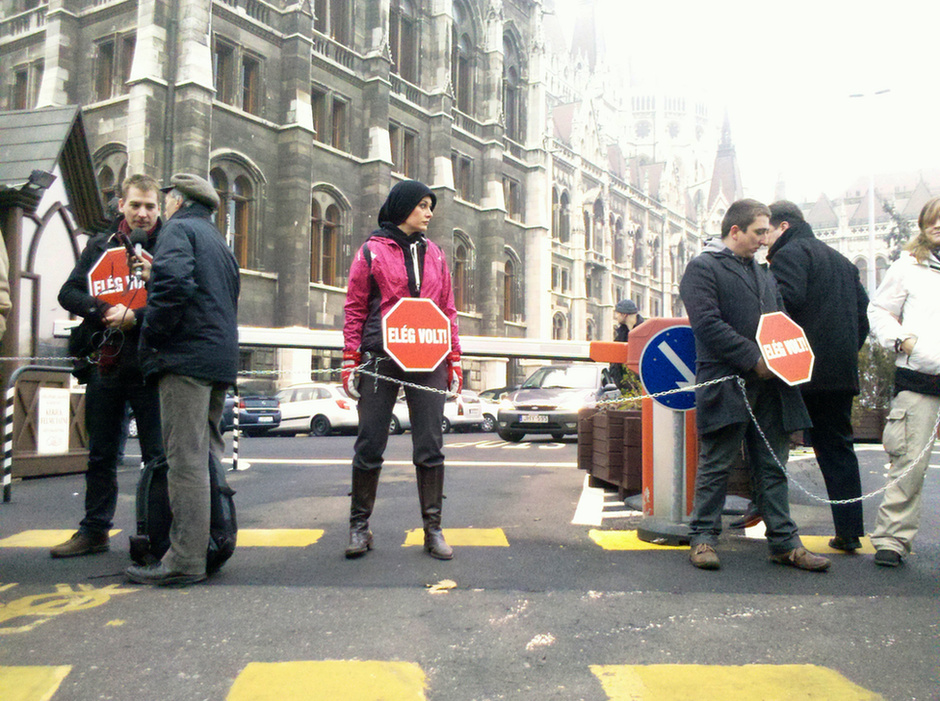
Demonstration and blocking of the HU parliament in December 2011, during the votes about antidemocratic amendments to the Constitution
Of course, it wasn’t just the green movement they targeted, it was also the human rights movement, feminist movements, LGBTI organisations, and so on. They basically wanted to make any kind of public participation, self-organisation, and active citizenship impossible. But of course, this also killed the opportunities of the green movement in Hungary. In 2014, the leader of a prominent Hungarian green NGO was arrested very publicly, with a police raid of their offices. The accusations were baseless, but it was a very clear message that there was no way for NGOs to organise themselves or to challenge the central political power.
What was the role of the European dimension in Hungarian Green politics? Europe became something of a diving line between the two parties, but in what ways did their approaches differ?
There were differing views on Europe and European Green politics. LMP was a more conservative, rural, and right-leaning political force committed to national sovereignty and autonomy. From the very beginning, they regarded the European Union as a supranational organisation with some suspicion. They regarded the EU as part of a global neoliberal system, which goes against sustainability, social justice, and national sovereignty. The more progressive and left-wing members of LMP moved to PM, who regarded the EU as an important force for maintaining peace and development in Europe, and a final anchor of democracy in a country sliding towards autocracy. In environmental policies, the EU was also seen as much more ambitious than national governments in the region.
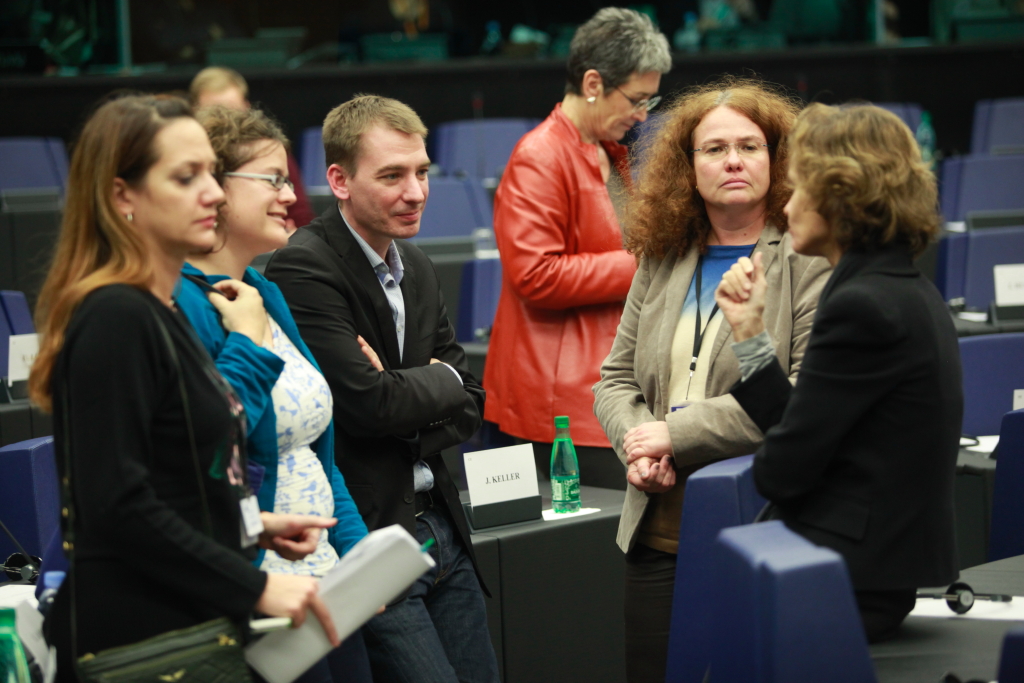
In the European Parliament in Strasbourg with Austrian Green MEPs Ulrike Lunacek and Monika Vana, and German Green MEP Helga Trüppel
There were also considerable differences in how we saw the European Green political line. For example, issues like LGBTQI rights or Roma minority protection were extremely important for those of us in the PM side of the party. Already in the 2010 campaign, there were huge discussions over whether public billboards and ads should focus on issues like social justice, inclusion, or LGBTQI and minority rights. This was always something the more conservative side of the party opposed. Some were sympathetic but felt it was not the primary issue we should deal with while others were openly against it. Since the Conservative side of LMP was already a bit suspicious of transnational organisations, they resisted European Green suggestions to prioritise or concentrate on issues which they didn’t feel should be the main messages in a Hungarian electoral campaign. This also led to some internal conflict.
It was not unique. From the late 2000s, more Greens were being elected to parliaments in Central and Eastern Europe, such as in Czechia and Estonia. But initially, the European Greens felt no need to develop a specific or new approach for these parties. They were expected to imitate the messages and priorities of successful Western European Green parties. It took some time to realise that the social and political reality is different in countries like Hungary, Romania, Latvia, or Croatia, and that this might require different answers. For that reason, I think some Green parties from the region found it hard to find their place in the European Green family, compared to the more established Western member parties. If you look at the successful Green parties in the region, often they approached politics in a different way rather than copying Western parties. But very often, this doesn’t go without internal conflicts.
Hungary recently went through an important political turning point with Orbán’s Fidesz government ousted from power after 16 years. How do you see the role of opposition forces and resistance movements, including the Greens but also more broadly, in this outcome? In particular, how important were local actors and struggles, in places such as Budapest?
To outsiders, the collapse of the Orbán regime in 2026 might have seemed to have come suddenly out of the blue. In fact, it was the result of a combination of many developments beneath the surface. For one thing, unlike in Türkiye or Russia, Orbán was never able to completely oppress and destroy resistance to the system. He invested a lot of money in controlling and capturing the media. But ultimately, he was never able to completely destroy or close down independent media outlets. There was also an ongoing resistance at the municipal level – perhaps the regime’s first major political loss was the local elections of 2019, in Budapest but also in many major cities in the countryside. Half of the 50 biggest Hungarian cities elected opposition mayors and majorities to the city councils, which was unexpected. These municipal leaders and mayors, in Budapest especially, were able to sustain the hope that it was possible to defeat Fidesz and restore democracy.
In Budapest, the city government from the very beginning invested a lot of energy, time, and financial resources into making the system more participatory and democratic for citizens. This resistance was very important because it showed that the Orbán regime was not omnipotent. The 2025 Pride in Budapest was also a crucial moment because it defied the government’s statements that the march wouldn’t take place. The municipality was able to organise the march despite the attempt to ban it – in fact that turned it into what was perhaps the biggest ever demonstration in Budapest, with hundreds of thousands marching on the streets not just in support of the LGBTQI community but also to show that we were ready to stand up for our rights. It was a powerful demonstration of Hungarian society’s commitment to democracy. And it was a humiliation for the government because it was not a small local event – the images were broadcast across the world and it was attended by international politicians. It showed they could be publicly mocked and defeated – something very damaging for an autocratic strongman.
But the final reason was economic. With the suspension of the EU funds in 2022, the Russian aggression in Ukraine the same year and the subsequent energy crisis, and the global economic turmoil, the Hungarian economy was running out of steam. A high inflation rate, the stagnant economy and the daily livelihood struggles of the people undermined the political foundations of the system. Péter Magyar, a talented politician, and his party Tisza stepped onto the stage at the right moment.
Looking ahead, what do you see as the main areas where the Hungarian Greens need to focus and target their efforts to rebuild, in terms of reconnecting with citizens now and in the years to come?
After 16 years of Orbán’s rule, both the Green parties were destroyed; they lost the parliamentary seats, and more or less disappeared institutionally or organisationally. The green movement is now in very bad shape. Many NGOs have been closed down. Now, the most important task is to build a powerful and flourishing new movement, almost from scratch. That’s going to be extremely difficult because people have been demobilised and their views repressed for so long.
But before thinking about any parties or directly political initiatives, I think that the first thing is to build a movement gathering committed, experienced people who are ready to act together. The good news is that, at the April 2026 elections, the participation rate was the highest ever in Hungary – close to 80 per cent – with youth participation extremely strong. Young people have grown up being part of the EU and they value the freedoms and liberties that come with this, like being able to travel and study abroad. But the Orbán regime offered only a turn towards Russia and China instead of European cooperation. They were fed up with the government’s nationalism so they made the change by showing up to vote. That’s the crucial element of the political socialisation: we had a conviction, we decided to act, and it made a difference.
According to the most recent polls, Hungarians aged between 18 and 25-30 are now the most politically active young people in Europe. It used to be the opposite – even before the Orbán regime. My own past research at university found that political participation and activism among young generations in Hungary was extremely low in comparison to other countries. But now they have a very positive experience with making a change in politics. So the big question is whether the green movement – or a newly built green movement – can capitalise on this to mobilise them and nurture this political activism under a new government. Perhaps this activism could lead to a new green political movement, or even a new party. I hope that in the coming years, a new, active, and successful green movement will grow in Hungary, that will be able to create its own political representation sooner or later.
Such a new green political organisation should be based on systemic ecopolitics, going beyond environmental protection to address broader societal challenges. It would need a coherent vision for both society and the economy. And it would have to be responsive and inclusive, listening to diverse social perspectives and understanding people’s concerns rather than preaching at, or judging them. Finally, a new green movement must be innovatively democratic. It must defend democracy against authoritarianism while moving beyond traditional representative models towards greater citizen participation and ecological democracy. Flexible organisational structures, meaningful dialogue, and diverse opportunities for engagement are essential, particularly for younger generations who seek genuine influence over political decisions.