
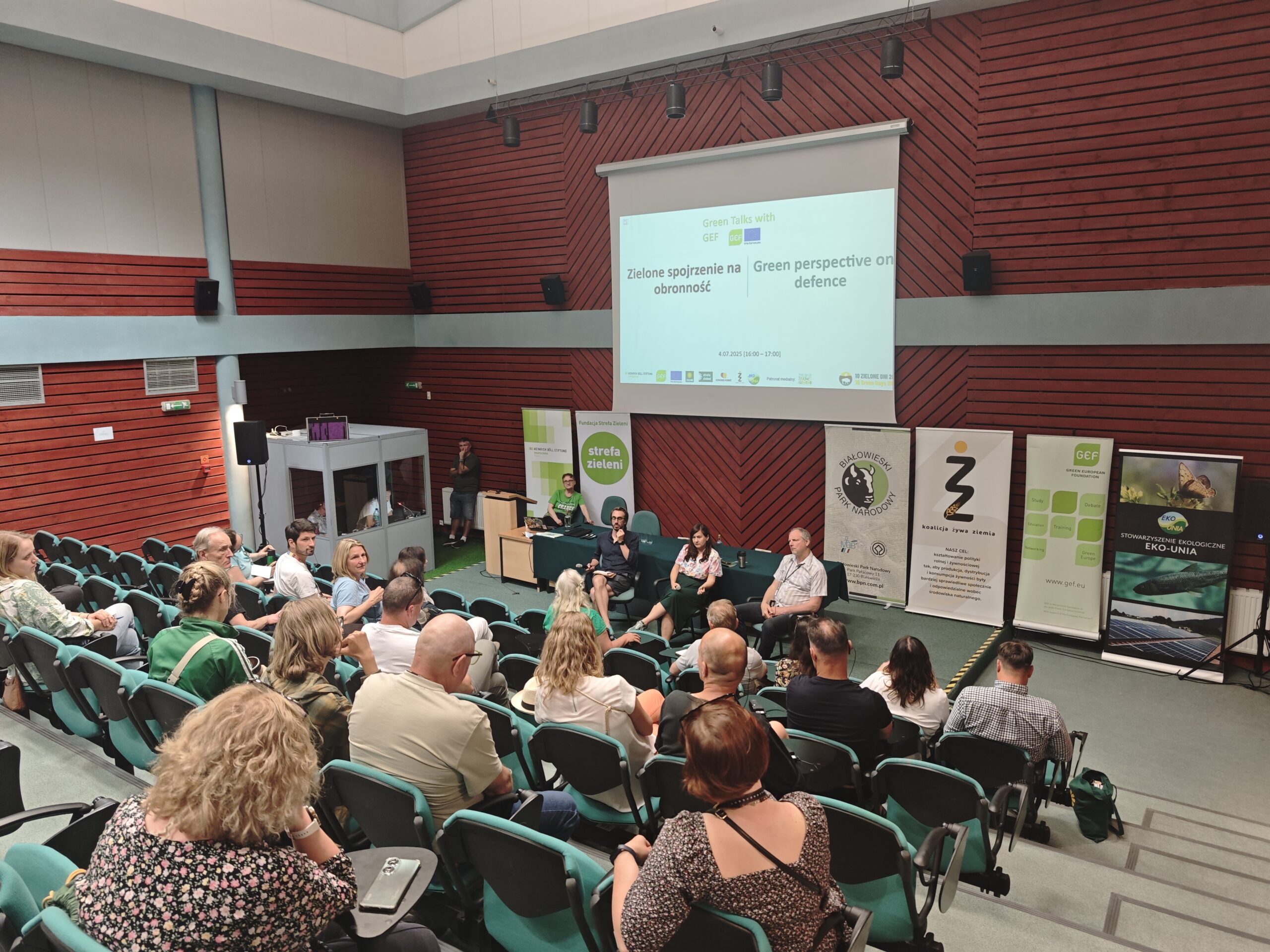
Green Talks with GEF at the Green Days 2025 (Białowieża National Park)
Ewa Sufin-Jacquemart graduated in sociologist from Warsaw University and the Sorbonne in Paris. Currently she is director of the Green Polish foundation “Strefa Zieleni”, writes for their publication, and coordinates the Green Centre of the Congress of Women.
In this interview by Edouard Gaudot, Ewa Sufin-Jacquemart traces her journey from a little NGO, turned consulting firm, called Utopia and sustainable development in France to becoming a key figure in Poland’s Green movement. She reflects on building the Polish Greens, advancing environmental politics, overcoming electoral setbacks, forging alliances, and helping climate issues gain prominence in Polish society.
You are the president of Strefa Zeleni – the Polish Greens’ political foundation – and a leading figure in political ecology in Poland. What path led you here?
I’m a French–Polish dual national. I lived in France for 25 years, then in 2011 returned to Poland to head the Polish Green Foundation. That’s what brought me back here.
I became interested in environmental issues when, as part of my continuing professional development in France, I studied strategic foresight, sustainable development, and the environment. I had already come across the concept of corporate social responsibility (CSR) through a little NGO turned consulting firm called Utopia. That you could do business while also caring for society and the environment was a revelation.
So I studied CSR on my own, then at the Conservatoire national des arts et métiers (CNAM). France was somewhat of a pioneer in CSR: in the 1970s, it introduced the idea of social reporting, before eventually making non-financial reporting mandatory in the early 2000s.
I also worked for a large non-profit that organises sports holidays, the UCPA, where I developed the thinking around CSR. But it was later at Club Med where I really came face to face with these challenges, working alongside a quality director who had just convinced management to create a sustainable development department in a sector in the midst of a revolution. That’s where the ecological awareness stems from.
The political side of things I first saw by chance as a political advisor at the Polish embassy in Luxembourg. From there I got a behind-the-scenes view of preparations for the COPs – notably the 2008 meeting in Poznań. I saw how Polish institutions struggled to engage with these questions seriously. And I was one of the few advisors who read the notes sent by experts on climate and environmental issues. When I went to meetings with colleagues, or with other members of the diplomatic corps, I could see their mistrust. They looked at things through the narrow lens of short-term thinking.
I realised just how far Poland lagged behind politically on these issues. Not just the Polish state but also the media, which is highly politicised. At the time, not one of the country’s 460 MPs talked about climate, the environment, or biodiversity, even though they had to legislate on these matters. That’s when I made this vow: I would get at least one Green MP elected to parliament.
This matters because since 2004 Poland has been a member of the EU, where climate policy is at the heart of the agenda?
Exactly. At that point, I thought the planet’s future might to a degree hinge on the environmental awareness of Poles, because the European Union is the only global political bloc that can aspire to steer the world towards a new paradigm, with ambitious goals. Poland punches above its weight on these subjects in the EU, because it enjoys a certain amount of clout with other member states from Central and Eastern Europe.
When I returned to Poland, I called Claude Turmes, a Luxembourgish MEP who sat with the Greens/EFA in the European Parliament, to arrange a meeting. He was a tad surprised because, as the group’s coordinator for climate and energy in the European Parliament, his relations with Polish officials and MEPs had never been particularly friendly. It was he who helped and guided me in devoting myself to the green cause in my country.
In what way?
The Polish Greens (Zieloni) immediately put me in charge of the foundation that they had just created. It took time to get this off the ground, because everything needed to be built, working alongside the Green European Foundation (GEF) and other members of Europe’s political ecology family. But we eventually joined the network of Green foundations, and I became Zieloni’s delegate tn the European Green Party [delegates from member parties meeting during the Party’s annual events, represent their party and work on common European resolutions, they also elect the Party’s leadership and committee]. One of the first concrete things we did was to organise Green summer schools in Poland, modelled on similar events held in other countries, with the support of GEF. The first was held in 2015 in Białowieża, home to the last remnants of the great European primeval forest. It’s a magnificent place, with profound historical and symbolic political significance. Since then, we’ve organised these gatherings every year, because they’re essential for ensuring the cohesion and political continuity of the environmental movement in Poland.
As president of the foundation, you’ve watched the growth of the Polish Green Party first hand, so you know its roots and history inside out. Can you give us a brief overview?
When I joined the Polish Greens in 2011, I was struck that they were considered the only true party of the Left in Poland. The others, like the SLD (an old social-democratic party that emerged out of the former Communist Party in power until the Round Table Talks), had little of the Left about them. There were a few left-wingers who gravitated around it. One was my former ambassador to Luxembourg, Barbara Labuda, an ex-Solidarność activist, former MP and stalwart of the Polish feminist movement who served as a minister for several years in the chancellery of President Kwasniewski (SLD) among others. But strikingly, most people who called themselves left-wing were drawn naturally towards the Greens.
The party was founded in 2004, built on three social and cultural movements that were very powerful at the time: environmentalism, LGBT activism (gay rights campaigners especially), and feminism. The German Greens provided vital assistance in creating the party: they funded a seminar where representatives of these movements could meet one another and gave them training on things like how to build a party and run election campaigns.
In this new coalition, everyone learnt from each other: gay rights activists and feminists became eco-conscious, and environmentalists included feminist and LGBT perspectives in their approach. That coalition became a Polish Green Party.
When you joined in 2011, the party was struggling in the institutions and had just lost another election, which it fought in alliance with the SLD. It would have to wait until 2019 to finally send a Zieloni MP to the Sejm [Lower House of Polish Parliament]. How did the party bounce back after its string of election defeats? How did it have to change?
From the outset, the biggest problem has always been money. The Greens never had much in the way of resources. For a start, Green activists aren’t very rich. What’s more, without electoral success, it’s impossible to access public funding. For years, our daily struggle boiled down to two questions: how do we pay the rent for our headquarters this month? And what can we do with no money? When we were based in Marszałkowska Street in Warsaw, which was quite a large space, we regularly organised debates on the premises.
We always managed to get by with what we had, drawing on our members’ skills whenever we could. For example, the co-chair in Warsaw back in the day was Ella Rovenko, an incredible activist and painter of enormous creative talent. She lent a hand with everything from decorations to banners and posters, especially for Pride marches, which were for years a key platform for raising our profile in the outside world.
These conditions create a strong sense of solidarity and belonging but don’t encourage strategic debate or tactical pragmatism. How did you navigate these challenges?
It’s true that this held us back. I also don’t think that Polish society was ready for the Green message. People hadn’t developed enough environmental awareness, because they were pursuing materialist and consumerist goals first and foremost. They simply wanted to get richer, to make up for 60 years of communism, and reach a Western standard of living. Looking after the planet, and environmentalism in general, were seen as obstacles to economic growth and higher living standards. They weren’t very popular.
The general public confused us with Greenpeace: “you’re the ones who chain yourself to trees, right?” That’s why we had to add “party” to our name – Partia Zieloni – to make clear the specific nature and institutional ambitions of our message. We also had to gain political credibility. It was a battle on two fronts: to be recognised not just as a political movement in our own right, but also a distinctive left-wing movement.
A crucial test came in 2013 with the campaign Stop podwyżkom cen biletów ZTMi (Stop the transport fare hike). The city of Warsaw wanted to introduce a steep rise in ticket prices for public transport. It was a clearly antisocial and anti-environmental move because we need reliable and affordable public transport for everyone. The campaign took the form of a citizens’ initiative that required us to collect people’s physical signatures along with their personal details like addresses and social security numbers. It was a huge undertaking, but we managed to gather 25,000 signatures in a very short space of time, despite harsh winter weather.
This type of success creates connections and builds momentum. For example, it allowed us to forge closer ties with a small left-wing organisation called Młodzi Socjaliści (Young Socialists) that was involved in the campaign. This youth organisation was set up in opposition to the SLD and shared many of the causes we championed, and we gradually stepped up our cooperation.
How did they respond to your threefold identity as environmentalist, feminist, and pro-LGBT rights?
They pushed us to add a social dimension, so they brought another side to our identity. When the Young Socialists came on board, we worked together to amend the Greens’ founding manifesto to place greater emphasis on social issues.
Around this time, the Women’s Party joined us too. With this momentum, we went into the 2015 general elections with the goal of reaching the 3 per cent vote-share threshold that would open the door to public funding.
As well as money, we also had to address two related weaknesses: the lack of an identifiable figurehead, and poor visibility in the public sphere. The crucial question was: what strategy do we adopt for these elections? Should we go it alone? Should we form a coalition, and if so, with which lead candidates? Should we create a single Green-left party, as advocated by the Young Socialists? And so on. There were multiple questions, and each answer came with benefits and trade-offs.
The electoral requirements for a single party are less stringent than those for a coalition. But this would have meant accepting a merger, which was a tough sell, as it could have spelt the end of the Greens as an independent force. When our members voted to keep the party’s identity, cooperation fell apart and the Young Socialists, as well as some of our activists, broke away to found the radical left party Razem (Together).
This split was a disaster for us, because while Razem had the same funding problems as us, they didn’t share our figurehead issues: they had a charismatic leader who was very comfortable in the media and who shone in televised debates. They managed to pass the 3 per cent threshold. As for us, our more centrist coalition with the SLD and Twoj Ruch (Your Movement) failed to return any MPs.
But at least you got public funding?
Yes. That was the silver lining in our defeat: we got our first public funding. It wasn’t much – because we were part of a coalition – but it allowed us to begin a real process of consolidation. We no longer worried about paying the rent. And the campaign allowed us to broaden our activist base. People joined and stayed. We could employ permanent staff. It was a new start.
In the wake of this defeat, which proved a valuable learning experience, did the party stay focused on the same themes?
Yes and no. We placed social issues at the heart of our message: “Solidarity” took its place beside “ecology” and “democracy”. The creation of Razem changed things too: there was suddenly a new left-wing party, and this reshaped the political landscape. It brought competition but also clarification, which forced us to shift a little towards the centre.
We even found ourselves wrestling with the old clichés: “neither right nor left”, but “straight ahead” for a “different” political movement. During this period, our membership of the European Greens and our relationship with its group in the European Parliament played a crucial role in strengthening our legitimacy. It showed that we stood apart from the traditional left yet still belonged to an established political family.
What else has happened over the last 10 years?
The landscape on the Left has become even more complicated since Robert Biedroń founded his Wiosna (Spring) movement: he used his strong environmental record as mayor of Słupsk to claim a monopoly on left-wing political ecology, so he saw us as rivals to eliminate.
This competition from both Razem and Wiosna squeezed our political space and led us into increasingly centrist coalitions. That’s why we made a tactical move towards Donald Tusk’s Platforma Obywatelska (Civic Platform).
But before that we needed to show our strength, which we did at the 2018 regional elections. For the first time, we had electoral results from running on our own: no seats, but around 180,000 votes, which provided an estimate of our relative support among the electorate. This success then gave us bargaining power in coalition talks with Tusk.
Since 2019 and your agreement with Koalicja Obywatelska (Civic Coalition), you’ve had MPs in parliament. What has this accomplished?
We’ve achieved our main goal: we’re now part of the public debate and people know there are Greens in Poland. This is also thanks to the work of our Deputy Minister of Climate and the Environment, Urszula Zielińska. She has tackled issues like energy and renewables, drawing on her experience in the private sector to master her brief and her messaging. She is a well-known minister whose at times divisive positions attract an enormous amount of attention.
Then there’s MP Klaudia Jachira, who was elected as part of the Civic Coalition list, but later joined our party. A diligent and dedicated MP, she’s also an actor and satirist with a highly active and visible online presence. She, too, has become one of the party’s best-known faces.
We’ve built up our institutional visibility and credibility, as well as our financial resources. What we still lack is representation at European level, which is where the big strategic decisions are made on climate and the environment.
How important is Europe for Poland’s Green movement? Not just the EU, but your German and Baltic neighbours and the Visegrád Group.
The European political family helps foster certain ties, particularly with the Lithuanians and the Germans. But the European dimension has long been central to our political battles and this predates Poland’s 2004 accession, as we had to introduce European acquis into Polish law prior to joining the bloc. Standards are set by legislation, but they must also be enforced in practice, especially when it comes to making sure funds are invested in projects with environmental added value – in green, not grey.
This is where NGOs come in: they campaign to make sure that legislation is followed on the ground or pressure the government to transpose directives or comply with European Court of Justice judgments, as happened in the Rospuda case.
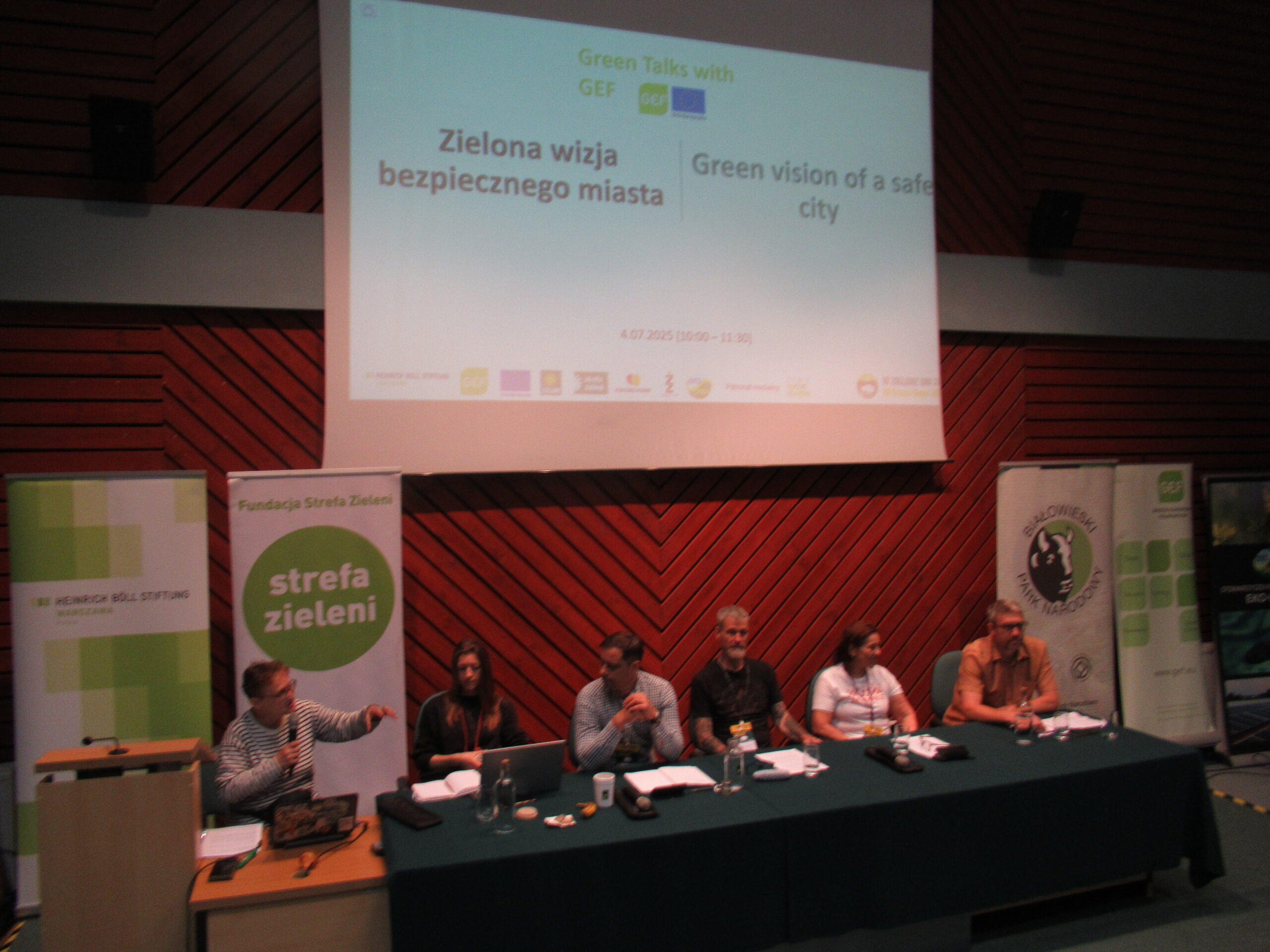
Green Days 2025 in Białowieża, marking the event’s 10-year anniversary
What assessment – even provisional – can be made of the progress of Green ideas in Polish society over the last 15 years?
There has been real change. Fifteen years ago, nobody was talking about the climate. In 2013, at COP19 in Warsaw, climate march organisers looked for civil society groups to partner with in putting on the traditional COP march. They couldn’t find any. All they found was Koalicja Klimatyczna (Climate Coalition), but it just focuses on lobbying and monitoring institutional negotiations. There were no grassroots organisations. So I had to step in. We put together a little committee and scraped some money together to bring 700 activists over from Brussels on a special train.
As well as handling all the logistics, we even arranged for them to meet the trade unions. In the end, 3,000 people marched, with the Greens leading the procession. It was a source of great pride. Today, all sorts of movements campaign on climate. In 2018 at COP24 in Katowice, there were over 40,000 of us. Greta Thunberg spoke at the conference. It’s a different level in terms of scale and impact.
Clearly, environmental issues are increasingly cutting through in Polish society. Campaigns to save natural heritage have played their part, too, like the movement for Bialowieza in 2016, which echoed the mass protests over Rospuda in 2006. This fight to protect Bialowieza’s primeval forest attracted huge media coverage and mobilised people who had never previously been involved in environmental activism.
I’ve also managed to place environmental issues at the heart of feminist concerns of the Women’s Congress [Kongres Kobiet is a major Polish social movement and NGO established in 2009], of which I’m a member, because all the research shows that women are slightly more environmentally aware and willing to act, whether it’s on climate, animal welfare, or waste.
There’s still a long way to go, but we’ve already achieved a lot.