
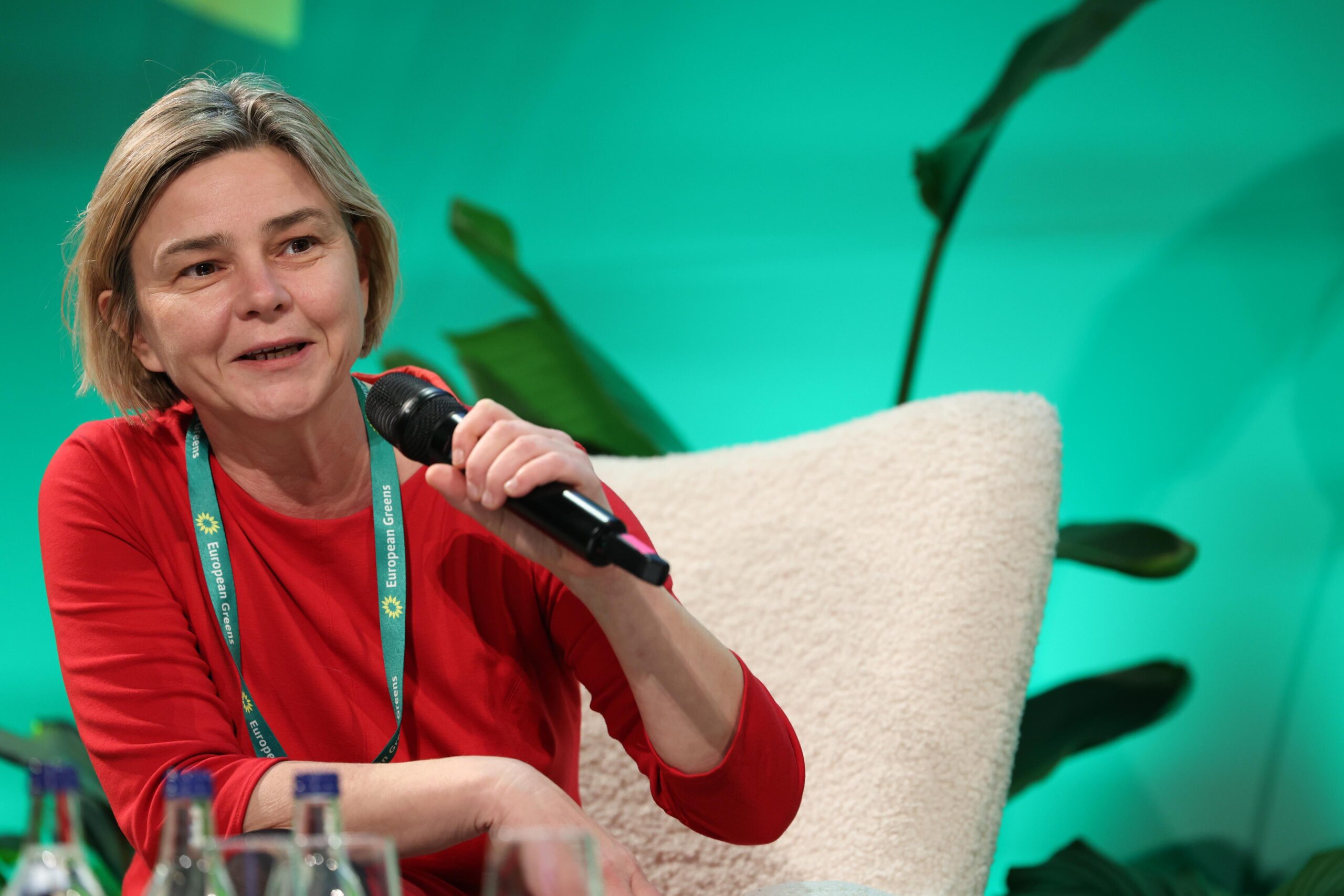
Sandra Bencic ©️ European Greens / Margot L’Hermite
Sandra Benčić is a Croatian politician and legal expert who graduated from the Faculty of Law at the University of Zagreb. She demonstrated an early interest in human rights during her university education and subsequently pursued a career in civil society organisations. Benčić is one of the founders and coordinators of the Green-Left political party Možemo!. Since the 2020 national parliamentary elections, she has been serving as the president of the Možemo! parliamentary group and has acted as the Chair of the Environment and Nature Conservation Committee in the Croatian Parliament. Her main areas of work concern environmental protection, transparency, and fair economic policies.
In this interview by Jamie Kendrick, Sandra Benčić reflects on Možemo!’s rise from a grassroots Zagreb initiative to one of Croatia’s leading political forces. She discusses the movement’s key electoral breakthroughs, strategy for broadening support, vision for a fair green economy, and ambitions to build a progressive majority in Croatia and Europe.
Why did you choose the name Možemo!, and what does it tell us about the movement?
We didn’t start as Možemo!. We started in 2017 as a municipal political initiative called Zagreb je NAŠ! – “Zagreb is ours” – and the goal was to get a few representatives, mostly activists, into the city assembly. At the time, Zagreb had been run for almost two decades by an administration marked by one corruption scandal after another. Nobody thought we would clear the 5% threshold and get into the city assembly, but we did – and not with one representative, but four. That was our starting point. In 2018 we began talking about building a national initiative to represent green-left values – the same values we stood for in Zagreb, but at the national level – and about whether we could grow a network of municipal initiatives into a national party.
We discussed whether it should be a green-left party in the traditional sense or something different, something that wouldn’t put us in a box. We wanted to signal that things really can change. In Zagreb in 2017 we had succeeded with one month of campaigning and practically no money – so who knew what else was possible? That’s why we called ourselves Možemo! – “We can!” – because it can be done.
What have been the key milestones on Možemo!’s road so far?
Entering the city assembly in 2017, then founding the national party in 2019. We first set up local organisations outside Zagreb – in Karlovac, Rijeka and Split. In Dubrovnik we had partners who already existed as a municipal initiative, and in Osijek we started to broaden out. Then came 2020: an election year, but also the year of the coronavirus pandemic and the big earthquake that hit Zagreb in March. It was a terrible time. After the earthquake much of the city was badly damaged, the pandemic was raging, and we couldn’t even meet in person. By May it was clear that the government wasn’t doing anything about post-earthquake reconstruction, so we started campaigning for a reconstruction law for Zagreb. Then the ruling majority decided to dissolve parliament ahead of early elections – without passing that law. We protested in front of parliament, and several of us from the party stayed there all night. In the morning the MPs arrived for the vote on dissolution and the television crews were there. The prime minister was booed by the protesters, and that was the turning point. The elections were in July, and we became nationally recognised.
So we went into the election campaign with the political capital we had built through those demands. At the start of the campaign we were polling at one or two percent nationally. It looked really bad. Then we began to rise, but we still didn’t really expect to get into parliament. And then things shifted. In July we won seven seats. It was a total shock. We were complete underdogs – nobody expected us to win even one seat, and we won seven. Not all seven were from Možemo! – two were from our coalition partners. So we became a parliamentary party, and very quickly we earned a reputation as one of the most active and constructive parties in parliament. We kept up the pressure until the law on the reconstruction of Zagreb was passed, and we fought for public funding so that people would not have to pay for rebuilding their homes on their own.
Then, in 2021, came the local elections. Tomislav Tomašević, who was leading our parliamentary group at the time, was our candidate for mayor of Zagreb – and he won. Then everything changed, because now we were in power in the capital but in opposition in parliament, and that’s a very difficult balance to strike. We also won in Pazin, the administrative seat of Istria County. In 2024 there were parliamentary elections again. We decided not to run in a coalition with the SDP, the Social Democrats. We were heavily criticised for that – by some of our own voters, but mainly by SDP voters, who felt we were protecting ourselves and our brand rather than trying to change the government. That wasn’t true; all the polls showed that a joint list wouldn’t have been enough to win. Today we are polling behind the SDP, but the gap is narrowing. We have announced that we will run together with the SDP in the next parliamentary elections, because the situation is now quite different. We could win. It will be difficult, but a government without the right is possible. But the real milestone for us was the 2025 local elections, and whether we would be re-elected in Zagreb and Pazin. We were – convincingly.
Who are your activists, your membership, and beyond that, who are your voters? It’s a much bigger group now, if you’re third in the polls.
Our membership is still too narrow. We were very careful about membership, because we didn’t want a sudden surge in members and votes. Many third parties have experienced sudden growth within a few years – they shot up and then collapsed, because their membership was so broad and heterogeneous that they couldn’t manage it. So we took the opposite approach. Now, though, we are looking at ways to open up – not only to new members, but also to people who simply want to contribute more, and in different ways. Ultimately, we will need to open the party up much more if we want to build a strong presence at the local level across Croatia.
Generally speaking, our voters are urban, highly educated and on higher incomes. You could say the same about many green parties in Europe, and it’s not good. We also have the largest share of young voters – but they, too, tend to be more educated. Our policies focus on inequality, poverty and low-income families, and yet we have not yet earned the trust of many of the people those policies are meant for. Meanwhile, people who don’t face those problems themselves see that our programmes are fair, and they vote for us. So we need to change that. And the only way to do it is to have authentic people from those communities speaking to those communities. If you want to talk to farmers, you need to send a farmer. You can’t send me, because they see me as an urban feminist. We need to attract people to the party who share our values but who also authentically represent groups that are not the usual Možemo! crowd.
You said you chose the name Možemo! because you wouldn’t be happy being labelled as a somewhat fringe green or radical-left party. You wanted much broader appeal. Do you aspire to become a majority party?
We want to show that you can start from the margins and still put forward policies for the majority. If we were a catch-all party, we would do what the big centre-left and centre-right parties do, which is to avoid taking a position on polarising issues. We don’t avoid them. But it’s very hard to hold that line, because the right constantly attacks us over a so-called “woke” agenda. They use us to frighten people – claiming, for example, that we want to make children change their sex, which is absurd and deeply manipulative. And some people believe it. For a long time we didn’t respond, because we thought it was too absurd to be taken seriously. That was a mistake. That’s where the question of reaching beyond your membership, towards the centre, comes in – finding the farmers, finding people who are not part of the urban elite, to represent you.
There are a lot of movements around Europe that are a few steps behind Možemo!. What advice do you have for young movements with big dreams?
First, get into the national parliament – to be visible. It’s crucial. You can run a city, even the capital, but without that national platform it’s really difficult. Second, we were very cautious at the beginning, and that protected us from many failures we would otherwise have faced. You need to be patient and avoid taking big risks. Tactical positioning matters. It isn’t about compromising on your values; it’s about being strategic, so that you survive long enough to put those values into practice.
It’s also important to protect the flow of information, the conversations and the deliberation inside the party. People join parties like ours because they want to contribute, to say what they think, and to see that things actually get done. They’re not there just to carry a party card. So nurturing internal debate is essential. We hold Zoom meetings with around a thousand people and spend hours discussing major issues, because that matters. For the leadership, it’s important to hear how people think.
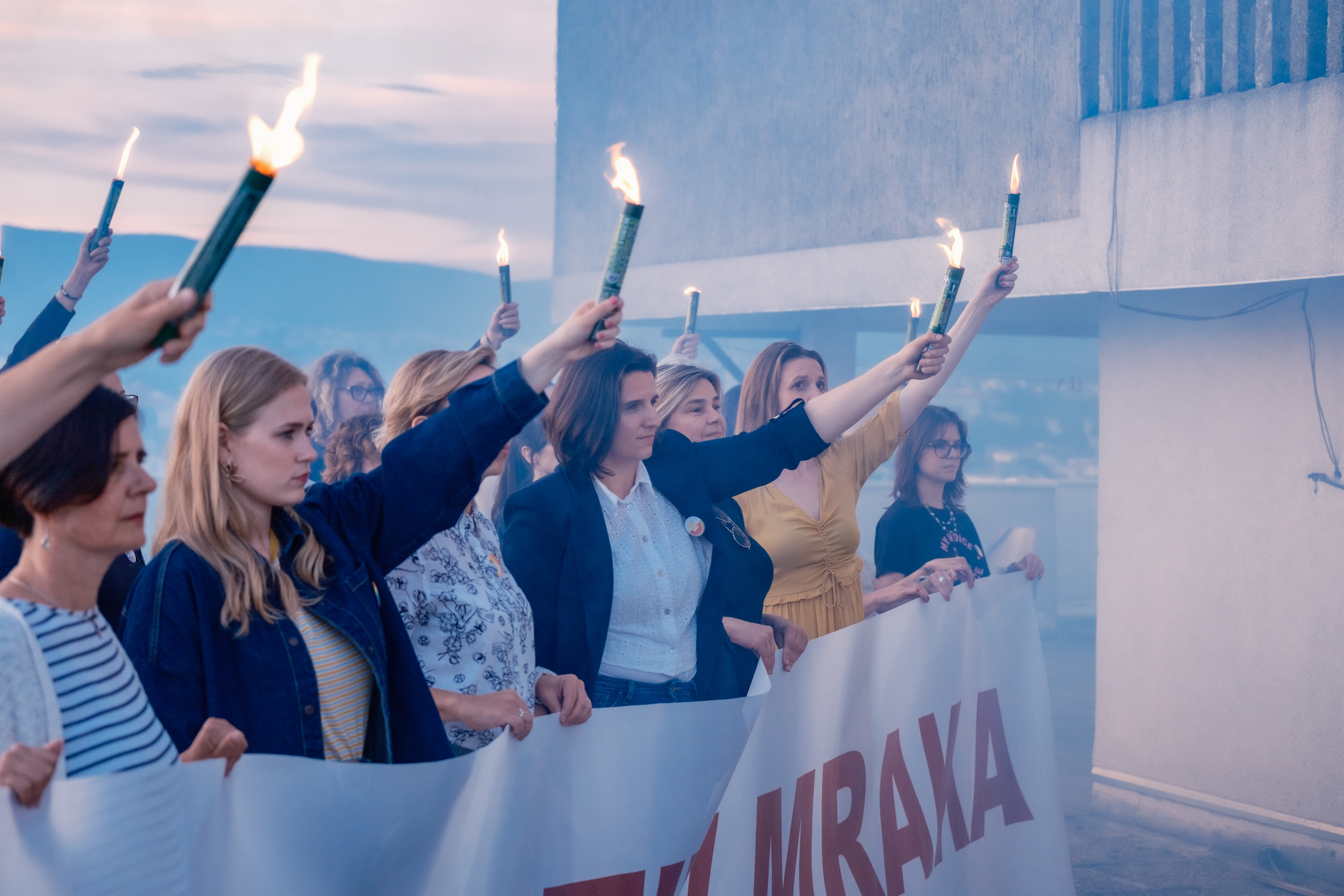
Zagreb © EGP/Shervin Sardari
Možemo! seems to be trying to speak to the majority by developing an alternative economic platform for the country. How does that fit with the visions of the movements that have pushed for degrowth, the commons and so on?
It has been inspired by spatial justice movements, economic justice groups, think tanks and others working on climate issues and better economy. We are building an economic programme focused on how to move from an economy based on rents and tourism to a more productive one. We can reindustrialise the country, but that reindustrialisation would focus on producing the goods and services we need for the major social transformations we want to achieve over the next 20 years – in climate, equality, care, an ageing society and so on. It’s a combination of doughnut economics and a mission-oriented economy, where you look at what you actually need to produce in order to achieve your goals. But to change the economics, we also need to change where the money goes. More of it needs to go into food production, energy and housing. So we are looking at how to use the financial institutions that are still in state ownership. There are only two such institutions left in Croatia, so the question is how to use them to support that transformation. In our communication with voters, we focus on affordability – of housing and food – as well as inflation, good jobs and wages, and quality of life.
Could you say a bit more about care – and particularly kindergartens, which Možemo! is known for in Zagreb?
When we came to power, 3,000 children in Zagreb couldn’t get a kindergarten place at all. There simply weren’t enough places. Since then we have built around 20 new kindergartens, and by the end of 2027 there will be 28. By then, every child will be able to get a place in a public kindergarten in their own neighbourhood.
In our first term the priority was kindergartens; in our second, it’s schools. We are renovating schools and building new ones in neighbourhoods that grew very chaotically over the last 20 years, without proper planning, and were left without basic infrastructure – schools, health centres and so on.
What about housing?
Our priority is not only to build new homes, but to bring existing ones back into use – flats that are empty or not being rented out – and make them available to the people who need them. That’s a generational project. Part of reindustrialisation is supporting the production of the materials needed to renovate the housing stock, especially new sustainable materials such as wood or hemp, which haven’t been widely used here before. So that is one industry we want to support. Others include food processing – in Zagreb we have piloted green public procurement of food for 30 schools, prioritising fresh produce and short supply chains. Zagreb’s new trams, for instance, are being built by a Zagreb-based manufacturer that won the public tender, which shows the kind of industrial capacity we want to strengthen. We also want more cooperative ownership and stronger collective bargaining between workers and employers. In short, we want workers in the private sector to have a real voice.
How does Možemo!’s economic programme fit into the larger European economy, in which institutions such as the central bank, and issues like trade policy, are decided at the European level?
I think Europe keeps making the same mistake. We have been trying to become more competitive and to protect ourselves from China and others, without thinking about where we want to be in 20 years. Instead, Europe accepted the rules of the global market and, for instance, let its shipyards close because China was building cheaper ships. It didn’t think about the whole chain – the companies, the knowledge, the people – that goes into the final product. Strategic sectors can’t be judged only by short-term competitiveness. The question shouldn’t be how we protect ourselves from China, or from the US for that matter, but what Europe needs – and how we produce it here. The problem is that in many sectors we are not planning for the long term.
Is this economic programme, which challenges the way that the mainstream parties in Europe think and talk about the economy, also a challenge to the far right in Europe?
When it comes to the far right, we will take this ground back. It’s a mistake that the left and the greens have lost the narrative about people’s participation, about making policies for people, about being grounded, to the far right. If you want to win that ground back, you have to be ready to communicate messages to majority of working people. Some will say that a certain policy serves the interests of a big industry. Fine – but the interests of millions of people matter more. Others will say that people simply need to recycle more. But that puts both the cost and the moral responsibility on the consumer. That’s the wrong approach, because in a capitalist economy people buy what they can afford – most people simply can’t afford anything else. Ethical consumer choices shouldn’t be a privilege of the wealthy.
There’s a huge conflict in Ukraine, and there is war across the Middle East. How does Možemo! position itself on security and defence, especially given that Croatia is a post-conflict society?
Our roots are anti-militarist. Many of us come from the peace movement, including me. But of course we understand that Europe, especially now, needs to develop its own security and defence policy. We emphasise a broader notion of security. We want a Europe that trains, funds and connects civil protection services across member states, because that is where the most immediate threats are – fires, floods and so on. We need better-integrated civil protection services that can work together in major disasters. We need the same in defence: closer cooperation within NATO and at the European level, joint exercises and joint command structures. Europe needs to define its own security interests and pursue them through credible defence capabilities and strong diplomacy. We don’t want to copy the American model of militarisation – Europe needs to find its own way of providing security for the continent. Of course we need a credible defence, but the scale of militarisation now under way is not the right path for us.
What’s your opinion on the accession of the Western Balkans and EU enlargement?
We are very clear and vocal about that in parliament. We strongly support fast-tracking the Western Balkans’ accession to the European Union. It’s really important, because other powers are exerting strong influence in the region and pulling it in different directions. Many of these countries face serious institutional weaknesses, but the process of joining the EU – and then membership itself – helps build the institutional capacity that domestic politics alone has not been able to deliver.
Serbia under Vučić could not join the Union, but as the country changes course after the 25 October 2026 elections, we should do everything we can to bring it in. The EU has treated North Macedonia deeply unfairly. Montenegro and Albania are currently the frontrunners, and it is essential that Slovenia and Croatia support those countries in EU accession.