
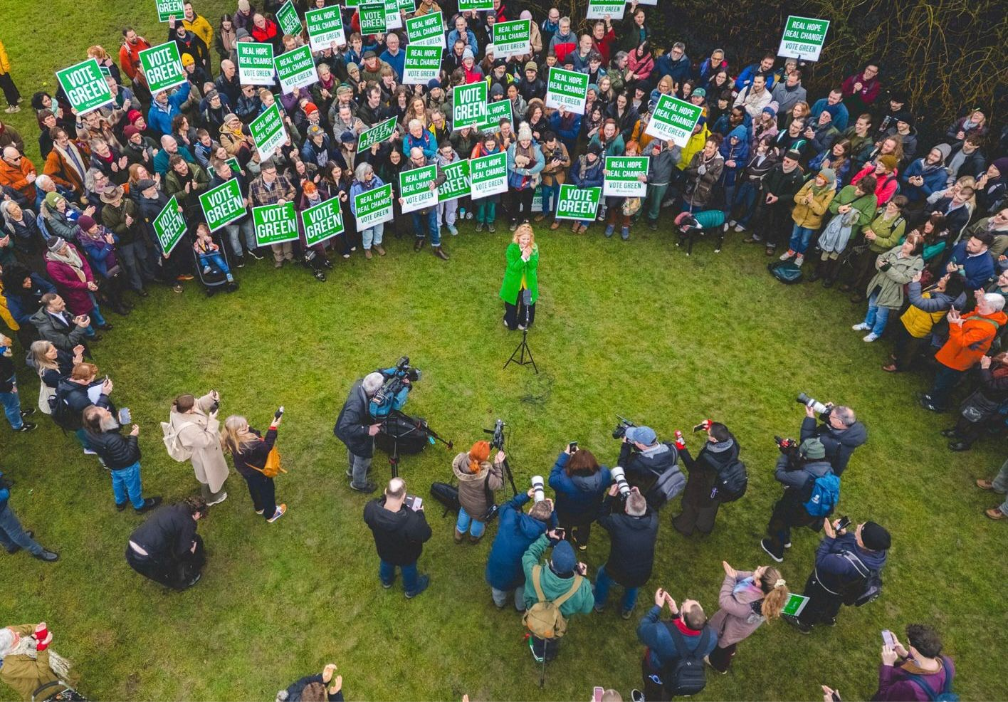
Chris Williams joined the Green Party of England and Wales (GPEW) in 2004, after initially doubting whether such a small party could deliver meaningful change under Britain’s first-past-the-post electoral system. But a week-long study session with like-minded young Greens from across Europe in 2003 drew him in. Although the party’s numbers were very small, it was a growing movement, and Williams realised that the party’s influence would ultimately depend on the energy and commitment of people like himself. He subsequently became a key figure in the party’s campaigning, overseeing the “Target to Win” strategy that helped deliver many breakthroughs at the local level and four seats at the 2024 General Election – a massive leap forward for a party which had previously only been represented by a single Member of Parliament.
In this interview by Beatrice White, Chris Williams looks back at the party’s political and campaigning trajectory and takes stock of its current position.
Before entering Parliament, much of the work to build up the party’s power happened at the local level over many years. Can you explain the role of local politics in the steady rise of GPEW?
First past the post (FPTP) is a huge barrier because of the high vote share you need to win. So making progress at a local level first is easier. You can build up your infrastructure at a local level: building up a team of volunteers and a relationship with the voters. For voters as well, it’s a smaller leap of faith to take. If you build their trust, it can be a stepping stone to Parliament – that’s what happened in Brighton [where Greens won their first seat in 2010], which got its first Green councillor in 1996. It’s easier for people to make small steps towards supporting us when you’re taking them on a journey. And for grassroots power to beat the establishment, party campaigners have to put their lives on hold for a while or donate a lot of money. Those small local wins early on really help build that confidence. When you believe you can win, you tend to win.
Were there some wins then that were really genuinely surprising? Wins in unexpected places that subsequently had an impact on future ambitions and strategy.
Some people have certainly been surprised. At the last general election, we won four seats – two very rural, and two very urban. That was very confusing for the media because we have a reputation as an urban party. As strategists we haven’t surprised ourselves because we’ve won in places we targeted and prioritised – we don’t win by accident. But we’ve managed to attract a pretty broad spectrum of demographics of voters towards us.
What was the role of infrastructure around Green councillors in building up a bigger political project from pockets of success across the country?
The Association of Green Councillors – what we call our network of local councillors – was very helpful to build competence and confidence in how to be effective as local councillors, for those who got elected. You start in opposition with two or three councillors, then build larger groups and enter coalition, and now we run six councils in England with an outright majority, three in London and three outside of London. So we’ve really been on a journey.
The breakthroughs at the national level – first with Caroline Lucas becoming an MP in 2010, then achieving four seats in 2024 and a fifth one in a by-election earlier this year – were the result of very focused campaigning and tactical organising: Target to win. Can you explain the main idea behind this strategy and its place in the development of GPEW campaigning?
Target to win ultimately really means selecting the number of geographical areas, called a ward or constituency, Greens can feasibly campaign in to win and then focus all resources in those places. Going too wide means we win fewer seats and of course focussing too narrowly means you win too few seats as well. So getting the right focus and combining it with evidenced and tested campaign tactics combines to form a strategy. As a general rule, it’s helpful to have a concrete model on how to campaign, like a recipe book. So this is our strategic approach to elections.
When I joined the party, there was a strong sense that we have to focus resources because of the electoral system. We must be really hyper-focused, so I understood that, and observed what might work, how you might engage with voters. You have to listen to the community you’re trying to represent through conversations with them on the doorstep – this helps to understand what they’re looking for and work out how to refine your messages as you’re talking. It’s a live experiment, in terms of what tools might be helpful to get across those messages, how you organize your volunteers and activists, and often that’s through leaflets and door knocking. So it’s trial and error and trial and improvement over the years for all of us. But really, it’s a big team effort to constantly keep on reviewing how things are. And it’s become part of the party’s culture – trialling different things and sharing their learning.
Canvassing is a long-standing practice in Anglo-Saxon nations – it’s a part of the political culture. But I think Greens were poor at data collection for a long time because they just didn’t have a system. GPEW has only just got a proper nationwide system now. For the past 10-15 years we were using Excel spreadsheets, and before that paper, which was a cumbersome mess. People didn’t fully understand why you had to be so rigorous. And we don’t just ask people whether or not they are going to vote for us and try to gauge how likely they are to vote, and then move on, like some other parties. We knew we really had to build connections with people to persuade people. That’s always been our focus.
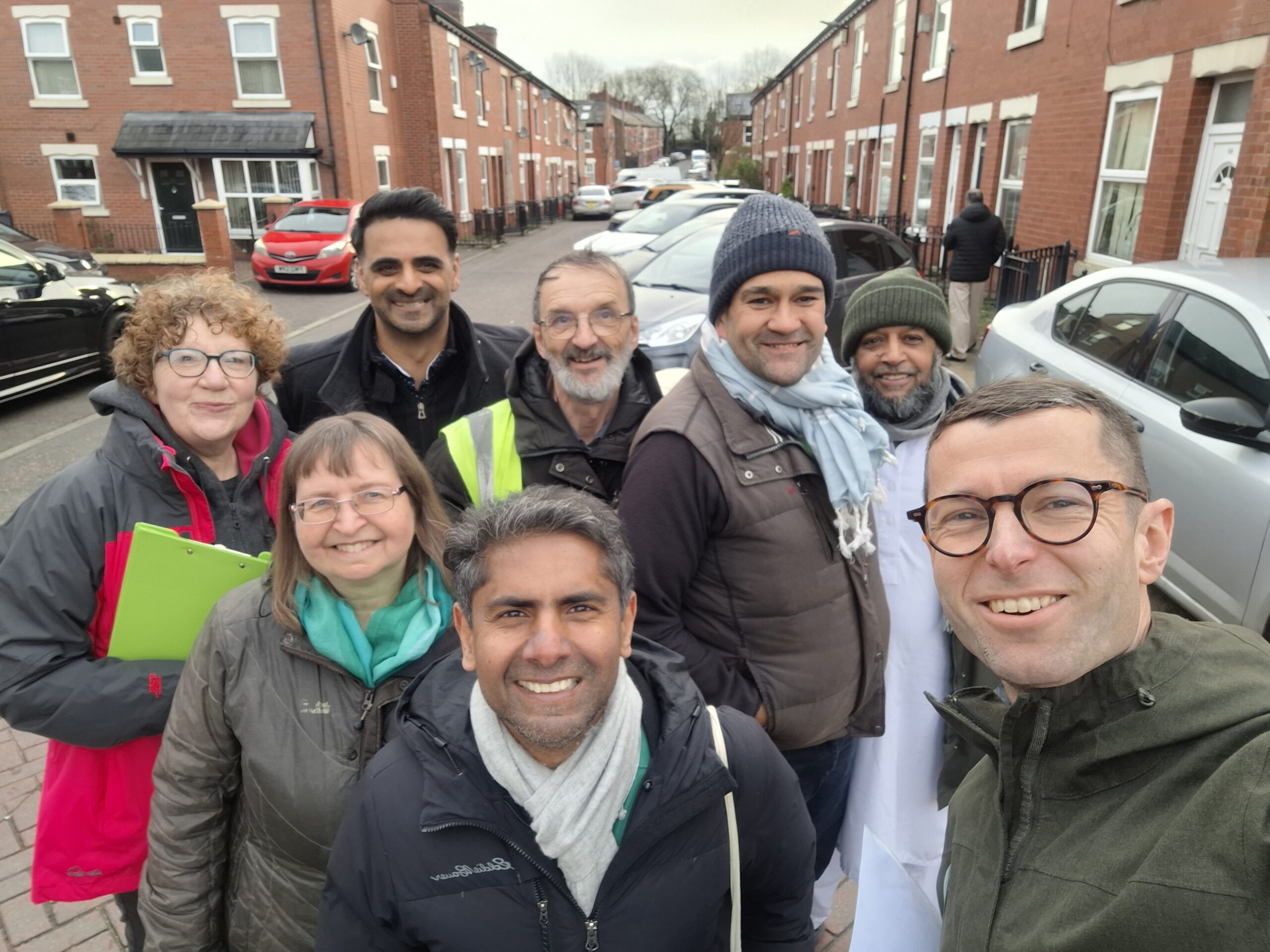
William and others on a canvass in the Gorton and Denton by-election campaign, 2026.
With field campaigns like canvassing, how do you balance the need to maximise efficient use of limited resources – in terms of people, finances, and time – with the community-building aspect needed to maintain volunteer engagement and motivation?
I think what is not necessarily unique, but we’re particularly good at is the community aspect of it because it’s very easy to slip into hyper-efficiency mode. Rather than meeting up somewhere first, it’s much more efficient if people just leave their homes and start knocking on doors or delivering leaflets straight away. But it’s not very motivating, especially if it’s cold and rainy outside. If you’re meeting other people, you don’t want to let them down. So we’re really good at the before and after, meeting up to plan and then debrief, creating the community because that keeps people involved.
There has been research in the UK on why members of political parties generally get involved in campaigning, because most of them don’t. And it’s either because there is some personal gain because they’re trying to get elected themselves, or because it’s their community and they feel connected with other people. So if you don’t build that community, people will just float away. There are other things to do in life.
Under this strategy, how much autonomy have local groups had to determine their own campaigning priorities, approaches, and messages?
They do have a lot of autonomy – the Green Party set up in that way, as I’m sure many Green Parties are. Local is in charge. We present our general recommendations and approaches nationally, but we don’t tell people not to do something because that is always a red flag to Greens. It is important that local teams have that autonomy, so we give them tools on how to come up with messaging rather than tell them what the messages should be, because they know their community, they’re doing the listening. Because nationally, it’s not possible to be certain of what local people think in a place we’ve never been to. If we teach our teams how to come up with good messaging, they will be much more effective.
Have there been challenges reconciling a rather centralised strategy with the pluralism and autonomy which are important values for the party and its members?
As people have gone to help in other campaigns, they’ve started to learn what the ingredients for success are. Going back to the recipe analogy, they can see there are certain ingredients that are essential, and others that are less so. Our campaign managers are supported and advised by staff who build relationships with them, helping and mentoring volunteer campaign managers to take the lead in their own areas. Through that relationship of trust, they’ll generally listen to the staff member because it’s their profession. They’re learning what’s effective in election campaigns every day of the week. If you’ve got a busy life and only half a Saturday to devote to a local council election, you haven’t got time to reinvent the wheel.
So there is discipline for sure. Sometimes teams do things we think are bad ideas, and either they learn something from it, or we do. If everything is identical or a photocopy of the previous campaign, our innovation will stop, so we’re happy to experiment. It’s really about helping people think through the process, or at least encouraging them to test something, like messaging, for example. Experimentation but with guardrails.
Money is something that has often been an issue for the party – its financial resources have long been scarce due to the party’s ethical approach to donations and a lack of the kind of state funding that would be available to small parties in some other countries. To what extent have these financial constraints shaped deeper strategic and organisational decisions?
We have been really constrained by financial resources due to the dependence on small donations, which made it difficult to be heard in mainstream media and to compete with other parties that can fund so much more. Our strength is people power, and volunteers can do a lot – including organising other volunteers – but to campaign across a very large area in a general election you need staffing, and that’s expensive. Campaigning costs money, whether it’s social media or leaflets. That’s where almost all the money goes: people, paper, and online.
I think it has shaped our campaigns. Often we’ve had to work around the lack of tools – digital tools and canvassing software can be expensive, for example. So that’s held us back. It’s often meant more work for already exhausted campaigners. It feels like we’re washing our clothes without a washing machine, while the other parties have tools that make things much simpler. But compromising on our values isn’t an option for us. We’ve had another big surge in members, and that means more money coming from them, which is great. My budget has doubled in the space of the last 12 months, but it’s still small compared to other political parties.
The Green Party saw an important surge in membership under Natalie Bennett’s leadership (2012-2016), when there was a strong push to communicate around Green concepts and issues that weren’t generally being heard in UK politics. How do you see the significance of that period?
Natalie might have been ahead of her time in talking about austerity, at the time it was quite a niche term. And then suddenly she was using it in the general election TV debates. But then she was joined by the Scottish Nationalist Party and the Plaid Cymru leaders, also using it as well. And suddenly, the public were googling “austerity”, and it became a mainstream term. It was a word the public might not have been using, but which captured something many people were already feeling the effects of – a sense of neglect. The decline and growing inequality in Britain have continued – and accelerated, particularly after the financial crisis and after Brexit.
There’s now a whole generation who have grown up during that period and, as adults, have known nothing different. They can see their lives being significantly worse than their parents’, while their parents can see their children facing worse prospects than they had. It feels like the first generation for whom things are going backwards – with no sense of progress. So the anger towards the status quo, has grown. And with that has come a much bigger political space and a bigger electoral opportunity.
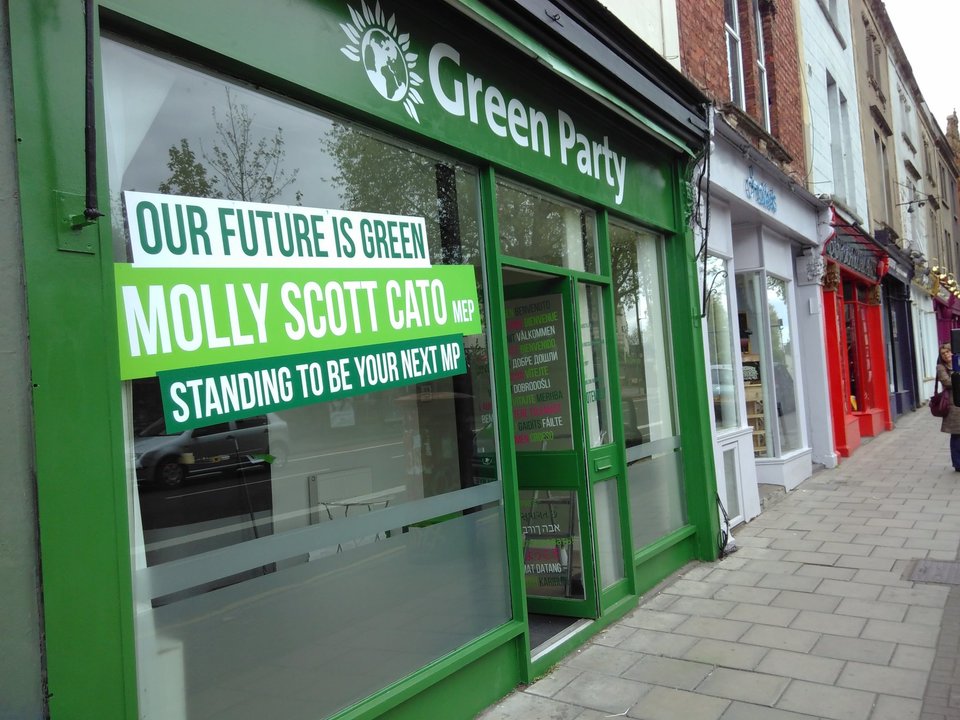
Green Party shop at the 2017 General Election in Bristol (for former MEP Molly Scott Cato).
The current electoral context – with the rise of support for smaller parties like the Greens and Reform, at the expense of what have traditionally been the two dominant parties – is now very different. How has the party’s rhetoric adapted?
In the early 2000s, the assumption was you had to be the most middle-of-the-road party to win, because people don’t want the boat rocked. But everything is up in the air now as people don’t want tweaks to the status quo, they want more radical change. Zack [Polanski, the current leader of GPEW] saw that opportunity, he understood that millennials and Gen Z were feeling so screwed over, and could tap into that discontent. Most politicians are just wallpaper in that they all say virtually the same things. Zack really stuck out as an energising and powerful communicator. That has been a powerful combination and in Britain it has really helped move the Overton window in a number of areas. The Iran war started just a few days after we won the [Gorton and Denton] by-election in February, but Britain didn’t join in. Usually, when America says you need to join in this war, Britain does.
Through research we’d been doing over the past years we found that Greens inspired a high level of sympathy and trust among many people. Given trust is so low in politics, that was significant. They liked us, but they just weren’t voting for us. People consistently appreciated our stance on climate and environment and felt we were telling the truth. They saw us as prescient, determined, and consistent. But they expressed a lack of clarity about where we stood on issues of social justice – like care and the health service. The new leadership really understood that as well. So we’ve got voices that are now heard on those issues, and that has convinced a lot more voters.
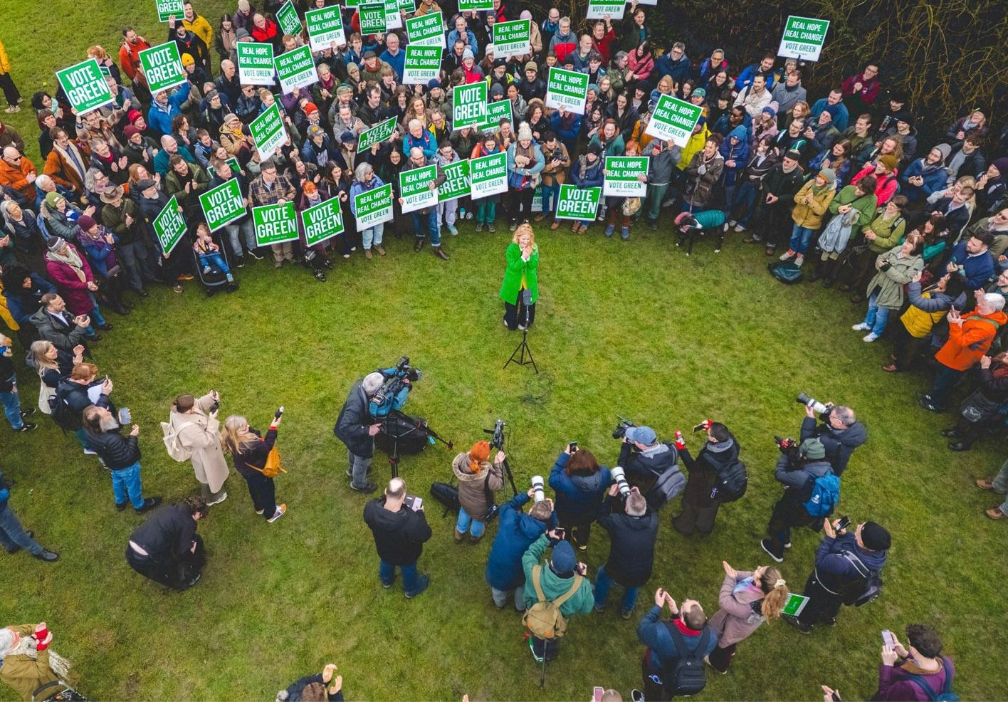
Campaign day in Gorton and Denton, Feb 2026.
Prominent figures like Zack Polanski and the party’s newest MP Hannah Spencer embody a new type of political communication for the Greens – bold, direct, authentic, and not taking itself too seriously. Is that a symptom of the transformation of the information landscape, or a deliberate shift in response to the need for strong, clear messages?
Greens always struggled with getting attention; so often the media just want entertainers, not people who can put together a coherent argument, but somebody who can put it interestingly. It’s about retaining viewers or listeners. And even if you get in the media, your points have to land with the public.
Zack and Hannah are both very strong and authentic communicators. Being authentic in politics takes you a long way now. Hannah left school at 16 – that’s an unusual profile for Greens who are so highly educated and have a highly educated voter base. She sounds like a working class person and she isn’t trying to blend into Parliament. She’s anything but wallpaper. And I think that makes her very attractive to the media, because they know she’ll connect with the public.
How do you see the best way to scale up the tried-and-tested strategies and refine the playbooks as GPEW continues to grow?
In the 2024 general election, it sometimes felt as if we were running four unique campaigns – four boutique businesses. We probably could expand that to more using the exact same methods. But actually, our eyes are on bigger numbers than that. And if you want to win dozens more seats, then suddenly you can’t operate in the same way. Imagine you had four boutique bakeries, and suddenly you’re trying to have 50 or 100 of them. You can’t run it in the same way. You’re becoming a chain. You need more resources and templates, as well as guidance and flexibility. So we’re trying to become more efficient as we try and win more seats – with staff specialising in certain skills working on multiple campaigns, for example.
And the size of a campaign very much depends on where we are in the national polls because the splintering of British politics means you can win seats with fewer votes. In some ways, FPTP has almost become a lottery, and the difference between first place and sixth place can be a very small percentage of the votes. So the winning bar is lower, and if we’re starting higher in the polls, then maybe our campaign doesn’t need to be as intensive. Even just going up or down by 5 per cent in the polls can make a huge difference to campaign decisions. But overall, the infrastructure behind it that we’re putting in place is much more flexible and centralised. Not in terms of dictates, but provision of resources and sharing of knowledge. A message on a leaflet in one campaign might work just as well in another one 100 miles away, for example, or might just need to be tweaked slightly.
There’s long been an assumption that Green Party members are middle-class, urban, liberal, and highly educated. Are the party’s demographics changing, and if so, is this happening organically or by design?
There’s more to do, but our voter base has become more defined over the past year. Age and gender are now very strong indicators: young women, particularly those under 24, are very likely to vote Green, men less so. Muslim voters are much more likely to vote Green, and people from a global majority background are also more likely to vote Green than white voters. Gaza has a lot to do with that, as does the Labour Party pushing away some of their supporters.
So in some ways we’ve broadened our appeal, and in other ways we’ve become more defined. We have greater diversity among our voters, but we’re also more defined by age and education. That’s contributed to us becoming more urban, too. There used to be little difference between our urban and rural support, whereas now there is. So perhaps some of those old stereotypes are hardening in a sense, but they’re also changing – particularly in terms of our voter base being less white.
What factors do you think will be most decisive to determine whether the trend of electoral success continues for the party? Is the key more about a convincing big-picture narrative nationally or continuing to build power locally?
I think it’s both. Traditionally, Greens have struggled to get any national airtime. But we have been very successful in the past year at getting the headlines. And the door-knocking is still really valuable. So I think now the strategy is twofold: it is doing really well in national media and with that national messaging and winning over the public effectively through our national communications, and then supplementing that with the local campaigning. This is what can take us from a good position to a winning position – convincing the wavering voters. If we can get both right, it’s a powerful combination.
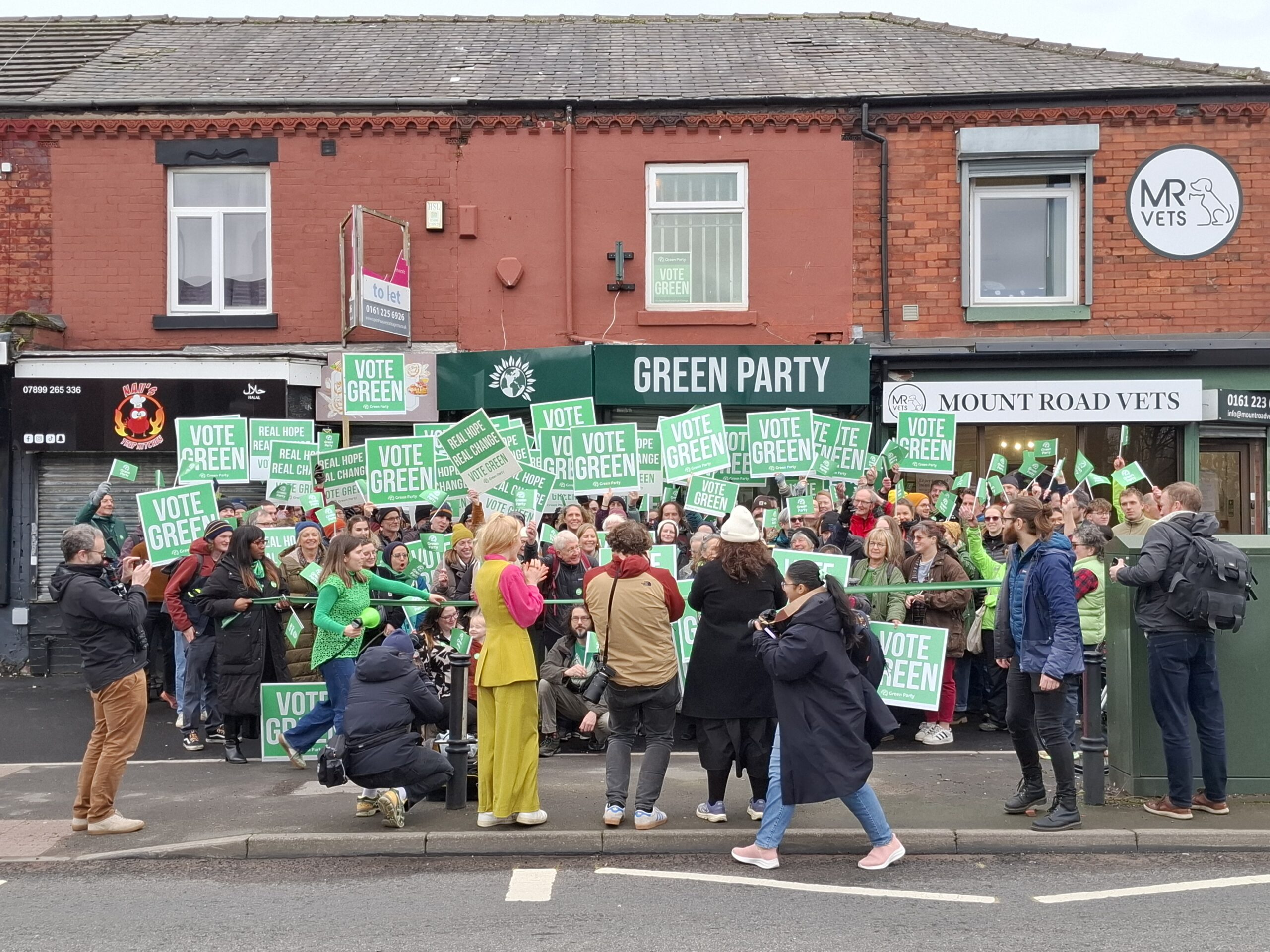
Campaigners in Gorton and Denton, 2026.