
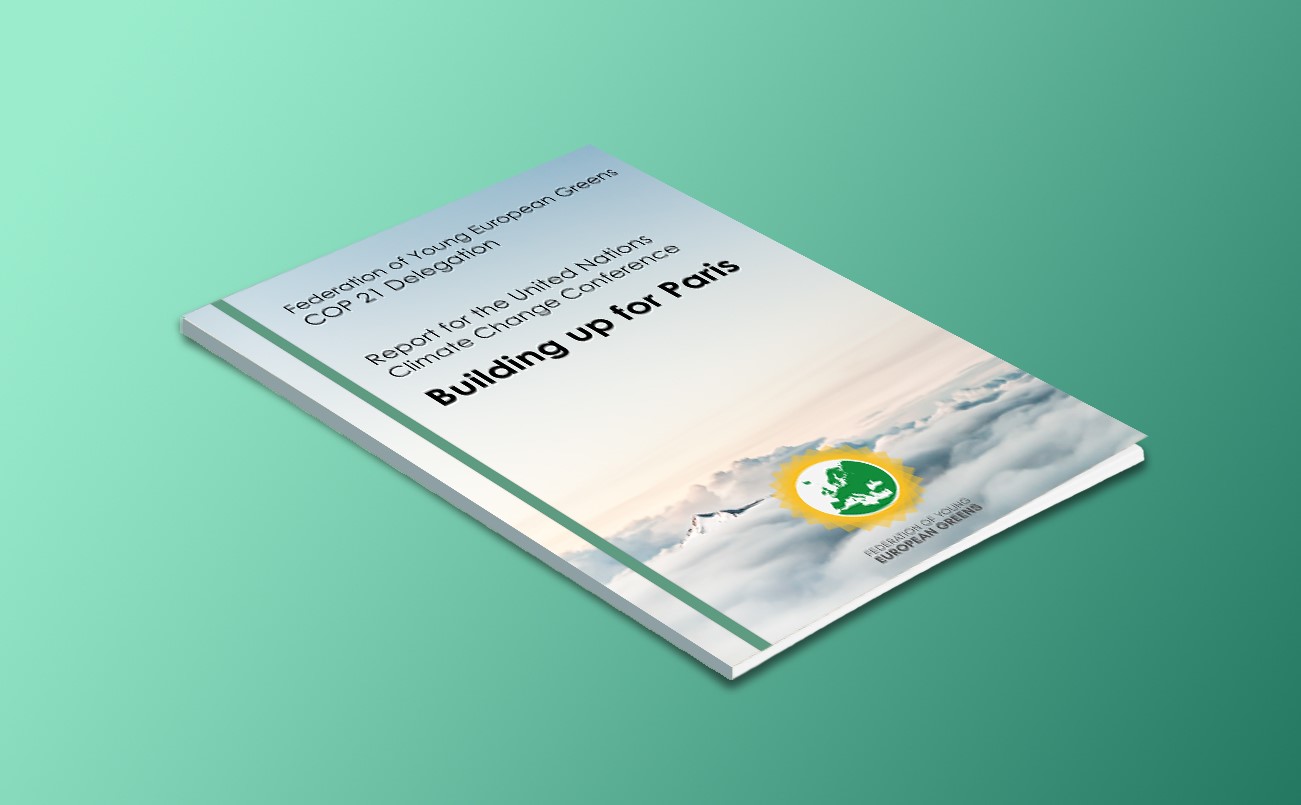
Building up for Paris: COP21

By Uncategorized

2015 is a crucial year for climate negotiations. The current agreement – the Kyoto Protocol – is in its final commitment period (2013-2020) and this year marks the deadline for world leaders to reach a new agreement. As the United Nations Framework Convention on Climate Change (UNFCCC) states, this agreement could be in the form of “a protocol, another legal instrument or an agreed outcome with legal force under the Convention applicable to all Parties”, which will enter into force post-2020 in order to keep global warming below 2°C.

Over the year, the Parties met at different sessions. The most recent one took place in Bonn in June and there will another session in the beginning September. These events all pave the way towards the 21st Conference of the Parties (COP) that will be held in Paris in December, where the negotiations will peak.

The chapters in the report are structured as follows: chapter two provides a summary of the history of COPs since the UNFCCC was created by the Parties following the Earth Summit in 1992. The third chapter assesses what is at stake in Paris. In the fourth chapter, we discuss the legal nature that a Paris deal could adopt.

The fifth chapter provides a deeper analysis on a core principle guiding the negotiations: common but differentiated responsibilities. The sixth and the seventh chapters give an insight on the broader concepts of mitigation and adaptation in the context of the UNFCCC negotiations.

The eighth chapter focuses on the CBDR principle and the notion that the implementation of the Convention worldwide needs financial mechanisms. This chapter is followed by a critical perspective on market mechanism, before moving on to discuss land-use, land-use change and forestry in the tenth chapter – giving an insight on the broader topic of agriculture within the UNFCCC.

To follow, the eleventh chapter deals with another part of the Convention, essential for its implementation but often forgotten: education. The twelfth chapter focuses on the blockers in the UNFCCC process, divided in two parts: the countries analysed through their group position (Umbrella and EU); and the business and industry networks. Finally, the publication concludes with the elaboration of possible scenarios for the COP in Paris.

Green News – Climate Edition

By Uncategorized

With articles in English, French and Polish, this e-book includes, among others, an examination of climate change as a moral challenge, an economic deconstruction of climate change as a ‘neoliberal illusion’, and a social perspective on climate change as a threat to the public goods that belong to all citizens.

A wide array of authors have contributed to the publication, including NGO representatives, political figures, scientists, and even an award-winning documentary-maker from several European countries. The e-book also contains case studies on how climate change is impacting specific areas such as the Arctic, the Amazon and Indonesia, as well as how the fight against climate change is manifested in areas such as resistance to TTIP, and how to spur further action and maintain the momentum of the campaign, now that COP21 is behind us.

The European Patient – A Diagnosis of the EU’s Maladies

By Uncategorized

Today, Europe is in the midst of a number of overlapping crises: among others, economic, social, political, and environmental. For years it has been obvious that the European project cannot go on in the way it exists today, but the warnings were not taken seriously by the governments and major political forces in Europe. A “Grexit” or “Grexident” was barely averted in 2015, and 2016 saw a majority of voters in the United Kingdom opting to leave the European Union. In the meantime, opinion polls have shown that large parts of the population in other member countries, France and Denmark amongst others, would not mind following the British example of continuing their lives outside the European Union.

The compilation is subjective, and is based on the readings of the author and the GEF team, as well as a survey of the correspondents of the Green European Journal. The selected articles do not represent the views of the whole of the Green movement; rather their goal is to provide food for thought and to provide a selection of interesting readings

This publication looks into a number of possible reasons that have led, according to analysts, politicians, journalists, and activists, to the current problems of the EU, in order to identify the most important issues of concern, and – as a next step of our project – provide solutions to the shortcomings of the European Union.