This Oppressive System & our Mental Health (Rouen)

By

About the Event

This youth-focused summer camp will consist of workshops and discussions exploring mental health in all of its political relevance, including how such issues disproportionally affect the oppressed and activists, and its relation to freedom of expression, right to protest, and access to information in Europe.

GEF, with the support of our partner FYEG, is providing selected participants with a crash course on how public policies and civil society actions address mental health at various levels, including on a European scale. Participants will be challenged to use their creativity, critical thinking, and activist skills to design the green visions and policy solutions of the future–addressing mental health and the fight against oppression across Europe.

Programme

09:30-10:00 Morning circle 

10:00-11:30 Mental health and policy: national and regional level 

11:30-12:00 Coffee break 

12:00-13:30 Mental health and policy: European and international level 

13:30-15:00 Lunch 

15:00-16:30 Radical view: imagining the policies for an ideal future 

16:30-17:00 Coffee break 

17:00-19:30 Committee work and reflection groups 

19:30-20:30 Dinner 

21:00 Non-stereotypical cultural fair 

More details on programme and speakers will be announced shortly! 

Practicalities

Date: 27 July (10:00 – 22:00) 

Location: Rouen, France (Auberge de Jeunesse – 3, rue du tour Route de Darnétal) 

Audience: This summer school gathers 40 young people aged between 15 and 35. Registrations are now closed and all selected participants have been informed.  

Language: The main language of this activity will be English. Not being comfortable interacting in English  


These summer school sessions are organised by the Green European Foundation with the support of FYEG and the financial support of the European Parliament to the Green European Foundation.


This Oppressive System & our Mental Health (France)

By

About the Event

This six-day summer camp will consist of insightful workshops and discussions exploring the topic of mental health in all of its political relevance.  We will aim to unravel how such issues disproportionally affect oppressed individuals and communities as well as the activists fighting against the systems of oppression. We will also tackle other issues such as freedom of expression, right to protest, and access to information in Europe.

GEF will be organising a one-day summer school as part of this activity, with a particular focus on mental health in the European political context and how the green movement can play a role.

Practicalities

When: 23 – 28 July (arrival on July 22nd, departure on July 29th)

Where: France (exact location to be confirmed)

Who: We are looking for 40 young people between 15-35, residing in one of the Council of Europe member states, Belarus, Russia and Kosovo*. We welcome applications reflecting diversity in all forms; therefore we encourage applications from those who identify as women*, LGBTQIA+, POC, or with a disability or other health impairment.

Language: The main language of this activity will be English. Not being comfortable interacting in English should not prevent you from applying, as we will try finding a solution with you to support you.

Further information on cost, Covid guidelines, and travel and accommodation can be found here.

How to Apply

Registrations are now closed.


These summer school sessions are organised by the Green European Foundation with the support of FYEG and the financial support of the European Parliament to the Green European Foundation.


European Green Academy

By

About the Event

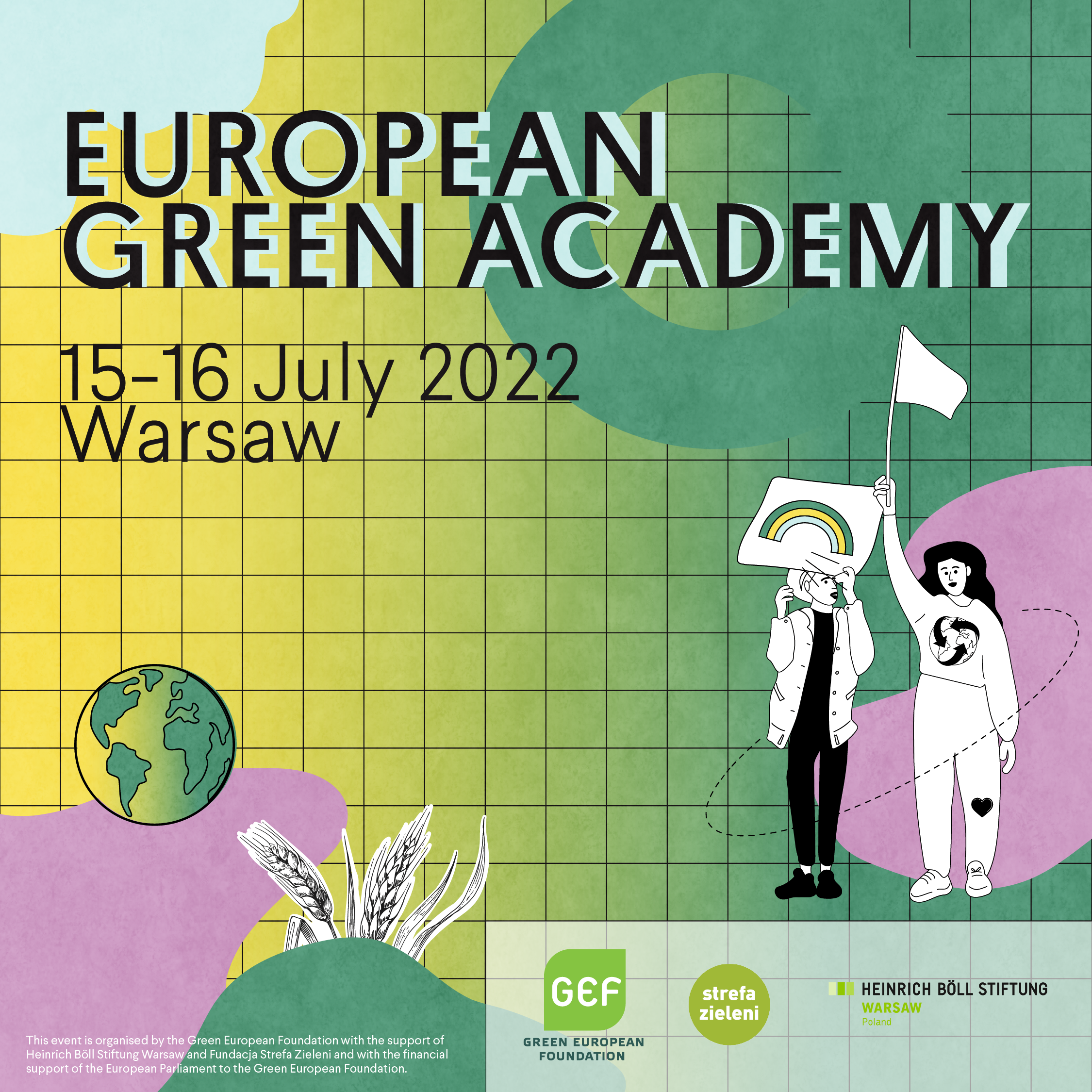
The European Green Academy opens its doors for the first time! On this occasion, the Green European Foundation, in cooperation with Strefa Zieleni and Heinrich Böll Stiftung Warsaw will invite diverse green actors, activists, politicians, and academics from all over Europe to further explore the political situation in Poland and build bridges and connections between national and European-level debates.

Topics and methods

The Academy will be the key meeting point for over 150 Green actors and interested citizens from Poland and across Europe to connect, debate, and build capacities. With this initiative, the organisers seek to promote an inspiring learning environment, facilitating skills building to collectively bring about a better future. With that in mind, the programme will delve into salient green issues via a diverse range of formats, including workshops, training, plenary debates and networking. The Academy will also serve as a space to strengthen connections between the Polish and European Green movements. The sessions will be split into four different streams:

The Green European Academy will be hosted by Agnieszka Lichnerowicz and Sebastian Wehrsig

Programme


FRIDAY 15 JULY


08:45 – 09:30

ARRIVAL AND REGISTRATIONS

09:30 – 11:00

STREAMS

Parallel 1

RoundtableConference Hall

Parallel 2

Doughnut Economy in Polish Cities: Utopia or Political Project?

[EN]

🕊

Refugees and Migration: Poland, Ukraine and the EU Perspective 

[EN]

Shared Energy, Efficient, and Sufficient Energy, [EN/PL] 

[EN]

LGBTIQA+ Rights in the Green Movement 


[PL] 

11:15 – 12:15

CONNECT

12:15-12:45

GROUP PHOTO

Roof Terrace

12:45 – 14:15

LUNCH

14:15 – 14:45

WELCOME [EN/PL]

Conference Hall 


14:45 – 16:15

PLENARY

Go Green Go Social: Challenges and Pathways for a Socially Just Transition in Poland and the EU [EN/PL]

16:15-16:45

BREAK

16:45 – 18:15

STREAMS


Conference HallRoundtableParallel 2Parallel 1
 

Right to Housing in Times of Instability

[EN/PL]
🕊

Just Transition in Rural Areas 

[PL/EN]

Deconstructing the Nuclear Industry Myth and Lobbying

[EN/PL]

Feminist Foreign Policy

[EN/PL] 

18:30 – 20:30

NETWORKING DINNER

Roof Terrace


SATURDAY 16 JULY 


09:30 – 10:00

◉ KEYNOTE

Conference Hall 

10:00– 11:30

◉ PLENARY

Peace and Security:  What do Polish and Ukrainian Perspectives Mean for the Debate on a Green European Vision for Security? [EN/PL]

Conference Hall 

11:30 – 11:45 

BREAK   

11:45 – 13:15

STREAMS

Conference Hall Parallel 1Roundtable

Parallel 2

Media Literacy to Strengthen Democracy in Eastern Europe

🕊

Food Security in Times of Crisis

[EN/PL]

Metals for the Energy Transition

[EN]

Reproductive Rights in Central and Eastern Europe

[EN/PL]

13:20 – 14:00

ENERGY SECURITY: A EUROPEAN PERSPECTIVE [EN & PL]

Conference Hall 

14:00 – 15:30

LUNCH

15:30 – 17:00

STREAMS

Parallel 1

Conference Hall

Parallel 2

Roundtable


Greens Reinvent the City

[EN]


🕊

Biodiversity & Conflict: the Environmental Cost of the War in Ukraine

[EN & PL]

Skills Training – Tiktok: Debunking Disinformation on Nuclear

[EN/PL]

Dare to Care or Ecofeminist Power of Change

[EN/PL] 

  17:00 – 19:00

📽 SCREENING AND DEBATE

Conference Hall 


Practicalities

Date: 15-16 July 2022

Location: Conference Hall at the Copernicus Science Centre (Centrum Nauki Kopernik), Warsaw, Poland

Language: English and Polish. 

Registrations are now closed.

For questions or more information, contact antoine.preel-dumas@gef.eu. 


This event is organised by the Green European Foundation with the support of the Fundacja Strefa Zieleni, Heinrich Böll Stiftung Warsaw and with the financial support of the European Parliament to the Green European Foundation. 

We are the future, but we are here NOW (Riga)

By

About the Event

Around 30 young people from Eastern Europe (Latvia, Poland, Balkans, South Caucasus, Ukraine and Belarus) will meet up to discuss the actions that can be taken in the ever-shrinking space for civil society in the Eastern part of our continent. We will look at the EU integration processes, the future of activism and politics and concentrate on 4 different skill-oriented tracks that are becoming more and more useful for the youth in Eastern Europe:

1. Creative Campaigning

2. Debates and public speaking

3. Movement organising

4. Non-Formal Education

The programme will be based on the principles of non-formal education and intercultural learning. We strive for an active and inclusive environment for direct communication and sharing of knowledge. The sessions will be balanced between theoretical inputs, work in small groups, workshops, discussions, training, and other interactive methods of non-formal learning.

Programme:

Arrival day

Day 1: Introductions, Team building, takaways from the 1st event, home evaluation groups

Day 2: Introductions to: Non formal education, creative campaigning, public speaking, non verbal communication, local actions planning, intercultural evening

Day 3: Introducions to: live and online events, urban performances, debates, non formal education methodologies, public speaking, free evening 

Day 4: Non formal education in local actions, working wiht trainers, public speaking, teambuilding, presentation, movie night

Day 5: Morning cicle, technicalities of reporting, local actions planning and presentations, evaluation, final party

Departure day

Speakers & trainers

  • Nika Tarasevich (she, Belarus/Georgia) teacher of art, expert on artivism and long time practitioner.
  • Luka Gudek (he, Croatia) CDN alumnus, master degree holder of Political science.
  • Hanna Filistovich (she, Belarus/Lithuania) seasoned activist and organiser, experienced with the movement organising in Belarus.
  • Maja Klimentic (she, Bosnia and Herzegovina/Czech Republic) CDN alumnus, she was a member of 10+ preparatory teams, Non-formal eduction expert and gender activist.

Practicalities

When: 8-12th May, 09:00-18:00 PM CEST

Time Zone: Eastern European Summer Time (EEST) / Coordinated Universal
Time (UTC) + 3

Location: Rija VEF Hotel, Brīvības 199c, Riga, Latvija, LV-1039 

Language: The main language of this activity will be English. But not being comfortable with interacting in English should not prevent you from applying. GEF & CDN strives to create an inclusive atmosphere at the events, where participants are encouraged to express themselves and ask for clarifications or translations from peers that speak the same language.


Additional Reading

Bulgaria’s Greens: From Street Protests to Government

How Green Independents Broke Through in North Macedonia

Extraction and Energy Transition in Serbia

Can Protests Steer Serbia Back Towards Democracy?

The War in Ukraine is Part of the Soviet Empire’s Unravelling

The Unfinished Business of Building Bosnia-Herzegovina

The Romanian Protest Wave: A Path to a New Political Era?
Belarus’s Struggle for Democracy


This event is organised by the Green European Foundation with the support of CDNEE and with the financial support of the European Parliament to the Green European Foundation and supported by the European Youth Foundation of Council of Europe. The European Parliament is not responsible for the content of this event.


This Oppressive System and our Mental Health (France)

By

About the Event

This six-day summer camp will consist of insightful workshops and discussions exploring the topic of mental health in all of its political relevance.  We will aim to unravel how such issues disproportionally affect oppressed individuals and communities as well as the activists fighting against the systems of oppression. We will also tackle other issues such as freedom of expression, right to protest, and access to information in Europe.

GEF will be organising a one-day summer school as part of this activity, with a particular focus on mental health in the European political context and how the green movement can play a role.

Practicalities

When: 23 – 28 July (arrival on July 22nd, departure on July 29th)

Where: France (exact location to be confirmed)

Who: We are looking for 40 young people between 15-35, residing in one of the Council of Europe member states, Belarus, Russia and Kosovo*. We welcome applications reflecting diversity in all forms; therefore we encourage applications from those who identify as women*, LGBTQIA+, POC, or with a disability or other health impairment.

Language: The main language of this activity will be English. Not being comfortable interacting in English should not prevent you from applying, as we will try finding a solution with you to support you.

Further information on cost, Covid guidelines, and travel and accommodation can be found here.

How to Apply

Please apply online via this link.

Deadline: May 16th at midnight CET

You will be informed about the results of the selection within ten days after the deadline.


These summer school sessions are organised by the Green European Foundation with the support of FYEG and the financial support of the European Parliament to the Green European Foundation.


Anti-Conspiracy on TikTok bootcamp

By

About the bootcamp

Our very first anti-fake news and hate-speech bootcamp will take place in Zagreb, Croatia, in January 2022. There you will have the unique chance to get expert training on how to spot fake news, conspiracy theories and hate speech, and how to take action.  

You will be a part of small international group of young activists, and spend 4 days discussing and creating with a common goal: how to make TikTok a better place – for yourself and others! 

 No need for any prior experience on climate-change related topics, or on conspiracy theories and fake news. All you need is the desire and passion to make this platform a better, safer place. And a TikTok account of course.

Practicalities

This training will take place online

Dates: 21st-24th January


About us

We are the Green European Foundation, a European level political organisation funded by the European Parliament. We promote greater participation by citizens in politics and believe youth plays a central role in promoting a more just and sustainable future in Europe.


*The implementation of the “Anti-conspiracy theories on TikTok bootcamp” project within the framework of the Bosch Alumni Network and the Green European Foundation was made possible by the International Alumni Center and the financial support of the European Parliament.  


Anti-Conspiracy on TikTok

By

About the bootcamp

Our very first anti-fake news and hate-speech bootcamp will take place in Zagreb, Croatia, in January 2022. There you will have the unique chance to get expert training on how to spot fake news, conspiracy theories and hate speech, and how to take action.  

You will be a part of small international group of young activists, and spend 4 days discussing and creating with a common goal: how to make TikTok a better place – for yourself and others! 

 No need for any prior experience on climate-change related topics, or on conspiracy theories and fake news. All you need is the desire and passion to make this platform a better, safer place. And a TikTok account of course.

Practicalities

This training will take place online

Interested? 

Apply before the 18th January! 

Send an email to laura.bazen@gef.eu and tell us a bit about yourself and why you’re interested to apply. Any format will do (a few paragraphs, a video, a poster, etc).  

About us

We are the Green European Foundation, a European level political organisation funded by the European Parliament. We promote greater participation by citizens in politics and believe youth plays a central role in promoting a more just and sustainable future in Europe.


*The implementation of the “Anti-conspiracy theories on TikTok bootcamp” project within the framework of the Bosch Alumni Network and the Green European Foundation was made possible by the International Alumni Center and the financial support of the European Parliament.  


Terrestrial Forum: Horizons of Change- Summer School

By

About the event:

Sociologists define social change as changes in human interactions and relationships that transform cultural and social institutions. Well known examples of such change have resulted from social movements in civil rights, women’s rights, and LBGTQ rights, to name just a few.

The desire for change will be the driving force of this Summer School. We will explore together progressive policies, institutional practices and the fight for a just society within the limits of global sustainability. The National Forum’s purpose is to inspire progressive policy discussions and facilitate a networking space for social actors. This year’s program comprises three modules:

  • Affordable housing.
  • Democratization of public services and management of public resources.
  • A fair energy transition.

Context

Serbia has been under a conservative and authoritarian government for almost a decade. During this time, the powers in office have rapidly decomposed all the remaining welfare services and further deteriorated the already fragile democratic institutions. Whether one looks at the political, economic or social aspects, the Serbian society cries out for a radical structural change. Although we’ve witnesses a rise in resisting practices that show alternative models of governing, we need to strengthen our efforts to coordinate the counter-hegemonic voices to achieve better results.

Practicalities:

The program will unfold under the current COVID-19 measures. Travel, accommodation and food costs are covered by the summer school organizer. The official language of the school will be B / C / S, while some lectures will be held in English.

Dates: 23rd-29th August

Where: Sremski Karlovci (Serbia)


This event is organised by Green European Foundation with the support of MINISTARSTVO PROSTORA and with the financial support of the European Parliament to the Green European Foundation.

EGAT – Croatia

By

About the Project

The aim of the EGATV is to familiarise participants with green topics (climate change, biodiversity and environmental protection, human rights and democracy, feminism, active citizenship), green policies and sustainable development policies, as well as the institutions of the European Union. Through various activities and discussions with the representatives of international organisations and the European Union, we aim to explore the opportunities of active and professional participation in the development of a greener and more just society.

Many EGAT participants remained active in the fields of sustainable development and green policies, while some even had the opportunity to do an internship and find a permanent position in the institutions of the EU.

Along with Croatia, participating organizations come from Finland, Greece, Hungary, Catalonia, Poland and the Czech Republic. 

The project consists of three national training sessions and one study visit to the European institutions in Brussels:

  1. First national training (Red Cross mountain lodge, Sljeme) – 1-3/10/2021
  2. Second national training (Red Cross mountain lodge, Sljeme) – 26-28/11/2021
  3. Third national training (Red Cross mountain lodge, Sljeme) – 17-19/12/2021
  4. Study visit to Brussels – end of February/beginning of March (exact date TBA)


Participation in the project

Participants are required to participate in meetings and all three national training sessions, as well as the study trip to Brussels.

To participate in all national training sessions, EU Digital COVID Certificate will be required as a proof of COVID-19 recovery, vaccination or a negative test result (not older than 48 hours for rapid antigen tests, not older than 72 for PCR tests). On the national training sessions, all precautionary measures will be undertaken, as per the instructions of Croatian Institute for Public Health.

In case epidemiological situation in Croatia worsens and more restrictive measures are introduced, national training sessions will be conducted online or in a hybrid form, depending on the situation and following the recommendations of Croatian Institute for Public Health.

This call is open for everyone from Croatia from 18-25 years of age. Applications from individuals with less experience in aforementioned topics are encouraged. After the selection process, 20 participants will be selected to participate in the project.

One-time participation fee amounts to 450 HRK (60 EUR), while the costs of accommodation and catering are covered by the organizing team. For participants outside of Zagreb, there is a possibility to cover the travel costs.

In case of a significantly bad epidemiological situation on the level of the European Union, there is a possibility of cancellation or postponing the study visit to Brussels. 

Practicalities

Application deadline: This call is open until 8tht September 2021.

For any additional information, you can reach us at info@zeleniprozor.hr


This project is organised by the Green European Foundation with the support of Sustainable Development Forum Green Window and with the financial support of the European Parliament to the Green European Foundation.

Handling personal information collected by this call for participants, will be handled in accordance with the European laws (EU Directive 95/46/EC).

EGAT Czech Republic Akumulátor (“The Accumulator”)

By

About the event

You will participate in a three-weekend training session taking place in different corners of the Czech Republic and in an international study tour to Brussels. The program starts on the first weekend of October 2021, and will closure in March 2022 as we meet in Brussels with young people from Finland, Hungary, Spain, Poland, Greece, and Croatia, who are undergoing similar training courses.

What can you learn?

How to step into the public space and make an impact. We will explore different fields in politics with activists, journalists, academics, experts, and politicians, who will be our guests as part of the training.

We will awake your sense of initiative and support your skills in the field of activism, teamwork, campaigning, or work with the media. Together we will go through a whole range of approaches and tools that can change the world around. It is important for us to connect theory and practice.

In addition to practical skills, we will focus on important cross-cutting themes such as climate change, education, feminism and more.

Program

The training program consists of 2 national trainings, the online course EU for Beginners and the study tour in Brussels with a short preparatory meeting beforehand.

1st meeting:   October 1st – 3rd, Fara Skramníky , CZ

Welcome to the Akumulátor and EGAT, get engaged!

2nd meeting: December 17th – 19st, Toulcův dvůr (Praha area), CZ

Feminism, gender and intersectionality + practical workshop about fundraising

3rd meeting:  January  29th, online

“Czechia + EU = ?” Towards the common Europe critically, preparation for Brussels study tour, not financed by GEF

Brussels study tour: February 2022

Please note: Due to the particular circumstances during the COVID-19 pandemic, all activities could potentially be subjected to changes depending on the epidemiological data and any restrictive measures and guidelines at that time. Some parts of the program involving travel may take place online.

PRACTICALITIES

The training course is open for the participants between age 15 and 23. You don’t need to have any experiences with any kind of activism or politics, it is your motivation to make a change and impact that matters!

The sliding fee for the whole training is 5000 CZK (circa 200€). Sliding fee means, that while writing your application, you can choose how much of the real costs you can afford to pay. Institute of active citizenship will cover the remaining sum. We don’t want anyone to be excluded because of the money and the amount of your contribution doesn’t play any role in the selection of the participants!

Apply through this application form until August 27th, the decisions will be informed by September 6rd. Altogether 15 participants will be selected for the course.

For more information in Czech click here.


This EGAT programme is organised by Green European Foundation with the support of Institute of Active Citizenship and with the financial support of the European Parliament to the Green European Foundation.


Dark shades of green: The political struggle for the narrative of the young environmental movements in the Western Balkans

By

About this event

The right-wing has for a long time been associated with climate denial and justifications of industrial pollution. However, this rhetoric seems to be changing, and environmental issues are becoming central to right-wing politics. In the Western Balkans, environmental problems are emerging as a mobilizing factor across different political actors and social movements. Issues that are traditionally claimed by the progressive greens, are now coming into focus of the populist right, opening new fields for reaching and engaging otherwise passive citizens. Driven by the unsustainable re-industrialization, the growth in the construction sector, and new, often foreign investments in mining, fossil fuels, land grabs and destruction of nature, environmental threats are ever more mobilizing the citizens on the anti-establishment wave. Catching sight of the loss of the EU perspective and the increased post-truth crisis during the pandemic conditions, the right wing is not missing their chance. The struggle for nature is often painted with nationalist and traditionalist narratives.

On the other hand, the greens nor the left do not seem to be keeping pace with these developments, appearing unfit to offer credible alternatives to the populist narratives of the local grassroots movements. The environmental civil society initiatives, and the social justice and human rights organizations, are not connected enough, and their knowledge and experiences are atomized. In addition, many actors are insisting that the environment is intrinsically an “apolitical” issue, accusing each other of “hijacking” it. These processes are not only happening in the Western Balkans, however there is an important specific context related to the recent history and genealogy of the green movement. In the context of a blurred EU perspective for the Western Balkans, and in the absence of strong green and left alternatives, will the right wing populism succeed in appropriating the topic of environmental justice? How can the progressive forces be enabled to take the lead in environmental struggles?

The discussion is opening one of the important questions of many about the future of green politics in Europe. We are happy to use this opportunity to present Serbian translations of the publications with extended analysis of political ecology from the greens perspective – the Green European Journal editions: A World Alive: Green Politics in Europe and Beyond and 2049: Open Future.


Speakers:

Balša Lubarda is an environmental sociologist specializing in environmental communication, radicalism, right-wing politics and political ideologies. He is also a Doctoral Fellow and the Head of Ideology Research Unit at the Centre for Analysis of the Radical Right, as well as a member of the Emancipatory Rural Politics Initiative (European branch). His research has been published in peer-reviewed journals such as Environmental Values, Sociologia Ruralis and other non-academic outlets, including New Eastern Europe, Fair Observer, Open Democracy, Undisciplined Environments, Altre Economia etc. Balša has also provided commentary for The BBC Radio 4 and The New York Times.

Damir Zejnulahović is a PhD student of sociology at the Faculty of Philosophy of Belgrade University. He completed his undergraduate studies of sociology at the same faculty, where he took courses in “Culture” and “Politics” modules during his undergraduate studies. He got his Master degree in sociology, at the same faculty, defending his master thesis „Ideological underpinnings of a conservative Srpski pokret Dveri”. The focus of his research interests are political sociology, sociology of knowledge, historical sociology, critique of ideology.

Iva Marković is an environmental activist and researcher in political ecology from Belgrade. Her current focus is on water as a common good and on developing alternative policies for sustainable governing of natural wealth. Her interests are in commons, natural resources management, social impact of climate change, degrowth, just energy transition and ecofeminism. She is involved in organizing left and green actors and networking inside the environmental movement. She is a co-founder of Right to Water (Pravo na vodu) initiative, organization for political ecology Polekol, Women For Environment network, and active in the Save the Blue Heart of Europe campaign against small hydro projects in the Balkans.


Moderator: Aleksandra Tomanić (tbc)


Practicalities:

This event takes place on Zoom, please register and join via this link.

Simultaneous interpretation Serbian – English will be provided for this event.

Call for Author: Youth Chapter for the Just Transition Book

By

About the Event

The chapter will be published in the Book on Just Transition produced as part of the multiannual and multipartner project carried out by the Green European Foundation, led by Oikos and participated by green European partners. It will be divided in five parts: (1) Setting the stage, (2) European regions on their way, (3) Just transition and the EU Green Deal, (4) Frontrunners showing the way, and (5) Conclusions. The Youth Chapter will open part 4.

We are looking for someone who can bring a fresh perspective and nuanced insights into the following questions:

  • How do young people take the future into their own hands?
  • How are grassroots movements changing the narrative and convincing politicians to push for a socially just transition?
  • How are young activists from marginalised communities and minority groups impacted by climate change, and how are they fighting for climate justice?
  • Why are current EU programmes such as Next Generation EU not good enough?
  • How has the pandemic transformed the efforts of grassroots activists and changed their methods to create impact?

We are looking for one or two young authors with a passion for writing who are interested in the topic and committed to unpack the relation between the work of activists everywhere in Europe and the political advancement towards a more sustainable, welcoming and fairer Europe.


Context

About the chapter:

  • The content of the chapter should have a strong focus on the role of youth, grassroots and marginalised and minority groups in achieving a better and more just transition away from fossil fuels towards a socially and environmentally sustainable future
  • The chapter should have a clear sub-structure (contextual introduction, main body divided in sub-sections and topics, summarising conclusion) and can include various formats (analysis, essays, case studies and/or interviews)
  • The chapter should support analysis with figures and examples from at least three European countries (including at least one non-EU)
  • The chapter should consist of 4000 to 6000 words
  • The contribution should be written in English
  • The remuneration for the writing of the chapter is EUR 500

We accept both individual and joint applications of maximum two authors to co-write the chapter. If you decide to apply with someone please send in only one joint application.

The writer(s) applying should:

  • Be interested and passionate about tactics, methods and narratives used by grassroots movements across Europe to achieve a socially just transition
  • Be determined in expanding their knowledge on the topic by doing research, following the work or contacting activists
  • (Possibly) have previous experience in writing extensive pieces
  • Feel comfortable in writing long texts in English

Timeline:

  • Send your application by 2nd April at 23:59 CET
  • You will be informed of the decision at the latest by 7th April (all applicants will be informed)
  • Start writing!
  • A first draft of the chapter should be sent in by the 7th of May
  • Wait for the feedback and comments of the FYEG Executive Committee
  • The final version of the chapter should be sent in by the 31st of May


Practicalities

To apply:

Please send the following to project.manager@fyeg.org by 2nd April @ 23:59 CET:

  • Your pitch for the chapter: a description of what you would like to write about (between 300 and 400 words)
  • A short mention of the structure and format you plan to use
  • A proposal for a concise title
  • Your CV (or CVs if two authors are applying)

‘Gaming Europe’ National Workshop 2 (Brussels)

By

About the event

With the “Gaming Europe” project looking at video games, the Green European Foundation aims to engage its audience directly in workshops on the use of video games by European teenagers aged 12 to 14. Based on the results of these workshops, we aim to assess with experts from both the education sector and the video games world whether video games can be used as a medium to address the topic of Europe in an engaging, fun, and non-patronising fashion for this target group and, if the answer is yes, develop a game concept. The ultimate, long-term goal of the project is to transfer this game concept into a game accessible to youth across Europe.

This national workshop’s main objective is to give the floor to young Belgians about their taste and habits in video games, their interest and knowledge of the European Union, learning to conceptualise the skeleton of a fun and interesting game with a video game developer around the theme of Europe and its values. Around the table, we will have both young gamers aged 12-14, but also nonprofit representatives working on education, and video game designers.

Practicalities

The language of the workshop is French and will be moderated by Action Medias Jeunes asbl.

This is a closed event.

The event is organised in collaboration with Action Medias Jeunes asbl, with the financial support of the Bosch Alumni Network


‘Gaming Europe’ National Workshop 1 (Lisbon)

By

About the event

With the “Gaming Europe” project looking at video games, the Green European Foundation aims to engage its audience directly in workshops on the use of video games by European teenagers aged 12 to 14. Based on the results of these workshops, we aim to assess with experts from both the education sector and the video games world whether video games can be used as a medium to address the topic of Europe in an engaging, fun, and non-patronising fashion for this target group and, if the answer is yes, develop a game concept. The ultimate, long-term goal of the project is to transfer this game concept into a game accessible to youth across Europe.

This national workshop’s main objective is to give the floor to young Portuguese about their taste and habits in video games, their interest and knowledge of the European Union, learning to conceptualise the skeleton of a fun and interesting game with a video game developer around the theme of Europe and its values. Around the table, we will have both young gamers aged 12-14, but also nonprofit representatives working on education, and video game designers.

Practicalities

The language of the workshop is Portuguese and will be moderated by 4Change.

This is a closed event.

The event is organised in collaboration with 4Change, with the financial support of the Bosch Alumni Network


‘Gaming Europe’ Online transnational workshop

By

About the event

With the “Gaming Europe” project looking at video games, the Green European Foundation aims to engage its audience directly in workshops on the use of video games by European teenagers aged 12 to 14. Based on the results of these workshops, we aim to assess with experts from both the education sector and the video games world whether video games can be used as a medium to address the topic of Europe in an engaging, fun, and non-patronising fashion for this target group and, if the answer is yes, develop a game concept. The ultimate, long-term goal of the project is to transfer this game concept into a game accessible to youth across Europe.

This transnational workshop brings together national workshops’ participants with representatives from the video gaming world and non-profit organisations working on education on Europe. Based on the discussions and outcomes of their national sessions in Belgium and Portugal, it aims to highlight key findings, striving to harvest common lessons and ideas, and brainstorm on video game ideas that render the EU more graspable to young Europeans (12 – 14 year olds).

Practicalities

The language of the workshop is English and will be moderated by an external moderator.

This is a closed event.

The event is organised by the Green European Foundation, with the financial support of the Bosch Alumni Network


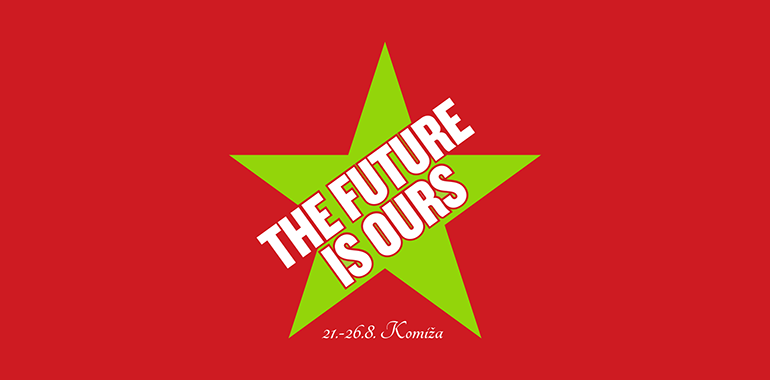
Green Academy 2020 “The Future is Ours” (Komiža)

By

About the event

The Green European Foundation and Institute for Political Ecology are organising the 10th edition of the Green Academy.

Under the title “The Future is Ours,” this summer university will focus on cities and municipalities as the real changemakers and terrains for progressive political change.

The dynamic and interactive program is composed of workshops, debates and lectures designed to encourage participants to dive deeper into the municipalist world and seek solutions that can be the driving force for political change at the local level.


Speakers:

KEYNOTE SPEAKERS:

  • Kathleen Lynch, University College Dublin
  • Andreas Malm, Lund University
  • Tine De Moor, Utrecht University

and many more…


Programme:                                                              

FRIDAY 21st OF AUGUST

12:00 – 14:00 ARRIVALS AND CHECK-IN IN HOTEL BIŠEVO

17:00 – 19:30 REGISTRATION

20:00 WELCOME AND OPENING

21:00 “ADA FOR MAYORS” SCREENING

22:00 WELCOME DRINK


SATURDAY 22nd OF AUGUST

10:00 – 11:00 PROGRAM PRESENTATION

11:00 – 12:00 TOWARD GREEN INDUSTRIAL POLICY FOR THE EU

-Vladimir Cvijanović

12:00 – 14:00 THE FUTURE IS OURS – MUNICIPALISTS ON THE MOVE

Success stories from municipalists and green political movements (Lyon, Ghent, Barcelona)

17:00 – 19:30 WORKSHOPS – parallel sessions

See detailed programme here

21:00 OUR RAILWAYS – Presentation of IPE’s research on the democratisation of railways


SUNDAY 23rd OF AUGUST

10:00 – 11:00 KEYNOTE LECTURE

-Kathleen Lynch, University College Dublin

TIME FOR A NEW POLITICS: WHY AFFECTIVE JUSTICE MATTER AS A SITE OF RESISTANCE TO NEOLIBERAL CAPITALISM

11:00 – 12:00 HOW TO RECLAIM PUBLIC FUTURE THROUGH LAW

-Marija Bartl

12:00 – 14:00 THE FUTURE IS OURS – MUNICIAPALISTS ON THE MOVE

Cities Donuts – Introduction to the vision of sustainable and just cities (IPE)

17:00 – 19:30 WORKSHOPS – parallel sessions

See detailed programme here


MONDAY 24th AUGUST

10:00 – 11:00 KEYNOTE LECTURE

-Andreas Malm, Lund University

CORONA, CLIMATE AND CHRONIC EMERGENCY

11:00 – 12:00 PUBLIC OWNERSHIP IN / OF ENERGY TRANSITION – EU / UK EXPERIENCES

-Andrew Cumbers

12:00 – 14:00 THE FUTURE IS OURS – MUNICIPALISTS ON THE MOVE

-Case study – Mediterranean cities

17:00 – 19:30 WORKSHOPS – parallel session

See detailed programme here

21:00 “PUSH” SCREENING


TUESDAY 25th AUGUST

10:00 – 11:00 KEYNOTE LECTURE

-Tine De Moor, Utrecht University

COMMONS AND COLLECTIVE ACTION IN ENERGY TRANSITION

11:00 – 12:00 ESKOM TRANSFORMED: ACHIEVING A JUST TRANSITION FOR SOUTH AFRICA

-Daniel Chavez

12:00 – 14:00 THE FUTURE IS OURS – MUNICIPALISTS ON THE MOVE

-Case study – post-industrial cities

17:00 – 19:30 WORKSHOPS – parallel sessions

See detailed programme here

21:00 GREEN ACADEMY 2020 – IDEAS FOR THE FUTURE

22:00 PARTY

WEDNESDAY 26th AUGUST

DEPARTURES


Practicalities:

The event will be in Croatian and English.

Hotel accommodation and two meals per day (breakfast and dinner) is provided by the organisers. Travel costs can be reimbursed up to €250.

Given the COVID-19 pandemic, the organizers have been meeting various challenges, therefore minor changes to the program can still occur. This call is published at short notice.

Support for maximum 12 places is offered to participants from across Europe:

3 – the Balkans, Russia, Georgia, Ukraine

3 – Central and Eastern Europe

3 – Southern Europe

3 – Western and Northern Europe

Given the short deadline, the organisers ask for a short biography in English (no longer than 1 page) and a letter of interest (maximum 2000 characters) with two reference contacts (email and phone), preferably from people who have already participated in the Green Academy in previous years. Applications should be sent to ipe(at)ipe.hr by August 18, 4:00 PM CET. 

The organisers reserve the right to cancel the event last-minute in case of a COVID-19 emergency. The event follows a NO REGRETS POLICY: travel can be reimbursed only after the event has taken place and once the travel documentation was provided to the organisers (in accordance with the guidelines provided prior to the event by IPE).

The organisers will ensure basic epidemiological standards are met during the event, however also bear in mind the general COVID-19 guidelines that need to be respected outside and beyond the conference, for everybody’s safety and well-being.

Applicants will be informed about the outcome by August 19.


This event is organised by the Green European Foundation with the support of Institute for Political Ecology and with the financial support of the European Parliament to the Green European Foundation. The European Parliament is not responsible for the content of this event.
 

Hold Your Local Hackathon on Social Rights

By Uncategorized

This guide has been created for those who wish to organise a hackathon on social rights, based both upon best practices from the world of tech and the experiences of the authors in running the more rights-based hackathon that took place in Serbia, Summer 2019.

Hackathon on Social Rights is published by the Federation of Young European Greens and is a result
of the Reclaim Your Social Rights! project.

The project is supported by the European Youth Foundation of Council of Europe . The Summer Hackathon is organised by the Green European Foundation with the support of the Federation of Young European Greens and with the financial support of the European Parliament to the Green European Foundation. The Council of Europe or the European Parliament are not responsible for the content of this project.


Download

Available in Greek

Congress of Young Europeans 2019 (Marseille)

By

About the Event

During the three-day Congress, 75 selected participants from across Europe will have the opportunity to come together and take advantage of different panels and interactive workshops. Panel debates and workshops at the congress are going to evolve around the strategies and experiences with fighting for climate and democracy in Europe and beyond. 

In addition to this, the Green European Foundation (GEF) will contribute to the congress with a pre-event online course, providing for a common knowledge base for all participants, as well as a platform for debates ahead of their trip to Marseille.

Programme

The final programme in full can be found here. 

Practicalities

Venue: Friche Belle de Mai – 41 Rue Jobin, 13003 Marseille: Google Maps location.
Accomodation :
Village Club du Soleil, 23 rue François Simon, 13003 Marseille: Google Maps location.

How to get there?

The Bus No. 6 ( https://www.marseille-airport.com//parkings-et-acces/acces/bus/marseille-centre ) will bring you from Marseille Airport to Marseille Saint Charles (Central Station). It leaves every 10 minutes and it takes you roughly 30 minutes to get to the Central Station. You can purchase tickets online, beforehand ( https://store.marseille.aeroport.fr/bus.html ), get them in ticket offices on the spot or even from the coach driver, if the ticket office happens to be closed.

From Saint Charles to our venue and your hotel, you can either walk ( ca. 20 mins) and you will pass by our venue on your way : https://goo.gl/maps/mPjuGqiKvVdiYJka6  OR you can take a bus (ca. 15 mins) https://goo.gl/maps/wkZxKnY2RkS7dUg86


This event is organised by the Green European Foundation in cooperation with the Heinrich Böll Foundation Paris. 

European Green Activist Training (Hungary)

By

About European Green Activist Training (EGAT)

During the EGAT course, you will learn about Green values, meet politicians and experts working at the frontline of fighting for positive change, and of course connect with plenty of other like-minded young people!

The course will give you insights into the political decision-making processes on the national and European levels, develop your skills as an activist to enact societal change, and explore how Green values promote more equal and sustainable societies.

More specifically, the training course is comprised of two intense training weekends taking place in Hungary, an online course on Green Learning , and culminating in a one-week study trip to Brussels to visit the European Institutions alongside EGAT participants from other countries.

We encourage people from across Hungary and from all backgrounds to apply to take part.

Find out more about EGAT on the EGAT project page. 

Programme

The exact details of the programme are to be confirmed, please check back later for more information.

First Meeting  

  • 21 September 2019
    10:00 – 18:00,  in Budapest

Second Meeting

  • 25 – 27 October  2019

Brussels Study Trip

  • Early March 2020 (exact dates TBC)

Practicalities 

The EGAT course is free of charge, excluding travel to Budapest and to the airport.

All materials, travel (including flights) and accomodation costs in Brussels are covered by the Green European Foundation, on the assumption that the participant has successfully completed the national training sessions in Hungary.

How to Apply

Applicants must be 18-26 years old. Previous experience in Green organisations is not required.

We are looking for passionate young people with a strong motivation to learn and make a difference!

Apply via the form found here. 

APPLICATION DEADLINE: Sunday 25 August 2019 


The course is organised by Green European Foundation with the support of Ecopolis Foundation and with the financial support of the European Parliament to the Green European Foundation. 

Summer School – Youth and the City: Young People for Fair and Green Cities (Prague)

By

About the Event

Green European Foudnation partner Cooperation and Development Network Eastern, alongside Alternative Urbanisation Working Group, are announcing a call for Participants for the summer school “Youth and the City: Young People for Fair and Green Cities”.

The Summer School aims to conceptualise and promote the model of sustainable and democratic cities among active young people in the Central and Eastern Europe and provide them with tools for reclaiming their cities.

The aims and objectives of the project are:

  • To create a space for youth to discuss the concept and role of Alternative Urbanisation in shaping the future of the cities;
  • To empower young people to use the city as a platform for doing local, Green and alternative politics;
  • To create a toolkit of positive practices and methods of influencing politics on a very local level.

Practicalities

The event will take place from 5th to 9th of August in Prague ( 4th and 10th are travel dates to and from Prague.)

Language: The main language of this activity will be English. But not being comfortable interacting in English should not prevent you from applying, the majority at the event will be non-native speakers and the group will be able to help out if there is some term you might not know!

Costs: The full cost of working materials, visa and lodging (accommodation in multi-bed rooms, vegetarian food, and refreshments) during the event will be covered by the organizers. In exchange, we ask for a participation fee of 20 EUR for participants coming from non-EU countries and 30 EUR for participants coming from EU countries.

Accommodation, food, working space, travel and visa costs for participants will be fully covered. For selection of travel means we encourage participants to combine the most economic and environmentally friendly way (lowest price + travel time + CO2 emissions).

Programme

The programme for this event can be found here.


*All references to Kosovo, whether to the territory, institutions or population, in this text shall be understood in full compliance with the United Nations Security Council Resolutions 1244 and without prejudice to the status of Kosovo.