A modernised European single market for a new reality of economic security

By Publications

About

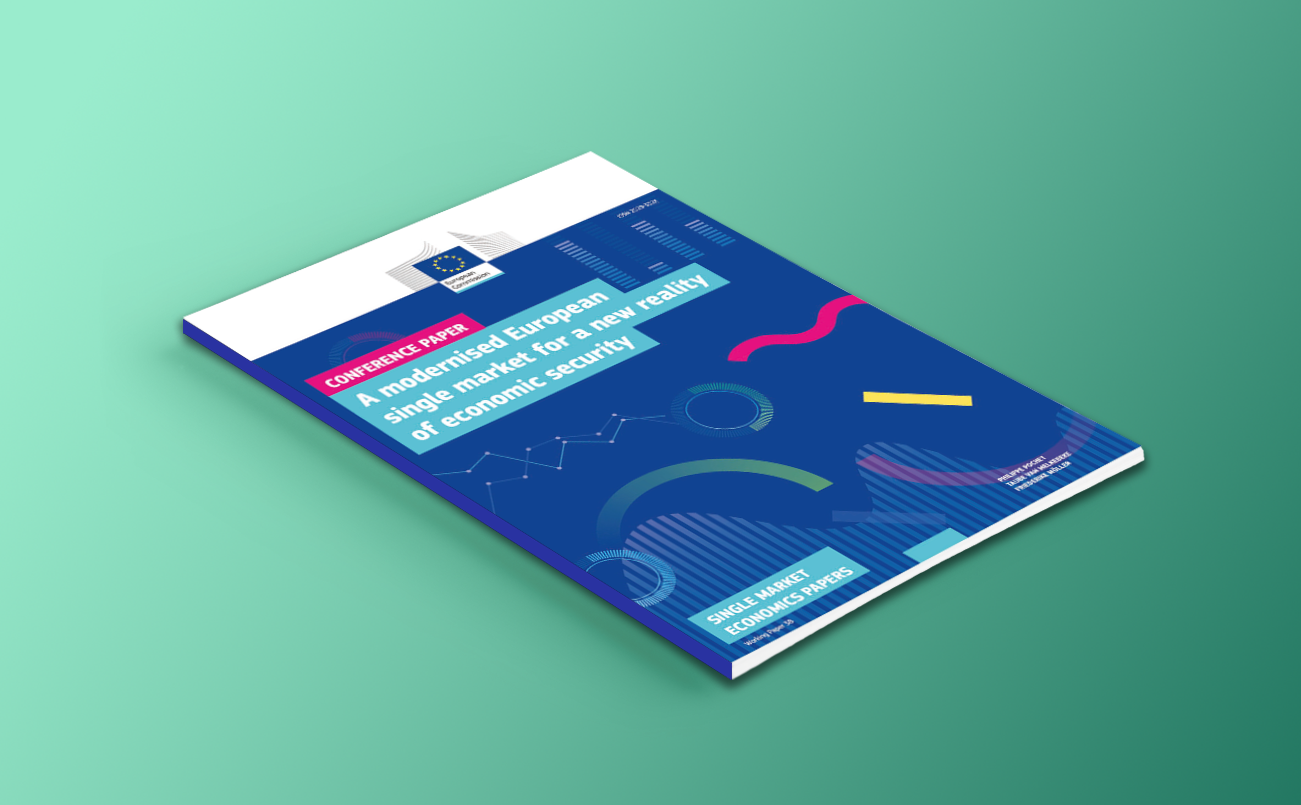
This paper was published as part of the Single Market Economics Papers by the Directorate-General for Internal Market, Industry, Entrepreneurship and SMEs of the European Commission.

Time is of the essence in aligning European economic systems with both environmental and social goals. To achieve this, it is essential to leverage all available tools – the single market being the most potent instrument. However, unlocking its full potential requires the adoption of a new strategy based on a reformed sense of economic security.

The persistence of path dependency and a reflexive attachment to the status quo has left the single market ill-suited to meet the needs of its citizens. The 2025 Single Market strategy should be viewed as a starting point to overcome outdated frameworks and to reflect on the intentionality and construction of the single market.

This paper argues that the potential of the European single market in providing economic security within a dramatically changed context has been overlooked. It aims to fill the gaps in current understandings of economic security by developing an expanded framework that incorporates economic resilience and, more specifically, environmental and social security. Ultimately, it seeks to contribute to the current debate on reforming the single market by addressing both existing and emerging threats to the European economy.

Authors

  • Philippe Pochet collaborates with GEF on the topics of welfare states, single market and the circular economy as a GEF fellow. He was Director of the Observatoire Social Européen (OSE) for over 15 years and then General Director of the European Trade Union Institute (ETUI) from 2008 to 2023. He is currently a Professor at the Catholic University of Louvain and a Visiting Professor at the College of Europe in Bruges. He is also an Affiliate Professor at the Sant’Anna School of Advanced Studies, Pisa.
  • Taube Van Melkebeke is Head of Policy at the Green European Foundation (GEF). She leads the various Knowledge Communities of the Foundation. For more information, contact her at taube.vanmelkebeke@gef.eu.
  • Friederike Möller is policy intern at the Green European Foundation.

This document has been prepared for the European Commission; however, it reflects the views only of the authors, and the European Commission is not liable for any consequence stemming from the reuse of this publication.


A European Wellbeing Economy: Avenues for political action

By Publications

About

The starting point of this publication is that the EU’s economy is ultimately embedded in cultural and social systems, which in turn are sub-systems of the Earth’s biosphere. As Fullerton notes, “the history of economic theory is [therefore] not over with Keynes and Hayek”. Instead, we need to be more critical, more systemic, and more daring. A wellbeing economy addresses this need – it aims at delivering quality of life for people, while pulling our economy back within planetary boundaries.

Adopting a wellbeing-centred approach would enable the EU to tackle social-ecological risks linked to the triple planetary crises, to increase fairness, and to transform towards a quality-focused economic strategy. It can inform a sustainable and transformative policy and investment agenda, that goes beyond crisis-after-crisis response. Learning from the past five years of the COVID-19 pandemic, energy and cost of living crises, and at the start of the new mandate, EU leaders have the opportunity to carve out an offer that truly delivers for their citizens amidst geopolitical turmoil.

Our publication is a call to action for EU policymakers across the political spectrum to make the crucial years ahead count for the wellbeing of current and future generations on our planet. Ultimately, we aim to clarify that a wellbeing economy is not an abstract utopia; it is a strategic response to the lessons of history and the need for long-term security. In a world increasingly defined by great power competition, Europe’s best bet is not to be trapped between rival blocs but to define a distinct path – one that prioritises security and protection in the broadest sense. After all, what is security if not the health of people, the resilience of our environment, the strength of education systems, and the assurance of a safe and stable future?

The publication is the result of a one-year-long exchange within a Knowledge Community of more than 60 experts that aims to map the main challenges and provide recommendations to inspire the European institutions in the delivery of their ambition to work toward the wellbeing of its peoples. It discusses the state of play and problem identification, and develops EU-level reflections, solutions and recommendations for 6 interrelated thematic clusters for a European wellbeing economy.


Contributors

  • Emma Bergeling is Junior Policy Analyst, Climate and Circular Economy at the Institute for European Environmental Policy (IEEP),
  • Antoine Oger is Executive Director of the Institute for European Environmental Policy (IEEP),
  • Taube Van Melkebeke is Head of Policy at the Green European Foundation (GEF). For further information, contact her at taube.vanmelkebeke@gef.eu.

This report is also available in Portuguese.

Summary for policymakers

A  summary of the publication can be found here: Summary


Published by the Green European Foundation with the collaboration of the Institute for European Environmental Policies, and with the financial support of the European Parliament to the Green European Foundation. The European Parliament is not responsible for the content of this publication. The views expressed in this publication are solely those of the editor and contributors and do not necessarily reflect the views of the European Parliament or the Green European Foundation. 
Post-growth Future(s): New Voices, Novel Visions

By Publications

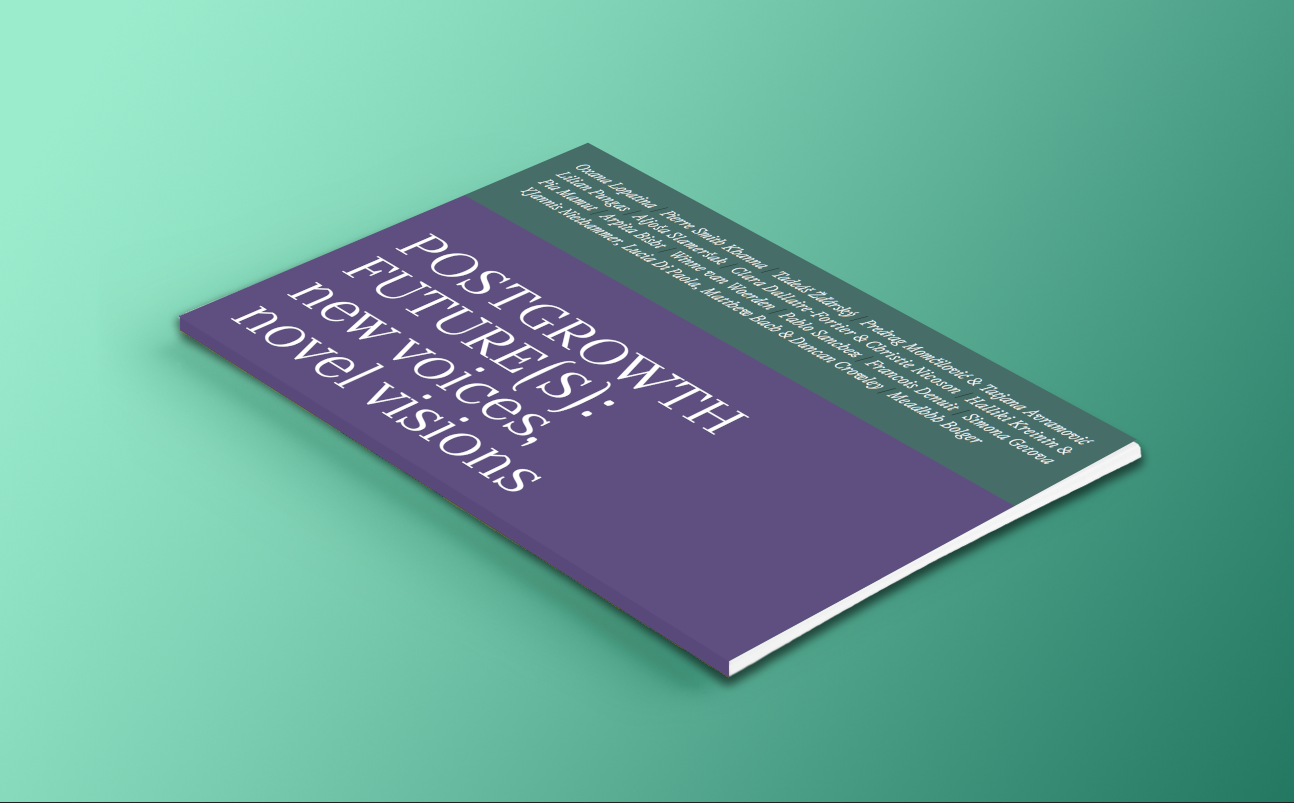
Growth is no longer a viable path, yet the idea of a post-growth society is still struggling to enter mainstream politics. Despite mounting ecological and social crises, policy discussions remain locked in outdated economic paradigms. However, recent years have marked a turning point, with post-growth thinking gaining momentum in European institutions, civil society, and academia.

The age of growth is behind us, but hardly anybody dares to admit it. […] In this publication, we say it loud and clear: growth is past tense. We need to engage now, without delay, in reimagining prosperity and wellbeing beyond growth

This publication brings together 20 authors from across Europe to explore what a future beyond growth could look like. Through diverse perspectives, it examines how post-growth ideas can reshape economic structures, social justice frameworks, and environmental policies. It also highlights how new voices (academics, activists, and policymakers) are translating these ideas into concrete political and policy action. By connecting emerging debates with real-world transformations, the publication contributes to strengthening the movement for a just and sustainable post-growth future.

This publication is part of the Green European Foundation’s work on post-growth in the scope of the project Post-Growth Future(s). It builds on discussions from key post-growth events, including the Beyond Growth Conference in Brussels and the International Degrowth Conference in Zagreb. The publication amplifies new ideas and connects them with the broader movement for systemic change.


This publication has been realized by the Green European Foundation with the support of  the Institute of Political Ecology and the Heinrich Böll Stiftung, as well as with the financial support of the European Parliament to the Green European Foundation. The European Parliament is not responsible for the content of this publication.

Making our economies fit for the people and the planet (Brussels)

By

About the event:

Geopolitical tensions and inequality between and within countries highlight the urgent need for a socially just transition that leaves no one behind. While the EU has taken significant steps through the EU Green Deal, contradictions persist. Wellbeing is mentioned in EU documents, but a comprehensive plan for making human and planetary wellbeing a priority in decision-making is still missing.

As we strive for an economy that aligns with human needs and planetary boundaries, new economic approaches are emerging across academia, civil society, and institutions. The publication we are launching aims to address this challenge by developing ideas and political proposals to turn the EU’s ambition to “work towards an integrated framework for wellbeing” into action.

Our political brief is the result of a one-year-long exchange within a  Knowledge Community of more than 60 experts, mapping key challenges and offering recommendations to guide European institutions in making wellbeing a reality. Join us for the launch event to explore the findings and exchange ideas on pathways forward. View the agenda here.

Practicalities

Date and Time: 4 March 10:00-12:30 – the debate will be followed by a networking lunch
Location: Topos Parlement, Brussels, and online
Language: English
Registration: please register now to join the event


This publication launch is organised by the Green European Foundation in collaboration with the Institute for European Environmental Policy (IEEP) and with the financial support of the European Parliament to the Green European Foundation.

Enough: Thriving Societies Beyond Growth (Helsinki)

By

About the event:

Who is afraid of degrowth? The term alone throws mainstream opinion makers and many economists in Europe into a panic. Growth is the lubricant of capitalism. We are told that if the economy is growing, all is well. But what do we mean by growth? Should everything keep growing endlessly? The ecological crisis shows that infinite growth on a finite planet is impossible. Meanwhile, the current economic system fails to secure livelihoods and exacerbates inequalities. There is an alternative to this self-destructive system: an economy of enough, which would provide for everyone’s basic needs while addressing greed and overconsumption. The EU has the potential to lead the ecological transition – but we need to envision a different European economy, rooted in a new paradigm, before we can build it.

In Enough, the authors build on the work of visionaries, both past and present, recognising that Earth is on loan to us from future generations. They explore how societies can thrive without depending on economic growth. The essay presents a compelling vision: fewer private jets, less inequality, fewer burnouts, and reduced waste, alongside more quality of life, more time for each other, more sustainable products, and a healthier planet. In other words, it provides the keys to imagining a different Europe – one that ensures a good life for everyone within the planet’s limits.

At this book launch event, we will dive deeper into what this means in practice. How are principles of sufficiency and an “economy of enough” already reflected in local initiatives and policy proposals today? What are the levers of change, within and outside of political institutions? And how do we make sure that this vision of thriving beyond growth resonates and really does not leave anyone behind, especially at a time when socio-economic fears are framed directly in opposition to climate policy and a green transition?

Project background:

In early 2024, GEF released Enough: Thriving Societies Beyond Growth. This publication sought to spotlight many of the ideas that the foundation has been exploring on post-growth and a just green and social deal, presenting them in an accessible and inspiring booklet. Now, we are taking it on a tour to spark conversations across the continent on how Europe can reconcile social and ecological justice in a wellbeing project for all with sufficiency.

Programme and speakers

Author Dirk Holemans will be joined in the panel by:

  • Tuuli Hirvilammi  – Senior Research Fellow in social policy, Faculty of Social Sciences, Tampere University
  • Paavo Järvensivu – Associate Professor of Environmental and Social Policy (Docent), University of Helsinki

Moderated by Leena Brandt – Journalist

Practicalities

Date and Time: Monday 20 January 17:15-19:00 EET (18:15-20:00 Brussels time
– 17h15: arrival and refreshment
– 17h30: book presentaiton by Dirk
– 18h00: panel discussion around the book’s topics
– 18h45: Q&A
Location: Kaisa-talo, Kaisaniemenkatu 5, Helsinki, and online to this link
Language: English
Registration: Please register in advance via this link. This is a hybrid event, so you can also join us online. However, you must register in advance to receive the meeting link, or access the venue.


This book launch is organised by the Green European Foundation with the support of Visio and with the financial support of the European Parliament to the Green European Foundation.

Enough: Thriving Societies Beyond Growth (Stockholm)

By

About the event:

Who is afraid of degrowth? The term alone throws mainstream opinion makers and many economists in Europe into a panic. Growth is the lubricant of capitalism. We are told that if the economy is growing, all is well. But what do we mean by growth? Should everything keep growing endlessly? The ecological crisis shows that infinite growth on a finite planet is impossible. Meanwhile, the current economic system fails to secure livelihoods and exacerbates inequalities. There is an alternative to this self-destructive system: an economy of enough, which would provide for everyone’s basic needs while addressing greed and overconsumption. The EU has the potential to lead the ecological transition – but we need to envision a different European economy, rooted in a new paradigm, before we can build it.

In Enough, the authors build on the work of visionaries, both past and present, recognising that Earth is on loan to us from future generations. They explore how societies can thrive without depending on economic growth. The essay presents a compelling vision: fewer private jets, less inequality, fewer burnouts, and reduced waste, alongside more quality of life, more time for each other, more sustainable products, and a healthier planet. In other words, it provides the keys to imagining a different Europe – one that ensures a good life for everyone within the planet’s limits.

At this book launch event, we will dive deeper into what this means in practice. How are principles of sufficiency and an “economy of enough” already reflected in local initiatives and policy proposals today? What are the levers of change, within and outside of political institutions? And how do we make sure that this vision of thriving beyond growth resonates and really does not leave anyone behind, especially at a time when socio-economic fears are framed directly in opposition to climate policy and a green transition?

Project background:

In early 2024, GEF released Enough: Thriving Societies Beyond Growth. This publication sought to spotlight many of the ideas that the foundation has been exploring on post-growth and a just green and social deal, presenting them in an accessible and inspiring booklet. Now, we are taking it on a tour to spark conversations across the continent on how Europe can reconcile social and ecological justice in a wellbeing project for all with sufficiency.

Programme and speakers

Author Dirk Holemans will be joined in the panel by:

  • Rebecka Le Moine – member of the Swedish Parliament for the Green Party.
  • Åsa Callmer – PhD, sufficiency expert

Moderated by Isadora Wronski  – Project Leader Wellbeing Economy, Greenpeace International

Practicalities

Date and Time: Monday 20 January 18:30-20:30 CET
Free vegan soup, bread and coffee from 17:30 CET
Venue open for mingle from 16:30 and closes 21:30.
Location: Allaktivitetshuset, Sturegatan 10, next to Sundbyberg station, Stockholm, and online to this link
Language: English
Registration: Please register in advance via this link. This is a hybrid event, so you can also join us online. However, you must register in advance to receive the meeting link, or access the venue.


This book launch is organised by the Green European Foundation with the support of Cogito and with the financial support of the European Parliament to the Green European Foundation.

Enough: Thriving Societies Beyond Growth (Edinburgh / online)

By

About the event:

Who is afraid of degrowth? The term alone throws mainstream opinion makers and many economists in Europe into a panic. Growth is the lubricant of capitalism. We are told that if the economy is growing, all is well. But what do we mean by growth? Should everything keep growing endlessly? The ecological crisis shows that infinite growth on a finite planet is impossible. Meanwhile, the current economic system fails to secure livelihoods and exacerbates inequalities. There is an alternative to this self-destructive system: an economy of enough, which would provide for everyone’s basic needs while addressing greed and overconsumption. Countries in the Global North have the potential and indeed the responsibility to lead this ecological transition – but we need to envision a different economy, rooted in a new paradigm, before we can build it.

In Enough, the authors build on the work of visionaries, both past and present, recognising that Earth is on loan to us from future generations. They explore how societies can thrive without depending on economic growth. The essay presents a compelling vision: fewer private jets, less inequality, fewer burnouts, and reduced waste, alongside more quality of life, more time for each other, more sustainable products, and a healthier planet. In other words, it provides the keys to imagining a different Europe – one that ensures a good life for everyone within the planet’s limits.

At this book launch event, we will dive deeper into what this means in practice. What is the most helpful way of conceptualising a move beyond growth? How do ongoing initiatives, like the Wellbeing Economy, work towards meeting these objectives? What more can we do, both within and outside of political institutions? What role is there for transnational exchange and experimentation, in Scotland as well as the EU? And what do our current legislative configurations enable and prevent us from doing?

Project background:

In early 2024, GEF released Enough: Thriving Societies Beyond Growth. This publication sought to spotlight many of the ideas that the foundation has been exploring on post-growth and a just green and social deal, presenting them in an accessible and inspiring booklet. Now, we are taking it on a tour to spark conversations across the continent on how Europe can reconcile social and ecological justice in a wellbeing project for all.

Speakers

  • Dirk Holemans – Honorary President of the Green European Foundation and author of “Enough: Thriving Societies Beyond Growth”
  • Shona McIntosh – Scottish Greens Councillor for Musselburgh, East Lothian Council
  • More to be announced!

Moderated by Gabriel Sanson Gomez – Degrowth researcher at Generation Climate Europe, Scottish Young Greens

Practicalities

Date and Time: Tuesday, 10 December 2024 (18:15 – 20:00 GMT)
Location: St Ninians Room, Greyfriars Charteris Centre, 138-140 Pleasance, Edinburgh
Language: English
Registration: Please register via this link. This is a hybrid event, so you can also join us online via Zoom. However, you must register in advance to receive the meeting link.


This book launch is organised by the Green European Foundation with the support of Scottish Young Greens and with the financial support of the European Parliament to the Green European Foundation.

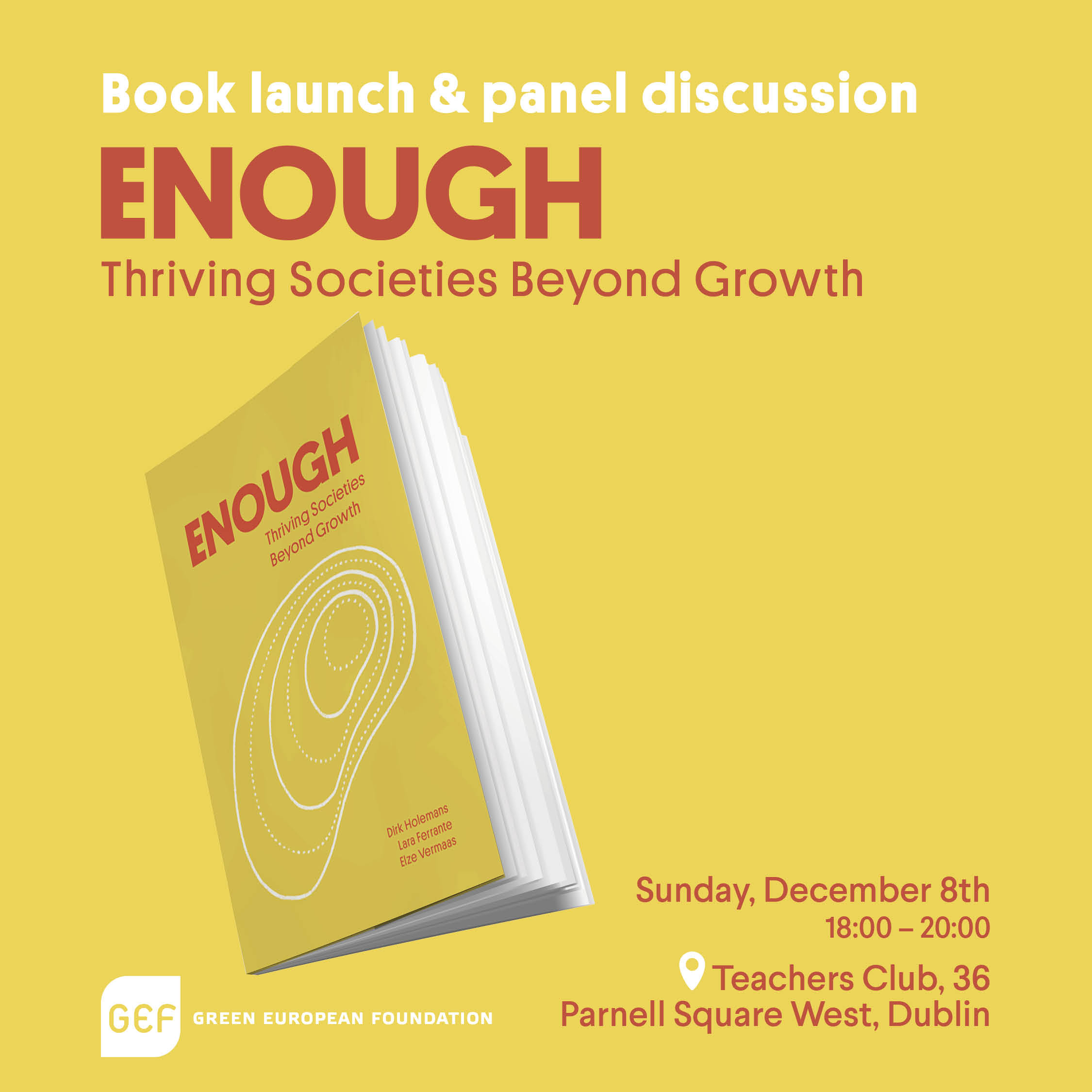
Enough: Thriving Societies Beyond Growth (Dublin)

By

About the event:

Who is afraid of degrowth? The term alone throws mainstream opinion makers and many economists in Europe into a panic. Growth is the lubricant of capitalism. We are told that if the economy is growing, all is well. But what do we mean by growth? Should everything keep growing endlessly? The ecological crisis shows that infinite growth on a finite planet is impossible. Meanwhile, the current economic system fails to secure livelihoods and exacerbates inequalities. There is an alternative to this self-destructive system: an economy of enough, which would provide for everyone’s basic needs while addressing greed and overconsumption. The EU has the potential to lead the ecological transition – but we need to envision a different European economy, rooted in a new paradigm, before we can build it.

In Enough, the authors build on the work of visionaries, both past and present, recognising that Earth is on loan to us from future generations. They explore how societies can thrive without depending on economic growth. The essay presents a compelling vision: fewer private jets, less inequality, fewer burnouts, and reduced waste, alongside more quality of life, more time for each other, more sustainable products, and a healthier planet. In other words, it provides the keys to imagining a different Europe – one that ensures a good life for everyone within the planet’s limits.

At this book launch event, we will dive deeper into what this means in practice. How are principles of sufficiency and an “economy of enough” already reflected in local initiatives and policy proposals today? What are the levers of change, within and outside of political institutions? And how do we make sure that this vision of thriving beyond growth resonates and really does not leave anyone behind, especially at a time when socio-economic fears are framed directly in opposition to climate policy and a green transition?

Project background:

In early 2024, GEF released Enough: Thriving Societies Beyond Growth. This publication sought to spotlight many of the ideas that the foundation has been exploring on post-growth and a just green and social deal, presenting them in an accessible and inspiring booklet. Now, we are taking it on a tour to spark conversations across the continent on how Europe can reconcile social and ecological justice in a wellbeing project for all.

Programme and speakers

Author Dirk Holemans will be joined by a selection of experts, from politicians to academics to civil society and local changemakers:

  • Anne B. Ryan – coordinator of Basic Income Ireland and author of “Enough is Plenty: Public and Private Values for the 21st Century”
  • David Donoghue – Distinguished Fellow of ODI, former Permanent Representative of Ireland to the UN in New York, co-facilitator of the intergovernmental negotiations on the 2030 Agenda for Sustainable Development
  • Janet Horner – Green Party representative for the North-Inner City on Dublin City Council

Moderated by John Gormley (Green Foundation Ireland).

Snacks and networking drinks will be provided.

Practicalities

Date and Time: Sunday, 8 December 2024 (18:00 – 20:00)
Location: Teachers Club, 36 Parnell Square W, Rotunda, Dublin, Ireland
Language: English
Registration: Please register in advance via this link.


This book launch is organised by the Green European Foundation with the support of Green Foundation Ireland and with the financial support of the European Parliament to the Green European Foundation.

Enough: Thriving Societies Beyond Growth (Belfast)

By

About the event:

Who is afraid of degrowth? The term alone throws mainstream opinion makers and many economists in Europe into a panic. Growth is the lubricant of capitalism. We are told that if the economy is growing, all is well. But what do we mean by growth? Should everything keep growing endlessly? The ecological crisis shows that infinite growth on a finite planet is impossible. Meanwhile, the current economic system fails to secure livelihoods and exacerbates inequalities. There is an alternative to this self-destructive system: an economy of enough, which would provide for everyone’s basic needs while addressing greed and overconsumption. Europe has the potential to lead the ecological transition – but we need to envision a different economy, rooted in a new paradigm, before we can build it.

In Enough, the authors build on the work of visionaries, both past and present, recognising that Earth is on loan to us from future generations. They explore how societies can thrive without depending on economic growth. The essay presents a compelling vision: fewer private jets, less inequality, fewer burnouts, and reduced waste, alongside more quality of life, more time for each other, more sustainable products, and a healthier planet. In other words, it provides the keys to imagining a different Europe – one that ensures a good life for everyone within the planet’s limits.

At this roundtable, we will discuss some of the key themes and proposals put forward by the book and the post-growth community more broadly. As Europe is once again eyeing austerity and conservative and even far-right forces have captured key levels of government and institutions, what pathways remain for this crucial transition? How can we mobilize societies for such deep and rapid change? What are the key levers and obstacles to translating the environmental science around the limits to growth into concrete action?

Project background:

In early 2024, GEF released Enough: Thriving Societies Beyond Growth. This publication sought to spotlight many of the ideas that the foundation has been exploring on post-growth and a just green and social deal, presenting them in an accessible and inspiring booklet. Now, we are taking it on a tour to spark conversations across the continent on how Europe can reconcile social and ecological justice in a wellbeing project for all.

Programme and speakers

This interactive roundtable will provide plenty of space for audience input, questions, and reactions. They will be accompanied by invited experts:

  • Dirk Holemans – Honorary President of the Green European Foundation and author of “Enough: Thriving Societies Beyond Growth”
  • Dr. Amanda Slevin – Director of the Centre for Sustainability, Equality and Climate Action at Queens University Belfast
  • Prof. John Barry – Professor of Green Political Economy at Queens University Belfast and co-chair of the Belfast Climate Commission

Practicalities

Date and Time: Monday, December 9th (19:00 – 21:00 GMT)
Location: Peter Frogatt Centre, Room 02/018, Queen’s University Belfast, 7-9 College Park East, Belfast
Language: English
Registration: Please register in advance via this link.


This roundtable is organised by the Green European Foundation with the support of Green Foundation Ireland and QUB’s Centre for Sustainability, Equality and Climate Action and with the financial support of the European Parliament to the Green European Foundation.

Ecopolis: Hope Needs Action (Brussels)

By

About the event:

With a mix of panels, workshops, performances, and more, Ecopolis fosters cross-border and multi-lingual dialogues on the ecological challenges of our time. The 2024 edition is entitled “Hope Needs Action” and seeks to turn climate concerns into commitment. Featuring a wide range of authors, scientists, academics, practitioners, activists, artists, and policymakers, this event will answer to the simultaneous need for deep reflection and collective action to ensure a truly just transition in Europe and the world.

To this end, Ecopolis aims specifically to bring together different movements and thereby contribute to a flourishing and diverse European public space – fostering connections between the ecological movement, fights for social justice, decolonisation and anti-racism initiatives, feminist activism, and more. This year, GEF will contribute by hosting a stream of sessions touching on some of our core interests, including energy security, a post-growth Europe, and democratic participation.

Project background:

Ecopolis is an annual meeting point for anyone concerned about a fair and sustainable future. Because ecological challenges know no borders, this event is international, diverse, and interactive. For GEF, it is a key moment to connect and inspire green-minded citizens, activists, NGOs, and other stakeholders and to provide them with the tools, concepts, and energy to fight for a better Europe and world.

Programme:

GEF will be hosting a dedicated stream of sessions as part of this event at different locations .

10h45-12h15, European Quarter – Lobby Tour

A walk organised and guided by the Corporate Europe Observatory. The tour guide will be Hans van Scharen.

13h-14h30, De Markten, zolder – Workshop : Climate Citizen Assembly (FR)
  • Merlijn de Rijcke (coordinator climate citizen panel Brussels)
  • Elze Vermaas (Oikos staff member)
15h-16h30, De Markten, zolder – Workshop : Climate Citizen Assembly (NL)
  • Merlijn de Rijcke (coordinator climate citizen panel Brussels)
  • Elze Vermaas (Oikos staff member)
15h-16h30, De Markten, spiegel room – Is the energy transition a smokescreen?
  • Jean-Baptiste Fressoz (science, technology and environmental historian)
  • Jorrit Smit (researcher)
  • Chloé Mikolajczak (activist)

Moderator: Alice Hubbard (GEF’s Strategy Manager)

17h-18h30, De Markten, spiegelzaal – No climate solution without democratic innovations
  • Sophie Howe (first commissioner for future generations)
  • Eva Rovers (founder of Bureau Burgerberaad)
  • two participants of the Brussels Climate Citizens Panel.

Moderator: Tine Hens (historian, author and journalist)

13h-14h30, Muntpunt, Literair Salon – How to keep democracy alive?
  • Erica Benner (political philosopher and author)
  • Hans van Scharen (Corporate Europe Observatory)

Moderator: Elze Vermaas (Oikos contributor and author)

15h-16h30, Muntpunt, Literair Salon – Book presentation : Enough
  • Lara Ferrante (Oikos employee and co-author of Enough)
  • Dirk Holemans (Oikos coordinator and co-author of Enough)

These are solely the session hosted by GEF, but there are many more ! You may find the complete program on the partner’s website.


Practicalities:

Date: November 9th

Location: Brussels, Belgium

Language: English, Dutch, and French

Tickets and registration: (closed)


This event is co-organised by the Green European Foundation with the support of Oikos and with the financial support of the European Parliament to the Green European Foundation. The European Parliament is not responsible for the content of this event.

Green Academy: Stay with the Trouble! (Komiža)

By

About the event:

The Green Academy is a discussion and dialogue platform, established in 2010 as a space for advanced learning in political ecology. The 9th edition of Green Academy is entitled ”Stay with the Trouble,” and will feature a varied programme of keynotes, panels, workshops, and social activities. As part of the programme, GEF is hosting a series of Green Talks spotlighting our latest work on the wellbeing economy, adaptation, and building a resilient Europe beyond growth.

Project background:

If trends continue, the summer of 2024 is likely to be the hottest yet, with the daily reality of the climate crisis coming into even sharper focus for ever more citizens. Yet unlike five years ago, climate and biodiversity do not dominate the political headlines or European voter priorities, whether due to disillusionment, disinformation, or competing concerns like cost-of-living and (in)security.

More than ever, it is important to demonstrate how social and ecological justice go hand in hand, and to foster the bottom-up democracy to make that happen. Concepts and ideas like post-growth, the commons, and citizen assemblies may hold some of the answers, but need the right narratives and policy grounding to truly pierce the mainstream European debate. GEF has supported this endeavour for a long time, including as a partner of the 2023 Beyond Growth Conference in the European Parliament and the International Degrowth Conference that took place in Zagreb that same year.

As we get ready to enter a new EU cycle, with a reshuffled parliament and Commission, it is crucial to keep the momentum going and ensure that wellbeing and a prosperous Europe beyond growth remain on the agenda. The Green Academy provides a constructive yet convivial setting in which to learn, exchange and expand on this challenge, in line with GEF’s role as a hub for political education and laboratory for new ideas.

Programme and Speakers:

GEF’s Green Talks  are featured in specific slots throughout the programme. August 24th and August 28th are arrival and departure days.

Monday, 26/08 (12 – 13:30): Enough – Thriving Democracies for Tomorrow’s Europe

Panel discussion with Remy Bonny, Danijela Dolenec, Dirk Holemans, and Elze Vermaas (moderated by Alice Hubbard)

Tuesday, 27/08 (12 – 13:30): A Race Against the Clock? Time and Climate Adaptation

Panel discussion with Marc Martorell Escofet, Marie-Monique Franssen, and Katarina Kusic (moderated by Alessio Giussani)

Tuesday, 27/08 (17 – 19:00): Knowledge Community on the European Wellbeing Economy

Interactive workshop with Emma Bergeling and Antoine Oger (moderated by Sien Hasker and Laurent Standaert)

Practicalities:

Date and Time: 24-28 August

Location: Hotel Biševo – Komiža, Croatia

Language: English 

This is an invitation-only event with limited capacity. For more information please contact sien.hasker@gef.eu and/or lana@ipe.hr.   


This event is co-organised by the Green European Foundation with the support of the Institute for Political Ecology and with the financial support of the European Parliament to the Green European Foundation. The European Parliament is not responsible for the content of this event.

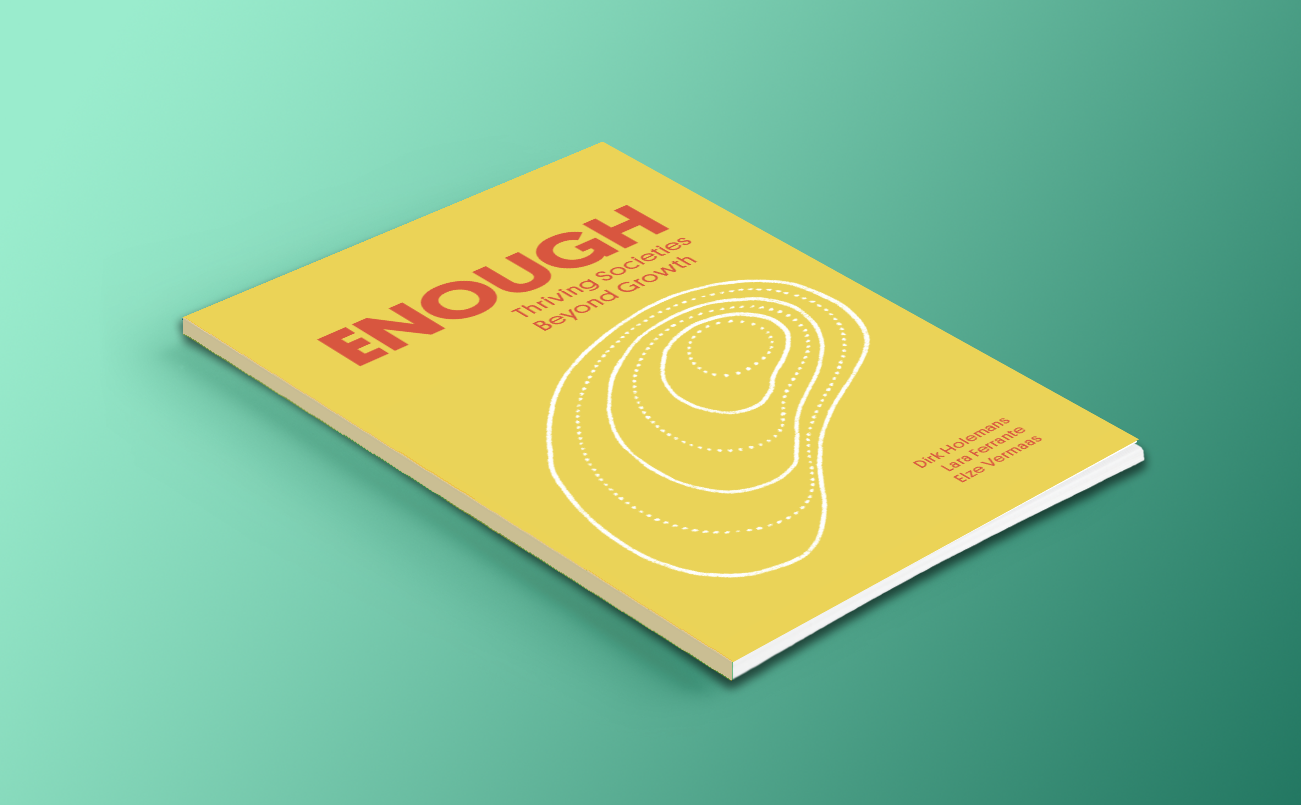
Enough – Thriving Societies Beyond Growth

By Publications

The ecological crisis shows that infinite growth on a finite planet is impossible. Meanwhile, the current economic system fails to secure livelihoods and exacerbates inequalities. There is an alternative to this self-destructive system: an economy of enough, which would provide for everyone’s basic needs while addressing greed and overconsumption.

The EU has the potential to lead the ecological transition. Although the Green Deal was a significant step forward, it remains entrenched in a growth-addicted economy centered on competition within a single market, and it does not sufficiently address social inequality. We need to envision a different European economy, rooted in a new paradigm, before we can build it.

In this essay, the authors build on the work of visionaries, both past and present, recognising that Earth is on loan to us from future generations. They explore how societies can thrive without depending on economic growth. The essay presents a compelling vision: fewer private jets, less inequality, fewer burnouts, and reduced waste, alongside more quality of life, more time for each other, more sustainable products, and a healthier planet. In other words, this essay provides the keys to imagining a different Europe – one that ensures a good life for everyone within the planet’s limits.

The ecological crisis in its entirety, including climate change, biodiversity loss and all its other facets, is without doubt the greatest challenge of our lifetime. […] For this reason, grand projects like the European Green Deal have begun to address social dimensions to guarantee that the transition is a just one.

About the authors

  • Dirk Holemans is director of Think Tank Oikos and former co-president of the Green European Foundation.
  • Lara Ferrante is a staff member at Oikos and wrote a master’s thesis on degrowth.
  • Elze Vermaas is a staff member at Oikos and former vice-chair of the Dutch young green think tank Jong Wetenschappelijk Bureau GroenLinks.


Endorsements

“Have you ever wondered how our social, economic and ecological crises are connected, and what we could do about them? This short and perfect book demonstrates how a ‘Wellbeing Economy For All’ addresses the interconnected crises of our time, and imaginatively motivates us to be part of its realization.” — Julia Steinberger


“For too long, the planetary crisis has loomed as a monstrous inevitability. But what if we dared to imagine otherwise? Enough paints a vibrant picture of a society that has transcended the limitations of endless growth, prioritising ecological well-being and human connection. It takes on the difficult task of envisioning a future where societies can thrive beyond the shackles of constant expansion and in harmony with the natural world.” — Amitav Ghosh


“This book does crucial work in offering vision, delivering hope and providing a way forward from a world where we are trashing the planet while creating miserable societies. It works towards a model for living within the limits of this fragile planet while allowing humans to thrive in a healthy future.” — Natalie Bennett


“Enough is a brilliant combination of imaginative vision, conceptual clarity and concrete proposals. A necessary handbook for an ecological civilisation.” — Roman Krznaric


“Enough challenges us to look beyond the current economic models that form the root cause of the climate crisis. If our human society is to survive this century, fundamental change is inescapable. This means embracing enough, coupled with a profound decolonisation of current world relations and building true democracy.” — Anuna De Wever


Book tour

With book tour events across Belgium, Croatia, Ireland, the UK, Finland, and Sweden, GEF is using this book to spark conversations across the continent on how Europe can reconcile social and ecological justice in a wellbeing project for all. You can watch the recordings here


This publication has been realised with the support of Oikos Think Tank and the financial support of the European Parliament to the Green European Foundation. The European Parliament is not responsible for the content of this publication.

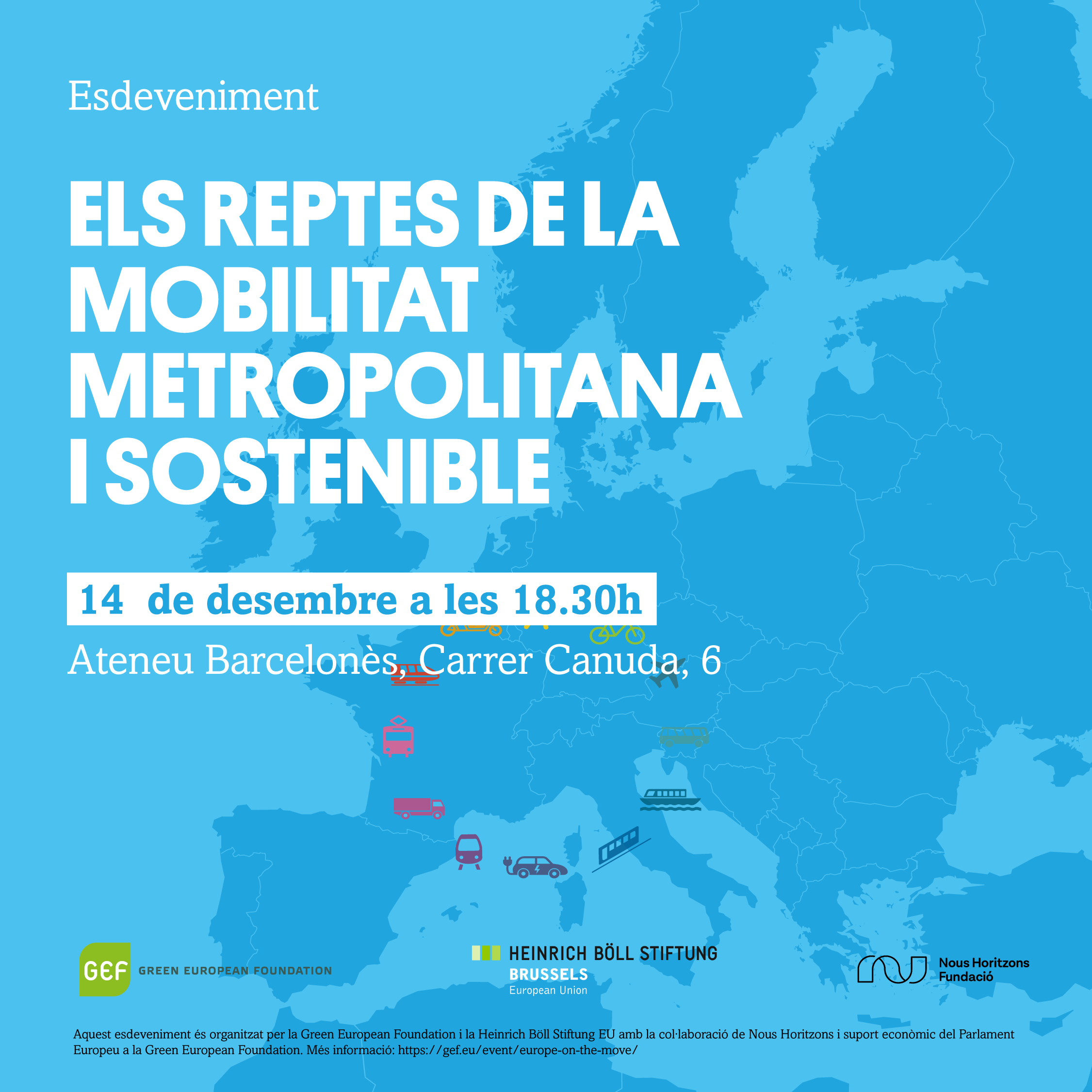
The Challenges of Metropolitan Sustainable Mobility

By

About the event

Sustainable mobility is a particular priority in metropolitan areas because of its impact on air quality, on the daily lives of millions of people and economic actors, and as an instrument of territorial cohesion. Public transport, cycling and walking are at the heart of a model that guarantees the right to sustainable mobility.

The Barcelona metropolitan area, with its population exceeding 3.5 million inhabitants, is a paradigmatic case in this debate, as it is an area that risks being sanctioned by the EU due to its poor air quality.

Within this context, what are the examples of good and bad practices of mobility? What are the challenges that lie ahead? Can we find successful sustainable urban mobility practices in other European cities?

These questions and possible answers will be the subject of this dynamic debate, bringing together diverse experts, academics, and local government actors.


Project background

This event is part of a series of debates entitled “Europe on the Move: Shaping the Future of Sustainable Mobility in the Iberian Peninsula” organised by the Green European Foundation and Heinrich Böll Stiftung EU with the support of Transición Verde, Instituto José Tengarrinha, Fundació Nous Horitzons, EcoPolítica and the financial support of the European Parliament to the Green European Foundation.

This series of debates aims to foster debate in Portugal and Spain around the future of mobility, bringing together relevant stakeholders from civil society, academia and politics to analyse and explore challenges and opportunities for the future of mobility and the Green Deal in Europe.


Speakers

  • Guille Lopez, Barcelona City Councillor and Promoter of the Eixample Breathe platform
  • Carme Miralles, Professor of Urban Geography at the UAB
  • Laura Campos, Montcada I Reixac City Councillor
  • Zeeger Ernsting, Amsterdam City Councillor


Practicalities

Date and Time: 14th December, 6:30pm CET

Location: Ateneu Barcelones, Carrer Canuda, 6

Registration: Prior registration is required – please register here.

Language:  Catalan with English simultaneous translation

Recommended reading: European Mobility Atlas


This event is organized by the Green European Foundation and Heinrich Böll Stiftung EU with the support of Fundació Nous Horitzons and the financial support of the European Parliament to the Green European Foundation.

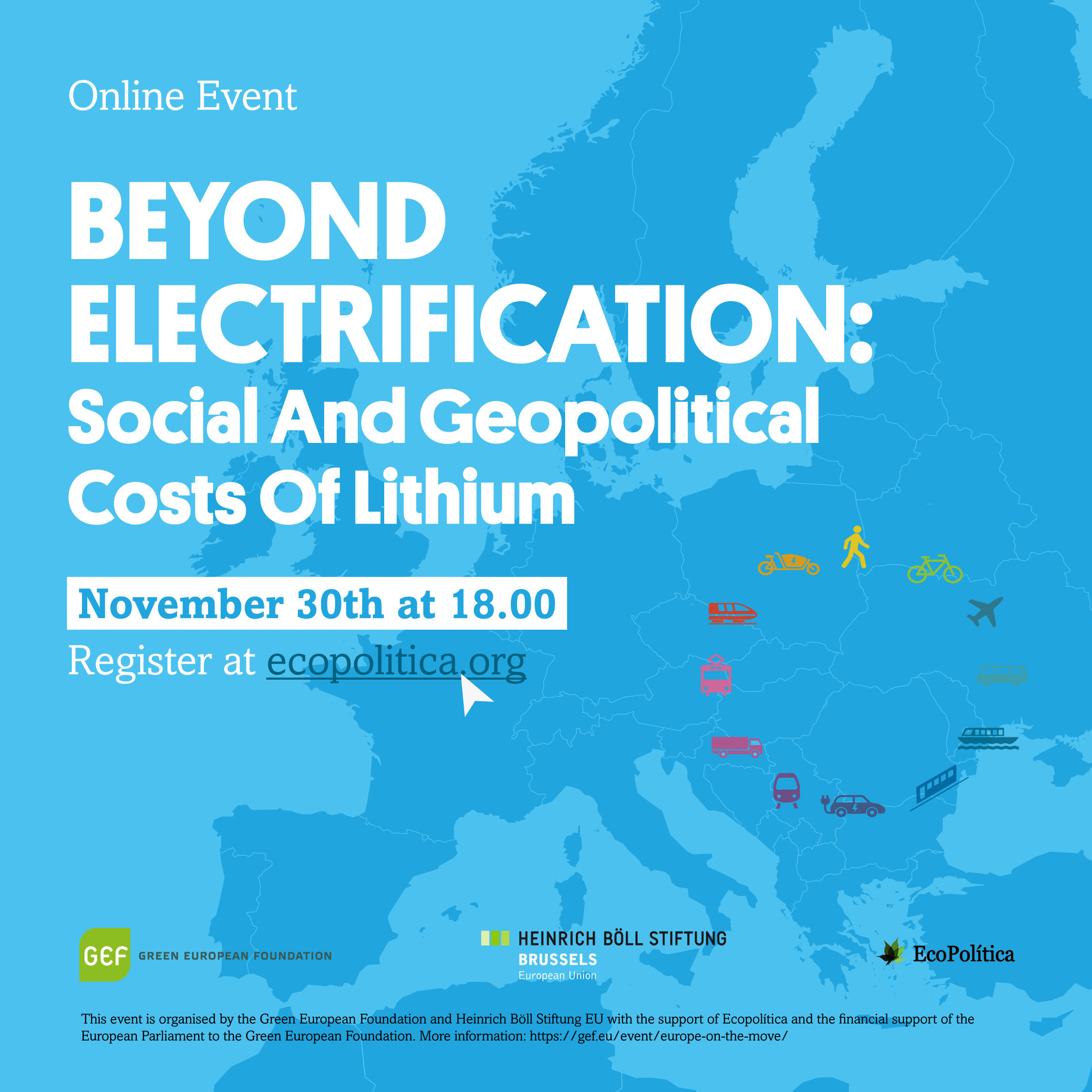
Beyond Electrification: Social and Geopolitical Costs of Lithium

By

About the event

The growing demand for electrification does not come without its own costs. Environmental, social and ethical considerations arise when taking into account the impact on local communities. To obtain the necessary resources, huge extractivist industries threaten to devastate entire regions. How can we resist them? Furthermore, electrification also poses some serious global issues. Can we move beyond our outdated electricity and mobility model without compromising social justice and the exploitation of the Global South?

This session will bring together voices and expertise from politics and civil society to expose the flaws and limitations of the current model of electrification at local, national and European levels. The aim of the event is to create a dynamic space for debate where we can explore ways to ensure a more sustainable and socially just electrified future.


Project background

This event is part of a series of debates entitled “Europe on the Move: Shaping the Future of Sustainable Mobility in the Iberian Peninsula” organised by the Green European Foundation and Heinrich Böll Stiftung EU with the support of Transición Verde, Instituto José Tengarrinha, Fundació Nous Horitzons, EcoPolítica and the financial support of the European Parliament to the Green European Foundation.

This series of debates aims to foster debate in Portugal and Spain around the future of mobility, bringing together relevant stakeholders from civil society, academia and politics to analyse and explore challenges and opportunities for the future of mobility and the Green Deal in Europe.


Speakers

  • Catalina Abell (moderator), EcoPolitica, expert in political communication and political processes.
  • Florent Marcellesi, former-MEP. Federal Co-Spokesperson of Verdes Equo.
  • Adriana Espinosa, Amigas de la Tierra (Friends of the Earth Spain). Responsible for the Area of Natural resources and Waste. Author of the next AdT inform on “Materials for the energetic and digital transition”.
  • Catarina Scarrott, Associação Unidos em Defesa de Covas do Barroso (UDCB) movement. Covas de Barroso is being targeted as a ‘sacrifice zone’ for lithium mining, and the local population, represented by the UDCB, is opposed.
  • Diego MarinPolicy Officer for Raw Materials and Resource Justice, European Environmental Bureau


Practicalities

Date and Time: 30th November, 6pm-7:30pm CEST

Location: Online

Language: The main languages of the event will be Spanish and English, with simultaneous interpretation provided EN<>SP.

Registration: Prior registration is required – Please register in advance here.

Recommended reading:


This debates series is organised by the Green European Foundation and Heinrich Böll Stiftung EU with the support of, EcoPolítica and the financial support of the European Parliament to the Green European Foundation.

New Mobility: Economy and Employment

By

About the event

The decarbonisation of mobility is one of the great challenges of the European Union. The transformation it entails is complex and not without its difficulties, but it can be an opportunity to reactivate the economy and generate employment. The latter is a particularly relevant aspect in maintaining social stability, especially at a time when populism and the extreme right are on the rise in Europe.

In this event, we seek to analyse the challenges and opportunities of zero-emission mobility in terms of the economy and employment in Spain, paying special attention to the bicycle sector from a gender perspective.

The event is a roundtable open to all those interested in mobility, especially members of organisations and platforms working on the issue, government officials, politicians, academia, and civil society associations. Our aim is to raise awareness of the employment opportunities associated with zero-emission transport and to promote the shift towards more sustainable mobility.

The event will be held via zoom platform, requiring prior registration.


Project background

This event is part of a series of debates entitled “Europe on the Move: Shaping the Future of Sustainable Mobility in the Iberian Peninsula” organised by the Green European Foundation and Heinrich Böll Stiftung EU with the support of Transición Verde, Instituto José Tengarrinha, Fundació Nous Horitzons, EcoPolítica and the financial support of the European Parliament to the Green European Foundation.

This series of debates aims to foster debate in Portugal and Spain around the future of mobility, bringing together relevant stakeholders from civil society, academia and politics to analyse and explore challenges and opportunities for the future of mobility and the Green Deal in Europe.


Speakers

  • Albert Vilallonga, geographer and mobility technician at ISTAS (Union Institute for Labour, Environment and Health). Author of the report on Zero-emission mobility.
  • Iria Vázquez, equity coordinator at ConBici, professor of sociology at the University of Vigo and expert in gender studies.
  • Philipp Cerny,Transport Policy Consultant. Chief Executive Editor of the EU Mobility Atlas.
  • Moderation: Pilar Calvo, board member of Transición Verde and expert in operational security and transportation


Practicalities

Date and Time: 11th December, 5:30pm – 7pm CET

Location: Online, via zoom.

Registration: Prior registration is required – please register here. The session will be recorded and made available on YouTube.

Language:  The main languages of the event will be Spanish.

Recommended reading: European Mobility Atlas


This event is organized by the Green European Foundation and Heinrich Böll Stiftung EU with the support of Fundación Transición Verde and the financial support of the European Parliament to the Green European Foundation.

The Geopolitics of Degrowth (London)

By

About the event

Can the UK and the European Union be the first to renounce economic growth but still be global players? What are the tensions, as well as important synergies, in trying to bring about such a transition of our economic systems and international relations at the same time?

This event brings together leading academic and political voices to consider how we might transform our economy away from one predicated on growth, and what this means for our diplomatic and trade relations, as well as defense policy, arms control, and the threats posed by current and future conflicts, including in Ukraine.


Project background

This event is part of GEF’s project Geopolitics of a Post-Growth Europe, which explores the tensions between degrowth/post-growth and geopolitics. The project aims to ignite a conversation between critics of economic growth and progressive thinkers on foreign and security policy, who now often operate in separate circuits. It aims to find solutions beyond naïve anti-militarism and convenient belief in green growth. Find out more about the project and its findings at geopoliticspostgrowth.eu.

Speakers

  • Casper Wits – Lecturer in East Asian Studies, Leiden University
  • Frank Meeussen – Diplomatic Advisor to Belgian Deputy-Prime Minister George Gilkinet, Ecolo
  • Gabriela Cabana-Alvear – Transdisciplinary scholar and degrowth researcher, London School of Economics
  • Marissa Conway – CEO, United Nations Association UK
  • Prof. Peter Newell – Professor of International Relations, University of Sussex


Programme:

15:00 – 15:30    Arrivals and welcome (London venue)

Introductions from UK-UNA, Green House and the Green European Foundation

15:30 – 16:30    Session 1: How will a degrowth agenda impact on international relations?

  • Casper Wits: China-Europe relationships – what will the future look like?
  • Gabriela Cabana-Alvear: The EU-Chile trade agreement – a degrowth perspective
  • Prof: Peter Newell: Steering away from extractivism

Short presentations followed by panel discussion.

16:30 – 16:45    Break

16:45 – 17:45     Session 2: Defence policy in a post-growth world

  • Frank Meeussen: Arms control as a condition for a post-growth world
  • Marissa Conway: Shifting away from Militarism.

Short presentations followed by panel discussion.

17:45 – 18:00    Closing discussion


Practicalities:

Date and Time: October 17th, 15:00 – 18:00 BST (UK time).

Location: This is a hybrid event. You can join online via Zoom or in person at the United Nations Association of the UK – 3 Whitehall Court, London, United Kingdom.

Language:  English

Registration: Please register in advance via this form. Registration is required both for online and in person participants. Spots in the venue are limited, so register quickly and do notify us if you can no longer make it, via events@greenhousethinktank.org.


This event is organised by the Green European Foundation with the support of Green House Think Tank and the financial support of the European Parliament to the Green European Foundation.

Geopolitics of Degrowth in a Conflicted Europe (Leipzig)

By

About the event

Green policies that respect planetary boundaries and allow the Global South to develop seem incompatible with unlimited economic growth in the EU. We need a realistic scenario for a future in which we consume more sparingly but live better together. A scenario that could be possible within a degrowth context.

The war in Ukraine completely changed the geopolitical landscape. Today, the idea of ending GDP growth in the EU encounters new and important impediments, with power and wealth being measured in military capacity. Can a degrowth Europe build strength and resilience in this context?

To tackle this issue, the Green European Foundation with the support of BlueLink is organising a workshop in Leipzig, as part of a series of expert meetings across Europe. The outcomes from these meetings and further research and interviews will feed into a final publication to be launched in the autumn of 2023.

We invite researchers, activists and policy makers – particularly from Central and Eastern Europe and Ukraine – with an interest in green policies and geopolitics to present perspectives, experiences, analytical or activity reports and to engage in a discussion around the following questions:

  • How does degrowth within the EU affect the EU’s ability to achieve geopolitical objectives like providing security, and what are the resulting tensions and synergies?
  • Can such tensions be mitigated? If so, how?
  • How would it be possible to optimize the possibilities that degrowth offers, including for democratic flourishing and a safer Europe and world?

Not every question has a definitive answer and we promote creativity, analytical thinking, and a fresh approaches to the challenge.

Project Background

This event is part of GEF’s project Geopolitics of a Post-Growth Europe, which explores the tensions between degrowth/post-growth and geopolitics. The project aims to ignite a conversation between critics of economic growth and progressive thinkers on foreign and security policy, who now often operate in separate circuits. It aims to find solutions beyond naïve anti-militarism and convenient belief in green growth. Find out more about the project and its findings at geopoliticspostgrowth.eu.

Practicalities

This GEF workshop will take place as part of the International Roundtable 2023 held by the Peaceful Revolution Foundation in Leipzig. You can find out more information about this conference here. 

Date and time: October 11th, 2023 (14:30 CET) 

Location: Leipzig, Germany and online (hybrid event) 

Language: English 

Registration: Open to all interested participants, but please register in advance via this link. Please use the ‘Questions and Comments’ field to specify your scope of interest or proposed intervention. You will receive a confirmation email after registration. 

In case you want to attend the workshop in person in Leipzig, please also email office@bluelink.net by Friday, October 6th 


This event is organized by the Green European Foundation with the support of BlueLink. It will take place as part of the Revolutionale International Round Table 2023 held in Leipzig by the Peaceful Revolution Foundation.  


Ontgroei, Coöperaties En De Stad (UTRECHT)

By

About the event

Post-growth is about much more than just greening economies. It is a new way of understanding society, also understood as an ambitious, science-based, values-driven, social and realistic way of thinking. Post-growth is about shifting the focus from quantitative growth (consumption and GDP growth) to qualitative growth (quality of life growth).

In his book, Paul Schenderling highlights the importance of cooperatives in the transition to post-growth and he describes what is possible at the local level. After a short lecture by Schenderling, we will further explore the link between de-growth and cooperatives in a panel discussion. We will focus on the city, in particular Utrecht. Cooperatives will participate in the panel discussion to contribute to the discussion from their practical experience. Besides Paul Schenderling, Laura van Oers (Ontgroei Nederland), Joost Brinkman (energy cooperative Rijne Energie) and Maud van den Bercken (BuurtWerkKamerCoöperatie) will take part in the panel.


Speakers

  • Paul Schenderling, author of Er is leven na de groei
  • Laura van Oers (Ontgroei [Degrowth] Netherlands)
  • Joost Brinkman (energy cooperative Rijne Energie)
  • Maud van den Bercken (social cooperative BuurtWerkKamerCoöperatie)

Moderator: Hans Rodeburg, Wetenschappelijk Bureau GroenLinks.


Practicalities

Date and Time: 25th January 2023, 8PM – 9:30PM

Location: De Kargadoor, Oudegracht 36, Utrecht, The Netherlands.

Language:  The main languages of the event will be in Dutch.

Registration: The event is public and free of charge.


This project is organised by the Green European Foundation with the support of Wetenschappelijk Bureau GroenLinks and with the financial support of the European Parliament to the Green European Foundation. The European Parliament is not responsible for the content of this event. 

Geopolitics of Degrowth (Zagreb)

By

About the conference

A perspective on degrowth from the post-socialist semi-periphery of Croatia, with a turbulent transition to capitalism in hindsight, suggests that capitalist development can lead to dedevelopment, depopulation and environmental degradation — making an alternative pathway into a just and sustainable future not only necessary but also politically desirable.

After the Hague, Manchester, Malmö, Budapest, Leipzig, Venice, Barcelona and Paris, the 9th International Degrowth Conference is taking place this summer in Zagreb. It will sit at the heart of a broader Zagreb Degrowth Week, a free arts and conviviality festival realised in cooperation with neighbouring capitals.

About GEF’s session

It makes sense for the EU to be a frontrunner in the transition to a degrowth society. This is a matter of ecological justice: EU countries bear the greatest historical responsibility for the crises of climate and biodiversity, and can free up natural resources for the Global South without loss of wellbeing. But what would degrowth mean for geopolitics? Can a Europe that is the first to renounce economic growth still remain (or become) a global player? Will it be able to defend itself, its allies, democracy and the international rule of law against aggressive autocrats? After all, the power of countries and alliances is largely determined by their wealth and military capabilities. Without billions in Western support, both money and arms, Ukraine would not be able to hold out against the Russian aggressor. This panel brings together policymakers, experts and practitioners for a frank conversation on the geopolitical risks and opportunities for a degrowth Europe. What concepts, alliances, or alternative forms of power might answer to the challenge of combining ecological, democratic, and geopolitical resilience?


Practicalities

Date and Time: 30.08.2023 at 6pm
Location: Zagreb
Venue: Centar Mladih ribnjak – Center for Youth Ribnjak, Park Ribnjak 1, 10000, Zagreb; room ZV-KC-2
Type: Non-academic Session

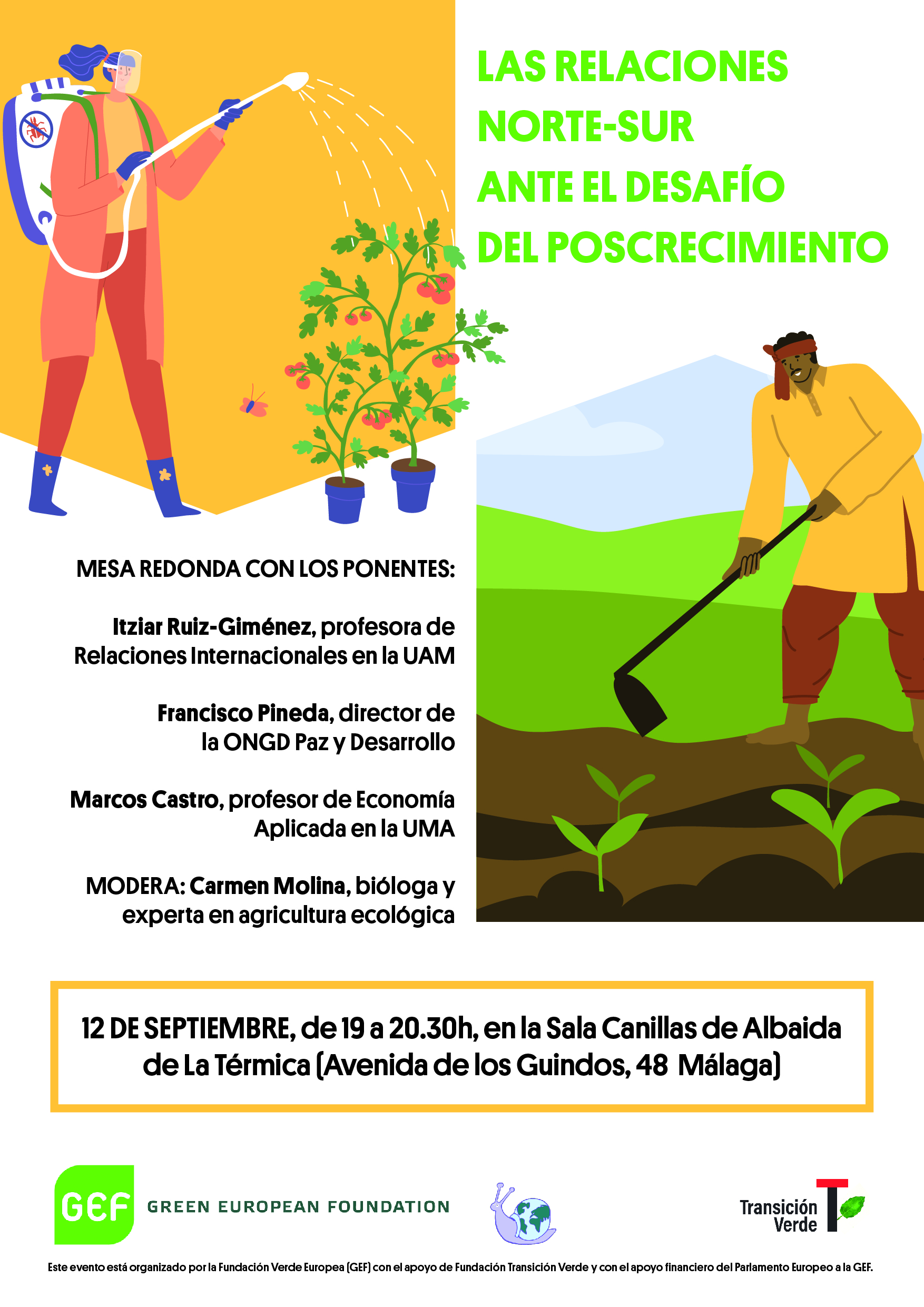
North-South Relations and the Post-Growth Challenge (Málaga)

By

About the event

The Club of Rome report “The limits to growth” was published in 1972 . These 50 years have gradually confirmed the validity of the study. However, despite the ever-closer risk of environmental and social collapse, the main focus of the economy remains profit growth, which is clearly unsustainable and profoundly unequal. In response to this crisis of the hegemonic socio-economic model, the degrowth/post-growth movements advocate for an economic model that overcomes the ecological limits of the planet, improves human well-being and reduces inequalities, challenging the growth dogma. In Europe, these movements are becoming increasingly popular among activists and scientists, and the debate has even begun open up at the institutional level.        

Moving away from growth may represent an opportunity for the EU to increase its resilience and reduce its energy and raw materials dependence. However, this is something that undoubtedly poses important geopolitical and geostrategic challenges, including that of North-South relations. How would the EU’s post-growth approach influence relations with the global South, what would be the main tensions and synergies, and what challenges will it face in establishing cooperative and equal relations with these countries?

In this expert meeting, we will explore the advantages and also the challenges that the post-growth EU would face in its external relations with the Global South, and more specifically with the African continent. To this end, we will introduce into the equation the prospects of demographics and global population movements as a geopolitical factor, and as an opportunity for European foreign policy to put human rights, gender equality, sustainability of life and care, reduction of inequalities and a profound environmental transition at the centre. 


Project background

This event is part of GEF’s project Geopolitics of a Post-Growth Europe, which explores the tensions between degrowth/post-growth and geopolitics. The project aims to ignite a conversation between critics of economic growth and progressive thinkers on foreign and security policy, who now often operate in separate circuits. It aims to find solutions beyond naïve anti-militarism and convenient belief in green growth. Find out more about the project and its findings at geopoliticspostgrowth.eu.    


Speakers
 

  • Itziar Ruiz-Giménez. Lecturer in International Relations at the Autonomous University of Madrid. Coordinator of the Group of African Studies and of the International Studies Group of this university. PhD in International Relations. Bachelor in Law and in Political Science. 
  • Francisco Pineda. Director of the NGDO Paz y Desarrollo. Advisor in International Relations and Cooperation, he has worked for 30 years in International Development Cooperation projects in Latin America, Africa and Asia. 
  • Marcos Castro. Professor of Applied Economics at the University of Malaga. PhD in Economics and Master in Territorial and Urban Planning Policy. His lines of work are ecological economics, critical economics and international cooperation. 
  • Moderator: Carmen Molina. Biologist and expert in ecological agriculture 


Practicalities

Date and Time: 12th September, 7pm-8:30pm CEST 

Location: La Térmica (Avenida de los Guindos, 48 – Málaga, Spain) 

Language: The main language of the event will be Spanish 

Registration: Open event. No prior registration is required 


This event is organised by the Green European Foundation with the support of Fundación Transición Verde, and with the financial support of the European Parliament to the Green European Foundation.