
From Sustainability to Sufficiency – The Next Step for Cities

By

Join us in Stockholm for a one-day workshop on urban sufficiency – the next step for cities beyond sustainability.

Many European cities have made real progress on sustainability – cleaner air, greener streets, better mobility. But staying within planetary boundaries while ensuring a good life for all requires a deeper shift. Cities still consume too many resources, and overconsumption by some creates scarcity for others.

Taking place in Stockholm, this one-day workshop will explore urban sufficiency*: a practical, forward-looking approach to healthier, more resilient and socially just cities. We’ll look at how cities can make bold choices on energy, land, water and resource use, strengthen sharing and repair, support citizen initiatives, and address challenges like excessive tourism.

* The IPCC defines in its Climate Report AR6 sufficiency as: “a set of policies, measures, and everyday practices that avoid or reduce demand for energy, materials, water, and land, while delivering human well-being for all within planetary boundaries”.

Why join?

Gain a new language and mindset beyond sustainability, learn how sufficiency works in practice for housing, consumption, circular economy and public space, and get inspired by concrete examples from across Europe. Connect with peers, exchange ideas, and leave with insights you can apply in your work, city or community.

Provisional programme 

(more info to follow)

09.30 – 09.45Welcome
09.45 – 10.15Who’s in the room
10.15 – 10.35Crash course on sufficiency

·       Dirk Holemans, Coordinator, Oikos ThinkTank

10.35 – 10.50Break
10.50 – 11.20Sufficiency in Sweden: why it matters & what’s on the table

·       Ann-Charlotte Mellquist, RISE research institute

11.20 – 12.30WORKSHOP 1: Horizontal system change – addressing the advertising industry that drives consumption

·       Gustav Martner, Greenpeace

12.30 – 13.30Lunch
13.30 – 14.00Examples of sufficiency in European Cities

·       Vedran Horvat, GEF

14.00 – 15.30WORKSHOP 2: Exploring concrete sufficiency dimensions

·       Dirk Holemans, Coordinator, Oikos ThinkTank

15.30 – 16.00Wrap up, next steps, thank you


This event is organised by the Green European Foundation with financial support of the European Parliament to the Green European Foundation. 


Next Generation – Summer Academy (Siófok)

By

About the event:

Young people today are faced with a plethora of (bad) news and complex challenges, and it can be difficult to see the forest for the trees. How do local water struggles connect to the EU’s green agenda? What can health system failures tell us about rethinking care ahead of the next pandemic? And what is the role of education in building a society that is ready for a green and just transition?

With interactive sessions and expert inputs, this summer academy tries to combat skepticism and misinformation with vibrant discussions and ideas for change. Join us to think and work with others who are equally committed to a green future, and learn more about potential levers of change – in Hungary and across Europe.


Project background:

GEF’s Next Generation summer academy builds on several years of training young green activists in Hungary and beyond, offering tools, knowledge, and skills to counter disengagement and Euroscepticism in times of crisis.


Speakers:

  • Gergely Karácsony – Mayor of Budapest
  • Miklós Sebők – Research Professor at Centre for Social Sciences
  • Lili Aschenbrenner – Fridays for Future
  • István Bart – Energiaklub
  • Mia Machac-Tóth – United Forum of Students
  • Rebeka Szabó – Párbeszéd (Dialogue)
  • Eliza Popper – Green European Foundation
  • László Szilágyi – Progressive Hungary Foundation

And many more!


Programme:

Please note that the exact programme and timings remain subject to change. Registered participants will be informed accordingly.

Saturday, 14 September

13:00 – 13:30    Welcome speeches and icebreaker

13:30 – 14:15     Book talk: “The Beginning of the World”

14:15 – 15:00     Green Europe 2030: what comes next?

15:00 – 15:45    Future of the Green Deal following the European elections

15:45 – 17:00    BREAK

17:00 – 18:00    Fight against climate change: is adaptation really our last chance?

18:00 – 19:00    Next Generation of Green Europe: a conversation with the Mayor of Budapest

19:00                   Dinner, campfire, and party

Sunday, 15 September

09:20 – 10:00  Book talk: “Handbook for Revolutionaries”

10:00 – 10:45   U.S. presidential election and the future of global climate policies

10:45 – 11:00    BREAK

11:00 – 11:45     From silence to action: where is the future of education?

11:00 – 12:00    Sustainable healthcare on the brink of climate change

12:45 – 13:30    LUNCH and closing


Practicalities:

Date and Time: Saturday, 14 September (13:00) – Sunday, 15 September (14:00)

Location: Siófok Youth Hotel, Balaton, Hungary

Language: Hungarian

Registration: Please register in advance via this link. Meals and accommodation are provided free of charge, you just need to cover your own travel. Spots are limited, so do register as quickly as possible!


This summer academy is organised by the Green European Foundation with the support of the Progressive Hungary Foundation (MMAA) and the financial support of the European parliament to the Green European Foundation.
Moving to the Future: Reimagining Urban Mobility (Lisbon)

By

About the event

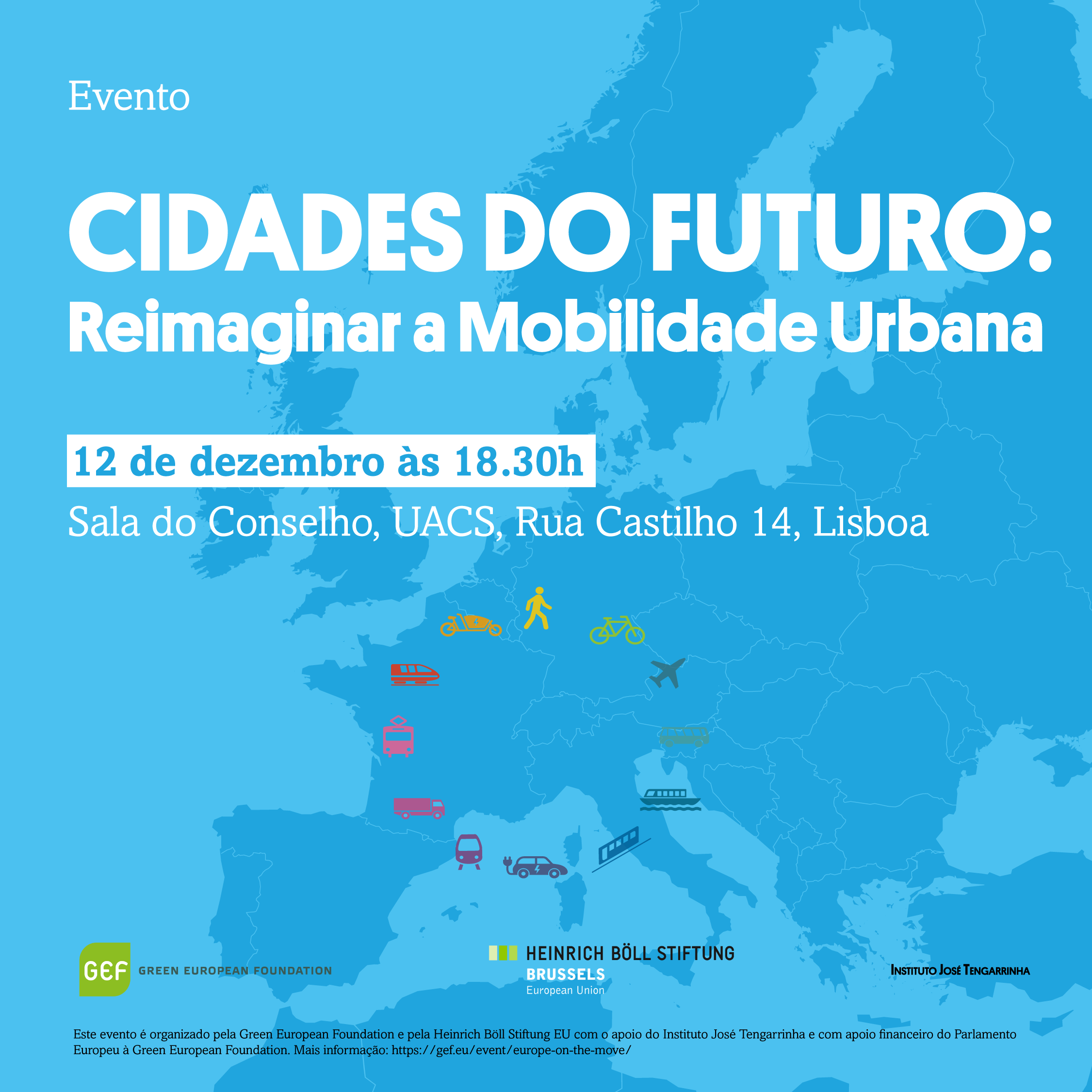
The present ecological crisis impels us to seek a change in the way we move, leading to increased efforts towards the decarbonisation of mobility. A mix of new and old solutions are key to change the urban mobility panorama, namely the electrification and the expansion of public transportation networks, and the creation of walking or cycling infrastructure to make active mobility attractive and pleasant. This change can also be seen as an opportunity to improve people’s lives by decreasing commuting time, improving the air quality, reducing noise, and promoting an active lifestyle. 

In a simple sentence, there is a need to shift the cities’ focus from cars to people. To achieve this, a new mindset that prioritises public transportation is needed, or “the social ideology of the motorcar”, as the philosopher André Gorz named it back in 1973. 

Sustainable mobility must not only encompass ecological considerations, but also needs to include an intersectional approach which takes gender and accessibility dimensions into account. As such, we will also speak about gender and accessibility, and dive into how to make daily commuting in metropolitan areas more sustainable, accessible, and inclusive. 

Project background

This event is part of “Europe on the Move: Shaping the Future of Sustainable Mobility in the Iberian Peninsula” event series, which aims to nurture the debate in Portugal and Spain around the future of mobility and the Green Deal, with a particular eye for the challenges and opportunities for sustainable mobility and how they relate to Iberian realities.  

Speakers

  • Manuel Banza, EMEL 
  • Carla Castelo, Local Councillor at Oeiras 
  • Rosa Félix, Instituto Superior Técnico 
  • Philipp Cerny, Chief Executive Editor of the European Mobility Atlas 
  • More to be announced 

Practicalities

Date and Time: 12th December, 6:30pm-8:30pm GMT 

Location: Sala do Conselho, UACS, Rua Castilho 14, Lisboa 

Language: The main languages of the event will be Portuguese and English, with simultaneous interpretation provided EN<>PT.   

Registration: N/A 

Other useful info: A recording will be uploaded to the GEF Youtube channel following the event. 

Recommended reading: 


This event is organised by the Green European Foundation and Heinrich Böll Stiftung EU with the support of Instituto José Tengarrinha and the financial support of the European Parliament to the Green European Foundation. 
GEF at the European Forum (Madrid)

By


About the event

The European Forum is a unique space for the left, greens and progressives to come together. This event allows like-minded political foundations to organise debates and discussions on key social and green topics. Within this context and in collaboration with Transform! Europe and FEPS, GEF is organising two workshops on 11 November.

GEF’s role in the European Forum will draw from our Knowledge Community: the Future of the EU’s Energy Project and our work on Post- and Degrowth.


Programme

9:30-11:30 The Role of the State  

Forging a socio-ecological welfare state defined by wellbeing within planetary boundaries could be the chance to face the polycrisis. Indeed, our welfare states should ensure universal access to high-quality essential services such as clean, affordable and energy-efficient housing and mobility, as well as strengthened social protection systems that mitigate the devastating consequences of climate change and environmental degradation. A new socio-ecological state would have a responsibility in enabling policy frameworks so citizens everywhere can take into their stride the new challenges brought about by digital breakthroughs and the climate crisis. By implementing social policies that tackle socio-economic inequalities, reduce our carbon emissions and limit our environmental impact, socio-ecological welfare states stand the chance to improve people’s quality of life and strengthen their resilience to shocks. 


12:00-14:00 The Climate Dimension of the Future of the EU’s Energy Project

The current EU energy framework showed its weaknesses over the past couple of years – amidst crises. These uncovered problems with fossil fuel resource dependency, as well as with dependences on single countries as such. They showed the missing links between EU energy policy and security/geopolitics. The polycrisis also showed the lack of social safeguards and consideration in the EU and MS energy policy, it showed that the democracy dimension has been too much underlit, and above all – it clearly showed that, if the EU had doubled down on its clean energy transition a decade earlier, it would have been much more resilient to what it is experiencing today.  Mitigating and adapting to climate change is in other words not solely extremely important in terms of avoiding climate damage and emergency, but also has positive spillover effects on energy security, and if done rightly on the social and democratic dimension of energy. So why isn’t it going faster? Panelists will be asked how to speed up the EU’s clean transition, zooming in as well on the existing stumbling blocks and cross-cutting policy areas. 


Speakers

The Role of the State  

  •  (Moderated by Kevin Le Merle, FEPS) 
  • Diego Lopez Garrido, Former Secretary of State for the European Union in the Spanish Ministry of Foreign Affairs and Cooperation 
  • Cornelia Hildebrandt, co-president Transform ! Europe 
  • Léa Das Neves Bicho, Political adviser to MEP Lamberts 
  • Ajda Pistotnik, Co-founder and Director, Policy Lab (Slovenia) 
  • Marta Iglesias Lopéz, International Action Director, Movimiento Por La Paz 

The Climate Dimension of the Future of the EU’s Energy Project

  • (Moderated by Taube Van Melkebeke, GEF) 
  • Davide Panzeri, ECCO, Italian think tank on climate change 
  • Eva García Sempere, Environmental activists, former MP and energy transition expert 
  • Kevin Le Merle, Analyst at the Foundation for European Progressive Studies, FEPS 
  • Sean Currie, Co-spokesperson Federation of Young European Greens 


Practicalities

Date and Time: 11th November

Location: Madrid

Language:  The main languages of the event will be English, Spanish and French.

You can read the full programme here. For more info, get in touch with Taube Van Melkebeke


This event is organised by the Green European Foundation with the support of with Transform! Europe , FEPS and with the financial support of the European Parliament to the Green European Foundation. The European Parliament is not responsible for the content of this event.
Green Political Activist Training – Sustainable Energy Politics (Budapest)

By

About the event

This event is divided into different sections. The first part of the workshop will cover the basics of EU energy policy and climate policy nexus.  It will also look at Hungary’s energy policy objectives, compliance with EU targets, and current investments, with a particular focus on the construction of Paks2.

The part, will look at current energy policy developments. What determines the price of energy commodities, what can be expected in the near future, how will the war in Ukraine and inflation affect energy conditions?

For the third part,  we will analyse the EU’s renewable energy targets and the current developments in Hungary: solar and wind energy, the potential of geothermal energy. The speaker in this section will analyse the chances of a green transition at EU and national level. We will continue familiarising ourselves with the role of statistics in the field of energy politics, and then we will turn to the following topics:

  • EU Clean Energy Package (CEP)
  • The possibilities of the Hungarian CEP implementation
  • The solidarity economy paradigm and the possibilities of creating energy communities
  • The development of energy community financing
  • Cooperative principles.

The event will close with an analysis on the potential of energy efficiency.


Project background

This event is part of the Green European Foundation’s Green Political Activist Training Project. We put together a series of learning activities aiming to help participants to understand the concepts of political ecology and apply them to both local and European-level politics. We will examine various policies and policy proposals ranging from local politics to the European Green Deal. Our goal is to prepare participants for both assessing and advocating policies in line with progressive green values. We’ll also provide young green activists with them tools and knowledge, as well as an opportunity to network, get in contact with political actors and experts on multiple levels and come together as a political community. It is essential for us to help like-minded movements and actors connect in order to help the political ecosystem flourish.


Speakers

  • Benedek Jávor, Green European Foundation Board Member
  • Rosa Martinex, Green European Journal Board Member
  • Balázs Felsmann, Regional Centre for Energy Policy Research
  • Nóra Feldmár, Habitat for Humanity
  • Zsolt Balajti, expert on energy industry
  • Béla Munkácsy, Eötvös Loránd University & World Wildlife Forum
  • Márton Fabók, Solidarity Economy Center


Programme

9:30 – 10:00 Arrival, registration

10:00 – 10:10 Opening – Rosa Martinez on the EU energy architecture

10:10 – 10:50 Benedek Jávor: Hungary’s sustainable energy policy – how are EU commitments being met?

10:50 – 11:30 Balázs Felsmann: Current situation on the energy market, availability of energy resources, energy prices (tbc)

11:30 – 11:40 Coffee break

11:40 – 12:20 Béla Munkácsy: Situation of renewable energy use – EU overview

12:20 – 12:50 Lunch break

12:50 – 13:30 Nóra Feldmár: Energy poverty, social issues

13:30 – 14:10 Márton Fabók: Energy self-determination, energy communities

14:10 – 14:50 Zsolt Balajti: The potential of energy efficiency (tbc)

14:50 – 15:20 Discussion


Practicalities

Date and Time:  14th October, 2023,  9:30 am – 15:30 pm

Location: Budapest. Gödör Klub, Budapest, Király u. 50, 1061

Language:  The event will be held in Hungarian.

Registration: Please register in advance here.

Other useful info: The event will be held  in person. We have limited places, the registration follows a first come-first served logic.


This event is organised by the Green European Foundation with the support of  Progressive Hungary Foundation and the financial support of the European Parliament to the Green European Foundation. The European Parliament is not responsible for the content of this event.

GEF at the Budapest Forum

By

About the event

The Budapest forum is an annual event organised by the Municipality of Budapest, Political Capital, and CEU Democracy Institute to push forward the ‘Building [of] Sustainable Democracies’. You can find more information on the programme and speakers here.

The European Energy Governance is a critical component for building and sustaining democratic systems in the EU. The way we envisage our energy systems impacts the very fabric of our societies and, therefore, our common future as Europeans. The war of aggression in Ukraine and the numerous turbulences in the global economic and geopolitical landscape have stressed more than ever the consequences the European energy policy implementation. The wide-ranging impacts extend beyond energy procurement and security, encompassing democracy, environmental sustainability, and social justice.

The current EU energy framework showed its weaknesses over the past couple of years amidst the polycrisis. These uncovered issues, ranging from fossil fuel resource dependency to dependences on single countries. It thereby showed the missing links between EU energy policy and security. The polycrisis also showed the lack of social safeguards and consideration in the EU and energy policy. It showed that the democracy dimension has been severely neglected. And above all, it showed that if the EU had doubled down on its clean energy transition at least a decade earlier, it would have been much more resilient than it is today.

GEF will tackle the future of the EU’s energy project as part of the Budapest Forum with a panel entitled Tomorrow’s Europe – replacing energy at the centre of the European political and democratic project, building on GEF’s Knowledge Community: the Future of the EU’s Energy Project.


Speakers

  • Jesse Scott- Research Fellow at the German Institute for Economic Research.
  • Stéphane Bourgeois-Leader of Collaborative Low Energy Vision for the European Region and European Relations and Policy Manager at NégaWatt Association.
  • Rosa Martínez Rodríguez-  Board member of the Green European Journal, member of the political ecology think tank Ecopolítica, and Former Green member of the Spanish Parliament.
  • Eero Yrjö-Koskinen-, executive Director of the Institute for European Environmental Policy (IEEP).
  • Benjamin Denis- Senior Policy advisor and Head of industrial policy coordination at industriAll Europe.

Moderated by Taube Van Melkebeke- Policy Mnaager (Green European Foundation)


Practicalities

Date and Time: 11th – 12th October

Location: online and CEU, Nador 15, Budapest

Language:  The main languages of the event will be English.

Registration: Please find the link to online and on site registration here You can read the full programme here.


This event is organised by the Green European Foundation with the support of City of Budapest, Political Capital Institute, CEU Democracy Institute and with the financial support of the European Parliament to the Green European Foundation. The European Parliament is not responsible for the content of this event.
Ontgroei, Coöperaties En De Stad (UTRECHT)

By

About the event

Post-growth is about much more than just greening economies. It is a new way of understanding society, also understood as an ambitious, science-based, values-driven, social and realistic way of thinking. Post-growth is about shifting the focus from quantitative growth (consumption and GDP growth) to qualitative growth (quality of life growth).

In his book, Paul Schenderling highlights the importance of cooperatives in the transition to post-growth and he describes what is possible at the local level. After a short lecture by Schenderling, we will further explore the link between de-growth and cooperatives in a panel discussion. We will focus on the city, in particular Utrecht. Cooperatives will participate in the panel discussion to contribute to the discussion from their practical experience. Besides Paul Schenderling, Laura van Oers (Ontgroei Nederland), Joost Brinkman (energy cooperative Rijne Energie) and Maud van den Bercken (BuurtWerkKamerCoöperatie) will take part in the panel.


Speakers

  • Paul Schenderling, author of Er is leven na de groei
  • Laura van Oers (Ontgroei [Degrowth] Netherlands)
  • Joost Brinkman (energy cooperative Rijne Energie)
  • Maud van den Bercken (social cooperative BuurtWerkKamerCoöperatie)

Moderator: Hans Rodeburg, Wetenschappelijk Bureau GroenLinks.


Practicalities

Date and Time: 25th January 2023, 8PM – 9:30PM

Location: De Kargadoor, Oudegracht 36, Utrecht, The Netherlands.

Language:  The main languages of the event will be in Dutch.

Registration: The event is public and free of charge.


This project is organised by the Green European Foundation with the support of Wetenschappelijk Bureau GroenLinks and with the financial support of the European Parliament to the Green European Foundation. The European Parliament is not responsible for the content of this event. 
Sketches of a New City

By Uncategorized

Context

While no city is the same, one thing all have in common is the challenge of creating a society that is fit for the future. Some of the most present problems citizens living in cities are experiencing are the effects of climate change–such as rising heat or lack of water. On a political level, cities often lack opportunities for citizens to actively engage and be part of decision-making processes on citie’s future.

Far too often, big and ambitious projects end with failures. We want to start in the opposite way – with small sketches; with working material that can in time develop into something durable and resilient’’

Objectives

In this publication, researchers, scholars, practitioners and activists share their insights gained through the direct experience and empirical evidence on the daily struggle of key changemakers at the municipal level aiming to inspire and educate citizens all over the world.


Project Background

This publication is one of the results of IPE’s participation in the GEF transnational project “Cities as Places of Hope – Resilient Cities”, where we aimed to vividly illustrate the most recent developments in some European cities and trace the pathways through which they can develop resilience, increase the well-being of citizens, reach ecological sustainability, and achieve more social justice.

Available in

Translations

Available in Macedonian

Available in Greek


This report has been realised by the Green European Foundation with the support of the Institute for Political Ecology, and the financial support of the European Parliament to the Green European Foundation. The European Parliament is not responsible for the content of this publication.
Local and EU transformative communities (Skopje)

By

About the Event

As part of this event we will discuss the wave of local green transformations across countless cities in Europe, setting a path for a different urban living future. We will hear the perspectives of independent and green local counselors as well as community leaders, whose actions and initiatives could lead the transformation.

Context

The purpose of this roundtable will be to present GEF and its partners’ research and mapping of progressive and transformative practices on the Western Balkans, explore possibilities for cities to organise themselves in trans-local networks, and connect them to the Green movement to facilitate their exchanges. The findings of the Cities as places of hope project and local green examples presented at the event will focus on the fields of mobility, housing, energy, waste, food and climate.

This event will bring EU green local policies from different cities across Europe exploring transformative practices. We will look at the steps already taken and the roadmap ahead to turn our cities into places of hope.

 Speakers

  • Dirk Holemans – President of GEF and co-founder of Oikos – Leading partner of the project
  • Aleksandar Gjorgjievski – National coordinator of the project
  • Hristijan Stanoevikj – Moderator
  • Local councilors, representatives of local municipalities and NGOs working on transformative practices

Programme


18:00

Arrivals

18:10-18:20

Introduction

18:20-18:40

Session with speaker’s presentations on transformative cities

18:45-19:00

Break

19:00-20:00

Panel discussion with local councilors, representatives of local municipalities and NGO’s working on transformative practices

The primary language is Macedonian but simultaneous interpretation in English for the speakers will be provided


Practicalities

Date and Time: 15 November, 6pm

Location: Skopje

Audience: This is a closed event, with invitation only.


This event is organized by the Green European Foundation with the support of Sunrise and with the financial support of the European parliament to the Green European Foundation.
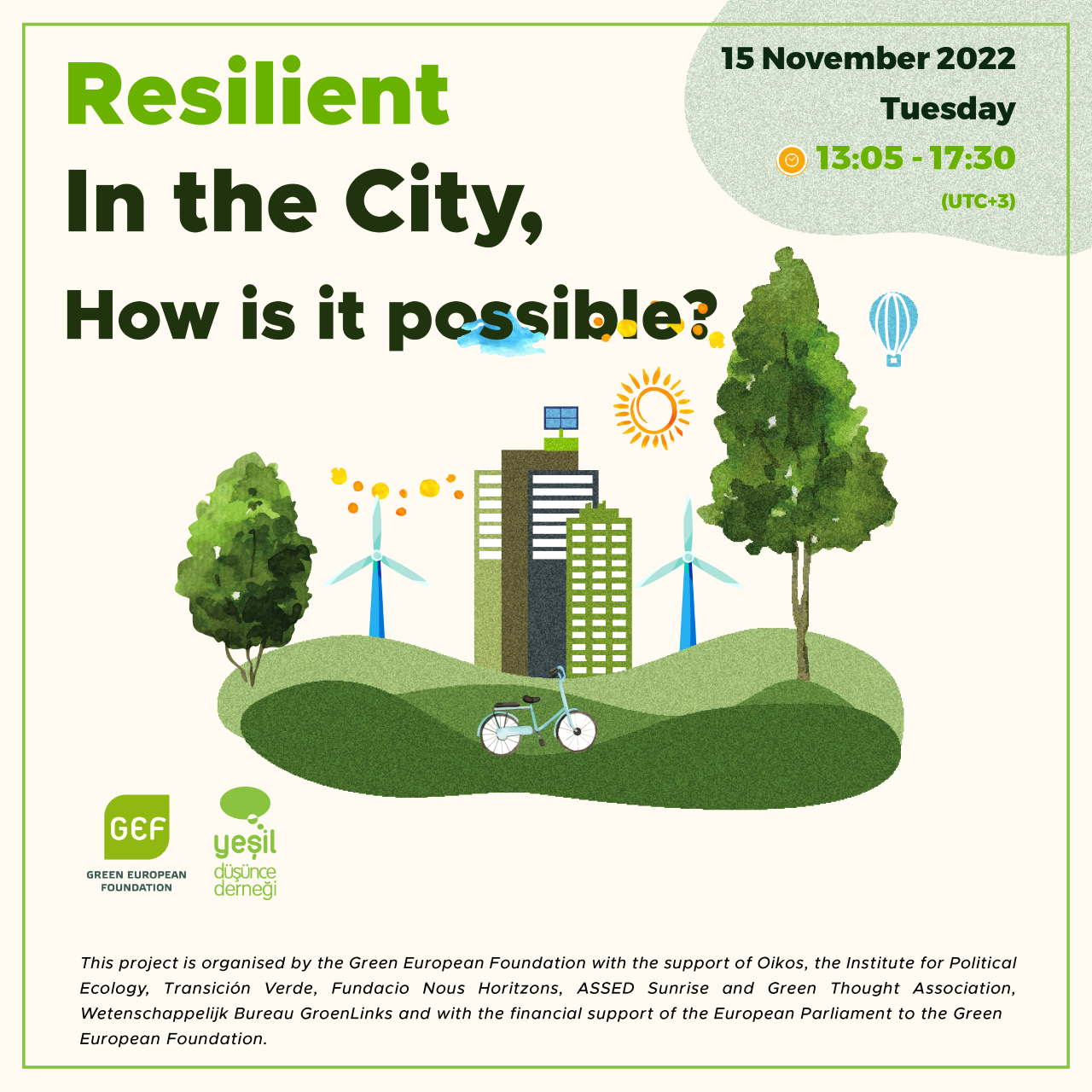
 

Resilience in the City, How?

By

Context

Resilient cities are able to withstand potential disasters, whether they are social, economic or geographical. The climate crisis, in particular, is  affecting the way people live in cities more and more. It creates social injustices with the most vulnerable communities being affected the most. Some local governments in Europe address these challenges by adopting transformative policies and innovative solutions to increase the accessibility to basic needs such as health, sanitation, housing, food, transportation, and water management.

The Green European Foundation alongside the Green Thought Association, aim to be a part of the solution by organizing the webinar “Resilience in the City, How?” within the scope of the ongoing project “Cities as Places of Hope”.

About the event

During this conference, various urban actors, academics and green activists will gather to raise awareness, build capacities and discuss how cities could become more resilient. Within the scope of resilience, the experts will focus on the social and ecological issues caused by the climate crisis and social injustice through various examples.

Programme

Session 1: Politics of Resilience
13:05 – 14:05

  • Last three years with Cities As Place of Hope – Dirk Holemans
  • What is Resilience?- Eray Çaylı
    14:05- 14:15 Break

Session 2: Resilience in the Context of Food, Housing and Social Issues
14.15- 15.30

  • Resilience and Housing in Europe – Kim Van Sparrentak
  • Feeding the Metropolis During A Crisis – Berkan Özyer
  •  Increasing Social Resilience in the City – Who Owns the Night?- Yasemin Bahçekapılı

15.30-16.30

  • Open Session

Practicalities

Date and Time: 15 November 2022 at 13.00 (CET+3).

Location: Online

Language: Turkish

Registration: Sign up here.


This event is organised by the Green European Foundation with the support of Green Thought Association and with the financial support of the European Parliament to the Green European Foundation. The European Parliament is not responsible for the content of this event

The Future of the City: What do Donuts have to do with it? (Zagreb)

By

Context

Our international speakers will give an introduction to doughnut economics, explain the concept of degrowth doughnut, and show why more and more European cities are adopting it.

This event is part of the Cities As Places of Hope project, organised by the Green European Foundation with the support of Oikos, the Institute for Political Ecology, Transición Verde, Nous Horitzons Fundacio, Sunrise, Green Thought Association and Wetenschappelijk Bureau GroenLinks, and with the financial support of the European Parliament to the Green European Foundation. The project, launched in 2019, has aimed at fostering progressive city networks to achieve a fairer, greener Europe. Its theme in 2022 is “Resilient cities”.
 

Speakers

Dirk Holemans (Oikos, GEF Co-President) Ajda Pistotnik (Policy Lab, Ljubljana)Mladen Domazet (Institut za političku ekologiju, Zagreb)Clara Dallaire-Fortier (PhD student, Lund University) – via ZoomTomislav Cik (Institut za društvena istraživanja, Zagreb)


Practicalities

Date and Time: 11th November, 18:00PM CET.

Location: MAMA Zagreb, Preradovićeva 18 10000 Zagreb, Croatia

Registration: Not required.

Language: This event will be in English language.


This event is organized by the Green European Foundation with the support of Insitute for Political Ecology and the financial support of the European Parliament to the Green European Foundation.
City and countryside: so close, so far

By Uncategorized

Context

In an increasingly urban world, building resilient cities has become a challenge. But for this challenge to be successfully addressed, we cannot focus solely on urban areas. We need to develop strategies that consider the territory surrounding cities, as well as their dependence on the resources from rural areas. Establishing a balanced relationship between cities and their rural environment will bring mutual benefits while giving greater autonomy and independence to the city itself in obtaining the basic resources it needs. Based on this premise, this publication explores best practices in managing food, water or energy to make our cities and territories more resilient.

This report is partially based on the outputs of the conference “City and Countryside: So Close, So Far Away” (May 26th 2022), as part of the “Cities as places of hope” project.


Resilience is the capacity of a living being to adapt to a disturbing agent or an adverse situation. This term also applies to cities, for which this capacity to adapt is essential to respond to the major crises of our time.


Download

Available in Spanish

Available in Polish


This publication has been realized by the Green European Foundation and Transición Verde with the financial support of the European Parliament. The European Parliament is not responsible for the content of this publication.

Cities as Places of Hope: Expert Meeting (Utrecht)

By

About

Cities all around the world have the potential to be the primary drivers behind the transition towards a sustainable and just society. At the moment, however, cities cannot provide a good life for all within planetary boundaries. They are still part of an economic system that depends on hyper consumption and extractivism. In this context, a foundational shift is needed, starting with a transformation in our world view. A shift that departs from the view of humans as homo economicus, towards a mode of living that recognises the fundamental vulnerability of human and non-human life. A world view based on the ethics of care as the founding principle for a new city. The question is how we can make this world view a reality. Whit what reforms can local politicians start working today? This expert meeting will focus on the reforms that local politicians can start working on today and explore the contours of a framework for an ecologically and socially just city.

Context

This expert meeting is part of the Green European Foundations project Cities as Places of Hope, in which we highlight inspiring examples of progressive cities across Europe which are the frontrunners of the social-ecological transition.

Organizers

Dirk Holemans, Coordinator of Oikos Think Tank, Co-president of the Green European Foundation
Hans Rodenburg, Wetenschappelijk Bureau GroenLinks, Project Coordinator

Practicalities

Date and time: Tuesday, 18th October from 15.00 to 17.00 CET.

Audience: This expert meeting will take place in Dutch and is invitation only.


This project is organised by the Green European Foundation with the support of Wetenschappelijk Bureau GroenLinks and Oikos Think Tank with the financial support of the European Parliament to the Green European Foundation. The European Parliament is not responsible for the content of this event.
City and countryside: so close, so far

By

About the event

With around 55% of the world’s population living in urban areas (over 75% in Europe), building resilient cities has become a challenge. But to successfully meet this challenge, we cannot focus only on urban areas. The strategies put in place must consider the territory they are part of and their dependence on the resources of rural areas. Establishing a balanced relationship with its rural environment will bring mutual benefits, as well as giving greater autonomy and independence to the city itself in obtaining the basic resources it needs.

Based on this premise, how should we manage food, water or energy to make our cities and territories more resilient? We will talk about this in this session organised by the Green European Foundation (GEF) with the support of the Transición Verde Foundation.

Speakers

  • Marta Olazabal is the head of the Adaptation research group at the Basque Centre for Climate Change (BC3). She has participated in the drafting of the IPCC 2022 report, in chapter 6 on Urban Areas.
  • Jorge Molero is a consultant and project technician at the Entretantos Foundation and is in charge of the technical secretariat of the Network of Municipalities for Agroecology.
  • Francesc La Roca is a founding member of Fundación Nueva Cultura del Agua (New Water Culture Foundation) and professor in the Department of Applied Economics at the University of Valencia.
  • Ismael Morales is the head of communications at the Fundación Renovables (Renewables Foundation) and a contributor on energy issues to the newspaper El Confidencial.

Moderator: Lidia Ucher, journalist specialising in communication for social and climate justice.

Practicalities

When: 26th May, 18:00-19:30 PM CEST

Where: The event is online on Zoom, open and free of charge.

Language: The main language of this activity will be in Spanish. The access link and technical details will be sent to all registered participants on 25th May.

Registration: Sign up here 


This event is organised by the Green European Foundation with the support of Transición Verde and with the financial support of the European Parliament to the Green European Foundation. The European Parliament is not responsible for the content of this event.
Resilient Cities in the Context of Climate Crisis

By

About the event

In this event, we aim to further explore the theoretical knowledge around the concept of resilient cities and talk about exemplary green city practices from both Europe and Turkey. We welcome anyone who wishes to increase their knowledge and contribute to the discussion about solutions to the pressing problems of our time.

Context

This event is part of the Cities As Places of Hope project. A project organised by the Green European Foundation with the support of Oikos, the Institute for Political Ecology, Transición Verde, Fundacio Nous Horitzons, ASSED Sunrise and Green Thought Association, Wetenschappelijk Bureau GroenLinks and with the financial support of the European Parliament to the Green European Foundation.
Launched in 2019, this project focuses on the development of progressive city networks as a key factor to create a better Europe. The project aims to bring together progressive and transformative local and international city networks, provide spaces for cooperation, facilitate information exchange, share and give visibility to best practices, and ultimately contribute to the creation of a positive narrative about the future of Europe. “Resilient cities” will be the theme of the project in 2022.

Programme (CET)

13.00 – 13.05 – Opening (Board member or project coordinator)

13.05 – 13.30 – A presentation/speech around the concept of “resilient cities” from Dr. Zeynep Deniz Yaman Galantini

13.30 – 13.50 – A presentation/speech about green city policies from Imane Nadif (Green City Councillor from Amsterdam)

13.50 – 14.05 – A presentation/speech from a partner of Cities as Places of Hope Project

14.05 – 14.20 – Q&A

14.20 – 14.30 – Break

14.30 – 15.00 – Sharing good practices in 2 or 3 breakout rooms

15 minutes – A short presentation/speech about good practice

15 minutes – Q&A and networking

Practicalities

Date and Time: 28th April, 1pm

Registration: Please register here

Language: Simultaneous translation (TR-ENG / ENG-TR) will be provided (except for breakout rooms discussions)


This event is organized by the Green European Foundation with the support of the Green Thought Association and the financial support of the European Parliament to the Green European Foundation.
Cities as Places of Hope (Vilvoorde)

By

About the Event

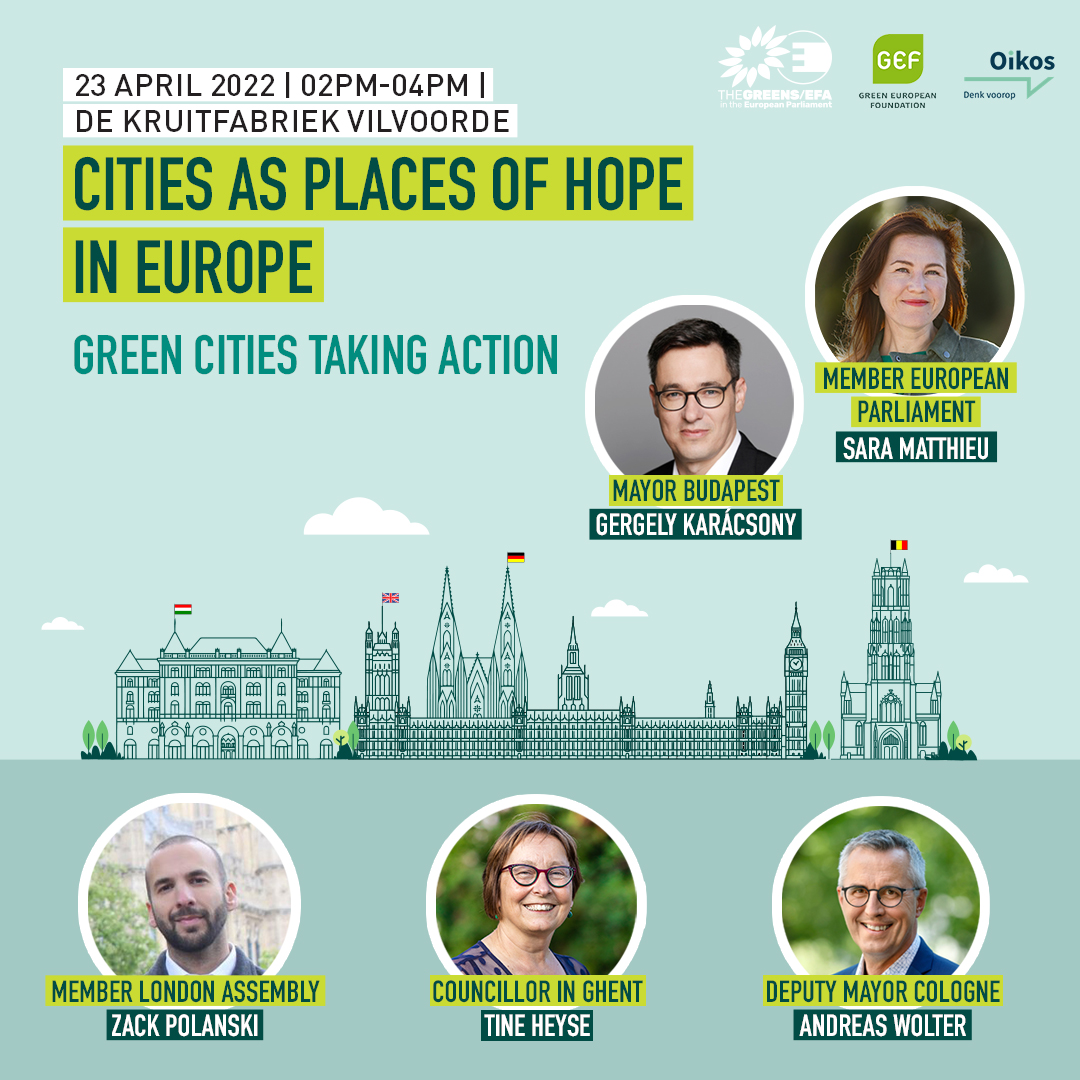
This event brings together advocates for progressive and transformative city policies in various Green Cities in Europe. Gergely Karácsony, mayor of Budapest as well as other Belgian and European mayors and vice-mayors will present transformative policies from their home cities and enter into conversation. There will also be a video presentation on green initiatives in the city of Ghent, one of Belgium’s most progressive green cities.

This event presents an opportunity to learn about projects to make European cities sustainable and green, to inspire one another and strengthen the inter-city network. Everyone interested in making our cities green places of hope is welcome.

Context

This event is co-organized by the Green European Foundation, Oikos Think Tank and Member of European Parliament Sara Matthieu, as part of the GEF project Cities as Places of Hope. Cities as Places of Hope aims to bring together progressive and transformative trans-local city networks, to connect them and facilitate their exchanges, ultimately contributing to a positive narrative for the future of Europe.

Speakers

  • Gergely Karácsony, Mayor of the City of Budapest
  • Sara Matthieu, Member of European Parliament (Group of the Greens/European Free Alliance)
  • Andreas Wolter, Mayor of the City of Cologne
  • Zack Polanski, London Assembly
  • Tine Heyse, vice-mayor of the city of Ghent
  • Benedek Jávor, Head of the Budapest Representation in Brussels and former MEP

Programme

14:00-14:15pm: Welcoming and introduction by MEP Sara Matthieu + video Ghent14:15-14:30pm: Keynote lecture by Gergely Karácsony14:30-15:15pm: Conversation between Benedek Jávor, Andreas Wolter and Tine Heyse, moderated by Dirk Holemans 15:15-15:30pm: Q&A with audience15:30-15:45pm: Presentation on Ghent + video of Ghent15:45- 16:15pm: Conversation between Sara Matthieu & Zack Polanski, moderated by Dirk Holemans16:15-16:30pm: Q&A with audience

16:30: end of the event


Practicalities

Location: De Kruitfabriek – Steenkaai 44D – 1800 Vilvoorde

Date and Time: Doors open at 13:30; Event starts at 14:00 and ends at 16:30

Registration: Please sign up through this link.

 Audiovisual Material


This event is co-organised by the Green European Foundation,  Oikos think tank, Member of the European Parliament Sara Matthieu and with the financial support of the European Parliament to the Green European Foundation. The European Parliament is not responsible for the content of this event.
The Potential of Railways

By

About the Event

The event is open to all those interested in mobility, especially members of organisations and platforms working on the issue, government officials, politicians and civil society associations.

Our aim is to publicise more sustainable alternatives when choosing a means of transport and to raise awareness of the need to change our mobility habits.

The events will be held via zoom and will have simultaneous translation from Spanish-English. Prior registration is required.

Context

This is the third event of the series of conferences entitled “The Future of European Mobility”

One of the key factors in the economic development in our global society has been the ease of mobility for people and goods due to the abundance of cheap oil. But we can already witness the consequences of this irrational mobility in the form of the climate crisis and air pollution.

In order to achieve Europe’s decarbonisation goals, the transport sector is a priority. That is why the German Heinrich Böll Foundation launched last year the European Mobility Atlas, a comprehensive analysis of the situation of the sector in Europe. The Green European Foundation and the Fundació Nous Horitzons have translated the Atlas into Spanish and, together with Transición Verde, have prepared a specific annex on the situation in Spain. For its launch, we have organised three online events on some modes of transport whose future is key to move towards low-emission mobility.

The last session of the series will focus on the railway. The most efficient means of motorised transport which, beyond the AVE (high-speed rail line), has been losing its condition as the backbone of the Spanish geography. Should it recover that condition? Can a large part of freight be transferred to the railway?

Speakers

  • Juantxo López de Uralde, national Deputy and president of the Commission for Ecological Transition and Demographic Challenge of the Spanish Congress.
  • José Luis Ordóñez, spokesperson of the State Coordination for a Public, Social and Sustainable Train.
  • Tilly Metz, MEP in the Greens/EFA group and member of the Committee on Transport and Tourism.
  • Manel Ferri , Spanish Sustainable Mobility Foundation)

Moderation: Lidia Ucher, environmental journalist.

Practicalities

Date ant Time: 8th February 18:00-19:30

Language: The events will be held in Spanish via zoom, and will have simultaneous translation in English.

Registration: Prior registration is required- Please register here.

The day before each session we will send a message to the registered persons with the access link.

The sessions will be recorded and made available on YouTube.


This event is organised by the Green European Foundation with the support of Transición Verde and Fundació Nous Horitzons, and with the financial support of the European Parliament to the Green European Foundation.

Cycling and new public space

By

About the Event

The event is open to all those interested in mobility, especially members of organisations and platforms working on the issue, government officials, politicians and civil society associations.

Our aim is to publicise more sustainable alternatives when choosing a means of transport and to raise awareness of the need to change our mobility habits.

The events will be held via zoom and will have simultaneous translation from Spanish-English. Prior registration is required.

Context

This is the second event of the series of conferences entitled “The Future of European Mobility”

One of the key factors in the economic development in our global society has been the ease of mobility for people and goods due to the abundance of cheap oil. But we can already witness the consequences of this irrational mobility in the form of the climate crisis and air pollution.

In order to achieve Europe’s decarbonisation goals, the transport sector is a priority. That is why the German Heinrich Böll Foundation launched last year the European Mobility Atlas, a comprehensive analysis of the situation of the sector in Europe. The Green European Foundation and the Fundació Nous Horitzons have translated the Atlas into Spanish and, together with Transición Verde, have prepared a specific annex on the situation in Spain. For its launch, we have organised three online events on some modes of transport whose future is key to move towards low-emission mobility.

This second session will focus on public space and urban mobility and, in particular, cycling. We will discuss the process of urban transformation in favour of the car and to the detriment of the use of public space as a space for coexistence; urban mobility strategies; and the transformative role of the bicycle.

Speakers

  •  Pilar Vega Pindado, geographer and expert in territorial and environmental planning. Professor at the Complutense University of Madrid. Consultant at gea21
  •  Laura Vergara, President of ConBici and Vice-President of Mujeres en Movimiento (Women on the Move).
  • Jaime Caballero, Councillor for Sustainable Urban Development at Logroño City Council.

Moderation: Raúl Gómez, director of Transición Verde Foundation.

Practicalities

Date ant Time: 8th February 18:00-19:30

Language: The events will be held in Spanish via zoom, and will have simultaneous translation in English.

Registration: Prior registration is required- Please register here.

The day before each session we will send a message to the registered persons with the access link.

The sessions will be recorded and made available on YouTube.


This event is organised by the Green European Foundation with the support of Transición Verde and Fundació Nous Horitzons, and with the financial support of the European Parliament to the Green European Foundation.
Greener Local Communities

By

About the event

During this session, we will discuss the wave of local green transformations across many cities in Europe that are setting the path towards a different urban living future. As well as considering climate change, these cities are deeply connected to their citizens. Their local policies aim at improving people’s quality of life, thus becoming places of hope for the local communities of tomorrow.

Context

This online event will bring EU green local policies from different cities across Europe exploring transformative practices. We will look at the steps already taken and the roadmap ahead to turning our cities into places of hope. The findings of the GEF Cities as places of hope project as well as local green examples will be the object of discussion during the event, with a focus on mobility, housing, energy, waste, food and climate.
With this event, we will present our research and mapping of progressive and transformative practices on the Western Balkans and explore the EU practices and possibilities for cities to organise themselves in trans-local networks and connect them to the Green movement to facilitate their exchanges.

Speakers:

  • Aleksandar Gjorgjievski, President, Sunrise, North Macedonia
  • Raúl Gómez, Director,Transición Verde, Spain (video intervenion)
  • Dr. Sc. Biljana Apostolovska Toshevska, professor at Institute of Geography, Faculty for Natural Sciences and Mathematics, Skopje
  • Milosh Sokolikj, Service designer, SmartUp – Social Innovation Lab


Programme

12:00 Participants join the event

12:10-12:20 Introduction

12:20-13:00 Session with speaker’s presentations on transformative cities

13:00-13:20 Panel discussion and Q&A

The primary language is Macedonian but simultaneous translation in English will be provided.


Practicalities

Date and time: Saturday, December 11th from 12:00h CET

Audience: This event will take place in Macedonian language with simultaneous translation in English

Registrations:

Register in advance for this event: https://us02web.zoom.us/meeting/register/tZMkce-tqj8qEtGPrQK9X5ModmuKvNRezcWXAfter registering, you will receive a confirmation email containing information about joining the event.

*The event will take place on the ZOOM platform 


This event is organised by the Green European Foundation with the support of Sunrise and with the financial support of the European parliament to the Green European Foundation.

Turning Over a New Leaf (Zagreb)

By

About the event

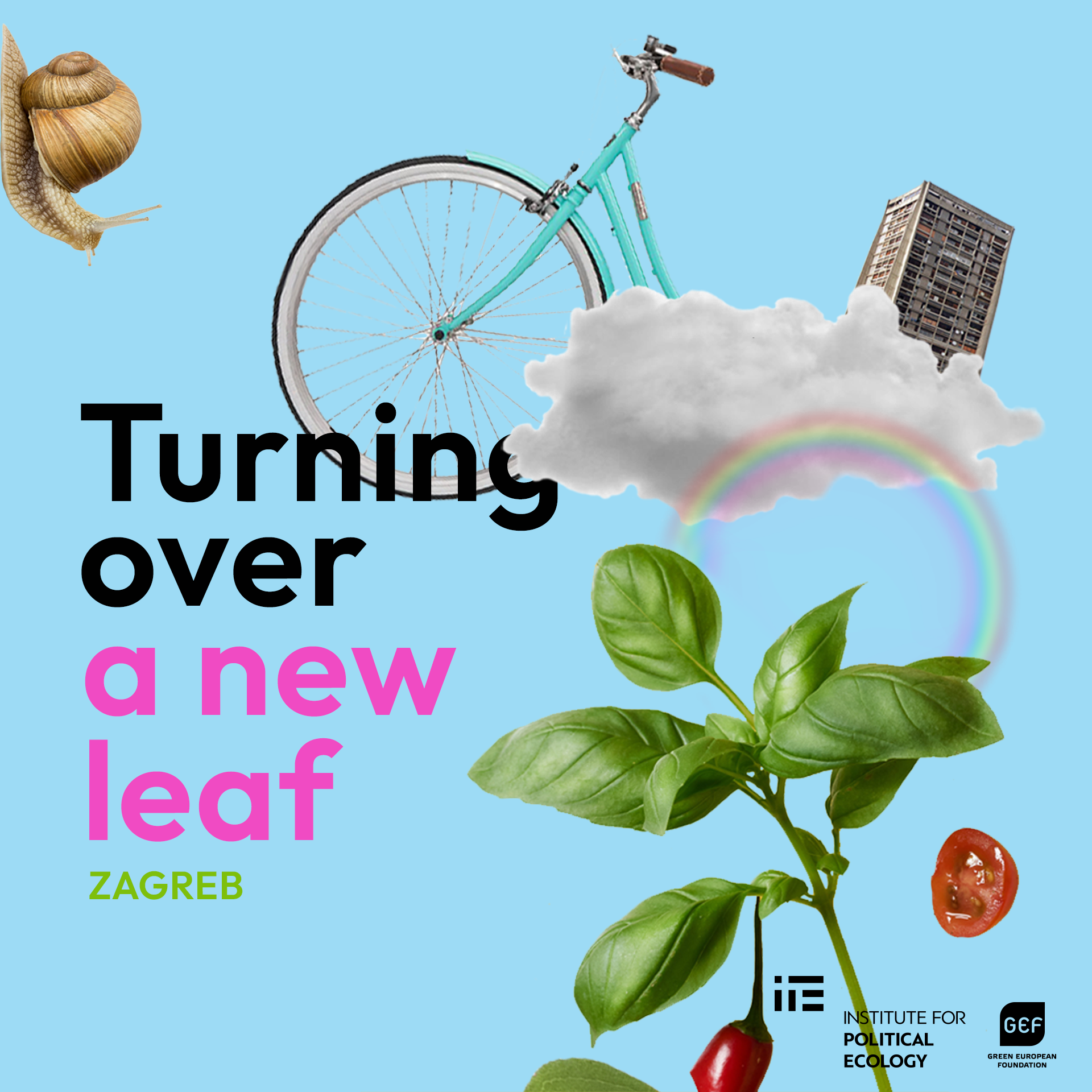
In the spring of 2021, Zagreb became a city of hope and elected a new green government. But this fresh energy is facing many old challenges (and some new ones). How can the city transform its deeply rooted issues, from housing to mobility, and make itself more resilient to climate change? Some changes are simple, but how do we really turn over a new leaf? This event will explore different transformative practices and potential pathways in an exchange with other green European cities. Inspiring videos of the Cities as Places of hope project will be presented to the audience.

Context

This event is part of the ‘Cities as Places of Hope’ series; a project launched in 2019 focussing on progressive city networks that are a key factor in the development of a positive narrative on the future of Europe. The project brings together partners from Spain (Fundación Transición Verde), Catalonia (Fundacio Nous Horitzons), Croatia (The Institute for Political Ecology-IPE) , Belgium (Oikos), North Macedonia (Sunrise), WBGL (Netherlands) and Turkey (Green Thought Association). This 2021 project aims to bring together progressive and transformative trans-local city networks, to connect them and facilitate their exchanges, ultimately contributing to a positive narrative for the future of Europe

Speakers

The speakers of the event will be protagonists with transformative stories from Zagreb, representatives of Green European cities and Project Partners.

  • Iva Marčetić – Pravo na grad
  • Sarah Baron Brljević
  • Svibor Jančić – Zagreb je naš!
  • Dražen Šimleša – ZMAG
  • Benjamin Badouard – Co-Président du groupe “Les écologistes” à la Métropole de Lyon chez Métropole de Lyon
  • Dirk Holemans – Co-President of the Green European Foundation, Oikos Think Tank

The conversation will be moderated by Vedran Horvat (Managing Director, IPE) and Lana Pukanić (IPE) and accompanied by project videos.


Practicalities

Date and time: Wednesday, December 1st from 18:00 PM CET

Audience: This event will take place in English

Event link: https://us02web.zoom.us/j/88469944631

*The event will take place on the ZOOM platform 

Follow our Facebook event: Zagreb: Turning over a New Leaf 


This event is organised by the Green European Foundation, with the support of Institute for Political Ecology and with the financial support of the European Parliament to the Green European Foundation. The European Parliament is not responsible for the content of this event.