Geopolitics of a Post-Growth Europe (Sofia)

By

About the event:

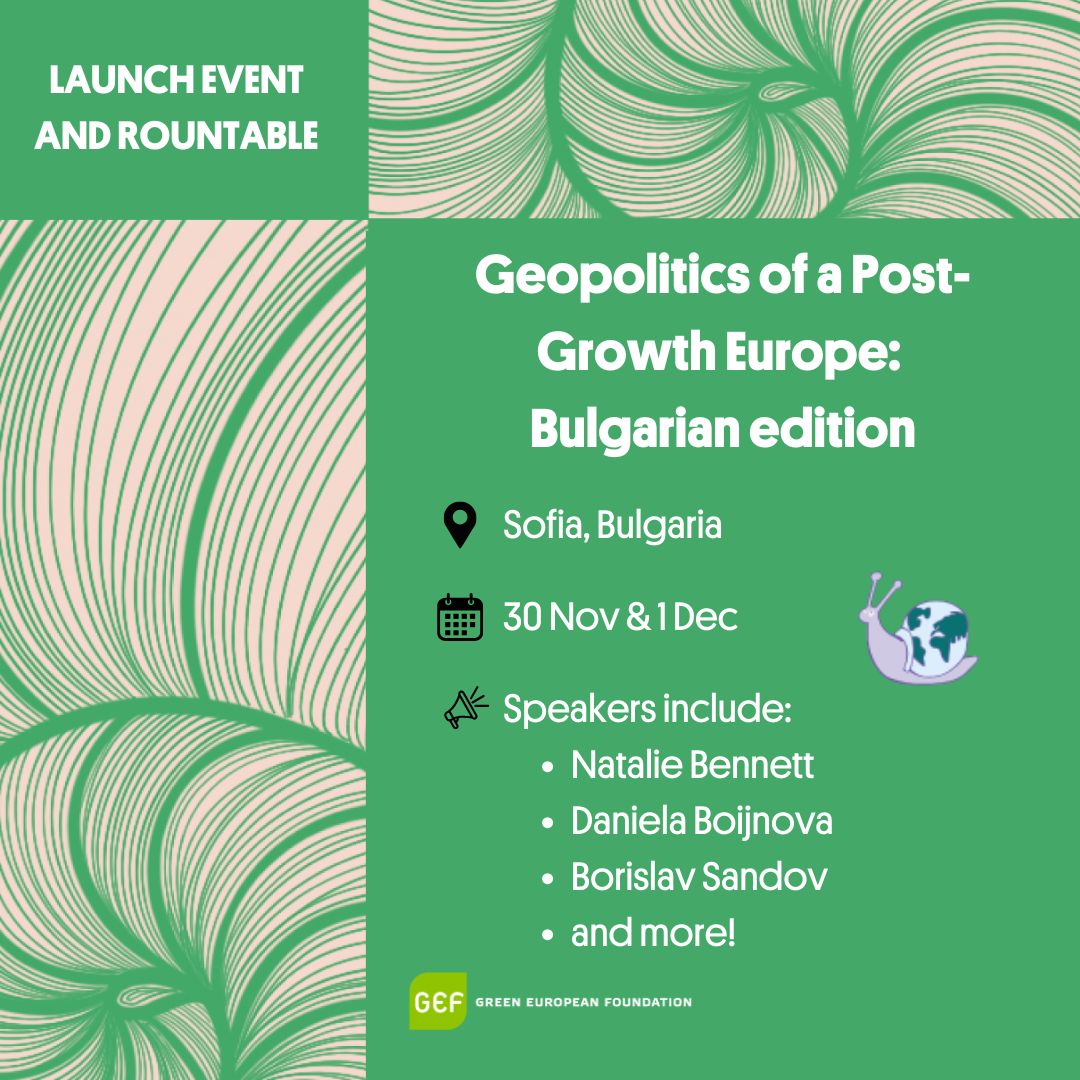
GEF is hosting a festive launch event in Sofia to spotlight the Bulgarian edition of our publication “Geopolitics of a Post-Growth Europe.” This will be followed by an expert roundtable delving deeper into the policy dilemmas and potential synergies of Europe’s ecological and geopolitical security. Both events will bring together green activists, experts, researchers, policymakers, and civil society representatives, including inputs and interventions from other parts of Europe.

Project background:

In the project “Geopolitics of a Post-Growth Europe”, the Green European Foundation and its partners explored the tensions between degrowth/post-growth and geopolitics. The project worked to ignite a conversation between critics of economic growth and progressive thinkers on foreign and security policy, who now often operate in separate circuits. Find out more about the project and its findings at geopoliticspostgrowth.eu.

Programme and speakers:

Festive book launch and reception (Saturday, 30 November, 13:00 – 14:30)
With speeches and interventions by:

  • Natalie Bennett, Green member of the UK House of Lords and member of the editorial board of the Green European Journal
  • Carlos Teixeira, co-president of Instituto José Tengarrinha, Portugal
  • Daniela Bojinova, Direct Participation Expert and Democracy International Board Member, Co-Chair, Bulgarian Green Movement

Expert roundtable: Geopolitical versus Ecological Security? Green policy dilemmas at a time of wars and pressure against European democratic values (Sunday, 1 December, 9:00 – 10:30)

  • Keynote presentation by Richard Wouters (Wetenschappelijk Bureau GroenLinks)
  • Moderated by Pavel Antonov (BlueLink)
  • Discussants include: Daniela Bojinova (Direct Participation Expert and Democracy International Board Member, Co-Chair of the Bulgarian Green Movement), Borislav Sandov (former Deputy Prime Minister, Climate Policies), Magdalena Maleeva (Founder, Gorichka.bg), Dimitar Sabev (Green Economist, Bulgarian Academy of Sciences), Assen Nenov (Degrowth/Postgrowth Expert, Climate Fresc and Circular Economy Institute)

Practicalities:

Date and Time: November 30th (13:00-14:30) & December 1st (9:00-10:30)

Location: Krasno Selo Culture House, Sofia

Language: The event will take place primarily in Bulgarian, with some interventions in English. Whisper translation will be provided where necessary.

Registration: Both events are open to the general public, but you can register in advance via this link.


This event is organised by the Green European Foundation with the support of BlueLink and with the financial support of the European Parliament to the Green European Foundation.
Geopolitics of Degrowth in a Conflicted Europe – Global South’s Perspectives

By

About the event

Green policies that respect planetary boundaries and allow the Global South to develop seem incompatible with unlimited economic growth within the EU. We need a realistic scenario for a future in which we consume more sparingly but live better together. 

Could a post-growth EU that considerably reduces its ecological footprint with the purpose of freeing up natural resources find partners in the Global South? What should these partnerships entail?

To tackle this issue, the Green European Foundation with the support of BlueLink is organising a webinar focusing on the Global South. Participants will have the opportunity to review and reflect upon the outcomes from expert meetings, research and interviews, held across Europe during 2023. 

We invite researchers, activists and policy makers – particularly from the Global South  – with an interest in green policies and geopolitics to present perspectives, experiences, analytical or activity reports and to engage in a discussion around the following questions:

  • How would it be possible to optimize the possibilities that degrowth offers, including for democratic flourishing and a safer Europe and world?
  • Could a post-growth EU considerably reduce its environmental footprint with the express purpose of freeing up natural resources for the Global South?
  • Can the EU hope for strategic partnerships with (democratic) Global South countries, which are vital for greater security and legitimacy?
  • Could a post-growth EU still make a larger contribution to poverty reduction, global public goods, tax justice, legal migration routes, international climate finance, and compensation for climate loss and damage?
  • Could the older EU members come to terms with their colonial pasts, and on what conditions? How important is this for the Global South?
  • Will exports from Global South suffer if a post-growth EU  reduces its overconsumption of global resources?
  • How much EU’s partnership with the Global South depend on technology transfer?
  • What role of technology beyond trade, development, and climate: is it intertwined with geopolitics?

Not every question has a definitive answer and we promote creativity, analytical thinking, and a fresh approaches to the challenge.


Project Background

This event is part of GEF’s project Geopolitics of a Post-Growth Europe, which explores the tensions between degrowth/post-growth and geopolitics. The project aims to ignite a conversation between critics of economic growth and progressive thinkers on foreign and security policy, who now often operate in separate circuits. It aims to find solutions beyond naïve anti-militarism and convenient belief in green growth. Find out more about the project and its findings at geopoliticspostgrowth.eu.


Practicalities

This GEF e-workshop will be held in Zoom by BlueLInk.

Date and time: December 11, 2023 (14:00 UCT / 15:00 CET / 16:00 EET) 

Language: English 

Registration: Open to all interested participants, but please register in advance via this link. Please use the ‘Questions and Comments’ field to specify your scope of interest or proposed intervention. You will receive a confirmation email after registration. 


This event is organized by the Green European Foundation with the support of BlueLink. It will take place online, in partnership with the Association for Progressive Commnunications and its members.

Geopolitics of Degrowth in a Conflicted Europe (Leipzig)

By

About the event

Green policies that respect planetary boundaries and allow the Global South to develop seem incompatible with unlimited economic growth in the EU. We need a realistic scenario for a future in which we consume more sparingly but live better together. A scenario that could be possible within a degrowth context.

The war in Ukraine completely changed the geopolitical landscape. Today, the idea of ending GDP growth in the EU encounters new and important impediments, with power and wealth being measured in military capacity. Can a degrowth Europe build strength and resilience in this context?

To tackle this issue, the Green European Foundation with the support of BlueLink is organising a workshop in Leipzig, as part of a series of expert meetings across Europe. The outcomes from these meetings and further research and interviews will feed into a final publication to be launched in the autumn of 2023.

We invite researchers, activists and policy makers – particularly from Central and Eastern Europe and Ukraine – with an interest in green policies and geopolitics to present perspectives, experiences, analytical or activity reports and to engage in a discussion around the following questions:

  • How does degrowth within the EU affect the EU’s ability to achieve geopolitical objectives like providing security, and what are the resulting tensions and synergies?
  • Can such tensions be mitigated? If so, how?
  • How would it be possible to optimize the possibilities that degrowth offers, including for democratic flourishing and a safer Europe and world?

Not every question has a definitive answer and we promote creativity, analytical thinking, and a fresh approaches to the challenge.

Project Background

This event is part of GEF’s project Geopolitics of a Post-Growth Europe, which explores the tensions between degrowth/post-growth and geopolitics. The project aims to ignite a conversation between critics of economic growth and progressive thinkers on foreign and security policy, who now often operate in separate circuits. It aims to find solutions beyond naïve anti-militarism and convenient belief in green growth. Find out more about the project and its findings at geopoliticspostgrowth.eu.

Practicalities

This GEF workshop will take place as part of the International Roundtable 2023 held by the Peaceful Revolution Foundation in Leipzig. You can find out more information about this conference here. 

Date and time: October 11th, 2023 (14:30 CET) 

Location: Leipzig, Germany and online (hybrid event) 

Language: English 

Registration: Open to all interested participants, but please register in advance via this link. Please use the ‘Questions and Comments’ field to specify your scope of interest or proposed intervention. You will receive a confirmation email after registration. 

In case you want to attend the workshop in person in Leipzig, please also email office@bluelink.net by Friday, October 6th 


This event is organized by the Green European Foundation with the support of BlueLink. It will take place as part of the Revolutionale International Round Table 2023 held in Leipzig by the Peaceful Revolution Foundation.  


How to protect a Post-Growth Europe? (Sofia)

By

About the event

Green policies that respect planetary boundaries and allow the Global South to develop seem incompatible with unlimited economic growth in the EU. We need a realistic scenario for a future in which we consume more sparingly but live better together, a scenario that concepts of degrowth and post-growth can offer.

The war in Ukraine completely changed the global landscape. Today, the idea of ending GDP growth in the EU encounters new and important geopolitical impediments with power and wealth being measured in military capacity. Can a degrowth Europe build strength and resilience in this context?

To tackle this issue, the Green European Foundation is organising a series of expert meetings across Europe, including the present one with the support of BlueLink in Bulgaria. Outcomes from these expert meetings and further research and interviews will feed into a final publication to be launched in autumn 2023.

We invite Bulgarian researchers, activists and policy makers with an interest in green policies and geopolitics to present papers and/or engage in an analytical discussion defined by the following analytical framework:

  • What are the tensions and synergies between managed degrowth within the EU and the EU’s ability to achieve its geopolitical objectives, such as promoting security in a broad sense?
  • Can tension be mitigated? If so, how?
  • How would it be possible to optimize the possibilities that degrowth offer?

Not every question has a definitive answer and we promote creativity, analytical thinking and fresh approaches to the challenge.

Project background

This event is part of GEF’s Geopolitics of Post-Growth project, which explores the tensions between degrowth/post-growth and geopolitics. The project aims to ignite a conversation between critics of economic growth and progressive thinkers on foreign and security policy, who now often operate in separate circuits. It aims to find solutions beyond naïve anti-militarism and convenient belief in green growth. 

Speakers and Programme 

Further details to be announced. 

Practicalities

Date and Time: April 28th, 14:00 – 17:00 CET

Location: House of Europe – 124, 1000 Sofia Center, Sofia, Bulgaria

Language:  The seminar will be held in Bulgarian, but presentations in English are acceptable.

Registration: Researchers, experts, activists or politicians wishing to join the discussion with academic or conceptual contributions, opinions and opinions, or as discussants on the subject, are invited to register for participation via this link. Only registered participants will be admitted to the event.

If you have any further questions or wish to discuss your potential contribution, please reach Pavel Antonov, PhD at tel. 0888 704 661 or by e-mail at office@bluelink.net. 


This expert seminar is organised by the Green European Foundation with the support of BlueLink and the financial support of the European Parliament to the Green European Foundation. The European Parliament is not responsible for the content of this event.
Towards Sustainable Agriculture and Cleaner Energy in the NRRP

By

About the Event

The Green European Foundation, with the support of BlueLink, has been closely following the drafting and submission process of Bulgaria’s National Recovery and Resilience Plan, with an aim to highlight key areas for scrutiny and foster a public debate on this important EU initiative. 

This media event will feature some our key expert contributors, as they give their input on the NRRP and its different versions, focusing particularly on the key areas of agriculture, climate and energy, and circular economy. We will also present some comparative analyses based on studies of the NRRPs submitted by three other EU member states: Latvia, Portugal, and Slovakia.   

Speakers

  • Petko Kovachev – Green Policy Institute 
  • Gavrail Gavrailov – BlueLink 
  • Albena Simeonova – chairperson of the “bioproducts” organic farmers branch organisation 
  • Natalia Dimitrova – BlueLink 

Practicalities

Date and Time:  2nd December, 10 am

Location: Sofia (Bulgaria)

This is an invite-only media event. If you would like to join, please send an email to sien.hasker@gef.eu. The event will be in Bulgarian, and will also be streamed online. 


This media event is organised by the Green European Foundation, with the support of BlueLink and the financial support of the European Parliament to the Green European Foundation. 
 

Revision of the Economies in the Balkans (Skopje)

By

CONTEXT 

This research report was produced as part of a project of the Green European Foundation in 2017 with the joint effort of the research teams in three Balkan countries:
BlueLink Foundation – Bulgaria 
The Association for Sustainable Social and Economic Development SUNRISE – Macedonia
Networked – Serbia.  

The research report highlights which political conditions are necessary to move towards a green economy in the three countries, and compares their prospects in terms of social factors and legal and policy frameworks.

This event is invitation only. The full research publication is available for free at GEF website. 

PROGRAMME 

21st September 2018 

16:00 – 16:30   Registration and welcome coffee 

16:30 – 16:50   Opening and Introduction of the research and cooperation with GEF  

Aleksandar Gjorgjievski – Transnational coordinator ASSED Sunrise – Skopje 

16:50 – 17:30   Hristina Odzaklievska – National researcher in Macedonia 

 Presentation of research and methodology 

17:30 – 18:00   Coffee break 

18:00 – 18:30   Ervin Regjepagic – Energy sector in Macedonia  

18:30 – 19:00   Jasmina Pakaski – Sustainable development

19:00 – 19:30   Bojan Petrovski – Green economy and Green policy 

19:30 – 20:00   Aleksandar Gjorgjievski – President of ASSED Sunrise – Macedonia  

Presentation of the GEF project Green Economy: Cooperative Society and Announcement of the International conference on 6th October 2018 

20:00 – 21:00   Dinner and closing of the promotion event 

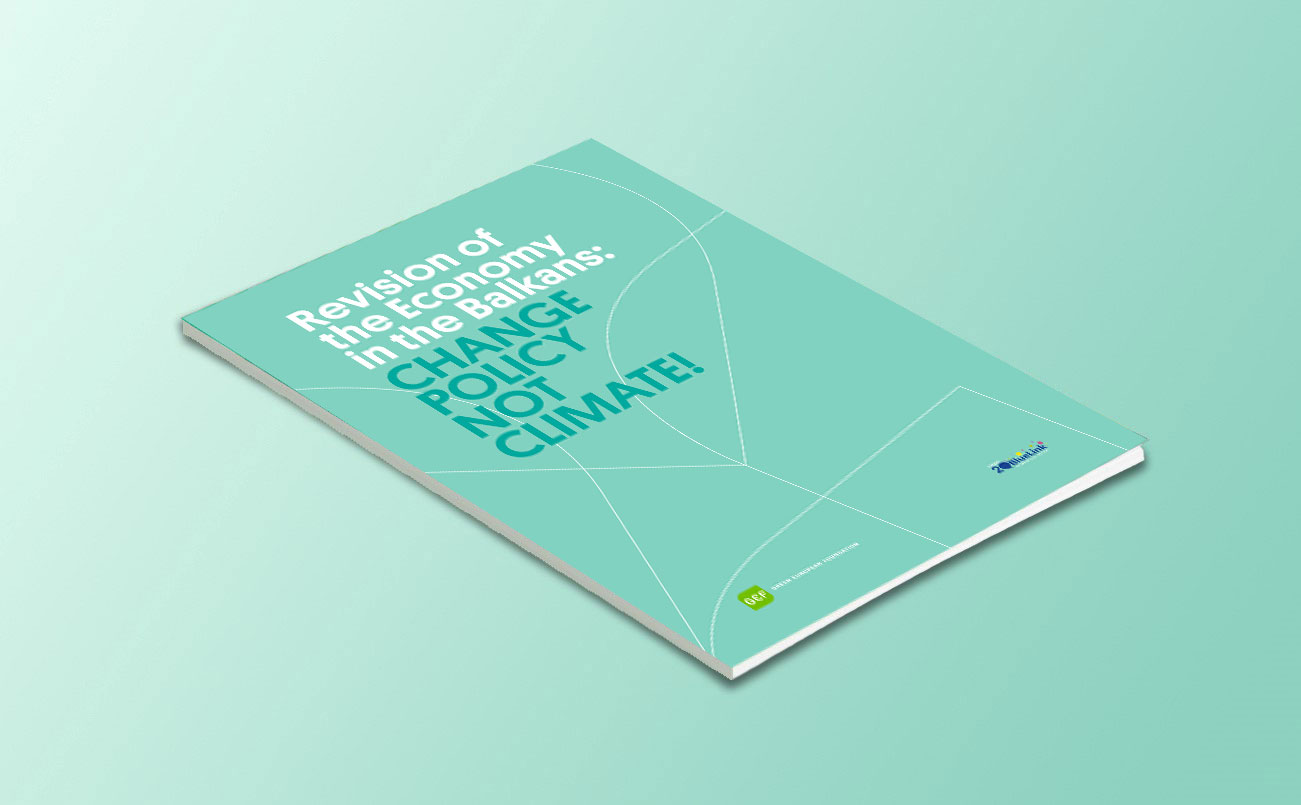
Revision of the Economy in the Balkans: CHANGE POLICY NOT CLIMATE!

By Uncategorized

This project had the aim to to raise awareness among stakeholders, politicians and the general public for the economic potential of a Green Economy, to stimulate changes in consumption and production patterns, and promote a participatory approach to policy making. The report and other project activities respond and contribute to one of the priorities for Bulgaria’s presidency of the EU in 2018: eco-innovation as a driver for economic progress.

Research goals

The purpose of the research was to accomplish the following goals set by the project:

  1. To gather best practices from the three participating countries – Serbia, Macedonia and Bulgaria – for a green economy;
  2. To showcase and promote the transformation of the economy towards environmental, low-carbon and energy-efficient production along with increasing prosperity and equity in society;
  3. To provide useful facts and arguments for Green politicians and activists to raise awareness among stakeholders, politicians and the general public about the economic potential of the green economy, to stimulate changes in consumption and production patterns, and to promote a participatory approach to policy-making.

A Democratic and Inclusive Green Economy

The research report highlights which political conditions have to be fulfilled to move towards a green economy in those three countries and compares the prospects of Serbia, Bulgaria and Macedonia in terms of social factors, legal framework and the policy framework.

Download

Digital version in English is available here

Digitial version in Bulgarian is available here

Digital version in Macedonian is available here

Digital version in Serbian is available here

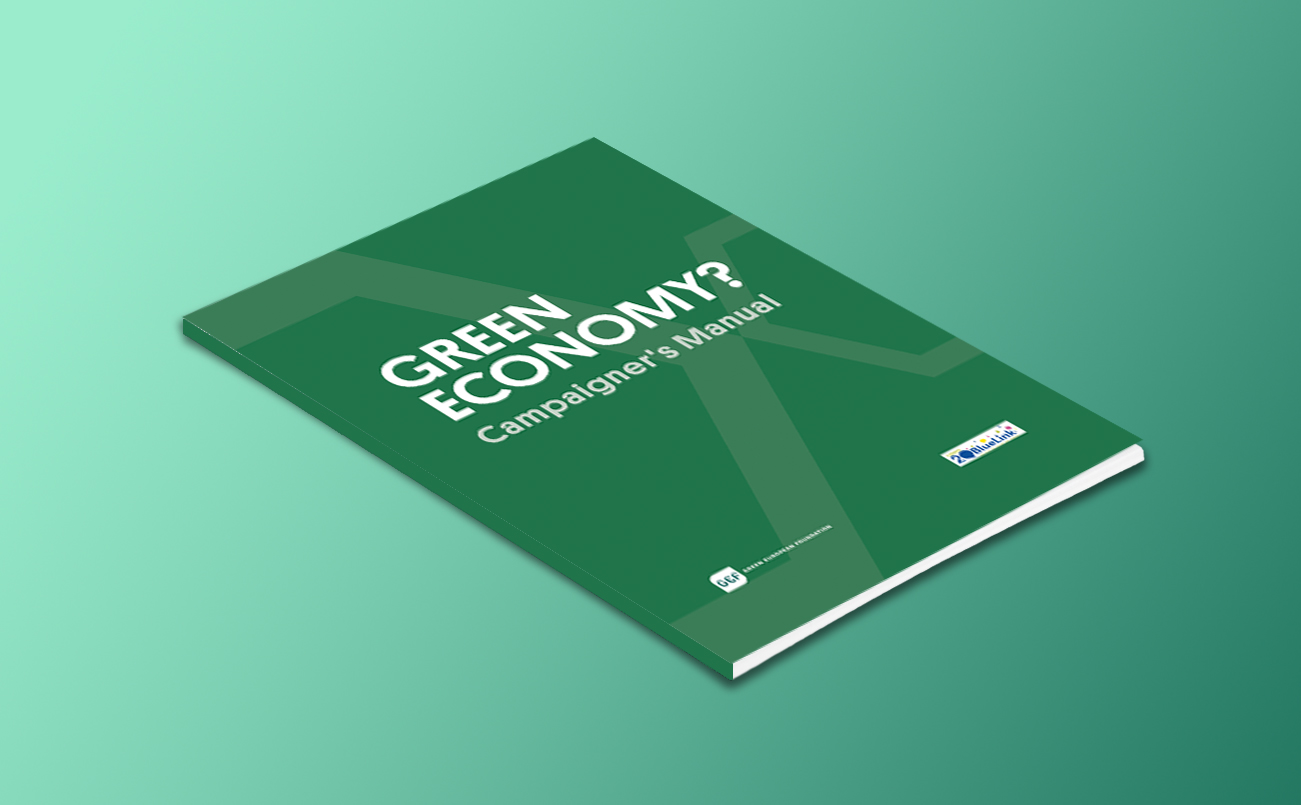
GREEN ECONOMY? Campaigner’s Manual

By Uncategorized

The manual’s aim is to promote the economic potential of a Green Economy by summarising the most important definitions and giving policy makers a tool at hand to argue in favour of a green economy and to debunk the most common misconceptions.

Download the digital version of the manual in English here.

The digital version of the manual is also available in Turkish here.

Eco-innovations for Economic Change & Shared Prosperity (Sofia, Bulgaria)

By

This event is a part of the ongoing project “Revision of the Economy in the Balkans: Change Policy not Climate” which aspires to raise awareness among stakeholders, politicians and the general public for the economic potential of a Green Economy in Serbia, Macedonia and Bulgaria, to stimulate changes in consumption and production patterns, and promote a participatory approach to policy making. The project is implemented jointly by the Green European Foundation, BlueLink Foundation (Bulgaria), Networked (Serbia) and the Sunrise Association for Sustainable Social and Economic Development (Macedonia).

Conference:

The topic of the event is closely related to one of the major priorities of the Bulgarian presidency of the EU, which starts on 1 January 2018, as defined by the so-called EU presidency trio – Bulgaria (Jan-Jun 2018), Estonia and Austria, during the meeting of the Council of the EU ministers of the environment which took place on 13 and 14 July, 2017 in Talin. The priority refers to eco-innovations as an engine for the transition to circular economy and stimulating green investments in energy transformation and clean technologies, in order to spur the overall competitiveness and achievement of shared prosperity across the EU.

A comparative study focusing on European climate, renewable energy and Green economy policy landscapes took place between April and September 2017 in Bulgaria, Macedonia and Serbia. The most important conclusions from the study will be presented and discussed at the conference, as well as in 3 national research publications, Green political handbook and journalistic materials published on regional electronic media – BlueLink.

Programme:

Please download the detailed programme of the conference here.

Registration:

Enquiries regarding participation and logistics are expected by 06 November 2017, to the attention of Mrs. Eva Stefanova, EU Projects assistant, at the following email address: eva@bluelink.net.

Eco-innovations for Green Economic Change & Shared Prosperity

By

Context

EU policies and strategic documents, such as Europe 2020, the EU Energy Roadmap 2050, EU Climate Adaptation Strategy, outline approaches to renewable energy and Green and circular economy in order to end the overuse of resources and the social inequality and mitigate climate change. But how do they apply to post-socialist member states and candidates countries in South Eastern Europe? How can eco-innovations contribute to a lasting change of economy and society at large? What are the drawbacks and challenges of Green economy that we need to deal with, to make sure it brings shared prosperity and environmentally sustainable development for everyone? And how can politicians, activists and business communicate effectively, to take society at large on board of the transformation to green economy?

Conference

Researchers, policy analysts and practitioners are invited to propose papers in response to these, and related questions, for the conference ‘Eco-innovations for Green Economic Change and Shared Prosperity in Bulgaria, Macedonia and Serbia’ on November 9 – 10, 2017.

The conference is part of the ongoing project “Revision the Economy in the Balkans: Change Policy not Climate” project by the Green European Foundation, organised with the support of the BlueLink Foundation Bulgaria, Networked Serbia and the Sunrise Association for Sustainable Social and Economic Development Sunrise from Macedonia. The project aims to foster economy transformation towards environmental, low-carbon and energy efficient reduction, along with increasing prosperity and equity in society.

A comparative study of the policy landscapes in Bulgaria, Macedonia and Serbia, practical and political recommendations to achieving equitable Green economy in the three countries will be presented and discussed at the conference. The event will respond to one of the priorities of Bulgaria’s forthcoming presidency of the EU in 2018: eco-innovations as a driver for economic progress. How can they work for achieving shared prosperity and democratisation of the society?

Call for papers

We welcome submissions of research papers, position papers, investigation presentations, or multimedia/film presentations. Abstracts can be submitted by Sunday, October 8, 2017 via email to office@bluelink.net. Find all the guidelines for submitting your abstract in this brief guide.

Participation

No participation fees will be charged for this conference. The working language will be English. In case you have any questions, please contact the Bluelink team by sending an email to office@bluelink.net.

“Balkan Watchdogs: Cross border Environmental Reporting” Workshop in Bulgaria

By

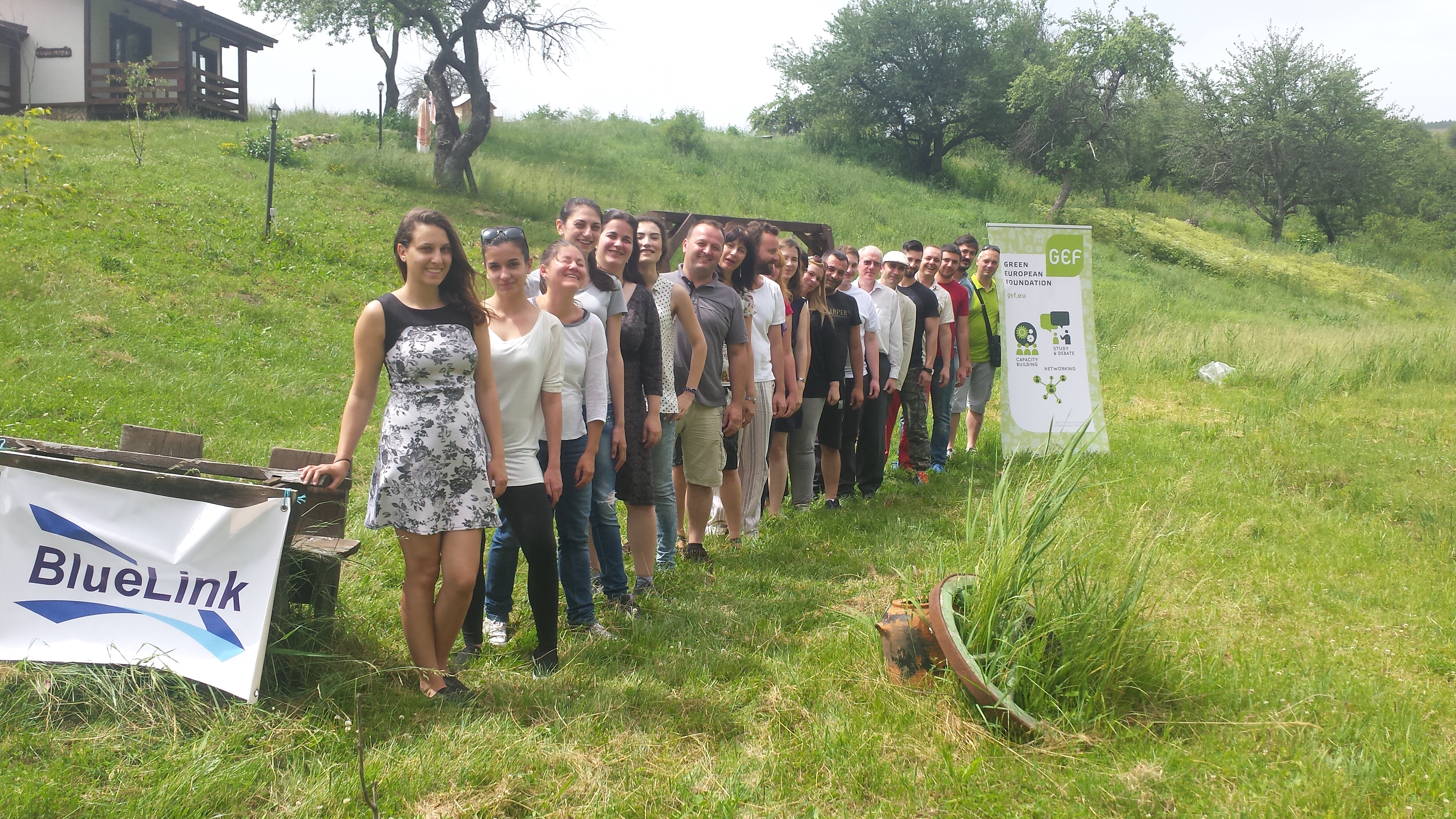
The workshop’s aim was to support young and active journalists from Bulgaria, Serbia and Macedonia, who have an interest in the practice of watchdog journalism, telling stories of environmental dangers and exploring new sustainable solutions offered by the Green economy. This event is a part of the Journalists and Policy Makers Boost Green Economy project, organised by the Green European Foundation, with the support of the BlueLink Foundation (Bulgaria), the Association for Sustainable Social-Economic Development Sunrise (Macedonia) and Drugi Novi Centar Association (Serbia).

The training represented a great opportunity for the young journalists and professionals with an interest in the practice of watchdog journalism in the public interest. It provided the participants with important insights in the cross-border environmental issues in the Balkans and the Green policies as the alternative solutions. This experience served as a platform for knowledge exchange and a chance to enhance the professional skills of the participants. The training was implemented in English.

The workshop was facilitated by: Dr. Pavel Antonov, Chief Editor at the Evromegdan.bg virtual newsroom of the BlueLink foundation; Paul Brown, Editor, Climate News Network; Zlatko Simonovski, researcher and journalist and Beatrice White, Deputy Editor at Green European Journal.


Purpose of the Workshop

With rule of law and democratic mechanisms failing to protect nature and public interest, ethical professional watchdog journalism is essential for raising awareness and promoting Green policy solutions in South Eastern European societies. Success stories of environmental and social change, environmental justice and Green policies advanced by new politicians, policy-makers and activists fail to effectively reach – and inspire – the general public.

Therefore, the workshop aimed to:

  • Build on the professional skills and integrity of young and active journalists;
  • Engage them creatively and professionally in a virtual newsroom to facilitate authoritative and well-written creative feature articles of environmental change;
  • Guide them while they publish and popularise journalistic articles (in text and image) in English and their native languages;
  • Allow new policy-makers, Green politicians, academic and civil society experts to foster journalists’ understanding of available success cases, technological and policy solutions.

Green Watchdog Stories Wanted from Bulgaria, Macedonia and Serbia

By

Freelance journalists based in one of the three countries, who are willing to work as public interest watchdogs applying high ethical and professional standards, are welcome to submit stories about environmental challenges and Green policies as sustainable alternative solutions. Interested authors should send their story proposals and a brief professional biography by email to contact@bluelink.info.

Please note that full story texts are not required at this stage. Successful proposals will need to identify an environmental problem or issue that affects at least two of the covered countries and:

  • indicate what facts, developments and figures the journalists intend to collect and investigate;
  • list the main story characters, organisations or sides, whose explanation, stand or opinion will be part of the story; and
  • explain its impact on the everyday life of individuals, communities or groups affected.

The editor will respond within 5 working days and will offer feedback to successful candidates, make suggestions on the story structure and word length, and eventually invite them to develop full text stories. A detailed introduction to BlueLink’s ethical and professional editorial requirements will also be offered to new authors.

Authors and editors will then work as a team to produce illustrated feature stories of outstanding quality and will eventually see them published online by the BlueLink.info e-magazine. Multimedia features will be encouraged. Certain journalistic pieces will be also translated and republished in Bulgarian, Serbian or Macedonian.

Published authors will be remunerated based on the contracted length and complexity of each story. Additional funds will be available for reporting trip(s) or other expenses that are essential for the quality of their articles. An average author’s fee for a 1750 words long story should be about EUR 100 in total, including all applicable taxes and deductions. Travel and related costs may also be covered separately where necessary. The deadline for this call is the 30th of November 2016, but story proposals will be accepted on a first come – first served basis as long as funding is available.

This call is part of the Journalists and Policy Makers Boost Green Economy project funded by the Green European Foundation (Brussels), implemented by the BlueLink Foundation (Sofia) in partnership with the Association for Sustainable Social-Economic Development Sunrise (Skopje) and Drugi Novi Centar Association (Belgrade). The project is organised with financial support of the European Parliament to the Green European Foundation.