
Pilot projects on UBI

By

About the event

“The Unconditional Basic Income is a periodic cash transfer granted to all members of a political community, without work requirement nor means-testing, and high enough to ensure an existence in dignity and participation in society”.

During this event, we will analyse some examples of UBI pilot projects that have been developed in recent years as debunk negative stereotypes. The last part of the session will focus on deriving lessons and best practices for a future universal basic income.

Context

The idea of a basic income was, for decades, a utopia. But the last few years have seen it become more and more real, to the point where we now have many basic income pilot programs up and running around the world.

The severity of the pandemic has also highlighted the need to reduce inequalities and protect the most vulnerable. With the crisis generating so much financial loss and uncertainty, and with public stimulus packages failing to meet the needs of millions, we need decisive actions and bold solutions more than ever.

Speakers

Julen Bollain: Spanish economist specialising in unconditional basic income. Julen is a lecturer and researcher at the University of Mondragón (Basque Country). He is also a PhD student in Development Studies, under the direction of Daniel Raventós. He is a member of the Board of Directors of the Basic Income Network and a life member of the Basic Income Earth Network (BIEN). He is one of the protagonists of the documentary on Basic Income “RBUI, our right to live” (2018) together with philosophers, economists, politicians or social activists such as Philippe Van Parijs, Guy Standing or Louise Haagh.

In the 2016 elections to the Basque Parliament Julen Bollain was elected MP for Elkarrekin Podemos. During the 11th legislature he was the coalition’s economic spokesperson, as well as acting as President of the Basque Parliament’s Health Committee

Mike Danson : Professor Mike Danson is an economist, Professor Emeritus of Enterprise Policy, Heriot-Watt University, Visiting Professor in Energy Policy, University of Strathclyde, and Fellow of the Academy of Social Sciences. He has published widely on rural, regional and island economies, microbreweries, minority languages, and many other areas of Scottish economic policy and social development. Chair of Basic Income Network Scotland, Chair of the 2021 BIEN (Basic Income Earth Network) world congress, depute Convenor Jimmy Reid Foundation, Trustee of Nordic Horizons and Community Renewal, Mike was on the Scottish Government’s Just Transition Commission and has advised, national and international organisations: OECD, WHO, EC, trades unions and community groups. Mike is Co-Director of the Scottish Centre for Island Studies. Contact: michael.danson@hw.ac.uk.


Moderation:
Susanne Rieger: Co-president of the Green European Foundation. She has been responsible for European issues and European relations in the Catalan Green foundation Fundació Nous Horitzons (FNH) for the past ten years.

Practicalities

Date and Time: 2nd Nov  (17:00-18:00)
Audience: The webinar is free and open to the general public.
Registration: Please register here.


This event is organised by the Green European Foundation with the support of Transición Verde and with the financial support of the European Parliament to the Green European Foundation. The European Parliament is not responsible for the content of this event.
UBI & the COVID-19 pandemic

By

About the event

“The Unconditional Basic Income is a periodic cash transfer granted to all members of a political community, without work requirement nor means-testing, and high enough to ensure an existence in dignity and participation in society”.

During this event, we’ll put UBI on the spotlight as a driving solution to tackle poverty and income inequality and other problems in a changing world.

We will also review GEF brochure on social policy responses to COVID-19, which examines the social policy reactions to the Covid-19 crisis in a dozen different European countries.

Context

The COVID-19 crisis continues to change the way we live our lives, and how social services continue to respond to the needs of the most vulnerable. This crisis will affect how governments plan their future responses to social emergencies, and UBI could be one effective way to do it.

This event is part of our knowledge community ‘A welfare state of the 21st century’. The Green European Foundation has been working on this issue for several years with the aim of opening a debate on UBI across Europe. We are now joining forces with other social actors to give this effort a broader scope.

As the debate continues, we too would be interested in expanding our analysis to include new information and additional countries.

Speakers

Valerija Korošec, PhD in Postmodern Sociology. She is a representative of Slovenia in the Basic Income Earth Network (BIEN) and the European Network for the Fair Sharing of Working Time.
Natalie Bennet, Green member of the House of Lords in the UK. Former leader of the Green Party of England and Wales from 2012 to 2016. She previously spent 20
years working as a journalist, (the Bangkok Post, The Times, and the Guardian Weekly)
Simo Raittila, Coordinator of the Finnish think tank Visio and a PhD student in Sociology at the University of Helsinki. In 2018 he worked on last-resort social assistance register research at Kela, the Social Insurance Institution of Finland.

Moderation:
Hannes Mehrer. Coordinator of the Basic income working Group of the German Green party and of the Green Network of UBI supporters.


Practicalities

Date and Time: October 19th (17:00-18:00)
Audience: The webinar is free and open to the general public.
Registration: Please register in advance via this link.


This event is organised by the Green European Foundation with the support of Transición Verde and with the financial support of the European Parliament to the Green European Foundation. The European Parliament is not responsible for the content of this event.
A Basic Income for Europe

By

About the event

“The Unconditional Basic Income is a periodic cash transfer granted to all members of a political community, without work requirement nor means-testing, and high enough to ensure an existence in dignity and participation in society”.

During this event, we’ll seek to analyse if a European UBI is possible. We’ll put the focus on what benefits it would bring compared to nationwide implementation and how institutions could finance it.

We will also review how the European Citizens’ Initiative (ECI) for a European Basic Income emerged and whether European society is actually ready for a basic income.

Context

Views on a guaranteed basic income vary drastically across Europe. In 2020 a Universal Basic Income ECI was launched to request the EU Commission to make a proposal for unconditional basic incomes throughout the EU to reduce regional disparities and to strengthen the economic, social and territorial cohesion in the EU.

This event is part of our knowledge community ‘A welfare state of the 21st century’. The Green European Foundation has been working on this issue for several years with the aim of opening a debate on UBI across Europe. We are now joining forces with other social actors to give this effort a broader scope.

As the debate continues, we too would be interested in expanding our analysis to include new information and additional countries.

Speakers

  • Malcolm Torry. Dr. Malcolm Torry is a Visiting Fellow at the Institute for Policy Research at the University of Bath and treasurer of the Basic Income Earth Network (BIEN), and was until recently a visiting senior fellow at the London School of Economics and director of the Citizen’s Basic Income Trust. He has written a number of books about Basic Income, and for nearly twenty years has researched the financial feasibility of illustrative Basic Income schemes.


  • Klaus Sambor. One of the main initiators of activities surrounding basic income in Austria and in Europe and one of the main organizers of the European Citizens’ Initiative “Start Unconditional Basic Incomes (UBI) throughout the EU”, which is taking place in all countries of the European Union.


Moderation:

Ewa Suffin-Jacquemart.  Member of the Board of the Green European Foundation and Director of the Polish green foundation Fundacja Strefa Zieleni.


Practicalities

Date and Time: October 5th (17:00-18:00)
Audience: The webinar is free and open to the general public.
Registration: Please register in advance via this link.


This event is organised by the Green European Foundation with the support of Transición Verde and with the financial support of the European Parliament to the Green European Foundation. The European Parliament is not responsible for the content of this event.
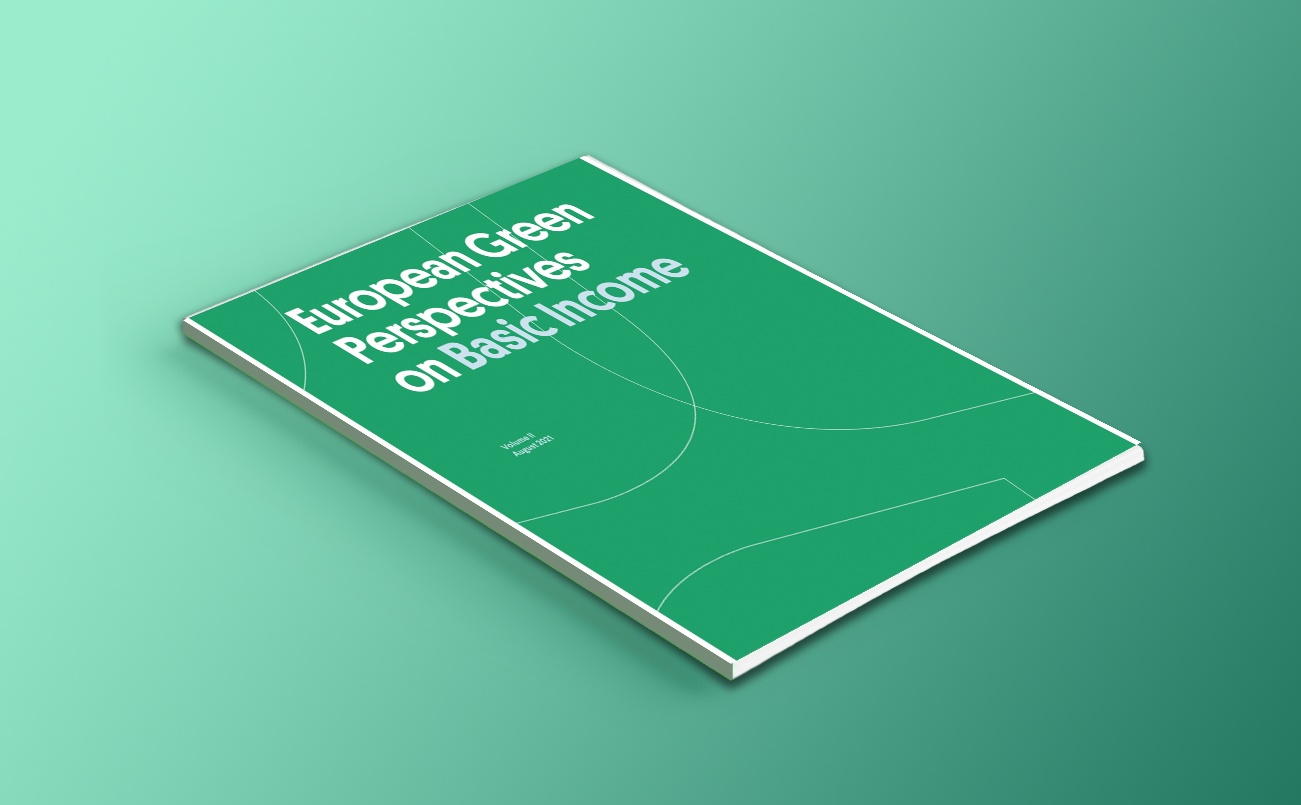
Steps Towards Universal Basic Income? The Effect of the Covid-19 Crisis on Welfare Policies and Support for UBI in the European Union

By Uncategorized

Context

When the Covid-19 pandemic hit Europe, it put an enormous strain on the lives and livelihoods of millions. Amid lockdowns and quarantines, many countries responded by (temporarily) broadening their social security policies and providing additional support to those at risk of falling through the cracks. Yet as we slowly emerge from this crisis, there are already others looming. Society will continue to feel the effects of COVID-19 for a decade or more without an urgent public policy overhaul. We need to re-examine our social security approaches and implement bold measures to make societies more resilient to change and crisis. One such proposal is the Universal Basic Income.

There is no place for narrow views or short-sighted policies aimed at continuing to patch up a wound that is gradually – although more and more rapidly – bleeding us dry. Nor is there any point in trying to face the challenges of the 21st century with policies from the last century that have already proved to be unsuccessful.

Objectives

This report examines the social policy reactions to the Covid-19 crisis in a dozen different European countries. Drawing on survey and qualitative data, we explore how these expanded support measures relate to the vision of Universal Basic Income. To what extent do they represent a step towards UBI, despite government hesitancy? And what do they say about the (in)ability of our existing social security systems to deal with crises? The report also investigates the popularity of UBI among Europe’s citizens. Has the pandemic made an impact on the way people talk and think of UBI?

Experts and stakeholders across Europe contributed data for this publication, and shared their insights and reflections as part of our project “Change of Mindset–Civil Society Dialogue around UBI, Social Justice, and Climate Impact.” As the debate continues, we too would be interested in expanding our analysis to include new information and additional countries.

If you wish to:

  • Submit a survey response;
  • Provide details or resources on countries not featured in this analysis;
  • Send us your feedback;

Please get in touch! GEF’s work on UBI continues–read more here.


This publication has been realised with the support of Visio and Fundació Nous Horitzons and the financial support of the European Parliament to the Green European Foundation. The European Parliament is not responsible for the content of this publication.

European Green Perspectives on Basic Income

By Uncategorized

Context

Since 2017, the Green European Foundation has shaped the discussion of advancing universal basic income in Europe and, if possible, worldwide.

“European Green Perspectives on Basic Income” is the second volume of a collection of articles tackling different facets and perspectives on basic income (BI) 1.

Because of the Covid-19 pandemic, the debate about basic income has gained a lot of traction. In Europe, and around the world, we’ve seen efforts to ease the economic crisis across all levels of government.

A considerable amount of aid programs that were approved included a partial basic income. For the first time, many people realised we can all suddenly find ourselves in an economically challenging situation through no fault of our own.

An unconditional basic income may help us focus our energies on finding a way out of this crisis. The Covid-19 pandemic further highlighted and aggravated social injustice and economic inequalities as much as it raised questions on the social responsibility of individuals and solidarity at all levels of society.

Objectives

Our aim is to support initiatives to foster a debate within and outside Green circles to learn from each other and to allow an exchange of alternative social policies. Following the suggestion of the “European Green network of basic income supporters”, we have updated and expanded the Green European Foundation’s publication, European Green Perspectives on Basic Income, from 2019 to create this present publication. Similar to the first edition, this second volume aims to provide insights into the discussions about BI in various European countries,–both within the Green movement as well as in the broader public–and contextualises those in historic and cultural prerequisites.

“From a degrowth perspective, UBI should be implemented as a tool to reinforce democracy by reconnecting people by creating solidarities and by questioning basic needs and how to fulfil them in a sustainable way.”


Download

Available  in Greek

Available in Albanian

Available in Croatian