
Five Decades of Green Politics and the European Green Project
Jean Lambert is a long-standing member of the Green Party of England and Wales, where she has held a number of posts of responsibility. She served as London’s Green Party MEP for four terms (1999-2019) and was a member of the Employment and Social Affairs Committee and the Civil Liberties Committee. Jean chaired the EP’s Delegation to the Countries of South Asia for ten years and took part in a number of Election Observation missions. Prior to her election to the EP, Jean worked as a secondary school teacher in East London. Jean is now a Trustee of the European Network on Statelessness (ENS) and a Board member of a Brussels-based organisation promoting citizens’ rights. She also recently served on the Committee of the European Green Party. She is an avid reader of crime fiction and loves dancing.
In this interview by Alice Hubbard, Jean Lambert reflects on five decades of Green politics, from its early roots to its influence on the European agenda. She explores the lessons of European cooperation, the challenges of delivering a socially just green transition, and why the movement must keep climate at its core while rediscovering its original imagination and ambition.
Can you please introduce yourself?
My name is Jean Lambert. I’ve been in the Green Party of England and Wales for nearly 50 years and during that time I’ve had various positions within the party nationally, but also served for 20 years as a member of the European Parliament.
I want to start at the very beginning. You joined the Ecology Party [former name for the Green Party of England and Wales] in 1977, at a time when Green politics was still a rather marginal political project. What drew you in, and what was the movement trying to do differently from the other parties around it?
Well it was actually because of the guy I ended up marrying. He’d joined in 1976, and there were the practicalities of, well, how much were we going to see of each other if I wasn’t in the party as well as he was heavily involved in setting up the Ecology Party in London. But one of the things that really attracted me was the whole systems approach – a whole politics approach. Greenpeace or Friends of the Earth were looking at specific issues with a specific policy shift. The Ecology Party asked what you have to change about the system in order to make the policies better in the first place, so that you didn’t then have to campaign on the policies. Jonathan Porritt used to say that it was the difference between saving the sardine this year, the mackerel next year, and the tuna the year after. But if you actually change the system that puts those in danger, it’s much more effective. That’s what the party was trying to do. And it was questioning economic growth: how much could you actually grow, how much could you consume. At the time the concerns were very much about resources – what finite resources did we have? How long were they going to last? – and that if you just kept going with a growth economy and ever growing consumption, you were going to hit those limits to growth. And that’s really where the Green Party came from.
You were also involved in the early construction of the European Federation of Green Parties. What was the thinking back then about a genuinely European Green movement? What did Greens have in common, and what differences did they have?
In those early days other parties were forming in different places, so the question was how could you work together, learn from each other, what were the principles, what were the goals that you had in common; to demonstrate that what was happening here was actually a global movement, not just a domestic movement. Our party took a lot of inspiration in the early days from the Values Party in New Zealand, so we were writing lots of letters. One of our chairs into the early 1980s was Gundala Dorey. I remember her being invited to the Partito Radicale conference in Italy and saying, “Well, it’s very good and really enjoyable, but it’s not Green.” You know, because survival of the planet is what we used to talk about, and it didn’t have that.
In terms of Europe, the UK joined in 1973. In 1975 we had our first referendum to get Labour out of a hole, the second referendum was to get the Tories out of one. There were different views on the European project amongst Green parties. The UK’s early position was actually leaving the European Union (…) I stood in the 1984 European elections; our election leaflet was “Better out than in”. By 1989 we were moving to a “reform from within” position, with a vote on that very narrowly won at party conference. So in a sense we were more with the Swedes, the Austrians, the Danes as they came into play (…) It was in 1985 that we actually hosted the European Greens Congress in Dover. I was very happy to do the cross-party work: what can we learn, how can we change this, how can we work together? It was that cooperation which also helped us with the 1989 European election result [in which we won 15% of the vote share], which was a real milestone for us and where you could actually see Greens shift the agenda in the UK. Part of that was because we could say that we were part of a European movement. We had representation in the European Parliament.
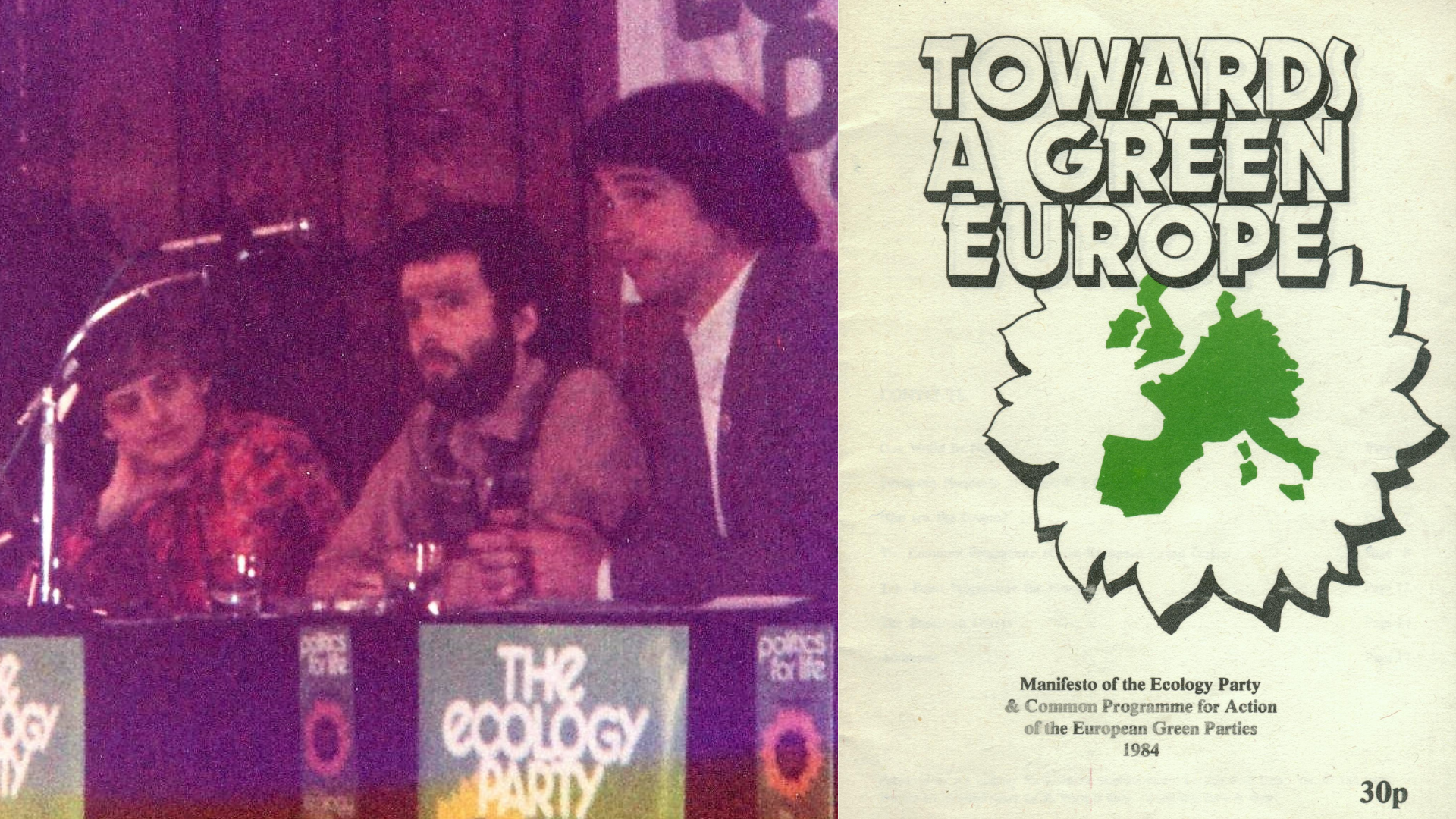
(Left) Petra Kelly alongside Jonathon Porritt [former chair of The Ecology Party from 1979 to 1980, and from 1982 to 1984] and Tony Jones at the 1983 Ecology Party Conference in Dover. (Right)1984 Manifesto of the Ecology Party & Common Programme for Action of the European Green Parties
Let’s talk about 1999. It was a significant turning point, particularly with the introduction of proportional representation for the EU elections, which allowed UK Greens to enter the European Parliament for the first time. You were one of the first two MEPs. What changed for the Green movement when it started to acquire a more institutional presence in European politics, and what did the experience of actually exercising influence within the parliament teach you about both the possibilities and limits of institutional power?
By 1999, you’re beginning to see more co-decision, and a lot more on the environment, with the budget side of it becoming more important. Our priority was getting Caroline [Lucas] onto the trade committee because that was her policy background. You’re also learning about negotiations: what are some of the possibilities here? How do you make this work for your constituents and for the agenda that you have as a Green? What are the areas where you don’t necessarily have specific legislative power, but you have influence, and therefore what can you introduce, what can you move, and where are the real blockages? But also what you’re not supposed to touch. This is a real frustration within the parliament, particularly for the Greens who want to work on all sorts of issues which are relevant at home but where the EU has pretty limited power. Housing would be one. Can you expand that power? What are the levers that you have to influence that? So it was quite an interesting learning curve. You learnt to cooperate with people that you never thought you could cooperate with – on, for example, asylum policy work – and learnt that, while you won’t win everything, there are still things you can win, and that ideas can come from anywhere – a random remark, or a small research finding can be inspirational.
You worked on the Green New Deal and the issue of employment, which became central to European politics in the 2000s. What did the Greens need back then to change how they talked about the economy, work and industrial transformation? And is there anything that Greens are still struggling to answer when it comes to these topics?
Part of it was having good relationships at the European level with the trade union movement. One of things I learned early on on the employment committee was that while in the UK you looked at the two sides of industry, that wasn’t the way it worked in a lot of other countries. You looked at the German model or you discovered that the EPP coordinator on the employment committee was a former trade unionist. From a British perspective that almost seemed impossible, but there it was totally normal. That was lesson one.
The European Trade Union Confederation had a strong perspective on how the world was changing. The leader of it at that time was John Monks, who had been leader of the Trades Union Congress in the UK and was very close to the Blair government. The Blair government understood climate change; in their last UK Presidency it was a thread that ran through the whole thing, from foreign affairs right across. So you had prospective allies but you had to do a lot of groundwork in the parliament. It used to be a favourite thing of mine, when the agencies came to present to us in the employment committee, to ask them what they were doing about green jobs, green transition. What struck me was that if you were trying to link employment and ecology for an audience at home, we had all of these wonderful targets, but how are we going to deliver them if you don’t actually have a workforce that can deliver? Who was actually going to be constructing wind turbines and whatever? So the targets alone are very nice – but how to operationalise that?
It [the green transition] still can sound very threatening because it doesn’t answer the question of what happens to my job. Your jobs in coal mining go, and you don’t necessarily have jobs in that particular place to replace them. So how do you answer that question? It’s a bit like AI now. What does it mean for me? And I think we’re still not good at that; we can still sound far too technical. We’re not leaning into the research work that the European Union is now funding through Horizon about how to make it work at the regional level. Maybe we also haven’t been flexible enough in terms of how to keep the arguments for the green transition going when it comes under pressure from a mad American president or whatever.
Migration and asylum have also been a constant part of your political work. What tensions have you seen between Green principles and the rise of the far right and Trump, and the political pressures that Green parties are facing?
I remember one of my Danish colleagues saying that if you go into coalition you have to do some very nasty things. You’ll get some very good things, but there will be some nasty things and quite often those attach to migration. It’s been very interesting watching the German Greens and what they’ve managed to do on the expansion of citizenship. These are models that I don’t think we’re looking at enough. I don’t think we look enough at where the Greens have actually managed to win things and draw lessons from that. We’re often very good at big messaging; we’re not so good at the details because we don’t like to talk about things like return [of migrants] – we don’t like to talk about difficult topics.
This is where the Dutch Greens have been very good for us. We want to honour our commitments under international law on asylum. We want to have a welcoming atmosphere for migrants. We want people to have a clear path to citizenship. But we also want to make sure that we can actually keep our social security models going. Therefore, how do we find a balance? There’s also confusion about legal frameworks for asylum seekers – people with well-founded fear of persecution – and other forms of migration. You find in some Green parties that there is a very limited view of who migrants are – that it’s quite often about people who are moving because of terrible situations at home – and that’s not the full picture of migration at all. It was very difficult at the European level to find organisations that actually represented people who were migrating voluntarily for work or family purposes or whatever to be part of the discussion about migration policy. Big city lawyers migrate; not every migrant struggles to get here. The reluctance to engage with some of the really difficult stuff means that you don’t necessarily have an argument when the far right comes at you.
Another area of discussion is climate migration – whether you put such people in the same grouping as refugees or whether you have to find other ways to manage it, because it’s not always clear cut. Climate migrants are not necessarily seeking sanctuary from persecution; they’re actually seeking somewhere where they need to build a new life. Ideally we’d quite like to do without borders, but it’s a different world.
How do you think the role of the European Union has changed in Green political thinking? And how has the movement’s understanding of European integration changed with it, particularly with regards to enlargement and the rise of the far right?
When you look at who the potential governments might be across Europe, you think, well, if these are the people in charge, how much power do you want Europe to have versus a national government? It makes it much more difficult to argue for more Europe.
Within our own party the feeling has been that we should rejoin as fast as we can. I’ve come to see Europe as part of a climate adaptation strategy – that if people are going to move to fill shortages in one place, actually removing some of those barriers to trade is not a bad thing. We can pool resources. But this only works if you make people feel it’s working for everybody.
Another point is the arguments the European Union is having over AI and big tech. In some ways this is really useful, because we can make the point that we are actually trying to control these corporations or the Trumps of the world who have been spending a lot of time, money and political weight trying to undermine the European Union. This is why we’re under so much pressure. People who consider themselves progressive really ought to be looking at how we make those arguments for the power of the European Union, at that level and on those things. I also think that Trump has made the European Union itself and people within it look at the potential partners that we have elsewhere in the world who share certain values.
Let’s go back to the England and Wales Greens. It’s gone from a small ecological movement to being elected to European Parliament, and now has a quarter of a million members. What continuities underlie some of those very different moments? And how have Green ideas become a political force, and what does this mean for the party?
A questioning of the economic system is one continuity, but now it’s more than simply
a critique of the capitalist economy. We came up in a time of two blocs – a capitalist economy and a real extractivist economy under the Soviet Union. There were certain similarities in the way those systems treated the world and its resources.
We’re also seeing a shift towards labelling the party as socialist. For old Greens like me I find it something of a problem because of the question of who do you exclude once you put a label that has so much history on it. The political positioning to be avowedly to the left of Labour has been a very deliberate move by some people but it risks making you dependent on Labour’s positioning. It’s their choice; others of us don’t like it, but what are we doing about it?
Our view of the climate and environmental crisis is still there. To see the standing ovation Zack Polanski received at the party conference [in October 2026] when he talked about climate was really quite moving because I had been worrying that we were losing that. We need to keep that anchor because it’s an area where we have had success in shifting the agenda. In the 1989 elections, we got 15% of the vote, and in some places over 20%. That came as a real shock to a lot of people, and partly to ourselves. But we’d run a very strong campaign that had quiet backing from a variety of organisations, as well as a national newspaper urging people to vote Green on their front page. That vote actually shifted politics – the Labour and Conservative party conferences that year were doing much more on the environment than they had ever done, and the government introduced an environment minister and a sustainability strategy for the first time ever. You really saw a shift once they realised that people were willing to vote on these issues. And I think that cannot be underestimated in terms of what that has done for British politics, and elsewhere. We need to keep that going. Fuel companies are investing to undermine progressive change; the international agreement on climate change is under attack. There’s still a need for a really strong Green movement, Green parties and Green thinkers in other parties to keep climate as a really strong focus.
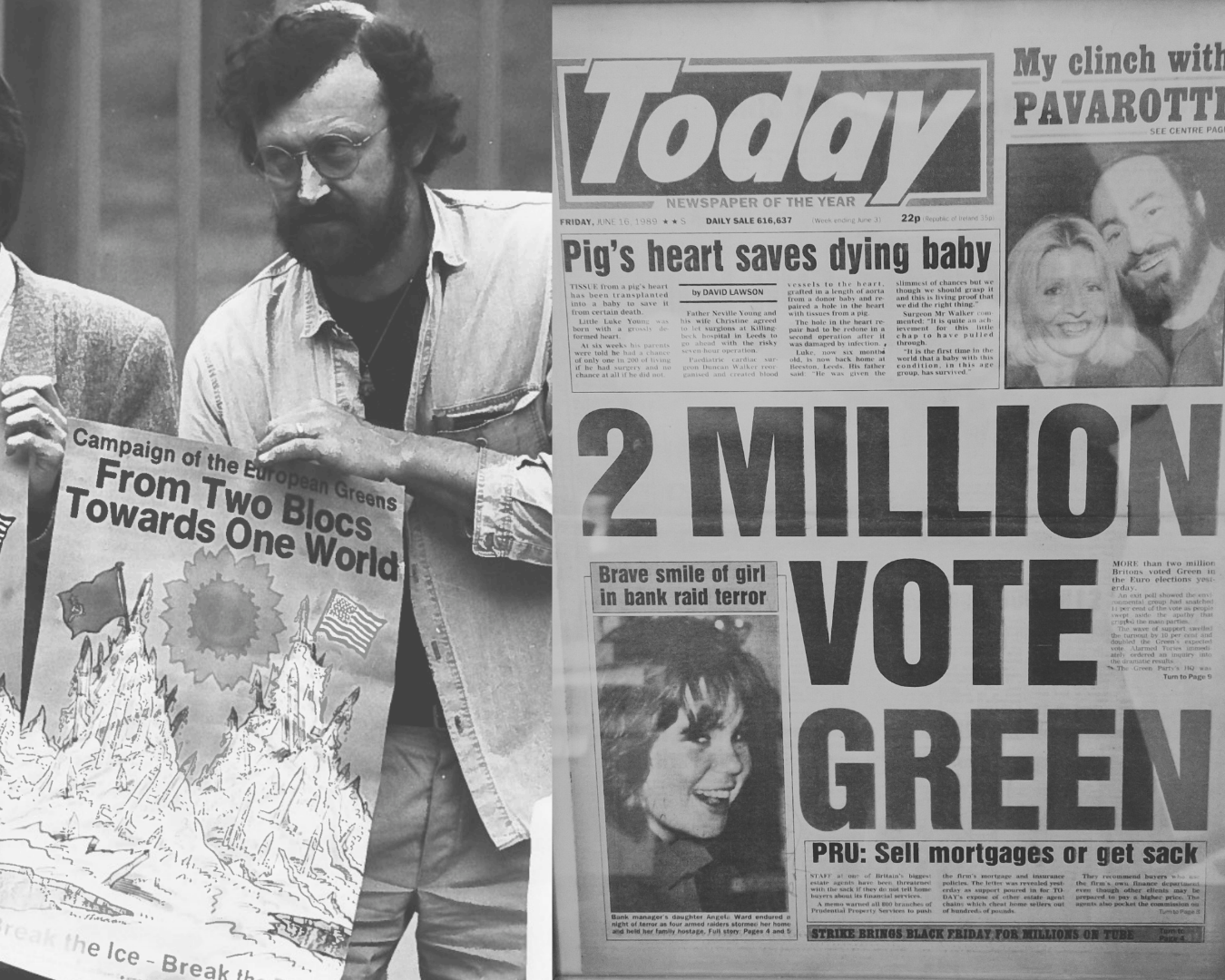
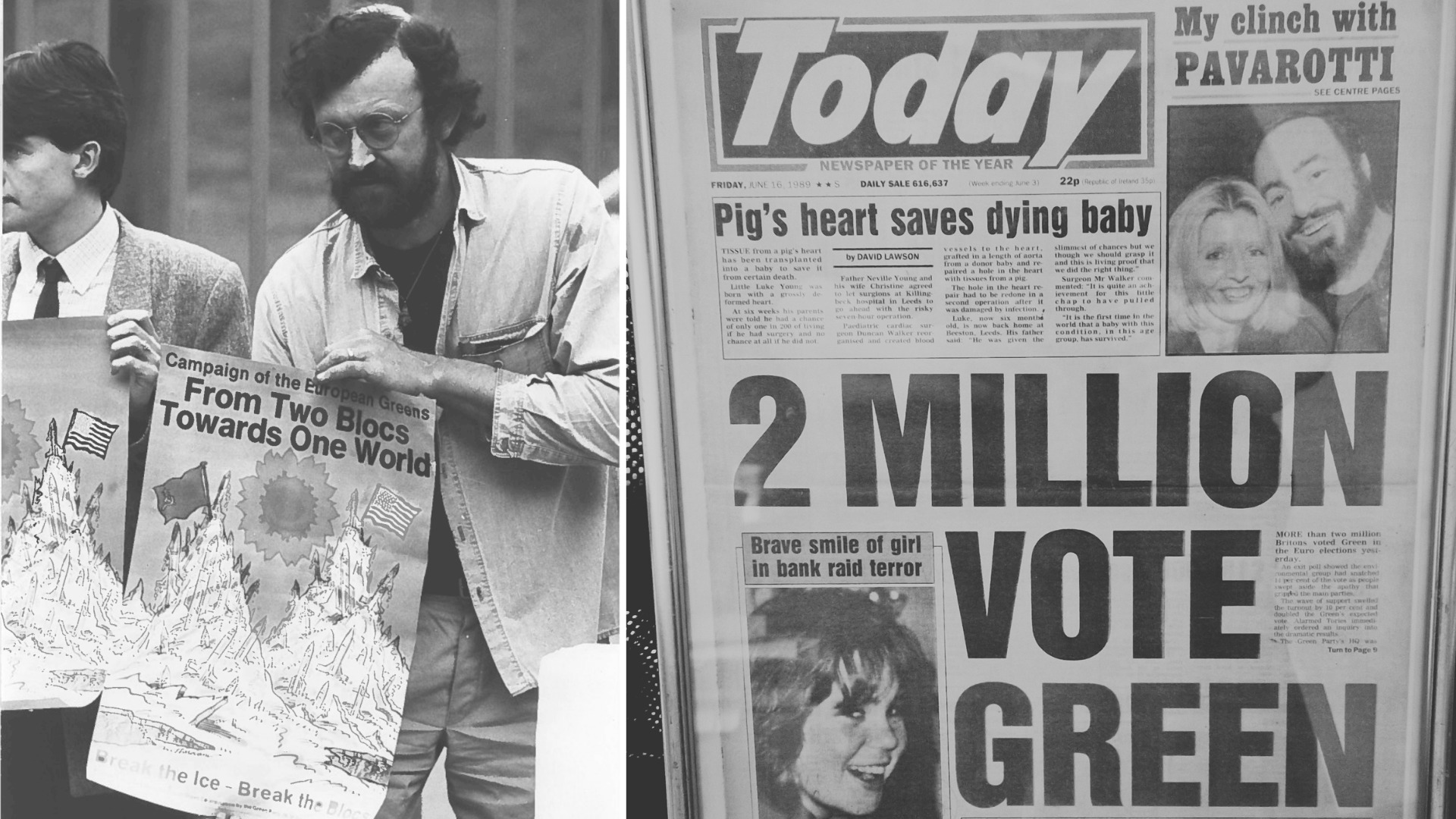
(Left) "From Two Blocs Towards One World" - a historical joint European peace campaign launched in April 1986 and (right) 1989 front page of 'Today' newspaper - '2 MILLION VOTE GREEN' : Coverage of the historic performance by the Green Party in the UK during the 1989 European Parliament elections, where they won roughly 15% of the vote (over 2.3 million votes).
Read Green party correspondence on the historical campaign “From Two Blocs Towards One World” here.
Looking ahead 20 years, what do you want the Green movement to have built in terms of a political project and a force in European society? What would a successful European Green project look like?
It would bring us to a point where it becomes almost impossible to question the importance of the environment, nature, biodiversity – the fundamental structure on which we all depend. That we’re no longer having to pay lip service to the idea that there’s a debate, and that the argument is instead about how best do we do this. I’m still quite impressed by the Bhutanese Gross National Happiness Index, which is a really rigorous analysis. It’s not just fluffiness. We met the people who introduced that and saw how they operate it. People feel very much engaged in it – you can actually see why it matters and where you fit and how you and society as a whole benefit from it.
For the Greens it would be really useful if we rediscovered a bit of the imagination and the joy that we had at the beginning. If you look at our film for the 2004 launch of the European Green Party in Italy, it has Morricone’s music – he allowed us to use it. It’s a beautiful film and it’s about colour in the widest sense: a sense of joy; a gentleness without weakness; an ownership of something different. We’ve got a bit dull visually and verbally; we don’t have that freshness that people thought we had. We have to remember that this is cultural – that’s part of politics as well.