The Greenhouse Training for Activists 2026: Applications Closed

By

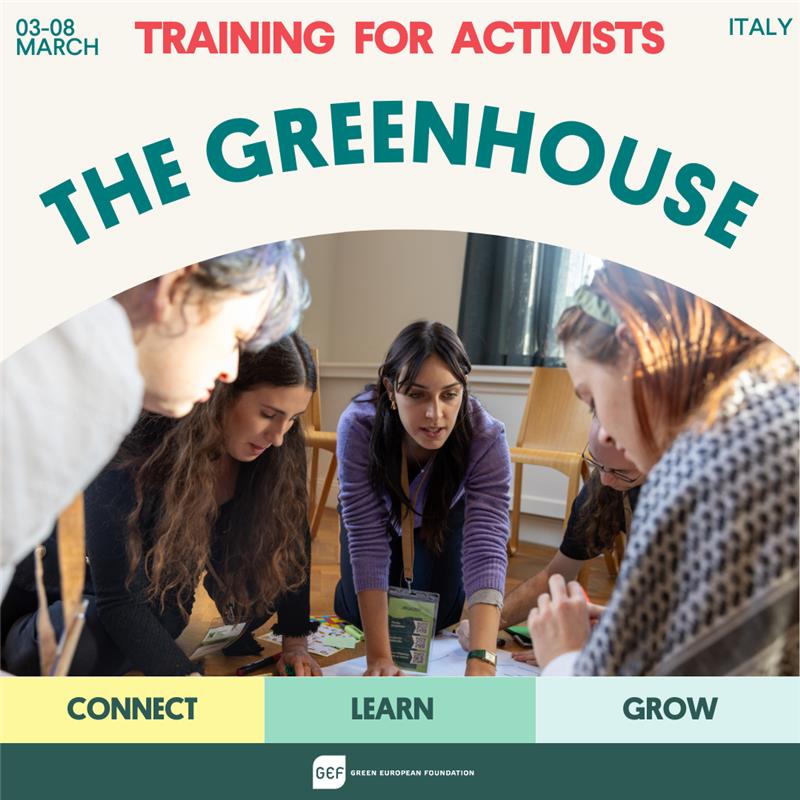
The Greenhouse: Training for Activists is a unique opportunity to connect, learn and grow as part of a new generation of green and green-minded Europeans leading change in their communities. Taking place in Reggello, Tuscany from 03.03.2026-08.03.2026, the training will bring together 30 young Europeans committed to building a more just and sustainable Europe to further build their political skillset through practical training, transnational exchange, and political ecology education. 

Please note that applications for this event are now closed.

About The Greenhouse: Training for Activists 

The Greenhouse Training is a five-day intensive for activists, thinkers, organisers, and anyone committed to shaping a vibrant, sustainable, and democratic Europe. 

Rooted in political ecology education, the training combines participatory methods, expert-led workshops and debates, and community-building activities.  During the training, participants will deepen their understanding of the roots and trajectories of the green movement, explore pressing societal challenges through a European lens, and strengthen their competences in areas like rhetoric and debating. The March 2026 edition of The Greenhouse centres around the timely theme of “Technology and Democracy”.  

At GEF, we believe that the European green movement is strongest when it is diverse, inclusive, and interconnected. This training is designed to foster lasting relationships and build a resilient cohort of green Europeans ready to lead change in their own communities. 


The training includes:  

  • Political Ecology Sessions exploring the roots and trajectories of the European Green movements, connecting past struggles to current political challenges
  • Deep dive into the theme “Technology and Democracy”
  • Practical skill-building in argumentation and political debate
  • A strong focus on collaboration, peer learning, and European perspectives 
  • Guidance and mentorship from expert facilitators and insights from leading voices in the European Green movement 
  • Networking with fellow European activists and local political actors to foster lasting relationships across borders
  • Introduction into the Greenhouse Community – opening further opportunities for training, mentorship, and networking


Programme:
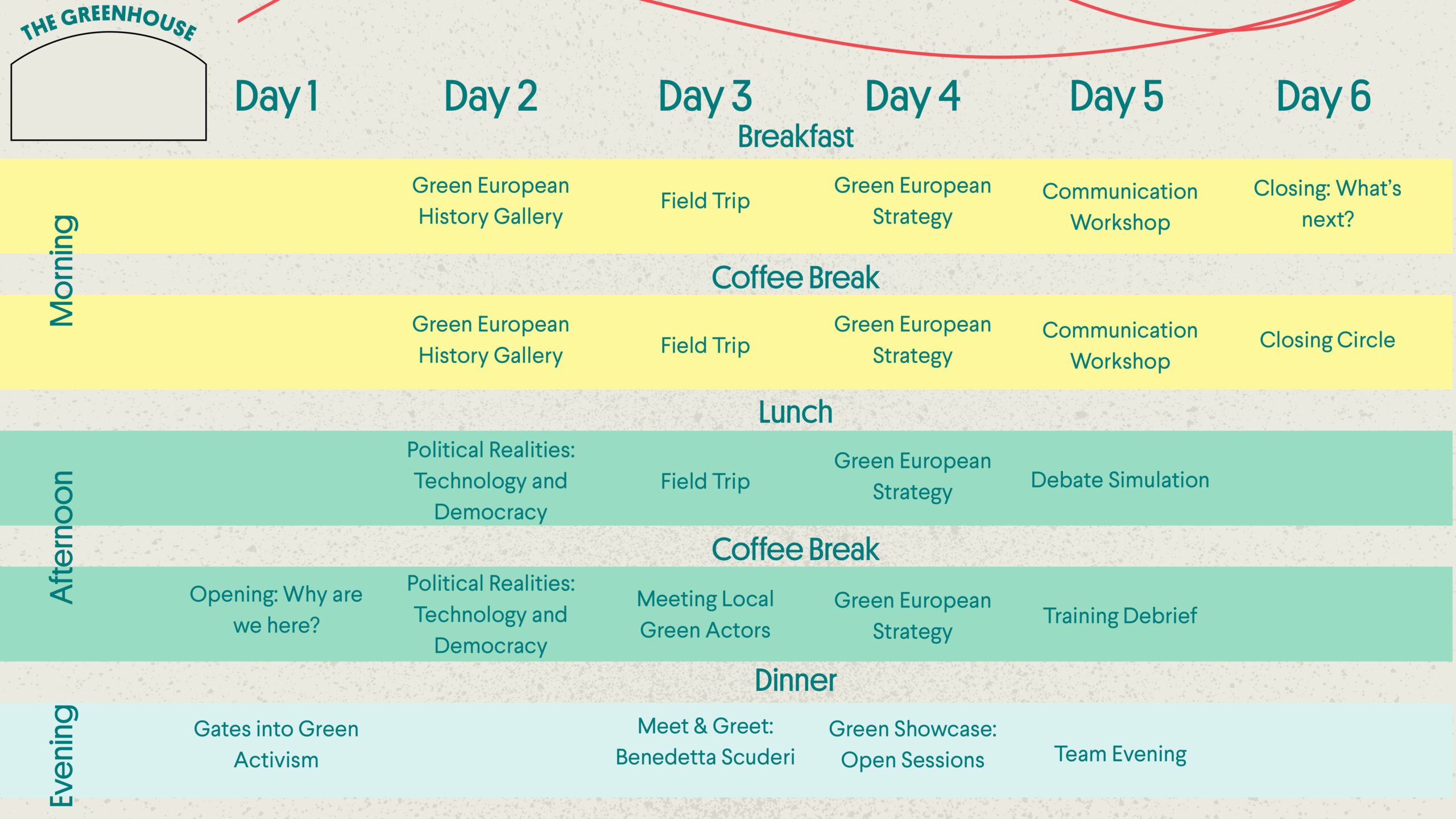

Next to the five-day training 03-08 March, The Greenhouse: Training for Activists includes three online sessions 

  • Greenhouse pre-training session (24.02.2026 – 17:00 – 18:30) 
  • Greenhouse post-training Session #1 (07.04.2026 – 17:00 – 18:30) 
  • Greenhouse post-training Session #2 (05.05.2026 – 17:00 – 18:30) 

These sessions are an integral part of the training. Your availability during these timeslots is conditional for your application to be considered. 


Expert speakers and Trainers  

Edouard Gaudot – Historian and Political Scientist; Expert on Political Ecology, expert speaker

Benedetta Scuderi – MEP (Italy), Greens/EFA, expert speaker

Benedetta de Marte – Secretary General, European Green Party, expert speaker

Eliza Popper – Co-founder, The Good Enough Company, trainer

Sebastian Huehne – Network & Training Assistant, Green European Foundation, trainer

Local Italian Green Movement Actors (names tbc)

Participation fees and financial considerations 

Successful applicants will be asked to contribute a €75–120 participation fee (sliding scale) to confirm their spot. This contribution supports the Green European Foundation’s co-financing efforts, helping to make the training sustainable and accessible for future generations of activists. We will cover all other costs related to the training, including participant accommodation, catering, and a full travel reimbursement for journeys to and from Italy.

Our aim is to ensure that financial barriers do not prevent committed young activists from taking part in this unique learning experience. No profit is incurred. If the participation fee presents a barrier to your participation, please indicate this in your application – we are committed to finding a solution together.


Participant Profile  

The ideal candidate for The Greenhouse: Training for Activists is: 

  • a young (18–30 years old) green or green-minded activist, academic, community organiser, trainer, journalist, civil society/political actor actively engaged in shaping a more just, sustainable, and democratic society 
  • anchored in local green and progressive movements and/or organisations 
  • motivated to deepen their understanding of political ecology, strengthen their advocacy and debate skills, and interested in exploring the political debates at the intersection of Technology and Democracy. 
  • ready to engage at the transnational level and connect with a diverse network of green-minded peers from across Europe 
  • ready to bring their learning back to their local context through concrete actions and initiatives 
  • eager to join a growing European community of young green leaders and remain actively engaged beyond the training


Project Background

The Greenhouse is the Green European Foundation’s activist training initiative dedicated to offering political education on Europe, capacity building for the green movement at large, and fostering engagement and participation of young leaders and activists across the continent – to support a strong and vibrant European democracy.   

Joining The Greenhouse Training opens doors for continued networking, mentoring, and training as part of the Greenhouse Community – such as facilitated sessions with the biggest thinkers and doers in the European green movement and the opportunity to join our summer trainings, where we delve deeper into the core principles and practices of green leadership and political organising. 

Across its different formats, The Greenhouse nurtures the foundations of collective action and cultivates the routes forward for young European citizens to shape systemic change in their local communities.  


Practicalities 

Date and Time: 03 – 08 March 2026

Location: Reggello (Tuscany), Italy – around one hour south of Florence

Language:   Fluency in both written and spoken English is required to participate in the training 

Participants: 25 activists aged 18 – 30 years from across Europe (EU and non-EU countries) 

Application: Applications for this training are now closed.

If you have any questions about the training, contact training@gef.eu


This event is organised by the Green European Foundation with the financial support of the European Parliament to the Green European Foundation.
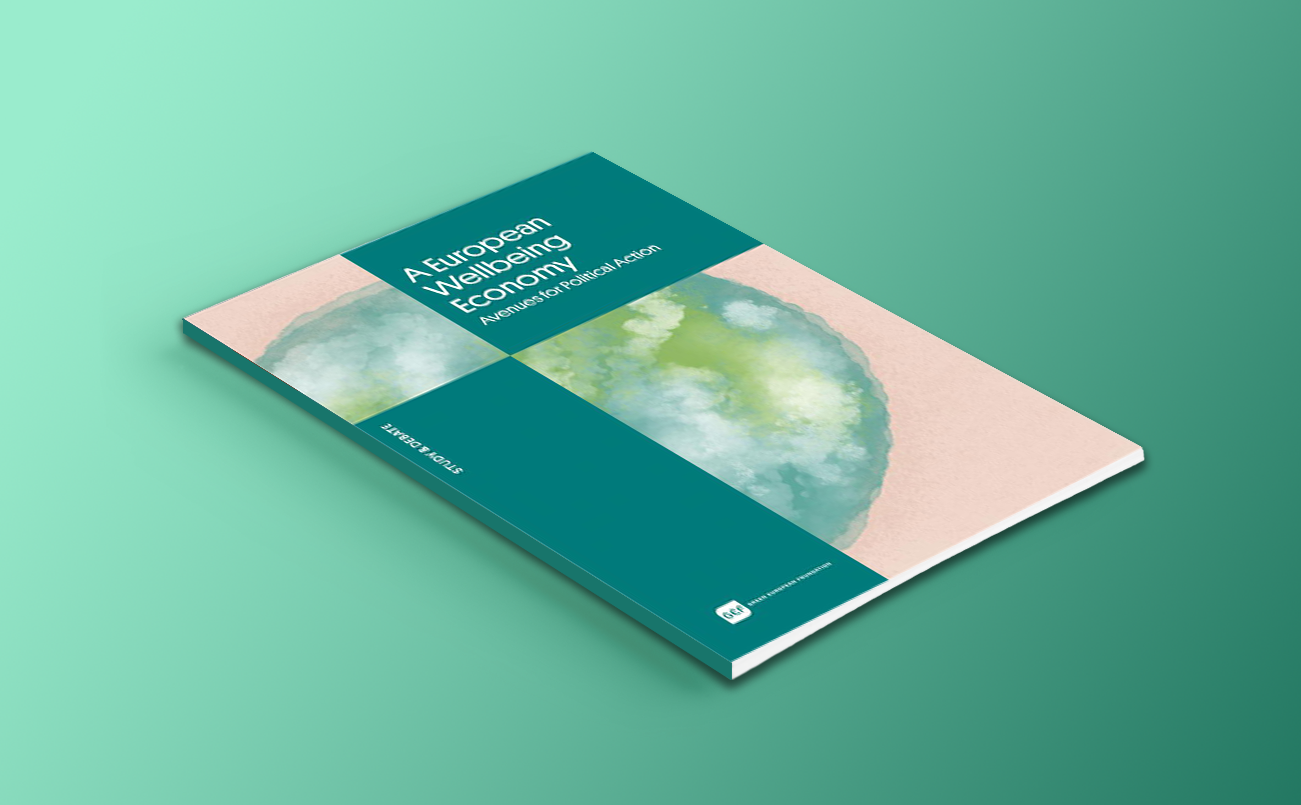
A European Wellbeing Economy: Avenues for political action

By Publications

About

The starting point of this publication is that the EU’s economy is ultimately embedded in cultural and social systems, which in turn are sub-systems of the Earth’s biosphere. As Fullerton notes, “the history of economic theory is [therefore] not over with Keynes and Hayek”. Instead, we need to be more critical, more systemic, and more daring. A wellbeing economy addresses this need – it aims at delivering quality of life for people, while pulling our economy back within planetary boundaries.

Adopting a wellbeing-centred approach would enable the EU to tackle social-ecological risks linked to the triple planetary crises, to increase fairness, and to transform towards a quality-focused economic strategy. It can inform a sustainable and transformative policy and investment agenda, that goes beyond crisis-after-crisis response. Learning from the past five years of the COVID-19 pandemic, energy and cost of living crises, and at the start of the new mandate, EU leaders have the opportunity to carve out an offer that truly delivers for their citizens amidst geopolitical turmoil.

Our publication is a call to action for EU policymakers across the political spectrum to make the crucial years ahead count for the wellbeing of current and future generations on our planet. Ultimately, we aim to clarify that a wellbeing economy is not an abstract utopia; it is a strategic response to the lessons of history and the need for long-term security. In a world increasingly defined by great power competition, Europe’s best bet is not to be trapped between rival blocs but to define a distinct path – one that prioritises security and protection in the broadest sense. After all, what is security if not the health of people, the resilience of our environment, the strength of education systems, and the assurance of a safe and stable future?

The publication is the result of a one-year-long exchange within a Knowledge Community of more than 60 experts that aims to map the main challenges and provide recommendations to inspire the European institutions in the delivery of their ambition to work toward the wellbeing of its peoples. It discusses the state of play and problem identification, and develops EU-level reflections, solutions and recommendations for 6 interrelated thematic clusters for a European wellbeing economy.


Contributors

  • Emma Bergeling is Junior Policy Analyst, Climate and Circular Economy at the Institute for European Environmental Policy (IEEP),
  • Antoine Oger is Executive Director of the Institute for European Environmental Policy (IEEP),
  • Taube Van Melkebeke is Head of Policy at the Green European Foundation (GEF). For further information, contact her at taube.vanmelkebeke@gef.eu.

This report is also available in Portuguese.

Summary for policymakers

A  summary of the publication can be found here: Summary


Published by the Green European Foundation with the collaboration of the Institute for European Environmental Policies, and with the financial support of the European Parliament to the Green European Foundation. The European Parliament is not responsible for the content of this publication. The views expressed in this publication are solely those of the editor and contributors and do not necessarily reflect the views of the European Parliament or the Green European Foundation. 

Yellow Vest and the Green Deal

By Publications

Context

In late 2018, France witnessed a social movement that profoundly impacted public consciousness: the Yellow Vest movement. Week after week, tens of thousands of people gathered at roundabouts and in the streets, sparked by opposition to higher carbon taxes on fuel. This movement has since become a pivotal point in discussions about achieving an ecological transition. But who were the Yellow Vests, and how did they relate to ecological issues?

This report amplifies the voices of those who transformed public spaces into platforms for political expression. Their actions conveyed a strong demand to be seen, heard, and included in decisions shaping their futures. Spanning rural and urban settings, the Yellow Vest movement highlights the urgent need to harmonize ecological objectives with social justice. It calls into question governance structures and pushes for fairer, more inclusive decision-making processes.

The report begins with an essay by Kevin Puisieux, director of the Fondation de l’Écologie Politique, which examines the tensions between social equity and ecological imperatives. Drawing from the Yellow Vest movement, Puisieux explores the contradictions of a just transition while proposing pathways to bridge grassroots demands with institutional policies. This essay is supported by firsthand testimonies, reflective interviews, and in-depth research.

This publication does not offer simple solutions but invites readers to confront the complexities of these intertwined challenges. It encourages us to rethink long-standing assumptions and envision a Europe where social and ecological justice advance hand in hand.

About the authors

Kevin Puisieux – Director of the Fondation de l’Écologie Politique
Pierre Blavier
– Research fellow at the CNRS / Clersé
Etienne Walker – Lecturer in geography at the University of Caen Normandy
Chloé Alexandre – Doctoral Candidate in Political Science, Sciences Po Grenoble, UGA
Alix Levain – Research Fellow in Anthropology, AMURE
Simon Persico – Professor of Political Science, Sciences Po Grenoble Université Grenoble-Alpes – PACTE
Magali Della Sudda – Research Fellow in Political Science – Centre Emile Durkheim

The Future of the City: What do Donuts have to do with it? (Zagreb)

By

Context

Our international speakers will give an introduction to doughnut economics, explain the concept of degrowth doughnut, and show why more and more European cities are adopting it.

This event is part of the Cities As Places of Hope project, organised by the Green European Foundation with the support of Oikos, the Institute for Political Ecology, Transición Verde, Nous Horitzons Fundacio, Sunrise, Green Thought Association and Wetenschappelijk Bureau GroenLinks, and with the financial support of the European Parliament to the Green European Foundation. The project, launched in 2019, has aimed at fostering progressive city networks to achieve a fairer, greener Europe. Its theme in 2022 is “Resilient cities”.


Speakers

Dirk Holemans (Oikos, GEF Co-President) Ajda Pistotnik (Policy Lab, Ljubljana)Mladen Domazet (Institut za političku ekologiju, Zagreb)Clara Dallaire-Fortier (PhD student, Lund University) – via ZoomTomislav Cik (Institut za društvena istraživanja, Zagreb)


Practicalities

Date and Time: 11th November, 18:00PM CET.

Location: MAMA Zagreb, Preradovićeva 18 10000 Zagreb, Croatia

Registration: Not required.

Language: This event will be in English language.


This event is organized by the Green European Foundation with the support of Insitute for Political Ecology and the financial support of the European Parliament to the Green European Foundation.

Green Hub events at COP26

By

Context

The 2021 United Nations Climate Change Conference or COP26 will take place in Glasgow, Scotland, from the 31st October to 12th November 2021.

To provide support for Green actors in Glasgow during this important event, the Green European Foundation, with the support of the European Green Party and the Scottish Greens, will be holding a Green Hub: a meeting point which any member of the Green family can use to rest and recharge, to meet other actors, attend a multitude of green events, prepare for the protest.

Register to join us (in person or online!) and stay up to date on events, programming and the Green buzz at the Glasgow Green Hub and COP26!

Practicalities

Date: 1st November – 12th November

Opening times:

  • 1st Nov to 4th Nov: 9:00 to 18:00
  • 5th Nov to 9th Nov: 9:00 to 21:30
  • 10th Nov to 12th Nov: 9:00 to 18:00

Location: Reinfield Training & Conference Centre, 260 Bath Street, Glasgow , G2 4JP, United Kingdom.

Venue accessible to individuals with disabilities.

If you have any questions, please email our local coordinator at marie.stadtler@scottishgreens.org.uk.

Programme

*The following activities have been confirmed (more information on the programme will be added soon.

▶ Hybrid events

✺ In-Person events

🟢 Youth Hub events

🔐 Closed meeting


Monday 1st November

[wpcs_schedule date=”2021-11-01″ layout=”grid” align=”full” session_link= tracks=”track-4″] [wpcs_schedule date=”2021-11-01″ layout=”grid” align=”full” session_link= tracks=”track-8″]


Tuesday 2nd November:

[wpcs_schedule date=”2021-11-02″ layout=”grid” align=”full” session_link= tracks=”track-8″]


Wednesday 3rd November:

[wpcs_schedule date=”2021-11-03″ layout=”grid” align=”full” session_link= tracks=”track-8,track-10″] [wpcs_schedule date=”2021-11-03″ layout=”grid” align=”full” session_link= tracks=”track-11″]


Thursday 4th November:

[wpcs_schedule date=”2021-11-04″ layout=”grid” align=”full” session_link= tracks=”track-8,track-3″]


Friday 5th November:

[wpcs_schedule date=”2021-11-05″ layout=”grid” align=”full” session_link= tracks=”track-8,track-3″] [wpcs_schedule date=”2021-11-05″ layout=”grid” align=”full” session_link= tracks=”track-4″] [wpcs_schedule date=”2021-11-05″ layout=”grid” align=”full” session_link= tracks=”track-1″]


Saturday 6th November:

[wpcs_schedule date=”2021-11-06″ layout=”grid” align=”full” session_link= tracks=”track-1″] [wpcs_schedule date=”2021-11-06″ layout=”grid” align=”full” session_link= tracks=”track-8,kelvingrove-park”]


Sunday 7th November:

[wpcs_schedule date=”2021-11-07″ layout=”grid” align=”full” session_link= tracks=”track-1,track-6″]


Monday 8th November:

[wpcs_schedule date=”2021-11-08″ layout=”grid” align=”full” session_link= tracks=”track-3,track-6,track-8″] [wpcs_schedule date=”2021-11-08″ layout=”grid” align=”full” session_link= tracks=”track-2″]


Tuesday 9th November:

[wpcs_schedule date=”2021-11-09″ layout=”grid” align=”full” session_link= tracks=”track-8,track-6,track-4,track-3″]


Wednesday 10th November:

[wpcs_schedule date=”2021-11-10″ layout=”grid” align=”full” session_link= tracks=”track-6″] [wpcs_schedule date=”2021-11-10″ layout=”grid” align=”full” session_link= tracks=”track-2″] [wpcs_schedule date=”2021-11-10″ layout=”grid” align=”full” session_link= tracks=”track-3,track-8″]


Thursday 11th November:

[wpcs_schedule date=”2021-11-11″ layout=”grid” align=”full” session_link= tracks=”track-8,track-3″] [wpcs_schedule date=”2021-11-10″ layout=”grid” align=”full” session_link= tracks=”track-6″]


Friday 12th November:

[wpcs_schedule date=”2021-11-12″ layout=”grid” align=”full” session_link= tracks=”track-4″] [wpcs_schedule date=”2021-11-12″ layout=”grid” align=”full” session_link= tracks=”track-3″] [wpcs_schedule date=”2021-11-12″ layout=”grid” align=”full” session_link= tracks=”track-8″]

This event is co-organised by the Green European Foundation and the European Green Party with the financial support of the European Parliament to the Green European Foundation.
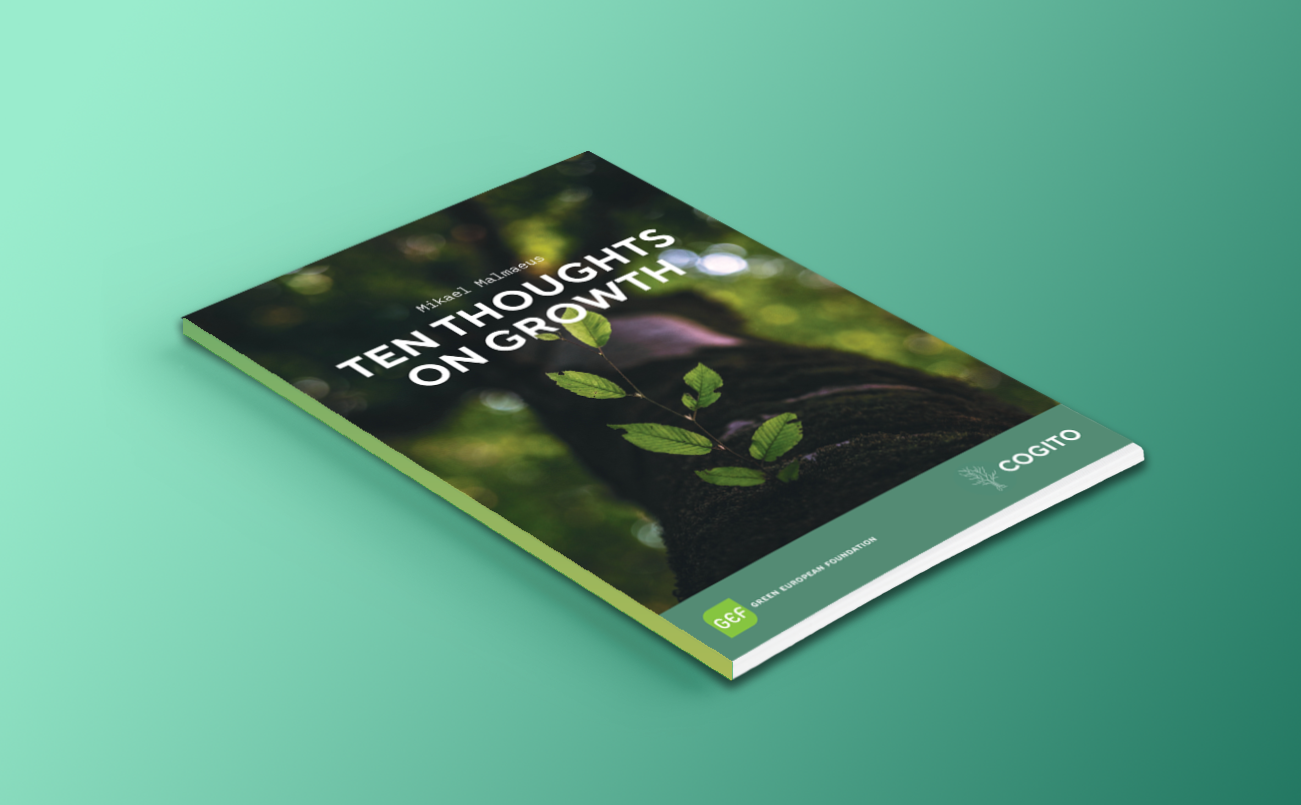
Ten Thoughts on Growth

By Uncategorized

With the ongoing Covid-crisis, it has become clear that “business as usual” is no longer an option, as the effects will be felt for years to come. Yet still, governments remain obsessed with growth based on GDP.

In this report, Mikael Malmaeus (board member in Cogito and researcher at The Swedish Environmental Research Institute) uncovers and clarifies the concepts of growth, their meaning and impact with the purpose to enable a meaningful, forward looking and insightful discussion on preferred futures and where to start to get there. With this collaboration, GEF and Cogito hope to contribute to a clear and comprehensive discussion on growth today and tomorrow, and to inspire actionable insight.

Download

Available in Polish

Available in Czech

Available in Albanian

Available in Turkish

Green Academy: Sustainable Urban Mobility / Public Transport during Covid-19

By

About the event

How is the Covid-19 pandemic changing our perspective of urban mobility? Can we use it as an opportunity to push for greater sustainability? What is the relation between urban cycling, business prosperity, healthy and resilient cities?

In the new webinar from the Czech Green Academy series, we will look at sustainable urban mobility from the perspective of cities and the Covid-19 pandemics.

Speakers

  • Bart Dhondt (presentation in English, scheduled from 18:10 to 18:30) – Brussels Alderman for Mobility and Public Works will talk about the initiatives the City of Brussels is taking to promote sustainable urban mobility.Roman Meliška – founder of the Urban Laab initiative for micromobility, modern urban mobility, and smart cities will look at the link between urban cycling, thriving businesses and rich cities.Renáta Krystyníková – Head of the Transport and Administrative Department of the City of Otrokovice will share her experience with the preparation of the Sustainable Urban Mobility Plan for a medium-sized Czech city.

Practicalities

⚠ Please note that after Bart Dhondt’s intervention, the event will be in Czech language only.

When: Tuesday 9 March from 18:00 to 19:30

Where: Zoom platform – you will receive access details by e-mail after registering here: https://forms.gle/MC3xqXwKeHfg8d6E7

We most cordially invite all those who are actively involved in promoting green policies at the local and regional level, and anyone else interested in sustainable living topics.

For further details visit the website of the Institute of Active Citizenship https://www.aktivniobcanstvi.cz/zelena-akademie

The Czech Green Academy is organized by the Green European Foundation with the support of the Institute of Active Citizenship and the financial support of the European Parliament to the Green European Foundation.

Blockers and Enablers for Decarbonising the Dutch Chemistry, Refinery and Basic Metals Industries

By Uncategorized

This report is part of the Green European Foundation’s Transnational Climate Emergency Economy project. The project explores the challenge of decarbonising ‘harder to abate’ sectors, such as the chemistry, basic metals and refinery industries and international trade. Wetenschappelijk Bureau GroenLinks, Green House Think Tank and Green Foundation Ireland each focus on a specific part of a climate emergency economy. This particular report was written by WBGL and focuses on Dutch energy-intensive industries.

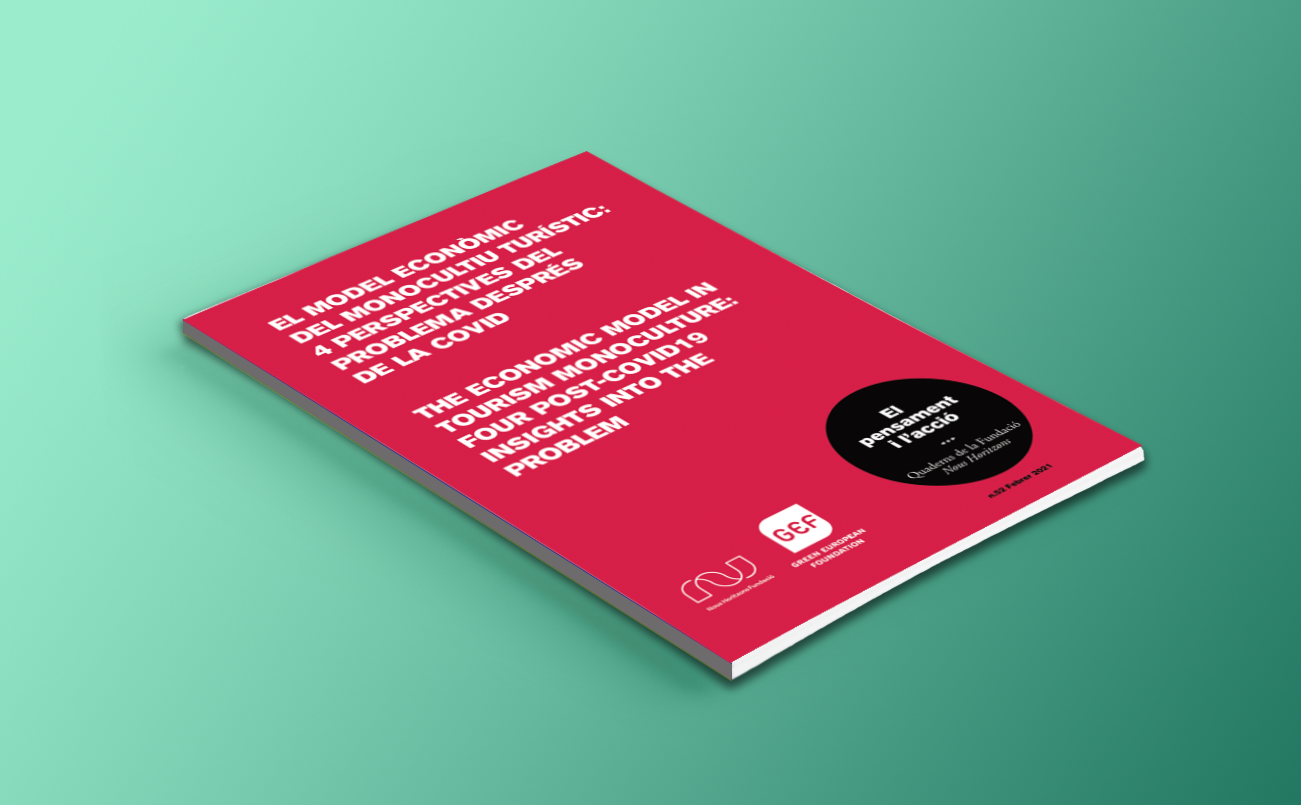
The Economic Model in Tourism Monoculture

By Uncategorized

EL MODEL ECONÒMIC DEL MONOCULTIU TURÍSTIC


As this project developed in 2020, COVID-19 wrestled hold of Europe and devastated tourism industries across the continent. With the streets and beaches empty, people and governments have been forced to look at the economic sustainability and the environmental impact of the sector; our project has been holding up a magnifying glass, allowing them to look more closely.

In this publication (EN/CAT) we analyse the sun and beach tourism model, and draw conclusions that may help  us find alternatives.


This publication is a summary of the workshop “The economic model of monoculture tourism: 4 perspectives of the problem after COVID” that took place on 3 December 2020 in the frame of the GEF (Green European Foundation) project “Fair and Carbon Free Tourism”. Different green foundations collaborate in this transnational project that will work for three years on different aspects of sustainable tourism.

More information: Fair and Carbon Free Tourism

Green Academy: Supporting sustainable agriculture for a healthier landscape

By

About the event

How do we imagine the future of our agriculture? Can local and regional governments ensure that their land is cultivated in harmony with nature and the needs of the people?
Can food self-sufficiency go hand in hand with sustainability, biodiversity protection and a fair system for small farmers?

In this new webinar from the Czech Green Academy series, we will look at environmentally friendly agriculture and local food production:

  • Dirk Holemans  – Oikos Coordinator and GEF Co-President.
  • Martin Smetana – landscape adaptation expert at the Partnership Foundation,  Adapterra Awards 2019 winner, organic farmer from South Moravia.
  • Alena Malíková – PRO-BIO leader and organiser of the Community Supported Agriculture initiative 0

Practicalities

⚠ Please note that after Dirk Holeman’s intervention, the event will be in Czech language only.

The event is taking place on Zoom platform – you will receive access details by e-mail after registering here: https://forms.gle/oYJAKeEmwv5tsRh97

We most cordially invite all those who are actively involved in promoting green policies at the local and regional level, and anyone else interested in sustainable living topics.

For further details visit the website of the Institute of Active Citizenship https://www.aktivniobcanstvi.cz/zelena-akademie

The Czech Green Academy is organised by the Green European Foundation with the support of the Institute of Active Citizenship and the financial support of the European Parliament to the Green European Foundation.
Green Academy: Getting smart about waste / Innovations in waste management

By

About the event

What is the new EU action plan for the circular economy? What opportunities does the new national waste legislation bring to municipalities? How to reduce the total amount of waste and deal sustainably with biodegradable waste in cities?

In the new webinar from the Green Academy series, we will look at the latest trends in waste management:

  • Piotr Barczak (presentation in English) – waste expert of the European Environment Agency (EEB). In his presentation, he will introduce new European legislation and trends in waste management. He will also touch upon the coming new Circular Economy Action Plan by the European Commission.
  • Tomáš Hlavenka – founder of ASHPA, the company which helps municipalities and companies to implement a circular economy system. He studied waste management at Mendel University in Brno. From 2009 to 2015, he worked as the director of a company providing waste collection and management in the Mikulov region, where he introduced an innovative system for the collection of separated waste based on the principles of circular economy.
  • Jan Machančík – waste manager of Jihlava, the city awarded in 2020 the Waste Oscar for exceptional achievement in reducing the production of mixed municipal waste. In his presentation, he will focus on way how the city can support its citizens in minimizing waste generation and motivate them to reduce the amount of mixed municipal waste.

Practicalities

The event is taking place on Zoom platform – you will receive access details by e-mail after registering here: https://forms.gle/9hy8go4sRVHUaW7J7

We most cordially invite all those who are actively involved in promoting green policies at the local and regional level, and anyone else interested in sustainable living topics.

For further details visit the website of the Institute of Active Citizenship https://www.aktivniobcanstvi.cz/zelena-akademie

The Green Academy is organised by the Green European Foundation with the support of the Institute of Active Citizenship and the financial support of the European Parliament to the Green European Foundation.
 

Climate Emergency – Raising Ambition (London)

By

Event Background

With the consequences of climate change beinng increasingly perceptible through extreme weather events (both worldwide and in European countries), verifiable research is urgently needed to set targets and policies that reduce greenhouse gas emissions by the amount necessary to secure a livable environment. At the same time, policies to reduce greenhouse emissions are often attacked for threatening existing jobs. 

GEF’s transnational project “Strengthening Climate Targets, Creating Local Climate Jobs” sets out to explore what greenhouse emissions reductions would mean in practical terms for our job markets and economies, and whether jobs could be created in rural areas across Europe. Can both a safe and just economically sound life for all be achieved? To this end, our project undertook research on the potential to create more climate jobs in three EU countries with diverse historic and economic prerequisites: United Kingdom, Ireland and Hungary. In 2019 the project is expanding also to Poland. 

About the Event: 

This climate energy conference is a one-day event for those looking to act on the climate emergency.  What can local authorities and communities do?  What scale of change do we need to be looking at?  What could the benefits be for jobs and local economies?  How do we keep fossil fuels in the ground? 

Speakers: 

  • Andrew Simms, (Rapid Transition Alliance) – the Climate Emergency
  • Nadine Andrews, (Green House) – Climate psychology & cultural shifts
  • Paul Allen, (Centre for Alternative Technology) – Zero Carbon Britain
  • Jonathan Essex and Peter Sims, (Green House) – Climate Jobs
  • Sam Mason (PCS Union) – Need for a Just Transition
  • Fatima Ibrahim (IPPR Environmental Justice Commission) – Need for a Just Transition
  • Yves Marignac, (Association négaWatt) – Europe-wide transition
  • Simon Pickering (Councillor, Stroud District Council) – Reducing in-house emissions
  • Philip Webber (formerly of Kirklees Council) – Street by street retrofit
  • Ian Christie ​(University of Surrey) – Widening the coalition
  • Agamemnon Otero (Repowering London) – Renewable energy
  • Page Dykstra (Community Supported Agriculture Network UK) – Land/Food Transition
  • Robert Read (The A Team Foundation) – Land/Food Transition
  • John Webb (Herts WithOut Waste) – Materials/Waste Transition
  • Neil Pitcairn (United Kingdom Without Incineration Network) – Materials/Waste Transition
  • Stephen Joseph (Transport Policy Consultant) – Transport Transition

Programme 

10:00-10:30 – Registration & refreshment

10:30 – Welcome and introductions – Natalie Bennett Green European Foundation, Anne Chapman Green House
– The Climate Emergency – Andrew Simms
– Climate Psychology and cultural change – Nadine Andrews
– Questions and discussion
– Introduction to parallel sessions and workshops

11:45 – Tea/ coffee break

12:00 – Parallel sessions – Making a plan
– Green New Deal and Just Transition – Fatima Ibrahim and Sam Mason
– Climate Jobs – Jonathan Essex and Peter Sims
– Zero Carbon plans – Paul Allen (Centre for Alternative Technology) and Yves Marignac (negaWatt)

13:00 – Lunch and information/discussion tables on:
– Reuse and recycling – Herts WithOut Waste & UKWIN
– Sustainable and Active Transport – Stephen Joseph,
– Renewable energy – Repowering London
– Food and farming – Community Supported Agriculture Network & Team A Foundation
– Street by street retrofit – Philip Webber (formerly Kirklees council)
– Local councils – Simon Pickering, Stroud District Council

14:30 – Workshops – Making it happen
– Making an Action Plan – Simon Pickering, with Jonathan Essex and Peter Simms
– Identifying key enablers and blockers of a step change in emissions.
– Widening the Coalition – Ian Christie, Surrey Climate Commission
– Establishing partnerships, setting up a local climate commission and citizens assemblies.

15:30 – tea/coffee break

15:45 – Making change happen – Feed back from workshops and panel discussion chaired by Natalie Bennett

17:00 – Conference Ends

Practicalities: 

Conference fee: £10

Please register for this event via the form found here.


Green Economy Congress – Municipalism: Economic Patterns for the Green Europe (Belgrade)

By

Event Background

The world is undergoing radical transformations which is changing the fundamental values on which the industrial era was founded. Multiple crises caused by growing inequality and environmental destruction need an urgent and sustainable answer.

The economic parameters that measure growth and success are changing and the biggest assets today are knowledge and experience. With the expertise of academics working on a green economy, we are producing new forces to create a more just and sustainable world.

The Green Economy Congress is an annual interactive conference, which gathers participants from the local region and across Europe. Since its inception, it has intended to break the business-as-usual path, not only in the economy but in the wider society. It aims to build synergies amonth actors developing positive initiatives and to work on narratives that have a greater impact on public debates.

The previous two editions of the Congress were held in the Serbian Chamber of Commerce, with over 300 participants and speakers attending.

About the Event

The Green Economy Congress is a Green summit, organised by the Green European Foundation in cooperation with Networked and Group for Analysis and Policy-Making from Serbia.

2019 marks the third edition of the Congress, which will focus on the theme of “Municipalism: Economic Patterns for the Green Europe”.

This year’s Congress will address Green topics and ways to make the Green agenda and sustainable development an integral part of our future philosophy and actions. This comes with a goal of inspiring leadership among global citizens to enact change and innovative solutions to tackle key economic, social and environmental challenges. There will be particular emphasis on Green cities as leaders of Green change and local policies that stimulate holistic approaches.

The Congress is open to professionals, academics, NGOs and private sector representatives, as well as other interested individuals.

Programme

Day I – Serbian Chamber of Commerce (Terazije 23/ II floor)

11.00 – 12.00 Opening: Municipalism: Economic Patterns for the Green
Europe
– Žaklina Živković, GAJP/ Networked
– Liljana Popovska, North Macedonia Member of Parliament/ DOM Macedonia

12.00 – 12.10 Coffee break

12.10 – 13.15 Panel: Circular Economy Regional Perspectives: Challenges
and Opportunities supported by Balkan Green Energy News
– Ana Petrovska, North Macedonia Ministry of Environmental Protection and
Physical Planning, State Secretary
– Representative of Republic of Serbia Ministry of Environmental Protection (TBC)
– Representative of business sector from Serbia (TBC)

13.15 – 13.25 Coffee break

13.25 – 14.25 Panel: Green Finance Lab: Blockchain + Crowdfunding
– Vladica Jovanović, BRODOTO
– Ivan Bjelajac, MVP Workshop

14.25 – 15.25 Lunch

15.25 – 16.15 Lecture: Mapping ecosystems and their services: a challenge
in a fast changing world

Day II – Cultural Center GRAD (Brace Krsmanovic 4)

14.00 – 15.00 Workshop: Go Circular: Circular economy for municipal well –
being
– Milan Veselinov, CirEkon – Expert for Circular Economy

15.00 – 15.10 Coffee Break

15.10 – 16.10 Panel: Business Going Green: The Emergence of the
Cooperative Society supported by EcoTech HUB Serbia
– Tanja Basta, EcoTech HUB
– Nemanja Inno Energy HUB and Climate – KIC Serbia
– Nenad Božić, SmartCat
– Dušan Vukanović, ICT Hub

16.10 – 16.20 Coffee Break

16.20 – 18.20 Workshops
“Sustainable Fashion Roundtable – new policy & business model” Dunja
Jovanović and Marija Radaković
“Zero waste in Action: Reduce your environmental footprint” MIlja Vuković

18.20 – 20.00 Networking Party & Dinner

Day III
10:00 – 12:00 Visit to Nikola Tesla Museum

Practicalities

Participants can apply to take part via the Green Economy Congress website, where more information on packages and prices can be found.

You can join the Facebook event page for the Congress here.


Real Democracy in Your Town: Public-Civic Partnerships in Action

By Uncategorized

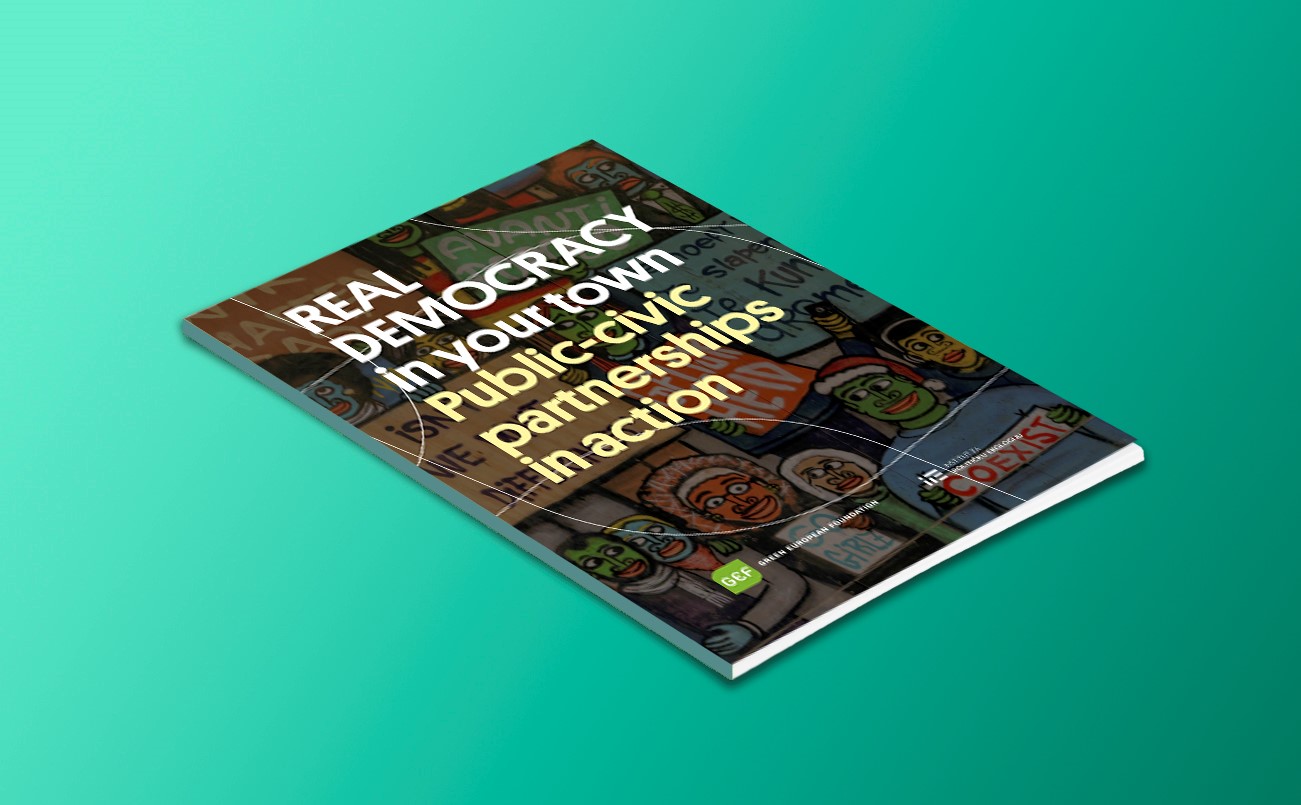
Real Democracy in Your Town: Public-Civic Partnerships in Action explores the potential of public-civil partnerships (as opposed to the conventional public-private partnerships), as an opportunity to provide basic public services within societies without the privitisation of public goods and making them subjects of the free market.

It particularly focuses on the power of municipalist and local citizens’ movements and highlights successful case studies in Europe from which to draw inspiration from.

Download your copy here. 

This publication is also available in Serbian, Hungarian & Spanish.


Revision of the Economies in the Balkans (Skopje)

By

CONTEXT 

This research report was produced as part of a project of the Green European Foundation in 2017 with the joint effort of the research teams in three Balkan countries:
BlueLink Foundation – Bulgaria 
The Association for Sustainable Social and Economic Development SUNRISE – Macedonia
Networked – Serbia.  

The research report highlights which political conditions are necessary to move towards a green economy in the three countries, and compares their prospects in terms of social factors and legal and policy frameworks.

This event is invitation only. The full research publication is available for free at GEF website. 

PROGRAMME 

21st September 2018 

16:00 – 16:30   Registration and welcome coffee 

16:30 – 16:50   Opening and Introduction of the research and cooperation with GEF  

Aleksandar Gjorgjievski – Transnational coordinator ASSED Sunrise – Skopje 

16:50 – 17:30   Hristina Odzaklievska – National researcher in Macedonia 

 Presentation of research and methodology 

17:30 – 18:00   Coffee break 

18:00 – 18:30   Ervin Regjepagic – Energy sector in Macedonia  

18:30 – 19:00   Jasmina Pakaski – Sustainable development

19:00 – 19:30   Bojan Petrovski – Green economy and Green policy 

19:30 – 20:00   Aleksandar Gjorgjievski – President of ASSED Sunrise – Macedonia  

Presentation of the GEF project Green Economy: Cooperative Society and Announcement of the International conference on 6th October 2018 

20:00 – 21:00   Dinner and closing of the promotion event 

Green Economy Congress 2018 (Belgrade)

By

Context

The world we live in is going through a radical transformation which is changing the fundamental values our societies but also economies are based on. Multiple crises due to the growing inequality and environmental destruction are calling for an urgent sustainable answer. As the economic parameters that are measuring growth and economic success are changing, we must use our knowledge and expertise to innovate the way we think about economy and cannot continue with “business as usual”.

About the event

The Green Economy Congress, taking place for the second time this year, is a series of interactive, multidimensional events designed to create and further build up on the notion of necessity for transition to sustainable and fair economy. Green economy is one of the most exciting concepts that is holistic in its form – it generates development while respecting the regional and global ecosystem, results in improved human well-being and social equity, while significantly reducing environmental risks and ecological scarcities.

For three days all participants will have the opportunity to listen to some of the most impressive economists, innovators, entrepreneurs and decision makers, to share their stories and discover ways to promote an alternative vision for growth and development across the world.

The long-term goal of the Congress is not only to raise awareness on green topics, but to also create a sustainable networking platform to enable green initiatives across Europe. This will be in particular the focus of the first day of the Congress, which will be organised by GEF.

Programme

Thursday November 1st

12:00 – 12:15: Official Opening 

  • Representative of Green European Foundation
  • Žaklina Živković, GAJP

12:15 – 13:15: Opening Panel – Public Policies and Circular Economy

  • Slobodan Perović, Republic of Serbia Ministry of Environment Advisor
  • Antoine Avignon, EU delegation in Serbia (tbc)
  • Olivera Kuzman, Zurovac OEBS expert on circular economy (tbc)
  • Siniša Mitrović, Serbian Chamber of Commerce (tbc)

13:15 – 13:25: Pause

13:25 – 14:00: Lecture – Innovation in Circular Economy: Closing the Loop in Agri-Business 

  • Grigoris Chazikostas, Biosense Institute

14:00 – 15:00: Lunch

15:00 – 16:00: Panel – Green Cities and Urban Development

  • Representative of EU Green Capital of Europe Nijmegen (tbc)
  • Representative of Cooperation and Development Eastern Europe (CDN)
  • Sinisa Trkulja, UN Urban Agenda Habitat III
  • Representative of City Council of Belgrade (tbc)

16:00 – 16:15: Coffee Break

16:15 – 17:15: Panel – New Plastic Economy: EU Circular Economy Package

  • Representative of Reloop Europe
  • Representative of Greentech Serbia
  • Representative of SEPEN
  • Expert in EU Circular Economy Package (tbc)

17:15 – 18:00: Coffee and Networking


Friday November 2nd

12:00 – 12:15: Opening 

  • Dubravka Negre, European Investment Bank

12:15 – 13:00: Toward the Green Finance

  • Representative of  Trag Foundation (tbc)
  • Representative of  Ethical Financing Cooperative of Croatia
  • Representative of  BRODOTO
  • Representative of  ERSTE bank

13:00 – 13:15: Coffee Break

13:10 – 14:10: Panel – Women in the Green Economy

  • Branislava Jovicic Bačkan, Green Energy News
  • Ankica Barbulov, GIZ (tbc)

14:00 – 15:00: Lunch 

15:00 – 16:00: Environmental Reporting: Media as a Catalyst for Change

  • Representative of Euractiv (tbc)
  • Slavica Gligorijevic, RTS (tbc)
  • Adam Santovac, N1 (tbc)
  • Represenative of CINS/BIRN (tbc)

16:00 – 16:15: Coffee Break

16:15 – 17:00: Democratisation of the Energy Sector: Prosumers and Cooperatives as Alternatives

  • Maja Turković, ASOR
  • Representative of CAN Europe (tbc)

Saturday November 3rd

12:00 – 15:00: Green Economy Fair + Workshops  

Workshops including:

  • Developing Circular Economy in Agriculture
  • Decentralised Energy Alternatives
  • Eco Design

Additionally, the Congress will entail a variety of social activities such as museum visits, get-togethers and more.

Who should apply?

This conference is suitable for both students who are just developing their interests for green economy models, and green economy professionals and activists. In case you would like to speak at our event, we have created Participants’ Panel. 


To find out more about the event, the registration process, as well as participation fees, please visit the Congress website. For programme updates, follow us on Facebook and Twitter, and subscribe to the Facebook profile of the Congress.


UBI - Basic Income

Technological Unemployment and Basic Income (Budapest)

By

Context

Technological change causes short-term job losses, that can ultimately lead to lasting increases in unemployment. Especially among young people in Europe, unemployment is already extremely high and unequal distribution of common resources, shrinking of social security and lack of access to low-skilled jobs deepens the insecurity about the future of work. To counter the erosion of the 20th century welfare state and the increasing youth precariousness, new ideas  have to be put forward on how society’s wealth can be distributed in a just way.

About the event

In the framework of this year’s Basic Income for all EU Citizens? transnational project, we will host this particular workshop to have a closer look at the prospects of a Universal Basic Income to combat youth precariousness and will especially address the following questions:

  • What is technological unemployment, what are its possible consequences and how does it relate to young people?
  • What are policy answers to technological unemployment and what kind of role could Basic Income play?
  • What are the digital tools we can use and what is the strategy to advocate for Basic Income in a digital world?

The workshop will be hosted at the Federation of Young Europeans’ week-long training “Common Digital (R)evolution”.

Programme

During this workshop, young Green activists from all across Europe will learn more about technological unemployment and its relation to basic income from Lilja Tamminen, Director Of Operations & Product Management at a computer software company, former Deputy Member of the Helsinki City Hall and expert on technological (un)employment.

Furthermore, the participants of the workshop will receive practical tools during a hands-on training session to argue for basic income as a means to move towards a more just society.


For more info on the event and how to participate, contact office@fyeg.org

Climate change

Facing up to Climate Reality (Norwich)

By

Context

With the consequences of climate change being more and more perceptible, also in European countries, through extreme weather events, verifiable research is urgently needed to set targets and policies that reduce greenhouse gas emissions by the amount required to secure a livable environment.

What would those reductions mean in practical terms, for instance for our economies? Can we create jobs in rural areas across Europe and not only secure a safe but also a just, economically sound life for all?

GEF’s transnational project “Strengthening Climate Targets, Creating Local Climate Jobs” explores those questions and aims to explore the potential to create more climate jobs in three EU countries with diverse history and economic prerequisites: United Kingdom, Ireland and Hungary.

About the event

Our upcoming one-day conference, organised with the support of Green House Think Tank, will consider these questions, as well as what we can learn from past extreme weather events in Europe for how we might cope in the future. It will be one stepping stone towards our upcoming research publication on the potential of local jobs creation in the three mentioned countries and will serve as an opportunity to discuss first findings for the United Kingdom more in-depth.

Programme

9:30 -10:00 REGISTRATION

10:00 -10:10 WELCOME AND INTRODUCTIONS – Rupert Read

10:10 – 11:30 FACING UP TO CLIMATE REALITY – chaired by Catherine Rowett, with Brian Heatley and Asher Minns

11:30 -11:45 BREAK

11:45 – 13:00 CLIMATE JOBS – chaired by Anne Chapman, with Jonathan Essex and Peter Sims

13:45 – 14:45 FUTURE OF AGRICULTURE AND RURAL ECONOMIES – chaired by Rupert Read, with Simon Fairlie and Helen Baczkovska

14:45 – 15:00 BREAK

15:00 – 15:30 DEALING WITH EXTREME WEATHER – chaired by Rupert Read, with Anne Chapman

15:30 – 16:00 FINAL DISCUSSION

Speaker Biographies

Rupert Read is chair of Green House think tank and Reader in Philosophy at the University of East Anglia.
Catherine Rowett is professor of philosophy at the University of East Anglia.  She was the Green Party parliamentary candidate for South Norfolk in the 2015 and 2017 General Elections.
Brian Heatley is a founder member of Green House think tank.  He is a former senior civil servant and former policy co-ordinator for the Green Party.
Asher Minns is executive director of the Tyndall Centre at the University of East Anglia.  He is a science communicator who specialises in knowledge transfer of climate change research to audiences that are outside of academia.
Jonathan Essex is a member of Green House and an associate of Bioregional where he advises on new project development and policy.  He previously worked for bioregional on sustainable construction and material reuse.  He is a Green Party district and county councillor for Redhill, Surrey.  He has led the work done by Green House on ‘Climate Jobs’.
Peter Sims is an Electronic Engineer who specialises in systems engineering and in particular the overlap and interfaces between human and non-human systems.  He has carried out the modelling to estimate the number of jobs that could be created by the transition to a low carbon economy in Green House’s work on ‘Climate Jobs’.
Simon Fairlie is one of the editors of The Land, an occasional magazine about land rights, and author of Meat, a Benign Extravagance (Permanent Publications, 2010).  He runs Chapter 7, which provides planning advice to smallholders and other low income people in the countryside. He has also had much practical experience of small scale farming in the UK and France.
Helen Baczkovska is an ecologist and writer based in rural Norfolk.  She works as a conservation officer at Norfolk Wildlife Trust.
Anne Chapman is a member of Green House think tank.  In 2017 she organised a conference in Lancaster (where she lives) on dealing with extreme weather.


Stay tuned for updates on the programme here and via our Twitter and Facebook channels.

The conference is free of charge but secure your place now by registering via this link. For further information, get in touch with info@greenhousethinktank.org.

Jobs in a Changing Climate (Dublin)

By

Context

With a changing climate, many traditional jobs will be lost all over Europe, as a just transition to less carbon emission intensive industries is inevitable. It will be vital for all stakeholders, such as policy makers, trade union representatives, civil society organisations, think tanks and businesses to establish a dialogue and to come up with new solutions to those challenges – and the Green movement can spearhead this process.

About the event

As part of the transnational project “Strengthening Climate Targets, Creating Local Climate Jobs”,  this conference will contribute to the discussion within the Irish society and among the key stakeholders on how to ensure a just transition to Zero Carbon and create local climate jobs across the country.

The event will also feature results of the ongoing research of the Green European Foundation and its partners to draft and launch strategies for local investment to create more climate jobs in Ireland.

One of the practical examples that will be discussed is the proposed closure of three peat burning power stations in the Midlands and the effect on the livelihoods of 400 workers. Studies have been carried out on how the transition to a low carbon society in the UK will create sustainable jobs in Sheffield and Isle of Wight. Also we will look at the Lucas Plan, where workers devised viable alternatives to redundancies, using their skills to develop socially useful products and services. The implementation of the Circular Economy will also affect jobs, positively and negatively, and mitigate greenhouse gas emissions.

Speakers

Duncan Stewart, Environmentalist, Broadcaster, and Chair, Green Foundation Ireland

Tommy Simpson, Project Coordinator Green Foundation Ireland and former President Dublin Council of Trade Unions

Jonathan Essex, Project Coordinator, Greenhouse Think Tank United Kingdom

Peter Simms, Researcher,Greenhouse Think Tank United Kingdom

Adrian Kane, Public Administration and Community Division Organiser, SIPTU

Sinead Mercier, Researcher, Just Transition

Yvonne O’Callaghan, Strategic Organiser, SIPTU Trade Union Ireland

Joseph Curtin, Senior Fellow, Institute of International and European Affairs

The input by the speakers will be each followed by Q&A sessions to allow for full participation in the event of those attending.


The event is free of charge but registration is required. To secure your spot follow this link.

Registration for the event on the day starts at 9:30.

For more  information on  the conference, please contact info@greenfoundationireland.ie

Economic Transformation

Greening the Economy in Balkans: Cooperative Society (Belgrade)

By

Context

At the beginning of 2018, a publication The Revision of the Economy in the Balkans: Change Policy, Not Climate, as well as a green economy manual, was published as a part of the transnational project carried out by Green European Foundation supported by Blue Link Bulgaria, Sunrise Macedonia and Networked Serbia.

The research done in the previous years has shown immense potential and pointed out the fact that these national economies are currently going in a different direction: subsidising multinational companies and mega infrastructure projects, privatizing natural resources. A process of political centralization, by taking competences from the local level and exclusion of the citizens from the economic and social decisions is evident. In this political environment, the only possible solution is a creation of bottom-up, self-organized, citizens’ initiatives with a purpose of association of labor and services. The countries of the region have their own historical legacy of a cooperative economy in socialism, which is now in a process of renewal.

About the event

The research has shown the immense potential of the process of greening the economy in Balkans, which is currently challenged. The conference will aim to present the relevant results of the study and to be a platform for discussion on how to start a green business in Serbia and on the cooperative model as one of the viable solutions.

The conference will be an occasion to present the main results of the research published in The Revision of the Economy in the Balkans: Change Policy, Not Climate. The event will host two panel discussions with prominent organisations and individuals working on the green economy in Serbia.

Programme

11:45 – 12:00 Opening a conference
12:00 – 13:30 Panel: How to start a green business in Balkans?

Hristina Odžaklieska, Sunrise Macedonia
Miloš Stančić, Networked/GAJP
Jelena Plavanski, PKS- Belgrade Chamber of Commerce
Ivana Marković, Trag Fondation
Moderator: Violeta Jovanov Peštanac, Networked

13:45 – 15:15 Panel: Green Cooperatives and Cooperative Economy: Innovative Forms of Economics

Represetative of Baštalište
Representative of Association for Sustainable Development (ASOR)
Stjepan Car, Green Energy Cooperative (ZEZ) Hrvatska
Kristina Cvejanov, Serbian Packaging waste Recyclers Association
Moderator: Iva Marković, Polekol

15:15 – 15:30 Closing word: Žaklina Živković, Networked

 Stay tuned for updates

Subscribe to our Facebook event, where you will receive reminders and the latest news on content. Follow us on Facebook or Twitter to learn about our other activities.