Making our economies fit for the people and the planet (Brussels)

By

About the event:

Geopolitical tensions and inequality between and within countries highlight the urgent need for a socially just transition that leaves no one behind. While the EU has taken significant steps through the EU Green Deal, contradictions persist. Wellbeing is mentioned in EU documents, but a comprehensive plan for making human and planetary wellbeing a priority in decision-making is still missing.

As we strive for an economy that aligns with human needs and planetary boundaries, new economic approaches are emerging across academia, civil society, and institutions. The publication we are launching aims to address this challenge by developing ideas and political proposals to turn the EU’s ambition to “work towards an integrated framework for wellbeing” into action.

Our political brief is the result of a one-year-long exchange within a  Knowledge Community of more than 60 experts, mapping key challenges and offering recommendations to guide European institutions in making wellbeing a reality. Join us for the launch event to explore the findings and exchange ideas on pathways forward. View the agenda here.

Practicalities

Date and Time: 4 March 10:00-12:30 – the debate will be followed by a networking lunch
Location: Topos Parlement, Brussels, and online
Language: English
Registration: please register now to join the event


This publication launch is organised by the Green European Foundation in collaboration with the Institute for European Environmental Policy (IEEP) and with the financial support of the European Parliament to the Green European Foundation.

Enough: Thriving Societies Beyond Growth (Helsinki)

By

About the event:

Who is afraid of degrowth? The term alone throws mainstream opinion makers and many economists in Europe into a panic. Growth is the lubricant of capitalism. We are told that if the economy is growing, all is well. But what do we mean by growth? Should everything keep growing endlessly? The ecological crisis shows that infinite growth on a finite planet is impossible. Meanwhile, the current economic system fails to secure livelihoods and exacerbates inequalities. There is an alternative to this self-destructive system: an economy of enough, which would provide for everyone’s basic needs while addressing greed and overconsumption. The EU has the potential to lead the ecological transition – but we need to envision a different European economy, rooted in a new paradigm, before we can build it.

In Enough, the authors build on the work of visionaries, both past and present, recognising that Earth is on loan to us from future generations. They explore how societies can thrive without depending on economic growth. The essay presents a compelling vision: fewer private jets, less inequality, fewer burnouts, and reduced waste, alongside more quality of life, more time for each other, more sustainable products, and a healthier planet. In other words, it provides the keys to imagining a different Europe – one that ensures a good life for everyone within the planet’s limits.

At this book launch event, we will dive deeper into what this means in practice. How are principles of sufficiency and an “economy of enough” already reflected in local initiatives and policy proposals today? What are the levers of change, within and outside of political institutions? And how do we make sure that this vision of thriving beyond growth resonates and really does not leave anyone behind, especially at a time when socio-economic fears are framed directly in opposition to climate policy and a green transition?

Project background:

In early 2024, GEF released Enough: Thriving Societies Beyond Growth. This publication sought to spotlight many of the ideas that the foundation has been exploring on post-growth and a just green and social deal, presenting them in an accessible and inspiring booklet. Now, we are taking it on a tour to spark conversations across the continent on how Europe can reconcile social and ecological justice in a wellbeing project for all with sufficiency.

Programme and speakers

Author Dirk Holemans will be joined in the panel by:

  • Tuuli Hirvilammi  – Senior Research Fellow in social policy, Faculty of Social Sciences, Tampere University
  • Paavo Järvensivu – Associate Professor of Environmental and Social Policy (Docent), University of Helsinki

Moderated by Leena Brandt – Journalist

Practicalities

Date and Time: Monday 20 January 17:15-19:00 EET (18:15-20:00 Brussels time
– 17h15: arrival and refreshment
– 17h30: book presentaiton by Dirk
– 18h00: panel discussion around the book’s topics
– 18h45: Q&A
Location: Kaisa-talo, Kaisaniemenkatu 5, Helsinki, and online to this link
Language: English
Registration: Please register in advance via this link. This is a hybrid event, so you can also join us online. However, you must register in advance to receive the meeting link, or access the venue.


This book launch is organised by the Green European Foundation with the support of Visio and with the financial support of the European Parliament to the Green European Foundation.

Enough: Thriving Societies Beyond Growth (Stockholm)

By

About the event:

Who is afraid of degrowth? The term alone throws mainstream opinion makers and many economists in Europe into a panic. Growth is the lubricant of capitalism. We are told that if the economy is growing, all is well. But what do we mean by growth? Should everything keep growing endlessly? The ecological crisis shows that infinite growth on a finite planet is impossible. Meanwhile, the current economic system fails to secure livelihoods and exacerbates inequalities. There is an alternative to this self-destructive system: an economy of enough, which would provide for everyone’s basic needs while addressing greed and overconsumption. The EU has the potential to lead the ecological transition – but we need to envision a different European economy, rooted in a new paradigm, before we can build it.

In Enough, the authors build on the work of visionaries, both past and present, recognising that Earth is on loan to us from future generations. They explore how societies can thrive without depending on economic growth. The essay presents a compelling vision: fewer private jets, less inequality, fewer burnouts, and reduced waste, alongside more quality of life, more time for each other, more sustainable products, and a healthier planet. In other words, it provides the keys to imagining a different Europe – one that ensures a good life for everyone within the planet’s limits.

At this book launch event, we will dive deeper into what this means in practice. How are principles of sufficiency and an “economy of enough” already reflected in local initiatives and policy proposals today? What are the levers of change, within and outside of political institutions? And how do we make sure that this vision of thriving beyond growth resonates and really does not leave anyone behind, especially at a time when socio-economic fears are framed directly in opposition to climate policy and a green transition?

Project background:

In early 2024, GEF released Enough: Thriving Societies Beyond Growth. This publication sought to spotlight many of the ideas that the foundation has been exploring on post-growth and a just green and social deal, presenting them in an accessible and inspiring booklet. Now, we are taking it on a tour to spark conversations across the continent on how Europe can reconcile social and ecological justice in a wellbeing project for all with sufficiency.

Programme and speakers

Author Dirk Holemans will be joined in the panel by:

  • Rebecka Le Moine – member of the Swedish Parliament for the Green Party.
  • Åsa Callmer – PhD, sufficiency expert

Moderated by Isadora Wronski  – Project Leader Wellbeing Economy, Greenpeace International

Practicalities

Date and Time: Monday 20 January 18:30-20:30 CET
Free vegan soup, bread and coffee from 17:30 CET
Venue open for mingle from 16:30 and closes 21:30.
Location: Allaktivitetshuset, Sturegatan 10, next to Sundbyberg station, Stockholm, and online to this link
Language: English
Registration: Please register in advance via this link. This is a hybrid event, so you can also join us online. However, you must register in advance to receive the meeting link, or access the venue.


This book launch is organised by the Green European Foundation with the support of Cogito and with the financial support of the European Parliament to the Green European Foundation.

Enough: Thriving Societies Beyond Growth (Edinburgh / online)

By

About the event:

Who is afraid of degrowth? The term alone throws mainstream opinion makers and many economists in Europe into a panic. Growth is the lubricant of capitalism. We are told that if the economy is growing, all is well. But what do we mean by growth? Should everything keep growing endlessly? The ecological crisis shows that infinite growth on a finite planet is impossible. Meanwhile, the current economic system fails to secure livelihoods and exacerbates inequalities. There is an alternative to this self-destructive system: an economy of enough, which would provide for everyone’s basic needs while addressing greed and overconsumption. Countries in the Global North have the potential and indeed the responsibility to lead this ecological transition – but we need to envision a different economy, rooted in a new paradigm, before we can build it.

In Enough, the authors build on the work of visionaries, both past and present, recognising that Earth is on loan to us from future generations. They explore how societies can thrive without depending on economic growth. The essay presents a compelling vision: fewer private jets, less inequality, fewer burnouts, and reduced waste, alongside more quality of life, more time for each other, more sustainable products, and a healthier planet. In other words, it provides the keys to imagining a different Europe – one that ensures a good life for everyone within the planet’s limits.

At this book launch event, we will dive deeper into what this means in practice. What is the most helpful way of conceptualising a move beyond growth? How do ongoing initiatives, like the Wellbeing Economy, work towards meeting these objectives? What more can we do, both within and outside of political institutions? What role is there for transnational exchange and experimentation, in Scotland as well as the EU? And what do our current legislative configurations enable and prevent us from doing?

Project background:

In early 2024, GEF released Enough: Thriving Societies Beyond Growth. This publication sought to spotlight many of the ideas that the foundation has been exploring on post-growth and a just green and social deal, presenting them in an accessible and inspiring booklet. Now, we are taking it on a tour to spark conversations across the continent on how Europe can reconcile social and ecological justice in a wellbeing project for all.

Speakers

  • Dirk Holemans – Honorary President of the Green European Foundation and author of “Enough: Thriving Societies Beyond Growth”
  • Shona McIntosh – Scottish Greens Councillor for Musselburgh, East Lothian Council
  • More to be announced!

Moderated by Gabriel Sanson Gomez – Degrowth researcher at Generation Climate Europe, Scottish Young Greens

Practicalities

Date and Time: Tuesday, 10 December 2024 (18:15 – 20:00 GMT)
Location: St Ninians Room, Greyfriars Charteris Centre, 138-140 Pleasance, Edinburgh
Language: English
Registration: Please register via this link. This is a hybrid event, so you can also join us online via Zoom. However, you must register in advance to receive the meeting link.


This book launch is organised by the Green European Foundation with the support of Scottish Young Greens and with the financial support of the European Parliament to the Green European Foundation.

Enough: Thriving Societies Beyond Growth (Dublin)

By

About the event:

Who is afraid of degrowth? The term alone throws mainstream opinion makers and many economists in Europe into a panic. Growth is the lubricant of capitalism. We are told that if the economy is growing, all is well. But what do we mean by growth? Should everything keep growing endlessly? The ecological crisis shows that infinite growth on a finite planet is impossible. Meanwhile, the current economic system fails to secure livelihoods and exacerbates inequalities. There is an alternative to this self-destructive system: an economy of enough, which would provide for everyone’s basic needs while addressing greed and overconsumption. The EU has the potential to lead the ecological transition – but we need to envision a different European economy, rooted in a new paradigm, before we can build it.

In Enough, the authors build on the work of visionaries, both past and present, recognising that Earth is on loan to us from future generations. They explore how societies can thrive without depending on economic growth. The essay presents a compelling vision: fewer private jets, less inequality, fewer burnouts, and reduced waste, alongside more quality of life, more time for each other, more sustainable products, and a healthier planet. In other words, it provides the keys to imagining a different Europe – one that ensures a good life for everyone within the planet’s limits.

At this book launch event, we will dive deeper into what this means in practice. How are principles of sufficiency and an “economy of enough” already reflected in local initiatives and policy proposals today? What are the levers of change, within and outside of political institutions? And how do we make sure that this vision of thriving beyond growth resonates and really does not leave anyone behind, especially at a time when socio-economic fears are framed directly in opposition to climate policy and a green transition?

Project background:

In early 2024, GEF released Enough: Thriving Societies Beyond Growth. This publication sought to spotlight many of the ideas that the foundation has been exploring on post-growth and a just green and social deal, presenting them in an accessible and inspiring booklet. Now, we are taking it on a tour to spark conversations across the continent on how Europe can reconcile social and ecological justice in a wellbeing project for all.

Programme and speakers

Author Dirk Holemans will be joined by a selection of experts, from politicians to academics to civil society and local changemakers:

  • Anne B. Ryan – coordinator of Basic Income Ireland and author of “Enough is Plenty: Public and Private Values for the 21st Century”
  • David Donoghue – Distinguished Fellow of ODI, former Permanent Representative of Ireland to the UN in New York, co-facilitator of the intergovernmental negotiations on the 2030 Agenda for Sustainable Development
  • Janet Horner – Green Party representative for the North-Inner City on Dublin City Council

Moderated by John Gormley (Green Foundation Ireland).

Snacks and networking drinks will be provided.

Practicalities

Date and Time: Sunday, 8 December 2024 (18:00 – 20:00)
Location: Teachers Club, 36 Parnell Square W, Rotunda, Dublin, Ireland
Language: English
Registration: Please register in advance via this link.


This book launch is organised by the Green European Foundation with the support of Green Foundation Ireland and with the financial support of the European Parliament to the Green European Foundation.

Enough: Thriving Societies Beyond Growth (Belfast)

By

About the event:

Who is afraid of degrowth? The term alone throws mainstream opinion makers and many economists in Europe into a panic. Growth is the lubricant of capitalism. We are told that if the economy is growing, all is well. But what do we mean by growth? Should everything keep growing endlessly? The ecological crisis shows that infinite growth on a finite planet is impossible. Meanwhile, the current economic system fails to secure livelihoods and exacerbates inequalities. There is an alternative to this self-destructive system: an economy of enough, which would provide for everyone’s basic needs while addressing greed and overconsumption. Europe has the potential to lead the ecological transition – but we need to envision a different economy, rooted in a new paradigm, before we can build it.

In Enough, the authors build on the work of visionaries, both past and present, recognising that Earth is on loan to us from future generations. They explore how societies can thrive without depending on economic growth. The essay presents a compelling vision: fewer private jets, less inequality, fewer burnouts, and reduced waste, alongside more quality of life, more time for each other, more sustainable products, and a healthier planet. In other words, it provides the keys to imagining a different Europe – one that ensures a good life for everyone within the planet’s limits.

At this roundtable, we will discuss some of the key themes and proposals put forward by the book and the post-growth community more broadly. As Europe is once again eyeing austerity and conservative and even far-right forces have captured key levels of government and institutions, what pathways remain for this crucial transition? How can we mobilize societies for such deep and rapid change? What are the key levers and obstacles to translating the environmental science around the limits to growth into concrete action?

Project background:

In early 2024, GEF released Enough: Thriving Societies Beyond Growth. This publication sought to spotlight many of the ideas that the foundation has been exploring on post-growth and a just green and social deal, presenting them in an accessible and inspiring booklet. Now, we are taking it on a tour to spark conversations across the continent on how Europe can reconcile social and ecological justice in a wellbeing project for all.

Programme and speakers

This interactive roundtable will provide plenty of space for audience input, questions, and reactions. They will be accompanied by invited experts:

  • Dirk Holemans – Honorary President of the Green European Foundation and author of “Enough: Thriving Societies Beyond Growth”
  • Dr. Amanda Slevin – Director of the Centre for Sustainability, Equality and Climate Action at Queens University Belfast
  • Prof. John Barry – Professor of Green Political Economy at Queens University Belfast and co-chair of the Belfast Climate Commission

Practicalities

Date and Time: Monday, December 9th (19:00 – 21:00 GMT)
Location: Peter Frogatt Centre, Room 02/018, Queen’s University Belfast, 7-9 College Park East, Belfast
Language: English
Registration: Please register in advance via this link.


This roundtable is organised by the Green European Foundation with the support of Green Foundation Ireland and QUB’s Centre for Sustainability, Equality and Climate Action and with the financial support of the European Parliament to the Green European Foundation.

Crisis Cascades: Green Responses to Europe’s Polycrisis (Vilnius)

By

About the event:

The term polycrisis has become a central feature of the European public debate. From pandemic and supply chain disruptions to war, cost-of-living, and climate breakdown, today’s compounding crises feed insecurity, instability, and distrust, with significant repercussions for EU integration and democracy. This is felt particularly acutely on Europe’s Eastern flank.

By discussing and connecting (in)security in all its facets – including social, ecological, and geopolitical – this event aims to confront the crisis cascades with equally multiplying solutions. What are the (green) tools and visions that can bolster security and resilience? What does crisis preparedness look like in practice, at local, national, and European level? And what lessons do the Baltic states hold for the rest of Europe in this regard?

We are gathering civil society, academics, activists and others from Lithuania and beyond to exchange on these questions and ideas in a series of lectures, panel debates, and discussion moments. Join us in Vilnius or online to contribute to this effort!

Project background:

Since 2022, GEF has used its unique connector position within and beyond the green movement to feed and define conversations on peace and security in Europe, and to bring diverse and multifaceted angles to the (geopolitical) discussion table. This conference continues those efforts, seeking to develop future-proof politics and policies for a more just, sustainable, and resilient Europe.

Programme and speakers:

Monday, November 11th

10:00 – 10:30    Welcome and opening remarks

with Laurent Standaert (GEF) and Eglė Radišauskienė (Institute of Democracy)

10:30 – 10:45     (Social) Security and Crisis Response: The EU’s Role and Responsibilities

with Julie Pascoet (European Network Against Racism)

10:45 – 11:15       Keynote lecture with Q&A: Putting the “Social” Back in Security

with Prof. Boguslavas Gruževskis (Vilnius University)

11:15 – 12:30     Panel debate: Social Safety in Times of Crisis – Lessons and Impact of the Pandemic and War in Ukraine

with Prof. Boguslavas Gruževskis (Vilnius University), Aistė Adomavičienė (National Network of Poverty Reduction Organizations), Jekaterina Rojaka (DSVL), moderated by Linas Kukuraitis (DSVL) 

12:30 – 14:00     Lunch and networking

14:00 – 14:30    Keynote lecture with Q&A: Balancing Security and Freedom – The Role of Democracy in Crisis Response

with Vytautas Valentinavičius (Kaunas University of Technology)

14:30 – 16:00    Regional panorama: Geopolitical Greens? Providing Credible yet Critical Responses in Times of Security Crisis

with Elina Pinto (Progresīvie), Klaudia Jachira (Zieloni), Lukas Savickas (DSVL), Michelle Haas (UGent), Indre Vareikyte (communications and gender equality expert, previously at EESC), moderated by Laurent Standaert (GEF)

16:00 – 20:00   Break

20:00 – 21:00   Building Resilience: Tomas Tomilinas and Elina Pinto on Green Lessons from the Baltics

Tuesday, November 12th

10:00 – 10:30    Keynote lecture with Q&A: Geopolitics of a Post-Growth Europe

with Richard Wouters (Wetenschappelijk Bureau GroenLinks)

10:30 – 12:00    Panel debate: Security and the Climate Crisis – Common Agendas or Clashing Priorities?

with Karolina Eklow (climate and security expert), Yuliia Melnyk (Ekoltava), Dominika Lasota (climate justice activist), Richard Wouters (Wetenschappelijk Bureau GroenLinks), moderated by Tomas Tomilinas (DSVL),

12:00 – 13:30     Break

13:30 – 16:30    Optional cultural programme: Gediminas castle visit

Practicalities:

Date: 11-12 November, 2024

Location: National Library of Lithuania – Gedimino pr. 51, Vilnius, Lithuania. Please arrive on time!

Language: The main language of the conference will be English, but some sessions or interventions may be in Lithuanian as well. In that case, simultaneous translation will be provided.   

Participation: This is a hybrid event, so participation is possible both in person and online. Please register in advance via this link. If you have any questions, please email sien.hasker@gef.eu.

_______________________________________

This conference is organised by the Green European Foundation, with the support of the Institute of Democracy and the financial support of the European Parliament to the Green European Foundation.

Next Generation – Summer Academy (Siófok)

By

About the event:

Young people today are faced with a plethora of (bad) news and complex challenges, and it can be difficult to see the forest for the trees. How do local water struggles connect to the EU’s green agenda? What can health system failures tell us about rethinking care ahead of the next pandemic? And what is the role of education in building a society that is ready for a green and just transition?

With interactive sessions and expert inputs, this summer academy tries to combat skepticism and misinformation with vibrant discussions and ideas for change. Join us to think and work with others who are equally committed to a green future, and learn more about potential levers of change – in Hungary and across Europe.


Project background:

GEF’s Next Generation summer academy builds on several years of training young green activists in Hungary and beyond, offering tools, knowledge, and skills to counter disengagement and Euroscepticism in times of crisis.


Speakers:

  • Gergely Karácsony – Mayor of Budapest
  • Miklós Sebők – Research Professor at Centre for Social Sciences
  • Lili Aschenbrenner – Fridays for Future
  • István Bart – Energiaklub
  • Mia Machac-Tóth – United Forum of Students
  • Rebeka Szabó – Párbeszéd (Dialogue)
  • Eliza Popper – Green European Foundation
  • László Szilágyi – Progressive Hungary Foundation

And many more!


Programme:

Please note that the exact programme and timings remain subject to change. Registered participants will be informed accordingly.

Saturday, 14 September

13:00 – 13:30    Welcome speeches and icebreaker

13:30 – 14:15     Book talk: “The Beginning of the World”

14:15 – 15:00     Green Europe 2030: what comes next?

15:00 – 15:45    Future of the Green Deal following the European elections

15:45 – 17:00    BREAK

17:00 – 18:00    Fight against climate change: is adaptation really our last chance?

18:00 – 19:00    Next Generation of Green Europe: a conversation with the Mayor of Budapest

19:00                   Dinner, campfire, and party

Sunday, 15 September

09:20 – 10:00  Book talk: “Handbook for Revolutionaries”

10:00 – 10:45   U.S. presidential election and the future of global climate policies

10:45 – 11:00    BREAK

11:00 – 11:45     From silence to action: where is the future of education?

11:00 – 12:00    Sustainable healthcare on the brink of climate change

12:45 – 13:30    LUNCH and closing


Practicalities:

Date and Time: Saturday, 14 September (13:00) – Sunday, 15 September (14:00)

Location: Siófok Youth Hotel, Balaton, Hungary

Language: Hungarian

Registration: Please register in advance via this link. Meals and accommodation are provided free of charge, you just need to cover your own travel. Spots are limited, so do register as quickly as possible!


This summer academy is organised by the Green European Foundation with the support of the Progressive Hungary Foundation (MMAA) and the financial support of the European parliament to the Green European Foundation.

Ecopolis: Hope Needs Action (Brussels)

By

About the event:

With a mix of panels, workshops, performances, and more, Ecopolis fosters cross-border and multi-lingual dialogues on the ecological challenges of our time. The 2024 edition is entitled “Hope Needs Action” and seeks to turn climate concerns into commitment. Featuring a wide range of authors, scientists, academics, practitioners, activists, artists, and policymakers, this event will answer to the simultaneous need for deep reflection and collective action to ensure a truly just transition in Europe and the world.

To this end, Ecopolis aims specifically to bring together different movements and thereby contribute to a flourishing and diverse European public space – fostering connections between the ecological movement, fights for social justice, decolonisation and anti-racism initiatives, feminist activism, and more. This year, GEF will contribute by hosting a stream of sessions touching on some of our core interests, including energy security, a post-growth Europe, and democratic participation.

Project background:

Ecopolis is an annual meeting point for anyone concerned about a fair and sustainable future. Because ecological challenges know no borders, this event is international, diverse, and interactive. For GEF, it is a key moment to connect and inspire green-minded citizens, activists, NGOs, and other stakeholders and to provide them with the tools, concepts, and energy to fight for a better Europe and world.

Programme:

GEF will be hosting a dedicated stream of sessions as part of this event at different locations .

10h45-12h15, European Quarter – Lobby Tour

A walk organised and guided by the Corporate Europe Observatory. The tour guide will be Hans van Scharen.

13h-14h30, De Markten, zolder – Workshop : Climate Citizen Assembly (FR)
  • Merlijn de Rijcke (coordinator climate citizen panel Brussels)
  • Elze Vermaas (Oikos staff member)
15h-16h30, De Markten, zolder – Workshop : Climate Citizen Assembly (NL)
  • Merlijn de Rijcke (coordinator climate citizen panel Brussels)
  • Elze Vermaas (Oikos staff member)
15h-16h30, De Markten, spiegel room – Is the energy transition a smokescreen?
  • Jean-Baptiste Fressoz (science, technology and environmental historian)
  • Jorrit Smit (researcher)
  • Chloé Mikolajczak (activist)

Moderator: Alice Hubbard (GEF’s Strategy Manager)

17h-18h30, De Markten, spiegelzaal – No climate solution without democratic innovations
  • Sophie Howe (first commissioner for future generations)
  • Eva Rovers (founder of Bureau Burgerberaad)
  • two participants of the Brussels Climate Citizens Panel.

Moderator: Tine Hens (historian, author and journalist)

13h-14h30, Muntpunt, Literair Salon – How to keep democracy alive?
  • Erica Benner (political philosopher and author)
  • Hans van Scharen (Corporate Europe Observatory)

Moderator: Elze Vermaas (Oikos contributor and author)

15h-16h30, Muntpunt, Literair Salon – Book presentation : Enough
  • Lara Ferrante (Oikos employee and co-author of Enough)
  • Dirk Holemans (Oikos coordinator and co-author of Enough)

These are solely the session hosted by GEF, but there are many more ! You may find the complete program on the partner’s website.


Practicalities:

Date: November 9th

Location: Brussels, Belgium

Language: English, Dutch, and French

Tickets and registration: (closed)


This event is co-organised by the Green European Foundation with the support of Oikos and with the financial support of the European Parliament to the Green European Foundation. The European Parliament is not responsible for the content of this event.

Green European Horizons Academy: Good for All (Belgrade)

By

About the event

GEF’s Green European Horizons Academy aims to expand the imaginarium of the green movement towards an alternative livable future equally across Europe and beyond. After the first two successful Academies, (1) The Good Story (focused on green narratives) and (2) The Good Collective (dealt with structures for resilient green organisations), with this Green European Horizons Academy: Good for All, the organisers wish to address raising extractivist and neocolonial practices being enacted inside the territory of the EU, in member and candidate EU countries, and outside the borders of the EU, especially in the light of the green energy transition and the ambitious goals of carbon neutrality.

What to expect

Under the noble goal of climate change mitigation, the mainstream decarbonisation agenda demands not just cuts in the use of old materials but also the exponential growth of demand for new ones. Thus far, it is blatantly evident that exploiting natural resources does not mean good for everyone. Neither profit nor pollution is evenly distributed worldwide and locally. With the desire to find answers to the questions of who earns and who pays with health, dependency, and poverty and how to achieve well-being for all while avoiding extractivist practices, we hope to contribute to both the domestic and the international networks of green actors by forging new ties and alliances and setting the basis for further discussion on EU’s policies regarding renewable energy.

In this Academy, we aim to disseminate both academic insights and activist perspectives on extractivism. Our discussions will span its historical roots, present-day practices, role in the global economy, and impact on international politics. We will delve into the conceptual framework of extractivism, exploring its potential and constraints, and examining its intersections with neocolonialism and exploitation. However, our primary emphasis will be on the escalating prevalence of contemporary extractivism, highlighting the environmental risks and harm it poses, as well as the grassroots efforts and local struggles against its detrimental effects.

Context

Positioned as an attractive prospect for foreign multinational companies and trade ministries, the Western Balkan countries are often marketed as a region with “low earnings and low environmental standards.” Unfortunately, this portrayal puts at risk the remaining protected nature areas, drinking water resources, and the potential for sustainable and organic agriculture. The looming threat comes from an escalating “mining frenzy” and unsustainable hydropower projects, poised to compromise various locations. Concurrently, a robust grassroots movement has emerged over the past decade, opposing extractivism in its various forms. Your presence and expertise could significantly benefit this movement. Our goal is to strengthen both domestic and international networks of green actors by fostering new connections and coalitions.

Speakers

  • Iskra Krstić – Polekol
  • Diego Marin –  European Environmental Bureau
  • Jan Moril –  Earthworks
  • Shanai Matteson –  Tamarack Water Alliance
  • Johnny Barber –  Honor the Earth
  • Allen Richardson – Honor the Earth
  • Anishinaabe elder Ricky DeFoe – Fond du Lac Band of Minnesota Chippewa
  • Lynda Sullivan – Yes to Life, No to Mining
  • Marijana Petkovic – Alliance of Environmental Organizations of Serbia – Gornje Nedeljice Village
  • Francisco Venes – Unidos em Defesa de Covas do Barroso (UCDB)
  • Majda Ibraković –  Eko forum Zenica

Programme

February 15th Thursday 

14:30 – 15:00 Registration
15:00 – 15:30 Setting the scene – presentation of the program and expectations
15:30 – 17:00 From global to local: getting to know each other and share different perspectives on green transition and extractivism – first part
17:00 – 17:30 Pause
17:30 – 19:00 From global to local: getting to know each other and share various perspectives on green transition and extractivism – second part

February 16th Friday 

10:00 – 10:30 Opening and welcome
10:30 – 12:00 Lecture and discussion: What do we mean when we say extractivism – Iskra Krstić, Polekol
12:00 – 12:30 Pause
12:30 – 13:30 Lecture and discussion: EU Critical Raw Material Act and Green New Deal – Diego Marin, European Environmental Bureau
13:30 – 15:00 Lunch
15:00 – 16:30 Lecture and discussion: Right to Say No

  • with Jan Moril, Earthworks, Shanai Matteson, Tamarack Water Alliance, Johnny Barber, Honor the Earth, Allen Richardson, Honor the Earth

16:30 – 17:00 Pause
17:00 – 19:00 Panel discussion: Moving from Extraction to Regeneration

  • with Anishinaabe elder Ricky DeFoe, Fond du Lac Band of Minnesota Chippewa, Lynda Sullivan, Yes to Life, No to Mining, Marijana Petkovic, Alliance of Environmental Organizations of Serbia – Gornje Nedeljice Village, Francisco Venes, Unidos em Defesa de Covas do Barroso (UCDB), Majda Ibraković, Eko forum Zenica

20:00 Dinner

Practicalities

Date : 15-17 February

Location:  Belgrade, Miljenko Dereta Space, Dobračina 55, Belgrade
Registration: If you are interested in participating, please send an email to: organizacija.polekol@gmail.com


The event is organised by the Green European Foundation with the support of PolEkol and the financial support of the European Parliament to the Green European Foundation. 

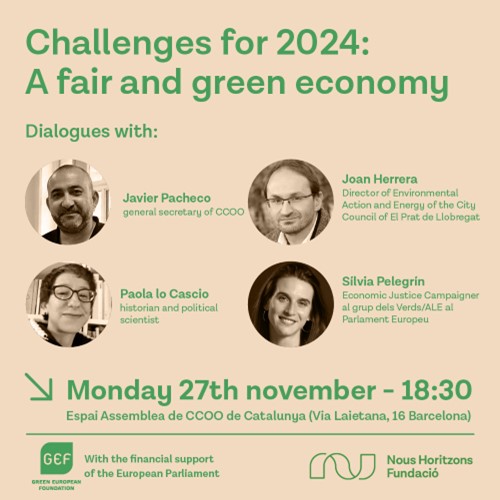
Challenges for 2024: A fair and Green Economy (Barcelona)

By

About the event

The pandemic may be over but economic instabilities continue. The effects of the war in Ukraine, high inflation rates, the energy crisis, and the Israeli-Palestinian conflict are just some examples of how the economic and social agenda will be impacted in 2024 in the fight against the climate emergency.

The year 2024 represents a change of cycle in Europe and in Spain. We must, therefore, define the priorities to move forward towards a green and just transition that allows European citizens make ends meet.


Context

GEF’s Green Red Dialogues, organised with the support of Fundació Nous Horitzons, aim to tackle pressing issues of our time and the challenges Europe faces with an explicit social and green lens. From COVID-19 to the war in Ukraine, far right resurgence to feminist struggles – these issues tend to reverberate across multiple countries and domains. Through the dialogues, we connect the red and the green and highlight Southern European perspectives on crucial topics and developments across the continent. 


Speakers

  • Javier Pacheco, Secretary General of the Comisiones Obreras (CCOO) trade union in Catalonia;
  • Joan Herrera, Lawyer and Director of Environmental Action and Energy of the City Council of El Prat de Llobregat;
  • Paola lo Cascio, Historian and political scientist;
  • Sílvia Pelegrín, Economic Justice Campaigner for the Greens/EFA group in the European Parliament.


Practicalities

Date and time: 27th November 2023, 6PM – 9 PM

Location: Espai Assemblea of CCOO (Via Laietana, 16 Barcelona)

Language: The main languages of this event will be Catalan and Spanish. A video-summary with English subtitles will be available after the event.

Registration: Please register in advance via this link. 


This event is organised by the Green European Foundation with the support of Fundacio Nous Horitzons and the financial support of the European Parliament to the Green European Foundation. 
Anticipating the Climate Collapse (Barcelona)

By

About the event

The future we predicted is unfolding before us. Devastating climate changes have resulted from pushing the planet to unprecedented limits. We must continue to fight to reverse the effects we have, unfortunately, already provoked. But in the meantime, we are living with climate changes that are here to stay. What can we do about it? How can we fight increasingly hot summers in our cities? How can we ensure the protection of the natural environment, so that deforestation and mistreatment do not continue? How can we live comfortably without damaging natural and energy resources? What can we do to ensure that our children live in a less polluted environment? How can we help young people who suffer from climate anxiety? How can we continue fighting and prevent ourselves from succumbing to inaction and helplessness?

Context

GEF’s Green Red Dialogues, organised with the support of Fundació Nous Horitzons, aim to tackle pressing issues of our time and the challenges Europe faces with an explicit social and green lens. From COVID-19 to the war in Ukraine, far right resurgence to feminist struggles – these issues tend to reverberate across multiple countries and domains. Through the dialogues, we connect the red and the green and highlight Southern European perspectives on crucial topics and developments across the continent. 

Speakers

  • Francesc Mauri – Weather Forecaster
  • Júlia Boada – Member of the Spanish Congress, former Political Advisor to the European Greens,
  • Llorenç Serrano – Just Transition manager (CCOO Catalonia)
  • Mercè Conangla– Psychologist

Practicalities

Date and time: Thursday, December 15th, 18:00 – 19:30 

Location: Espai Assemblea of CCOO (Via Laietana, 16 Barcelona)

Language: The main languages of this event will be Catalan and English.

Registration: Please register in advance via this link. 


This event is organised by the Green European Foundation with the support of Fundacio Nous Horitzons and the financial support of the European Parliament to the Green European Foundation. 

Green-Red Dialogues: Global Discourses on Feminism

By

About the event

This Green-Red Dialogue will address the situation of women and the feminist movement from different perspectives and geographies. Anahita Nassir, Iranian political scientist from Catalonia, will speak about the current struggle of women in Iran; Magdalena Galkiewicz, secretary general of the Greens in Poland, will be in charge of explaining the violation of women’s rights and the right to abortion in Poland; the political scientist Maria Freixanet, an expert in feminism and researcher on gender and politics, will give us an overview of the situation in Spain and Catalonia. 

All of them will establish a debate on the global situation of feminism in the world today and the challenges it faces, as well as the role Europe can and should play in ensuring that women’s rights continue to advance. 

Context

GEF’s Green Red Dialogues, organised with the support of Fundació Nous Horitzons, aim to tackle pressing issues of our time and the challenges Europe faces with an explicit social and green lens. From COVID-19 to the war in Ukraine, far right resurgence to feminist struggles – these issues tend to reverberate across multiple countries and domains. Through the dialogues, we connect the red and the green and highlight Southern European perspectives on crucial topics and developments across the continent. 

Speakers

  • Anahita Nassir – Universitat Autònoma de Barcelona, political analyst 
  • Maria Freixanet – Institut de Ciències Polítiques i Socials, researcher 
  • Aleksandra Sidoruk – European Green Party, campaigner 

Practicalities

Date and time: Thursday, December 15th, 18:00 – 19:30 

Location: Online, via Zoom  

Language: Catalan and English (simultaneous translation will be provided) 

Registration: Please register in advance via this link. 

Further reading and other resources

What African Green Feminist Power Has to Offer 

“We no longer ask to be treated as humans. We demand it.” 

A Green Feminist Foreign Policy for the EU 

Green Feminism – e-learning course 


This event is organised by the Green European Foundation with the support of Fundacio Nous Horitzons and the financial support of the European Parliament to the Green European Foundation. 

Green Horizons Academy: The Good Collective (Belgrade)

By

About the event

Throughout Europe, activists face numerous external pressures every day that threaten to stop their fight. To these pressures, we add a trap into which we as activists often unwittingly fall. We have all witnessed or experienced (self)exploitation, a productivity race to the bottom, unequal distribution of work tasks and power, various forms of discrimination, and even burnout and giving up the fight. That is why GEF, with the support of PolEkol, decided to discuss and work on building a good collective at the Green Horizon Academy! During the three days of the Academy, a series of lectures, workshops and panels will be organised, where we will try to answer some of the following questions: 

  • What are good activist collectives? 
  • What do sustainable structures look like? 
  • How to care for the mental health of activists and prevent burnout? 

On the path to a good collective, we have at our disposal knowledge and skills from the sphere of politics, psychology, sociology, and other social sciences. Within the growing green movement, they can help us apply the ideas we advocate for in public policies: the internal values and management of our organizations so that they are as humane and democratic as possible, the working environment as stimulating and supportive as possible, and collectives open to diversity. What does politics of care truly mean?

Programme

Friday, 18 November: Public Programme at Cultural Center GRAD 

17:00 – 17:45 – Lecture “Tell me about happiness” 

  • With Branko Anćić, Institute for Political Ecology, Zagreb 

17:45 – 19:00 – Panel discussion “Are we good?” 

  • With Brajan Brković (civil activist), Isidora Petrović (Ne Davimo Belgrade), Maja Stojanović (Civic Initiative), and Dragan Srećković (organizational development consultant) 


Saturday, 19 November: Closed Training at Arka Barka 

8:00 – 9:30 – Breakfast 

10:00 – 11:00 – Welcome and introduction of participants 

11:00 – 13:00 – Workshop: Structures for a Good Collective 

  • With Marina Škrabalo, Solidarna.HR 

13:00 – 14:30 – Lunch 

14:30 – 16:00 – Workshop: Put out the fire and save the flame – burnout prevention 

  • With Doris Rafajlovski, psychotherapist 

16:00 – 16:30 – Coffee break 

16:30 – 18:00 – Fishbowl discussion: Personal and political – feminization of the work of organizations 

  • With Lidija Vasiljević and Jelena Memet 

19:30 – Dinner 


Sunday, 20 November: Closed Training at Arka Barka 

10:00 – 11:00 – Let’s take a deep breath – yoga, breathing, anti-stress workshop 

  • With Nada Milosević 

11:15-13:00 – Workshop – Sustainable collective: communication, conflicts and support 

  • With Aleksandra Živković, environmental activist, professional coach and trainer 

13:00 – 14:00 – Impressions and conclusions 

14:00 – Lunch 

Practicalities

The Good Horizons Academy consists of two parts: a public programme and a private, invite-only training. All activities will take place in Serbo-Croat-Bosnian, with informal translation provided on the spot where needed. 

Public Programme 

Date and time: Friday, 18 November from 17:00 – 19:00 

Location: Cultural center GRAD, Braće Krsmanović 4, Belgrade 

Registration: No prior registration needed. You can also follow the event online via Facebook. 

Invite-Only Training 

The two-day training will take place after the public programme, with workshops, lectures, and experience-sharing sessions. Due to the nature of the topic and limited spots available, a selection of activists and NGO representatives have been invited. Please contact sien.hasker@gef.eu with questions or for more information. 


The event is organised by the Green European Foundation with the support of PolEkol and the financial support of the European Parliament to the Green European Foundation. 

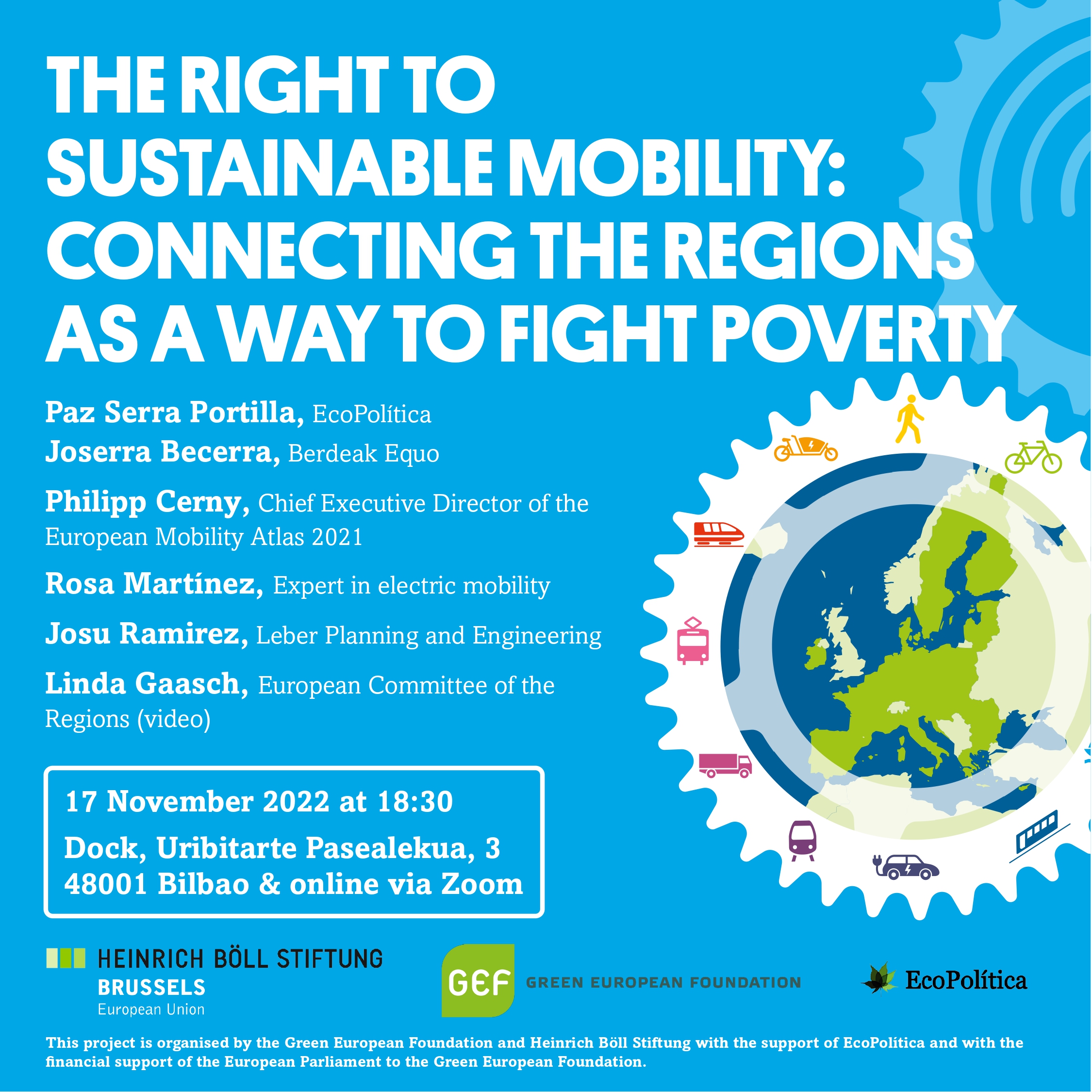
The Right to Sustainable Mobility: Connecting the Regions as a Way to Fight Poverty

By

Context

Mobility plays a fundamental role in people’s lives. The ease of movement not only favours the freedom to choose the place of residence and the exercise the right to work, but it is also essential to access basic public services such as education and health, as well as leisure and enjoyment of free time. It is, in short, a determining element of people’s well-being and their quality of life.

In this sense, the articulation of the subjective right to mobility in our societies, which guarantees all citizens equal conditions of access and use of mobility services, is becoming increasingly important. If mobility determines people’s quality of life, the impossibility of accessing sufficient mobility (due to physical or mental conditions, insufficient economic resources, or other factors) supposes not only a personal impediment, but also a breach of the constitutional principle of equality.

Throughout the 20th century, the economic system has linked this right with the use and enjoyment of the private car through an unprecedented cultural transformation. This has caused our towns and cities – and, ultimately, the geography in which we live – to be configured around the use and service of the private motor vehicle. No country in Europe has recognised the “right” to circulate and reach anywhere by car, and yet the car has usurped the routes traditionally used by pedestrians and other means of transport.

In fact, driving in a private car in a public space is a privilege rather than a right. Greenhouse gas emissions caused by automobiles, energy inefficiency, air and water pollution, noise, congestion of public space, accidents or the appropriation of the land are privileges associated with the enjoyment of the automobile, which are unaffordable and unsustainable for the planet, and harmful for people’s health and for society as a whole.

The war in Ukraine has accelerated the energy crisis caused by the progressive depletion of fossil fuels. However, the speed with which it has progressed has hit millions of people who use private vehicles for their daily commutes hard. According to official statistics from summer 2022, in Spain, 60% of drivers have limited the use of private vehicles, and 5% have stopped using them all together.

In this context, sustainable mobility is no longer simply a necessity to advance decarbonisation, it has now become the main alternative to tackle poverty linked to dependence on the private combustion car.

It is the obligation of local institutions to facilitate active mobility. Before the crisis, almost half of daily trips in the Basque Country were made on foot or by bicycle. However, facilitating the transfer of 40% of trips that are made by private vehicles requires adequate mobility planning at the municipal and regional levels to ensure minimum standards of safety, comfort, and accessibility. This situation turns non-motorised mobility into a high-risk exercise, instead of a routine habit.

On the other hand, public transport continues to be the main tool to guarantee everyone the right to move without distinction of physical, intellectual, economic capacity, or place of residence. In this sense, it is the obligation of local and regional authorities to act in a coordinated manner to ensure sufficient public transport coverage with minimum quality and sustainability standards, and with prices in line with the level of disposable income of users.

Lastly, we cannot forget the role that public policies will play in the coming decades, especially when it comes to reducing the demand for mobility, such as 15-minute city urban planning or land reuse policies. These will need to be combined with increased attention to rising property prices (which drive those with lower incomes to the periphery of cities), as well as addressing the social and cultural reconstruction of our way of life on a fairer and more sustainable basis.

Speakers

  • Paz Serra, EcoPolítica.
  • Joserra Becerra, Berdeak EQUO.
  • Philipp Cerny, Chief Executive Editor of the European Mobility Atlas 2021.
  • Rosa Martínez, Expert in electric mobility.
  • Josu Ramirez, Leber Planning and Engineering.
  • Linda Gaasch, European Committee of the Regions (video).

Practicalities

Date and Time:  Thursday 17 November, from 18:30 to 20:00 (CET).

Location: Hybrid event, Dock (Uribitarte Pasealekua, 3 Bilbao) and Zoom.

Language: The main language of the debate will be Spanish. Simultaneous interpretation will be provided ES<>EN.

The event is hybrid, open and free with prior registration through this form. Once registration has been completed, a confirmation email will be sent with the access details for joining the meeting.

Reading material

The event relates to the European Mobility Atlas, corresponding Spanish translation, and associated booklet, Present and Future of Mobility in Spain.


This project is organised by the Green European Foundation and Heinrich Boll Stiftung with the support of EcoPolítica and with the financial support of the European Parliament to the Green European Foundation.  
Green-Red Dialogues: Italian Election Consequences (Barcelona)

By

About the event

Europe is facing a multitude of crises. Just as the worst of the COVID-19 pandemic appeared to be behind us, Russia’s invasion of Ukraine brought war back to the continent at tremendous human and material cost. As ordinary citizens continue to lose their lives to senseless violence, the rest of Europe prepares for a difficult winter of energy crisis and social unrest.   

And as they say, in crises there are always ghosts. Those ghosts that some take advantage of to implant the ideas of fear, wrecking instead of building and fomenting panic to weaken the democratic system. It is in this context that we look to Italy, where the elections have produced a far-right coalition that is set to govern in the coming years. 

How does it affect us that a far-right government governs in a strategically key country for Europe, a country that can offer “help” to Putin’s Russia? What consequences and lessons do these results hold for the left and environmental movements? Should we be worrying about threats to European democracy? Together with our speakers, we will explore these crucial questions for the future of Europe.  

Context

GEF’s Green Red Dialogues, organised with the support of Fundació Nous Horitzons, aim to tackle pressing issues of our time and the challenges Europe faces with an explicit social and green lens. From COVID-19 to the war in Ukraine, far right resurgence to inflation–these issues tend to reverberate across multiple countries and domains. Through the dialogues, we connect the red and the green and highlight Southern European perspectives on crucial topics and developments across the continent. 

Speakers

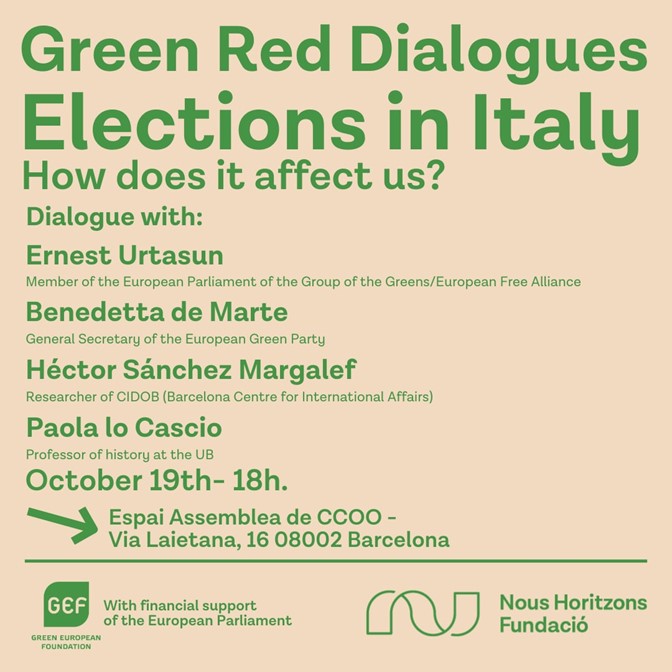
Ernest Urtasun – MEP, Greens/EFA 

Benedetta de Marte–Secretary General of European Green Party 

Héctor Sánchez Margalef–researcher at CIDOB (Barcelona Centre for International Affairs) 

Paola lo Cascio–professor of history at the University of Barcelona 

Moderated by Marc Rius 

Practicalities

Date and time: Wednesday, October 19th, 18:00–19:30 

Location: CCOO de Catalunya Assembly Space – Via Laietana 16, Barcelona  

Language: Catalan and English (simultaneous translation will be provided) 

Registration: Pre-registration is not required, but please arrive on time 

Further reading

The Climate Won’t Wait for Italian Politics 

Swedish Elections and the Mainstreaming of the Far Right 

Nationalising the Climate: Is the European Far Right Turning Green? 


This event is organised by the Green European Foundation with the support of Fundacio Nous Horitzons and the financial support of the European Parliament to the Green European Foundation. 
ECOPOLIS 2022: Multiple (Hi)stories, Multiple Future (Brussels)

By

Context

“Thinking out of the box is exactly how the box thinks. We are the boxes we strive to out-think,” writes philosopher Bayo Akomolafe, speaker at the eighth edition of Ecopolis where artists, thinkers and doers break open our frames. Social, ecological, and economic crises force us to think about a radically different way of living. Can unheard stories help us change today’s reality? And not any stories, but the ones that link different generations, geographical areas that are far apart, or ancient knowledge and technology. Can activism as a form of love take us further than doomsday thinking? “The world is not about to end; we are already living with a different world,” Akomolafe continues. Ecopolis brings stories that depict an inclusive and sustainable future for this new world.

About the event

Ecopolis is the perfect occasion to meet people who care about a sustainable future. Because ecological challenges know no national or linguistic borders, Ecopolis is diverse, international and interactive space to learn, discuss and connect with like-minded individuals. 

The conference welcomes Belgian and international authors to debate the transition towards a socio-ecological society. Inspiring books, documentaries and debates between writers, academics and civil society thinkers about ecology, economy and society are at the heart of this event. 

Programme

Times

Sessions

13:30 – 15:30

Minority walk with Omar Fassi Fehri (EN/FR)

The Minority Walk is a tour of the Brussels city-centre to discover the public space of the capital, told through the lens of how the oppression of minority groups is still taking place in different ways.

13:30 – 15:45

The Brussels of witches: feminist guided walk (EN/FR)

In the 14th century, as we move out of the ‘dark’ Middle Ages and into the Modern Age and the Renaissance, women are plunged into darkness – or rather into the flames of the stake. What does our urban public space reveal about that time… and about witches today?

14:00 – 15:30

Workshop ‘Limits to Growth’ (NL/EN)

To keep our planet livable, we urgently need to rethink our way of living. In this workshop we will encounter inspiring voices from Latin America who show that another way of life is possible. A life in which ‘well-being’ is central instead of ‘growth.

Panel discussions and performance

16:00 – 18:00

Colonisation as exploitation of people and nature

In this panel discussion, writers and artists from various backgrounds will talk about decolonisation and explore  the many narratives that survived colonialism while offering alternatives.

18:00 – 20:00

Different jobs, one planet. Stories of strong commitment

Whatever your studies, whatever your job, there are always plenty of opportunities for strong commitment to creating a better world.

21:00 – 22:00

The environmental impact of war

War’s impact on humans as well as on nature and biodiversity is dramatic. Ecopolis will feature playwrights and performers Enkidu Khaled and Joachim Robbrecht in the premiere of their play on the impact of war on the environment. Their stories  point out the importance of peace for all forms of life on this planet.

Learn more here about the programme and speakers. 

Practicalities

When: Saturday, October 15th (16:00 – 22:00). There are several connected events taking place before the core programme. More details to follow. 

Where: Ancienne Belgique – Bd Anspach 110, 1000 Brussels, Belgium 

Language: The primary language of this event will be English, with simultaneous translation to French and Dutch. 

Tickets: Ecopolis employs a “pay as you can” principle, please purchase your tickets in advance via this link.  The “Walks & Workshops” are included in the Ecopolis ticket, but you must reserve your spot in advance by registering here.  

Related Events

This year, Ecopolis goes beyond one date and one location! To find out more about the other events in Brussels and Kortrijk, please check the event website.  


Reading material

Degrowth Is About Global Justice

Beyond the Growth Imperative

Is Degrowth the Future?

Transforming Work, Reimagining Education

Hooked on Growth: Rewiring Institutions for Wellbeing

Questioning Our Limits to Leave Scarcity Behind

Beyond the Choke Hold of Growth: Post-growth or Radical Degrowth?

The Long Fight for Environmental Justice in the Caribbean

The “White Saviour” Deal for Nature

Politics for Change: Black Lives Matter in Europe

The Politics of Representation in the Climate Movement

Why We Need a Decolonial Ecology

Russia’s Invasion of Ukraine

The Environmental Cost of the War in Ukraine


This event is organised by the Green European Foundation and Oikos, with the support of various partners and with financial support of the European Parliament to the Green European Foundation. 
 

A just transition: between a bitter pill and sweet dreams

By

Context

Transition is a word that arouses bad associations in the Western Balkans region. When talking about the transition, people usually first think of collapsing institutions, selling off public companies and social property. At a time when the Western Balkans are witnessing mass privatisation and commodification of natural resources, talks on green transition and transformation towards sustainability are emerging too (although still far behind the European average).

These days, we are witnessing mass protests for environmental justice in Serbia and miners’ protests in Bosnia and Herzegovina. The simple introduction of environmental standards, without a social dimension, has never worked. Therefore, this is an important topic for discussion, even more so within the framework of a fair transition in Europe.

The concept of a just transition is a comprehensive guideline that complements the Green Deal in the transformation towards an environmentally sustainable society in a just and fair way. With the development of this concept, trade unions and climate movements emphasise the need for systemic transformation. A fair transition implies fundamental changes, not only of key economic branches and consumer systems, such as energy, transport, agriculture and food, but also changes in infrastructure, social values and politics. In addition, this concept highlights the need for a global shift towards a humane and fair economic system, with a healthy ecosystem, health, public services, education and culture at its core.

During the discussion that will be organized by the Green European Foundation in cooperation with the organization for political ecology Polekol, we will try to find answers to some of these questions:

– What is the broader context of a fair transition and why we need it?

– What does a fair transition mean for the Western Balkans region and how can we reach it?

– What is the role of workers and unions in the green transition?


Speakers

Dr. Maja Pupovac, project manager of the RES Foundation
Miodrag Pantović, project assistant on the project “On the way to the EU” of the European Trade Union Confederation (ETUC) and the regional network “SOLIDARITY” with the support of the European Commission
Alma Midzic, Crvena Sarajevo
Moderated by:  Žaklina Živković, Polekol


Practicalities

Date and time: 28th December

Audience: the event is open for the general public.

The webinar will be broadcasted on the Polekol Facebook page.


This project is organised by the Green European Foundation with the support of Polekol and with the financial support of the European Parliament to the Green European Foundation. The European Parliament is not responsible for the content of this event.

Pilot projects on UBI

By

About the event

“The Unconditional Basic Income is a periodic cash transfer granted to all members of a political community, without work requirement nor means-testing, and high enough to ensure an existence in dignity and participation in society”.

During this event, we will analyse some examples of UBI pilot projects that have been developed in recent years as debunk negative stereotypes. The last part of the session will focus on deriving lessons and best practices for a future universal basic income.

Context

The idea of a basic income was, for decades, a utopia. But the last few years have seen it become more and more real, to the point where we now have many basic income pilot programs up and running around the world.

The severity of the pandemic has also highlighted the need to reduce inequalities and protect the most vulnerable. With the crisis generating so much financial loss and uncertainty, and with public stimulus packages failing to meet the needs of millions, we need decisive actions and bold solutions more than ever.

Speakers

Julen Bollain: Spanish economist specialising in unconditional basic income. Julen is a lecturer and researcher at the University of Mondragón (Basque Country). He is also a PhD student in Development Studies, under the direction of Daniel Raventós. He is a member of the Board of Directors of the Basic Income Network and a life member of the Basic Income Earth Network (BIEN). He is one of the protagonists of the documentary on Basic Income “RBUI, our right to live” (2018) together with philosophers, economists, politicians or social activists such as Philippe Van Parijs, Guy Standing or Louise Haagh.

In the 2016 elections to the Basque Parliament Julen Bollain was elected MP for Elkarrekin Podemos. During the 11th legislature he was the coalition’s economic spokesperson, as well as acting as President of the Basque Parliament’s Health Committee

Mike Danson : Professor Mike Danson is an economist, Professor Emeritus of Enterprise Policy, Heriot-Watt University, Visiting Professor in Energy Policy, University of Strathclyde, and Fellow of the Academy of Social Sciences. He has published widely on rural, regional and island economies, microbreweries, minority languages, and many other areas of Scottish economic policy and social development. Chair of Basic Income Network Scotland, Chair of the 2021 BIEN (Basic Income Earth Network) world congress, depute Convenor Jimmy Reid Foundation, Trustee of Nordic Horizons and Community Renewal, Mike was on the Scottish Government’s Just Transition Commission and has advised, national and international organisations: OECD, WHO, EC, trades unions and community groups. Mike is Co-Director of the Scottish Centre for Island Studies. Contact: michael.danson@hw.ac.uk.


Moderation:
Susanne Rieger: Co-president of the Green European Foundation. She has been responsible for European issues and European relations in the Catalan Green foundation Fundació Nous Horitzons (FNH) for the past ten years.

Practicalities

Date and Time: 2nd Nov  (17:00-18:00)
Audience: The webinar is free and open to the general public.
Registration: Please register here.


This event is organised by the Green European Foundation with the support of Transición Verde and with the financial support of the European Parliament to the Green European Foundation. The European Parliament is not responsible for the content of this event.
UBI & the COVID-19 pandemic

By

About the event

“The Unconditional Basic Income is a periodic cash transfer granted to all members of a political community, without work requirement nor means-testing, and high enough to ensure an existence in dignity and participation in society”.

During this event, we’ll put UBI on the spotlight as a driving solution to tackle poverty and income inequality and other problems in a changing world.

We will also review GEF brochure on social policy responses to COVID-19, which examines the social policy reactions to the Covid-19 crisis in a dozen different European countries.

Context

The COVID-19 crisis continues to change the way we live our lives, and how social services continue to respond to the needs of the most vulnerable. This crisis will affect how governments plan their future responses to social emergencies, and UBI could be one effective way to do it.

This event is part of our knowledge community ‘A welfare state of the 21st century’. The Green European Foundation has been working on this issue for several years with the aim of opening a debate on UBI across Europe. We are now joining forces with other social actors to give this effort a broader scope.

As the debate continues, we too would be interested in expanding our analysis to include new information and additional countries.

Speakers

Valerija Korošec, PhD in Postmodern Sociology. She is a representative of Slovenia in the Basic Income Earth Network (BIEN) and the European Network for the Fair Sharing of Working Time.
Natalie Bennet, Green member of the House of Lords in the UK. Former leader of the Green Party of England and Wales from 2012 to 2016. She previously spent 20
years working as a journalist, (the Bangkok Post, The Times, and the Guardian Weekly)
Simo Raittila, Coordinator of the Finnish think tank Visio and a PhD student in Sociology at the University of Helsinki. In 2018 he worked on last-resort social assistance register research at Kela, the Social Insurance Institution of Finland.

Moderation:
Hannes Mehrer. Coordinator of the Basic income working Group of the German Green party and of the Green Network of UBI supporters.


Practicalities

Date and Time: October 19th (17:00-18:00)
Audience: The webinar is free and open to the general public.
Registration: Please register in advance via this link.


This event is organised by the Green European Foundation with the support of Transición Verde and with the financial support of the European Parliament to the Green European Foundation. The European Parliament is not responsible for the content of this event.