About the event:
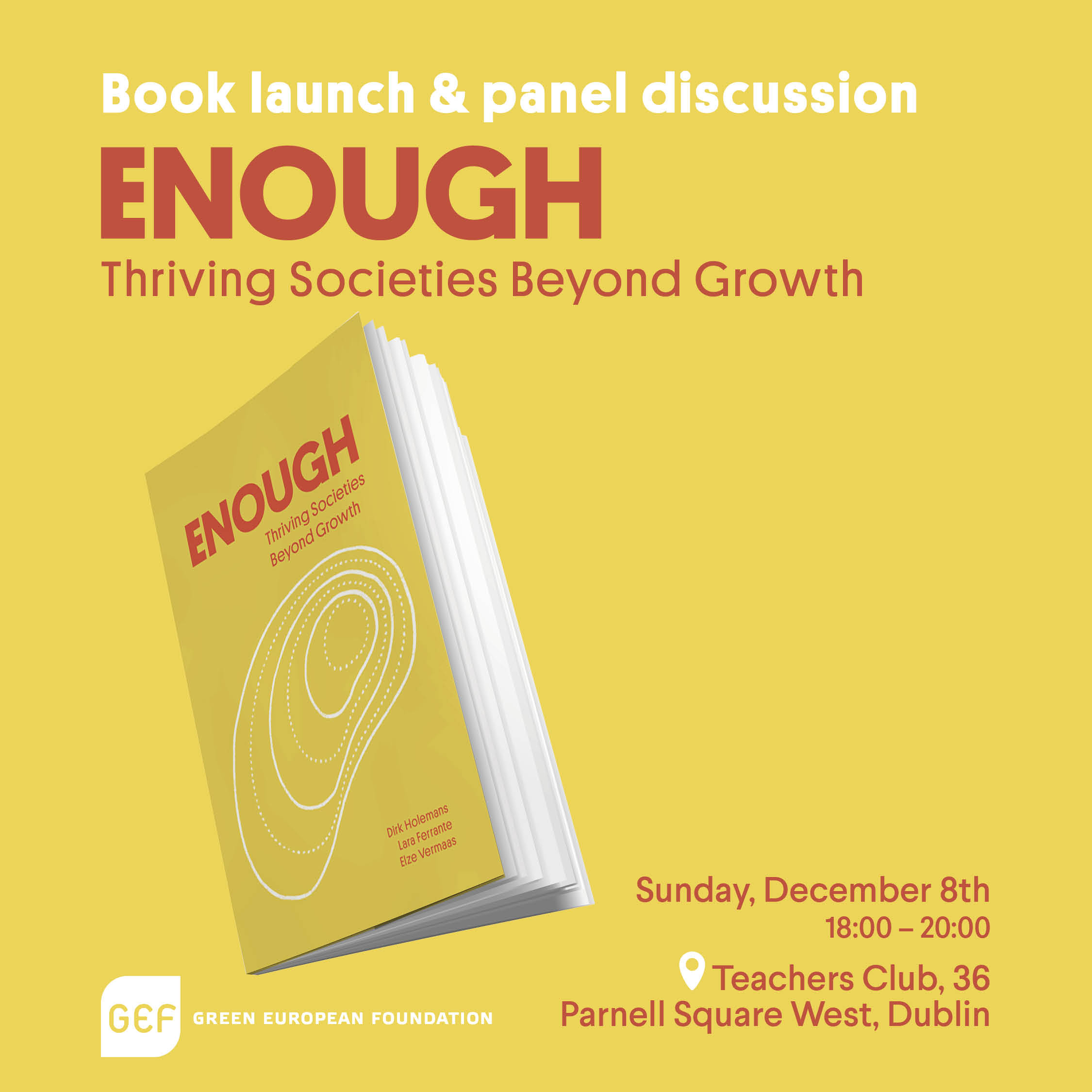
Who is afraid of degrowth? The term alone throws mainstream opinion makers and many economists in Europe into a panic. Growth is the lubricant of capitalism. We are told that if the economy is growing, all is well. But what do we mean by growth? Should everything keep growing endlessly? The ecological crisis shows that infinite growth on a finite planet is impossible. Meanwhile, the current economic system fails to secure livelihoods and exacerbates inequalities. There is an alternative to this self-destructive system: an economy of enough, which would provide for everyone’s basic needs while addressing greed and overconsumption. The EU has the potential to lead the ecological transition – but we need to envision a different European economy, rooted in a new paradigm, before we can build it.
In Enough, the authors build on the work of visionaries, both past and present, recognising that Earth is on loan to us from future generations. They explore how societies can thrive without depending on economic growth. The essay presents a compelling vision: fewer private jets, less inequality, fewer burnouts, and reduced waste, alongside more quality of life, more time for each other, more sustainable products, and a healthier planet. In other words, it provides the keys to imagining a different Europe – one that ensures a good life for everyone within the planet’s limits.
At this book launch event, we will dive deeper into what this means in practice. How are principles of sufficiency and an “economy of enough” already reflected in local initiatives and policy proposals today? What are the levers of change, within and outside of political institutions? And how do we make sure that this vision of thriving beyond growth resonates and really does not leave anyone behind, especially at a time when socio-economic fears are framed directly in opposition to climate policy and a green transition?
Project background:
In early 2024, GEF released Enough: Thriving Societies Beyond Growth. This publication sought to spotlight many of the ideas that the foundation has been exploring on post-growth and a just green and social deal, presenting them in an accessible and inspiring booklet. Now, we are taking it on a tour to spark conversations across the continent on how Europe can reconcile social and ecological justice in a wellbeing project for all.
Programme and speakers
Author Dirk Holemans will be joined by a selection of experts, from politicians to academics to civil society and local changemakers:
- Anne B. Ryan – coordinator of Basic Income Ireland and author of “Enough is Plenty: Public and Private Values for the 21st Century”
- David Donoghue – Distinguished Fellow of ODI, former Permanent Representative of Ireland to the UN in New York, co-facilitator of the intergovernmental negotiations on the 2030 Agenda for Sustainable Development
- Janet Horner – Green Party representative for the North-Inner City on Dublin City Council
Moderated by John Gormley (Green Foundation Ireland).
Snacks and networking drinks will be provided.
Practicalities
Date and Time: Sunday, 8 December 2024 (18:00 – 20:00)
Location: Teachers Club, 36 Parnell Square W, Rotunda, Dublin, Ireland
Language: English
Registration: Please register in advance via this link.
This book launch is organised by the Green European Foundation with the support of Green Foundation Ireland and with the financial support of the European Parliament to the Green European Foundation.



 Dr Colin Sage – Senior Lecturer in Geography at UCC with research interests in food systems, environmental policy and civic initiatives for social change. He is the author of Environment and Food (2012) and co-editor of Transdisciplinary Perspectives on Transitions to Sustainability (2017), Food Transgressions: Making sense of contemporary food politics (2014) and Strategies for Sustainable Development. Colin is honorary Visiting Professor on the Food Studies program at the American University, Rome as well as at the University of Gastronomic Sciences near Turin, Italy, and has just completed a Visiting Research Fellowship at the University of Tasmania. He is strongly committed to public engagement and is Chair of the Cork Food Policy Council which he co-founded in 2013.
 Dr Christina Grasseni – Professor of Anthropology at the University of Leiden, Netherlands. Her research interests lie broadly in economic, political and visual anthropology, focusing especially upon skilled visions and ecologies of belonging. She is the author of Beyond Alternative Food Networks (2013) which analysed Italy’s solidarity economy networks as ethnographic models of grassroots transition to sustainable consumption and food sovereignty. Her most recent book, The Heritage Arena (2017) unravels the political agency of heritage cheese in the reinvention of local economies and ecology in the Alps. Cristina currently leads a major European Research Council project, Food citizens? Collective food procurement in European cities which examines the premises and consequences of collective forms of food production, distribution and consumption in three European cities.
 Dr. Oliver Moore – has a PhD in the sociology of farming and food and writes in the field of organics, direct selling and consumer-producer relations. He is a contributor to the Irish Examiner where he writes a weekly column on organic food and farming. A member of the Irish Food Writers Guild he also contributes to Food and Wine magazine, and to Organic Matters magazine. Dr. Moore is Communications Manager with ARC2020, an EU agri-food and rural NGO based in Paris and also maintains a lively and informative
  Regina Sexton – a food historian, food writer, broadcaster and cook. Her research interests include food and identity, food and tradition and food in the Irish country house. She has published widely at academic and popular levels. Her publications include A Little History of Irish Food (Gill and Macmillan, 1998) and Ireland’s Traditional Foods (Teagasc, 1997). At University College Cork, she lectures in the area of food history with the School of History, the Food Industry Training Unit and Adult Continuing Education. Her research interests encompass food and culinary history, food preservation, food and identity, ’traditional‘ food cultures, and constructed and ‘invented‘ food traditions. Regina is secretary of the Agricultural History Society of Ireland.