Enough: Thriving Societies Beyond Growth (Dublin)

By

About the event:

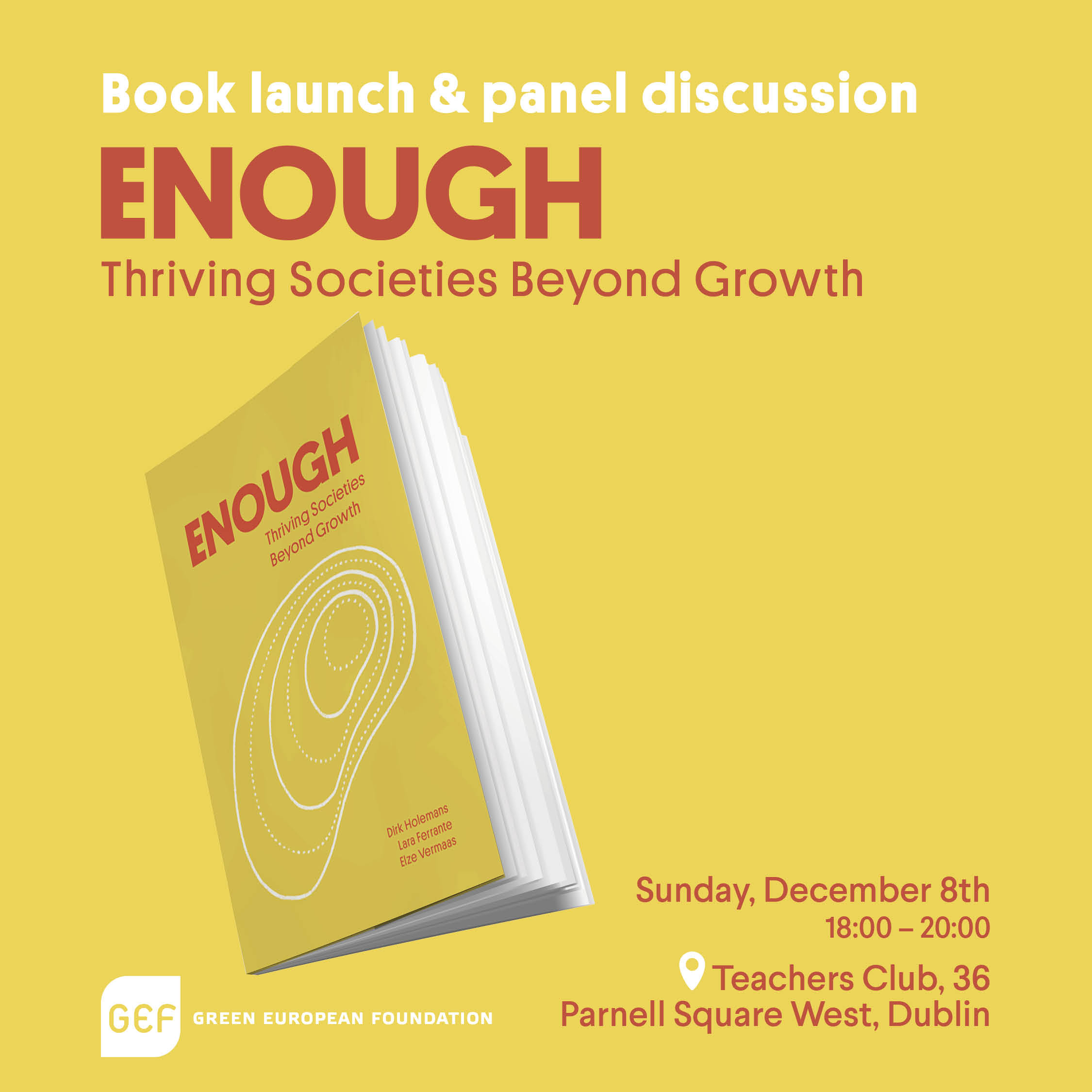
Who is afraid of degrowth? The term alone throws mainstream opinion makers and many economists in Europe into a panic. Growth is the lubricant of capitalism. We are told that if the economy is growing, all is well. But what do we mean by growth? Should everything keep growing endlessly? The ecological crisis shows that infinite growth on a finite planet is impossible. Meanwhile, the current economic system fails to secure livelihoods and exacerbates inequalities. There is an alternative to this self-destructive system: an economy of enough, which would provide for everyone’s basic needs while addressing greed and overconsumption. The EU has the potential to lead the ecological transition – but we need to envision a different European economy, rooted in a new paradigm, before we can build it.

In Enough, the authors build on the work of visionaries, both past and present, recognising that Earth is on loan to us from future generations. They explore how societies can thrive without depending on economic growth. The essay presents a compelling vision: fewer private jets, less inequality, fewer burnouts, and reduced waste, alongside more quality of life, more time for each other, more sustainable products, and a healthier planet. In other words, it provides the keys to imagining a different Europe – one that ensures a good life for everyone within the planet’s limits.

At this book launch event, we will dive deeper into what this means in practice. How are principles of sufficiency and an “economy of enough” already reflected in local initiatives and policy proposals today? What are the levers of change, within and outside of political institutions? And how do we make sure that this vision of thriving beyond growth resonates and really does not leave anyone behind, especially at a time when socio-economic fears are framed directly in opposition to climate policy and a green transition?

Project background:

In early 2024, GEF released Enough: Thriving Societies Beyond Growth. This publication sought to spotlight many of the ideas that the foundation has been exploring on post-growth and a just green and social deal, presenting them in an accessible and inspiring booklet. Now, we are taking it on a tour to spark conversations across the continent on how Europe can reconcile social and ecological justice in a wellbeing project for all.

Programme and speakers

Author Dirk Holemans will be joined by a selection of experts, from politicians to academics to civil society and local changemakers:

  • Anne B. Ryan – coordinator of Basic Income Ireland and author of “Enough is Plenty: Public and Private Values for the 21st Century”
  • David Donoghue – Distinguished Fellow of ODI, former Permanent Representative of Ireland to the UN in New York, co-facilitator of the intergovernmental negotiations on the 2030 Agenda for Sustainable Development
  • Janet Horner – Green Party representative for the North-Inner City on Dublin City Council

Moderated by John Gormley (Green Foundation Ireland).

Snacks and networking drinks will be provided.

Practicalities

Date and Time: Sunday, 8 December 2024 (18:00 – 20:00)
Location: Teachers Club, 36 Parnell Square W, Rotunda, Dublin, Ireland
Language: English
Registration: Please register in advance via this link.


This book launch is organised by the Green European Foundation with the support of Green Foundation Ireland and with the financial support of the European Parliament to the Green European Foundation.

Enough: Thriving Societies Beyond Growth (Belfast)

By

About the event:

Who is afraid of degrowth? The term alone throws mainstream opinion makers and many economists in Europe into a panic. Growth is the lubricant of capitalism. We are told that if the economy is growing, all is well. But what do we mean by growth? Should everything keep growing endlessly? The ecological crisis shows that infinite growth on a finite planet is impossible. Meanwhile, the current economic system fails to secure livelihoods and exacerbates inequalities. There is an alternative to this self-destructive system: an economy of enough, which would provide for everyone’s basic needs while addressing greed and overconsumption. Europe has the potential to lead the ecological transition – but we need to envision a different economy, rooted in a new paradigm, before we can build it.

In Enough, the authors build on the work of visionaries, both past and present, recognising that Earth is on loan to us from future generations. They explore how societies can thrive without depending on economic growth. The essay presents a compelling vision: fewer private jets, less inequality, fewer burnouts, and reduced waste, alongside more quality of life, more time for each other, more sustainable products, and a healthier planet. In other words, it provides the keys to imagining a different Europe – one that ensures a good life for everyone within the planet’s limits.

At this roundtable, we will discuss some of the key themes and proposals put forward by the book and the post-growth community more broadly. As Europe is once again eyeing austerity and conservative and even far-right forces have captured key levels of government and institutions, what pathways remain for this crucial transition? How can we mobilize societies for such deep and rapid change? What are the key levers and obstacles to translating the environmental science around the limits to growth into concrete action?

Project background:

In early 2024, GEF released Enough: Thriving Societies Beyond Growth. This publication sought to spotlight many of the ideas that the foundation has been exploring on post-growth and a just green and social deal, presenting them in an accessible and inspiring booklet. Now, we are taking it on a tour to spark conversations across the continent on how Europe can reconcile social and ecological justice in a wellbeing project for all.

Programme and speakers

This interactive roundtable will provide plenty of space for audience input, questions, and reactions. They will be accompanied by invited experts:

  • Dirk Holemans – Honorary President of the Green European Foundation and author of “Enough: Thriving Societies Beyond Growth”
  • Dr. Amanda Slevin – Director of the Centre for Sustainability, Equality and Climate Action at Queens University Belfast
  • Prof. John Barry – Professor of Green Political Economy at Queens University Belfast and co-chair of the Belfast Climate Commission

Practicalities

Date and Time: Monday, December 9th (19:00 – 21:00 GMT)
Location: Peter Frogatt Centre, Room 02/018, Queen’s University Belfast, 7-9 College Park East, Belfast
Language: English
Registration: Please register in advance via this link.


This roundtable is organised by the Green European Foundation with the support of Green Foundation Ireland and QUB’s Centre for Sustainability, Equality and Climate Action and with the financial support of the European Parliament to the Green European Foundation.

Rethinking Demand: Realities and Opportunities (Dublin/online)

By

About the event

The Green European Foundations is bringing together Green House Think Tank (UK), Etopia (Belgium) and Green Foundation Ireland at an event hosted with the Lord Mayor of Dublin Caroline Conroy. This event will launch our Rethinking Demand Framing Paper and explore the complexity of the actions needed to reduce our demand for energy as well as the politics involved in doing so.  

As the urgency of the need to limit emissions to prevent further climate harm grows, and the all-encompassing nature of achieving this dawns, the pivotal role of rethinking how our societies deliver wellbeing for all has become ever more critical. During this conference, sessions will explore how social and business practices, infrastructure, and our governance structures can be transformed to reduce the collective demand for energy and unlock a future without fossil fuels.

Context

This event is part of the GEF transnational project Climate Emergency Economy: Rethinking Demand. Building on several years of work exploring what it means to create an economy fit for the climate emergency, GEF and its partners are this year focusing on the crucial question of how to reduce demand for energy and materials. With the support of Green House Think Tank, Etopia, and Green Foundation Ireland, we will explore how to frame rethinking demand politically, and articulate clear plans for demand reduction so green narratives are better grounded in reality and a shared vision of hope. 

Programme

Please note that all times are indicated in IST/BST. For participants joining online from a CEST time zone, everything will be one hour later.

Our FULL PROGRAMME OF EVENTS is available here. Please see below a short overview:


14:00 Address by Dublin’s Lord Mayor Caroline Conroy.

Presentation and discussion of Green House Think Tank’s framing paper “Rethinking Energy Demand” by two of its authors, Jonathan Essex and Peter Sims.

Panel discussion facilitated by Michael Smith (Editor of The Village magazine) with keynote speaker John Gibbons (Environmental journalist and commentator) and Claire Downey (Rediscovery Centre), Davie Philip (Cultivate) and Rosalind Skillen (Keep Northern Ireland Beautiful).

“Circular Economy and Demand Reduction” with Minister Ossian Smyth.

17:00 Closing reflections and drinks reception.

Practicalities

Date and Time: Wednesday, October 26th from 14:00 – 17:30 IST (15:00 – 18:30 CEST) 

Location: In person at the Mansion House in Dublin, Ireland. Please note that you can also follow this event online, via Zoom. 

Audience: Open to all registered participants. The event will be in English. 

Registration: Whether you are joining in person or online, please register in advance via THIS LINK. Spots for in person attendees are limited, so if they fill up you may be placed on a waiting list. With any questions regarding registration, please contact info@greenfoundationireland.ie  

Related reading

For Energy Independence, the EU Must Think Bigger than Power

Energy Crisis: Keeping the Cost of Living Down While Protecting the Climate

Affordable, Sustainable Housing Can Bring the Green Deal Home

The Devil’s in the Data: How the Energy Crisis Could Reshape Ireland’s Economy

Alexander Langer’s Case for an Ecological Conversion


This event is organised by the Green European Foundation with the support of Green Foundation Ireland, Etopia, and Green House Think Tank and the financial support of the European Parliament to the Green European Foundation. 
Rethinking Demand: EU Roundtable

By

About the event

As Russia’s war in Ukraine puts pressure on energy supplies across Europe, governments are preparing for an uncertain winter, with concepts like rationing and controlled blackouts suddenly on the table. 

Yet the need to structurally rethink our demand for energy and other key goods is not new. Amid the multiple crises facing Europe and the world, not least the climate emergency, there is a continued failure to acknowledge the role of reducing demand in the rapid and fundamental change needed. Mainstream understanding of demand management focuses on improving efficiency and engaging consumers, which tends to reproduce existing consumption levels with marginally less energy and resource use.  This is insufficient to deliver the reduction in energy use needed as part of a rapid shift to zero carbon and to remain at 1.5°C warming. 

A better understanding of the realities of demand change is required, and exploring how to frame this difficult topic is critical to reaching climate targets and energy independence goals. This expert roundtable will bring together academics, politicians, activists and NGO/foundation representatives to discuss to what extent we need to reduce energy demand and how we can go about it in a just yet decisive manner. Results of this discussion will inform a framing paper to be published in the autumn. 

Context

This event is part of the GEF transnational project Climate Emergency Economy: Rethinking Demand. Building on several years of work exploring what it means to create an economy fit for the climate emergency, GEF and its partners are this year focusing on the crucial question of how to reduce demand for energy and materials. With the support of Green House Think Tank, Etopia, and Green Foundation Ireland, we will explore how to frame rethinking demand politically, and articulate clear plans for demand reduction so green narratives are better grounded in reality and a shared vision of hope. 

Programme

More details on the programme will follow. 

Practicalities

Date and Time: Thursday, 15th September (15:00 – 17:00 CEST)

Audience: This is a closed roundtable. For more information please contact sien.hasker@gef.eu 


This expert roundtable is organised by the Green European Foundation with the support of Green House Think Tank and the financial support of the European Parliament to the Green European Foundation. 
Food Sovereignty, Climate action and Local Resilience

By Uncategorized

Context

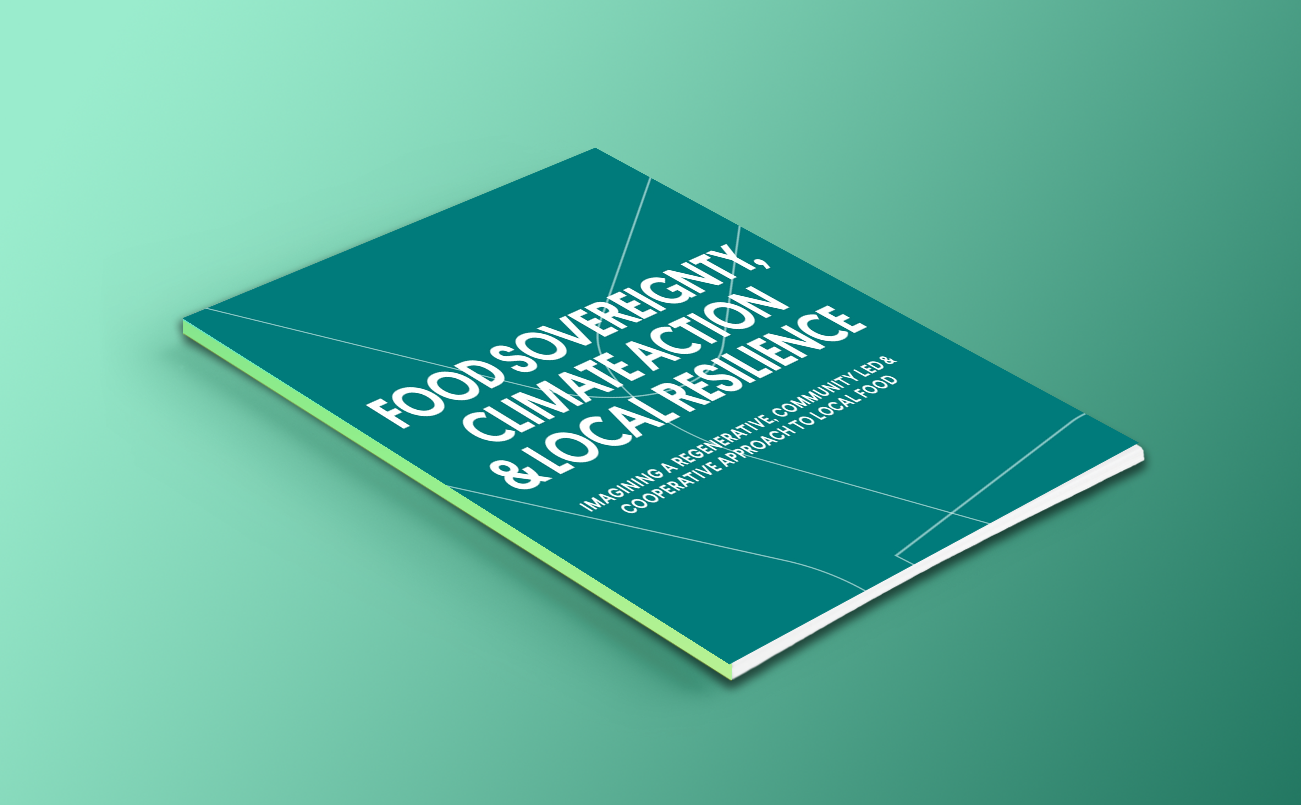
This pamphlet on Food Sovereignty, Climate Action and Local Resilience follows on from A Question of Scale: “Imagining a cooperative, community-led approach to regional resilience”. A framing paper in which we explored the potential of the Social and Solidarity Economy, Doughnut Economics, Just Transition, The Commons, Community Wealth Building, Federated co-ops as approaches to help us address the climate and ecological emergency.

The co-creation of this pamphlet began with a first draft distributed to local food, community and cooperative advocates. Then, they attended a webinar to discuss identify the blockers and enablers of this regenerative and community-led approach. Finally, we added the harvest of the session, along with links to initiatives in the field, and an infographic.

Challenging the global trade regime and the bilateral trade agreements which en-trench trade relations and which negatively affect peasant farmers on both sides is a vital part of the picture of Food Sovereignty and the global conversation that needs to be had about how to protect, encourage and support biodiverse, agroecological and small scale production not just in our backyard, but across the world.


This publication was produced as part of GEF’s Climate Emergency Economy project, exploring the challenge of such a climate emergency economy by focusing on “hard-to-decarbonise” sectors like transport, trade, industry, or agriculture.


Download

Also available in Polish.


This publication has been realised with the support of the Green Foundation Ireland, Cultivate and the financial support of the European Parliament to the Green European Foundation. The European Parliament is not responsible for the content of this publication.
Practicing Food Sovereignty in the Climate Emergency

By

About the Event

GEF, with the support of Green Foundation Ireland and Cultivate, has built on our 2020 publication ‘A Question of SCALE’ and the findings of a webinar held in June 2021 to produce a new pamphlet: ‘Food Sovereignty, Climate Action and Local Resilience.’

This launch event will include conversations with leading Irish and European advocates of regenerative agriculture, rural regeneration, and sustainability. Drawing from the pamphlet, it will explore how we might take climate action and strengthen the resilience and wellbeing of our local places through the practice of food sovereignty.

Context

This webinar is part of the project Climate Emergency Economy–organised by GEF with the support of Green House Think Tank, Wetenschappelijk Bureau GroenLinks, Green Foundation Ireland, and the Foundation for Environment and Agriculture. The project explores policies required in ‘hard-to-reach’ sectors for Europe to reach zero carbon. In 2021, activities are centred around three key pillars: agriculture, hydrogen, and transport infrastructure and trade.

Speakers

  • Thomas Waitz – Austrian MEP (Greens/EFA), ecological farmer and forester
  • Ewa Sufin-Jacquemart – Director of the Green Polish foundation “Strefa Zieleni”  
  • Judith Hitchman – Food sovereignty activist and president of Urgenci, the global Community Supported Agriculture network 
  • Mike Small – Scottish freelance writer, journalist, author and publisher.  He worked in the Fife district of Scotland to develop new models of organizing around local food that culminated in a book titled Scotland’s Local Food Revolution. 
  • Lisa Fingleton – Artist, grower, writer and filmmaker based on an organic farm on the Wild Atlantic Way in Ireland. Her book The Local Food Project explores the power of growing and eating local food. 
  • Bridget Murphy – Regenerative hill farmer based in County Sligo and Core Group member of Talamh Beo, an alliance of farmers, growers and land-workers on the island of Ireland. 
  • Moderated by Davie Philip (Cultivate / ECOLISE.eu) 

Practicalities

This webinar will be taking place via Zoom, in English. As always, there will be an interactive Q&A section which will allow full participation by those attending. 

Please register in advance via this link. Contact info@greenfoundationireland.ie with any further questions. 


This project is organised by the Green European Foundation with the support of Green Foundation Ireland and Cultivate, with the financial support of the European Parliament to the Green European Foundation. 
 

Food Sovereignty, Climate Action & Local Resilience

By

About the Event:

This webinar aims to bring together food sovereignty advocates, progressive farmers, environmentalists, and cooperative and local economy activists, as well as interested members of the general public for a conversation on regional resilience and climate action. 

Climate Action is both absolutely necessary and open to exploitation by those with economic power. Food Sovereignty and Local Resilience approaches mean climate action can happen via a people’s transition.  

Conversations with leading advocates of food sovereignty, rural regeneration and sustainable community will explore how we might strengthen the resilience and wellbeing of our local places through regenerative agriculture.  

Context:

This webinar is part of the project Climate Emergency Economy – organised by GEF with the support of Green House Think Tank, Wetenschappelijk Bureau GroenLinks, Green Foundation Ireland, and the Foundation for Environment and Agriculture. The project explores policies required in ‘hard-to-reach’ sectors for Europe to reach zero carbon. In 2021, activities are centred around three key pillars: agriculture, hydrogen, and transport infrastructure and trade. 

Speakers:

Confirmed speakers include: 

  • Fergal Anderson – Small farmer and chair of Talamh Beo, The Irish Landworkers Alliance; formerly at Via Campesina Brussels 
  • Morgan Ody – Farmer, member of Confederation Paysanne and the European Coordinating Committee of Via Campesina. 
  • Hannes Lorenzen – Advisor on Agriculture and Rural Development, Greens/EFA  
  • Suzie Cahn – Climate Justice Centre at TASC, Carraig Dulra, council member of ECOLISE.eu 
  • Dr. Oliver Moore – Researcher and communicator with ARC 2020 
  • Jennifer McConnell – Food Sovereignty Researcher, former CEO of Irish Seed Savers Association 

The webinar will be facilitated by Davie Philip (Cultivate).  

Programme:  

A context paper on ‘Food Sovereignty, Climate Change and Local Resilience’ is being developed. This will be published as a pamphlet with case studies and graphics – the first draft will be made available to contributors and webinar participants on Monday, June 28th, and outputs from the webinar will be added to the document. 

The webinar will consist of a number of conversations and open questions responding to aspects of the article, with room for both speaker and audience input.  

Practicalities:

This event will take place online on Tuesday, June 29th (16:30 – 18:00 CEST). 

Admission is free but you must register in advance via this link. The Zoom link and other practical details will be shared upon registration. 


This event is organised by the Green European Foundation with the support of Green Foundation Ireland and Cultivate and with the financial support of the European Parliament to the Green European Foundation. The European Parliament is not responsible for the content of these workshops.
 

A Question of Scale (Supply Chains and Local Economies)

By

Context:

The Green European Foundation, in cooperation with Green Foundation Ireland is organising the online conference as part of the Climate Emergency Economy project.  This work forms part of a wider project led by the GEF involving Green Foundation Ireland, Green House in the UK and  the Scientific Bureau Groenlinks in the Netherlands. The work of the project is to identify the key enablers and blockers in order to formulate strategies to stop those actors of the EU and global economy from blocking the transition to limit climate change to 1.5°C.  

About the Event:

A QUESTION OF SCALE: “Imagining a co-operative, community-led approach to regional resilience” (SCALE being the acronym for Supply Chains and Local Economies)

“A Question of Scale” is a conversation in the context of global vulnerabilities and challenges – climate, pandemic, risks to supply chain, jobs, etc – that will…

  • Identify ‘Blockers & Enablers’ to a cooperative, community-led approach to regional resilience;
  • Secure local supply chains and strengthen regional economies;
  • Outline the benefits of regional economies (especially, but not limited to, the agri-food sector);
  • Encourage cooperative effort in local production for local need;
  • Identify the potential for livelihoods in our regions (with a focus on the midlands).

Speakers:

  • Tommy Simpson (Green Foundation Ireland)
  • Dirk Holemans (Oikos, Co-President Green European Foundation)
  • Ciarán Cuffe MEP (Greens/EFA group, European Parliament) 
  • Stanka Becheva (Friends of the Earth Europe)
  • Peter Sims (Green House Think Tank)
  • Jonathan Essex (Green House Think Tank)
  • Oliver Moore (Cultivate; ARC2020)
  • Davie Philip (Cultivate)
  • Sinead Mercier (Philip Lee) 
  • Sean McCabe  (TASC)
  • Liam McGinley (Glencolmcille)

Programme:

13:30 – Welcome & introduction

13:45 – Context of SCALE -Supply Chains and Local Economies

13:55 – Sharing and listening exercise

14:15 – 14:35 Reflections

  • Supply Chains
  • Circular and Local Economies
  • Cooperative Approaches

14:45 Plenary

16:00 Keynote Reflection

16:30 End of event


Practicalities:

This event will be in English.

Time: BST (British Summer Time)

The event is invitation only and free of charge, however registration is required.

Registration link:  https://bit.ly/2GvptQU

For further information please contact: info@greenfoundationireland.ie


Acknowledgements:

This event is organised by the Green European Foundation with the support of Green Foundation Ireland and Cultivate with the financial support of the European Parliament to the Green European Foundation.
Climate Jobs and a Just Transition: responding to our climate and ecological emergency (Belfast)

By

About the Event

A radical shift towards a green and sustainable economy is needed to address the global climate and ecological crises.

This conference will look at the urgency and scale required to mobilise climate action and how we can deliver an alternative energy system.

Furthermore, we will explore how we can ensure a just transition that is fair to everyone in society, and the technologies we need to change our energy system.

Politicians, energy experts, union representatives and speakers from a range of other perspectives will discuss and exchange, offering key insights into the potential solutions to these pressing crises.

Programme

10:00 to 11:00:
Climate Jobs Report by Green House Think Tank
Speakers include:

  • Jonathan Essex (Green House Think Tank)
  • Peter Sims (Green House Think Tank)

11:00 to 12:00:
Place-Based Policy Alignment and Just Transition – The Belfast Climate Commission
Speakers include:

  • Damien McIlroy (Queen’s University Belfast)
  • Clare McKeown (Belfast City Council)
  • Amanda Slevin (Queen’s University Belfast / Place-Based Climate Action Network)

12:00 to 13:30:
Trade Unions and the Just Transition – From Origins and Context to Policy and Practice
Speakers include:

  • Sean McCabe (TASC)
  • Sinéad Mercier (National Economic and Social Council)
  • Stiofán Ó Nualláin (Trademark Belfast)
  • Jeff Robinson (Unite the Union)

14:30 to 15:30:
Keynote Address – Asad Rehman (War on Want)

15:30 to 16:30:
Fuelling the Just Transition – The Role of Non-Carbon Energy
Speakers include:

  • Juliana Early (Queen’s University Belfast)
  • Andy Gouldson (Leeds University / Place-Based Climate Action Network)
  • Paul McCormack (Belfast Metropolitan College)

16:30 to 17:30:
Political Party Panel

Registration

This event is free and open to the public.

Please register your attendance at this event here. 


Food as a Commons (Cork)

By

Event Background

As part of the transnational project Fair and Healthy Food, GEF aims to reach different actors and bring them together to explore alternative solutions and reforms to the European Union’s Common Agricultural Policy and how to redesign food systems around agroecological principles.

Alongside exploring examples of cities developing their own outstanding food policies, the project will also examine how regional sustainable food systems can revitalise rural communities.

About the Event

Rising public concern around climate change and biodiversity loss has led to increasing attention on our food system as both a cause but also a potential contributing solution to environmental breakdown. While efforts are underway to reform European food and agricultural policies in order to better protect nature and rural livelihoods, growing numbers of people are becoming actively involved in reshaping food systems at local level.

Such efforts are demonstrating a creative resurgence of ideas and practices of how we can recover the multidimensional values of food as a public good rather than allow it to remain as a means for private corporate profit, and to help reduce our own personal environmental footprint and retrieve some control over our food supply.

The event proposes that food is not only a vital source of personal well-being but offers a route toward greater citizen engagement. Growing food in cities offers numerous benefits for the urban environment and community resilience and can improve availability of fresh, nourishing produce especially for those for whom access is restricted by income. Above all, it enables us to re-establish the central purpose of a food system: to produce food sustainably to feed people adequately.

This day-long event is an opportunity to pool ideas, share experiences and celebrate the power of community in growing, cooking and eating food.

You are encouraged to book early for this event as we will restrict numbers in order to facilitate an engaged, constructive and convivial experience.

Programme

09:15 – 09:30
Gather in the Lecture Room of Nano Nagle Place

09:30 – 11:00
Two keynote presentations will address new thinking that is helping us to redesign civic food systems led by Henk Renting, Researcher and Lecturer in Urban Food Systems at AERES University of Applied Sciences, Almere, the Netherlands and Orla O’Donovan, Lecturer at the School of Applied Social Studies, University College Cork. The session will be introduced and chaired by Colin Sage, Co-Founder and former Chair of the Cork Food Policy Council.

11:00 – 12:45
In order to enable full engagement by participants this session will be organised as a World Café, and convened by Klaus Harvey of Transition Town Kinsale. Coffee and nibbles will be available and there will be short presentations as inputs to deliberations from Food Historian Regina Sexton, GIS Expert Tomás Kelly and others.

12:45 – 13:30
Report back from table hosts, discussion and elaboration of final action points.

13:30 – 14:00
Walk to St. John’s Central College, Sawmill Street, Cork (a short 5 minute walk).

14:00 – 16:00
We will join the ‘street feast’ that is being hosted by La Cocina Pública, a Chilean theatre group that will be based in the Cork South Parish neighbourhood as part of the Cork Midsummer Festival. Please note that the registration fee will include lunch here.

Speakers

  • Henk Renting
    Researcher and Lecturer in Urban Food Systems,
    AERES University of Applied Sciences, Almere, The Netherlands
  • Orla O’Donovan
    Lecturer at the School of Applied Social Studies,
    University College Cork
  • Colin Sage
    Co-Founder and former Chair of the Cork Food Policy Council

La Cocina Pública / The Public Kitchen
Housed in a shipping container La Cocina Pública is a mobile kitchen that brings people together through theatre, food and dining.
Travelling from Chile through cities and neighbourhoods in Europe in search of local recipes, aromas, practices and customs, La Cocina Publica will work with Cork’s South Parish residents to share stories and food that will be enjoyed at delicious collective dining events – with Chilean and Cork artists, storytellers, singers and musicians providing you with memories and entertainment. Your ticket includes a meal, but to encourage a family-friendly atmosphere for all ages, no alcohol will be served at these events.

Tickets

This event costs €20 per person (plus booking fee), which covers entrance to all events on Saturday, including morning coffee as well as lunch during the Cocina Pública street feast.

Please secure your place by booking here – early booking is RECOMMENDED as numbers will be restricted in order to facilitate an engaged, constructive and convivial experience.


Fair and Healthy Food (Belgrade)

By

Event Background

This event is the first to be held as part of the Fair and Healthy Food project, which aims to connect different actors across Europe that are working to redesign food systems around agroecological principles.

About the Event

To be held in Belgrade, Serbia, with the support our project partner Networked, this event will feature experts who will engage in a dynamic discussion on fair and healthy food. The event will be organised in two parts:

Part One: Fair and Healthy Food Production – discussion & Q&A session

Speakers:

  • EU CAP expert, who will explore the Serbia-EU negotiation process for EU membership and its effects on sustainable food production in Serbia.
  • Representative from Belgrade city garden project
  • Representative from women’s organisation working on sustainable food production in south Serbia.

Part Two: Tastes of Old Mountain – dinner

This dinner will be prepared by Networked in cooperation with women activists from Old Mountain in Serbia, who are fighting to protect their rivers from hydro-industry construction in protected natural areas.

The ingredients for the meal will be sourced from Old Mountain to highlight the power of sustainable food production to revitalise small communities and empower women especially.


Registration

To register for this event, please complete the form found here. 

Join the Facebook event here. 

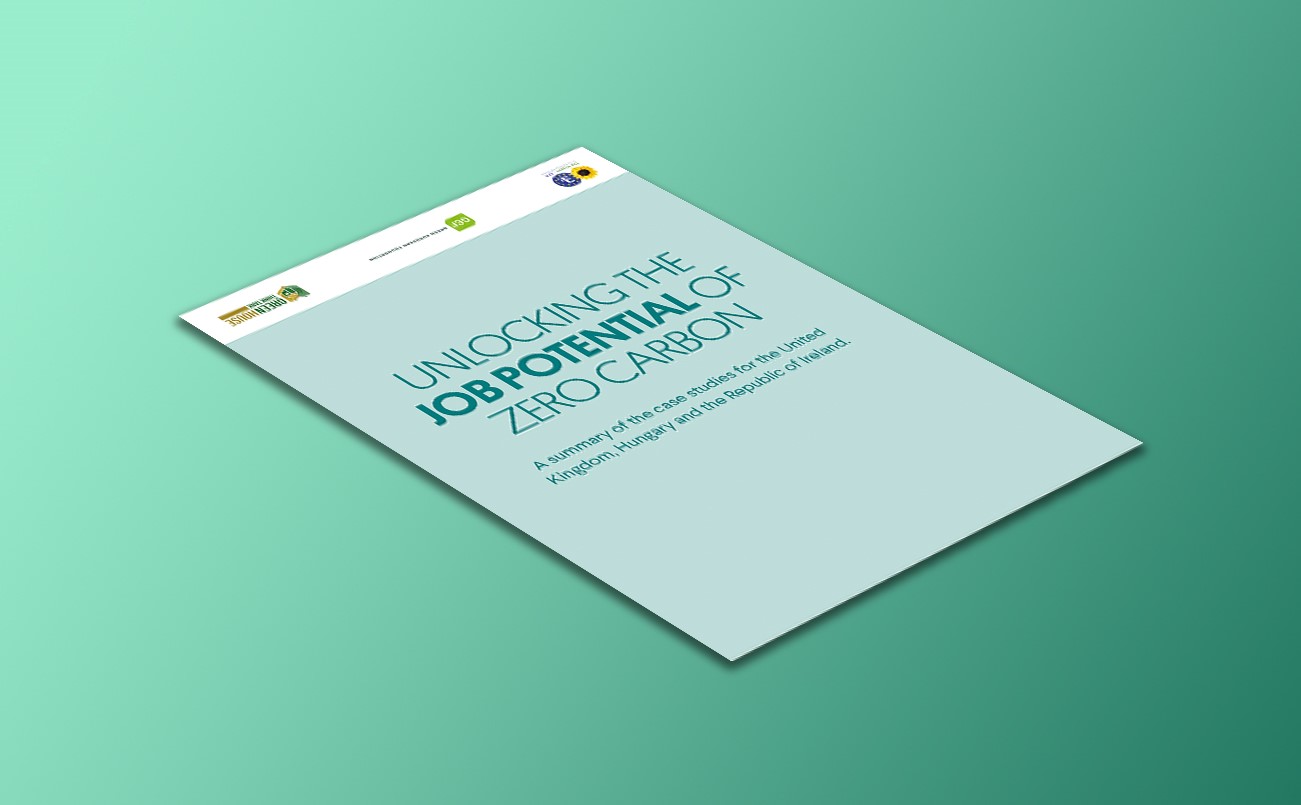
Unlocking the Job Potential of Zero Carbon – Summary

By Uncategorized

This publication is the summary of the full report “Unlocking the Job Potential of Zero Carbon”, which is the result of the Green European Foundation transnational project “Strengthening Climate Targets, Creating Local Climate Jobs”, conducted with its partners Green House Think Tank (United Kingdom), Ecopolis (Hungary) and Green Foundation Ireland.

Meeting the challenge of climate change requires structural changes to the economy so that it is no longer dependent on fossil fuels: we need to reduce overall energy use and ensure that all the energy that we do use is from renewable sources. This will require the creation of a large number of new jobs.

The Green European Foundation, with the support of Green House Think Tank, has developed a model to estimate the number of jobs that would be created in key sectors of the economy, to not only demonstrate that a transition is achievable but to also show where those jobs will be.

This model has been applied to the United Kingdom,  as well as to Ireland (with the support of Green Foundation Ireland) and Hungary (with the support of Ökopolisz Alaptivány). The methodology used in that work and its results are presented in this report.

Download your copy here.

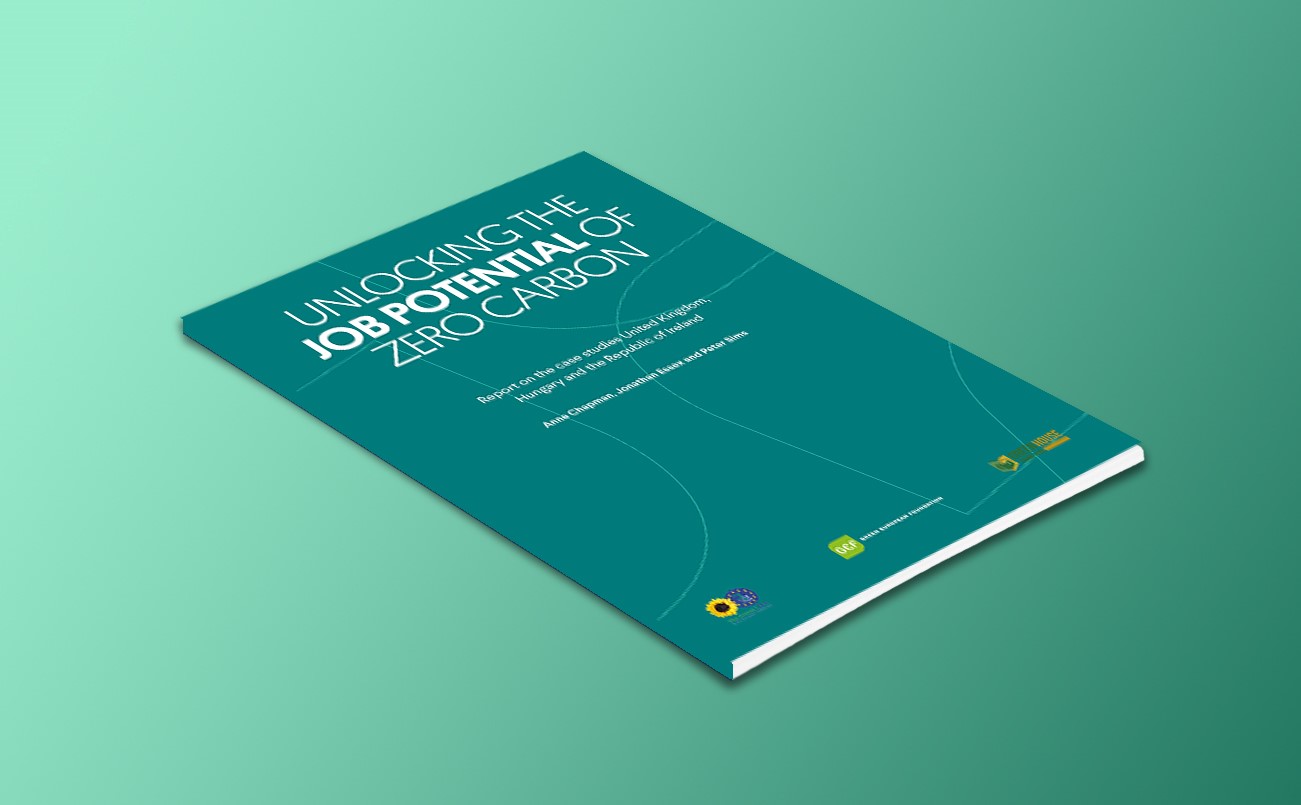
Unlocking the Job Potential of Zero Carbon – Full Report

By Uncategorized

This report is the result of the Green European Foundation transnational project “Strengthening Climate Targets, Creating Local Climate Jobs”, conducted with its partners Green House Think Tank (United Kingdom), Ecopolis (Hungary) and Green Foundation Ireland.

Meeting the challenge of climate change requires structural changes to the economy so that it is no longer dependent on fossil fuels: we need to reduce overall energy use and ensure that all the energy that we do use is from renewable sources. This will require the creation of a large number of new jobs.

The Green European Foundation, with the support of Green House Think Tank, has developed a model to estimate the number of jobs that would be created in key sectors of the economy, to not only demonstrate that a transition is achievable but to also show where those jobs will be.

This model has been applied to the United Kingdom,  as well as to Ireland (with the support of Green Foundation Ireland) and Hungary (with the support of Ökopolisz Alaptivány). The methodology used in that work and its results are presented in this report.

Download your copy here.

This publication is also available in Hungarian, which can be read here. 

The appendix can be accessed here.

A summary of the report can also be found here. 

Following on from the work conducted for this report, GEF’s partner Green House Think Tank conducted further research into climate jobs modelling for regions in the UK, which can be found on their website here.


Food Community

Restoring Food to the Heart of the Community (Cork)

By

Context

The broadening and deepening of global food production and supply has been a powerful force of economic, social and environmental transformation for the last three decades or more with profound changes, not only to farming systems that become locked into industrial commodity production, but also to adverse environmental effects leading to major ecological ruptures: The productivist agri-industrial model has achieved a remarkable grip over the policy agenda surrounding food security. Yet the consequences include growing concern over emissions of greenhouse gases and impacts upon biological diversity.

The summer school will propose policy changes not only in response to the review of the EU Common Agricultural Policy (CAP) which is taking place in 2018 but also to the Milan Urban Food Policy pact. The European Commission’s communication on the review of the CAP states that climate change and preserving the environment is the main challenge facing the EU, and the CAP must play an enhanced role in this battle – not only to protect farmers from the impact of climate change but also to ensure that farming does not contribute to making the problem worse. Stringent new goals will be set at European level to ensure farming contributes fully to helping meet the EU’s international commitments on climate change and sustainability.

About the event

The Summer University is organised in collaboration with academics, local policy makers, artisan producers, community food security NGOs and local growers. Its objective is to discuss a new policy which can develop a new healthy, sustainable and resilient food system. The aim is to improve equitable access to quality food, create a fairer and sustainable food system, and reduce the environmental footprint of food.

Programme

Friday, June 29

19:30 Welcome reception and opening address

  • Nuala Ahern (Green Foundation Ireland)
  • Colin Sage (School of the Human Environment in UCC and Chair of the Cork Food Policy Council)
  • Duncan Stewart (Chair of Green Foundation Ireland).

Saturday, June 30

09:30 – 09:40 Welcome and introductions

09:40 – 10:20 Dr Colin Sage Why we must restore food to the heart of community

10:20 – 11:00 Cristina Grasseni Food citizenship: Sustainable food procurement in cities

11:20 – 12:00 Oliver Moore re-CAP: Food and Farming Policy in Europe

12:00 – 12:40 Regina Sexton Cork: City of Food

12:45 – 13:30 Debate and Discussion

16:15  St. Stephen’s Sustainable Food Lab: Talk on food growing

17:15  Nano Nagle Place: Heritage experience

Speakers


Colin SageDr Colin Sage – Senior Lecturer in Geography at UCC with research interests in food systems, environmental policy and civic initiatives for social change. He is the author of Environment and Food (2012) and co-editor of Transdisciplinary Perspectives on Transitions to Sustainability (2017), Food Transgressions: Making sense of contemporary food politics (2014) and Strategies for Sustainable Development. Colin is honorary Visiting Professor on the Food Studies program at the American University, Rome as well as at the University of Gastronomic Sciences near Turin, Italy, and has just completed a Visiting Research Fellowship at the University of Tasmania.  He is strongly committed to public engagement and is Chair of the Cork Food Policy Council which he co-founded in 2013.
Dr Christina Grasseni – Professor of Anthropology at the University of Leiden, Netherlands. Her research interests lie broadly in economic, political and visual anthropology, focusing especially upon skilled visions and ecologies of belonging. She is the author of Beyond Alternative Food Networks (2013) which analysed Italy’s solidarity economy networks as ethnographic models of grassroots transition to sustainable consumption and food sovereignty. Her most recent book, The Heritage Arena (2017) unravels the political agency of heritage cheese in the reinvention of local economies and ecology in the Alps. Cristina currently leads a major European Research Council project, Food citizens? Collective food procurement in European cities which examines the premises and consequences of collective forms of food production, distribution and consumption in three European cities.
Dr. Oliver Moore – has a PhD in the sociology of farming and food and writes in the field of organics, direct selling and consumer-producer relations. He is a contributor to the Irish Examiner where he writes a weekly column on organic food and farming. A member of the Irish Food Writers Guild he also contributes to Food and Wine magazine, and to Organic Matters magazine. Dr. Moore is Communications Manager with ARC2020, an EU agri-food and rural NGO based in Paris and also maintains a lively and informative blog. He is a board member and active organiser for Cloughjordan Community Farm and Cloughjordan Ecovillage. In 2015 he participated in the La Via Campesina Forum for Agroecology in Nyéléni Mali.

Regina Sexton – a food historian, food writer, broadcaster and cook. Her research interests include food and identity, food and tradition and food in the Irish country house. She has published widely at academic and popular levels. Her publications include A Little History of Irish Food (Gill and Macmillan, 1998) and Ireland’s Traditional Foods (Teagasc, 1997). At University College Cork, she lectures in the area of food history with the School of History, the Food Industry Training Unit and Adult Continuing Education. Her research interests encompass food and culinary history, food preservation, food and identity, ’traditional‘ food cultures, and constructed and ‘invented‘ food traditions.  ‍ Regina is secretary of the Agricultural History Society of Ireland.
Registration

The Cork Summer University will cost €40 per person (plus booking fee), which includes wine reception on Friday evening as well as morning coffee and dinner on Saturday. Please note this does not cover the cost of lunch on Saturday.

To attend the Summer University in Cork, you can order your tickets here.

The Potential Impact of Brexit on the Prospects for a Green Transition in Europe

By Uncategorized

Context

In a referendum on 23 June 2016, 51.9% of the participating UK electorate (the turnout was 72.2% of the electorate) voted to leave the EU. On 29 March 2017, the British government invoked Article 50 of the Treaty on the European Union. The UK is thus on course to leave the EU on 29 March 2019.

This event has enormous implications not only for the future of the EU as a polity, but also for the green transition to a sustainable society and economy which is the fundamental aim shared by Green parties across Europe. The Green European Foundation therefore decided, with the help of its national project partner organisations, coordinated by Green House think tank in the UK, to hold a series of public discussion events over the course of 2017 to explore those implications.

About the project

The project aimed to examine these questions on a comparative European basis, involving selected EU member states for which Brexit raises particularly pressing issues, related either to their relationship with the UK or to their own national political situation (or both).

The rationale behind the project was two-fold. Firstly, it was intended to provide a platform for the exploration of the possible short- and medium-term impacts of Brexit on environmental and economic policies directly affecting the transition to sustainability, both in the UK and in the rest of Europe. Secondly, it was motivated by the belief that the Brexit decision in the UK raises urgent and difficult questions about the continuing coherence and effectiveness of the EU as a polity, at least in its current form, and whether it still represents the best vehicle for the achievement of sustainability in Europe in the long term.

The results and key finding are summarised in this paper. Free digital version is available for download below.

Transition to Sustainability in Europe post-Brexit (Belfast)

By

The event is a part of the ongoing transnational project “The potential impact of Brexit on the prospects for a Green transition in Europe” which attempts to support the much-needed public discussion of Brexit’s impact on individual Member States, as well as on the EU level, while exploring what this means for the Green movement’s endeavour in the transition to sustainability.

Debate in Belfast

“Transition to Sustainability in Europe post-Brexit” will be a one day event, consisting out of critical debates in which prominent speakers will provide insights into potential impacts of Brexit in the context of Ireland and the EU.

What are the implications and impacts of Brexit for the Green transformation of Europe? Are there progressive political potentials in the wake of the referendum decision in the UK last June and the ongoing political turmoil it has created? How should Greens and other progressives understand the rise of populism across Europe? And what are the likely impacts of Brexit for the island of Ireland?

All thematic sessions and confirmed speakers are listed below:

1. Brexit and Progressive Politics (10h – 11h)

SPEAKERS:

  • Ray Cunningham – Green House Think Tank
  • Steven Agnew – Green Party Northern Ireland
  • Stevie Nolan – Trademark
  • Chaired by John Barry – Queen’s University Belfast

2. Brexit and Sustainability in Northern Ireland, the UK and Europe (11h15 – 12h30)

SPEAKERS:

  • Emily Hunter – RSPB
  • Nichola Hughes – SNI
  • James Orr – Friends of the Earth
  • Chaired by John Barry – Queen’s University Belfast

3. Brexit, the Border and Futures for Ireland and Northern Ireland (13h30 – 15h30)

SPEAKERS:

  • Clare Bailey – Green Party Northern Ireland
  • David Phinnemore – Queen’s University Belfast
  • Mark Daly – Senator, Fianna Fáil
  • John Kyle – Progressive Unionist Party
  • Katy Hayward – Queen’s University Belfast
  • Chaired by John Barry – Queen’s University Belfast

4. Roundtable discussion on ‘Populism, Brexit and the European Green Movement’ (16h – 17h30)

SPEAKERS: 

  • Dick Pels
  • Lee McGowan – Queen’s University Belfast
  • Chaired by Ray Cunningham – Green House Think Tank

Please note that the programme is not finalised yet, more updates to come soon!

Registration

This event is free of charge and open to everyone. To confirm your attendance, please register here.

For more information please contact the Green Foundation Ireland via email to info@greenfoundationireland.ie!

“Green Values, Religion and Secularism” in Dublin

By

The project Green Values, Religion and Secularism

Following the successful implementation of the project Green Values, Religion and Secularism over the past two years, and the publication of a book under the same name, this conference addressed themes which arose from the seminars held during the past year to promote the book, and which were outlined in the concluding project report at the end of 2016.

The Conference

In an era of trending populism, the conference intended to remind a wide audience of both academia and Green activists of the necessity to consider the values underpinning European democracy and civil society and to engage in a dialogue to educate a wide public on Green viewpoints on how these values can be practiced in the world today. The event aimed at engaging in dialogue with academics on and religious communities on Green values and with Greens on the topic of religious and philosophical values. Therefore, the debate built on the following themes, which emerged during the project activities over the past two years.

Programme

The green critique of modernity approaches a religious critique of humanism, understood as humans being the measure of all things. Green values are also critical of the idea of the isolated individual as the basis of social and economic life. What are the core values which inspire ecological and social activism?

9:30-13:00h MORNING SESSION

Welcome and Introduction: Andrew Pierce on behalf of the Irish School of Ecumenics Trinity College and Nuala Ahern on behalf of Green European Foundation and GFI.

Chair Dr Geraldine Smyth (Adjunct Associate Professor, ISE): ‘What are the core values which inspire ecological and social activism?’

  • Dr Erica Meijers (Theologian and Co-Editor of ‘Green Values, Religion and Secularism’): the work of the German poet Novalis shows that the critical tradition of the Enlightenment and the longing for a world that is whole has always belonged together.They can both contribute to an inclusive humanism today.
  • Dr Andreas Weber (Biologist and cultural change expert): Only a science, politics and economics that puts the living world at its heart will be truly sustainable. Andreas discusses the idea that nature is a living commons and is not only about competition, but also about the commoning activities of a myriad of individual agents living in an ecosystem.
  • Dr Cathriona Russell (Assistant Professor in Theology, TCD): Integrating the good life and duty in environmental ethics.
  • Dr John Feehan (Geologist, botanist and environmental philosopher): Science, Spirituality and the Tao: Inching towards a Deeper Consilience.
  • Followed by Q&A session.

14:15-17:00h AFTERNOON SESSION

Chair Dr Andrew Pierce (Head of Discipline Irish School of Ecumenics): Spirit has been conceived as superior to the earthbound and the carnal in western philosophy since the Greeks, Moreover spirit has been located in the male mind and sexuality and materiality in the female body. Does the papal encyclical ‘Laudato si’ alter the idea of sin to include the desecration of the material world?

  • Dr John Dillon (former Regius Chair of Greek at Trinity College, founder and Director Emeritus of the Plato Centre);
  • Dr Mary Condren (Centre for Gender and Women’s Studies TCD; Director of Womenspirit Ireland);
  • Dr Jacob Erickson (Assistant Professor, Loyola Institute);
  • Catherine Devitt (Environmental Justice Officer, Jesuit Centre for Faith and Justice);
  • Followed by Q&A session.

More information

Registration: For more information, contact the Green Foundation Ireland.
Date & Time: 1 July 2017, 9:30-17:00
Venue: Trinity College Dublin, Irish School of Ecumenics

Green Values, Religion and Secularism Report

By Uncategorized

The project Green Values, Religion and Secularism was about dialogue and plurality within the Green movement. For two years, we have been debating and reflecting in a conversation on the relationship between secular and religious values in a political context. We published a collection of interviews and we conducted and took part in debates, seminars and media events. In this report, we try to give a small glimpse into the topics we talked about and the insights we gained.

In the publication and in the seminars two major themes were discussed. Firstly, the interconnectedness of religious or secular values and political attitude; secondly, the role of religion in the public forum. Topics that came up were the difficulty of defining religion and its changing role in society; conflicts between religions and fundamental rights, such as the freedom of religion and the principle of sexual and gender equality; the role of Islam in Europe and the relationship between spiritual worldviews and the struggle for a sustainable and just society.

The wide network of the Green European Foundation and its partner foundations were crucial in exploring these topics reflecting deeply on culture and identity in Europe. In this report, you will find a summary of the themes discussed as well as some recommendations how the Greens could proceed with this urgent debate on the relation between religions and secularism both in society as in our parties

Book Launch of ‘Green Values, Religion and Secularism’ in Dublin

By

Published by the Green European Foundation in December 2015, the book details the ways in which Green politicians from different European contexts reflect on the relationship between politics and religion, both in their own lives and in society.

Six European Green Foundations participated in conversations on religion, Green values and secularism with Green activists and politicians from across Europe: from Austria, Belgium, France, Germany, Greece, Ireland, The Netherlands, Poland and Turkey.

Find out more about the publication here.

Included in the book are three Irish interviewees: John Barry, Trevor Sargent and Mary White. All participated in the event, which was launched by eco-theologian Seán McDonagh.

The event took place on Friday 8th April at the European Parliament Offices in Dublin.

“European Migration: Causes and Effects” Dublin Summer School 2016

By

This year’s Summer School in Dublin focused on how civil society can manage migration and the attitudes towards it in a positive and constructive way, with a broader remit of linking migration to poverty and indeed to climate change and general Green issues. Furthermore, this event specifically addressed the situation in Ireland and its role as a Member State of the European Union in finding solutions to this humanitarian crisis.

LIST OF SPEAKERS:

  • Barry Andrews (Chief Executive Officer of GOAL)
  • John Barry (Professor of Green Political Economy at QUB)
  • Nessa Childers (Independent MEP for Dublin)
  • Valerie Cox (RTÉ journalist)
  • Catherine Devitt (Environmental Justice Officer, Jesuit Centre for Faith and Justice)
  • Sandy Dunlop (Terenure Initiative)
  • Mark Fielding (Chief Executive Officer of ISME)
  • Brian Killoran (Chief Executive Officer of Immigrant Council of Ireland)
  • Maria Giovanna Manieri (Advisor on Migration and Asylum for the Greens/EFA, European Parliament)
  • Duncan Stewart (Broadcaster and Chair of Green Foundation Ireland)


LOCATION: National College of Ireland, IFSC, Dublin 1

VIDEOS: Video recordings of the insightful lectures from this event are available in this link.