Class of 2014: New Green Voices in the European Parliament

By Uncategorized

Back in 2009, when the Green European Foundation and the Heinrich Böll Foundation gathered, for the first time, the ambitions of newly elected Green Members of the European Parliament (MEPs) in a yearbook, the European Union was a different type of affair. The effects of the financial and economic crises were not yet in full swing, austerity measures had not yet become the buzz-word of the political agenda, and the climate summit in Copenhagen was still preserving the hope that the European Union would deliver on its promises to be the world’s climate champion. Although clouds were on the horizon, the general mood in European circles was still very much business as usual.

Five years later, we are faced with a different scenario. The effects of the economic and financial crises, as well as the social impact of the austerity-driven response to these crises, had raised existential questions about the future of the European Union. Euro-scepticism reached unprecedented levels, and parties campaigning on explicitly anti-European platforms made gains across the Union. Citizens’ movements reacting to austerity measures imposed by “Brussels” made clear the popular disenchantment with a political establishment that seemed keener on bailing out banks than safeguarding jobs and welfare. There were times as recent as two years ago when the European Union seemed to be facing “make it or break it” types of challenges.

Even though this urgency has passed for now, the crisis is far from over. This is the background in which the newly-elected Green MEPs will be working over the next years.

New challenges, new voices

In a context where anti-European debates are likely to be placed in the spot-light, the challenge for the new Green Group will be to articulate their criticisms to the various EU policy approaches that venture off the paths of sustainability, equity, democracy and respect for fundamental rights, while keeping an overall pro-European narrative. Among this new Green group, there are many new, first-time parliamentarians. They will need dedication, imagination and an understanding of the need to reach out to civil society and grassroots movements to come up with successful policy approaches to the difficult tasks ahead: setting ambitious climate targets; tackling energy security and energy poverty; bringing prosperity back to the EU; ensuring a humane migration policy, and responding to new geopolitical realities.

The articles that make up this collection detail the new MEPs’ ambitions, expectations and analyses of the opportunities and challenges lying ahead in their specific policy fields. The articles discuss both the visions of the EU that they are bringing to Brussels, by reflecting on the messages picked up during the elections’ campaigns, as well as how these visions translate in a Green working project in the European Parliament. The contributions describe the biggest challenges for the upcoming years on topics such as greening the economy, transforming energy policy, building a democratic EU, creating a human-rights based migration policy, positioning the EU as a strong and fair global player in areas of trade, agriculture, foreign affairs – to mention but a few. Finally, the authors reflect on their ambitions from the various policies they’ll be focusing on and note their expectations for their parliamentary mandate.


Icon

Class of 2014 EN 1.75 MB 66 downloads

...
Icon

Class of 2014 FR 2.39 MB 154 downloads

...
Icon

Class of 2014 DE 2.41 MB 54 downloads

...

Read articles in other languages

Parts of the articles are available also in the respective native languages of the authors: Catalan, Croatian, HungarianSwedish and Spanish.

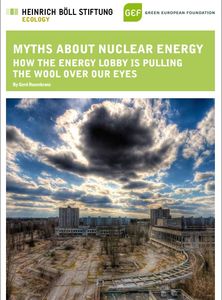
Myths of nuclear power – a guide

By Uncategorized

The publication highlights several common misconceptions regarding nuclear energy. One such misconception emphasises that supporting nuclear energy does not set back the development and spread of renewable energy sources, and that nuclear power plants can be a “bridge” between dirty and clean energy systems. This misconception has resulted in increased government investments throughout the world in improving and building new nuclear power plants rather than concentrating on safe, clean and not so costly renewable energy, as well as on promoting and investing in increased energy efficiency.

The publications below examine these issues in a forthright manner, and outline the reasons why atomic energy does not constitute a real solution to our energy problems.

The Green European Foundation has translated one of the studies, “Systems for change: Nuclear Power vs Energy Efficiency and Renewables” into Italian to facilitate the debate on the topic in more parts of Europe.


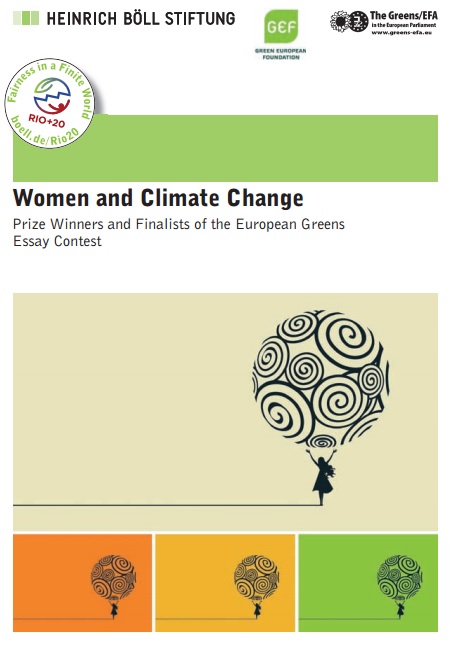
Women and Climate Change

By Uncategorized

The published essays are very diverse, but they all concur on one point: gender equality and the fight against climate change are two challenges that have to be tackled simultaneously and urgently. Adaptation to climate change seems to be the realm of women in countries across Africa, Asia and South America. They are often the ones working the land and getting water to feed their families, while they do not have control over the land they work on or the major decisions about where and how to live. Many contributions from developing countries are included in the publication, which reveal that the level of awareness of this topic in developing countries is much greater than in Europe. Gender, as often, is the blind spot of the academic and political debate on climate change. It is high time that more attention is paid to the women’s hardships as well as their inspiring solutions.

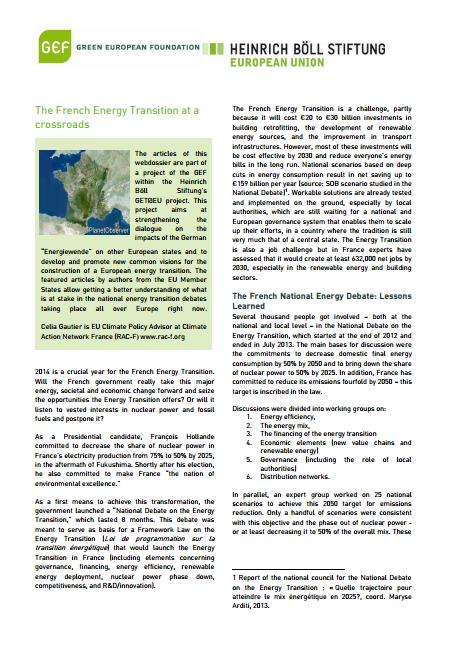
The UK, France, Poland and the future of EU energy policy

By Uncategorized

The French government is currently working on plans to reduce France’s reliance on nuclear energy and adopt ambitious CO2 reduction goals. The roadmap for this will be presented in an ambitious energy law, expected to be published later this year. Celia Gautier from Reseau Action Climate France outlines the current debate and highlights some of the challenges faced.

The UK, meanwhile, is facing an uncertain energy future, with efforts by some to impose uncertain CCS (carbon capture and storage) and risky fracking for shale gas in to the country’s energy mix. But what does this mean for its future investment in renewables? Mark Johnson from the European Policy Centre gives an overview of the situation.

Poland is a country in need of a major energy transition, yet the concept of widespread use of green energy is yet to take root. What concrete steps can be taken to change this? Andrzej Kassenberg, co-founder and president of the Institute for Sustainable Development Poland, provides some ideas.

The articles of this web dossier are part of a project of GEF within the Heinrich Böll Stiftung’s GET@EU project. This project aims at strengthening the dialogue on the impacts of the German “Energiewende” on other European states and to develop and promote new common visions for the construction of a European energy transition. Events as part of this project took place in LondonParisBrussels and Warsaw.