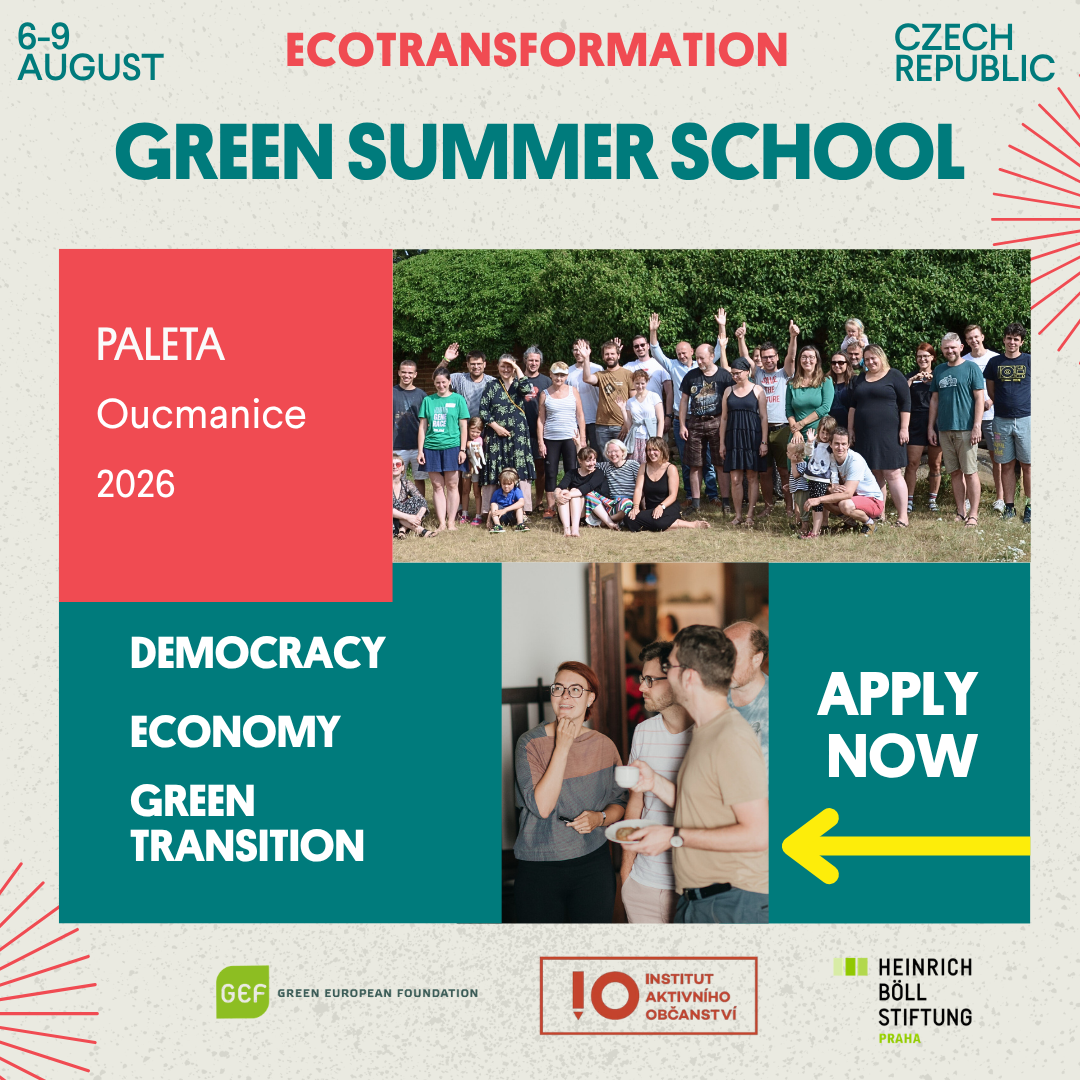
Join us for a four-day gathering in the Czech Republic to explore how we can defend democracy, build resilient communities, and drive a fair green transition in turbulent times.
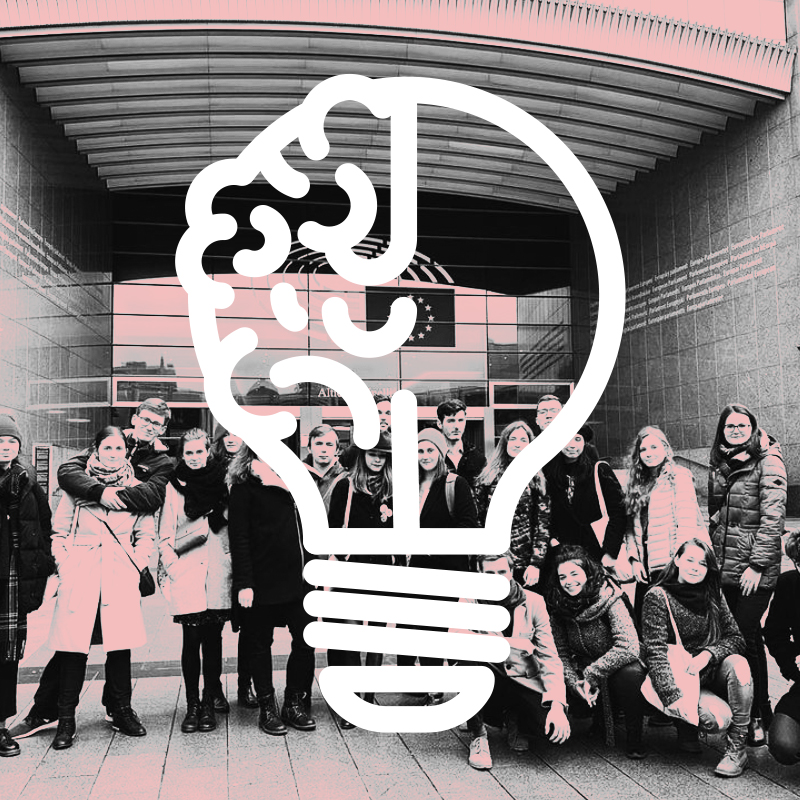
Read MoreDuring this three-day study trip, participants will have the chance to explore various topics such as political ecology, lobbying and just transition in Brussels through engaging with professionals, politicians, NGOs and other activists operating in and around the European institutions, as well as with each other.
With a range of formal and non-formal training methods, including interactive workshops, the trip will be a valuable learning experience for young activists brought together by Green values and a motivation to enact change.
The European Green Activists Training (EGAT) consists of training sessions for young Green activists in various phases. These include the completion of the online course EU for Beginners, the participation in national training sessions in their respective countries on domestic politics, as well as on European politics and institutions. The final stage is the study trip, which brings all the participants from across Europe together in Brussels.
The EGAT project aims to Europeanise existing training programmes for Green activists in several European countries by incorporating more pan-European content and to make these programmes more cooperative by enabling young activists to meet and network.
Tuesday March 5 –Kick off!
Wednesday March 6
Thursday March 7
This event is organised by the Green European Foundation with the financial support of the European Parliament to the Green European Foundation. The European Parliament is not responsible for the content of this event.
Sign up for Accumulator and become one of 15 young activists! You don’t need a CV full of experience. What’s important is the motivation to change things around you .During this programme, you will explore different aspects of politics and activism with experts in green issues, including journalists, academics, experts, and politicians. We will awake your sense of initiative and support your skills in advocacy, teamwork, campaigning, and work with the media. Together we will go through a whole range of approaches and tools that will help participants do their bit to change the world for the better. It is important for us to connect theory and practice. Besides practical skills, we will focus on important cross-cutting themes such as climate change, education, feminism and more.
In addition, you will become a member of a wide alumni network, which includes all former participants who today are often engaged in activism, politics and other exciting projects. Together we organize a big alumni weekend every summer where we get together to share our experiences.
We are starting this year’s Accumulator with a weekend at the end of October 2023, in the spring of 2024 we will meet in Brussels with young people from Finland, Lithuania, Latvia, Spain, Poland and Croatia who are delving into similar programmes as the Accumulator.
If there is any obstacle (for example financial, or regarding health or language) that could prevent you from participating in the project, let us know and we will adjust the program and conditions so that you can still participate. The accumulator is an open and inclusive space and all young people are welcome to apply despite their background.
Apply HERE by August 27!
Our goal is that all selected applicants are able to participate in the Accumulator, regardless of financial possibilities. Nevertheless, we ask for a solidarity fee to be able to fund all the activities. Please consider what your personal financial contribution possibilities are for the realization of the Accumulator. You can let us know the amount of your contribution when filling out the application form HERE. Please note that the amount of the contribution you are able to provide won’t influence the selection process.
The EGAT Akumulator consists of two weekend trainings and separate preparation for these trainings. It also includes a one-week study trip to Brussels, which is preceded by the EU for Beginners e-learning course and a preparatory meeting that will take place over a day the week before the visit to Brussels.
1. Accumulator, 20 – 22 October 2023, Veronici Centre, Hoštětín
SYSTEM ERROR: How to change it?
During the first weekend, we will get to know each other and decide how we want the entire Accumulator to work together. We will share our expectations, fears, experiences, and motivations. In short, we will try to create a safe environment for everyone to feel good and positive about the training.
We refer to the time in which we live in different ways. However, the common denominator is often the word “crisis”. We are talking about a climate, economic, global, energy crisis, but also a crisis of imagination. During the first weekend training, we will cover a little bit of all of the above. Through formal and non-formal education methods, we will try to think together about how individual crises are related to each other and try to examine problems at system level.
With a focus on deepening the ability to think systemically, we will try to understand the basic concepts that we will work with during the following weekends. We will talk, for example, about capitalism, but also globalization and colonialism.
At the end of the weekend, we should have a unified level of knowledge, clarified shared values and a deepened ability to think systems.
2. Accumulator, November 24-26, 2023, ČSOP Hostel, Vlašim
ENVIRONMENTAL MOVEMENT: From where and where?
From theory to practice. First, we will clarify the theoretical roots of political ecology, then we dive into activist political practice. Who are the green actors? What and who is involved in the environmental movement? How to become part of the change? We will solve all this during the second weekend together with specific actors from environmental organizations and platforms, for example Greenpeace, Fridays for Future or Re-set. In addition to activism, we will also explore the waters of politics with members of three political parties – Pirates, Greens and Future.
Finally, we will focus on creating campaigns. What to watch out for? What is the good practice of well-known environmental organizations?
3. Preparation for a study stay in Brussels, March 2024, one day (online or offline)
The main topic of the third weekend will be the European Union. The Impact Europe e-learning course will allow us not to have to deal with how the EU works all weekend, and we can then go straight to a critical discussion about its pros and cons and the relationship between its policies and the policies of the Czech Republic. We will talk about how political processes at the national and European level can be realistically influenced. At this meeting, which will take place online or offline, we will share practical information about the study trip to Brussels. At the same time, we will open here some of the topics that are dealt with at the European level by experts, MEPs and activists that we will meet in Brussels.
4. (BST – Brussels Study Trip) Study stay in Brussels, spring 2024
EUROPEAN GREEN ACTIVIST’S TRAINING – EGAT
Accumulator takes place in various forms simultaneously in Finland, Croatia, Spain, the Czech Republic, Poland, Lithuania and Latvia. Participants from these countries will meet for a one-week excursion in Brussels to share knowledge from individual trainings and take a look behind the scenes at the activities of the institutions of the European Union. We will visit the European Parliament and meet people who work in various positions in Brussels. Even with several members of the European Parliament.
But Brussels is not only about the EU, and we will have the chance to learn about local initiatives and how grassroots activism is done in a place where European politics intersects with Belgian politics.
Non-formal education lecturers Zuzana Kašparová and Miriam Macurová will guide you through the training and excursion to Brussels. Both have been active in the field of alternative education for several years and educate young people to take an active approach to public affairs. They themselves are socially engaged in the topics that will be discussed at the trainings. Both were members of the non-profit educational organization Be International. Zuzana is dedicated to the feminist project Vyhonit dábla, she is the author of the program “Na zachodce” for CT, she is involved in the activist crip collective and lectures on a freelance basis, for example sex education or intercultural competence. Miriam works as a campaigner and expert on European climate policy at Greenpeace, where she is also part of the environmental education program. The program is thus created on the basis of real experiences from the public space.
The program itself is based on meetings with people from practice, i.e. politicians, journalists, experts and activists, who will introduce the participants to politics and public events based on their experience.
In addition to workshops and guest lectures, the program is based on informal education. His methods are based on working in groups with an emphasis on individual initiative. So what you get from the Accumulator depends on how much you put into the training. An important part of the educational process is the sharing of experiences and reflection.
In informal education, they learn by experiencing and trying new things, which not only leads to new information, but also to the acquisition of practical skills and thinking about values. It is not graded, it does not know the role of the teacher, it is voluntary and the participants are themselves responsible for what they learn.
Developing the ability to work in a group is essential for the Accumulator. Although everyone takes away newly acquired skills and knowledge, we believe that the ability to collaborate collectively is crucial when trying to change the world around us and when involving other people in future activities.
This EGAT programme is organised by Green European Foundation with the support of Institute of Active Citizenship and with the financial support of the European Parliament to the Green European Foundation.
During the three-day study trip, participants will have the chance to explore various topics such as climate justice and lobbying in Brussels through engaging with professionals, politicians, NGOs and other activists operating in and around the European institutions, as well as with each other.
With a range of formal and non-formal training methods, including interactive workshops, the trip will be a valuable learning experience for young activists brought together by Green values and a motivation to enact change.
The European Green Activists Training (EGAT) consists of training sessions for young Green activists in various phases. These include the completion of the online course EU for Beginners, the participation in national training sessions in their respective countries on domestic politics, as well as on European politics and institutions. The final stage is the study trip, which brings all the participants from across Europe together in Brussels.
The EGAT project aims to Europeanise existing training programmes for Green activists in several European countries by incorporating more pan-European content and to make these programmes more cooperative by enabling young activists to meet and network.
Tuesday March 7 – Getting to know each other, the green movement and the green family
Wednesday March 8– Visit to European Parliament and Activism in practice
Thursday March 9 – Lobby in the EU and visit to the European Parliament
This event is organised by the Green European Foundation with the financial support of the European Parliament to the Green European Foundation. The European Parliament is not responsible for the content of this event.
With a focus on the Eastern flank of Europe, the 2022-2023 debates series seeks to enrich green and political ecology discourse. The series aim to provide spaces to hear the voices of green actors, peace and security experts, as well as partners from different regions. The goal of the Peace & Security Debate Series project, which we are developing in cooperation with the Czech organisation Institute for Active Citizenship, is to analyse the different approached to the crisis caused by Russia’s invasion of Ukraine, as well as other topics related to peace and security at a European level.
The discussion during this roundtable will explore how the Czech green movement has approached issues such as security, foreign policy and pacifism and what positions it should advocate for in the future. This event will also touch upon the European Green Charter as a document that frames the basic principles of green politics and will consider improvements in security and pacifism in light of current circumstances.
Moderation by Adéla Jurečková, Head of Office, Heinrich Boell Stiftung Prague
Date and Time: December 12 from 16:00-17:30 CEST
Location: Heinrich Boell Stiftung Prague Office, Jugoslávská 567/16,120 00 Prague 2, Czech Republic
Registration: This is a closed event
This event is organised by the Green European Foundation with the support of Institute for Active Citizenship and with the financial support of the European Parliament to the Green European Foundation. The Euroapean Parliament is not responsible for the content of this event.
As part of EGAT you will take part in a three-weekend training session taking place in different locations of the Czech Republic, as well as an international study trip. The program will run from the first weekend of October 2021, until March 2022, when the trip to Brussels will take place alongside young activists from Finland, Hungary, Spain, Poland, Greece, and Croatia, who are part of similar trainings.
During this programme, you will explore different aspects of politics and activism with experts in the field, including journalists, academics, experts, and politicians. We will awake your sense of initiative and support your skills in advocacy, teamwork, campaigning, and work with the media. Together we will go through a whole range of approaches and tools that can change the world around. It is important for us to connect theory and practice. Besides practical skills, we will focus on important cross-cutting themes such as climate change, education, feminism and more.
The training program consists of 2 national trainings, the online course EU for Beginners and the study tour in Brussels with a short preparatory meeting beforehand.
1st meeting: “Another world is possible!”
October 28th – 30th, Toulcův Dvůr, Prague area CZ
Welcome to the Akumulátor and EGAT, get engaged! Including practical workshops with external guests about the imagination and upcoming campaign on energy poverty in Czechia.
2nd meeting: “It’s all about campaigning!”
December 9th – 11st, Paleta Oucmanice, Pardubice area CZ
Critical approach to the (social) media content with journalist Vojtěch Boháč and campaigning strategies.
3rd meeting: “Why GRL PWR is not enough and is the future feminist?”
February 10th -12th, Kaprálův mlýn, Brno area CZ
Feminism, gender and intersectionality in the context of central and easter Europe. Among others including workshop about feminism in the climate movement, where we connect the climate crisis with feminist issues.
4th meeting: “Czechia + EU = ?” Towards the common Europe critically
TBC Half day online meeting before Brussels study tour
Brussels study tour: Spring 2023
Please note: Due to the particular circumstances during the COVID-19 pandemic, all activities could potentially be subjected to changes depending on the epidemiological data and any restrictive measures and guidelines at that time. Some parts of the programme involving travel may take place online.
This training is open to participants between age 15 and 23. You don’t need experience in activism or politics to apply, it is your motivation to make a change and impact that counts!
The sliding fee for the whole training is 5000 CZK (circa 200€). While writing your application, you can choose how much you can afford to pay. Institute of active citizenship will cover the remaining sum. We don’t want anyone to be excluded because of the money and the amount of your contribution doesn’t play any role in the selection of the participants!
Apply through this application form until September 10th, the decisions will be informed by September 6rd. Altogether 15 participants will be selected for the course.
For more information in Czech click here.
This EGAT programme is organised by Green European Foundation with the support of Institute of Active Citizenship and with the financial support of the European Parliament to the Green European Foundation.
During the five-day study trip, will have the chance to explore various topics such as climate justice and lobbying in Brussels through engaging with professionals, politicians, NGOs and other activists operating in and around the European institutions, as well as with each other.
With a range of formal and non-formal training methods, including interactive workshops, the trip will be a valuable learning experience for young activists brought together by Green values and a motivation to enact change.
The European Green Activists Training (EGAT) consists of training sessions for young Green activists in various phases. These include the completion of the online course EU for Beginners, the participation in national training sessions in their respective countries on domestic politics, as well as on European politics and institutions. The final stage is the study trip, which brings all the participants from across Europe together in Brussels.
The EGAT project aims to Europeanise existing training programmes for Green activists in several European countries by incorporating more pan-European content and to make these programmes more cooperative by enabling young activists to meet and network.
Monday 30th May– Getting to know each other and working together!
Tuesday 31st May – Green movement from a political perspective
Wednesday 1st June– Activism, Culture and Community
Thursday 2nd June – Lobby in the EU: the good and the bad
About previous editions:
This event is organised by the Green European Foundation with the financial support of the European Parliament to the Green European Foundation. The European Parliament is not responsible for the content of this event.
The quick transformation of European energy is one of our biggest challenges today. Russia’s attack on Ukraine, and thus on democracy and fundamental freedom, has shown that investment in renewable energy production and storage is crucial not only for tackling the climate crisis and mitigating its effects but also as part of a strategy to increase European security and our energy independence.
Unfortunately, the Czech Republic is still lagging behind in this regard. Will the amendment to the Energy Act bring a change that sets rules for community energy production? What can cities and municipalities do today to promote renewables and increase energy self-sufficiency? The ongoing crises highlight the need for significant changes in how we operate as a society, how we manage limited resources, care for the natural environment, and care for each other. What is the role of politicians, activists and other partners in achieving such change? How can we support each other and spread green ideas? These are the questions we’d like to debate this during this summer school.
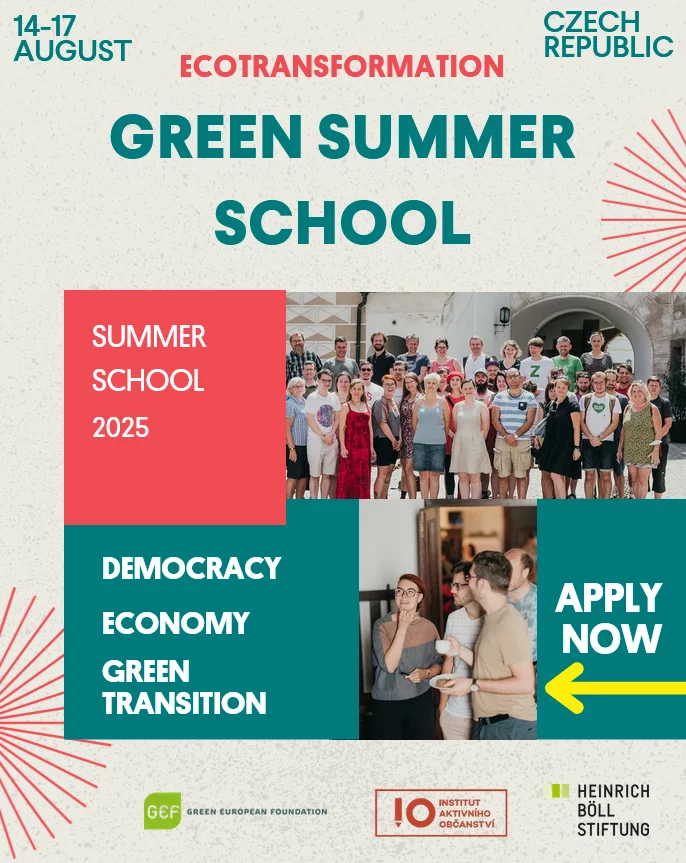
Ecotransformation is an environmental policy summer school, but it’s also a weekend full of interesting seminars, debates, presentations and experiential workshops aimed at helping you develop skills to drive green social change. In this third edition, we will focus on the following areas and topics:
We invite anyone passionate about green policy and wanting to take an active part in promoting it. This event can be beneficial for people interested in environmental issues who want to explore how to implement practical sustainable solutions such as activists, researchers, students, scientists, teachers, politicians, journalists and so on.
THURSDAY 14 JULY
19:00–21:00 Public Debate: Pacifism and green values in the light of the war in Ukraine
Dagmar Tutschek (Co-president of the Green European Foundation and chair of FREDA, Austria)
Kateřina Vnoučková (Faculty of Social Science, Charles University in Prague)
Moderator: Michal Berg
FRIDAY 15 JULY
9:00–9:45
Introduction & Ice-breakers
Klára Berg (GEF)
10:00–11:00
Community energy – experience from Austria – Michael Sigmund, Vice Mayor of Pressbaum, Austria
Modern waste management – example of good practice – Jan Pažin, Choceň Town Councillor
11:15–12:45
The energy revolution: reducing our dependence on Russian fossil fuels – Patrícia Čekanová, Association of Community Energy of the Czech Republic
14:30–16:00
Organizing the climate movement – Klára Bělíčková, Klára Suková, Fridays for Future Czech Republic
Walking tour of Litomyšl – Citizen participation in the design of urban public space – Daniel Brýdl, Litomyšl Town Mayor
16:30–18:00
Community energy projects: energy self-sufficiency of municipalities – Jiří Krist, Local Action Group Opavsko
Active hope – doing activism sustainably (workshop) – Martin Nawrath, therapist and facilitator
20:00–21:30
Debate: Barriers and opportunities for engaging women in active citizenship
Anna Kárníková (Friends of the Earth Czech Republic)
Klára Bělíčková (Fridays for Future Czech Republic)
Eliška Koldová (cooperative SdruŽeny)
Moderator: Marie Sehnalová
SATURDAY 16 JULY
9:00–10:30
Group Work & networking
Klára Berg (GEF)
10:45–12:15
Building communities – experience from Poland (workshop in English) – Dagmara Kubik, Rzecz Społeczna
Ageing in the city, cities friendly to older people – Marcela Petrová Kafková, Department of Sociology, Faculty of Social Studies, Masaryk University in Brno
14:30–16:00
How to engage religious communities in environmental issues – Marek Drápal, Czech Christian Environmental Network (ČKES)
Light pollution – Hynek Medřický, the lighting expert
16:30–18:00
Klimavize – the future of the Czech climate movement – Tereza Navarová, klimavize.cz
Citizens’ assemblies as a tool for change – Andrea Culková, filmmaker, author of the documentary Citizens’ Assemblies
20:00–21:30
Civil society in Ukraine before and during the war (helping activists in occupied Ukraine) – Milan Štefanec, NESEHNUTÍ
SUNDAY 17 JULY
9:00 – 12:30
Open space – an opportunity to bring your own topics
Date: 14. 07- 17. 07. 2022
Location: Castle Hill in Litomyšl
Price: The price of the registration fee includes accommodation and meals
– basic amount of fee 990 CZK
– reduced fee 650 CZK
– sponsorship fee (any amount over 990 CZK)
The reduced fee is intended for those participants who, for whatever reason, cannot afford the basic fee – we do not require any justification. If you can support the event with an amount higher than 990 CZK, we will use it to pay the total budget.
Accommodation: the price of the registration fee includes accommodation in 2-4 bed rooms with shared bathroom facilities.
If you have questions or special requests for accommodation, do not hesitate to contact us.
Meals: we provide common vegan / vegetarian meals for all participants throughout the event.
Registration: Registrations are now closed for this summer school
Contact person: Martina Dušková, project coordinator, martinaduskova@yahoo.co.uk
– We look forward to seeing you in July!
This event is organised by the Green European Foundation, with the support of the Institute for Active Citizenship and the financial support of the European Parliament to the Green European Foundation.
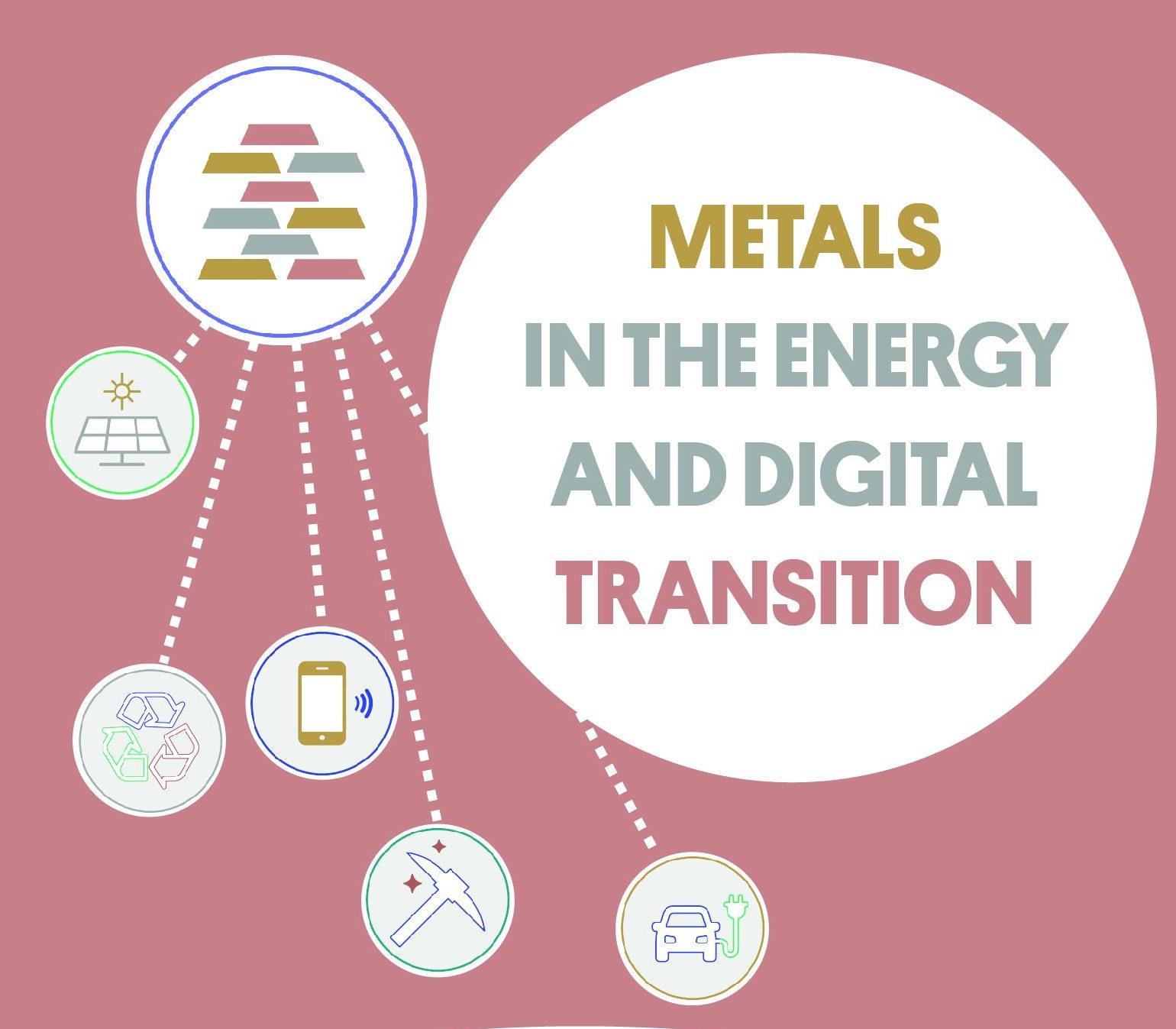
The climate crisis leaves us no choice but to make a swift transition from fossil fuels to renewable energies. However, while energy from renewable sources such as solar and wind is nearly infinite, the resources we need to capture it are not. Solar panels, wind turbines, batteries, and power cables all contain metals. Their various properties, including toughness and conductivity, make metals uniquely suitable for renewable energy technologies. But first they must be extracted from ores that are dug up from the ground. Because of its decentralised nature, a renewable energy system requires far larger quantities of metals than a fossil energy system.
The more energy we harvest from the skies above our heads, the deeper we will have to dig for the metals beneath our feet.
Both the energy transition and the digital transition require large quantities of metals, such as lithium, cobalt, and rare earth. As a result, Europe must face up to various types of scarcity. This Agenda for Action sets out how we can achieve the sparing, circular use of metals and the responsible sourcing of the virgin metals that we really need.
Available in Dutch
Available in Spanish
Available in Czech
Available in French
Available in Polish
Available in Swedish
Available in Serbian
Available in Portuguese
This publication is part of the Metals for a Green and Digital Europe project. The project is led by Wetenschappelijk Bureau GroenLinks and supported by Fundacja Strefa Zieleni, Institut Aktivního Občanství, the Green Economics Institute, Etopia, Visio, and Transición Verde, with Cogito from Sweden providing additional expertise.
You will participate in a three-weekend training session taking place in different corners of the Czech Republic and in an international study tour to Brussels. The program starts on the first weekend of October 2021, and will closure in March 2022 as we meet in Brussels with young people from Finland, Hungary, Spain, Poland, Greece, and Croatia, who are undergoing similar training courses.
What can you learn?
How to step into the public space and make an impact. We will explore different fields in politics with activists, journalists, academics, experts, and politicians, who will be our guests as part of the training.
We will awake your sense of initiative and support your skills in the field of activism, teamwork, campaigning, or work with the media. Together we will go through a whole range of approaches and tools that can change the world around. It is important for us to connect theory and practice.
In addition to practical skills, we will focus on important cross-cutting themes such as climate change, education, feminism and more.
The training program consists of 2 national trainings, the online course EU for Beginners and the study tour in Brussels with a short preparatory meeting beforehand.
1st meeting: October 1st – 3rd, Fara Skramníky , CZ
Welcome to the Akumulátor and EGAT, get engaged!
2nd meeting: December 17th – 19st, Toulcův dvůr (Praha area), CZ
Feminism, gender and intersectionality + practical workshop about fundraising
3rd meeting: January 29th, online
“Czechia + EU = ?” Towards the common Europe critically, preparation for Brussels study tour, not financed by GEF
Brussels study tour: February 2022
Please note: Due to the particular circumstances during the COVID-19 pandemic, all activities could potentially be subjected to changes depending on the epidemiological data and any restrictive measures and guidelines at that time. Some parts of the program involving travel may take place online.
The training course is open for the participants between age 15 and 23. You don’t need to have any experiences with any kind of activism or politics, it is your motivation to make a change and impact that matters!
The sliding fee for the whole training is 5000 CZK (circa 200€). Sliding fee means, that while writing your application, you can choose how much of the real costs you can afford to pay. Institute of active citizenship will cover the remaining sum. We don’t want anyone to be excluded because of the money and the amount of your contribution doesn’t play any role in the selection of the participants!
Apply through this application form until August 27th, the decisions will be informed by September 6rd. Altogether 15 participants will be selected for the course.
For more information in Czech click here.
This EGAT programme is organised by Green European Foundation with the support of Institute of Active Citizenship and with the financial support of the European Parliament to the Green European Foundation.
Today, more than 70% of people in the Czech Republic live in cities. For most of us, the city has become a major environment. The appearance of urban space is fundamentally reflected in the quality of our lives. But cities also have a significant impact on their surroundings. They contribute significantly to the production of carbon emissions and thus contribute to climate change. Urban sustainability is one of the keys to solving many global problems.
This July, we will discuss ideas and inspirations on how to build healthier, greener and more resilient post-pandemic cities. We will explore topics such as sustainable urban mobility, supporting healthy local food, introducing principles of the circular economy or climate neutrality at the urban level, and how these concepts impact the quality of life in cities.
Promoting change towards a more sustainable future requires cooperation with many partners. We must communicate our ideas in an inclusive way and invite others to the dialogue. This is why we traditionally include practical workshops in the program, for example on communicating climate change, or how to link municipal policy and local activism in a divided society. Like planetary resources, our powers are not unlimited, so we will also find time for tips on how to take care of your mental health and not burn out.
This is the second edition of the Ecotransformation summer school, which seeks to empower (local) politicians, activists, academics, and engaged citizens to better understand key green and environmental issues and act for change in their own communities. With a mix of traditional debates and presentations, but also skill-building workshops and more open and informal networking spaces, the summer school inspires, connects, and activates participants for a lasting impact.
And many more!
A weekend full of interesting seminars, debates, presentations and experiential workshops awaits us.
Thursday, July 22nd
19:00 – 21:00 Public debate: Green Recovery of Europe, with Lucie Trlifajová (Institute of Sociology of the Czech Academy of Sciences) and Barbora Bakošová (Re-Set)
Friday, July 23rd
9:00 – 9:45 Icebreaker with Klára Berg (GEF)
10:00 – 12:00 Parallel sessions: Air Quality in Cities / How to Talk about the Climate Crisis
14:30 – 16:00 Parallel sessions: Modern Waste Management of Cities / Mental Wellness – Forest Mind
16:30 – 18:00 Parallel sessions: Re-use Centres / Gender-Sensitive Budgeting and Public Spending
20:00 – 22:00 Debate: Cooperation of Progressive Environmental Movements in Politics, with Michal Šmarda, Michal Berg and others
Saturday, July 24th
9:00 – 10:30 Parallel sessions: Metals for a Green and Digital Europe / Visual Smog in Cities
11:00 – 12:30 Parallel sessions: Transport and Sustainable Urban Development / Email Marketing and Copywriting
14:30 – 16:00 Parallel sessions: Urban Green Space Management in Times of Climate Change / Guided Arboretum Walk
16:30 – 18:00 Parallel sessions: A Charter for the Smart City / Communal Politics and Local Activism in a Time of Social Division
20:00 – 22:00 Mental Wellness: Self-Care in Politics and Activism
Sunday, July 25th
9:00 – 12:30 Open Space – time for participants’ own ideas and contributions
Date: 22-25 July
Place: Kostelec nad Černými lesy, Czech Republic
Price: The registration fee includes accommodation and meals.
The reduced fee is intended for those participants who, for whatever reason, cannot afford the basic fee. We do not require any justification. If you can afford to contribution more than CZK 990, we will use it towards the project costs.
The registration fee includes accommodation in rooms of 2-3 beds with shared bathroom facilities. It is possible to book accommodation in 2-3 bed apartments for an additional fee of 100 CZK / person / night.
Full board meals will be provided starting with dinner on Thursday (22/07) until lunch on Sunday (25/07). Vegetarian food will be provided.
Registration: This summer school will take place primarily in Czech. Advance registration is required via the registration form here.
After completing the application, you will receive a confirmation by email and instructions on how to pay the registration fee. Only after payment will your application be valid.
If you have any questions or difficulties, please contact Martina Dušková at martinaduskova@yahoo.co.uk.
Please note that we continue to closely monitor the local COVID-19 situation. Any activities will take place in full compliance with the required hygiene measures, and participants will be informed accordingly.
This event is organised by the Green European Foundation, with the support of the Institute for Active Citizenship and the financial support of the European Parliament to the Green European Foundation.
During the four-day event, the green-minded youth will have the chance to explore various topics such as climate justice and lobbying in Brussels by engaging with professionals, politicians, NGOs and other activists operating in and around the European Institutions, as well as with each other.
Throughout the event, the participants will have the opportunity to discover and learn from the various other countries. Through a variety of team building and icebreaker sessions, participants will present and share information about their countries and find points of common interests and as well as differences.
With a range of formal and non-formal training methods, including interactive workshops, the trip will be a valuable learning experience for young activists brought together by Green values and a motivation to enact change.
The European Green Activist Training project aims to Europeanise existing training programmes for Green activists in several European countries by incorporating more pan-European content and to make these programmes more cooperative by enabling young activists to meet and network.
Wednesday 21 April– Welcome note
Thursday 22 April and Friday 23 April- Team building, discovering and influencing the European Union
Parallel sessions:
Saturday 24 April– Climate, economy and environment
Workshops:
Sunday 25 April: Online Activism
The exact details and timings of the programme are to be confirmed, please check back later for more information.
This years EGAT edition is supported by: Ökopolisz (Hungary), Green Window (Croatia), Institute for Active Citizenship (Czechia), Visio (Finland), Fundacja Strefa Zieleni (Poland), and Fundació Nous Horitzons (Catalonia).
If you would like to take part in the next generation of EGAT, there will be a call for participant applications in late summer 2021 in the Czech Republic, Croatia, Finland, Hungary, Catalonia, Poland and Greece.
During the event we will reflect on:
Do we have enough raw materials in Europe to produce the required amount of batteries?
Can we mine the necessary rare metals such as lithium, cobalt and rare earth without the risk of major damage of the environment?
Don’t we risk depending on the purchase of precious metals from developing countries or dictatorial regimes, where mining neglects the dignity of workers and excessively devastates nature?
Given the lithium deposits in the Czech Republic, can the production of batteries be an opportunity for Czech companies on the European or world market? Do we have technologies that can recycle metals from obsolete batteries, making the energy storage sector part of the circular economy? Is there room for Czech companies in the field of battery recycling?
These are some of the questions we will address in the presentations and discussion.
The event will be moderated by Martin Ander, Chairman of the Institute.
Where: Online platform – ZOOM
Date and time: Wednesday, 28th April from 15:00 to 17:00 CET.
Audience: this webinar is open to the general public
Registrations: Click here
Language: simultaneous interpretation Czech – English will be provided for this event
This event is organised by the Green European Foundation with the support of Institute for Active Citizenship
and with the financial support of the European Parliament to the Green European Foundation. The European Parliament is not responsible for the content of this event.
How is the Covid-19 pandemic changing our perspective of urban mobility? Can we use it as an opportunity to push for greater sustainability? What is the relation between urban cycling, business prosperity, healthy and resilient cities?
In the new webinar from the Czech Green Academy series, we will look at sustainable urban mobility from the perspective of cities and the Covid-19 pandemics.
⚠ Please note that after Bart Dhondt’s intervention, the event will be in Czech language only.
When: Tuesday 9 March from 18:00 to 19:30
Where: Zoom platform – you will receive access details by e-mail after registering here: https://forms.gle/MC3xqXwKeHfg8d6E7
We most cordially invite all those who are actively involved in promoting green policies at the local and regional level, and anyone else interested in sustainable living topics.
For further details visit the website of the Institute of Active Citizenship https://www.aktivniobcanstvi.cz/zelena-akademie
The Czech Green Academy is organized by the Green European Foundation with the support of the Institute of Active Citizenship and the financial support of the European Parliament to the Green European Foundation.
How do we imagine the future of our agriculture? Can local and regional governments ensure that their land is cultivated in harmony with nature and the needs of the people?
Can food self-sufficiency go hand in hand with sustainability, biodiversity protection and a fair system for small farmers?
In this new webinar from the Czech Green Academy series, we will look at environmentally friendly agriculture and local food production:
⚠ Please note that after Dirk Holeman’s intervention, the event will be in Czech language only.
The event is taking place on Zoom platform – you will receive access details by e-mail after registering here: https://forms.gle/oYJAKeEmwv5tsRh97
We most cordially invite all those who are actively involved in promoting green policies at the local and regional level, and anyone else interested in sustainable living topics.
For further details visit the website of the Institute of Active Citizenship https://www.aktivniobcanstvi.cz/zelena-akademie
The Czech Green Academy is organised by the Green European Foundation with the support of the Institute of Active Citizenship and the financial support of the European Parliament to the Green European Foundation.
What is the new EU action plan for the circular economy? What opportunities does the new national waste legislation bring to municipalities? How to reduce the total amount of waste and deal sustainably with biodegradable waste in cities?
In the new webinar from the Green Academy series, we will look at the latest trends in waste management:
The event is taking place on Zoom platform – you will receive access details by e-mail after registering here: https://forms.gle/9hy8go4sRVHUaW7J7
We most cordially invite all those who are actively involved in promoting green policies at the local and regional level, and anyone else interested in sustainable living topics.
For further details visit the website of the Institute of Active Citizenship https://www.aktivniobcanstvi.cz/zelena-akademie
The Green Academy is organised by the Green European Foundation with the support of the Institute of Active Citizenship and the financial support of the European Parliament to the Green European Foundation.
In November, GEF is launching the Green Academy with the support of Institute for Active Citizenship.
The Academy will offer those interested in enforcing climate and other green policies, especially on the local and regional level, the opportunity to learn more about respective topics and practical solutions, discuss ideas and network across regions in Czechia.
GEF will implement a series of regular, maximum 90 minutes long, online participatory workshops and webinars with content devoted to one particular topic for each session.
3 dimensions of the topic will always be explored: the European, national and local one.
2 speakers will be invited to each of the workshops; presenting current developments in the topic at the European level (EP), explaining links to the Czech state politics and legislation and specific local projects that would serve as inspiration for specific activities at the local level. The seminars will take place every 4-6 weeks. Currently, four instalments until end-March are planned.
Thematically, the workshops will focus on climate-related policies, such as energy, waste management, Blue-green infrastructure, mobility, CC adaptation, degrowth etc.
In the first webinar of the Green Academy series, we will look at reducing carbon emissions and promoting renewable energy sources from the perspective of local and regional authorities. We will focus on practical steps that cities or regions can take towards carbon neutrality and greater energy self-sufficiency.
The event is taking place on Zoom platform – you will receive access data by e-mail after registration here: https://forms.gle/qkB6eJurkQPomyS5A
The Green Academy is organised by the GEF – Green European Foundation with the support of Institute of Active Citizenship with the financial support of the European Parliament for the Green European Foundation.
During the EGAT course, participants learn about Green values, meet politicians and experts working at the frontline of fighting for positive change, and of course connect with plenty of other like-minded young people!
The course gives them insights into the political decision-making processes on the national and European levels, develop skills as an activist to enact societal change, and explore how Green values promote more equal and sustainable societies.
The aim of EGAT is to familiarise trainees with the institutions of the European Union, green topics, green policies, and sustainable development policies, and through various activities and discussions with representatives of international organizations and representatives of the European Union, to explore opportunities for active and professional involvement in building a greener and more just society.
The training course will be comprised of two weekend training sessions in the Czech Republic, an online course, a preparation session for the Brussels trip and then culminating with a one-week study trip to Brussels to visit the European Institutions alongside EGAT participants from other countries.
Czech Republic- Institute for Active Citizenship- October 24, 25
Programme: introduce EGAT programme, explore motivations and expectations of programme, presentation of Young Greens, workshops on different methods of civic participation.
2. Second national training
Czech Republic- Institute for Active Citizenship- November 20-21
Programme: focusing on the topics of feminism, gender, and social media strategies in the online era, participants will create educational content to use for their very own campaigns. Workshops on the topic of social networks and how they work as a marketing and educational tool.
3. Third national training
Czech Republic- Institute for Active Citizenship- January 29-31
This international webinar will offer local government representatives, politicians, municipal officials, as well as academic experts and practitioners from Czech and Slovak cities the opportunity to share their experiences and be inspired by the practices of other cities.
We will discuss how to strengthen the environmental qualities of cities through citizens’ participation. For example, through presenting various examples of using citizens as motivated amateur scientists, equipping them with modern technologies for direct data collection.
This project is a part of the GEF transnational project “A Charter for the Smart City II”.
All over Europe, so-called ‘smart cities’ are the testing grounds for new technologies that affect how we live, how we organise our societies and what our ethical foundation is. Given the opportunities that new technologies offer for reducing the ecological footprint of cities and creating new urban commons, but also the potential threats they pose to civil liberties and social justice, GEF aims to stimulate the debate on smart cities.
To this end, GEF has developed, with the support of its partners, a Charter for the Smart City, consisting of guiding principles that will make it easier for green European politicians and activists to assess and steer technological innovations in their cities. Throughout 2019, ideas were solicited digitally and through events across Europe, including best practices from NGOs, experts, and local green politicians, as well as from GEF partner foundations and other Green European actors. These resulted in the published Charter for the Smart City.
9:00-9:05 Welcome
9:05-9:15 Richard Wouters (NL)
9:15-9:35 Alena Bartoňová (NOR)
9:35-9:50 Thomas Van Oppens (BE)
9:50-10:05 Dana Mareková (SK)
10:05-10:20 Michal Šindelář (CZ)
10:20-10:30 Discussion and conclusions.
The conference will take place via videoconferencing platform Zoom in Slovak, Czech and English. Simultaneous English-Slovak interpretation will be provided
Participation in the online conference is free, only electronic registration is required here: https://forms.gle/7CNYS8krsHGToAEs5
——
This conference is organised by the Green European Foundation with the support of Institute for Active Citizenship and Wetenschappelijk Bureau GroenLinks with the financial support of the European parliament to the Green European Foundation