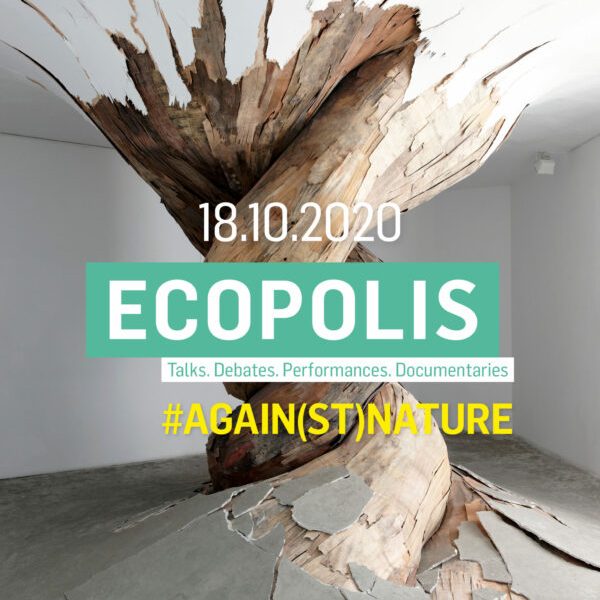
Ecopolis – Again(st) Nature (Brussels, Belgium)

By

About Ecopolis: 

Anno 2020. Nature is on fire, from Australia to the Ardennes. Forests are felled, no more insects on the windshield, concrete everywhere, a million species are in danger of extinction. A virus turns the world upside down. The exploitation of nature is threatening our existence. Vulnerable groups here and in the South are facing even harder times.

How much longer do we saw off the very branch that supports us? Or do we change course?

Ecopolis 2020 puts the finger on the pulse and looks ahead. What are the post-corona challenges? How do we feel part of nature again? How do we restore the balance? How does this support a vigorous climate and nature policy? Which transitions are necessary ― urban, agricultural, etc. ― for a society that respects people and nature? And gives everyone prospect of a good life.

Ecopolis 2020 is moving online, follow the event at home via livestream.

Due to the recent increase of coronavirus infections, we have had to take a difficult decision. This year’s edition will have no live audience, and will move entirely online. We will build a cosy studio on the Kaaitheater stage and stream the lectures and conversations directly to your living room, with opportunities for online interaction.

Speakers:

  • Jan Rotmans, Urgenda
  • Warda El-Kaddouri, De Groene Amsterdammer
  • Yousra Benfquih, University of Antwerp
  • Hans Van Dyck, UCLouvain
  • Tom Bauler, Université Libre de Bruxelles
  • Hendrik Schoukens, Ghent University
  • Anuna De Wever, climate activist
  • Eva Meijer, Wageningen University
  • Myriam Dumortier, Ghent University

And many more names to be announced!

Programme:

11:00 – 12:30 | Corona lessons for a resilient society

The corona crisis has taught us that you cannot just cut down forests or deal carelessly with animals endlessly. Outsourcing all production to low-wage countries is also no longer an option. How do we build resilient societies that are ecologically and socially durable?

A panel discussion with Myriam Dumortier (bio engineer and senior researcher at INBO), Koen Vannmechelen (contemporary conceptual artist), Jan Rotmans (transition thinker) and Christine Van Acker (writer).

12:30 – 14:00 | Meet the animal

For centuries we have been intrigued by animals and have used them in our stories. Who does not know Reynard the Fox? Only recently have we learned how small the differences between humans and animals are. What does an understanding relationship with animals with recognition of their own abilities mean?

A conversation that explores new paths with: Eva Meijer (writer, philosopher and artist), Hans Van Dyck (professor Behavioral Biology), Hendrik Schoukens (environmental lawyer), Lisa Tostado (Heinrich Böllstiftung, which recently released the Insect Atlas).

14:00 – 15:30 | Transition to a fair agro-ecology

Agricultural soils are eroding, biodiversity is declining alarmingly. Fortunately, we see new agro-ecological farmers emerge. Through short-chain they restore contact with consumers while also taking care of the surrounding nature. The challenge is to make these innovative practices the new normal.

A conversation with Yousra Benfquih (lawyer, poet and columnist), Louis De Jaeger (landscape architect) and others.

15:30 – 17:00 | Cities full of nature and the barren countryside

It is at odds with what we think: the city is full of nature and agricultural areas are increasingly turning into deserts. But there is work to be done everywhere. For example, green space in the city is unevenly distributed and there is a need for a different vision of open space with reinforced village centers.

With Paul Demets (poet), Els Vervloesem (transition architect) and Tom Bauler (ecological economist).

17:00 – 18:00 | Final debate

The starting point is the question posed by the French thinker Bruno Latour: Where can we land? How can we “ground ourselves” and take care of our living environment, while being open to the world?

With Warda El-Kaddouri (researcher and journalist), Anuna De Wever (climate activist), Olivier de Schutter (UN special rapporteur on extreme poverty and human rights) and Dirk Holemans (coordinator of Oikos – Think tank for socio-ecological change).


Labiomista, Genk

In 2019 artist Koen Vanmechelen launched LABIOMISTA, an evolving work of art situated on the foundations of a former zoo in Genk (BE).

Vanmechelen is one of the most versatile thinkers of these times. He works at the confluence of art, science, philosophy and community. LABIOMISTA is the embodiment of his artistic and philosophical vision. It is based on the belief in art as a driver of mutual understanding and as a guide in the search for answers to the major challenges of the 21st century, the relationship between nature and culture and in particular the development of sustainable communities.

The 24-hectare park is a permanent and evolving work of art, a garden of order and chaos, an arena of culture and nature. It invites, challenges and inspires. It is a hotbed for a wealth of new ideas, creations, projects and collaborations; and a meeting place for all the species of this world.

Exclusively, the Ecopolis conversation is hosted in the artist private studio. Seats are limited. With your Ecopolis ticket you also have free access to the park.


Programme:

10:00 – 19:00 | Labiomista visit (cancelled)

LABIOMISTA is open from 10:00 to 19:00. Visitors can visit the park prior to or following the talks and should count 2 hours.

12:30 – 14:00 | Ecopolis Brussels livestream

Meet the animal

14:00 – 16:00 | Talks & debates

  • Introduction to Ecopolis: Again(st) Nature
  • Introduction to LABIOMISTA, by Koen Vanmechelen
  • Are we necessary? The position of the human animal. Panel discussion with Koen Vanmechelen, Ignace Schops, Glenn Deliège and Lara Klaassen, moderated by Peter Dupont


Translab K at CC ‘t Schaliken, Herentals

13:30 – 15:30 | Softening with an eye for biodiversity

Building on their experiments on ‘softening with an eye for biodiversity’, VormingPlus invites Stijn Neuteleers (environmental philosopher), Tim Vekemans (architect) and Liesl Vanautgaerden (program director for spatial development at the Department of Environment of the Flemish Government).

15:30 – 18:00 | Ecopolis Brussels livestream

15:30 – 17:00   Cities full of nature and the barren countryside

17:00 – 18:00   Final debate


Practicalities:

Ecopolis goes on! Of course, we take into account the current circumstances and corona measures.

Ecopolis 2020 is moving online

Facebook event >> https://bit.ly/34E2VY0


Tickets

KAAITHEATER, BRUSSELS

– 10€ all day

– 5€ half-day (11h-14h or 14h-18h)

– 5€ livestream

BUY NOW.


LABIOMISTA, GENK

10€ all day, including visit to Labiomista and exclusive access to the studio

Tickets are available here.


TRANSLAB K ― CC ‘T SCHALIKEN, HERENTALS

Free but registration required.

Register via wannes@translabk.be.


How to find us?


ECOPOLIS 2020
Sunday 18 October 2020, 11:00 – 18:00
Kaaitheater, Sainctelettesquare 20, 1000 Brussels
Labiomista, Marcel Habetslaan 50, 3600 Genk
Translab K ― CC ‘t Schaliken, Grote Markt 35, 2200 Herentals
HOW TO GET TO KAAITHEATER
ON FOOT. At 15 min. walking distance from Brussel-Noordstation.
BIKE. Bike parking in front of the venue; Villo-station at Square Saincetlette (across the canal).
METRO. Stop at Ijzer/Yser (lines 2 and 6)
TRAM. Line 51.
BUS. Line 47 (MIVB) or lines 129, 190, 212, 213, 214, 230, 231, 232, 233, 235, 240, 241, 242, 243, 246, 250, 251, 260 and 355.
—————–

This event has been organised by the Green European Foundation with the support of Oikos and with the financial support of the European Parliament to the Green European Foundation. The European Parliament is not responsible for the content of this event.

Climate Emergency Seminar (Barcelona)

By

About the Event

This seminar will tackle the issue of the climate emergency to stimulate a more lively public debate on the subject in Southern Europe. Throughout the day, representatives from academia, politics, and civil society will look at the different aspects of the climate emergency with a specific focus on the EU level as well as the situation in Spain and Catalonia.

Programme

10:10 WELCOME AND PRESENTATION OF THE DAY
Ernest Urtasun – MEP Green Group/EFA European Parliament
Susanne Rieger – Co-President Green European Foundation

10:20 PANEL: CLIMATE CHALLENGES, SPANISH AND CATALAN PERSPECTIVE
David Cid – Member of the Catalan Parliament, group Catalunya En Comú-Podem
Janet Sanz – 2nd Vice mayor of Barcelona for Environment, Urbanism, Infrastructures and Mobility
Koro López de Uralde – Climate activist
Andreu Escrivá – Environmentalist, adviser in Sustainability

11:45 COFFEE BREAK

12:15 PANEL II: CLIMATE CHALLENGES, EUROPEAN PERSPECTIVE
Ernest Urtasun – MEP Green Group/EFA European Parliament
Oriol Costa – Professor of International Relations at the Universitat Autònoma de Barcelona
Mar García – Secretary General of the European Green Party

13:45 CLOSING OF THE PLENARY AND PRESENTATION OF THE PRACTICAL WORKSHOPS IN THE AFTERNOON

14:00-16:00 LUNCH

16:00 PARALLEL WORKSHOPS

Energetical Challenges in Research and Development
Lourdes Berdié – Speaker of Network of Energetical Sovereignty

Food and Climate Change
Marta López Cifuentes – University of Natural Resources and Life Sciences, Vienna (BOKU) (Austria)

Mobility and Health
Pau Noy – President of the Foundation for Sustainable and Safe Mobility

Practicalities

The seminar will take place in English and Spanish, with simultaneous interpretation available.

Attendance at this seminar is free, but registration is required.
Please register your interest in attending by contacting fundacio@noushoritzons.cat


Details of this event are to be confirmed. Please check back later for more information. 

Green Academy Winter Seminar – Degrowth Kaleidoscope: Real-Existing Utopia(s) (Plitvička Jezera)

By

About the Event

The Green European Foundation, in cooperation with the Institute for Political Ecology, the Open Society Initiative for Europe and the Heinrich Böll Stiftung – Prague office, is organising the 3rd edition of the Green Academy Winter Seminar.

The seminar will focus on the ongoing debates around the Green New Deal and degrowth concepts and practices in the context of the climate emergency. Deeper avenues to be explored will look at the theoretical, political and practical level and identify convergencies and conflicts. The seminar will allow for exchanges to develop strategies for concrete change and policies.

Participants will be introduced to “degrowth doughnut” visualisations, underlining the cultural excesses and shortfalls in a democratic construction of a degrowth transition.

A “kaleidoscopic” perspective of the movement and various interconnections and differences will explore specific sectors where degrowth can make a fundamental difference, while also considering the significance of the emerging Green New Deal policies on both sides of the Atlantic.

Demands for a socially just and planned transition need to be articulated precisely in order to head off reactionary responses to the climate emergency. And this we shall redesign as we go, for the further Europeans slide into climate chaos without establishing a convivial sociality, the more likely we are to contend with authoritarian and inegalitarian powers to which emergency conditions often give rise.

The politics of this historical dynamic – the actors, alliances, institutions and social processes creating degrowth transitions is the subject of lively debate in Europe and beyond, shaping up right before our eyes. Given the fact that in 2020 Croatia will take over the EU Presidency, we will aim to explore ways how our thinking and actions can become turning points for Europe to be able to take another course.

Programme

FRIDAY 8th OF NOVEMBER

15:00 DEPARTURE FROM ZAGREB (ORGANISED BUS TRANSPORT – PARKING NEXT TO MAIN TRAIN STATION (ACCROSS IMPORTANE CENTRE ENTRANCE)

17:15 ARRIVAL TO HOTEL – CHECK-IN AND REGISTRATION

18:00 WELCOME NOTE AND INTRODUCTION

Vedran Horvat, IPE Zagreb, Head/Board of Directors, GEF

Nino Lejava, HBS, Head of Prague office

Jagoda Munić, FoEE, Director, Bruxelles/GA program council

Danijela Dolenec, Faculty of Political Sciences, Associate Professor,Zagreb/GA program council

Presentation of working groups: Clara Dellaire-Fortier, Nikolina Rajković, Andro Rilović, Ajda Pistotnik

EVENING CONVERSATION: ”DEGROWTH MOVEMENT, THOUGHT AND ACTION IN THE MIDST OF CLIMATE COLLAPS”

Evening conversation with Vincent Liegey, Cargonomia, Hungary/France

20:00 DINNER

SATURDAY 9TH OF NOVEMBER

09:00 MORNING LECTURETiziano Distefano

”Social cohesion in the ecological transition”

10:00 MORNING PANEL

GREEN NEW DEAL AND DEGROWTH – REAL-EXISTING UTOPIAS IN ACTION

With: Sean Sweney (TUED), Pawel Wargan (DiEM25), Marija Bartl (UA), Jagoda Munić (FoEE)

Moderated by: Danijela Dolenec and Vedran Horvat

11:30 COFFEE BREAK

11:30 WORKING GROUPS 1

  1. LABOR, DEMOCRACY AND DEGROWTH (Clara Dallaire-Fortier & Nina Rajković with Dario Farcy, Sean Sweney and Marija Bartl)
  2. DEGROWTH AND DEBT (Ajda Pistotnik with Mark Perreira and Tilman Hartley)
  3. DEGROWTH (&) MUNICIPALISM (Andro Rilović with Eugen Vuković, Eleanor Finley, Vincent Liegey)

13:30 LUNCH BREAK & WALK

17:30 WORKING GROUPS 2

  1. LABOR, DEMOCRACY AND DEGROWTH (Clara Dallaire Fortier & Nina Rajković with Dario Farcy, Sean Sweney and Marija Bartl)
  2. DEGROWTH AND DEBT (Ajda Pistotnik with Mark Perreira and Tilman Hartley)
  3. DEGROWTH (&) MUNICIPALISM (Andro Rilović with Eugen Vuković, Eleanor Finley, Vincent Liegey)

19:30 DINNER

21:00 DONUTS AND WINE EVENING TALK ON SUSTAINABILITY ON EUROPEAN (SEMI)PERIPHERY

  • Mladen Domazet
  • Clara Dallaire-Forter
  • Jenny Ufer
  • Branko Ančić

SUNDAY 10TH NOVEMBER

09:00 MORNING LECTURE

Petr Jiehlička, Open University, UK

Degrowth lessons from the European East: self-provisioning, sharing and the resilient food system

10:00 WORKING GROUPS 3

  1. LABOR, DEMOCRACY AND DEGROWTH (Clara Dallaire Fortier & Nina Rajković with Dario Farcy, Sean Sweney and Marija Bartl)
  2. DEGROWTH AND DEBT (Ajda Pistotnik with Mark Perreira and Tilman Hartley)
  3. DEGROWTH (&) MUNICIPALISM (Andro Rilović with Eugen Vuković, Eleanor Finley, Vincent Liegey)

11:30 BREAK

12:00 REPORTS FROM WORKING GROUPS

12:30 Post-growth awakening for EU: positioning degrowth agenda and international cooperation on climate action within the context of EU Croatian Presidency

Moderation: Dražen Šimleša

13:15 Closing

13:30 Lunch

14:30 Departure to Zagreb

17:00 estimated arrival


This event is a cooperation between the Institute for Political Ecology, the Green European Foundation, the Open Society Initiative for Europe and the Heinrich Böll Stiftung Prague office, with the financial support of the European Parliament to the Green European Foundation.

Ecopolis 2019: Generation Hope (Brussels)

By

Event Background

The past year has seen the remarkable rising worldwide of young people calling for action on the climate emergency: all across the world, the younger generations are bringing the debates on climate to the political forefront.

Ecopolis 2019 will focus on this inspiring “‘#GenerationHope”, exploring how we can ensure a sustainable future on our planet.

About the Event

Ecopolis is an annual conference held in Brussels and the perfect place to connect and discuss with others who are passionate about a sustainable future!

The ecological challenges we face are transnational and so Ecopolis is appropriately diverse, international and interactive to stimulate productive discussions.

Ecopolis will bring together Belgian and international authors and experts to debate on the transition to a socio-ecologically sound society. The conference will encompass inspiring books, documentaries and discussion sessions between academics, writers and civil-society thinkers on ecology, economy and society.

Speakers:

More speakers to be confirmed soon!

Anissa Boujdaini – Flore De Pauw – Mariyam Safi – Joke Hermsen – Christian Felber – Sofie Bloemen – Elvis Peeters – Arno Kempynck – Maeve Cohen ∙ Stijn Warmenhoven – Walter Lotens – Thomas de Groot – Christian Schwarzer – Arno Kempynck

For speaker profiles, please the Ecopolis website. 

Programme

10:30 – DOORS OPEN

11:00 – The Citizen Movement, the Government and Future Generations

Lecture performance by Dutch dramatists Anoek Nuyens and Rebekka De Wit.

11:30 – Can We Turn the Tide?

Discussion panel on the climate crisis, featuring Dutch writer Joke Hermsen, alongside climate activists from across Europe.

13:00 – Why Should We Still Study?

Discussion panel exploring the interplay between the climate crisis and education, featuring Post-Crash Economics Society founder Maeve Cohen, Austrian “Economy for the Common Good” movement founder Christian Felber, and UN Youth Representative on sustainable development Flore De Pauw.

14:30 – How to Unite Countries Torn Apart?

We will delve into the fragmentations evident in European societies and the challenges this poses to tackling the climate crisis with this panel discussion, featuring writer Elvis Peeters, and climate activists Stijn Warmenhoven and Mariyam Safi.

16:00 – Intermezzo:

Spoken word performance by Anissa Boujdaini

16:15 – Global Warming and the Male Meltdown – the interplay of misogyny, right-wing populism and climate denial

Debate discussing ecofeminism and the connections between anti-feminist movements and climate skepticism, featuring Sherilyn MacGregor (University of Manchester), Benedikte Zitouni (Université Saint-Louis), Leen Schelfhout (Extinction Rebellion) and Youna Marette (Manifeste de la Génération Climat), moderation by Bieke Purnelle.

18:00 – END

For the full programme description and list of speakers, please visit the Ecopolis website. 

Practicalities

Language

Simultaneous interpretation into Dutch, English and French will be available.

Directions to the venue

  • By foot – 15 min. walking distance for Brussel-Noord station.
  • By bike – bike parking in front of the venue; Villo-station at Square Saincetlette (across the canal)
  • Metro –  Stop at Ijzer/Yser (lines 2 and 6)
  • Tram – Line 51.
  • Bus –  Line 47 (MIVB) or lines 129, 190, 212, 213, 214, 230, 231, 232, 233, 235, 240, 241, 242, 243, 246, 250, 251, 260 and 355.

Tickets

Tickets can be purcahsed from the venue Kaaitheater website

Tickets cost 7 euro in presale and 10 euro at the door.


Further details of this event are to be confirmed, please check back later for more information.

The official website of the event can be found here. 

Univerde: Capitalism in Front of the Mirror – the Socio-Environmental Response to a Predatory System (Córdoba)

By

Event Background

The capitalist model of the 21st centuray has generated serious socio-evironmental crise, chiefly those of climate change and the degradation of biodiversity.

In the face of these challenges and the worryingly low levels of concern and action on the social and political levels, society must reflect on our future path to reverse the deterioration of the planet’s vital systems. The European Union needs to be a leader in the shifts to a more equitable and sustainable model.

About the Event

The 11th edition of the Green University in Spain, Univerde: Capitalism in Front of the Mirror – the Socio-Environmental Response to a Predatory System, will focus on the political and societal changes necessary to transition to a just and sustainable model. It will also explore the role of Europe as a leader in driving this change.

There will be particular focus on the topics of climate change, environmental refugees, geopolitics, conflicts over natural resources and Green policies versus the rise of the extreme right.

This event will allow for a political debate on the existing socio-economic model and the path forward, providing a space for exchange on good practices and real alternatives for a fairer, more equitable and respectful system for the planet.

Programme

FRIDAY 15
17:00 Welcome ceremony

17:30 Opening speech “Collapsing systems. Biophysical triggers of political situation”
• Nafeez Ahmed Mosadeqq, investigative journalist, author and academic

18:30 Break

19:00 Plenary Session “Understanding the system to change it”
It is increasingly clear that the capitalist system has ceased to increase the welfare of the majority
and is pushing environmental degradation to the limit. If we do not change course and overcome the
current social and economic model, the future will be seriously compromised. But to launch the
change we need to reflect on the system itself from different fields: political, educational, economic,
social …
Speakers:
• Antonio Campillo, philosopher and sociologist, professor of Philosophy at the University
of Murcia and former president of the Spanish Network of Philosophy
• Julio Anguita, teacher, politician and writer
• Lourdes Lucía, lawyer, editor, activist and co-founder of ATTAC Spain
Moderator: Manuel Bermúdez, Doctor of Philosophy, Professor in the Faculty of
Education Sciences at Córdoba University

SATURDAY 16
09:15 Parallel sessions
• Fake news and environmental crisis
Manuel Bermúdez, Doctor of Philosophy, Professor in the Faculty of Education Sciences at
Córdoba University
• Environmental migrations
Raquel Celis y Ana Ferri, CEAR Euskadi

11:00
Break

11:30
Keynote speech by Fernando Valladares, research professor of the Spanish Research
Council (CSIC) at the National Museum of Natural History (MNCN) and associated professor at the
Rey Juan Carlos University of Madrid

12:15
Plenary session “Biodiversity under threat”
Capitalism and its excesses are having terrible consequences on the biodiversity and ecosystems of
our planet. The latest IPBES report alerts us to its very serious situation and the threat of extinction
of more than one million animal and plant species in the coming decades. This loss and
deterioration of biodiversity on a global scale also puts humanity at serious risk by subtracting
possibilities for future generations to enjoy a decent and healthy life.
Speakers:
• Victoria Reyes García, environmental anthropologist. ICREA Research Professor at the
Institut de Ciència i Tecnologia Ambientals (ICTA) at Universitat Autònoma de Barcelona
• Pilar Marcos, environmental biologist, coordinator of the Biodiversity Area of Greenpeace
Spain
• Alejandro Sánchez, biologist, regional deputy, member of the board of Fundación EQUO
Moderator: Rosa Tristán, journalist

14:00
Break for lunch

16:00
Parallel sessions
• Basic Income as a tool towards the ecological transition
Julen Bollain, economist and researcher, member of the Basic Income Network and BIEN
(Basic Income Earth Network). Member of the Basque Parliament by Elkarrekin Podemos
Jorge Pinto, research associate at the Centre for Ethics, Politics and Society (University of
Minho, Portugal) and co-founder of the Portuguese party LIVRE
Lucía Baratech, economist specialized in Ecological and Social Economics. Member of the
Basic Income Network
• The emerging social movements
Yetta Aguado, Koro López de Uralde y Tomás Castillo, activistas por el clima

18:00
Break

18:30
Plenary session: “The EU and the challenge of an unplayable ecological transition”
In this panel discussion we will try to address the real capacity and possibilities of the European
Union to make a fair ecological transition from the current social and political situation; resistance
to change and progress made; its role, responsibilities and obligations globally.
Speakers:
• Ernest Urtasun, MEP. Vice-president of the Greens/EFA in the European Parliament
• Susana Borrás, Associate professor of Public International Law and International Relations
and coordinator of the Master’s Degree in Environmental Law at the University Rovira i
Virgili
• Marcos Castro, Professor of Applied Economics at the University of Malaga
• Juantxo López de Uralde, Ecologist. Member of the board of Fundación EQUO
Moderator: Lidia Ucher, journalist

20:15
Conclusions and closing

SUNDAY 17

10:00 – 14:00  Free visit to the archaeological complex of Medina Azahara, near Córdoba.

Practicalities

To register for this event, please visit the Univerde website (in Spanish), where you can also find more information on the event.

Registration fees:

  • €40 for registrations before the 31 October
  • €45 for registrations 1-11 November
  • €50 for tickets bought at the event
  • Reduced fees are available from €25 and €10


Energy Democracy Workshop (Ohrid)

By

About the Event

This event will bring together different actors from across the region and the EU to find alternative solutions and support positive changes to the energy sector in North Macedonia and in South-East Europe.

The topic of the workshop is how we can set a path to a participatory, inclusive and decentralised Green economy through promotion of the Energy Democracy concept.

The workshop will focus on energy cooperatives and other forms of socio-environmental economy in Europe, contributing to the debate and practice on the EU level with experiences and challenges from the Balkans perspective.

The workshop will connect with multiple priorities, underlining the need for a more democratic and inclusive society and educating on economic alternatives that address democratic deficiencies in EU and candidate countries, as well as the climate emergency.

Programme

Day 1

10:00 – 11:00   Introduction of the event, Opening of the event and Presenting 2019 workshop –

  • Aleksandar Gjorgjievski project coordinator
  • Maja Morachanin – Member of North Macedonian Parliament, Green perspective on Energy in North Macedonia and the Region

11:00 – 12:30   Presentations and Panel discusion:  Energy Sector in EU and the Balkan Region (Current and future perspectives)

  • Moderated by Ervin Redjepagikj – Energy consultant
  • Dirk Holemans – Oikos, Belgium – Presentation: Energy Democracy
  • Hajdana Rukavina, Zelena Energetska Zajednica – ZEZ from Croatia, member of REScoop – Presentation: Community energy experience from Europe and region
  • Natasha Gligorijevic – Center for Sustainable Development of Serbia – Presentation Green Public Procurement: Energy transition, innovation and Procurement

Discussion on Energy democracy

13:00 – 14:00   Lunch

Day 2

GEF Energy Democracy Summer School and Workshop

09:30 – 10:30   Working discussions in groups

Energy cooperatives

  • Hajdana Rukavina, ZEZ Croatia, member of REScoop – European federation of energy cooperatives

The Future of public policies in energy sector,

  • Ervin Redjepagikj – Energy consultant

Economic alternatives as result of democratic and inclusive society,

  • Zaklina Zivkovic, Networked – Serbia

Green Public Procurement

  • Natasha Gligorijevic – Center for Sustainable Development of Serbia

10:30 – 11:00   Conclusions and Closing of the event

The Facebook event for this event can be found here. 

Practicalities

This event will be held in conjuction with a workshop on fair and healthy food. 

Venue
The venue is located about 8 km (10 minutes drive) from Ohrid Airport and 4 km (10 minutes drive) from the Ohrid Central bus Station
By bus (ticket is € 0.5 to €2)
By taxi: (from € 3 to €7)

Language
Simultaneous interpretation into English will be provided on 8 September.

The sessions on 9 September will be held in Macedonian without interpretation, although participants and speakers are free to communicate in English.

Accommodation

If you would like to apply for accommodation covered by the organisers, please contact Aleksandar Gjorgjievski aleksgo@gmail.com.

Registration

Please register for this workshop via the form found here. 

Registration deadline: 5 September 2019


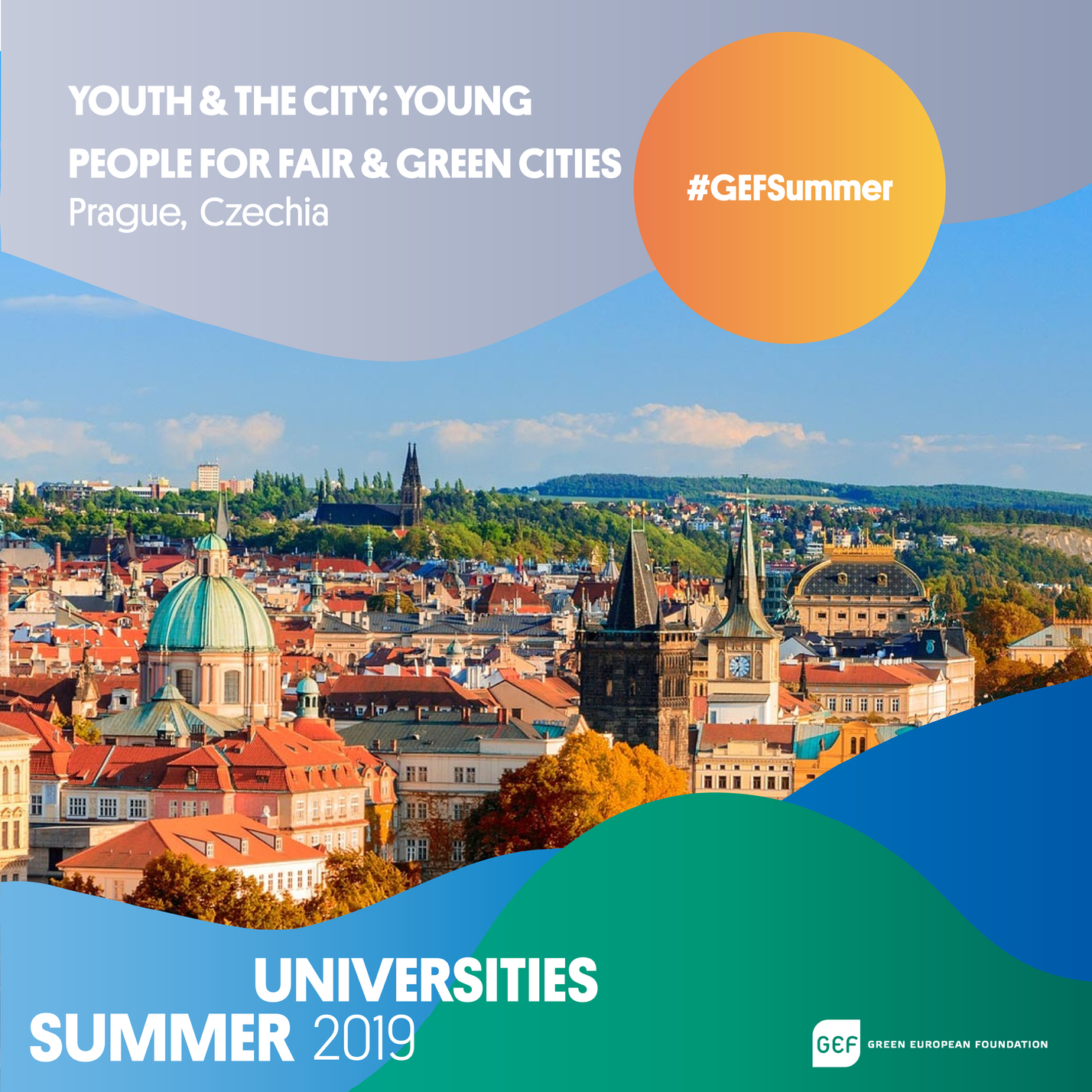
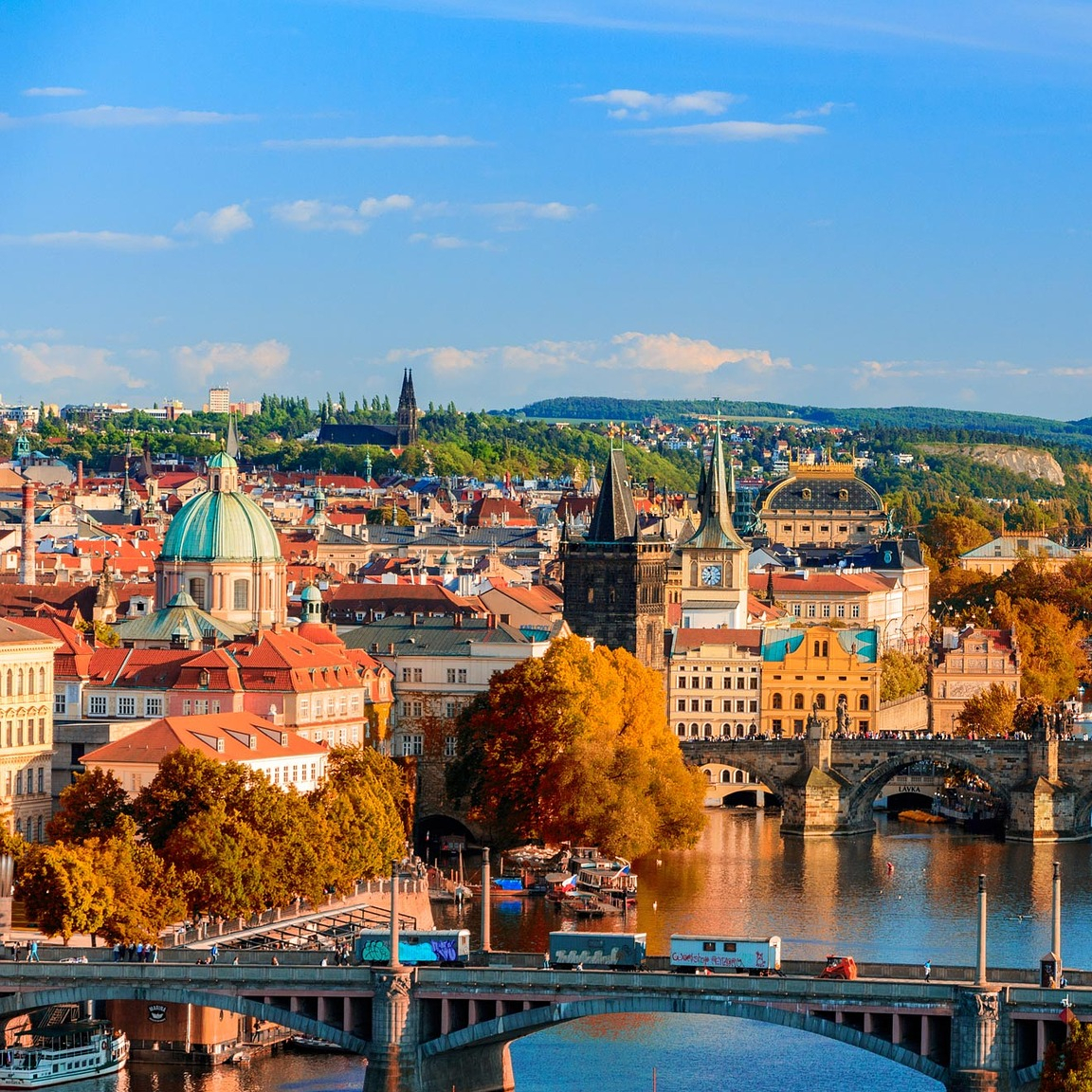
Summer School – Youth and the City: Young People for Fair and Green Cities (Prague)

By

About the Event

Green European Foudnation partner Cooperation and Development Network Eastern, alongside Alternative Urbanisation Working Group, are announcing a call for Participants for the summer school “Youth and the City: Young People for Fair and Green Cities”.

The Summer School aims to conceptualise and promote the model of sustainable and democratic cities among active young people in the Central and Eastern Europe and provide them with tools for reclaiming their cities.

The aims and objectives of the project are:

  • To create a space for youth to discuss the concept and role of Alternative Urbanisation in shaping the future of the cities;
  • To empower young people to use the city as a platform for doing local, Green and alternative politics;
  • To create a toolkit of positive practices and methods of influencing politics on a very local level.

Practicalities

The event will take place from 5th to 9th of August in Prague ( 4th and 10th are travel dates to and from Prague.)

Language: The main language of this activity will be English. But not being comfortable interacting in English should not prevent you from applying, the majority at the event will be non-native speakers and the group will be able to help out if there is some term you might not know!

Costs: The full cost of working materials, visa and lodging (accommodation in multi-bed rooms, vegetarian food, and refreshments) during the event will be covered by the organizers. In exchange, we ask for a participation fee of 20 EUR for participants coming from non-EU countries and 30 EUR for participants coming from EU countries.

Accommodation, food, working space, travel and visa costs for participants will be fully covered. For selection of travel means we encourage participants to combine the most economic and environmentally friendly way (lowest price + travel time + CO2 emissions).

Programme

The programme for this event can be found here.


*All references to Kosovo, whether to the territory, institutions or population, in this text shall be understood in full compliance with the United Nations Security Council Resolutions 1244 and without prejudice to the status of Kosovo.

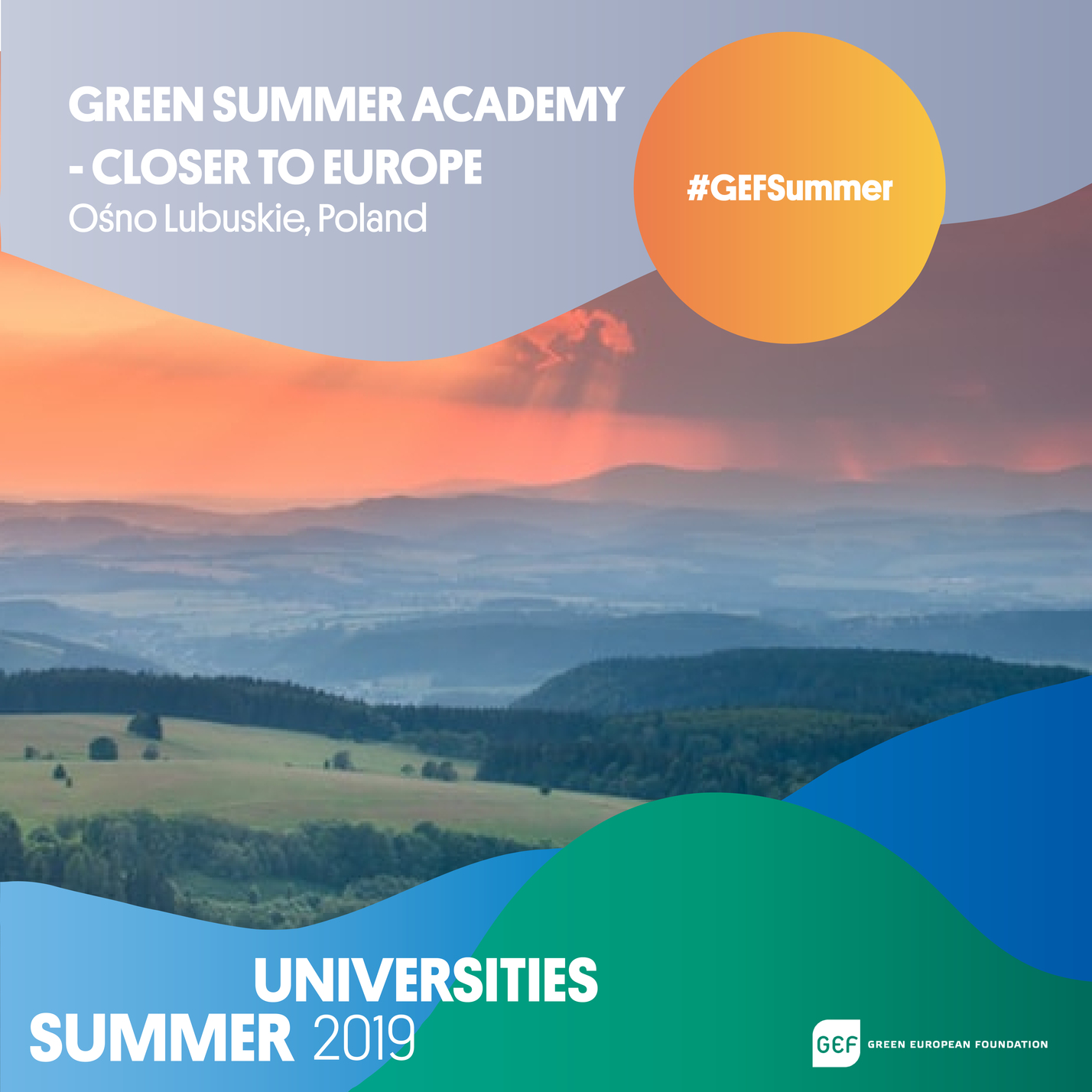
Green Summer Academy – Closer to Europe (Ośno Lubuskie)

By

About the Event

The fifth Green Summer Academy in Poland will take place 20km from the Odra River, a  natural border between Poland and Germany, near the two towns on the both sides of the river: Słubice in Poland and Frankfurt / Oder in Germany.

The Academy is set against the new political reality following the European Parliament elections, in which the Greens became the fourth largest force in the Parliament. At the same time, right-wing and conservative, authoritarian forces were highly successful in Poland and Hungary.

In Poland, pro-democracy and European opposition are preparing for national parliamentary elections in October. On a global context, we are facing crises in the form of climate change, biodiversity extinction, natural resource depletion, pollution, growing inequalities and rising nationalism.

On the other end of the spectrum, we are seeing citizens mobilising across the world, with initiatives at every level rising to meet these crises. Now more than ever Poland and the rest of Europe needs a strong, coordinated Green movement.

This Academy will bring together activists, experts and politicians to exchange and discuss these pivotal issues and how to empower those wanting to enact change.

Programme

The details of the following programme are still to be confirmed. Please check back later for more information.

Information on the event in Polish can be found here. 


11th of July 2019 – Thursday

14:00 PM- 16:00 – Arrival of participants and allocation in rooms or setting up tents

17:00 – 19:00 – Green Ośno Lubuskie, presentation of the Circle of the Greens and the specificity of the transborder city and region, including a meeting with Michael Kurzwelly, founder of the association and „city” Słubfurt and of Polish-German “state” New America  (Zespół Szkół Ekonomicznych, Rzepińska 8)

16:30 – 18:30 – meeting of young people from climate movements and young Greens from Ostra Zieleń association with the international youth camp of the Association of Friends of Korczakowo (transfer by cars or by bu,  departure at 16:15)

20:00 – diner of integration and presentation of the program and participating organizations (Zespół Szkół Ekonomicznych, ul. Rzepińska 8)

Possibility in the afternoon: nature expeditions: Owczary ecological station by the Club of Naturalists.


12th of July 2019 – Friday   /plenary debates and lecture/

5:30 – 8:30 AM – Nature expeditions: Owczary ecological station by the Club of Naturalists.

8:00 – 9:00 – Breakfast

9:00 – 9:30Official Oppening of the Green Summer Academy – Ewa Sufin-Jacquemart (GEF / Strefa Zieleni ) and Irene Hahn-Fuhr (HBS Warsaw)
PART ITHE FUTURE OF EUROPE
9:30 – 11:30“Does the Green Wave in the European Parliament give hope for facing a climate crisis, reduce inequalities and improve democracy in the EU?” – debate

[As part of the seminar “Towards Europe, democracy, ecology” in partnership with the Heinrich Boell Foundation in Warsaw]

Participants: Małgorzata Tracz (Partia Zieloni), Sergey Lagodinsky (MEP), Zuzana Pavelková (FYEG), Miriam Kennet (Green Economics Institute), Jamie Kendrick (Green European Journal).

Moderation: Maciej Słobodzian and Miłosława Stępień (Partia Zieloni)

Participants that did not confirmed yet: Edwin Bendyk (Collegium Civitas), Alena Karaschinski (90/Grunen in Frankfurt/Oder, Christine Chemnitz (HBS).

11:30 – 11:45Coffee Break
PART IICLIMATE CRISIS AND ENERGY TRANSITION
11:45 – 13:30Saving the climate: energy transition necessary but not sufficient”- debate.

Participants: Krystyna Boczkowska (ex-CEO Bosch Polska, Partia Zieloni), Radosław Gawlik (Eko-Unia, Partia Zieloni), Tomasz Wojciechowski (IGOZ, Partia Zieloni),  Maciej Wereszczyński (Extinction Rebellion).

Moderation: Piotr Trzaskowski (HBS Warsaw) and Urszula Zielińska (Partia Zieloni)

Participants that did not confirmed yet: Michael Cramer (ex-MEP), Stefan Schönfelder (HBS Dresden), prof. Jan Popczyk (Silesian University of Technology) , Monika Sadkowska (RT-ON)

13:30 – 14:30Lunch
PART IIIBIODIVERSITY AND POLITICS
14:30 – 16:156. Great Extinction – can Europe prevent it?” – debate

Introduction: “Political protection of biodiversity in the world and in the EU

Participants: prof. Piotr Skubała (Silesian University), Radosław Ślusarczyk (Association Workshop for All Beings), Marcin Kostrzyński (journalist, naturalist), Iwona Krępic (Oder Delta Safaris/ Save Rivers Coalition), Artur Furdyna ( TPRIiG Association/ Save Rivers Coalition), prof. Grzegorz Gabryś (Univ. of Zielona Góra)

Moderation: Marta Jermaczek-Sitak and Krzysztof Wychowałek

Participant that did not confirmed yet: Zenon Kruczyński (Niech Żyją!)

16:15 – 16:30Coffee break
PART IVFAIR AND HEALTHY FOOD
16:30 – 18:15From the Common Agricultural Policy to the Common Food Policy” – debate

[debate within the international GEF project “Fair and Healthy Food”]

Introduction: Olivier de Schutter

Participants: Andrzej Nowakowski (expert GGEP), Katarzyna Jagiełło (Greenpeace), Ewa Jakubowska-Lorenz (HBS Warsaw), Dorota Metera (IFOAM/ Forum of Organic Farming), Francesco Ajena (IPES-Food, Skype], Agnieszka Makowska (Living Earth Coalition and Nyeleni), Aleksandar Gjorgijevski (Sunrise, Macedonia).

Moderation: Ewa Sufin-Jacquemart

18:15– 19:30Diner
20:00 – 21:30Passive and ecological architecture” – lecture of Jarosław Malicki, Green architect
20:00 – 21:30

(salka debat)

Delta of the Odra River, threteaned natural tresure” – lecture of Iwona Krępic [partnership: Save Rivers Coalition]

16:30 – 18:00 – Marta Jermaczek-Sitak – ecological workshop for children and families (in Owczary nature station)

19:00 – 22:00 PM – Nature expeditions: Owczary ecological station by the Club of Naturalists

22:00 PM – Film or documentary screening (Afrikamera, Przemysław Stępień) + „Human Energy” ENG

Possibility of ad-hoc exchanges of knowledge and experiences in groups during the day.


13th of July 2019 – Saturday  /parallel workshops/trainings/round-tables/debates/

6:00 – 9:00 – Nature expeditions: Owczary ecological station by the Club of Naturalists

7:45  – 9:00 – Breakfast

AuditoriumLanguages roomWorkshops roomDebates room
9:00 – 9:45

Odra and the World Bank – press conf.

9:30 – 11:00

Platform of e-learning GEF – training

9:30 – 11:00

Ekofeminism – roundtable

9:30 – 11:00

Citizens’ Panel – lecture

9:45 – 11:00

The Greens in the EU – Q/A

11:15 – 13:00

Nuclear Energy – lecture


11:15 – 13:00

Hunting – roundtable

11:15 – 13:00

E-learning for climate movements – workshop

11:15 – 13:00

Mobilty inside the UE – witnesses

14:00 – 15:45

Ekonomy of sustainable development – panel

14:00 – 15:45

Education – panel


14:00 – 15:45

Electoral campaigning- training

14:00 – 15:45

Water in a city  – lectures/workshops

16:00 – 17:45

Green city – roundtable


16:00 – 17:45

Platforms and coalitions – roundtable

16:00 – 17:45

Young climatic and green activism  –workshop

16:00 – 17:45

Security policy -panel

  1. [Biodiversity] roundtable “Is hunting necessary and / or acceptable in times of the 6th Great Extinction?”  – Niech Żyją! Coalition and Living Earth Coalition
  2. [Climate] workshop „Who are the new climate movements, how can the Greens support them? – [the concept of GEF e-learning for climate movements as incentive for green activists], led by Urszula Sadłowska, GEF
  3. [Water, rivers, wetlands]: Save the Rivers Coalition: “River in the city” – Roman Konieczny and arch. Anna Januchta-Szostak PhD. Eng. (Faculty of Architecture at the Poznan University of Technology). Led by: Izabela Zygmunt
  4. [Rivers] „The Oder River and the of World Bank to protect Kotlina Kłodzka from floods”(press conference, Save the Rivers Coalition) – Radek Gawlik, Ewa Leś, Sascha Maier/BUND
  5. [Gender] “Will ecofeminism change the world?” – workshop – led by Magdalena Galkiewicz (Partia Zieloni/Gals4Gals) and Aleksandra Kołeczek (Partia Zieloni/Ostra Zieleń)

[As part of the seminar “Towards Europe, democracy, ecology” in partnership with the Heinrich Boell Foundation in Warsaw]

  1. [Economy] What does classic economics not include and how to compensate for sustainable development?” – debate

Dr Ewa Rumińska-Zimny (the Warsaw School of Economics / Congress of Women),                 dr Ewa Jastrzębska (SGH),  Jamie Kendrick (Green European Journal), prof), prof. Bożena Ryszawska (University of Economy, Wrocław)

Moderation: Justyna Szambelan

To read: https://www.greeneuropeanjournal.eu/from-global-tax-dodging-to-worldwide-wellbeing/

  1. [Green city] “How to develop Green cities in a conservative-nationalist region / country?” – workshop, led by: Paweł Pomian (Partia Zieloni Wrocław) and Aleksandra Zienkiewicz (miastoDrzew, Wrocław).
  2. [Civil democracy] “How to organize effective coalitions, platforms and movements? How to make them cooperate for achieving common goals?”- with representatives of the Coalition Living Earth (KŻZ) – Maria Staniszewska, Justyna Zwolińska, Save the Rivers Coalition – Izabela Zygmunt, Ewa Leś, coalition Niech Żyją! – Tomasz Zdrojewski, Krzysztof Wychowałek, young climate movements. Led by Ewa Sufin-Jacquemart
[As part of the seminar “Towards Europe, democracy, ecology” in partnership with the Heinrich Boell Foundation in Warsaw]

  1. [Climate/ young in politics] “How to attract young people to Green activism?” – workshop with Ostra Zieleń –Joanna Górska, Igor Skórzybut, and participants from young climate movements (Alina Pogoda and Maciej Wereszczyński from Extinction Rebellion and others). Led by: Artur Wieczorek and Aleksandra Kołeczek (Partia Zieloni)
  2. [security] “What should be Europe’s and Poland’s security policy in today’s unstable world?” – panel

Participants: Tadeusz Nowak (Partia Zieloni), Piotr Niemczyk, Weronika Grzebalska (Polish Academy of Science). Led by: Maciej Józefowicz (Partia Zieloni)

  1. [education ] “How to educate people in rapidly changing times full of challenges?” – panel

Piotr Działak (Center for education Tvind, Danmark), Krystyna Boczkowska (Partia Zieloni), Urszula Sadłowska (GEF). Led by Aleksandra Kretkowska (Partia Zieloni)

  1. [mobility in EU] „How to move to another country in the EU and actively participate in public life?” – panel : Joanna Kamińska, Ecolo, Brussels and Anna Czechowska, Agit-Polska, Berlin, led by: Urszula Zielińska (Partia Zieloni)

Expert lectures / training sessions:

  1. [civil democracy] “European citizens’ panel – utopia or the necessary evolution of direct democracy?” – Marcin Gerwin
  2. [Energy] “Why the Greens don’t see nuclear power as a climatic hope?” – Marcin Harembski (SMA) and video of experts of the GGEP: Yan Dupas, David Drui, Michel Raquet.
  3. [Green methods] „Green electoral campaign”– Maciej Słobodzian
  4. [Green tools] We get to know the green e-learning platform https://www.mygreenlearning.eu/ – GEF
  5. [Green family] Questions and answers on the European Parliament and the European Greens – Benedetta de Marte, political councillor in the Greens/EFA group in the EP.

11:15 – 13:00 – Marcin Kostrzyński – Meeting with nature (for children and families) (tbc.)

18:00 – 19:00  – Marcin Kostrzyński – Meetings with nature (for the participants of the GSA) (tbc.)

19:00  – Dinner

19:30 – 22:30 PM – Nature expeditions: Odra river and/or National Parc Dolina Ujście Warty

Possibility of ad-hoc exchanges of knowledge and experiences in groups during the day.

22:00 PM – Film or documentary screening (Afrikamera, Przemysław Stępień) + „Human Energy”


14th of July 2019 – Sunday

6:00 – 9:00 AM – Nature trip

9:00  – 10:00 – breakfast

10:00  – departure of the bus to Warsaw, on the way : River happaning „Big Jump” (International Day of Action)


Practicalities

Accommodation:
Accommodation partly subsidised (reduction included in the participation fee):
• Double and triple rooms: Hotel Dolina Leśnna, ul. Dolina Leśna 1, Ośno Lubuskie (for 70 people)
• Single and double rooms: Hotel Malinowy Dworek, ul. Gronowska 6a (for 14 people)
• 4-bed rooms with bunk beds: dormitory of Zespół Szkół Ekonomicznych ul. Rzepińska 8 (10 rooms for 40 people, each room shares the bathroom with residents of one tent)
• Space for 10 tents: the green area of Zespół Szkół Ekonomicznych ul. Rzepińska 8

Please note that the deadline for securing subsidised accomodation is 7th July.

Other possibilities:
Other options of accommodation in Ośno Lubuskie: camping, agrotourism, hotels.
There are more accommodation options in Frankfurt (Oder).

Participation Fees:

The full fee of PLN 500 should be paid by bank transfer to the account of Fundacja Strefa Zieleni. Transport to and from the event from Warsaw is also available for an extra PLN 100.

66 1020 1097 0000 7602 0237 0450, title: ‘Green Summer Academy participation fee’
(from abroad: IBAN: PL66 1020 1097 0000 7602 0237 0450, Swift/BIC: BPKOPLPW)

To make the event accessible to everyone, a lower participation fee is possible in certain circumstances. To enquire about this possibility, please contact Ewa Sufin-Jacquemart: +48-664673700 ewa.sufin@strefazieleni.org

Food:
Vegetarian and vegan meals (partly subsidized, reduction included in the participation fee): in the dining room of Zespół Szkół Ekonomicznych, ul. Rzepińska 8
In hostels there is a possibility to buy breakfast on your own (PLN 20).

Transport:
Collective transfer by autocar from Warsaw (departure on Thursday, 11.07 at 9:30 AM from the Palace of Culture and Science, return on Sunday, 14.07 at approx. 4:00 PM at Palace of Culture and Science), price: 50 PLN / person for one direction.

Train: The nearest railway stations: Rzepin 14 km (we will organize a transfer), Frankfurt (Oder) 30 km (we will organize a transfer), but there is also a possibility of travel by bus through Słubice.

Plane: Berlin airports, then by train to Rzepin or Frankfurt / Oder
From other cities in Poland, we will cross-link people who will arrive by car with people who are looking for transport.
People with accommodation in hotels: bikes would be useful (we recommend to get by train to Rzepin and then by bicycle to Ośno Lubuskie; a few bikes could be probably transported from Warsaw; some bikes will be made available to participants by local participants).

Registration

Please register for this event via the form found here (in Polish).
To register your interest in taking part in this event in English, please contact:

GEF project coordinator Urszula Sadlowska +32 (0)2 234 65 70  urszula.sadlowska@gef.eu

Event partner Ewa Sufin-Jacquemart +48-664673700 ewa.sufin@strefazieleni.org


The Green Summer Academy “Closer to Europe” is organized by the Green European Foundation with the support of the Fundacja Strefa Zieleni, with the financial support of the European Parliament to the Green European Foundation.
The seminar Towards Europe, democracy, ecology” is organized in cooperation and with the finantial support of the Heinrich Boell Foundation in Warsaw.
Debate on transition of cities towards the Commons is organized as a part of international project “Creating Socio-Ecological Societies through Urban Commons Transition” by the Green European Foundation with the support of the Fundacja Strefa Zieleni, with the financial support of the European Parliament to the Green European Foundation.

Call for Participants: Summer School – Youth and the City: Young People for Fair and Green Cities (Prague)

By

About the Event

Green European Foudnation partner Cooperation and Development Network Eastern, alongside Alternative Urbanisation Working Group, are announcing a call for Participants for the summer school “Youth and the City: Young People for Fair and Green Cities”.

The Summer School aims to conceptualise and promote the model of sustainable and democratic cities among active young people in the Central and Eastern Europe and provide them with tools for reclaiming their cities.

The aims and objectives of the project are:

  • To create a space for youth to discuss the concept and role of Alternative Urbanisation in shaping the future of the cities;
  • To empower young people to use the city as a platform for doing local, Green and alternative politics;
  • To create a toolkit of positive practices and methods of influencing politics on a very local level.

Who should apply?

We are looking for 20 young people aged 16-35, residing in Central and Eastern Europe (Albania, Armenia, Azerbaijan, Belarus, Bosnia and Herzegovina, Bulgaria, Croatia, Czech Republic, Cyprus, Estonia, Georgia, Greece, Hungary, Kosovo*, Latvia, Lithuania, Moldova, Montenegro, North Macedonia, Poland, Russia, Serbia, Slovakia, Slovenia, Turkey, Ukraine).

We encourage applications reflecting diversity in all forms; therefore we welcome applications from those who identify as women, LGBTQIA+, POC, migration background, or with a different ability.

Participants who have activism experience in working on the rights for the city and/or urban planning and policy making and with relevant knowledge or high motivation to learn about the topic are highly encouraged to apply.

Practicalities

The event will take place from 5th to 9th of August in Prague ( 4th and 10th are travel dates to and from Prague.)

Language: The main language of this activity will be English. But not being comfortable interacting in English should not prevent you from applying, the majority at the event will be non-native speakers and the group will be able to help out if there is some term you might not know!

Costs: The full cost of working materials, visa and lodging (accommodation in multi-bed rooms, vegetarian food, and refreshments) during the event will be covered by the organizers. In exchange, we ask for a participation fee of 20 EUR for participants coming from non-EU countries and 30 EUR for participants coming from EU countries.

Accommodation, food, working space, travel and visa costs for participants will be fully covered. For selection of travel means we encourage participants to combine the most economic and environmentally friendly way (lowest price + travel time + CO2 emissions).

DEADLINE for submitting online applications: 9th of June 2019 at Midnight CET. You will be informed about the results of the selection within two weeks after the deadline.

APPLY HERE.


*All references to Kosovo, whether to the territory, institutions or population, in this text shall be understood in full compliance with the United Nations Security Council Resolutions 1244 and without prejudice to the status of Kosovo.

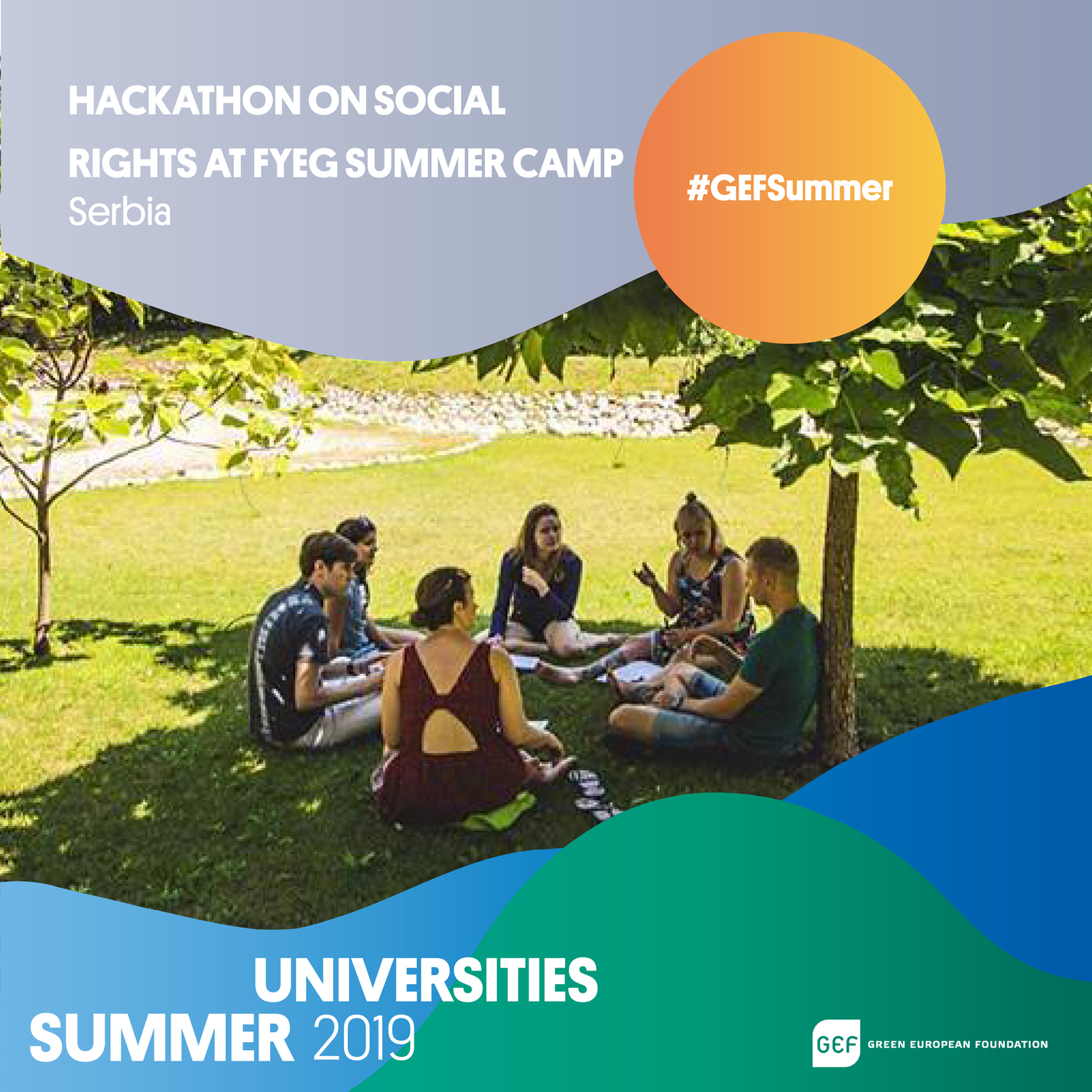
Hackathon on Social Rights at FYEG Summer Camp (Serbia)

By

Event Background

Summer Camp & GEF Hackathon

Green European Foundation partner Federation of Young European Greens is organising the Summer Camp “Our Social Rights – Our Future!” that will take place from 22 – 28 July 2019 in Serbia. GEF will support the Summer Camp and organise a hackathon that will take place on 25 and 26 July.

The summer camp will consist of five full days exploring different tools and platforms Young Greens can use to campaign and advocate for social rights. Participants will leave the summer camp with practical skills to use and share in their local contexts and on European level.

The aims of the summer camp are:

  • To understand how social rights apply to specific topics – including regional specificities, a just transition towards a sustainable society, and gender aspects.
  • To determine which tools to use for a campaign/advocacy depending on the cause and context, and how to apply these tools with limited resources.
  • To equip participants with the skills needed to carry out hackathons in their local regions.

About the Event

Hackathon – an intense, sprint-like, goal-oriented, small teamwork-based activity. Hackathon is a period of 36h when participants can plan, design and carry out their own mini-projects in small teams. The teams will be composed of young people – participants and guests – with different skills and backgrounds: activists, young advocates, lawyers, and programmers.

Programme

The programme will be based on the principles of non-formal education and intercultural learning. We strive for an active, inclusive environment for direct communication and sharing of knowledge. The summer camp will balance the dynamism of the hackathon with interactive discussions and reflections for participants to develop their practical and theoretical knowledge of social rights in an supportive and informal environment.

Participants will already be familiar with social rights and issues facing young people through the other activities of the summer camp.

The participants will identify their particular interests and choose one problem that they want to find a solution for. Forming teams of three-four, they will spend the next 40 hours designing an innovative solution to their chosen problem.

The session will start with a small teambuilding and sharing expectations excercise, as well as determining routine and agreeing breaks amongst the teams.

The hackathon will be participant-led, with monitoring from the prep-team who can offer guidance where needed.

The goal of the hackathon is to not necessarily have a concrete solution to the challenge posed, but to have developed ideas in how to approach the issues and work collectively and creatively towards solutions. Partiticipants will hone their practical skills by putting their ideas into reality.

Practicalities:

Language: The main language of this activity will be English.


Successful applicants to the FYEG Summer Camp will be notified by 5 June. Stay tuned for more information on the Summer Camp coming soon. 

Call for Participants: Summer Camp: “Our Social Rights – Our Future!”

By

Summer Camp & GEF Hackathon

Green European Foundation partner Federation of Young European Greens is announcing an open call for participants in the Summer Camp “Our Social Rights – Our Future!” that will take place from 22 – 28 July 2019 in Serbia. GEF will support the Summer Camp and organise a hackathon that will take place on 25 and 26 July. 

The summer camp will consist of five full days exploring different tools and platforms Young Greens can use to campaign and advocate for social rights. Participants will leave the summer camp with practical skills to use and share in their local contexts and on European level.

The aims of the summer camp are:

  • To understand how social rights apply to specific topics – including regional specificities, a just transition towards a sustainable society, and gender aspects.
  • To determine which tools to use for a campaign/advocacy depending on the cause and context, and how to apply these tools with limited resources.
  • To equip participants with the skills needed to carry out hackathons in their local regions.

Programme

The five days will be divided into three parts:

  • Opening of the event; sharing and building upon the conclusions from “Social Europe Now!’’ – a seminar that identified the struggles young people from various regions of Europe face today in relation to housing, education and healthcare as well as having fostered development of a common vision for the future of work.
  • Hackathon – an intense, sprint-like, goal-oriented, small teamwork-based activity. Hackathon is a period of 36h when participants can plan, design and carry out their own mini-projects in small teams. The teams will be composed of young people – participants and guests – with different skills and backgrounds: activists, young advocates, lawyers, and programmers.
  • Creating a Toolkit for a Hackathon on Social Rights: based on our common experience of running and taking a part in a social rights hackathon, we will create a toolkit for those who are going to organise one back home in the autumn 2019

The summer camp will be a fast pace, interactive experience of Young Greens creating campaigns together to make social rights a reality for all. Participants will also learn how to create their own FYEG-supported hackathons in their local regions in autumn 2019.

The programme will be based on the principles of non-formal education and intercultural learning. We strive for an active, inclusive environment for direct communication and sharing of knowledge. The summer camp will balance the dynamism of the hackathon with interactive discussions and reflections for participants to develop their practical and theoretical knowledge of social rights in an supportive and informal environment.

Applications

Applications are open to all young people inspired by fighting for social rights and green ideology. FYEG encourages applications reflecting diversity in all forms; therefore we welcome applications from those who identify as women*, LGBTQIA+, people of colour, or with a disability or other health impairment.

The “Our Social Rights – Our Future!” Summer Camp is the second activity of FYEG’s Reclaim Your Social Rights! project, supported by the European Youth Foundation of Council of Europe. The hackathon that will take place on 25 and 26 July and is organised by the Green European Foundation with the support of the FYEG and with the financial support of the European Parliament to the GEF.

Practicalities:

Participants: FYEG is looking for 50 young people aged between 16-35, residing in one of the Council of Europe member states, Belarus or Kosovo*.

Language: The main language of this activity will be English. But not being comfortable in interacting in English should not prevent you from applying, as FYEG will look into translation options for the event.

Costs: The full cost of working materials, visa and lodging (accommodation in multi-bed rooms, vegetarian food, and refreshments) during the event will be covered by the organisers. In exchange, FYEG asks for a participation fee of 40 EUR for participants coming from non-EU countries and 60 EUR for participants coming from EU countries, Norway, Switzerland, and Iceland. Applicants for whom paying this fee is an obstacle for participation, should still apply and mention this in their application. FYEG will try to find a solution together with the applicant after the selection is finalised.

FYEG will reimburse 70% of travel costs for the participants coming from the EU countries, Iceland, Norway and Switzerland and 90% for the participants from the non-EU Eastern European countries within reasonable limits and within Europe, with the condition to combine the most economic and environmentally friendly way (lowest price + travel time + CO2 emissions).

DEADLINE for submitting online applications: 29 May 2019 at Midnight CET. You will be informed about the results of the selection by 5 June.

APPLY HERE!


*All references to Kosovo, whether to the territory, institutions or population, in this text shall be understood in full compliance with the United Nations Security Council Resolutions 1244 and without prejudice to the status of Kosovo.

Call for Applications: Congress of Young Europeans 2019 (Marseille)

By

The Heinrich Böll Foundation, the Green European Foundation and the Federation of Young European Greens (FYEG) are calling for applications to participate in the 7th Congress of Young Europeans! The Congress will take place in Marseille, France, from 4th to 7th September 2019.

The main theme of this year’s Congress is “How to fight for climate and democracy”. How can young people with ideas and ideals at hand contribute to social and political change? What can we learn from movements like Fridays for Future? Which tools do successful activists use? How can we build and connect a movement?

During the three-day Congress, selected participants will have the opportunity to come together and participate in different panels and workshops focusing on these questions.

How to Apply

  • Are you already involved in a movement, NGO, or similar activity?
  • Are you interested in sharing and expanding your vision, knowledge and ideas?
  • Are you between 18 and 30 years old?
  • Are you interested in sharing and discussing ideas in a transnational environment?

Apply now to the Congress of Young Europeans and become part of a young and innovative European network!

The organisers will cover the the travel and accomodation costs for all selected participants of the Marseille Congress of Young Europeans.

The number of available spaces is limited.

The working language of the Congress is English.

Please apply via the application form found here: APPLY!

DEADLINE EXTENSION: 21st June


Open Call for Prep-Team

By

The Green European Foundation alongside the Federation of Young European Greens is announcing an open call to take part in the international preparatory team for the Summercamp Our Social Rights – Our Future!” that will take place from 22 – 28 July 2019 in Serbia.

The aim of this activity is to provide a platform for learning about and using different tools for campaigning and advocating for social rights. In particular:

  • To understand how social rights apply to specific topics – including regional specificities, a just transition towards a sustainable society, and gender aspects.
  • To determine which tools to use for a campaign/advocacy depending on the cause and context, and how to apply these tools with limited resources.
  • To equip participants with the skills needed to carry out hackathons in their local regions.

The activity will consist of 5 full working days and will consist of three parts:

  1. Opening of the event; sharing and building upon the conclusions from the ,,Social Europe Now!’’ – a seminar that identified the struggles young people from various regions of Europe face today in relation to housing, education and healthcare as well as having fostered development of a common vision for the future of work.
  2. Hackathon – an intense, sprint-like, goal-oriented, small teamwork-based activity. Hackathon is a period of 36h when participants can plan, design and carry out their own mini-projects in small teams. The teams will be composed of young people – participants and guests – with different skills and backgrounds: activists, young advocates, lawyers, and programmers.
  3. Creating a Toolkit for a Hackathon on Social Rights: based on our common experience of running and taking a part in a social rights hackathon, we will create a toolkit for those who are going to organise one back home in the autumn 2019.

In order to achieve these objectives, we are looking for 3 young activists to join forces with the rest of the preparatory team composed of FYEG’s Project Manager, one member of the Executive Committee, one member of the Coordination Team of the project and a member of Serbian Green Youth – the host organisation.


Prep-team members should speak English, be available during the preparation period, be responsible about fulfilling their tasks, have good organisational skills, be good team players and  committed to the aims of the project and FYEG’s values, and be familiar with non-formal education methods. We are looking for at least one person with experience in attending or organising a hackathon.

Main responsibilities of the prep-team:

  • Active participation in the regular online meetings prior the event (May 2019 – July 2019 // 3-4h a week)
  • Participation in a live prep team meeting (30 May – 2 June 2019 // 2 full working days)
  • Dissemination of the call and selection of participants, preparation of participants for the event and providing them with all the necessary information regarding the program;
  • Preparation and facilitation of the programme of the Summercamp; designing and preparing sessions based on non-formal education methodology, invitation and communication with speakers, experts, trainers and partners in accordance with the project aims;
  • Helping with the promotion of the event and ensuring media visibility;
  • Taking care of practicalities and of the general well-being of the participants;
  • Full participation during the entire event and prep team meeting before and after (arrival 20th July, departure 28/29 July)
  • Supporting the finalisation of the toolkit and with coordination of the local hackathons.
  • Helping with the reporting of the Summercamp (optional)

Being a prep-team member at a FYEG event would offer you:

  • Working in a lively, supportive and safe international environment;
  • Experience in managing youth projects – preparation, implementation, evaluation, follow up and reporting;
  • Becoming familiar with the Green values and FYEG’s work;
  • The chance to learn about social rights, campaigning and advocacy;
  • The chance to develop your facilitation skills in group work and non-formal education;
  • A lot of work and a lot of fun!

Methodology:

The program will be based on the principles of non-formal education and intercultural learning. We strive for an active, inclusive and direct communication and transfer and sharing of knowledge. Sessions will be balanced between theoretical inputs, trainings, workshops, discussions, reflection, planning, brainstorming and other interactive methods of learning.

Practicalities:

Accommodation, food, working space, travel and visa costs for preparatory team will be fully covered within reasonable limits and within Europe. For selection of travel means the condition is to combine the most economic and environmentally friendly way (lowest price + travel time + CO2 emissions).

The Summercamp is a part of the year-longe Reclaim your Social Rights! Project, supported by the European Youth Foundation of Council of Europe. The hackathon is organised by the Green European Foundation with the support of the FYEG and with the financial support of the European Parliament to the GEF.

If you are interested to try out your non-formal education skills, if you are willing to engage in an adventure of imagining the new ways of doing politics – this project is for you!

DEADLINE for submitting online applications: 28 April 2019 at Midnight CET

APPLY HERE!

Green Economy Congress – Municipalism: Economic Patterns for the Green Europe (Belgrade)

By

Event Background

The world is undergoing radical transformations which is changing the fundamental values on which the industrial era was founded. Multiple crises caused by growing inequality and environmental destruction need an urgent and sustainable answer.

The economic parameters that measure growth and success are changing and the biggest assets today are knowledge and experience. With the expertise of academics working on a green economy, we are producing new forces to create a more just and sustainable world.

The Green Economy Congress is an annual interactive conference, which gathers participants from the local region and across Europe. Since its inception, it has intended to break the business-as-usual path, not only in the economy but in the wider society. It aims to build synergies amonth actors developing positive initiatives and to work on narratives that have a greater impact on public debates.

The previous two editions of the Congress were held in the Serbian Chamber of Commerce, with over 300 participants and speakers attending.

About the Event

The Green Economy Congress is a Green summit, organised by the Green European Foundation in cooperation with Networked and Group for Analysis and Policy-Making from Serbia.

2019 marks the third edition of the Congress, which will focus on the theme of “Municipalism: Economic Patterns for the Green Europe”.

This year’s Congress will address Green topics and ways to make the Green agenda and sustainable development an integral part of our future philosophy and actions. This comes with a goal of inspiring leadership among global citizens to enact change and innovative solutions to tackle key economic, social and environmental challenges. There will be particular emphasis on Green cities as leaders of Green change and local policies that stimulate holistic approaches.

The Congress is open to professionals, academics, NGOs and private sector representatives, as well as other interested individuals.

Programme

Day I – Serbian Chamber of Commerce (Terazije 23/ II floor)

11.00 – 12.00 Opening: Municipalism: Economic Patterns for the Green
Europe
– Žaklina Živković, GAJP/ Networked
– Liljana Popovska, North Macedonia Member of Parliament/ DOM Macedonia

12.00 – 12.10 Coffee break

12.10 – 13.15 Panel: Circular Economy Regional Perspectives: Challenges
and Opportunities supported by Balkan Green Energy News
– Ana Petrovska, North Macedonia Ministry of Environmental Protection and
Physical Planning, State Secretary
– Representative of Republic of Serbia Ministry of Environmental Protection (TBC)
– Representative of business sector from Serbia (TBC)

13.15 – 13.25 Coffee break

13.25 – 14.25 Panel: Green Finance Lab: Blockchain + Crowdfunding
– Vladica Jovanović, BRODOTO
– Ivan Bjelajac, MVP Workshop

14.25 – 15.25 Lunch

15.25 – 16.15 Lecture: Mapping ecosystems and their services: a challenge
in a fast changing world

Day II – Cultural Center GRAD (Brace Krsmanovic 4)

14.00 – 15.00 Workshop: Go Circular: Circular economy for municipal well –
being
– Milan Veselinov, CirEkon – Expert for Circular Economy

15.00 – 15.10 Coffee Break

15.10 – 16.10 Panel: Business Going Green: The Emergence of the
Cooperative Society supported by EcoTech HUB Serbia
– Tanja Basta, EcoTech HUB
– Nemanja Inno Energy HUB and Climate – KIC Serbia
– Nenad Božić, SmartCat
– Dušan Vukanović, ICT Hub

16.10 – 16.20 Coffee Break

16.20 – 18.20 Workshops
“Sustainable Fashion Roundtable – new policy & business model” Dunja
Jovanović and Marija Radaković
“Zero waste in Action: Reduce your environmental footprint” MIlja Vuković

18.20 – 20.00 Networking Party & Dinner

Day III
10:00 – 12:00 Visit to Nikola Tesla Museum

Practicalities

Participants can apply to take part via the Green Economy Congress website, where more information on packages and prices can be found.

You can join the Facebook event page for the Congress here.


Climate for Future: Climate Summit (Austria)

By

Event Background

The Alps and the Carpathians mountain ranges that cover half of Europe are a critical part of climate protection, as they serve as an early warning system for the negative effects of climate change on Europe. The issues that climate change brings to these areas demonstrate what the rest of Europe must prepare for.

About the Event

The summit will feature a range of keynote speeches, workshops and excursions, conducted by experts who will offer attendees opportunities to learn more about climate change and how it specifically affects the alpine environment.

Programme

Thursday 20th June

17:00 – Opening

18:00 – The climate and ecosystem crisis –

  • Matthias Schickhofer, author of “Schwarzbuch Alpen – Why we have to save our mountains”.
  • Christoph Matulla, climatologist, ZAMG Vienna. Comment Leonore Gewessler, Global 2000.
  • Comment by Regina Hrbek.

20:00Dinner

21:00 – Climate change at all levels! Fish bowl discussion, with experts and politicians on the local and European level alternatively taking the ‘hot seat’.

Werner Kogler (Head of the Austrian Greens), Tom Waitz (MEP, Austria), Hannah Pfalzgraf ( youngest Cantonal Counselor of Switzerland), Gisela Sengl (Member of the Landtag, Bayern/Germany), Ingrid Felipe (Deputy Governor, Tyrol/Austria), Eva Lichtenberger (former MEP, Austria), Ewa Dziedzic (Federal Counselor, Austria), Helga Krismer (Member of the Landtag, Lower Austria), Norbert Lantschner (Member of the Landtag, Upper Adige/Italy), Johann Döller (Mayor Reichenau/Austria), et al.

Friday 21st June

09:30 – Workshops

Workshop 1: Climate Change, Economy and Environment
With experts and international initiatives.

Workshop 2: Climate Change and Us – Politics and Society
Best practices and new ways of cooperation.

12:30 – Climate change is system change. Synthesis and political mission.

14:00 Lunch buffet and graduation.

Supporting program (optional) for those who want to celebrate the longest day of the year with vision:
Afternoon trip by cable car to the Rax
In the evening, bonfires and festivities at the Biohof Babiol, Edlach / Rax.

The full programme in German can be found here. 

Practicalities

Language: the majority of the summit will be in German, with some activities accessible in English.

Transport:
Take the train to Payerbach / Bahnhof.
From there take the Höllentalbahn (museum train) to Hirschwang (departure 14:25, arrival 14:50).


Registration

Please register via the registration form found here (in German).

Climate Conference (Istanbul)

By

Event Background

Turkey has been seeing the tangible effects of climate change over the last few years, with impacts on food security, the economy, and other broader social ramifications.

Yet there is no solution-oriented action due to resistance by policy-makers and a lack of public awareness. There is particularly a lack of clarity in the debate regarding the link between urban and local ecological deterioration and climate change, and the effects of climate change on the local level. There is also an absence of understanding on how political decisions and action at an international level relate to the local level.

About the Event

Held in coordination with our partner Yesil Dusunce Dernegi, this national conference will offer a different perspective on climate change, connecting society, movements, communication and green politics. It aims to build capacities and raise awareness of the effects of climate change, local actions and green policy alternatives in the field.

It will bring together the agenda for the climate and ecology movements on both European and local levels, and provide networking opportunities.

In particular, the conference will focus on:

  • Opportunities to identify and compare relationships between mitigation and adaptation policies at national and local levels, and the obligations and potential they offer.
  • Develop awareness and comprehension of European policy proposals regarding climate change and encourage political debate that includes the Turkism perspective on the issue.
  • Establish solidarity networks between local movements directly affected by environmental disasters and those affected by ill-conceived fossil-fuel projects.

Programme

The working language of the conference will be Turkish.

10.00-10: 45 | Climate Policies

Moderator: Barış Gençer Baykan / Yeditepe University – Green Thought Association

Omer Madra / Açık Radyo
Kelsey DePorte / FYEG (European Young Greens) Climate Campaigner

10: 45-11.00 | Break

11: 00-11: 45 | Climate Law

Moderator: Serkan Köybaşı / Bahcesehir University – Green Thought Association

Gökşen Şahin / People’s Climate Case
Serde Atalay / Ecology Collective Association

11: 45-12.00 | Break

12: 00-13: 00 | Activism / Communication/ Campaigning

Teo Commet / FYEG Secretary General
XR (Extenction Rebellion) International
13: 00-14: 00 | Lunch

14: 00-16: 00 | Forum

XR Turkey (Extinction Rebellion / Rebellion Extinction)
FFF Turkey (Fridays For Future Turkey)
PFF Turkey (Parents For Future)
Local Movements
Climate Activists

Parallel Sessions:

10.00-13.00 | Informatics Education-kidsistanbul

This event will last for 3 hours and is suitable for children between the ages of 10-15.

Registration

This conference is free and open to all. However, registration is required.

Please register via this form that can be found here.