Beyond Borders: Strategic autonomy and Global Fairness in the EU’s Clean Energy Transition

By Publications

About

The EU’s green transition is dependent as much on internal regulation as on its external economic and political relationships. Europe’s internal market, while large, cannot sustain the scale up of clean industries, and the EU lacks sufficient domestic resources and workforce capacity to meet the demands of electrification, renewables and industrial decarbonisation. As a result, its ambition for “strategic autonomy” is inseparable from global interdependence. 

This brief argues that the EU must embed its energy transition within a broader vision that integrates security, human rights, economic resilience and social stability within and beyond its borders. Global fairness is not an ethical add-on but a condition for effective delivery. Measures that constrain policy space, overlook capacity constraints or externalise environmental and social costs risk rebounding on Europe through supply disruptions, political resistance, trade tensions and weakened alliances. By contrast, fairness, understood as reciprocal value creation, shared risk and co-ownership, can strengthen competitiveness, resilience and geopolitical influence.  

This author of the brief argues that the transition will ultimately depend on partnerships that align climate, trade and industrial goals with equitable engagement, making global fairness and energy security mutually reinforcing priorities. 

Investing in global fairness is an investment in the EU’s own future. It ensures that the European Green Deal and the Clean Industrial Deal are not only ambitious but deliverable, not only competitive but legitimate, and not only autonomous but connected to a broader system of cooperation. By moving decisively away from extractive models toward genuine partnerships, the EU can position itself as a stabilising force in the global transition. 

Author

  • Sofía Martínez is a climate and energy policy expert currently working in International Relations at Spain’s Institute for Energy Diversification and Saving (IDAE), under the Ministry for the Ecological Transition. She has extensive experience across the public and private sectors, including working with the European Commission and the United Nations, and is a fellow of the Green European Foundation.

Published by the Green European Foundation with the financial support of the European Parliament to the Green European Foundation. The European Parliament is not responsible for the content of this publication. The views expressed in this publication are solely those of the authors and contributors and do not necessarily reflect the views of the European Parliament.
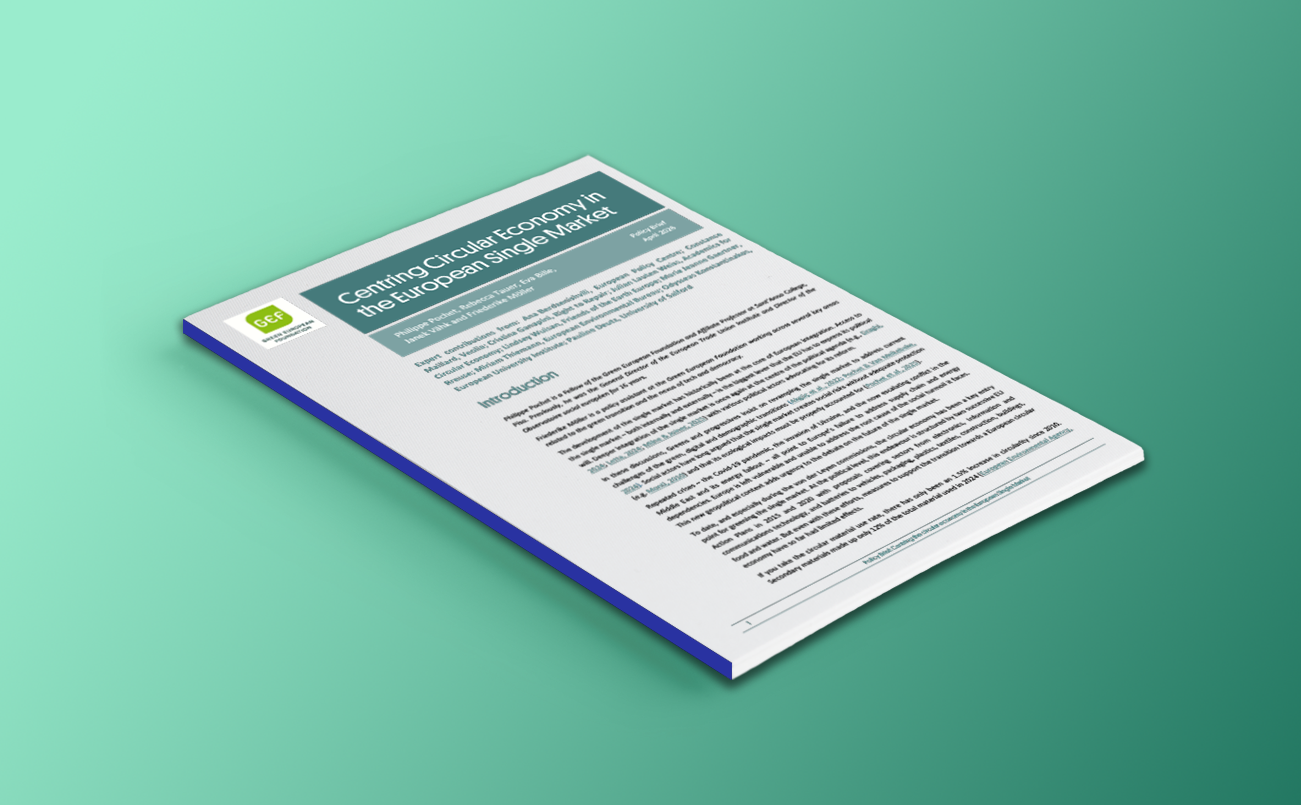
Centring Circular Economy in the European Single Market

By Publications

The circular economy is already a key entry point for greening the single market, but it could be so much more. With the potential to transform production models and recalibrate our dependencies, the circular economy could be the basis for a political project that connects resources, work and fairness, provided we seize this opportunity with the required ambition. Ahead of the upcoming Circular Economy Act, this brief makes the case for centring the circular economy as an engine for the single market’s transformation and points to the road ahead.

About

The development of the single market has historically been at the core of European integration. Access to the single market – both internally and externally – is the biggest lever that the EU has to express its political will. With the European economy under stress, the single market is once again in the spotlight.

This brief calls for an ambitious vision for Europe’s circular economy based on the following starting points:

  • While the circular economy is often considered a mere technical feat, we need to broaden the frame of reference. Only by considering the social distribution of resource consumption can we build a politically salient offer for economic, social, and environmental resilience around the circular economy.
  • From this vantage point, a circular single market is an economic agenda to transition towards a European Union that charts its own course towards autonomy and sovereignty.
  • Building on Europe’s strengths, the circular economy is a means to provide quality through the single market – quality of life, quality of goods and quality of jobs.

The authors of this brief explore the transformative potential and diversity of possible solutions along the “9 R chain” in three chapters, highlighting the power of circularity for economic, social and environmental resilience and outlining political and policy proposals that can untap this potential.

The EU is entering a decisive moment for climate, economic and social policymaking. While the debate is ongoing, this publication presents common threads to pull in the short and long term.

Authors

  • Philippe Pochet is a Fellow of the Green European Foundation, Affiliate Professor at Sant’Anna College, Pisa and the former General Director of the European Trade Union Institute (ETUI). Before joining ETUI in 2008, he was director of the Observatoire social européen for 16 years.
  • Rebecca Tauer leads the circular economy team within the business & markets department at WWF Germany, where she implements projects that advance a circular and resource-efficient economy.
  • Eva Bille is in charge of the European Environmental Bureau’s activities on circular economy policy, leading the team and co-chairing the working group across rethink, refuse, re-use, recycling, all the way to waste. This work includes both technical and political involvement in performance and information criteria across different policy areas related to circularity.
  • Janek Vähk is a circular economy and sustainability expert working to accelerate Europe’s transition to a zero-waste society. He is the Zero Pollution Policy Manager at Zero Waste Europe, where he focuses on landfills and waste incineration, and on the interlinkages between climate and waste policies.
  • Friederike Möller is the Policy Assistant at the Green European Foundation across several key areas related to the green transition and the nexus of tech and democracy.

Published by the Green European Foundation with the financial support of the European Parliament to the Green European Foundation. The European Parliament is not responsible for the content of this publication. The views expressed in this publication are solely those of the authors and contributors and do not necessarily reflect the views of the European Parliament.

Fair allocation of energy network costs

By Featured, Publications

About 

As Europe electrifies, it will need to invest massively in its grid. Grid investment is paid for through network tariffs, a component of energy bills. A surge in investment means a surge in network tariffs. But how should these costs be fairly allocated in the context of a just transition for all and an ongoing cost-of-living crisis across Europe? 

Well-designed grid tariffs can reward household flexibility that eases pressure on grids while protecting vulnerable consumers. This brief calls on the European Commission to provide stronger guidance for national regulators on designing network tariffs that encourage those who can to flex their electricity demand while protecting vulnerable consumers and working to reduce energy poverty.  

This policy brief is one in a series of briefs developed by a Knowledge Community of approximately 30 experts in energy and social policy from industry, the EU institutions, civil society and think tanks. The group met several times over half a year to discuss how to foster participation and inclusion in the energy transition. To write the briefs, the authors used a collaborative method where they presented each draft during Knowledge Community meetings, then led a dedicated discussion, drawing ideas from the expertise in the group to develop their work. 

You can access the publication here, also available in Catalan.

Authors

  • Tom Lewis is Energy Policy Coordinator at Climate Action Network Europe 
  • Christophe Jost is Energy Policy Coordinator at Climate Action Network Europe 

The other briefs in this series are: 

We encourage you to explore the two policy briefs featured above or access the complete collection below:


This policy brief is published by the Green European Foundation with the financial support of the European Parliament to the Green European Foundation. The European Parliament is not responsible for the content of this publication. The views expressed in this publication are solely those of the authors and contributors and do not necessarily reflect the views of the European Parliament or the Green European Foundation.

Published with the support of the Heinrich-Böll-Stiftung European Union| Global Dialogue. The analysis and opinions expressed in this report reflect the views of the authors, and do not necessarily reflect the views of the Heinrich-Böll-Stiftung European Union | Global Dialogue.

Increasing benefit sharing of renewable energy projects

By Featured, Publications

About 

The practice of benefit sharing of renewable energy projects is a win-win situation. It can make the energy transition fairer for local communities, help developers speed up project deployment and accelerate the EU’s renewable rollout. Project developers consult with local citizens and municipalities, and come to an agreement on sharing some of the benefits of the project, whether that be through local investment, in-kind benefits, or local part-ownership. Involving the local community can reduce local opposition and speed up permitting, and make projects more competitive.  

Despite its many advantages, the practice is still relatively limited. This brief calls for the EU to help widen and standardise benefit sharing by providing guidelines and setting out key principles that can be implemented across the EU. It calls on the European Commission to include benefit sharing in its Citizens Energy Package, look at making benefit sharing mandatory and include it in assessment criteria for permitting applications.  

This policy brief is one in a series of briefs developed by a Knowledge Community of approximately 30 experts in energy and social policy from industry, the EU institutions, civil society and think tanks. The group met several times over half a year to discuss how to foster participation and inclusion in the energy transition. To write the briefs, the authors used a collaborative method where they presented each draft during Knowledge Community meetings, then led a dedicated discussion, drawing ideas from the expertise in the group to develop their work. 

You can access the publication here, also available in Catalan.

Author 

  • Etienne Charbit is Europe Policy Officer at French NGO réseau Cler 


The other briefs in this series are: 

We encourage you to explore the two policy briefs featured above or access the complete collection below:


This policy brief is published by the Green European Foundation with the financial support of the European Parliament to the Green European Foundation. The European Parliament is not responsible for the content of this publication. The views expressed in this publication are solely those of the authors and contributors and do not necessarily reflect the views of the European Parliament or the Green European Foundation.

Published with the support of the Heinrich-Böll-Stiftung European Union| Global Dialogue. The analysis and opinions expressed in this report reflect the views of the authors, and do not necessarily reflect the views of the Heinrich-Böll-Stiftung European Union | Global Dialogue.

The beauty of what already exists: The contribution of renovation and repurposing to affordable energy-efficient homes

By Featured, Publications

About 

Political pressure is high to deal with Europe’s housing crisis. This policy brief calls on policymakers to resist the temptation for short-term fixes, arguing rather for a holistic understanding of housing affordability that looks beyond paying rent or mortgage to also account for the cost of living in a home. Quality housing can save energy, protect occupants’ health and resist extreme weather impacts. The policy brief makes the case that investing further in renovation and repurposing of existing buildings should be central to any response to the housing crisis.  

This policy brief is one in a series of briefs developed by a Knowledge Community of approximately 30 experts in energy and social policy from industry, the EU institutions, civil society and think tanks. The group met several times over half a year to discuss how to foster participation and inclusion in the energy transition. To write the briefs, the authors used a collaborative method where they presented each draft during Knowledge Community meetings, then led a dedicated discussion, drawing ideas from the expertise in the group to develop their work. 

You can access the publication here.

This brief is also available in Catalan.

Author

  • Emily Bankert is Researcher for Carbon and Energy in the Built Environment at Buildings Performance Institute Europe 
  • Hélène Sibileau is Senior Policy Advisor at Buildings Performance Institute Europe 

The other briefs in this series are: 

We encourage you to explore the two policy briefs featured above or access the complete collection below:


This policy brief is published by the Green European Foundation with the financial support of the European Parliament to the Green European Foundation. The European Parliament is not responsible for the content of this publication. The views expressed in this publication are solely those of the authors and contributors and do not necessarily reflect the views of the European Parliament or the Green European Foundation.

Published with the support of the Heinrich-Böll-Stiftung European Union | Global Dialogue. The analysis and opinions expressed in this report reflect the views of the authors, and do not necessarily reflect the views of the Heinrich-Böll-Stiftung European Union | Global Dialogue.

Political Steps towards Eco-Social Transformations

By Featured, Publications

About

This policy brief examines the political feasibility of transforming Europe’s welfare states to meet the dual challenges of ecological breakdown and rising social risks. While less transformative eco-social policies, such as those included in the current European just transition framework, have gained traction in recent years, they remain limited in scope, reactive in nature, and rooted in a growth-oriented paradigm. The brief argues that more transformative eco-social policies, grounded in the concept of sustainable welfare, are needed to address both the causes and consequences of the ecological crisis.

Drawing on the ‘three Is’ framework – interests, ideas, and institutions – the brief identifies barriers to transformative change and outlines strategies to overcome them. Key elements of these strategies include strengthening socio-ecological coalitions and constituencies; promoting rights-based ideas; and creating inclusive, multilevel and silo-breaking institutions. Ultimately, the brief calls for a bold rethinking of European social policymaking to ensure that ecological action reinforces, rather than undermines, democratic legitimacy and social justice.

Author

  • Matteo Mandelli, is a postdoctoral research fellow at the Centre for European Studies and Comparative Politics, Sciences Po Paris. He currently collaborates with the Green European Foundation (GEF) and is a board member of the Sustainable Welfare and Eco-social Policy Network. He holds a PhD in political studies from the University of Milan.

Published by the Green European Foundation with the financial support of the European Parliament to the Green European Foundation. The European Parliament is not responsible for the content of this publication. The views expressed in this publication are solely those of the author and contributors and do not necessarily reflect the views of the European Parliament. 


Bridging the Gap: Matching Europe’s budget with its strategic transformation needs

By Featured, Publications

About

The EU’s next long-term budget will be a defining test of its strategic direction. This policy brief makes the case for a bold new European Multiannual Financial Framework (MFF) that reflects the scale of today’s intertwined climate, social, and geopolitical challenges. It argues that without significantly increased and better-targeted public investment, the EU risks deepening divides, falling behind in global competitiveness, and losing public trust. The upcoming budget negotiations offer a rare opportunity to align Europe’s resources with its priorities: a green and inclusive economy and democratic resilience. With political momentum shifting and economic realities evolving, the moment to act is now. The brief lays out key principles and choices needed to deliver a budget fit for Europe’s future. Europe has the facts and data, the institutions, and the public support to lead through transformation. But it lacks a budget that matches its ambition. A forward-looking, adequately resourced, and strategically governed EU financial framework is essential, not only to navigate today’s crises but to shape a stable, green, and inclusive future.

This GEF Policy Brief was written with expert contributions from the independent climate think tank E3G.

Authors

  • Alba Berhami Sintomer is a Policy Advisor and a research lead at the climate change think tank E3G,
  • Sandra Tzvetkova is a Senior Policy Advisor at the climate change think tank E3G,
  • Taube Van Melkebeke is Head of Policy at the Green European Foundation (GEF). For further information, contact her at taube.vanmelkebeke@gef.eu.

Published by the Green European Foundation with the financial support of the European Parliament to the Green European Foundation. The European Parliament is not responsible for the content of this publication. The views expressed in this publication are solely those of the authors and do not necessarily reflect the views of the European Parliament or the Green European Foundation. 


A modernised European single market for a new reality of economic security

By Publications

About

This paper was published as part of the Single Market Economics Papers by the Directorate-General for Internal Market, Industry, Entrepreneurship and SMEs of the European Commission.

Time is of the essence in aligning European economic systems with both environmental and social goals. To achieve this, it is essential to leverage all available tools – the single market being the most potent instrument. However, unlocking its full potential requires the adoption of a new strategy based on a reformed sense of economic security.

The persistence of path dependency and a reflexive attachment to the status quo has left the single market ill-suited to meet the needs of its citizens. The 2025 Single Market strategy should be viewed as a starting point to overcome outdated frameworks and to reflect on the intentionality and construction of the single market.

This paper argues that the potential of the European single market in providing economic security within a dramatically changed context has been overlooked. It aims to fill the gaps in current understandings of economic security by developing an expanded framework that incorporates economic resilience and, more specifically, environmental and social security. Ultimately, it seeks to contribute to the current debate on reforming the single market by addressing both existing and emerging threats to the European economy.

Authors

  • Philippe Pochet collaborates with GEF on the topics of welfare states, single market and the circular economy as a GEF fellow. He was Director of the Observatoire Social Européen (OSE) for over 15 years and then General Director of the European Trade Union Institute (ETUI) from 2008 to 2023. He is currently a Professor at the Catholic University of Louvain and a Visiting Professor at the College of Europe in Bruges. He is also an Affiliate Professor at the Sant’Anna School of Advanced Studies, Pisa.
  • Taube Van Melkebeke is Head of Policy at the Green European Foundation (GEF). She leads the various Knowledge Communities of the Foundation. For more information, contact her at taube.vanmelkebeke@gef.eu.
  • Friederike Möller is policy intern at the Green European Foundation.

This document has been prepared for the European Commission; however, it reflects the views only of the authors, and the European Commission is not liable for any consequence stemming from the reuse of this publication.


Gender at the Heart of the EU Energy Transition: Key learnings from the French case

By Publications

About

The policy brief “Gender at the Heart of the EU Energy Transition” identifies the energy transition’s potential for gender equality. The publication exposes the gendered nature of our relationships to energy and the link between the fossil-based energy systems and gender inequalities. It examines gender-based disparities within the three key roles that define our relationships with energy: as consumer, producer, and governance actor.

The energy transition has the potential to tackle these inequalities. But to effectively counter these traditional dynamics, intentional policy is required. Using examples from France, the brief showcases that, while gender has entered the energy transition policy discourse here and there, more needs to be done to avoid repeating inequalities of the past. We argue that gender mainstreaming and active participation of all genders across demand, supply and decision-making spaces within the transition are critical and that EU policymakers must – and can – lead the way.


Authors

  • Barbara Nicoloso, Director of the French NGO Virage Énergie,
  • Taube van Melkebeke, Head of Policy at the Green European Foundation. For further information, contact her at taube.vanmelkebeke@gef.eu.

Published by the Green European Foundation with the financial support of the European Parliament to the Green European Foundation. The European Parliament is not responsible for the content of this publication. The views expressed in this publication are solely those of the authors and contributors and do not necessarily reflect the views of the European Parliament. 


A European Green Caring Society: Overcoming Fragmentation

By Publications

About

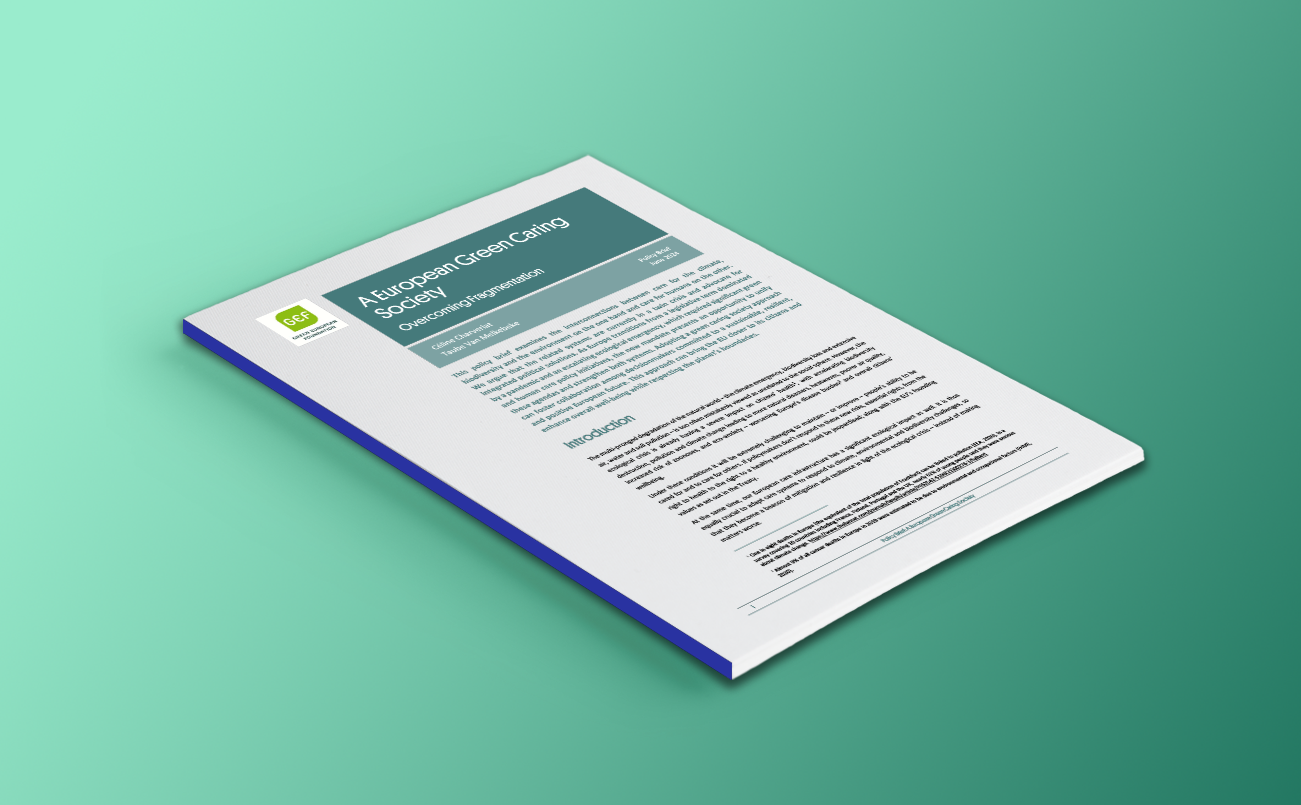
This policy brief examines the interconnections between care for the climate, biodiversity and the environment on the one hand and care for humans on the other. We argue that the related systems are currently in a twin crisis and advocate for integrated political solutions. As Europe transitions from a legislative term dominated by a pandemic and an escalating ecological emergency, which required significant green and human care policy initiatives, the new mandate presents an opportunity to unify these agendas and strengthen both systems. Adopting a green caring society approach can foster collaboration among decision-makers committed to a sustainable, resilient, and positive European future. Key proposals include extending the Do No Harm principle to encompass both human and environmental care, fostering a green care sector, implementing ecological and progressive tax reforms, establishing a People’s Sovereignty Fund and creating a new Commission Vice-Presidency for Caring Societies. These initiatives aim to bridge policy silos, promote sustainability, and ensure social equity, thus fostering a resilient and inclusive European society. This approach can bring the EU closer to its citizens and enhance overall well-being while respecting the planet’s boundaries. This unified approach of green and care policy strands has the potential to significantly enhance public support for the European project and ensure a sustainable, resilient future for all.


Contributors

  • Céline Charveriat, Core expert of this Knowledge Community, the Founder and Director of Pro(to)topia and Adjunct Professor at PSIA. She is an independent environmentalist and former Executive Director at the Institute for European Environmental Policy (IEEP).
  • Taube Van Melkebeke is Head of Policy at the Green European Foundation (GEF). She leads the different Knowledge Communities of the foundation. For further information, contact her at taube.vanmelkebeke@gef.eu.


This policy brief has been realised by the Green European Foundation with the financial support of the European Parliament to the Green European Foundation. The European Parliament is not responsible for the content of this publication.

The Future of the EU’s Energy Project: Democratic dimension

By Publications

About

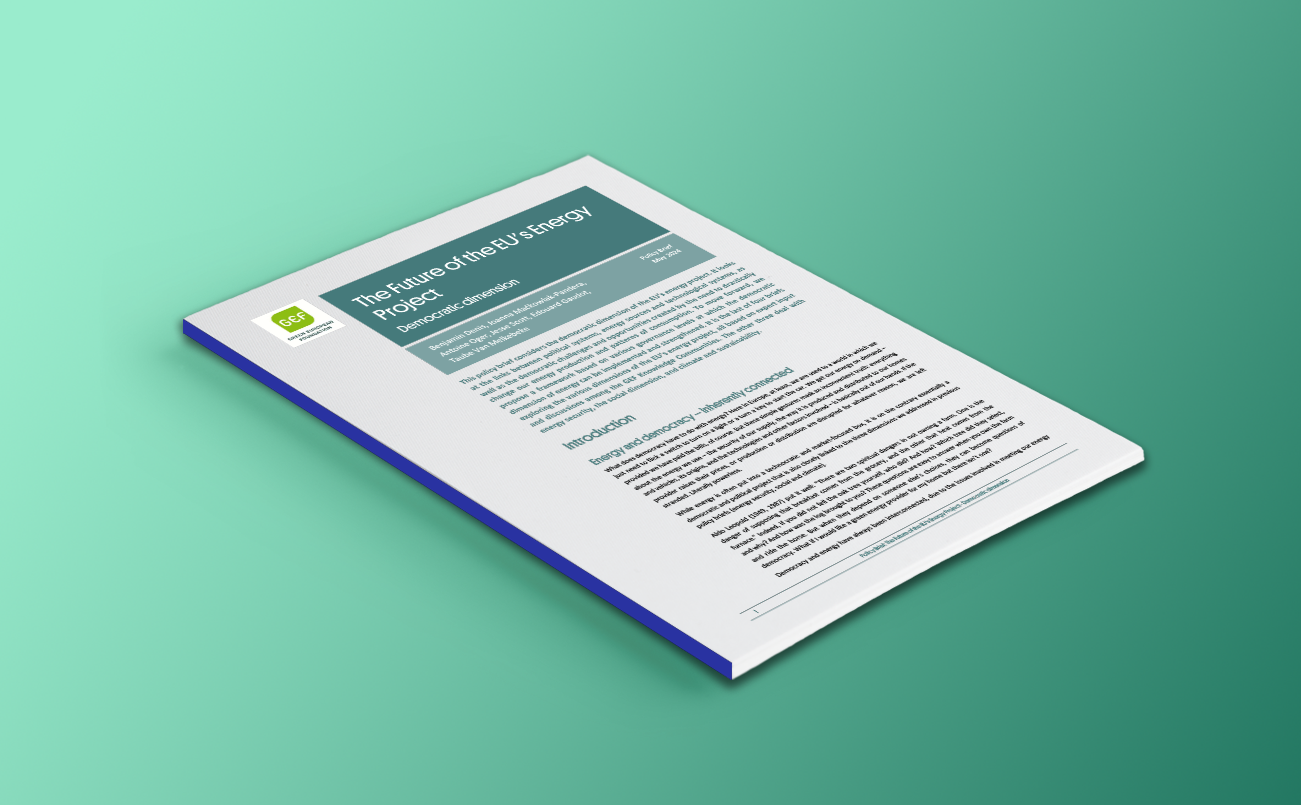
This policy brief considers the democratic dimension of the EU’s energy project. It looks at the links between political systems, energy sources and technological systems, as well as the democratic challenges and opportunities created by the need to drastically change our energy production and consumption patterns.

It is the last of four briefs exploring the various dimensions of the EU’s energy project, all based on expert input and discussions among the GEF Knowledge Communities. The other three deal with energy security, the social dimension, and climate and sustainability

Energy democracy can be seen as the glue binding all these other dimensions together, since it is relevant across the full spectrum of energy issues: continuity of supply, access, affordability and sustainability. It is therefore critical to the success of the energy project as a whole. To move its agenda forward, we propose a framework based on various governance levels, at which the democratic dimension of energy can be implemented and strengthened.


Contributors

  • Benjamin Denis, Core expert of this Knowledge Community, Senior Policy Advisor and Head of Industrial Policy Coordination at IndustriAll Europe.
  • Joanna Maćkowiak-Pandera, Core expert of this Knowledge Community, Founder and Head of Forum Energii.
  • Antoine Oger, Core expert of this Knowledge Community and Research Director, Global Challenges and SDGs at the Institute for European Environmental Policy (IEEP).
  • Jesse Scott, Core expert of this Knowledge Community, Adjunct at Hertie School Berlin and Visiting Fellow at DIW Berlin.
  • Taube Van Melkebeke, Head of Policy at the Green European Foundation (GEF). She leads the different Knowledge Communities of the foundation. For further information, contact her at taube.vanmelkebeke@gef.eu.


This policy brief has been realised by the Green European Foundation with the financial support of the European Parliament to the Green European Foundation. The European Parliament is not responsible for the content of this publication.

The Future of the EU’s Energy Project: Climate dimension

By Publications

About

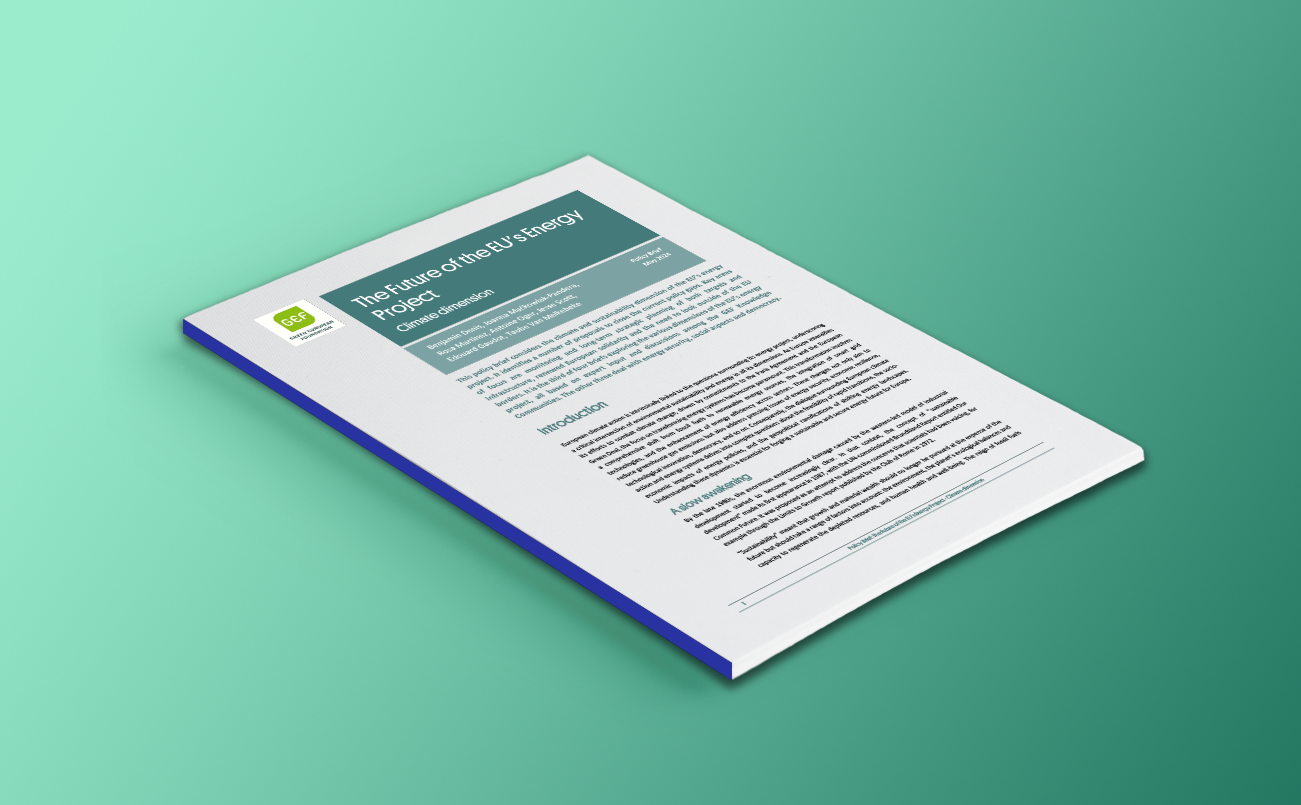
This policy brief considers the climate and sustainability dimension of the EU’s energy project. It identifies several gaps in the current state of the EU’s climate and energy intersection and delves into emerging needs, concerns, priorities, and potential unintended consequences of the green transition policy.

We propose closing existing policy gaps, strengthening the climate dimension of the EU’s energy project from a holistic point of view. This includes focusing on key areas such as:

  • Monitoring and long-term strategic planning of both targets and infrastructure;
  • Renewed European solidarity;
  • The need to look outside of the EU borders.
This is the third out of four briefs that delve into different dimensions of the EU’s energy project. All these briefs are informed by expert insights and discussions within the GEF Knowledge Communities.  The remaining three focus on energy security, social aspects, and democracy.


Contributors

  • Benjamin Denis, Core expert of this Knowledge Community, Senior Policy Advisor and Head of Industrial Policy Coordination at IndustriAll Europe.
  • Joanna Maćkowiak-Pandera, Core expert of this Knowledge Community, Founder and Head of Forum Energii
  • Rosa Martinez, Core expert of this Knowledge Community, Green European Journal Board Member and State Secretary for Social Rights in Spain.
  • Antoine Oger, Core expert of this Knowledge Community and Research Director, Global Challenges and SDGs at the Institute for European Environmental Policy (IEEP).
  • Jesse Scott, Core expert of this Knowledge Community, Adjunct at Hertie School Berlin and Visiting Fellow at DIW Berlin.
  • Taube Van Melkebeke, Head of Policy at the Green European Foundation (GEF). She leads the different Knowledge Communities of the foundation. For further information, contact her at taube.vanmelkebeke@gef.eu.


This policy brief has been realised by the Green European Foundation with the financial support of the European Parliament to the Green European Foundation. The European Parliament is not responsible for the content of this publication.

A European Single Market for the Future

By Publications

About

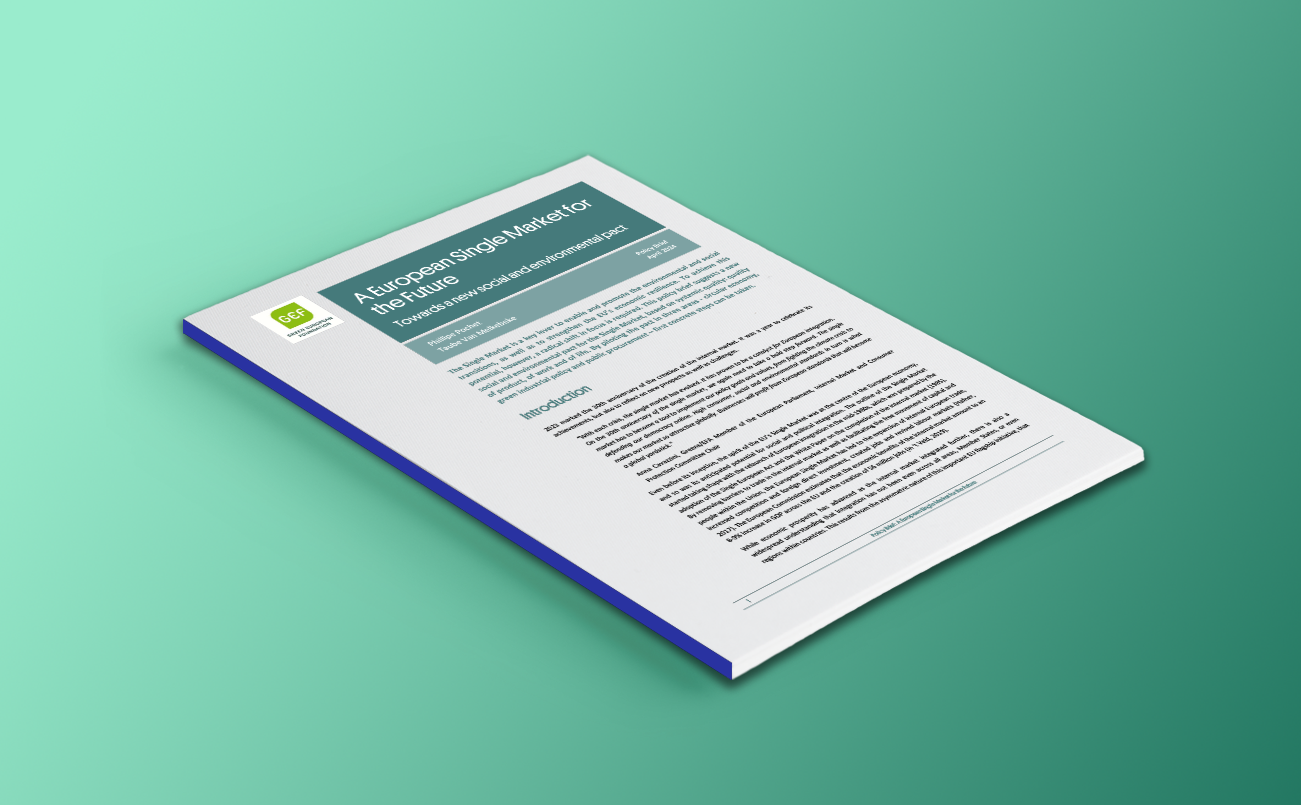
The Single Market is a key lever to enable and promote the environmental and social transitions, as well as to strengthen the EU’s economic resilience. To achieve this potential, however, a radical shift in focus is required. This policy brief suggests a new social and environmental pact for the Single Market, based on systemic quality: quality of product, of work and of life. This pact can bring together employers interested in quality products, workers and trade unions championing dignified labour conditions and NGOs and citizens advocating for a better quality of life and sustainable climate practices. By piloting the pact in three areas – circular economy, green industrial policy and public procurement – first concrete steps can be taken.

Contributors

  • Philippe Pochet, GEF fellow and core expert to this Knowledge Community. In the past, he held the position of Director of the Observatoire Social Européen (OSE) for over 15 years. From 2008 to 2023, he served as the General Director of the European Trade Union Institute (ETUI). Currently, he is a Professor at the Catholic University of Louvain and a Visiting Professor at the College of Europe in Bruges. He also holds the position of Affiliate Professor at Sant’Anna School of advanced studies, Pisa. Next to the topic of the Single Market, Philippe is also collaborating with GEF on Climate Emergency and Welfare States.
  • Taube Van Melkebeke, Head of Policy at the Green European Foundation (GEF). She leads the different Knowledge Communities of the foundation. For further information, contact her at taube.vanmelkebeke@gef.eu.


This policy brief has been realised by the Green European Foundation with the financial support of the European Parliament to the Green European Foundation. The European Parliament is not responsible for the content of this publication.

The Future of the EU’s Energy Project: Energy security dimension

By Uncategorized

About

This policy brief considers the energy security dimension of the EU’s energy project, with a particular focus on the new realities and dynamics of European (energy) security and the need to adapt energy frameworks accordingly.

Triggered by the climate emergency, cost-of-living crisis, geopolitical turmoil and fierce competition for the clean tech pole positions, energy security has evolved drastically over the last couple of years. The EU’s energy security toolbox, however, remained roughly untouched and left the Union paralysed. It’s high time to recognise the importance of this dimension of the Future of the EU’s Energy Project. Bringing order into this toolbox, thereby making it fit to deal with a changed world, is fundamental if we want to ensure sufficient, reliable and sustainable energy for all.

The authors of the policy brief propose a pathway, based on a revised European Energy Security Strategy. It is the first of four briefs exploring the various dimensions of the EU’s energy project, all based on expert input and discussions among the GEF Knowledge Communities. The other three deal with social aspects, climate and democracy.


Contributors

  • Joanna Maćkowiak-Pandera, Core expert of this Knowledge Community, Founder and Head of Forum Energii
  • Rosa Martinez, Core expert of this Knowledge Community, Green European Journal Board Member and State Secretary for Social Rights in Spain.
  • Jesse Scott, Core expert of this Knowledge Community, Adjunct at Hertie School Berlin and Visiting Fellow at DIW Berlin.
  • Taube Van Melkebeke, Head of Policy at the Green European Foundation (GEF). She leads the different Knowledge Communities of the foundation. For further information, contact her at taube.vanmelkebeke@gef.eu.


This policy brief has been realised by the Green European Foundation with the financial support of the European Parliament to the Green European Foundation. The European Parliament is not responsible for the content of this publication.

The Future of the EU’s Energy Project: Social dimension

By Uncategorized

About

This policy brief considers the social dimension of the EU’s future energy project, with a particular focus on social and territorial inequalities, energy poverty, inflation, jobs and skills.

It zooms in on the current policies and regulations, political context, investments and redistribution, and puts forward a number of political ideas and proposals. By shifting away from a consumption-driven approach, towards a planned, collective one, the authors argue, the EU can create real motivation for citizens to play an active part in the transition.

How?

a. Providing public measures and subsidies to fight energy poverty, while reducing overconsumption and maximising efficiency and sufficiency.

b. Creating new strategies and incentives for an inclusive transition on the labour market and schools.

c. Deploying the highest social and environmental conditionalities, at home and abroad.

d. Delivering the needed investments through a balanced combination of new money, new paradigm and new tax system.

This policy brief is part of the GEF Knowledge Communities. It is our second brief exploring the various dimensions of the EU’s energy project, all based on expert input and discussions. The other three deal with energy security, climate and democracy.


Contributors

Benjamin Denis, Core expert of this Knowledge Community, Senior Policy Advisor and Head of Industrial Policy Coordination at IndustriAll Europe.

Joanna Maćkowiak-Pandera, Core expert of this Knowledge Community, Founder and Head of Forum Energii.

Rosa Martinez, Core expert of this Knowledge Community, Green European Journal Board Member and State Secretary for Social Rights in Spain.

Antoine Oger, Core expert of this Knowledge Community and Research Director, Global Challenges and SDGs at the Institute for European Environmental Policy (IEEP).

Jesse Scott, Core expert of this Knowledge Community, Adjunct at Hertie School Berlin and Visiting Fellow at DIW Berlin.

Taube Van Melkebeke, Green European Foundation (GEF)’s Head of Policy and Knowledge Communities lead. For further information, contact her at taube.vanmelkebeke@gef.eu.


This policy brief has been realised by the Green European Foundation with the financial support of the European Parliament to the Green European Foundation. The European Parliament is not responsible for the content of this publication.

Climate Emergency and Welfare States

By Uncategorized

About

This policy brief develops arguments for an urgent evolution of European welfare states. We point out that, to answer the new climate emergency-related risks citizens face, welfare states should be reinvented and expanded. We suggest a set of concrete political proposals that can lead the way, ranging from the systematic decarbonisation of existing welfare state infrastructures to funding of an additional European welfare state sector, to new directives, new forms of European coordination, and the establishment of an EU monitoring body. The proposals have all been selected for their
feasibility and implementability during the next European legislature, as well as for their potential to spark public and political debates surrounding the intersection of the climate emergency and welfare states’ policy.

Contributors

  • Philippe Pochet, GEF fellow and core expert to this Knowledge Community. In the past, he held the position of Director of the Observatoire Social Européen (OSE) for over 15 years. From 2008 to 2023, he served as the General Director of the European Trade Union Institute (ETUI). Currently, he is a Professor at the Catholic University of Louvain and a Visiting Professor at the College of Europe in Bruges. He also holds the position of Affiliate Professor at Sant’Anna School of advanced studies, Pisa. Next to the topic of the Single Market, Philippe is also collaborating with GEF on Climate Emergency and Welfare States.
  • Taube Van Melkebeke, Head of Policy at the Green European Foundation (GEF). She leads the different Knowledge Communities of the foundation. For further information, contact her at taube.vanmelkebeke@gef.eu.


This policy brief has been realised by the Green European Foundation with the financial support of the European Parliament to the Green European Foundation. The European Parliament is not responsible for the content of this publication.