Next Generation – A Feminist Perspective

By

About the Event

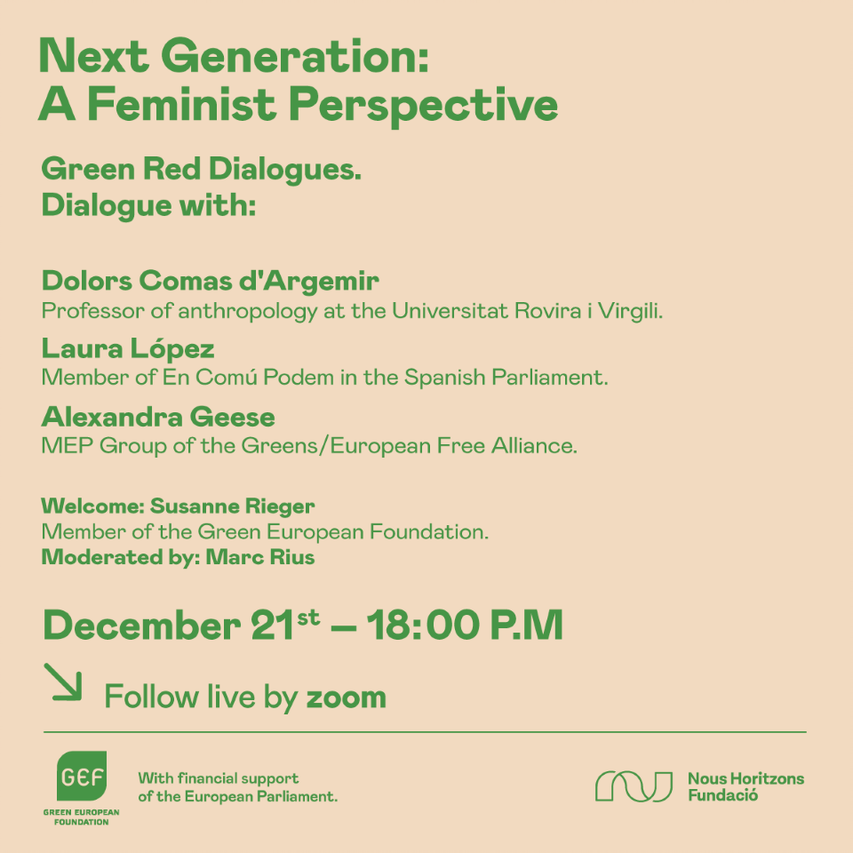
This Green Red Dialogue confronts the European Union’s Next Generation EU fund, a fund created to support member states in their economic and social recovery and resilience from the COVID-19 pandemic. Such massive investment has a great impact in setting the EU’s economic path for generations to come, but are feminist issues being considered ?

We will discuss the gendered effects of the COVID-19 crisis regarding job creation and overall livelihood improvement, and of course, whether the scheme contemplates the fundamental values of gender equality .

Context

The Green-Red Dialogues began in 2020 as a way to reflect on current issues from explicitly green and social perspectives. The challenges we face as a result of the COVID-19 crisis are new and unpredictable. Today it is more urgent than ever to reverse the consequences of a capitalist system that not only brought forth the pandemic but has also caused irreparable cracks in our planet. A capitalist system that has been shown to foster social inequality and that assaults the Earth.  

We cannot fall into fatalistic discourses and convey the message that all is lost. Instead, we must disseminate proposals and make the citizens of the European Union aware that another option is possible – that green policies are compatible with the economy, progress, and development. 

With this in mind, the Green Red Dialogues continue in 2021, once again providing the space for European policy makers, academics, activists, and citizens to address the challenges of today – combining current affairs and in-depth analysis to spark vibrant discussions about greener, more socially just solutions. 

Speakers

 Alexandra Geese – Greens/EFA MEP 

Laura Lopéz – MP for Catalunya in Común 

Dolors Comas – politician and anthropologist, Rovira i Virgili University 

Welcome by Susanne Rieger (GEF) and moderated by Marc Rius 

Practicalities

Date and Time: Tuesday, December 21st (18:00-19:00) 

Audience: The webinar is free and open to the general public. There will be simultaneous interpretation in Spanish and English.

Please register in advance via this link 

Recommended Reading

Delve more into the topics of this event by checking out some related articles in the Green European Journal! 

Go Greenr!

By

About the campaign 

Do you know any green trainers, consultants, or facilitators? Then join our campaign and encourage them to sign into our platform bynominating them on our social media. If selected, they will receive a 50% discount to join the Greenr community.  

How does it work? 

The campaign aims to encourage green users to bring in their green-minded trainer contacts. There are three ways to take part: 

  • Instagram: Like this post and mention your nominated person in a comment or share our post in your story tagging @gef_europe and your nominee. 
  • Twitter: Reply to this tweet mentioning your nominee and what makes them a good fit for Greenr. 
  • LinkedIn: Like this post and mention below your nominee and what makes them a good fit for Greenr. 
  • Facebook: Like this post , mention your nominated person in a comment and tell us what makes them a good fit for Greenr.

Don’t forget to use the hashtag #GoGreenr for all the above!

What happens next? 

Nominees can apply to become a Greenr member following this link. The application comprises fillinga short form, which will then be examined by our selection panel. This ensures thatGreenrremains a space for dedicatedgreenprofessionals seeking to achieve social change! Once approved, the selected nominees will get a 50% reduction in our fee to join the platform. Ready to participate? Go Greenr! 


Context

Greenr is the platform that connects green-minded facilitators, trainers and consultants with the green organisations that need them. Members of the Greenr community are part of a dynamic network of like-minded trainers and experts and have access to different training programmes and networking events. Want to know more about Greenr? Head over to www.greenr.eu .Training Green means training sustainably and inclusively. Greenr trainers are value-driven changemakers who use participatory, co-creative methodologies to ensure that all voices and perspectives are heard. Know someone like that? Nominate them today to #GoGreenr! 


Practicalities

End of the campaign: December 20th, which means you should nominate your candidate on our social media channels prior to this date. 

Application deadline: 15th January, which means nominees should fill in the application by this date. 

 If you have any questions, please send an email to kel.nkondock@gef.eu  

European Mobility Atlas

By Uncategorized

Context

Europe is the continent where multiple forms of transportation have been invented or brought to technological maturity. The free movement of persons has made Europe grow together and led to an ever-stronger sense of cohesion. Cross-border mobility is a prerequisite for a united EU and the experience of inter-connectedness on all levels. However, the Covid-19 pandemic has limited the freedom of movement extensively and shows the vulnerability of Europe as a place of constant movement. While air traffic decreased and the use of bicycles increased, there has also been a strong negative shift from shared transport to individual transport. If this change prevails, a great deal of earlier efforts to reduce GHG emissions in the transport sector will be nullified. If one thing is clear is that recovery packages to overcome the effects of the Covid-19 pandemic must be accompanied by a commitment to a sustainable transformation that avoids further carbon lock-in with a transport sector still largely powered by fossil fuels.

Objectives

Our European Mobility Atlas seeks to contribute to the efforts towards sustainable and just mobility in Europe. Thus, it covers a multitude of transport-related aspects relying on evidence-based research and highlighting concrete, tangible mobility solutions from across our continent. GEF is working together with Heinrich Böll Stiftung to Europeanise the debate on sustainable mobility on our continent. We are doing this by translating the English language version of the European Mobility Atlas to Spanish and Italian, as well as providing a series of infosheets on the mobility context in Spain.

With more and more people being mobile, Europe is a continent that needs to remain innovative in order to achieve the relevant climate goals. We need new technologies to align our mobility infrastructure and behaviour with the pressing challenges of the upcoming years. To save our climate, the European Green Deal has to be Europe’s first priority.

Download

Digital version in Spanish is available here.

Digital version in Italian is available here.

Digital version in Portuguese available here.

Complementary resources

Present and Future of Mobility in Spain (ES): available here.


These publications have been realised by the Green European Foundation in cooperation with Heinrich Böll Stiftung, and the financial support of the European Parliament to the Green European Foundation. The European Parliament is not responsible for the content of this publication

Green Central-Eastern Network

By

About the event

The Green European Foundation is organising an event tailored to those who have the long-term goal to ignite political change in their countries and advance the green movement locally. Specifically, the event will gather representatives of national political foundations and equivalent organisations from Eastern European countries where GEF has established partners as well as representatives from organisations that have a potential to help in building sustainable green movements. Gender balance will be observed as a key element in moderation and debate. We are looking at a balanced participation of both EU and non-EU countries

Objectives 

  1. Connectwe will foster exchanges on who are the agents of change in the region, and how they work; 
  1. Learn: we will address the challenges green organisations are facing, as well as their successes. We’ll have honest conversations on what works and what doesn’t.  
  1. Build: building on the two objectives above, we will identify what the network can achieve as a community, and what the next steps should be.  

Context

The Green European Foundation is committed to contribute to the advancement of the “green wave” in Central and Eastern Europe, in coordination with the efforts made by the other members of the European Green family. We want to reinforce and enlarge the green political movement and its impact in those regions of Europe.  

In this context, we are launching a Green Central-Eastern Network, aiming at facilitating a network of green political foundations and equivalent organisations from Central and Eastern Europe and allow them a space to co-create a framework of functioning; building an understanding of how shared history, political context, and topics can create opportunities for common work; Inspiring action by sharing successes and strategies for achieving them and methods of combatting common threats and challenges.This online event will serve as a preliminary work assessing the needs and strengths of the organisations in the region. The input gathered will impulse the networking event in Vienna next year.

Practicalities

Date: 10 December 2021

Location: Zoom

In case of questions, please contact luka.gudek@gef.eu 


This event is organised by the Green European Foundation with the financial support of the European Parliament to the Green European Foundation. The European Parliament is not responsible for the content of this event.

Green Horizons Academy: The Good Story

By

About the Event

The Green Horizons Academy is an educational programme that aims to expand the ideas surrounding the green movement towards the alternative liveable future across Europe. Addressing the climate crisis and environmental issues is a home ground for the greens. Still, we need to better prepare for the forthcoming battles of narratives, where everyone is “playing the green card”.

Populists and conservative authoritarians, especially in countries with a weak green opposition, are casting a long shadow over social movements and appropriating environmentalism. Europe’s narrative of openness and solidarity has been put to the test amid the pandemic. The Academy is a space for theory and practice that can serve both for political actors to step into closer communication with the people, and for citizens to politicize the growing environmental struggles.

This year’s Green Horizons Academy’s main topic is building a successful narrative around green values that resonates with the broad public, therefore its title – THE GOOD STORY.

Over three days, we hope to inspire European green actors and raise the capacities of citizens from South-East Europe in their approach to presenting green values and agendas. GHA will also examine the resilience of the local Green political organisations and offer the space for authentic policy debates designed for and from the region. The time has come for green-minded actors to create a cultural uprising, painting our views as possible, tangible, and popular! From the academic field of political theory to the environmental activists and new movements, the Green Horizons Academy will present, discuss, and articulate democratic, feminist, sustainable and just alternatives.

Programme

The 3-day event consists of two interlinked parts: 

  • closed daily workshops (registered participants only, in physical space)  
  • public evening sessions (online) with lectures and panels covering various topics 

Friday, 15 October 

17:30 Welcome 

18:00 –  19:15 PUBLIC SESSION: Moving of the Movements (panel): Analysis of the development cycle of the environmental movements, where are they today, what messages are they sending, and what are the roadmaps to success. 

  • Pablo Dominguez (Senior Eco-Anthropologist at the National Council for Scientific Research CNRS, France) 
  • Safet Kubat (Eco Movement Rivers of Bosnia and Herzegovina – Be the Change, PhD candidate in political ecology) 
  • Aleksandar Dragićević (Coalition for Sustainable Development, Montenegro) 
  • Žaklina Živković (Right to Water, Serbia) 
  • Moderator: Bojana Selaković (Civic Initiatives) 

19:30 – 20:45 PUBLIC SESSION: Environmentalism Gone Rights and Wrong (panel): Populist and conservative influences in environmental struggles and our green and left alternative. 

  • Speaker: Balša Lubarda – an environmental sociologist specializing in environmental communication, radicalism, right-wing politics and political ideologies. He is a Doctoral candidate at the Central European University, and Head of Ideology Research Unit at the Centre for Analysis of the Radical Right, United Kingdom. 
  • Commentators: Olga Nikolić (Institute for Philosophy and Social Theory) and Vladan Đukanović (activist, co-author of an investigative article on far-right ecologism) 

Saturday, 16 October 

9:30 – 11:00 Registration and onsite rapid COVID-19 testing 

11:00 – 11:30 Welcoming session – the role of the Green Horizons Academy in Europe today 

  • Iva Marković (Polekol) and Vedran Horvat (Green European Foundation) 

11:30 – 13:00 Green Ideas – workshop introducing and discussing universal values and principles 

  • Nikola Palibrk Ristić and Mika Nikolić (Serbian Green Youth) 

13:00 – 14:30 Lunch 

14:30 – 16:00 Political ecology lecture – climate crisis, management crisis, and what does political ecology have to do with this? 

  • Vedran Horvat (Green European Foundation, Institute for Political Ecology, Croatia) 

16:00 – 16:15 Coffee break 

16:15 – 17:45 Communicating Green – workshop on how to reach hearts and minds of a broader public, while being loyal to green values and principles 

  • Teo Comet Kortman (Green European Foundation), Vladan Đukanović (activist) 

18:00 – 19:30 PUBLIC SESSION: Story by the People for the People (panel): Choosing narratives and designing messages 

  • Marija Ratković (activist, founder of the Center for Biopolitical Education Biopolis, Serbia) 
  • Filip Balunović (Institute for Philosophy and Social Theory, Serbia) 
  • Sonja Dragović (KANA – Who If Not Architect group, Montenegro; PhD researcher at the 
  • ISCTE – University Institute of Lisbon) 
  • Teodor Celakoski (Možemo!, Croatia) 
  • Moderator: Srđan Đurović (Program Manager, Open Society Foundation, Serbia) 

20:00 Dinner (Stara Hercegovina restaurant) 

Sunday, 17 October 

9:30 – 10:00 Coffee and gathering 

10:00 – 11:30 Don’t take it outside, talk to each other! Lessons learned from work on alliances, coalitions, and networks of environmental movements about common communication strategies 

  • Lejla Kusturica (Balkan River Defenders alliance) and Natalija Stojmenović (Balkans United for Clean Air campaign) 

11:30 – 11:45 Break 

11:45 – 13:00 Reflections, conclusions, and final messages 

13:00 Lunch 

18:00 – 19:30 PUBLIC SESSION: The Good Story (panel): Green/left narratives put to practice. In the political arena, leverage of the greens and the left is not the force, capital or fear, rather it is the story of a happy ending, a hope for utopia where people can live a good life, in peace, equality and harmony with the planet. How to fight the power with a positive story, especially under the threats of arrests, voting manipulation, powerful far right and the burden of historical stigma? We’ll discuss how to successfully communicate affirmative narratives, what works and what doesn’t. 

  • Teresa Griesebner (Communist Party of Austria – Graz) 
  • Dobrica Veselinović (Don’t Let Belgrade D(r)own, Serbia) 
  • Nebojša Zelenović (Together for Serbia/Action, Serbia) 
  • Michal Berg (Co-chair of Czech Greens, Member of the Committee of European Greens) 
  • Rudi Sayat Pulatyan (Central Executive Committee Member, Green Party, Turkey) 
  • Moderator: Iva Marković (Polekol, Serbia) 

As the output of the event, topical articles will be compiled and curated in a guidebook publication. A more detailed programme and speaker names will be shared soon! 

Practicalities

The Green Horizons Academy will take place in Belgrade, Serbia from 15-17 October. The venue is the House of Civic Initiatives (Dobračina 55). The language of the event is BCS and English, and translation will be provided.  

The programme will be held in a hybrid model, where selected participants are in the physical space, and evening sessions are live streamed for the public. In person participants need to apply via this link by Monday, October 4th 

Watch the public sessions live via Facebook or click on the dedicated Zoom link for each programme session to enjoy translation.  

If you have any questions, please send an email to organizacija.polekol@gmail.com. 


This event is organised by the Green European Foundation, with the support of PolEkol and the financial support of the European Parliament to the Green European Foundation.  
Call for Participants: Green Horizons Academy

By

About the Call

The Green European Foundation and the Organisation for Political Ecology POLEKOL are launching a call for participants for the first Green Horizons Academy, under the title “The Good Story.”  

We are looking for participants that are active in environmental movements, civic initiatives, academic institutions and/or political organizations with green policy agenda. This three-day event will give you the opportunity to: 

  • Learn about political ecology and the green political idea in Europe 
  • Put forward ways to bring the green agenda into practice in South-East Europe  
  • Improve your green values communication skills 
  • Create an affirmative green narrative on sustainability, alternative to the populist one 
  • Network with potential green-minded allies 

Context

The Green Horizons Academy is an educational programme that aims to expand the imaginary of the broad green movement towards the alternative liveable future across Europe. Addressing the climate crisis and environmental issues is a home ground for the greens. Still, we need to prepare for the forthcoming battles of narratives, especially at a time where everyone is “playing the green card”.

Populists and conservative authoritarians, especially in countries with a weak green opposition, are casting a long shadow over social movements and appropriating environmentalism. Europe’s narrative of openness and solidarity has been put to the test amid the pandemic. The Academy is a space for theory and practice that can serve both for political actors to step into closer communication with the people, and for citizens to politicize the growing environmental struggles.

This year’s Green Horizons Academy’s main topic is building a successful narrative around green values that resonates with the broad public, therefore its title – THE GOOD STORY.

During three days of lectures, debates, and workshops, we hope to inspire European green actors and raise the capacities of citizens from South-East Europe in their approach to presenting green values and agenda. GHA will also examine the resilience of the existing Green political organisations in the region and offer the space for authentic policy debates designed for and from the region. The time has come for green-minded actors to create a cultural uprising, painting our views as possible, tangible, and popular! From the academic field of political theory to the environmental activists and new movements, the Green Horizons Academy will present, discuss, and articulate democratic, feminist, sustainable and just alternatives.

Practicalities

The Green Horizons Academy will take place in Belgrade, Serbia from 15-17 October. The language of the event is BCS and English, and translation will be provided.  

Please apply by filling out this online formThe application deadline is Monday, October 4th. If you have any questions, please send an email to organizacija.polekol@gmail.com. 

All applicants will be informed about the selection results by October 6th. 

As we are still in the middle of the pandemic, as a safety precaution, all participants will be Covid tested at the spot, right before the event starts.  

The programme will be held in a hybrid model, where selected participants are in the physical space, and evening sessions are live streamed for the public. 


This event is organised by the Green European Foundation, with the support of PolEkol and the financial support of the European Parliament to the Green European Foundation.  
Radical Humanism and Ecological Conversion: Ivan Illich and Alexander Langer

By

About the Event

Is Europe ready for the ecological conversion that scientific evidence stresses on us?

Ivan Illich and Alexander Langer are influential interpreters of the economic critique of consumer society. Their work and practice offer many stimuli for reflection and action in the contemporary context.

This conference will offer the opportunity to compare Illich’s and Langer’s views and proposals, and to examine not only their freshness and relevance but also their critical aspects.

The seminar will dedicate sessions to the translation of theoretical thinking into practical choices as they emerge from the different programs and practices of the Green political sphere, in order to design and develop new humanistic approaches and environmental strategies.

Context

Ivan Illich and Alexander Langer are two of the most authoritative interpreters of a critique of the consumer society based on the theory of market self-regulation.

Illich’s importance in representing a critical voice towards the Western social model, by now of global dimension, is well known. We aim to venture further and discuss the personal trajectory and new message that he wanted to propose without coming to terms with the corruptive logics of a consumerist society, and how can this apply to the present generations.

Langer spoke of the social desirability of an ecological conversion even before Pope Francis did so in his Encyclical. This can only succeed when it is socially desirable. What we need is a ritual passage which has the allure of solemnity: an “ecological constituent,” and a widespread commitment to reconsider our ways of living, producing, consuming in order to make our life-styles compatible with the limited amount of resources the world can provide.

The various conference contributions will study the religious aspects, those linked to agricultural and territorial choices, the theme of the frontier, and the economic and political aspects measured by the real goods and needs of the civil communities throughout Europe.


Programme and Speakers

Friday, 22/10 

17:00 Conference opening 

  • Mauro Bozzetti & Franz Tutzer 

17:30 “In the sign of the flying fish:” Ivan and Alexander 

  • Barbara Duden, Hannover University 

Saturday, 23/10 

9:00 It is not enough to be indignant. The concrete utopia of Illich and Langer. 

  • Mauro Bozzetti, University of Urbino 

10:00 Interculturality: from Illich to Langer 

  • Fabio Milana  

11:30 When the frontiers fall, all is the same – the disappearance of the ability-to-be-different 

  • Marianne Gronemeyer  

14:30 Not developing the production of goods, but the art of life 

  • Peter Kamerer  

15:30 The regeneration of the common good as an integral revolution 

  • Giannozzo Pucci  

17:00 Wolfgang Sachs: Memories, impressions, analysis 

  • Wuppertal Institute for Climate 

18:00 Brief interventions and reflections 

  • Fridays for Future, Lupus in Fabula, … 

Evening: eco-acoustic intervention by David Monacchi  

Sunday, 24/10 

9:00 Rethinking along with Alexander Langer and Ivan Illich 

  • Franz Tutzer 

9:45 Round table: Towards a European ecological conversion 

  • Moderated by Franz Tutzer & Mauro Bozzetti 

12:00 Conclusion 


Practicalities

Dates: 22-24 October 

Location: Monastery of Montebello, Italy 

Language: Italian (some sessions in German with guiding translation) 

Registration and further information: info@alexanderlanger.net (deadline – October 15th) 

Audience: The event is addressed both to persons interested in the work in Illich and Langer and more broadly to citizens with an interest in climate change and ecological policies, to students, scholars, and activists.

A brochure containing the conference contributions will be made available after the event, which will be beneficial in promoting, design and developing new humanistic approaches and environmental strategies for a desirable future, a “futuro amico”.


This conference is organised by the Green European Foundation with the support of Fondazione Alexander Langer and the financial support of the European Parliament to the Green European Foundation.  

 

EGAT-Finalnd

By

About the event

If you are eager to learn about green politics and change-making, this course is for you! Prior experience or membership of the Young Greens is not needed. In fact, we welcome those participants who could make the most out of this course! We are looking for applicants from diverse backgrounds – aged 15-25 from all across Finland. The most important thing we are looking for is motivation!

During EGAT, you will grasp green values from the local to international level. As a participant, you will get an insight into politics from legislators and other professionals, and learn how civil society organisations work from the inside.
This training will give you the knowledge, skills, and network you need to become a changemaker. You will find your way to become an activist, gain new friends and valuable experience.

Provisional programme

1st meeting, 15.-16.10.2021: Welcome to the training!

During the first meeting, we will get to know each other and introduce the Green Party and Young Greens. The meeting is organised in cooperation with the Green European Foundation and we will discuss green politics and activism at various levels – including local, national, and international.

2nd meeting, 27.11- 28.11.2021: Peek from local level politics to Brussels.

We will learn about local activism and how municipalities work. We’ll also explore how local politics are connected to the European Union. We will get familiar with the EU structures and the work of the Parliament. This training is organised in cooperation with the Green European Foundation.

3rd meeting, 28.-29.1. 2022: NGOs as environmental policymakers

Civil society organisations and NGOs are key players in promoting environmental or climate justice. We will find out more about different NGOs and their work in different environmental fields. This training is organised in cooperation with the Green European Foundation.

● 4th meeting, 8-9.1.2022: Equality and equity in politics and media

We will focus on the issues of equality and equity at both the national level of politics and at a European level. We’ll look at plans and actions aiming to promote equality and equity in democratic decision-making. We will also take a more global perspective and find out what are our challenges and objectives in promoting and ensuring equality, equity, and human rights in Europe and globally.

We aim to have in-person meetings, always following COVID-19
restrictions and health authorities’ recommendations. The participant fee is 100€. This will cover one meal and travel and accommodation for those coming from outside the Helsinki area. We are expecting a commitment to join all the pieces of training, but in case you are not able to attend some of the physical meetings, you can participate online.

In addition, we are trying to organise the traditional Brussels Study Tour in Spring 2022, but the specific dates and provisions will depend on the development of COVID-19 pandemic. The study trip will cost 120 euros per participant, which will cover all travel and
accommodation expenses.


Practicalities

The application period ends on Wednesday 15th September at midnight EEST. We will select 25 participants altogether. All applicants will be informed whether their application was successful by Tuesday 28th September at the latest. Fill out the application here.

In case of questions or any further information don’t hesitate to contact us:

Saara Loukola
International Projects Officer, Young Greens of Finland
saara.loukola@vihreatnuoret.fi
+358542113577


This EGAT programme is organised by the Green European Foundation with the support of Fundacja Strefa Zieleni and with the financial support of the European Parliament to the Green European Foundation.

EGAT-Catalonia

By

About the event

We offer you to participate in a training program for young European green activists.

You will learn how European institutions work and how things can be changed from politics, from social justice, green and feminist values.

You will meet other activists, with whom you will share your struggles and experiences.

You will be able to go to Brussels to get to know the European institutions and participants from six other countries (Croatia, Hungary, Poland, Czech Republic, Greece and Finland).

Programme

We’ll hold two training seminars from Friday afternoon to Sunday afternoon with different green politicians and experts. You will get in-depth into the concepts and techniques to achieve change working in small groups,

October 1-3, 2021

“Green policies from my neighborhood to Europe“

December 3-5, 2021

“Tools to transform reality“

January 2022

Online meeting with activists from other countries

February 2022

Trip to Brussels


This EGAT programme is organised by the Green European Foundation with the support of Nous Horitzons and with the financial support of the European Parliament to the Green European Foundation.
EGAT-Catalonia

By

About the event

We offer you to participate in a training program for young European green activists.

You will learn how European institutions work and how things can be changed from politics, from social justice, green and feminist values.

You will meet other activists, with whom you will share your struggles and experiences.

You will be able to go to Brussels to get to know the European institutions and participants from six other countries (Croatia, Hungary, Poland, Czech Republic, Greece and Finland).

Programme

We’ll hold two training seminars from Friday afternoon to Sunday afternoon with different green politicians and experts. You will get in-depth into the concepts and techniques to achieve change working in small groups,

November 12-3, 2021
First seminar
December 3-5, 2021
Second seminar
January 2022
Online meeting with activists from other countries
February 2022
Trip to Brussels


Practicalities

Application

Interested? Please applying by through this link.

Deadline: September 22, 2021.

This activity has no economic cost for the participants.

Please note: Due to the particular circumstances during the COVID-19 pandemic, all activities could potentially be subjected to changes depending on the epidemiological data and any restrictive measures and guidelines at that time. Some parts of the programme involving travel may take place online.

For any questions contact us egat@noushoritzons.cat


This EGAT programme is organised by the Green European Foundation with the support of Nous Horitzons and with the financial support of the European Parliament to the Green European Foundation.
EGAT-Poland

By

About the event

The European Green Activist Training (EGAT) is an international training program for young people (16-26 years old) culminating with a study visit to the European Parliament. The EGAT takes place between October 2021 and April 2022. During this time, participants will take part in 3 hybrid (offline+online) meetings, during which they will learn how the European Parliament works and how to implement their own social projects. Finally, they will receive microgrants and mentoring support to implement their own social projects.

Who is the EGAT for?

  • Young people between 16 and 26 years of age, both those who already have activist experience, as well as those are taking their first steps in activism,
  • Members of school climate strikes, youth city councils, youth organizations and associations or young people active in informal youth groups,
  • For people who believe in values ​​such as: respect for the natural environment and planetary boundaries, human and animal rights, democracy and openness to others, respect for people and animals, regardless of their origin, religion, gender, sexual orientation or social status.
  • People who want to grow and make change to the world around them.

Good knowledge of English language is desired, but not required.

What awaits the participants of EGAT?

1.   Three hybrid meetings in various places in Poland (or online in case the pandemic situation escalates),

2.   Participation in two e-learning courses on the functioning of European Parliament.

3.   Small grants and support from mentors in the implementation of their own campaigns or local actions,

4.   Participation in a study visit to the European Parliament (might happen online, depending on the pandemic situation).

Practicalities

EGAT schedule

• 15 October- 15 November 2021 – three meetings and e-learning phase

During the meetings participants will get to know each other, establish new contacts and learn to plan actions and activities together. During e-learning, they will learn about the structure and functioning of the European Parliament and deepen their knowledge on policy issues. The offline meetings will take place on the following dates:


I) 15-17 October,

II) 30-31 October,

III) 12-14 November.


• December 2021 – February 2022 – implementation of own projects

Enriched with new knowledge, participants of EGAT will be able to start implementing their own ideas for action. In small teams (4-5 people) they will implement their small, local or online projects. They will receive the support of mentors, as well as microgrants (up to 1000 PLN) to implement their ideas. Project implementation is not a mandatory element of the program, but participants will be strongly encouraged to implement their own projects.

• April 2022 – visit to the European Parliament

Participants who complete all stages of the EGAT will take part in a visit to the European Parliament together with a hundred people from other countries, where similar trainings take place (Finland, Czech Republic, Croatia, Hungary, Spain, Greece). During 3 days of the study tour they will visit the Parliament, meet MEPs and take part in joint workshops with young activists from other countries. Participation in the a study visit is not obligatory.

Participation costs

Thanks to funding from the European Parliament, participants have to bear only 10% of the cost of participation in the training, i.e. 200 PLN. The Green European Foundation and Green Zone Foundation will cover the costs of participation in three offline meetings (including travel, accommodation and meals), as well as the cost of participation in a study visit to the European Parliament (travel, accommodation and meals).

In case of a difficult financial situation, please contact us. We want everyone to be able to participate in the program, regardless of their financial situation, therefore, it is possible to cover 100% of participation cost from the solidarity fund for people in difficult financial situation.

Recruitment

Please fill in the recruitment form no later than September 6th, 2021, 23:59. All persons qualified to participate in the project will be informed about the recruitment results by September 20th.

Find more info at: www.egatpoland.org


This EGAT programme is organised by the Green European Foundation with the support of Fundacja Strefa Zieleni and with the financial support of the European Parliament to the Green European Foundation.
EGAT Poland

By

About the event

The European Green Activist Training (EGAT) is an international training program for young people (16-26 years old) culminating with a study visit to the European Parliament. The EGAT takes place between October 2021 and April 2022. During this time, participants will take part in 3 hybrid (offline+online) meetings, during which they will learn how the European Parliament works and how to implement their own social projects. Finally, they will receive microgrants and mentoring support to implement their own social projects.

Who is the EGAT for?

  • Young people between 16 and 26 years of age, both those who already have activist experience, as well as those are taking their first steps in activism,
  • Members of school climate strikes, youth city councils, youth organizations and associations or young people active in informal youth groups,
  • For people who believe in values ​​such as: respect for the natural environment and planetary boundaries, human and animal rights, democracy and openness to others, respect for people and animals, regardless of their origin, religion, gender, sexual orientation or social status.
  • People who want to grow and make change to the world around them.

Good knowledge of English language is desired, but not required.

What awaits the participants of EGAT?

1.   Three hybrid meetings in various places in Poland (or online in case the pandemic situation escalates),

2.   Participation in two e-learning courses on the functioning of European Parliament.

3.   Small grants and support from mentors in the implementation of their own campaigns or local actions,

4.   Participation in a study visit to the European Parliament (might happen online, depending on the pandemic situation).

Practicalities

EGAT schedule

• 15 October- 15 November 2021 – three meetings and e-learning phase

During the meetings participants will get to know each other, establish new contacts and learn to plan actions and activities together. During e-learning, they will learn about the structure and functioning of the European Parliament and deepen their knowledge on policy issues. The offline meetings will take place on the following dates:


I) 15-17 October,

II) 30-31 October,

III) 12-14 November.


• December 2021 – February 2022 – implementation of own projects

Enriched with new knowledge, participants of EGAT will be able to start implementing their own ideas for action. In small teams (4-5 people) they will implement their small, local or online projects. They will receive the support of mentors, as well as microgrants (up to 1000 PLN) to implement their ideas. Project implementation is not a mandatory element of the program, but participants will be strongly encouraged to implement their own projects.

• April 2022 – visit to the European Parliament

Participants who complete all stages of the EGAT will take part in a visit to the European Parliament together with a hundred people from other countries, where similar trainings take place (Finland, Czech Republic, Croatia, Hungary, Spain, Greece). During 3 days of the study tour they will visit the Parliament, meet MEPs and take part in joint workshops with young activists from other countries. Participation in the a study visit is not obligatory.

Participation costs

Thanks to funding from the European Parliament, participants have to bear only 10% of the cost of participation in the training, i.e. 200 PLN. The Green European Foundation and Green Zone Foundation will cover the costs of participation in three offline meetings (including travel, accommodation and meals), as well as the cost of participation in a study visit to the European Parliament (travel, accommodation and meals).

In case of a difficult financial situation, please contact us. We want everyone to be able to participate in the program, regardless of their financial situation, therefore, it is possible to cover 100% of participation cost from the solidarity fund for people in difficult financial situation.


This EGAT programme is organised by the Green European Foundation with the support of Fundacja Strefa Zieleni and with the financial support of the European Parliament to the Green European Foundation.
EGAT-Hungary

By

About the event

Participants will take part in a 3-day training from October 8th-10th, 2021.
The following session will be in January 2022 (a Saturday in Budapest) and finally,  a study trip to Brussels during the spring of 2022 – all for free!
Those who fill in the application form and receive a written confirmation after the application deadline are eligible.
In case of over-application, the applicants will be pre-screened, due to the number limit .We can provide a place for 20 applicants. 

Context

Participants will learn about the history, principles, and challenges of the green movement from researchers, politicians, and NGO representatives. We will examine the Green political map and the main social, economic, and political actors involved in it.
From a practical point of view, we examine what types of actions we need for ecopolitics to gain more space in the 21st century. We will heavily focus on Europe, the EU institutions, actors, history, and current affairs, which reflect the political composition of the European Parliament and the functioning and strategy of the European Commission.
The other important aspect of the training is for the participants to get to know each other and share their knowledge experiences.

Programme

PLANNED TRAINING DATES IN HUNGARY:
October 8-10, 2020 (Friday afternoon to Sunday afternoon), Mátraháza-Sástó
January 2021 (Saturday) 10:00 – 16:00, Budapest location

BRUSSELS STUDY TRIP (BST):
Active participants will also be invited to a 5 days long joint study trip to Brussels, which is expected to take place in March 2022.

Practicalities

PARTICIPATION FEE AND REIMBURSEMENT OF EXPENSES:
The training program in Hungary and Brussels is completely free.
We provide the return trip from and to Budapest for the 3-day training and the BST.
Travel to Budapest and travel to the airport is paid by the applicant.
 
INTERNATIONAL TEAM: 
The training is part of the international European Green Activist Training (EGAT) program and is organised by the Green European Foundation (GEF) in Brussels, with the financial support of the European Parliament to the Green European Foundation. Our partners on the study trip to Brussels will be the Finnish, Czech, Polish, Croatian, Spanish and Greek groups.  

APPLICATION DEADLINE:  September 12, 2021 (Sunday) 24:00

Click here for the application 


This EGAT programme is organised by the Green European Foundation with the support of Ecopolis foundation and with the financial support of the European Parliament to the Green European Foundation.
Please note: Due to the particular circumstances during the COVID-19 pandemic, all activities could potentially be subjected to changes depending on the epidemiological data and any restrictive measures and guidelines at that time. Some parts of the programme involving travel may take place online. 

EGAT Hungary

By

About the event

Participants will take part in a 3-day training from October 8th-10th, 2021.
The following session will be in January 2022 (a Saturday in Budapest) and finally,  a study trip to Brussels during the spring of 2022 – all for free!
Those who fill in the application form and receive a written confirmation after the application deadline are eligible.
In case of over-application, the applicants will be pre-screened, due to the number limit .We can provide a place for 20 applicants. 

Context

Participants will learn about the history, principles, and challenges of the green movement from researchers, politicians, and NGO representatives. We will examine the Green political map and the main social, economic, and political actors involved in it.
From a practical point of view, we examine what types of actions we need for ecopolitics to gain more space in the 21st century. We will heavily focus on Europe, the EU institutions, actors, history, and current affairs, which reflect the political composition of the European Parliament and the functioning and strategy of the European Commission.
The other important aspect of the training is for the participants to get to know each other and share their knowledge experiences.

Programme

PLANNED TRAINING DATES IN HUNGARY:
October 8-10, 2020 (Friday afternoon to Sunday afternoon), Mátraháza-Sástó
January 2021 (Saturday) 10:00 – 16:00, Budapest location

BRUSSELS STUDY TRIP (BST):
Active participants will also be invited to a 5 days long joint study trip to Brussels, which is expected to take place in March 2022.

Practicalities

PARTICIPATION FEE AND REIMBURSEMENT OF EXPENSES:
The training program in Hungary and Brussels is completely free.
We provide the return trip from and to Budapest for the 3-day training and the BST.
Travel to Budapest and travel to the airport is paid by the applicant.
 
INTERNATIONAL TEAM: 
The training is part of the international European Green Activist Training (EGAT) program and is organised by the Green European Foundation (GEF) in Brussels, with the financial support of the European Parliament to the Green European Foundation. Our partners on the study trip to Brussels will be the Finnish, Czech, Polish, Croatian, Spanish and Greek groups.  
APPLICATION DEADLINE:  September 12, 2021 (Sunday) 24:00

Click here for the application 


This EGAT programme is organised by the Green European Foundation with the support of Ecopolis foundation and with the financial support of the European Parliament to the Green European Foundation.

Please note: Due to the particular circumstances during the COVID-19 pandemic, all activities could potentially be subjected to changes depending on the epidemiological data and any restrictive measures and guidelines at that time. Some parts of the programme involving travel may take place online. 


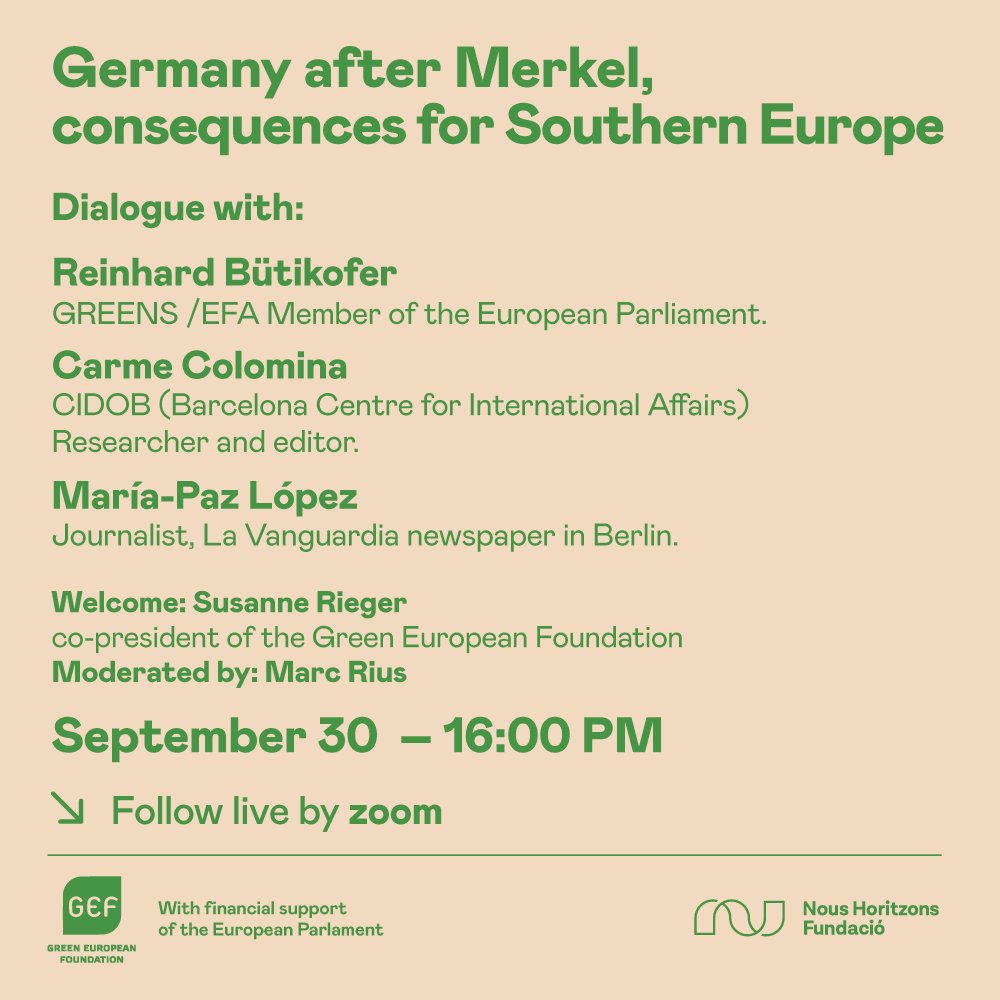
Germany after Merkel – Consequences for Southern Europe

By

About the Event:

Germany will be heading to the polls on September 26th to elect a new government. Citizens across Europe will follow the results with anticipation – also in Spain and Catalonia.
Is a green government possible? What will the results mean for German relations with Southern Europe? Will a potential Green Wave help Spanish and Catalan Greens gain more space and influence too?
We will discuss these and other questions with our guest speakers. Together we’ll try to get insight into what could be a consequential moment in European politics.


Context:

The Green-Red Dialogues began in 2020 to trigger a reflection on current issues from explicitly green and social perspectives. The challenges we face as a result of the COVID-19 crisis are new and unpredictable. Today we highlight the need to reverse the consequences of a capitalist system that generated the pandemic and has also caused irreparable cracks in our planet. A capitalist system that fosters social inequality and that assails the Earth.
We cannot fall into fatalistic discourse and convey the message that all is lost, and consequently, there isn’t much more to do. Instead, we must disseminate proposals and make EU citizens aware that an alternative way of living is possible – that green policies are compatible with a prosperous economy, progress, and development.
With this in mind, the Green Red Dialogues continue in 2021, once again providing the space for European policymakers, academics, activists, and citizens to address today’s challenges – combining current affairs and in-depth analysis to spark vibrant discussions about greener, more socially just solutions.


Speakers:

Reinhard Bütikofer – German MEP, European Greens
Carme Colomina – researcher specialising in the EU, disinformation, and global politics at CIDOB (Barcelona Centre for International Affairs)
María-Paz López – La Vanguardia, Berlin correspondent

Welcome by Susanne Rieger (co-president of the Green European Foundation)
Moderation by Marc Rius


Practicalities:

Date and Time: September 30th (16:00-17:30)
Audience: The webinar is free and open to the general public.
There will be simultaneous interpretation in Spanish and English.
Registration: Please register in advance via this link.


This event is organised by the Green European Foundation with the support of Nous Horitzons and with the financial support of the European Parliament to the Green European Foundation. The European Parliament is not responsible for the content of this event.

EGAT Czech Republic Akumulátor (“The Accumulator”)

By

About the event

You will participate in a three-weekend training session taking place in different corners of the Czech Republic and in an international study tour to Brussels. The program starts on the first weekend of October 2021, and will closure in March 2022 as we meet in Brussels with young people from Finland, Hungary, Spain, Poland, Greece, and Croatia, who are undergoing similar training courses.

What can you learn?

How to step into the public space and make an impact. We will explore different fields in politics with activists, journalists, academics, experts, and politicians, who will be our guests as part of the training.

We will awake your sense of initiative and support your skills in the field of activism, teamwork, campaigning, or work with the media. Together we will go through a whole range of approaches and tools that can change the world around. It is important for us to connect theory and practice.

In addition to practical skills, we will focus on important cross-cutting themes such as climate change, education, feminism and more.

Program

The training program consists of 2 national trainings, the online course EU for Beginners and the study tour in Brussels with a short preparatory meeting beforehand.

1st meeting:   October 1st – 3rd, Fara Skramníky , CZ

Welcome to the Akumulátor and EGAT, get engaged!

2nd meeting: December 17th – 19st, Toulcův dvůr (Praha area), CZ

Feminism, gender and intersectionality + practical workshop about fundraising

3rd meeting:  January  29th, online

“Czechia + EU = ?” Towards the common Europe critically, preparation for Brussels study tour, not financed by GEF

Brussels study tour: February 2022

Please note: Due to the particular circumstances during the COVID-19 pandemic, all activities could potentially be subjected to changes depending on the epidemiological data and any restrictive measures and guidelines at that time. Some parts of the program involving travel may take place online.

PRACTICALITIES

The training course is open for the participants between age 15 and 23. You don’t need to have any experiences with any kind of activism or politics, it is your motivation to make a change and impact that matters!

The sliding fee for the whole training is 5000 CZK (circa 200€). Sliding fee means, that while writing your application, you can choose how much of the real costs you can afford to pay. Institute of active citizenship will cover the remaining sum. We don’t want anyone to be excluded because of the money and the amount of your contribution doesn’t play any role in the selection of the participants!

Apply through this application form until August 27th, the decisions will be informed by September 6rd. Altogether 15 participants will be selected for the course.

For more information in Czech click here.


This EGAT programme is organised by Green European Foundation with the support of Institute of Active Citizenship and with the financial support of the European Parliament to the Green European Foundation.

 

Be Brave Decentralised Summer Camps

By

About the Event:

The decentralised activities will respond to the following objectives:

  1. Explore the struggles with active participation for youth-led organisations, movements and informal groups in different parts of Europe;
  2. Promote and develop skills of community organising;
  3. Exchange successful online and offline tools to expand and improve youth participation in political decision-making, as well as increase participation in their organisation; and
  4. Develop young people’s skills to organise activities and/or campaigns in their local contexts.


About the decentralised summer camps: 

This event is open for candidates and full MOs, as well as groups that are either part of FYEG network or have previously worked with FYEG. Based on the feasibility of the action plan as well as a realistic assessment of the budget, the project’s Coordination Team in consultation with FYEG Executive Committee will select the four best activity proposals among the received applications.

The activity: The summer camp must be 5 days long (6 nights), gather between 20 and 40 young participants and can be either a national or regional activity.

– A national activity shall be organised by one Member Organisation and gather mainly participants from one country (possibility to invite a few international participants).

– A regional activity shall be organised by two or more Member Organisation based in neighbouring countries and can gather participants from these countries. Only one application should be submitted by the Host Organisation and should indicate the other participating Member Organisations.

Expected timeframe for project implementation: August 15th to October 10th 2021 with reporting to be finalised within one month after concluding the activity (i.e. at the latest by November 10th 2021)

Summer Camp Programme: To make sure we all have coordinated actions that are recognised as a joint effort of Young Greens all over Europe, we created a template programme to be implemented. Session outlines will be provided to local prep teams, describing methods to facilitate most sessions, while some slots are left free for the organisation of personalised sessions (i.e. invite local speakers and/or trainers, discuss local context and more). Ideas on the content for the customised sessions should be shared as part of the application.

Partners visibility: This granting programme is organised in collaboration with the FYEG, Greens/EFA Group in the European Parliament, Green European Foundation, EYF and CoE. Therefore, their logos should be visible on all the outcomes, materials and the venue. Live presence or virtual intervention of the Green European Foundation or of a member of the Greens/EFA Group in the European Parliament should be ensured. FYEG will support reaching out to these partners and coordination with them.

Training opportunity for organisers and Member Organisations: The local prep teams and participants of each decentralised summer camp will receive a fully-customised training held by professional national or international trainers to follow-up and implement the plans and strategies identified during the activity.


This years Summer Camps will be organised in five locations:

  • Ukraine: (regional Belarus, Poland, Latvia, Ukraine): 24-28th August
  • Georgia: 27th August to 2nd September
  • Scotland/ Ireland: 30th August to 5th September
  • Catalonia: 1st to 5th September
  • Greece: 22nd to 26th September


Programme:

Arrival day

Day 1: Introductions, Team Building, Democracy and our role in it, Session with Local Speakers

Day 2: Faces of Power, Workshops, Youth Participation Struggles, Reflection Groups

Day 3: Organizing vs. Mobilizing, Barriers to Organising, Community Organising Starter Kit I & II

Day 4: Online tools, Offline tools, Citizens’ Assemblies, Study Visit

Day 5: Co-operation in decision making, Offline tools II, Outputs and Participants’ Plans, Evaluation

Departure day


In case of any further questions, do not hesitate to contact project.manager@fyeg.org.


This summer camp is organised by the Green European Foundation with the support of the FYEG and with the financial support of the European Parliament to the Green European Foundation.

Open call: Be Brave Decentralised Summer Camps

By

About the Event:

This call is an invitation for FYEG Member Organisations (MOs) to submit applications to hold Decentralised Summer Camp on democracy and youth participation during August to October 2021. 

The decentralised activities will respond to the following objectives:

  1. Explore the struggles with active participation for youth-led organisations, movements and informal groups in different parts of Europe;
  2. Promote and develop skills of community organising;
  3. Exchange successful online and offline tools to expand and improve youth participation in political decision-making, as well as increase participation in their organisation; and
  4. Develop young people’s skills to organise activities and/or campaigns in their local contexts.


About the decentralised summer camps: 

Eligibility and selection: The call is open for candidates and full MOs, as well as groups that are either part of FYEG network or have previously worked with FYEG. Based on the feasibility of the action plan as well as a realistic assessment of the budget, the project’s Coordination Team in consultation with FYEG Executive Committee will select the four best activity proposals among the received applications.

The activity: The summer camp must be 5 days long (6 nights), gather between 20 and 40 young participants and can be either a national or regional activity.

– A national activity shall be organised by one Member Organisation and gather mainly participants from one country (possibility to invite a few international participants).

– A regional activity shall be organised by two or more Member Organisation based in neighbouring countries and can gather participants from these countries. Only one application should be submitted by the Host Organisation and should indicate the other participating Member Organisations.

Expected timeframe for project implementation: August 15th to October 10th 2021 with reporting to be finalised within one month after concluding the activity (i.e. at the latest by November 10th 2021)

Summer Camp Programme: To make sure we all have coordinated actions that are recognised as a joint effort of Young Greens all over Europe, we created a template programme to be implemented. Session outlines will be provided to local prep teams, describing methods to facilitate most sessions, while some slots are left free for the organisation of personalised sessions (i.e. invite local speakers and/or trainers, discuss local context and more). Ideas on the content for the customised sessions should be shared as part of the application.

Partners visibility: This granting programme is organised in collaboration with the FYEG, Greens/EFA Group in the European Parliament, GEF, EYF and CoE. Therefore, their logos should be visible on all the outcomes, materials and the venue. Live presence or virtual intervention of the Green European Foundation OR of a member of the Greens/EFA Group in the European Parliament should be ensured. FYEG will support reaching out to these partners and coordination with them.

Training opportunity for organisers and Member Organisations: The local prep teams and participants of each decentralised summer camp will receive a fully-customised training held by professional national or international trainers to follow-up and implement the plans and strategies identified during the activity.


About the application and reporting: 

Budget: Applicants can find a budget template HERE and should submit an updated version recalculated based on local prices, envisioned number of participants and other activity needs.

The activity’s budget should include the following costs:

  • Preparation: one live Prep Team meeting for 3 or 4 people including 2 nights accommodation, meals for 2 days, national travel and working space rental)
  • Implementation: one live national or regional summer camp for 20 to 40 participants, including the 3/4 members of the local Prep-team + 2 international participants (for FYEG’s coordination-team live presence) for a 5-day long activity (accommodation 6 nights, meals 5 days, travel), 5 days venue rental, 2 local speakers (all covered expenses + fees), material and visibility expenses
  • Follow-up: service providers’ fees to finalise activity (graphics, layoutting, designing etc.)

The total budget allocated to each activity/summer camp will take local costs and prices into account and will thus be decided upon on a case-by-case basis. Nonetheless, the total grant per project will be maximum EUR 15,000 and can of course include additional co-funding. Shifts in budget that are considered to add value to the activity can be accepted if justified in the application. The Coordination Team may come back with follow-up questions if the budget lines are not clear in the application.

Be mindful that, as any other source of income, this grant will also be considered as income for the calculation of the member organisation membership fee to FYEG.

Narrative and financial reporting: It is the responsibility of the applying organisation to collect and submit a full financial report listing all the costs (together with the corresponding proofs) within a month after the end of the activity. FYEG will process payments directly (for venue rental, accommodation, catering, trainer fees, to service providers etc.) whenever possible and will reimburse all other expenses within the activity’s approved budget upon the submission of the financial report and eligible proofs. Direct transfers of part of the grant might be possible where necessary and will be agreed upon on a project-by-project case.

Practicalities:

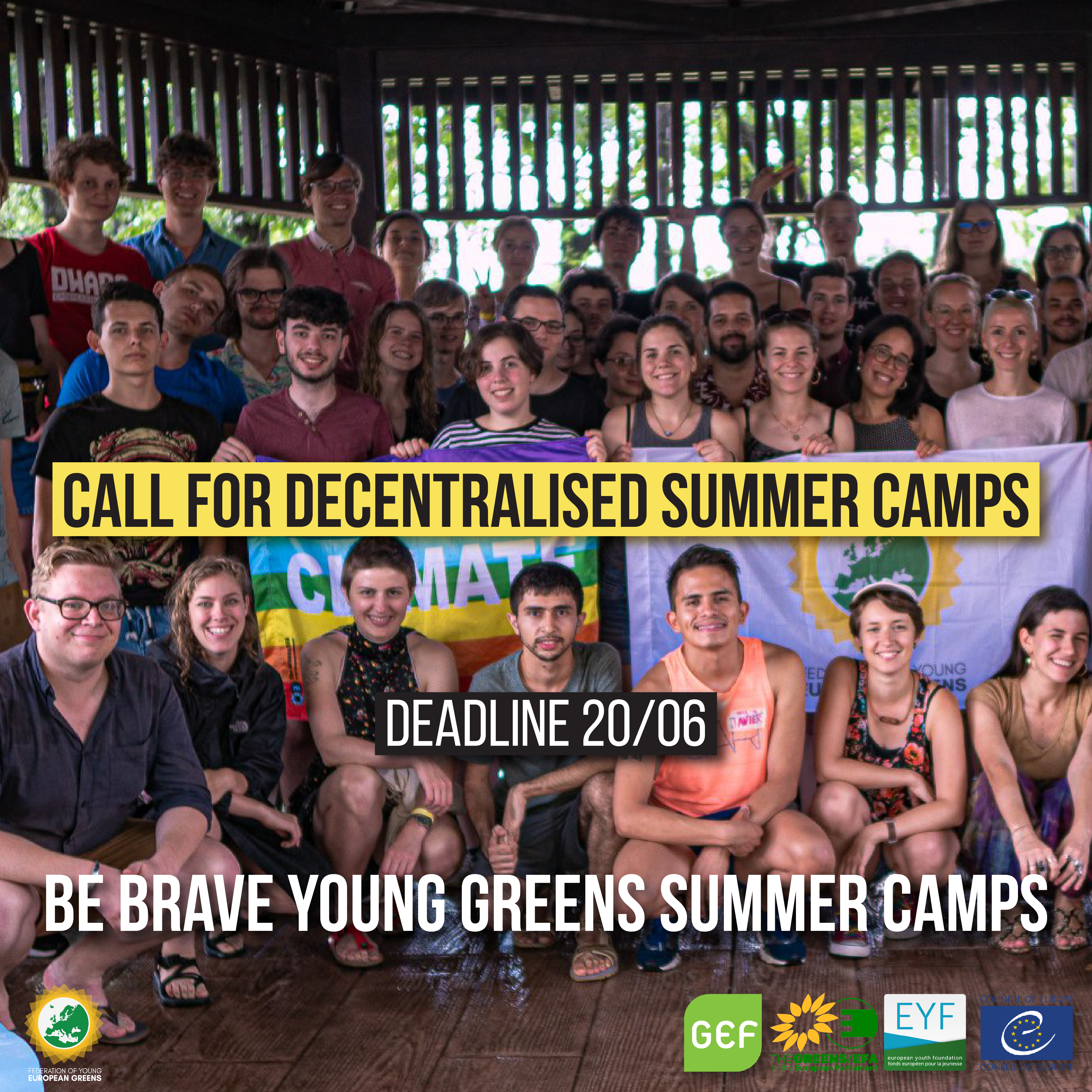
Deadline for application: June 20th, 2021 at Midnight CEST (successful applicants will be notified by June 31st at the latest).

How to apply: Open the APPLICATION FORM and the BUDGET and duplicate them: go to File / Make a Copy. Fill these application documents and forward them to project.manager@fyeg.org by the deadline June 20th, 2021 at Midnight CEST with Decentralised Summer Camp proposal in the subject. Organisations that have less experience with grant applications and reporting can be supported by FYEG Office in this process if necessary.

In case of any further questions, do not hesitate to contact project.manager@fyeg.org.


This summer camp is organised by the Green European Foundation with the support of the FYEG and with the financial support of the European Parliament to the Green European Foundation.
Recovering sustainably from the pandemic

By

The European Green Deal – Thinking Locally


The impact of the Covid 19 pandemic on Europe’s economy, health systems and democracy is enormous. In terms of European policy it will now be important to shape the economic construction in Europe in a socially and ecologically sustainable way. The policy fields of climate, energy, environment, digitalisation as well as economy, labour and social affairs must be thought together in the European Green Deal and shaped in such a way that social cohesion in Europe is strengthened. Germany, as the most populous and economically strongest country, will have to play a central role in this tour de force. The EU’s ability to act will continue to depend largely on the German government’s will to act. The Annual Conference on European Policy 2021 of the Heinrich Böll Foundation will therefore focus on the question of which European policy priorities the new German government should and must set after the federal elections in autumn 2021.

At this year’s annual conference on European policy, which will also take place online, European representatives from politics, science, political consultancy and civil society will analyse and discuss the current crisis and appropriate strategies to overcome it.

The focus is on the local dimension of the European Green Deal.

In many places, municipalities are seen as the new bearers of hope. Initiatives at the local level are already making a difference in many areas and are seen as potential drivers of the socio-ecological transformation, be it in the energy transition, sustainable mobility and infrastructure or in public space. We want to let some initiatives have their say and present good examples from practice that show the way forward and provide inspiration for imitation.

Speakers

  • Rasmus Andresen, MEP, EFA/Greens, Brussels
  • Dr. Franziska Brantner, German MP, Alliance90/The Greens, Berlin
  • Annika Hedberg, Head of Sustainable Prosperity for Europe Programme, European Policy Centre, Brussels
  • Dirk Holemans, Co-president of the Green European Foundation GEF, Brussels
  • Benedek Jávor, Representative of the City of Budapest, Brussels/Budapest
  • Ares Kalandides, Professor of Place Management, Manchester Metropolitan University, Manchester
  • Phoebe Koundouri, Professor, University of Economics and Business, Athens
  • Audrey Mathieu, EU Climate Policy Officer, Head of Berlin Office, Germanwatch, Berlin
  • Neil Makaroff, European Policy Officer, Reseau Action Climat, Paris
  • Bozena Ryszawska, Professor, Wroclaw University of Economics and Business, Wroclaw
  • Claude Turmes, Minister for Energy and Spatial Planning Luxembourg, Luxembourg
  • Dr. Ellen Ueberschär, President, Heinrich Böll Foundation, Berlin
  • Sanna Vesikansa, Deputy Mayor, for Social Services and Health Care, Helsinki

Practical information

Time: Thursday, 10 May 2020, 14.00 – 19.00 CEST

Conference languages: English/German with simultaneous translation

Full programme and registration:  See the Heinrich Böll Foundation website here

Freedom and Security in a Complex World (2021 edition)

By Uncategorized

Context

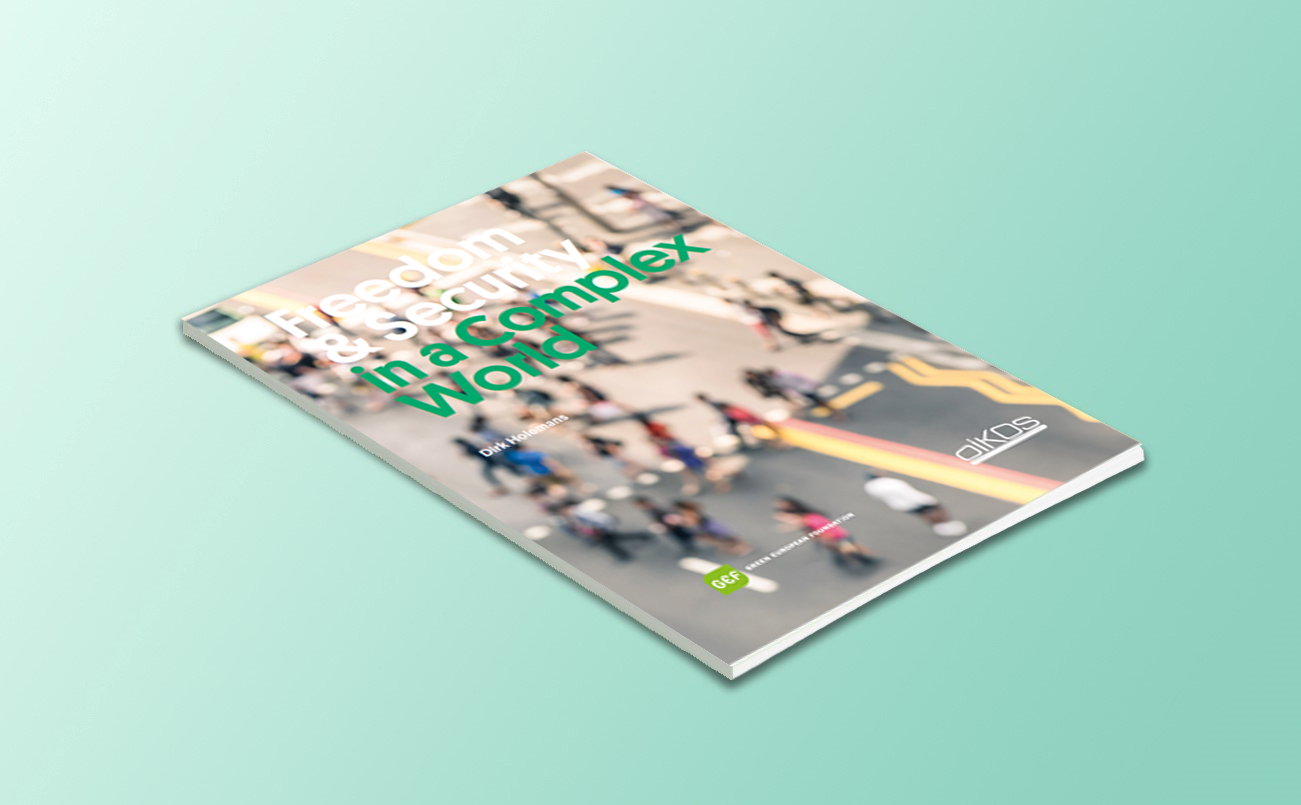
People all over the world are taking their future back into their hands. Together, they are taking initiatives in the fields of renewable energy, local food production, sharing tools, and so forth. This is the most hopeful movement of our time. Where the market and state fail, people are taking action. As free citizens, they are reinventing the collective, with open partnerships where personal development and social engagement go hand in hand. This observation seems to contradict what we experience every day. The system errors of our society model fill the newspapers: climate crisis, unstable banks, refugee flows. Accepted wisdom is that uncertainty is increasing. But both trends are happening, not by coincidence, at the same time.


Objectives

While examining the two interlinked concepts of Freedom and Security, this publication suggests that the answer needs to be the transformation into a socioecological society in the 21st century. It argues for the realisation of a societal project that strives for equal freedom for all people to flourish in security, within the boundaries of the planet, and proposes concrete steps towards it.


Download

Available in English here.

Available in French here.

Available in German here.

Available in Hungarian here.

Available in Spanish here.

Available in Macedonian here.

Available in Greek here.


This report presents a new and updated take on the 2017 version (Please see the English, French, German, Hungarian and Spanish editions from that year, which were part of the transnational project “A green transformation: Freedom and Security in uncertain times” ).

The 2021 report was developed in partnership with Oikos and with financial support from the European Parliament to the European Green Foundation.