Dark shades of green: The political struggle for the narrative of the young environmental movements in the Western Balkans

By

About this event

The right-wing has for a long time been associated with climate denial and justifications of industrial pollution. However, this rhetoric seems to be changing, and environmental issues are becoming central to right-wing politics. In the Western Balkans, environmental problems are emerging as a mobilizing factor across different political actors and social movements. Issues that are traditionally claimed by the progressive greens, are now coming into focus of the populist right, opening new fields for reaching and engaging otherwise passive citizens. Driven by the unsustainable re-industrialization, the growth in the construction sector, and new, often foreign investments in mining, fossil fuels, land grabs and destruction of nature, environmental threats are ever more mobilizing the citizens on the anti-establishment wave. Catching sight of the loss of the EU perspective and the increased post-truth crisis during the pandemic conditions, the right wing is not missing their chance. The struggle for nature is often painted with nationalist and traditionalist narratives.

On the other hand, the greens nor the left do not seem to be keeping pace with these developments, appearing unfit to offer credible alternatives to the populist narratives of the local grassroots movements. The environmental civil society initiatives, and the social justice and human rights organizations, are not connected enough, and their knowledge and experiences are atomized. In addition, many actors are insisting that the environment is intrinsically an “apolitical” issue, accusing each other of “hijacking” it. These processes are not only happening in the Western Balkans, however there is an important specific context related to the recent history and genealogy of the green movement. In the context of a blurred EU perspective for the Western Balkans, and in the absence of strong green and left alternatives, will the right wing populism succeed in appropriating the topic of environmental justice? How can the progressive forces be enabled to take the lead in environmental struggles?

The discussion is opening one of the important questions of many about the future of green politics in Europe. We are happy to use this opportunity to present Serbian translations of the publications with extended analysis of political ecology from the greens perspective – the Green European Journal editions: A World Alive: Green Politics in Europe and Beyond and 2049: Open Future.


Speakers:

Balša Lubarda is an environmental sociologist specializing in environmental communication, radicalism, right-wing politics and political ideologies. He is also a Doctoral Fellow and the Head of Ideology Research Unit at the Centre for Analysis of the Radical Right, as well as a member of the Emancipatory Rural Politics Initiative (European branch). His research has been published in peer-reviewed journals such as Environmental Values, Sociologia Ruralis and other non-academic outlets, including New Eastern Europe, Fair Observer, Open Democracy, Undisciplined Environments, Altre Economia etc. Balša has also provided commentary for The BBC Radio 4 and The New York Times.

Damir Zejnulahović is a PhD student of sociology at the Faculty of Philosophy of Belgrade University. He completed his undergraduate studies of sociology at the same faculty, where he took courses in “Culture” and “Politics” modules during his undergraduate studies. He got his Master degree in sociology, at the same faculty, defending his master thesis „Ideological underpinnings of a conservative Srpski pokret Dveri”. The focus of his research interests are political sociology, sociology of knowledge, historical sociology, critique of ideology.

Iva Marković is an environmental activist and researcher in political ecology from Belgrade. Her current focus is on water as a common good and on developing alternative policies for sustainable governing of natural wealth. Her interests are in commons, natural resources management, social impact of climate change, degrowth, just energy transition and ecofeminism. She is involved in organizing left and green actors and networking inside the environmental movement. She is a co-founder of Right to Water (Pravo na vodu) initiative, organization for political ecology Polekol, Women For Environment network, and active in the Save the Blue Heart of Europe campaign against small hydro projects in the Balkans.


Moderator: Aleksandra Tomanić (tbc)


Practicalities:

This event takes place on Zoom, please register and join via this link.

Simultaneous interpretation Serbian – English will be provided for this event.
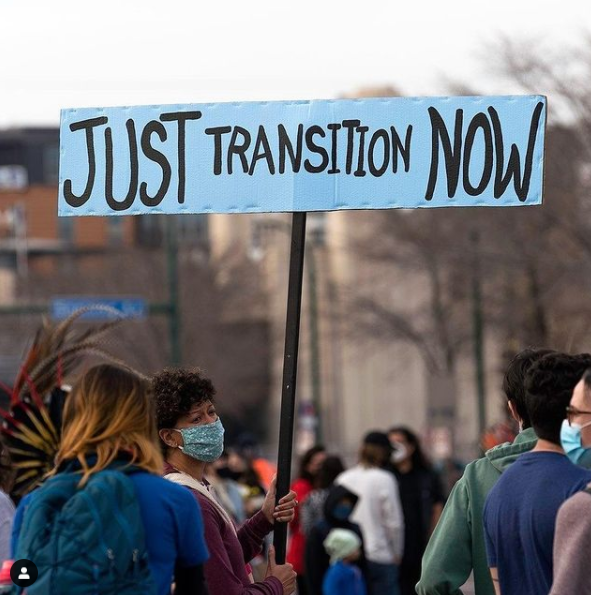
Call for Author: Youth Chapter for the Just Transition Book

By

About the Event

The chapter will be published in the Book on Just Transition produced as part of the multiannual and multipartner project carried out by the Green European Foundation, led by Oikos and participated by green European partners. It will be divided in five parts: (1) Setting the stage, (2) European regions on their way, (3) Just transition and the EU Green Deal, (4) Frontrunners showing the way, and (5) Conclusions. The Youth Chapter will open part 4.

We are looking for someone who can bring a fresh perspective and nuanced insights into the following questions:

  • How do young people take the future into their own hands?
  • How are grassroots movements changing the narrative and convincing politicians to push for a socially just transition?
  • How are young activists from marginalised communities and minority groups impacted by climate change, and how are they fighting for climate justice?
  • Why are current EU programmes such as Next Generation EU not good enough?
  • How has the pandemic transformed the efforts of grassroots activists and changed their methods to create impact?

We are looking for one or two young authors with a passion for writing who are interested in the topic and committed to unpack the relation between the work of activists everywhere in Europe and the political advancement towards a more sustainable, welcoming and fairer Europe.


Context

About the chapter:

  • The content of the chapter should have a strong focus on the role of youth, grassroots and marginalised and minority groups in achieving a better and more just transition away from fossil fuels towards a socially and environmentally sustainable future
  • The chapter should have a clear sub-structure (contextual introduction, main body divided in sub-sections and topics, summarising conclusion) and can include various formats (analysis, essays, case studies and/or interviews)
  • The chapter should support analysis with figures and examples from at least three European countries (including at least one non-EU)
  • The chapter should consist of 4000 to 6000 words
  • The contribution should be written in English
  • The remuneration for the writing of the chapter is EUR 500

We accept both individual and joint applications of maximum two authors to co-write the chapter. If you decide to apply with someone please send in only one joint application.

The writer(s) applying should:

  • Be interested and passionate about tactics, methods and narratives used by grassroots movements across Europe to achieve a socially just transition
  • Be determined in expanding their knowledge on the topic by doing research, following the work or contacting activists
  • (Possibly) have previous experience in writing extensive pieces
  • Feel comfortable in writing long texts in English

Timeline:

  • Send your application by 2nd April at 23:59 CET
  • You will be informed of the decision at the latest by 7th April (all applicants will be informed)
  • Start writing!
  • A first draft of the chapter should be sent in by the 7th of May
  • Wait for the feedback and comments of the FYEG Executive Committee
  • The final version of the chapter should be sent in by the 31st of May


Practicalities

To apply:

Please send the following to project.manager@fyeg.org by 2nd April @ 23:59 CET:

  • Your pitch for the chapter: a description of what you would like to write about (between 300 and 400 words)
  • A short mention of the structure and format you plan to use
  • A proposal for a concise title
  • Your CV (or CVs if two authors are applying)

Green Economy Congress

By

About the Event:

Today we live in a time of great crisis, confronted by one of the severest challenges that humanity has ever faced: COVID – 19 is seen as health and ecological consequence of the „business as usual “model that ignored boundaries of environmental capital, social inequalities and economic unsustainability. The Western Balkans region is affected on many levels: its fragile democracy is deteriorating, natural resources commodified, and local communities completely left on their own. There is no time to waste – we need to act now!

For four years now, Green Economy Congress aims to build synergies with actors who are developing positive initiatives in the Western Balkans and EU on a narrative which allows us to have a bigger impact in the society transformation. In 2020. more than ever we need to work together to overcome the crisis. What gives us hope is that all over the region, citizens are taking direct action – fighting for river conservation, demanding clean air and pointing out on damaging practices like deforestation, excessive extractive industry, unsustainable tourism, etc. Public policies and action from decision-makers are yet to follow.

The coronavirus crisis recovery and EU Green New Deal can be a chance to reshape a sustainable, inclusive economy, stimulating industry, protecting essential biodiversity systems and tackling climate change in Western Balkans – but only if it has a holistic approach. For two days, on October 15th and 16th, 2020. this year in digital space, using lectures and panel discussions, we will try to map this momentum.

Context:

This is the fourth edition of the Green Economy Congress, a successful conference series that has connected experts, activists, and academics across the Western Balkan and beyond. While this year’s edition will be taking place online, we hope to continue connecting great speakers and participants and sparking inspiring discussions on the topic at hand.

Speakers:

Green Agenda for Western Balkans: Politics & Policy

  • Liljana Popovska, DOM Macedonia
  • Ljiljana Jokić, URA Montenegro
  • Iva Marković, Organization for political ecology Polekol

(Un)sustainable: tourism in nature protected areas

  • Milan Ruzic, Bird Protection and Study Society of Serbia

Agenda 2030: Path for Green Balkans

  • Natasa Gligorijevic, Center for Sustainable Development of Serbia

My Green New Deal: Green Economy from Idea to Reality

  • Veljko Nešić, Small food producers in Serbia
  • Predrag Milovanović, Organela

Green Cities and The New Urban Agenda

  • Siniša Trkulja, independent expert

Climate Neutrality in Western Balkans: Time to set a new path

  • Vedad Suljic, Regional Education and Information Center for Sustainable Development in South-East Europe
  • Ana Petrovska, DOM Macedonia

Programme:

October 15th, 2020

  • 11: 00 – 12: 30 Panel Discussion – Green Agenda for Western Balkans: Politics & Policy
  • 13: 00 – 13: 45 Lecture – (Un)sustainable: tourism in nature protected areas

October 16th, 2020.

  • 11: 00 – 11: 45 Lecture – Agenda 2030: Path for Green Balkans
  • 12: 00 – 13: 15 Panel Discussion – My Green New Deal: Green Economy from Idea to Reality
  • 13: 30 – 14: 15 Lecture – Green Cities and The New Urban Agenda
  • 14: 30 – 15:45 Panel Discussion – Climate Neutrality in Western Balkans: Time to set a new path

Practicalities:

The Green Economy Congress will be taking online on 15 and 16 October, from 11:00 to 16:30.

Lectures and discussions will take place in Serbian and English, with simultaneous translation provided.

Please apply here. Participation in this year’s online edition is free, although voluntary contributions are very much appreciated to ensure the continued success of the Congress this year and in future editions.

Green Economy Congress – Municipalism: Economic Patterns for the Green Europe (Belgrade)

By

Event Background

The world is undergoing radical transformations which is changing the fundamental values on which the industrial era was founded. Multiple crises caused by growing inequality and environmental destruction need an urgent and sustainable answer.

The economic parameters that measure growth and success are changing and the biggest assets today are knowledge and experience. With the expertise of academics working on a green economy, we are producing new forces to create a more just and sustainable world.

The Green Economy Congress is an annual interactive conference, which gathers participants from the local region and across Europe. Since its inception, it has intended to break the business-as-usual path, not only in the economy but in the wider society. It aims to build synergies amonth actors developing positive initiatives and to work on narratives that have a greater impact on public debates.

The previous two editions of the Congress were held in the Serbian Chamber of Commerce, with over 300 participants and speakers attending.

About the Event

The Green Economy Congress is a Green summit, organised by the Green European Foundation in cooperation with Networked and Group for Analysis and Policy-Making from Serbia.

2019 marks the third edition of the Congress, which will focus on the theme of “Municipalism: Economic Patterns for the Green Europe”.

This year’s Congress will address Green topics and ways to make the Green agenda and sustainable development an integral part of our future philosophy and actions. This comes with a goal of inspiring leadership among global citizens to enact change and innovative solutions to tackle key economic, social and environmental challenges. There will be particular emphasis on Green cities as leaders of Green change and local policies that stimulate holistic approaches.

The Congress is open to professionals, academics, NGOs and private sector representatives, as well as other interested individuals.

Programme

Day I – Serbian Chamber of Commerce (Terazije 23/ II floor)

11.00 – 12.00 Opening: Municipalism: Economic Patterns for the Green
Europe
– Žaklina Živković, GAJP/ Networked
– Liljana Popovska, North Macedonia Member of Parliament/ DOM Macedonia

12.00 – 12.10 Coffee break

12.10 – 13.15 Panel: Circular Economy Regional Perspectives: Challenges
and Opportunities supported by Balkan Green Energy News
– Ana Petrovska, North Macedonia Ministry of Environmental Protection and
Physical Planning, State Secretary
– Representative of Republic of Serbia Ministry of Environmental Protection (TBC)
– Representative of business sector from Serbia (TBC)

13.15 – 13.25 Coffee break

13.25 – 14.25 Panel: Green Finance Lab: Blockchain + Crowdfunding
– Vladica Jovanović, BRODOTO
– Ivan Bjelajac, MVP Workshop

14.25 – 15.25 Lunch

15.25 – 16.15 Lecture: Mapping ecosystems and their services: a challenge
in a fast changing world

Day II – Cultural Center GRAD (Brace Krsmanovic 4)

14.00 – 15.00 Workshop: Go Circular: Circular economy for municipal well –
being
– Milan Veselinov, CirEkon – Expert for Circular Economy

15.00 – 15.10 Coffee Break

15.10 – 16.10 Panel: Business Going Green: The Emergence of the
Cooperative Society supported by EcoTech HUB Serbia
– Tanja Basta, EcoTech HUB
– Nemanja Inno Energy HUB and Climate – KIC Serbia
– Nenad Božić, SmartCat
– Dušan Vukanović, ICT Hub

16.10 – 16.20 Coffee Break

16.20 – 18.20 Workshops
“Sustainable Fashion Roundtable – new policy & business model” Dunja
Jovanović and Marija Radaković
“Zero waste in Action: Reduce your environmental footprint” MIlja Vuković

18.20 – 20.00 Networking Party & Dinner

Day III
10:00 – 12:00 Visit to Nikola Tesla Museum

Practicalities

Participants can apply to take part via the Green Economy Congress website, where more information on packages and prices can be found.

You can join the Facebook event page for the Congress here.


Fair and Healthy Food (Belgrade)

By

Event Background

This event is the first to be held as part of the Fair and Healthy Food project, which aims to connect different actors across Europe that are working to redesign food systems around agroecological principles.

About the Event

To be held in Belgrade, Serbia, with the support our project partner Networked, this event will feature experts who will engage in a dynamic discussion on fair and healthy food. The event will be organised in two parts:

Part One: Fair and Healthy Food Production – discussion & Q&A session

Speakers:

  • EU CAP expert, who will explore the Serbia-EU negotiation process for EU membership and its effects on sustainable food production in Serbia.
  • Representative from Belgrade city garden project
  • Representative from women’s organisation working on sustainable food production in south Serbia.

Part Two: Tastes of Old Mountain – dinner

This dinner will be prepared by Networked in cooperation with women activists from Old Mountain in Serbia, who are fighting to protect their rivers from hydro-industry construction in protected natural areas.

The ingredients for the meal will be sourced from Old Mountain to highlight the power of sustainable food production to revitalise small communities and empower women especially.


Registration

To register for this event, please complete the form found here. 

Join the Facebook event here. 

Revision of the Economies in the Balkans (Skopje)

By

CONTEXT 

This research report was produced as part of a project of the Green European Foundation in 2017 with the joint effort of the research teams in three Balkan countries:
BlueLink Foundation – Bulgaria 
The Association for Sustainable Social and Economic Development SUNRISE – Macedonia
Networked – Serbia.  

The research report highlights which political conditions are necessary to move towards a green economy in the three countries, and compares their prospects in terms of social factors and legal and policy frameworks.

This event is invitation only. The full research publication is available for free at GEF website. 

PROGRAMME 

21st September 2018 

16:00 – 16:30   Registration and welcome coffee 

16:30 – 16:50   Opening and Introduction of the research and cooperation with GEF  

Aleksandar Gjorgjievski – Transnational coordinator ASSED Sunrise – Skopje 

16:50 – 17:30   Hristina Odzaklievska – National researcher in Macedonia 

 Presentation of research and methodology 

17:30 – 18:00   Coffee break 

18:00 – 18:30   Ervin Regjepagic – Energy sector in Macedonia  

18:30 – 19:00   Jasmina Pakaski – Sustainable development

19:00 – 19:30   Bojan Petrovski – Green economy and Green policy 

19:30 – 20:00   Aleksandar Gjorgjievski – President of ASSED Sunrise – Macedonia  

Presentation of the GEF project Green Economy: Cooperative Society and Announcement of the International conference on 6th October 2018 

20:00 – 21:00   Dinner and closing of the promotion event 

Green Economy Congress 2018 (Belgrade)

By

Context

The world we live in is going through a radical transformation which is changing the fundamental values our societies but also economies are based on. Multiple crises due to the growing inequality and environmental destruction are calling for an urgent sustainable answer. As the economic parameters that are measuring growth and economic success are changing, we must use our knowledge and expertise to innovate the way we think about economy and cannot continue with “business as usual”.

About the event

The Green Economy Congress, taking place for the second time this year, is a series of interactive, multidimensional events designed to create and further build up on the notion of necessity for transition to sustainable and fair economy. Green economy is one of the most exciting concepts that is holistic in its form – it generates development while respecting the regional and global ecosystem, results in improved human well-being and social equity, while significantly reducing environmental risks and ecological scarcities.

For three days all participants will have the opportunity to listen to some of the most impressive economists, innovators, entrepreneurs and decision makers, to share their stories and discover ways to promote an alternative vision for growth and development across the world.

The long-term goal of the Congress is not only to raise awareness on green topics, but to also create a sustainable networking platform to enable green initiatives across Europe. This will be in particular the focus of the first day of the Congress, which will be organised by GEF.

Programme

Thursday November 1st

12:00 – 12:15: Official Opening 

  • Representative of Green European Foundation
  • Žaklina Živković, GAJP

12:15 – 13:15: Opening Panel – Public Policies and Circular Economy

  • Slobodan Perović, Republic of Serbia Ministry of Environment Advisor
  • Antoine Avignon, EU delegation in Serbia (tbc)
  • Olivera Kuzman, Zurovac OEBS expert on circular economy (tbc)
  • Siniša Mitrović, Serbian Chamber of Commerce (tbc)

13:15 – 13:25: Pause

13:25 – 14:00: Lecture – Innovation in Circular Economy: Closing the Loop in Agri-Business 

  • Grigoris Chazikostas, Biosense Institute

14:00 – 15:00: Lunch

15:00 – 16:00: Panel – Green Cities and Urban Development

  • Representative of EU Green Capital of Europe Nijmegen (tbc)
  • Representative of Cooperation and Development Eastern Europe (CDN)
  • Sinisa Trkulja, UN Urban Agenda Habitat III
  • Representative of City Council of Belgrade (tbc)

16:00 – 16:15: Coffee Break

16:15 – 17:15: Panel – New Plastic Economy: EU Circular Economy Package

  • Representative of Reloop Europe
  • Representative of Greentech Serbia
  • Representative of SEPEN
  • Expert in EU Circular Economy Package (tbc)

17:15 – 18:00: Coffee and Networking


Friday November 2nd

12:00 – 12:15: Opening 

  • Dubravka Negre, European Investment Bank

12:15 – 13:00: Toward the Green Finance

  • Representative of  Trag Foundation (tbc)
  • Representative of  Ethical Financing Cooperative of Croatia
  • Representative of  BRODOTO
  • Representative of  ERSTE bank

13:00 – 13:15: Coffee Break

13:10 – 14:10: Panel – Women in the Green Economy

  • Branislava Jovicic Bačkan, Green Energy News
  • Ankica Barbulov, GIZ (tbc)

14:00 – 15:00: Lunch 

15:00 – 16:00: Environmental Reporting: Media as a Catalyst for Change

  • Representative of Euractiv (tbc)
  • Slavica Gligorijevic, RTS (tbc)
  • Adam Santovac, N1 (tbc)
  • Represenative of CINS/BIRN (tbc)

16:00 – 16:15: Coffee Break

16:15 – 17:00: Democratisation of the Energy Sector: Prosumers and Cooperatives as Alternatives

  • Maja Turković, ASOR
  • Representative of CAN Europe (tbc)

Saturday November 3rd

12:00 – 15:00: Green Economy Fair + Workshops  

Workshops including:

  • Developing Circular Economy in Agriculture
  • Decentralised Energy Alternatives
  • Eco Design

Additionally, the Congress will entail a variety of social activities such as museum visits, get-togethers and more.

Who should apply?

This conference is suitable for both students who are just developing their interests for green economy models, and green economy professionals and activists. In case you would like to speak at our event, we have created Participants’ Panel. 


To find out more about the event, the registration process, as well as participation fees, please visit the Congress website. For programme updates, follow us on Facebook and Twitter, and subscribe to the Facebook profile of the Congress.


Economic Transformation

Greening the Economy in Balkans: Cooperative Society (Belgrade)

By

Context

At the beginning of 2018, a publication The Revision of the Economy in the Balkans: Change Policy, Not Climate, as well as a green economy manual, was published as a part of the transnational project carried out by Green European Foundation supported by Blue Link Bulgaria, Sunrise Macedonia and Networked Serbia.

The research done in the previous years has shown immense potential and pointed out the fact that these national economies are currently going in a different direction: subsidising multinational companies and mega infrastructure projects, privatizing natural resources. A process of political centralization, by taking competences from the local level and exclusion of the citizens from the economic and social decisions is evident. In this political environment, the only possible solution is a creation of bottom-up, self-organized, citizens’ initiatives with a purpose of association of labor and services. The countries of the region have their own historical legacy of a cooperative economy in socialism, which is now in a process of renewal.

About the event

The research has shown the immense potential of the process of greening the economy in Balkans, which is currently challenged. The conference will aim to present the relevant results of the study and to be a platform for discussion on how to start a green business in Serbia and on the cooperative model as one of the viable solutions.

The conference will be an occasion to present the main results of the research published in The Revision of the Economy in the Balkans: Change Policy, Not Climate. The event will host two panel discussions with prominent organisations and individuals working on the green economy in Serbia.

Programme

11:45 – 12:00 Opening a conference
12:00 – 13:30 Panel: How to start a green business in Balkans?

Hristina Odžaklieska, Sunrise Macedonia
Miloš Stančić, Networked/GAJP
Jelena Plavanski, PKS- Belgrade Chamber of Commerce
Ivana Marković, Trag Fondation
Moderator: Violeta Jovanov Peštanac, Networked

13:45 – 15:15 Panel: Green Cooperatives and Cooperative Economy: Innovative Forms of Economics

Represetative of Baštalište
Representative of Association for Sustainable Development (ASOR)
Stjepan Car, Green Energy Cooperative (ZEZ) Hrvatska
Kristina Cvejanov, Serbian Packaging waste Recyclers Association
Moderator: Iva Marković, Polekol

15:15 – 15:30 Closing word: Žaklina Živković, Networked

 Stay tuned for updates

Subscribe to our Facebook event, where you will receive reminders and the latest news on content. Follow us on Facebook or Twitter to learn about our other activities.

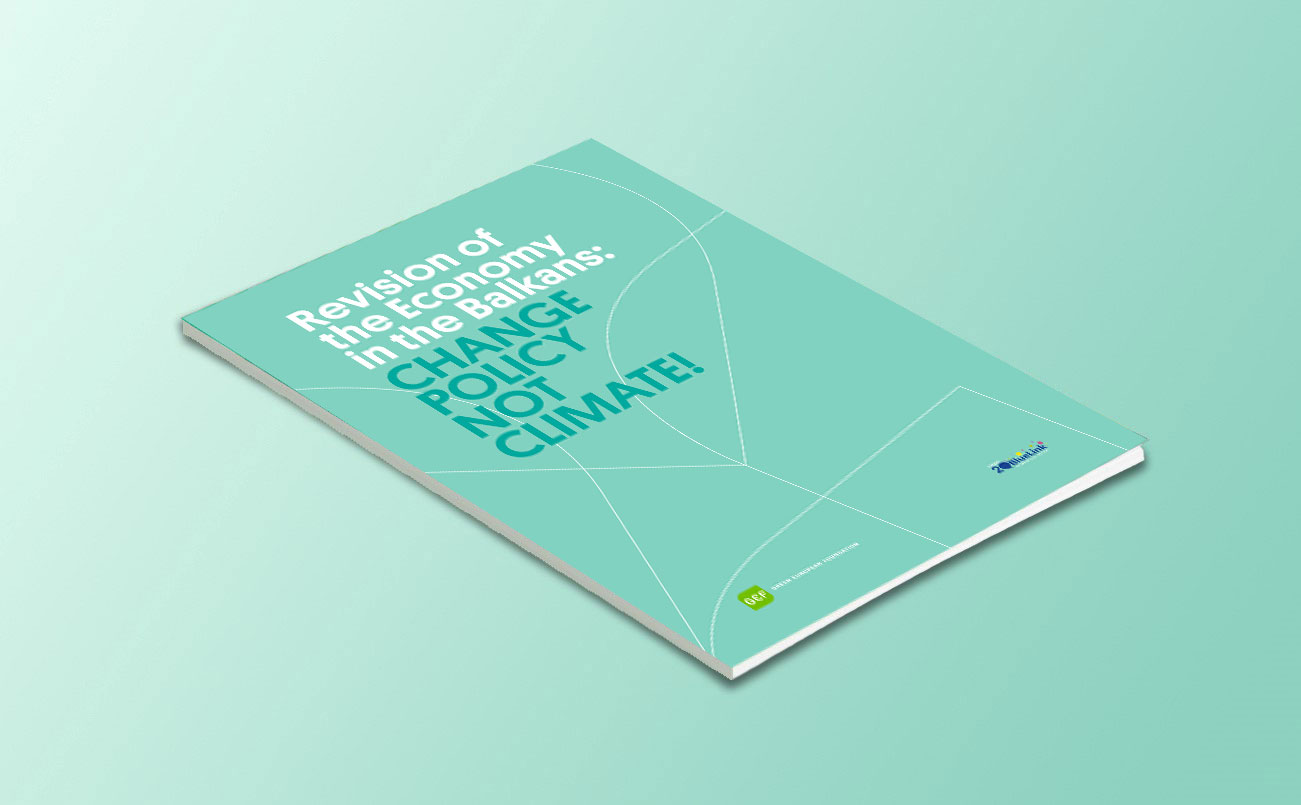
Revision of the Economy in the Balkans: CHANGE POLICY NOT CLIMATE!

By Uncategorized

This project had the aim to to raise awareness among stakeholders, politicians and the general public for the economic potential of a Green Economy, to stimulate changes in consumption and production patterns, and promote a participatory approach to policy making. The report and other project activities respond and contribute to one of the priorities for Bulgaria’s presidency of the EU in 2018: eco-innovation as a driver for economic progress.

Research goals

The purpose of the research was to accomplish the following goals set by the project:

  1. To gather best practices from the three participating countries – Serbia, Macedonia and Bulgaria – for a green economy;
  2. To showcase and promote the transformation of the economy towards environmental, low-carbon and energy-efficient production along with increasing prosperity and equity in society;
  3. To provide useful facts and arguments for Green politicians and activists to raise awareness among stakeholders, politicians and the general public about the economic potential of the green economy, to stimulate changes in consumption and production patterns, and to promote a participatory approach to policy-making.

A Democratic and Inclusive Green Economy

The research report highlights which political conditions have to be fulfilled to move towards a green economy in those three countries and compares the prospects of Serbia, Bulgaria and Macedonia in terms of social factors, legal framework and the policy framework.

Download

Digital version in English is available here

Digitial version in Bulgarian is available here

Digital version in Macedonian is available here

Digital version in Serbian is available here

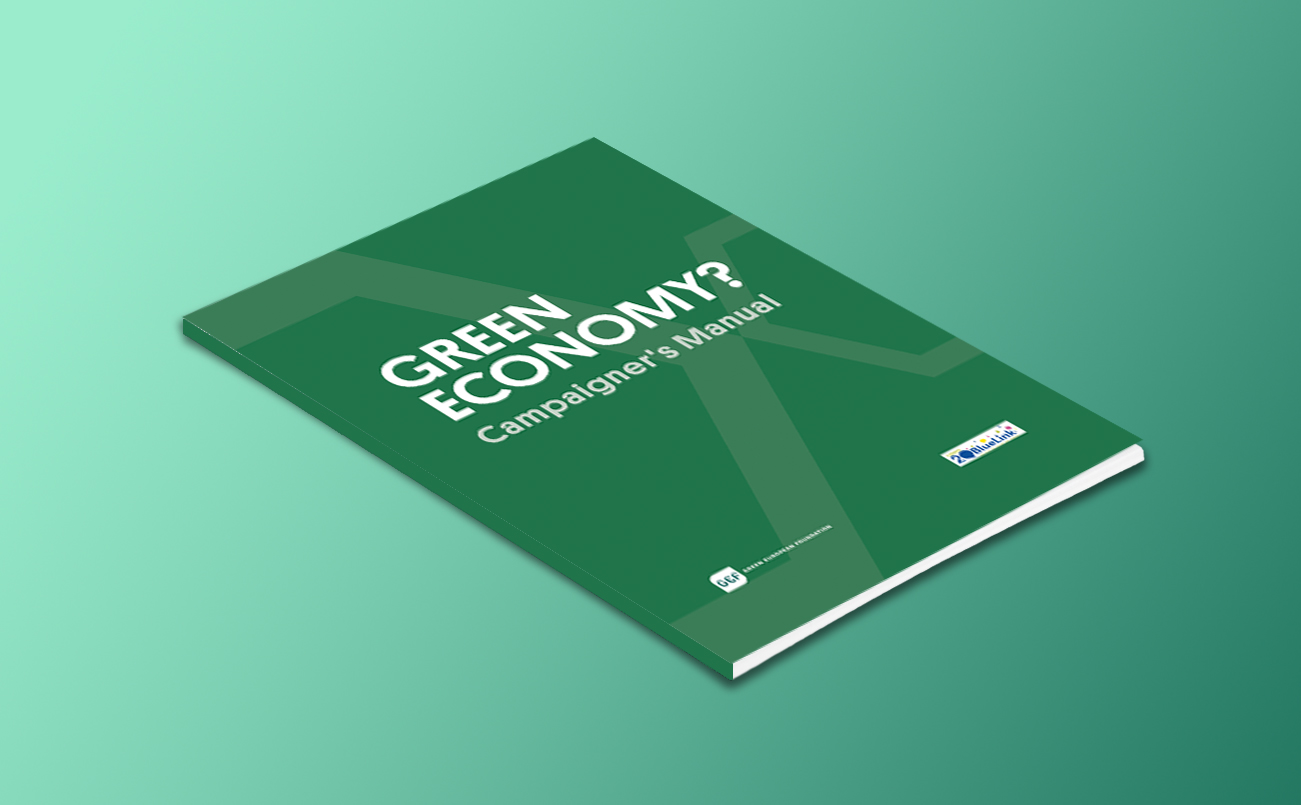
GREEN ECONOMY? Campaigner’s Manual

By Uncategorized

The manual’s aim is to promote the economic potential of a Green Economy by summarising the most important definitions and giving policy makers a tool at hand to argue in favour of a green economy and to debunk the most common misconceptions.

Download the digital version of the manual in English here.

The digital version of the manual is also available in Turkish here.