EGAT Study Trip 2022 (Brussels)

By

About the Event

During the five-day study trip, will have the chance to explore various topics such as climate justice and lobbying in Brussels through engaging with professionals, politicians, NGOs and other activists operating in and around the European institutions, as well as with each other.

With a range of formal and non-formal training methods, including interactive workshops, the trip will be a valuable learning experience for young activists brought together by Green values and a motivation to enact change.

Event Background

The European Green Activists Training (EGAT) consists of training sessions for young Green activists in various phases. These include the completion of the online course EU for Beginners, the participation in national training sessions in their respective countries on domestic politics, as well as on European politics and institutions. The final stage is the study trip, which brings all the participants from across Europe together in Brussels.

The EGAT project aims to Europeanise existing training programmes for Green activists in several European countries by incorporating more pan-European content and to make these programmes more cooperative by enabling young activists to meet and network.

Programme

Monday 30th May– Getting to know each other and working together!

  • Welcome note
  • Getting to know each other and team building activities

Tuesday 31st MayGreen movement from a political perspective

  • Green movement, history and values
  • Green family- GEF, EGP, FYEG
  • Political round-up
  • Preparing for the European Parliament visit

Wednesday 1st June– Activism, Culture and Community

  • Official visits to the European Parliament with MEPs Heidi Hautala, Alviina Alametsä, Ville Niinistö, Kira Marie Peter- Hansen, Jakop Dalunde, Alice Ban Kuhnke, Pär Holmgren & other speakers
  • Topical session on gender rights
  • Topical session on the ongoing energy crisis
  • EU careers human library and networking dinner

Thursday 2nd June – Lobby in the EU: the good and the bad

  • Activist Toolkit: Activism through media
  • Activist Toolkit: Public Speaking
  • Activist Toolkit: Activist burnout and well-being
  • Activist Toolkit: my activism
  • Closing Dinner

About previous editions:


This event is organised by the Green European Foundation with the financial support of the European Parliament to the Green European Foundation. The European Parliament is not responsible for the content of this event.

Ecologia: La Revolució del Segle XXI

By Uncategorized

Context

‘Ecology as the revolution of the 21st century’ takes the contributions of experts and authors as well as previously published Green European Journal pieces, to provide an overview of the formative green visions for Europe. The publication language is Catalan.

La crisi climàtica és una emergència glo bal que tan sols podrem superar des dels grans acords internacionals que ens permetin gover nar les interdependències que genera la globalització.

“The climate crisis is a global emergency that can only be overcome from the great international agreements that allow us to govern the interdependencies generated by globalization.”

Objectives

This issue of the Nous Horizons Magazine features insightful reflections on the state of the green movement and its relationship with the world of work, adding a European and global perspective to contextualize what is happening in the world we live in. It also aims to provide the right tools for political environmentalism to become the political paradigm of the 21st century.


This publication has been realized with the support of Nous Horitzons and the financial support of the European Parliament. The European Parliament is not responsible for the content of this publication.

Green-Red Dialogues: Ukraine and Europe’s New Role in the World

By

About the Event

The devastating war in Ukraine is a humanitarian disaster, with horrific consequences for the country’s inhabitants and more lives lost every day. Europe has taken a leading role in the international response, not just because of proximity and the direct consequences that this unprecedented conflict is having for the continent, but also because it marks an undeniable turning point that demands a joint and transversal response.

This crisis, however, will require not just short-term, but also mid-to-long term action, and a shift in how Europe positions itself in various domains. There are economic, energy, geopolitical and other implications, and important choices to be made. Faced with all this, we need to create room for debate where we can bring green and left-wing perspectives to the questions and consequences we will have to face.

Anna Lührmann and Ernest Urtasun will try to give us answers from this perspective, a European vision that will draw different perspectives from both Germany and southern Europe.

Context

GEF’s Green Red Dialogues, organised with the support of Fundació Nous Horitzons, aim to tackle pressing issues of our time and the challenges Europe faces with an explicit social and green lens. In doing so, these debates connect the red and the green and highlight Southern European perspectives on crucial topics like energy, mobility, and security in the 21st century.

Speakers

  • Anna Lührmann – Minister of State for Europe and Climate of the German government 
  • Ernest Urtasun – Member of the European Parliament, Greens/EFA 

Practicalities

Date and Time: Monday, April 25th (18:00 – 19:00 CEST) 

Location: Online, via Zoom 

Language: English and Catalan, with simultaneous translation 

Registration: Please sign-up in advance via this link 

Further Reading

Since the war in Ukraine began, our independent publication, the Green European Journal has been publishing articles and interviews to look into the regional context and impacts, the role of media and civil society, and the energy and environmental dimension, as well as its implications for the future of the European Union. Here’s what the Journal has published so far.


This webinar is organised by the Green European Foundation, with the support of Fundacio Nous Horitzons and the financial support of the European Parliament to the Green European Foundation. 

Barcelona: Proximity Tourism

By

Programme

January 21st

09:00 – 10:30  Introduction of the programme and the Metropolitan Area of Barcelona

11:00 – 12:30     Visit to Fundesplai Youth Hostel

12:30 – 13:30    Guided visit to “Eat, Act, and Impact” exhibition on New Food Systems

13:30 – 15:00    Lunch

15:00 – 16:00   Meeting with Association for Tourism and Gastronomy

16:00 – 17:00    Visit to Agriculture Park of Baix Llobregat

17:00 – …            Dinner and free time

January 22nd

09:30 – 11:30   Guided visit of Natural Park wetlands of Llobregat Delta

12:00 – 12:30    Visit to El Prat beach

12:30 – 13:30    Guided visit to CRAM (Recovery centre for sea animals and coastal birds)

14:00 – 15:30   Lunch

15:30 – 16:00    Closing

Practicalities

Date: 21-22 January

Location: El Prat, Barcelona Metropolitan Area, Spain

This is a closed study trip for selected project partners. Learn more about the project here.


This study trip is organised by the Green European Foundation with the support of Fundacio Nous Horitzons and the financial support of the European Parliament to the Green European Foundation

Rust: National Park Tourism

By

Programme

12 November

17:00 – 19:00    Arrivals

19:00 – 21:00    Traditional tavern dinner with regional cuisine

13 November

10:30 – 12:00    Ferry across Neusiedlersee

12:00 – 13:30    Lunch meeting with national park managing expert Alois Lang

13:30 – 14:30    Presentation on national park management and marketing (visitor centre)

14:30 – 16:30    Hands-on tour of the national park

18:00 – 20:00   Rust city tour with emphasis on tourism management and marketing

20:00 – 21:30   Dinner

14 November

10:30 – 12:00    Tour at sustainable vineyard – showcase of environmentally friendly farming techniques

12:30 – 13:00    Closing and departures

Practicalities

Date: 12-14 November, 2021

Location: Rust, Austria

This is a closed study trip for selected project partners. Learn more about the project here.


This study trip is organised by the Green European Foundation with the support of FREDA and the financial support of the European Parliament to the Green European Foundation.

Pula: Seasonal Tourism

By

Programme

13 October

16:00 – 17:00    Arrivals to Pula

17:00 – 18:30    Short sight-seeing tour of Pula

19:30 – 21:00    Dinner with hotel director

14 October

08:00 – 09:00 Breakfast meeting with Pula tourist board president

9:00 – 12:00     Visit to Arenaturist hotel

12:30 – 14:00    Lunch

14:00 – 15:00   Tour of community centre ROJC

15:00 – 17:00    Meeting with Dušica Radojčić from the Green-Left political platform / Pula city council

17:00 – 20:00   Project partners meeting: fiches, case studies, methodology, and lessons learned

20:00 – 21:30   Dinner

15 October

08:00 – 09:00 Breakfast

09:00 – 11:00   Project partners meeting: publication outline, policy recommendations, 2022 activities

11:30 – 15:00     Visit to Brijuni national park or local farm Kumparička

15:00 – 16:00   Closing and departures

Practicalities

Date: 13-15 October

Location: Pula, Croatia

This is a closed study trip for selected project partners. Learn more about the project here.


This study trip is organised by the Green European Foundation with the support of the Institute for Political Ecology and the financial support of the European Parliament to the Green European Foundation.

The Potential of Railways

By

About the Event

The event is open to all those interested in mobility, especially members of organisations and platforms working on the issue, government officials, politicians and civil society associations.

Our aim is to publicise more sustainable alternatives when choosing a means of transport and to raise awareness of the need to change our mobility habits.

The events will be held via zoom and will have simultaneous translation from Spanish-English. Prior registration is required.

Context

This is the third event of the series of conferences entitled “The Future of European Mobility”

One of the key factors in the economic development in our global society has been the ease of mobility for people and goods due to the abundance of cheap oil. But we can already witness the consequences of this irrational mobility in the form of the climate crisis and air pollution.

In order to achieve Europe’s decarbonisation goals, the transport sector is a priority. That is why the German Heinrich Böll Foundation launched last year the European Mobility Atlas, a comprehensive analysis of the situation of the sector in Europe. The Green European Foundation and the Fundació Nous Horitzons have translated the Atlas into Spanish and, together with Transición Verde, have prepared a specific annex on the situation in Spain. For its launch, we have organised three online events on some modes of transport whose future is key to move towards low-emission mobility.

The last session of the series will focus on the railway. The most efficient means of motorised transport which, beyond the AVE (high-speed rail line), has been losing its condition as the backbone of the Spanish geography. Should it recover that condition? Can a large part of freight be transferred to the railway?

Speakers

  • Juantxo López de Uralde, national Deputy and president of the Commission for Ecological Transition and Demographic Challenge of the Spanish Congress.
  • José Luis Ordóñez, spokesperson of the State Coordination for a Public, Social and Sustainable Train.
  • Tilly Metz, MEP in the Greens/EFA group and member of the Committee on Transport and Tourism.
  • Manel Ferri , Spanish Sustainable Mobility Foundation)

Moderation: Lidia Ucher, environmental journalist.

Practicalities

Date ant Time: 8th February 18:00-19:30

Language: The events will be held in Spanish via zoom, and will have simultaneous translation in English.

Registration: Prior registration is required- Please register here.

The day before each session we will send a message to the registered persons with the access link.

The sessions will be recorded and made available on YouTube.


This event is organised by the Green European Foundation with the support of Transición Verde and Fundació Nous Horitzons, and with the financial support of the European Parliament to the Green European Foundation.

Cycling and new public space

By

About the Event

The event is open to all those interested in mobility, especially members of organisations and platforms working on the issue, government officials, politicians and civil society associations.

Our aim is to publicise more sustainable alternatives when choosing a means of transport and to raise awareness of the need to change our mobility habits.

The events will be held via zoom and will have simultaneous translation from Spanish-English. Prior registration is required.

Context

This is the second event of the series of conferences entitled “The Future of European Mobility”

One of the key factors in the economic development in our global society has been the ease of mobility for people and goods due to the abundance of cheap oil. But we can already witness the consequences of this irrational mobility in the form of the climate crisis and air pollution.

In order to achieve Europe’s decarbonisation goals, the transport sector is a priority. That is why the German Heinrich Böll Foundation launched last year the European Mobility Atlas, a comprehensive analysis of the situation of the sector in Europe. The Green European Foundation and the Fundació Nous Horitzons have translated the Atlas into Spanish and, together with Transición Verde, have prepared a specific annex on the situation in Spain. For its launch, we have organised three online events on some modes of transport whose future is key to move towards low-emission mobility.

This second session will focus on public space and urban mobility and, in particular, cycling. We will discuss the process of urban transformation in favour of the car and to the detriment of the use of public space as a space for coexistence; urban mobility strategies; and the transformative role of the bicycle.

Speakers

  •  Pilar Vega Pindado, geographer and expert in territorial and environmental planning. Professor at the Complutense University of Madrid. Consultant at gea21
  •  Laura Vergara, President of ConBici and Vice-President of Mujeres en Movimiento (Women on the Move).
  • Jaime Caballero, Councillor for Sustainable Urban Development at Logroño City Council.

Moderation: Raúl Gómez, director of Transición Verde Foundation.

Practicalities

Date ant Time: 8th February 18:00-19:30

Language: The events will be held in Spanish via zoom, and will have simultaneous translation in English.

Registration: Prior registration is required- Please register here.

The day before each session we will send a message to the registered persons with the access link.

The sessions will be recorded and made available on YouTube.


This event is organised by the Green European Foundation with the support of Transición Verde and Fundació Nous Horitzons, and with the financial support of the European Parliament to the Green European Foundation.

The future of aviation

By

About the Event

This event is targeted at people interested in mobility, especially members of organisations and platforms working on the issue, government officials, politicians and civil society associations, but also the general public.

Our aim is to publicise more sustainable alternatives when choosing a means of transport and to raise awareness of the need to change our mobility habits.

Context

This is the first event of the series of conferences entitled “The Future of European Mobility”.

One of the key factors in the development of our global society has been the ease with which we move around and transport goods thanks to the abundance of cheap oil. But the consequences of this irrational mobility are already being felt in the form of the climate crisis and air pollution.

In order to achieve Europe’s decarbonisation goals, the transport sector is a priority. That is why the German Heinrich Böll Foundation launched last year the European Mobility Atlas, a comprehensive analysis of the situation of the sector in Europe. The Green European Foundation and the Fundació Nous Horitzons have translated the Atlas into Spanish and, together with Transición Verde, have prepared a specific annex on the situation in Spain. For its launch, we have organised three online events on some modes of transport whose future is key to move towards low-emission mobility.

The first session will focus on aviation, the only sector which, until the pandemic, continued to increase its emissions. What’s the current state of play of the aviation industry? What are its prospects? We will take the opportunity to take a closer look at the controversy surrounding the expansion of El Prat airport (Barcelona).

Speakers

Sergi Alegre, director general of the Airport Regions Council

Raúl Gómez, director of Transición Verde Foundation

Joan Herrera (Director of the Environment Department of El Prat City Council).

Moderation: Susanne Rieger (Member of the Board of Directors of the Green European Foundation)

Practicalities

Date and Time: Tuesday 1st February, 18:00-19:30

The events will be held via zoom and will have simultaneous translation from Spanish-English. Please register here.

The day before each session we will send a message to the registered persons with the access link.

The sessions will be recorded and made available on YouTube.


This event is organised by the Green European Foundation with the support of Transición Verde and Fundació Nous Horitzons, and with the financial support of the European Parliament to the Green European Foundation.

Next Generation – A Feminist Perspective

By

About the Event

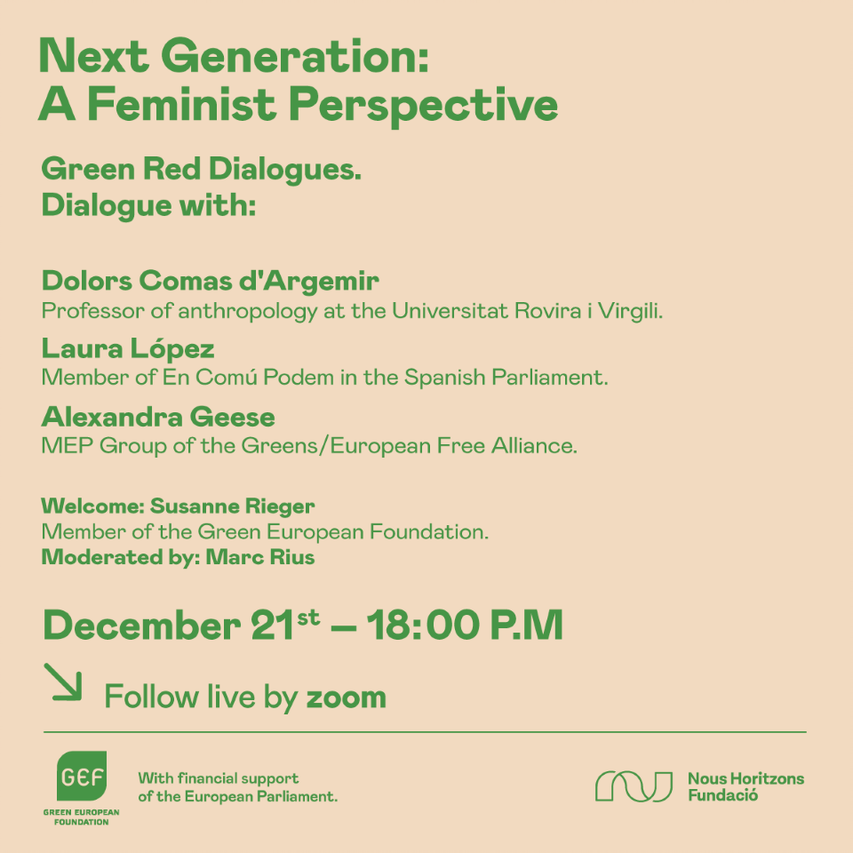
This Green Red Dialogue confronts the European Union’s Next Generation EU fund, a fund created to support member states in their economic and social recovery and resilience from the COVID-19 pandemic. Such massive investment has a great impact in setting the EU’s economic path for generations to come, but are feminist issues being considered ?

We will discuss the gendered effects of the COVID-19 crisis regarding job creation and overall livelihood improvement, and of course, whether the scheme contemplates the fundamental values of gender equality .

Context

The Green-Red Dialogues began in 2020 as a way to reflect on current issues from explicitly green and social perspectives. The challenges we face as a result of the COVID-19 crisis are new and unpredictable. Today it is more urgent than ever to reverse the consequences of a capitalist system that not only brought forth the pandemic but has also caused irreparable cracks in our planet. A capitalist system that has been shown to foster social inequality and that assaults the Earth.  

We cannot fall into fatalistic discourses and convey the message that all is lost. Instead, we must disseminate proposals and make the citizens of the European Union aware that another option is possible – that green policies are compatible with the economy, progress, and development. 

With this in mind, the Green Red Dialogues continue in 2021, once again providing the space for European policy makers, academics, activists, and citizens to address the challenges of today – combining current affairs and in-depth analysis to spark vibrant discussions about greener, more socially just solutions. 

Speakers

 Alexandra Geese – Greens/EFA MEP 

Laura Lopéz – MP for Catalunya in Común 

Dolors Comas – politician and anthropologist, Rovira i Virgili University 

Welcome by Susanne Rieger (GEF) and moderated by Marc Rius 

Practicalities

Date and Time: Tuesday, December 21st (18:00-19:00) 

Audience: The webinar is free and open to the general public. There will be simultaneous interpretation in Spanish and English.

Please register in advance via this link 

Recommended Reading

Delve more into the topics of this event by checking out some related articles in the Green European Journal! 

Innovative Food Systems (Barcelona)

By

Context

In 2022 the Cities as Places of Hope project aims to bring together progressive and transformative trans-local city networks, connect them and facilitate their exchanges, ultimately contributing to a positive narrative for the future of Europe. This year the project will continue with an inspiring public event in each country with the title ‘Talking about a Green City’ bringing together the broader green family of activists, civil society, new urban actors and the general public. In Barcelona, the focus of the activities will be around sustainable food systems and food production.

Programme


Sunday 8th May

Arrival of participants


Monday 9th May

09:30 Meeting with Victor Tenez (Responsible for food policy of the Metropolitan Government of Barcelona)

11:00 Visit to Parc Agrari (Agricultural Park Consortium)

13:30 Lunch

14:30 Meeting with Oscar Teruelo (President of AGT Association of Gastronomy and Tourism)

16:30 Visit to Espigoladors

Fundació Espigoladors is a non-profit organisation that fights against food waste and losses while empowering people at risk of social exclusion in a transformative, participative, inclusive and sustainable way.

17:00 End of the day


Tuesday 10th May

09:30 Meeting with Lidón Martrat (head of food policies of Barcelona City)

11:30 Visit to exhibition “Eat, act and impact”

13:00 Lunch

14:00 Conclusions

15.00 End of the study visit


Wednesday 11th May

Departures


Practicalities

Date and time: 12th-14th May

Audience: Cities as Places of Hope Project Partners

Location: Calle Riu Anoia 44, 08820 El Prat de Llobregat, Catalonia.


Audio visual materials

Interview with Laura Calabuig – Fundesplai

Interview with Anna Cornudella – Fundació Espigoladors


This project is organised by the Green European Foundation with the support of Fundació Nous Horitzons and with the financial support of the European Parliament to the Green European Foundation. The European Parliament is not responsible for the content of this event.
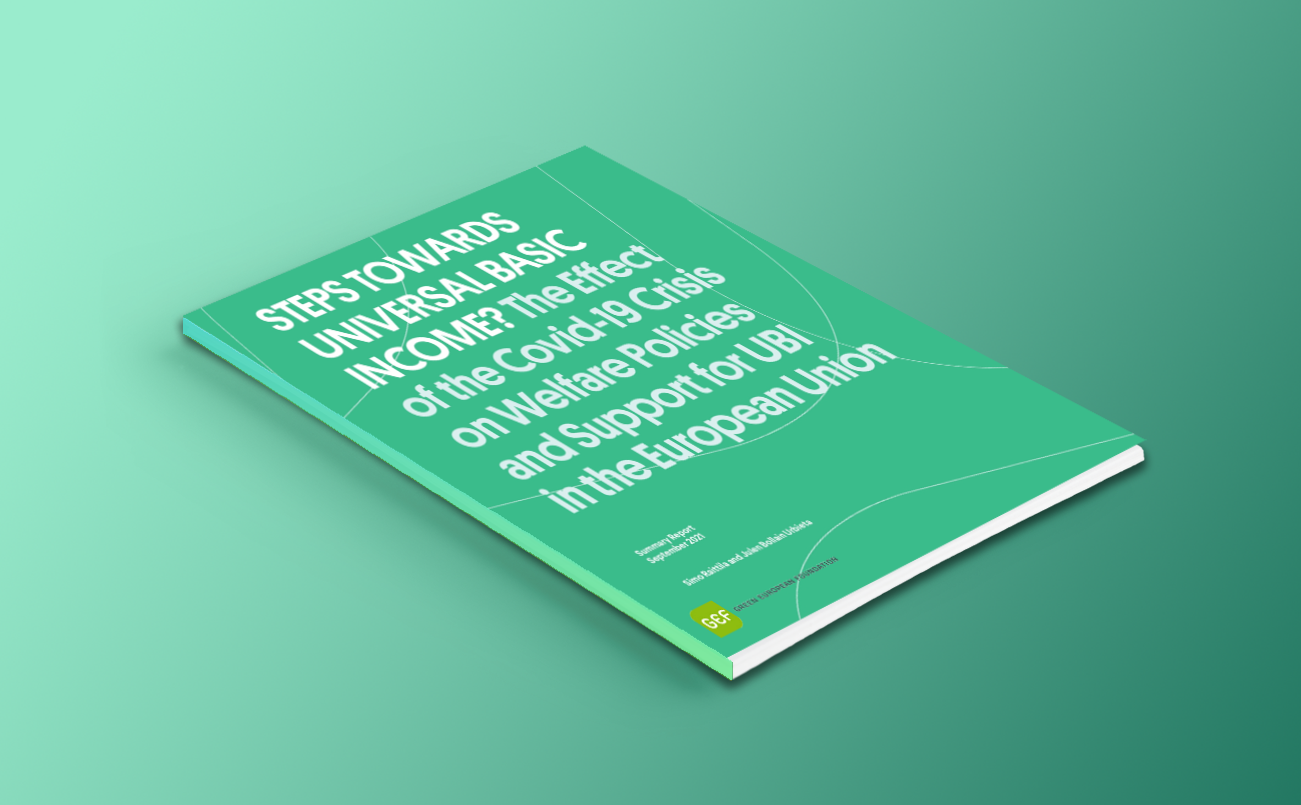
Steps Towards Universal Basic Income? The Effect of the Covid-19 Crisis on Welfare Policies and Support for UBI in the European Union

By Uncategorized

Context

When the Covid-19 pandemic hit Europe, it put an enormous strain on the lives and livelihoods of millions. Amid lockdowns and quarantines, many countries responded by (temporarily) broadening their social security policies and providing additional support to those at risk of falling through the cracks. Yet as we slowly emerge from this crisis, there are already others looming. Society will continue to feel the effects of COVID-19 for a decade or more without an urgent public policy overhaul. We need to re-examine our social security approaches and implement bold measures to make societies more resilient to change and crisis. One such proposal is the Universal Basic Income.

There is no place for narrow views or short-sighted policies aimed at continuing to patch up a wound that is gradually – although more and more rapidly – bleeding us dry. Nor is there any point in trying to face the challenges of the 21st century with policies from the last century that have already proved to be unsuccessful.

Objectives

This report examines the social policy reactions to the Covid-19 crisis in a dozen different European countries. Drawing on survey and qualitative data, we explore how these expanded support measures relate to the vision of Universal Basic Income. To what extent do they represent a step towards UBI, despite government hesitancy? And what do they say about the (in)ability of our existing social security systems to deal with crises? The report also investigates the popularity of UBI among Europe’s citizens. Has the pandemic made an impact on the way people talk and think of UBI?

Experts and stakeholders across Europe contributed data for this publication, and shared their insights and reflections as part of our project “Change of Mindset–Civil Society Dialogue around UBI, Social Justice, and Climate Impact.” As the debate continues, we too would be interested in expanding our analysis to include new information and additional countries.

If you wish to:

  • Submit a survey response;
  • Provide details or resources on countries not featured in this analysis;
  • Send us your feedback;

Please get in touch! GEF’s work on UBI continues–read more here.


This publication has been realised with the support of Visio and Fundació Nous Horitzons and the financial support of the European Parliament to the Green European Foundation. The European Parliament is not responsible for the content of this publication.

EGAT-Catalonia

By

About the event

We offer you to participate in a training program for young European green activists.

You will learn how European institutions work and how things can be changed from politics, from social justice, green and feminist values.

You will meet other activists, with whom you will share your struggles and experiences.

You will be able to go to Brussels to get to know the European institutions and participants from six other countries (Croatia, Hungary, Poland, Czech Republic, Greece and Finland).

Programme

We’ll hold two training seminars from Friday afternoon to Sunday afternoon with different green politicians and experts. You will get in-depth into the concepts and techniques to achieve change working in small groups,

October 1-3, 2021

“Green policies from my neighborhood to Europe“

December 3-5, 2021

“Tools to transform reality“

January 2022

Online meeting with activists from other countries

February 2022

Trip to Brussels


This EGAT programme is organised by the Green European Foundation with the support of Nous Horitzons and with the financial support of the European Parliament to the Green European Foundation.

EGAT-Catalonia

By

About the event

We offer you to participate in a training program for young European green activists.

You will learn how European institutions work and how things can be changed from politics, from social justice, green and feminist values.

You will meet other activists, with whom you will share your struggles and experiences.

You will be able to go to Brussels to get to know the European institutions and participants from six other countries (Croatia, Hungary, Poland, Czech Republic, Greece and Finland).

Programme

We’ll hold two training seminars from Friday afternoon to Sunday afternoon with different green politicians and experts. You will get in-depth into the concepts and techniques to achieve change working in small groups,

November 12-3, 2021
First seminar
December 3-5, 2021
Second seminar
January 2022
Online meeting with activists from other countries
February 2022
Trip to Brussels


Practicalities

Application

Interested? Please applying by through this link.

Deadline: September 22, 2021.

This activity has no economic cost for the participants.

Please note: Due to the particular circumstances during the COVID-19 pandemic, all activities could potentially be subjected to changes depending on the epidemiological data and any restrictive measures and guidelines at that time. Some parts of the programme involving travel may take place online.

For any questions contact us egat@noushoritzons.cat


This EGAT programme is organised by the Green European Foundation with the support of Nous Horitzons and with the financial support of the European Parliament to the Green European Foundation.

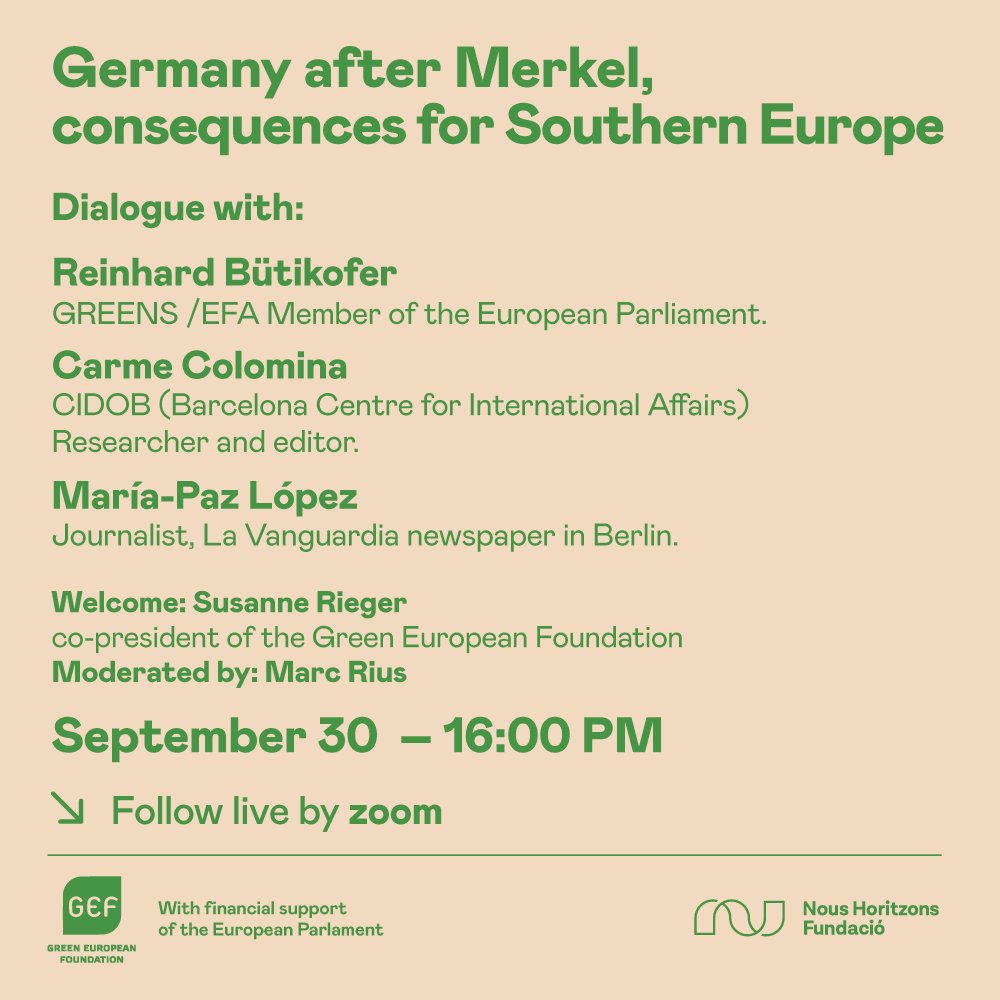
Germany after Merkel – Consequences for Southern Europe

By

About the Event:

Germany will be heading to the polls on September 26th to elect a new government. Citizens across Europe will follow the results with anticipation – also in Spain and Catalonia.
Is a green government possible? What will the results mean for German relations with Southern Europe? Will a potential Green Wave help Spanish and Catalan Greens gain more space and influence too?
We will discuss these and other questions with our guest speakers. Together we’ll try to get insight into what could be a consequential moment in European politics.


Context:

The Green-Red Dialogues began in 2020 to trigger a reflection on current issues from explicitly green and social perspectives. The challenges we face as a result of the COVID-19 crisis are new and unpredictable. Today we highlight the need to reverse the consequences of a capitalist system that generated the pandemic and has also caused irreparable cracks in our planet. A capitalist system that fosters social inequality and that assails the Earth.
We cannot fall into fatalistic discourse and convey the message that all is lost, and consequently, there isn’t much more to do. Instead, we must disseminate proposals and make EU citizens aware that an alternative way of living is possible – that green policies are compatible with a prosperous economy, progress, and development.
With this in mind, the Green Red Dialogues continue in 2021, once again providing the space for European policymakers, academics, activists, and citizens to address today’s challenges – combining current affairs and in-depth analysis to spark vibrant discussions about greener, more socially just solutions.


Speakers:

Reinhard Bütikofer – German MEP, European Greens
Carme Colomina – researcher specialising in the EU, disinformation, and global politics at CIDOB (Barcelona Centre for International Affairs)
María-Paz López – La Vanguardia, Berlin correspondent

Welcome by Susanne Rieger (co-president of the Green European Foundation)
Moderation by Marc Rius


Practicalities:

Date and Time: September 30th (16:00-17:30)
Audience: The webinar is free and open to the general public.
There will be simultaneous interpretation in Spanish and English.
Registration: Please register in advance via this link.


This event is organised by the Green European Foundation with the support of Nous Horitzons and with the financial support of the European Parliament to the Green European Foundation. The European Parliament is not responsible for the content of this event.
Budapest Forum – Building Sustainable Democracies

By

The past decade witnessed the emergence of several high-profile international events in the CEE region. The upcoming Budapest Forum is similar in aspiration to its regional counterparts, with its first edition focusing on the role of cities and local initiatives in building livable and sustainable democracies. Within this context, the Budapest Forum will also serve as a hub for the Pact of Free Cities city network, bringing together mayors and civic leaders from around Europe and beyond. Ideally, participants will leave the conference not only inspired and eager to create positive change in their respective fields, but also as parts of a new and vibrant network connecting prominent local stakeholders and experts across disciplines. You can find more information on the programme and speakers here.

About the event

Date: 16th September 

Time: 12:30-13:30 PM CET

Despite the rise of authoritarian forces on national scenes, many European cities are pursuing a green-progressive vision. For the Green European Foundation, these cities are a substantial source of inspiration for developing a positive narrative on the future of Europe. In this event, we take you on a small tour highlighting a few frontrunner cities that show that a transformation towards a socio-ecological society is possible and happening.

*part of GEF’s Cities as Places of Hope project

This 2021 project aims to bring together progressive and transformative trans-local city networks, to connect them and facilitate their exchanges, ultimately contributing to a positive narrative for the future of Europe. In autumn the project will continue with an inspiring public event in each country with a title ‘Talking about a Green City’ bringing together the broader green family of activists, civil society, new urban actors and the broader public. 

Visit the Green European Foundation’s stand during the three days of the Forum and interact with our GEF Staff Members. 


Budapest Forum programme

To learn more about the full programme of the Forum click here <<<


Speakers:

Dirk Holemans – Oikos Think Tank, Co-President Green European Foundation

Lana Pukanić– Institute for Political Ecology IPE

*further speakers will be announced shortly


Practicalities:

Where: In person (Central European University) & online

Time and date: 16th September

12:30-13:30 PM CET

Audience: attendees of the Budapest Forum & online participants

Registrations: Registrations are now open <<<


This event is organised by the Green European Foundation with the support of City of Budapest, Political Capital Institute, CEU Democracy Institute and with the financial support of the European Parliament to the Green European Foundation. The European Parliament is not responsible for the content of this event.
Food Policy in Barcelona Metropolitan Area

By

About the event

2021 marks Barcelona’s year as the World Sustainable Food Capital. A catalyst for a food transition towards sustainability that strengthens local economies and improves the health of both people and the planet.

In this context, the webinar will focus on different safe and affordable, sustainable food production and how to support local farmers.

Speakers:
  • Sergi Alegre, Fundació Nous Horitzons, welcome words
  • Susanne Rieger (Green European Foundation, Co-President), Introduction of the Green European Foundation
  • Alvaro Porro, Commissioner of social economy, local development and food policy of the City of Barcelona
  • Anna Martin, Vice-Mayor of El Prat
  • Gemma Frances, Director of Agricultural Parc of Baix Llobregat
Q&A

Practicalities:

Date and Time: 16th June 17:00 – 18:00 PM CET
Language: English/Catalan with simultaneous translation

This event is organised by the Green European Foundation with the support of  Fundació Nous Horitzons and with the financial support of the European Parliament to the Green European Foundation. The European Parliament is not responsible for the content of these workshops.

European Green Activist Training Week 2021

By

About the Event

During the four-day event, the green-minded youth will have the chance to explore various topics such as climate justice and lobbying in Brussels by engaging with professionals, politicians, NGOs and other activists operating in and around the European Institutions, as well as with each other.  

Throughout the event, the participants will have the opportunity to discover and learn from the various other countries. Through a variety of team building and icebreaker sessions, participants will present and share information about their countries and find points of common interests and as well as differences. 

With a range of formal and non-formal training methods, including interactive workshops, the trip will be a valuable learning experience for young activists brought together by Green values and a motivation to enact change.  


Event Background

The European Green Activist Training project aims to Europeanise existing training programmes for Green activists in several European countries by incorporating more pan-European content and to make these programmes more cooperative by enabling young activists to meet and network. 


Programme

Wednesday 21 April– Welcome note 

  • Welcome note: presenting EGAT history and introduce EGAT Alumni Ambassador 
  • Present overview of programme and objectives and gather expectations from participants 

Thursday 22 April and Friday 23 April- Team building, discovering and influencing the European Union 

  • Getting to know each other and team building activities 
  • Official virtual visits to the European Parliament with MEPs Heidi HautalaSylwia Spurek, Kira Peter Hansen and Marketa Gregorova 

Parallel sessions: 

  • Green family workshop 
  • The Good Lobby workshop 
  • European Youth Seminar visit 
  • EU Careers presentation 

Saturday 24 April Climate, economy and environment 

Workshops: 

  • Sustainable cities: workshop led by Nikoleta Petkovic- CDNEE 
  • Biodiversity and climate change: workshop led by Laura Hildt– The European Environmental Bureau 
  • Deforestations and nature degradation: workshop led by Rigas Tsiakiris– Green Insitute Greece 

Sunday 25 April: Online Activism 

  • Workshop on human rights and gender equality led by Mina/Giulio Tolu- FYEG Spokesperson 
  • Activist toolbox and training for online activism led by FYEG  
  • Groupwork and debates  


The exact details and timings of the programme are to be confirmed, please check back later for more information. 

This years EGAT edition is supported by:Ökopolisz(Hungary), Green Window (Croatia), Institute for Active Citizenship (Czechia), Visio (Finland), Fundacja Strefa Zieleni (Poland), and FundacióNous Horitzons (Catalonia). 


If you would like to take part in the next generation of EGAT, there will be a call for participant applications in late summer 2021 in the Czech Republic, Croatia, Finland, Hungary, Catalonia, Poland and Greece. 


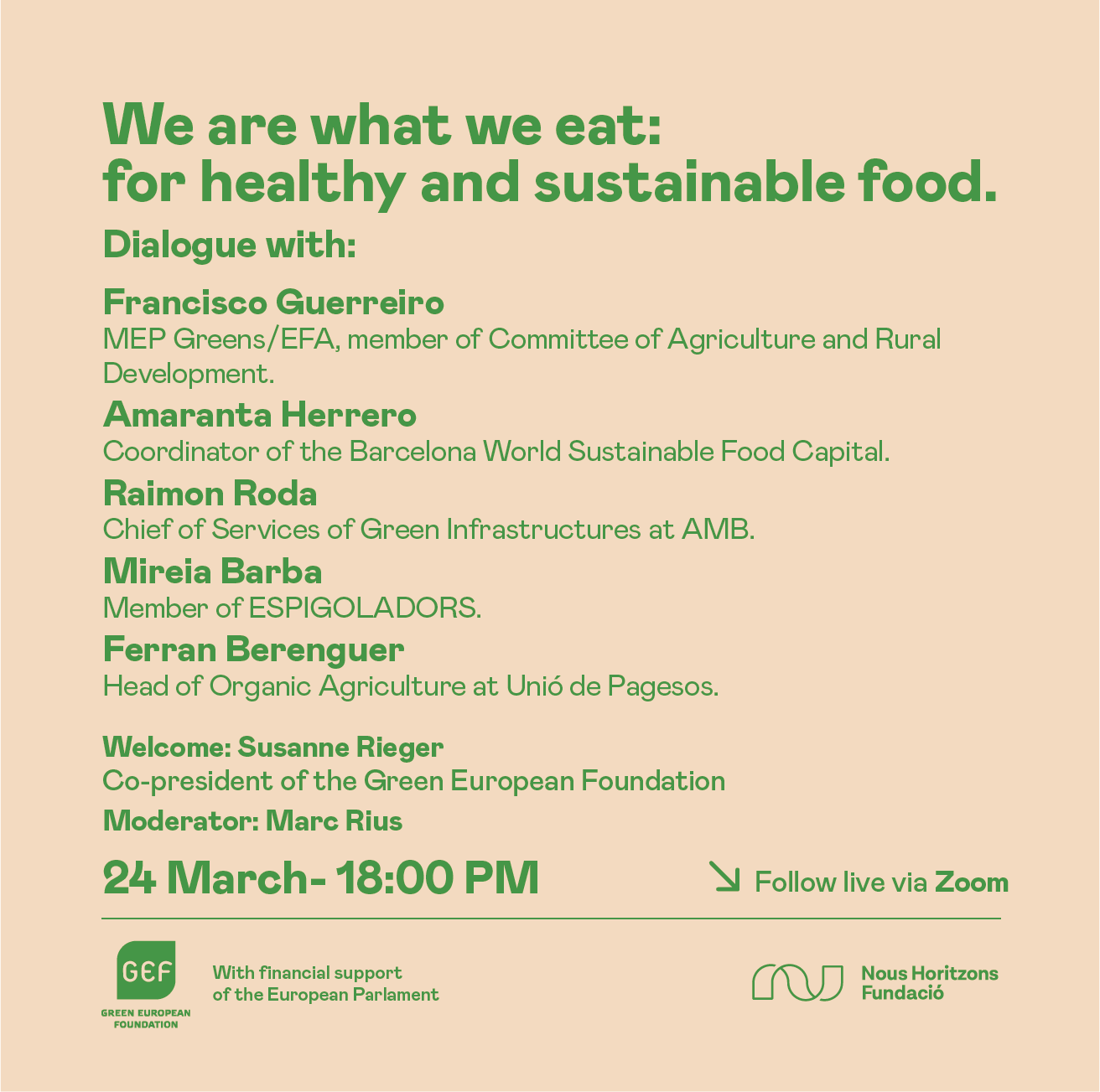
We are what we Eat: For Healthy and Sustainable Food

By

About the Event:

Our first Green-Red Dialogue of 2021 will tackle the sustainable production and consumption of food, from a multi-disciplinary approach. Because everything is fundamentally connected, from the mistreatment of animals and lack of respect for the vital cycles of nature to job insecurity in the countries that supply us. From landscape changes and deforestation to the air we breathe and consequences on our health.

The COVID-19 pandemic has forced us to slow down and reassess our consumption patterns, highlighting the importance of local trade and local production and making everyone a bit more aware of the risks involved. With the help of our speakers, we will explore these issues further, hoping to take advantage of this moment to consolidate some beneficial changes as we move beyond the crisis.

Context:

The Green-Red Dialogues began in 2020 as a way to reflect on current issues from explicitly green and social perspectives. The challenges we face as a result of the COVID-19 crisis are new and unpredictable. Today it is more urgent than ever to reverse the consequences of a capitalist system that not only brought forth the pandemic but has also caused irreparable cracks in our planet. A capitalist system that has been shown to foster social inequality and that assaults the Earth.

We cannot fall into fatalistic discourse and convey the message that all is lost and that, consequently, we cannot do much more. Instead, we must disseminate proposals and make the citizens of the European Union aware that another option is possible – that green policies are compatible with the economy, progress, and development.

With this in mind, the Green Red Dialogues return in 2021, once again providing the space for European policy makers, academics, activists, and citizens to address the challenges of today – combining current affairs and in-depth analysis to spark vibrant discussions about greener, more socially just solutions.

Speakers:

  • Francisco Guerreiro – MEP Greens/EFA, Vice-Chair of Committee on Agriculture and Rural Development
  • Amaranda Herrero – Coordinator of the Barcelona World Sustainable Food Capital
  • Raimon Roda – Chief of Services of Green Infrastructures at AMB
  • Mireia Barba – Member of ESPIGOLADORS
  • Ferran Berenguer – Head of Organic Agriculture at Unió de Pagesos

Welcome by Susanne Rieger, co-president of the Green European Foundation, and moderation by Marc Rius.

Practicalities:

Wednesday, March 24th (18:00 – 19:30)

The webinar is free and open to the general public. There will be simultaneous interpretation in Spanish and English.

Please register in advance via this link.

The Economic Model in Tourism Monoculture

By Uncategorized

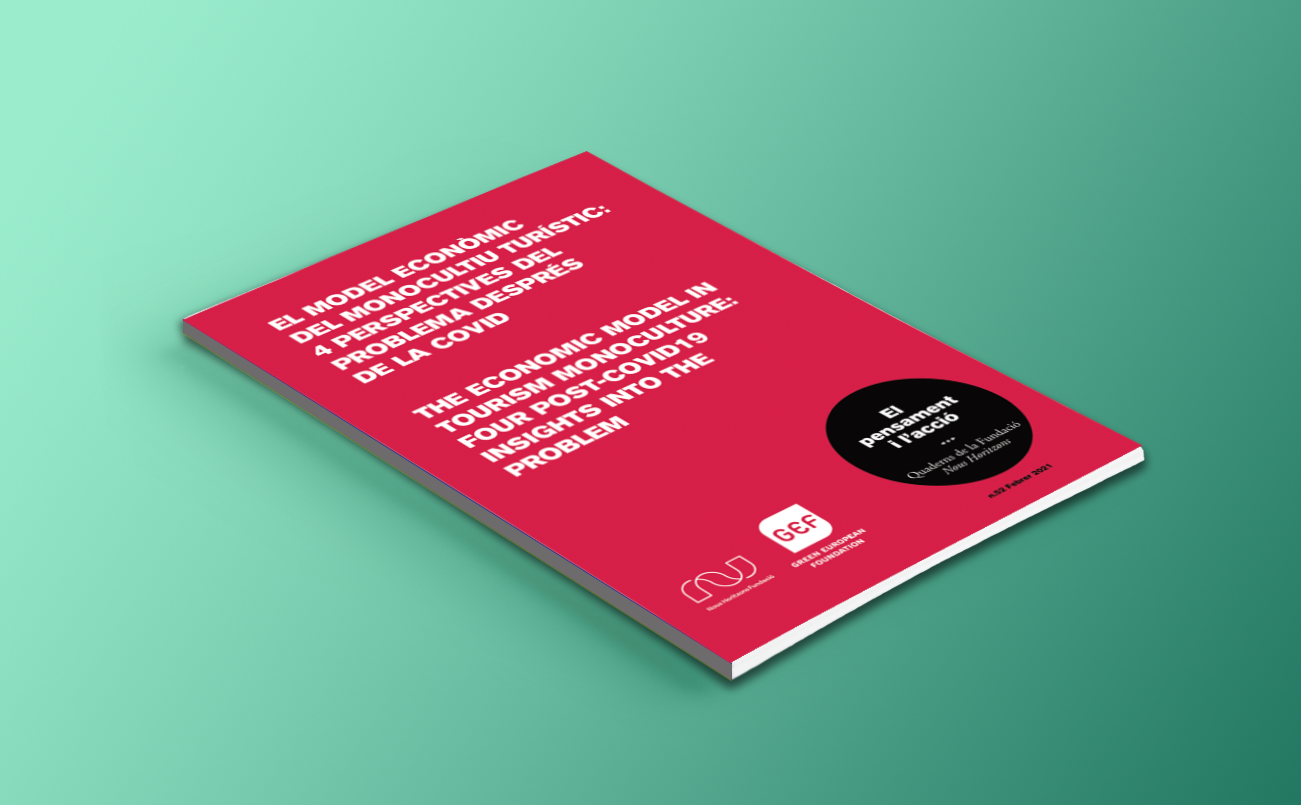
EL MODEL ECONÒMIC DEL MONOCULTIU TURÍSTIC


As this project developed in 2020, COVID-19 wrestled hold of Europe and devastated tourism industries across the continent. With the streets and beaches empty, people and governments have been forced to look at the economic sustainability and the environmental impact of the sector; our project has been holding up a magnifying glass, allowing them to look more closely.

In this publication (EN/CAT) we analyse the sun and beach tourism model, and draw conclusions that may help  us find alternatives.


This publication is a summary of the workshop “The economic model of monoculture tourism: 4 perspectives of the problem after COVID” that took place on 3 December 2020 in the frame of the GEF (Green European Foundation) project “Fair and Carbon Free Tourism”. Different green foundations collaborate in this transnational project that will work for three years on different aspects of sustainable tourism.

More information: Fair and Carbon Free Tourism