Yellow Vest and the Green Deal

By Publications

Context

In late 2018, France witnessed a social movement that profoundly impacted public consciousness: the Yellow Vest movement. Week after week, tens of thousands of people gathered at roundabouts and in the streets, sparked by opposition to higher carbon taxes on fuel. This movement has since become a pivotal point in discussions about achieving an ecological transition. But who were the Yellow Vests, and how did they relate to ecological issues?

This report amplifies the voices of those who transformed public spaces into platforms for political expression. Their actions conveyed a strong demand to be seen, heard, and included in decisions shaping their futures. Spanning rural and urban settings, the Yellow Vest movement highlights the urgent need to harmonize ecological objectives with social justice. It calls into question governance structures and pushes for fairer, more inclusive decision-making processes.

The report begins with an essay by Kevin Puisieux, director of the Fondation de l’Écologie Politique, which examines the tensions between social equity and ecological imperatives. Drawing from the Yellow Vest movement, Puisieux explores the contradictions of a just transition while proposing pathways to bridge grassroots demands with institutional policies. This essay is supported by firsthand testimonies, reflective interviews, and in-depth research.

This publication does not offer simple solutions but invites readers to confront the complexities of these intertwined challenges. It encourages us to rethink long-standing assumptions and envision a Europe where social and ecological justice advance hand in hand.

About the authors

Kevin Puisieux – Director of the Fondation de l’Écologie Politique
Pierre Blavier
– Research fellow at the CNRS / Clersé
Etienne Walker – Lecturer in geography at the University of Caen Normandy
Chloé Alexandre – Doctoral Candidate in Political Science, Sciences Po Grenoble, UGA
Alix Levain – Research Fellow in Anthropology, AMURE
Simon Persico – Professor of Political Science, Sciences Po Grenoble Université Grenoble-Alpes – PACTE
Magali Della Sudda – Research Fellow in Political Science – Centre Emile Durkheim
Green Approaches to Security and Defence

By Publications

In a shifting geopolitical landscape, Greens are grappling with the interplay between their traditional pacifist roots and the post-February 2022 security challenges. This report delves into their evolving stances on key defence issues, from EU military cooperation to disarmament, offering insights into the varied approaches adopted by Green parties from eight EU countries. Expert viewpoints featured throughout provide further feedback and inputs as to what a Green defence policy could (or should) look like. As Europe navigates turbulent waters, the report calls for renewed commitment to progressive and principled approaches to security and defence.

The report is structured into five chapters that address important EU military challenges. They portray a nuanced understanding of European security dynamics among Green parties, reflecting varying national contexts, strategic cultures, and historical perspectives. This report thus provides a clear mapping of green defence thinking across Europe, including points of convergence, gaps, and tensions. Complemented by the expert views, it gives a solid basis for further discussion within and beyond the Greens, to strengthen defence and security policy while maintaining a critical and progressive voice, even in uncertain times.

Chapter 1 delves into the complex institutional landscape of security and defence in Europe. It examines the debates surrounding the identity of the EU and looks at the respective roles of the EU and NATO as security providers.

Chapter 2 focuses on military expenditures and budget allocation. It discusses differing perspectives among Green parties on the use of GDP to set defence government budgets and on how these should be allocated.

Chapter 3 explores Green parties’ opinions on defence industrial policies broadly understood. It examines Green positions on grant programs put in place by the EU and shows diverging opinions on the allocation of public funds to industry.

Chapter 4 analyses positions on nuclear deterrence, disarmament, and arms control. Green parties generally continue to oppose the doctrine of nuclear deterrence, but the war in Ukraine has led some to revise their position on its effectiveness.

Chapter 5 delves into the intertwined concepts of civic militarism, civil protection and non-violence; their implications for military involvement in security as well as civilian participation to defence.


This report is a call to action for Green parties to embrace their role as catalysts for progressive security policies. By navigating the complexities of modern security with creativity, Greens can contribute to shaping a peace-oriented, sustainable, and common European security architecture.


About the authors

Agatha Verdebout is a researcher and deputy director at GRIP. Her main area of expertise is international peace and security law.

Anne Xuan Nguyen is a researcher at GRIP. Working more broadly on security and environmental issues, she specializes in conflict-related pollution and its remediation.


This report is also available in:

GreekGerman


This study was conducted by the Green European Foundation with the support of Etopia , Cogito , Cooperation and Development Network Eastern Europe, and Sustainable Development Forum Green Window . The study was commissioned by GEF to the Groupe de recherche et d’information sur la paix et la sécurité (GRIP). It is published with the financial support of the European Parliament to the Green European Foundation. The views expressed in this publication are solely those of the authors and do not necessarily reflect the views of the European Parliament or the Green European Foundation.

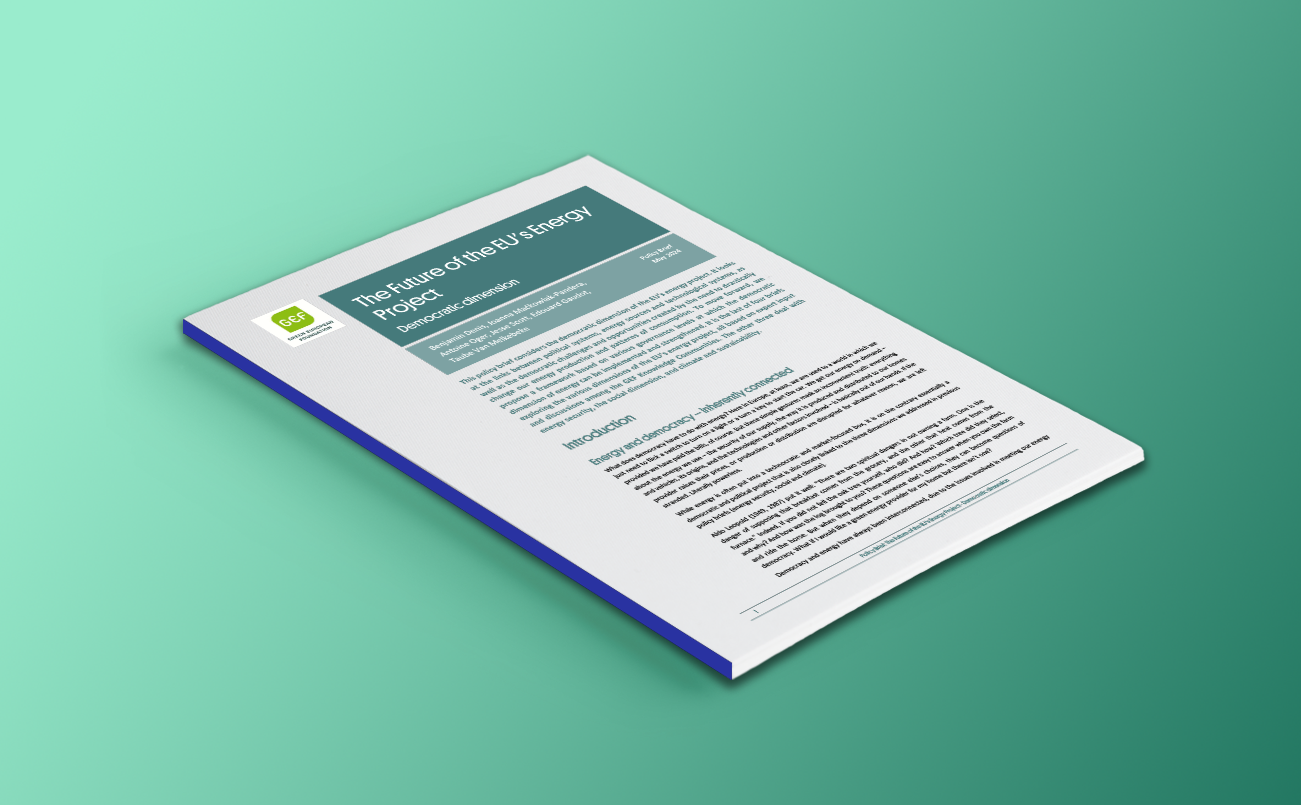
The Future of the EU’s Energy Project: Democratic dimension

By Publications

About

This policy brief considers the democratic dimension of the EU’s energy project. It looks at the links between political systems, energy sources and technological systems, as well as the democratic challenges and opportunities created by the need to drastically change our energy production and consumption patterns.

It is the last of four briefs exploring the various dimensions of the EU’s energy project, all based on expert input and discussions among the GEF Knowledge Communities. The other three deal with energy security, the social dimension, and climate and sustainability

Energy democracy can be seen as the glue binding all these other dimensions together, since it is relevant across the full spectrum of energy issues: continuity of supply, access, affordability and sustainability. It is therefore critical to the success of the energy project as a whole. To move its agenda forward, we propose a framework based on various governance levels, at which the democratic dimension of energy can be implemented and strengthened.


Contributors

  • Benjamin Denis, Core expert of this Knowledge Community, Senior Policy Advisor and Head of Industrial Policy Coordination at IndustriAll Europe.
  • Joanna Maćkowiak-Pandera, Core expert of this Knowledge Community, Founder and Head of Forum Energii.
  • Antoine Oger, Core expert of this Knowledge Community and Research Director, Global Challenges and SDGs at the Institute for European Environmental Policy (IEEP).
  • Jesse Scott, Core expert of this Knowledge Community, Adjunct at Hertie School Berlin and Visiting Fellow at DIW Berlin.
  • Taube Van Melkebeke, Head of Policy at the Green European Foundation (GEF). She leads the different Knowledge Communities of the foundation. For further information, contact her at taube.vanmelkebeke@gef.eu.


This policy brief has been realised by the Green European Foundation with the financial support of the European Parliament to the Green European Foundation. The European Parliament is not responsible for the content of this publication.

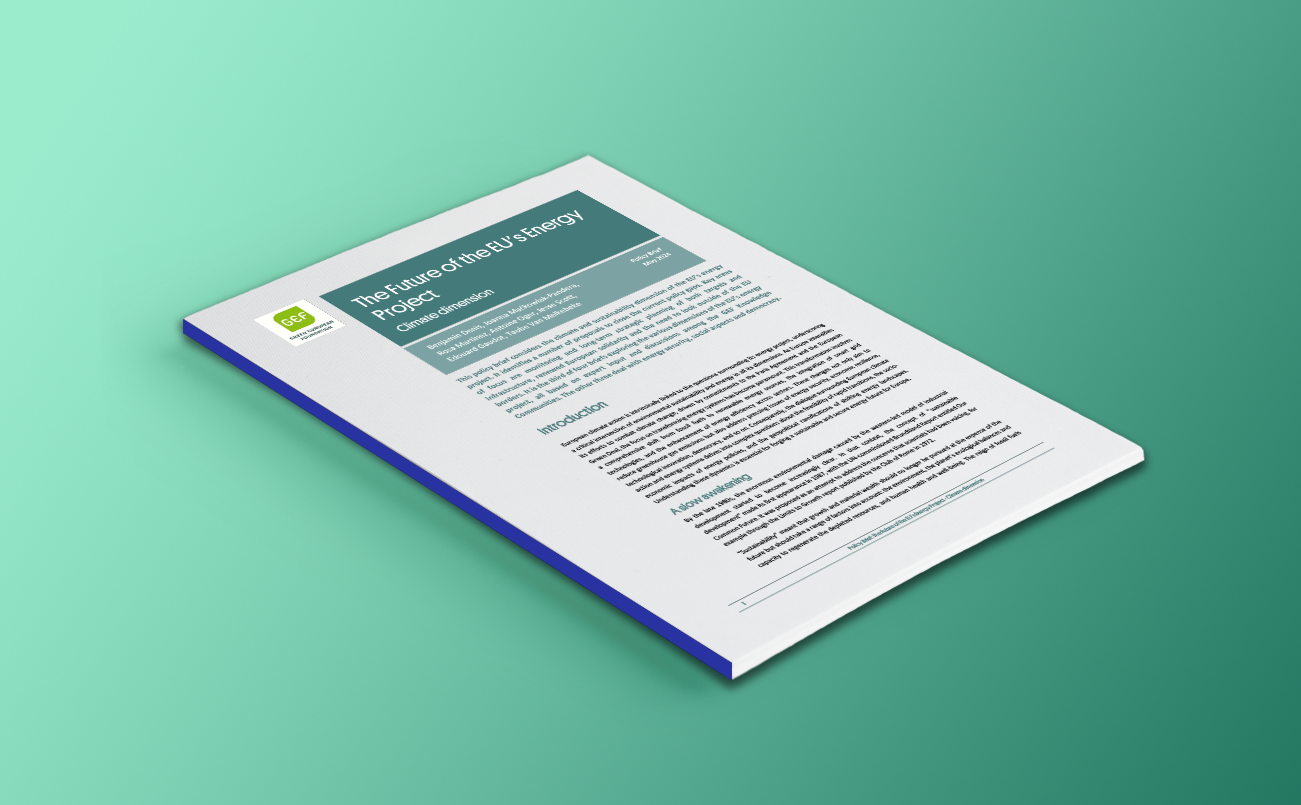
The Future of the EU’s Energy Project: Climate dimension

By Publications

About

This policy brief considers the climate and sustainability dimension of the EU’s energy project. It identifies several gaps in the current state of the EU’s climate and energy intersection and delves into emerging needs, concerns, priorities, and potential unintended consequences of the green transition policy.

We propose closing existing policy gaps, strengthening the climate dimension of the EU’s energy project from a holistic point of view. This includes focusing on key areas such as:

  • Monitoring and long-term strategic planning of both targets and infrastructure;
  • Renewed European solidarity;
  • The need to look outside of the EU borders.
This is the third out of four briefs that delve into different dimensions of the EU’s energy project. All these briefs are informed by expert insights and discussions within the GEF Knowledge Communities.  The remaining three focus on energy security, social aspects, and democracy.


Contributors

  • Benjamin Denis, Core expert of this Knowledge Community, Senior Policy Advisor and Head of Industrial Policy Coordination at IndustriAll Europe.
  • Joanna Maćkowiak-Pandera, Core expert of this Knowledge Community, Founder and Head of Forum Energii
  • Rosa Martinez, Core expert of this Knowledge Community, Green European Journal Board Member and State Secretary for Social Rights in Spain.
  • Antoine Oger, Core expert of this Knowledge Community and Research Director, Global Challenges and SDGs at the Institute for European Environmental Policy (IEEP).
  • Jesse Scott, Core expert of this Knowledge Community, Adjunct at Hertie School Berlin and Visiting Fellow at DIW Berlin.
  • Taube Van Melkebeke, Head of Policy at the Green European Foundation (GEF). She leads the different Knowledge Communities of the foundation. For further information, contact her at taube.vanmelkebeke@gef.eu.


This policy brief has been realised by the Green European Foundation with the financial support of the European Parliament to the Green European Foundation. The European Parliament is not responsible for the content of this publication.

Navigating NATO

By Publications

Green and progressive parties across Europe have historically held a sceptical view towards the military industry and defence alliances such as NATO. Russia’s war of aggression against Ukraine spotlighted existing security vulnerabilities and profoundly shifted the public and political debate. In this context, Greens may have differing attitudes towards NATO, but find themselves in the political reality of not if but how to engage within it. Based on desk research and expert interviews from ten European countries, this report explores different ways that greens and progressives can influence NATO, and the risks and opportunities this entails.


It is important to bring alternative thinking into mainstream and conservative security spaces, and with more Greens in parliaments and governments across the continent, there is both the room and need for greater influence and expertise.


About the author

Sarah Bitamazire

Sarah Bitamazire is a policy expert on international human rights law and foreign policy work in conflict and high-risk environments. She is currently Chief Policy Officer at Lumiera, a boutique advisory firm with policy, tech, and business expertise that equips organisations with responsible AI strategies. Prior to this she was at the heart of the Swedish policy debate on defence and foreign affairs, developing policy ideas for the Swedish Greens. Sarah is specialised in Public International Law and Human Rights Law, and holds a Law Degree from Uppsala University and Leiden University.


This report is also available in:

GreekGerman


This study was conducted by the Green European Foundation with the support of Cogito. It is published with the financial support of the European Parliament to the Green European Foundation. The views expressed in this publication are solely those of the authors and do not necessarily reflect the views of the European Parliament or the Green European Foundation.

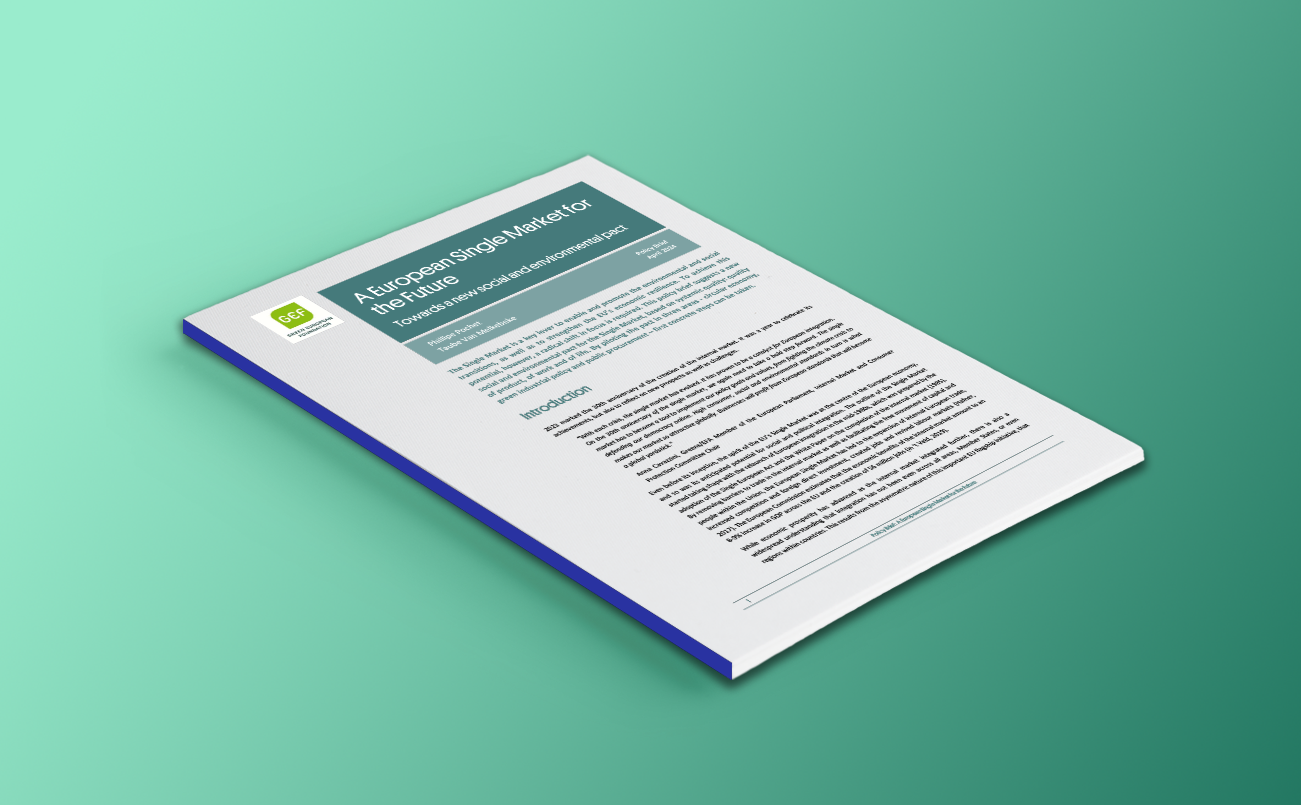
A European Single Market for the Future

By Publications

About

The Single Market is a key lever to enable and promote the environmental and social transitions, as well as to strengthen the EU’s economic resilience. To achieve this potential, however, a radical shift in focus is required. This policy brief suggests a new social and environmental pact for the Single Market, based on systemic quality: quality of product, of work and of life. This pact can bring together employers interested in quality products, workers and trade unions championing dignified labour conditions and NGOs and citizens advocating for a better quality of life and sustainable climate practices. By piloting the pact in three areas – circular economy, green industrial policy and public procurement – first concrete steps can be taken.

Contributors

  • Philippe Pochet, GEF fellow and core expert to this Knowledge Community. In the past, he held the position of Director of the Observatoire Social Européen (OSE) for over 15 years. From 2008 to 2023, he served as the General Director of the European Trade Union Institute (ETUI). Currently, he is a Professor at the Catholic University of Louvain and a Visiting Professor at the College of Europe in Bruges. He also holds the position of Affiliate Professor at Sant’Anna School of advanced studies, Pisa. Next to the topic of the Single Market, Philippe is also collaborating with GEF on Climate Emergency and Welfare States.
  • Taube Van Melkebeke, Head of Policy at the Green European Foundation (GEF). She leads the different Knowledge Communities of the foundation. For further information, contact her at taube.vanmelkebeke@gef.eu.


This policy brief has been realised by the Green European Foundation with the financial support of the European Parliament to the Green European Foundation. The European Parliament is not responsible for the content of this publication.

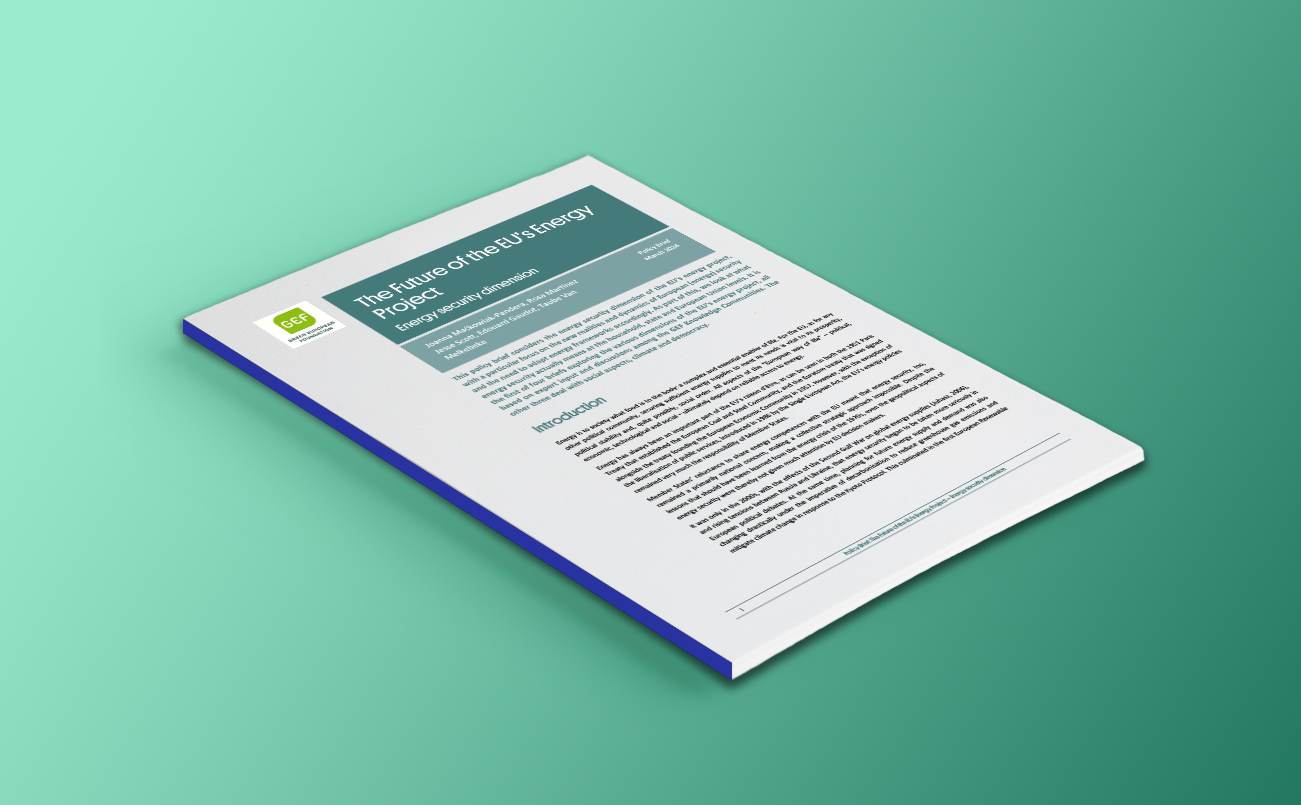
The Future of the EU’s Energy Project: Energy security dimension

By Uncategorized

About

This policy brief considers the energy security dimension of the EU’s energy project, with a particular focus on the new realities and dynamics of European (energy) security and the need to adapt energy frameworks accordingly.

Triggered by the climate emergency, cost-of-living crisis, geopolitical turmoil and fierce competition for the clean tech pole positions, energy security has evolved drastically over the last couple of years. The EU’s energy security toolbox, however, remained roughly untouched and left the Union paralysed. It’s high time to recognise the importance of this dimension of the Future of the EU’s Energy Project. Bringing order into this toolbox, thereby making it fit to deal with a changed world, is fundamental if we want to ensure sufficient, reliable and sustainable energy for all.

The authors of the policy brief propose a pathway, based on a revised European Energy Security Strategy. It is the first of four briefs exploring the various dimensions of the EU’s energy project, all based on expert input and discussions among the GEF Knowledge Communities. The other three deal with social aspects, climate and democracy.


Contributors

  • Joanna Maćkowiak-Pandera, Core expert of this Knowledge Community, Founder and Head of Forum Energii
  • Rosa Martinez, Core expert of this Knowledge Community, Green European Journal Board Member and State Secretary for Social Rights in Spain.
  • Jesse Scott, Core expert of this Knowledge Community, Adjunct at Hertie School Berlin and Visiting Fellow at DIW Berlin.
  • Taube Van Melkebeke, Head of Policy at the Green European Foundation (GEF). She leads the different Knowledge Communities of the foundation. For further information, contact her at taube.vanmelkebeke@gef.eu.


This policy brief has been realised by the Green European Foundation with the financial support of the European Parliament to the Green European Foundation. The European Parliament is not responsible for the content of this publication.

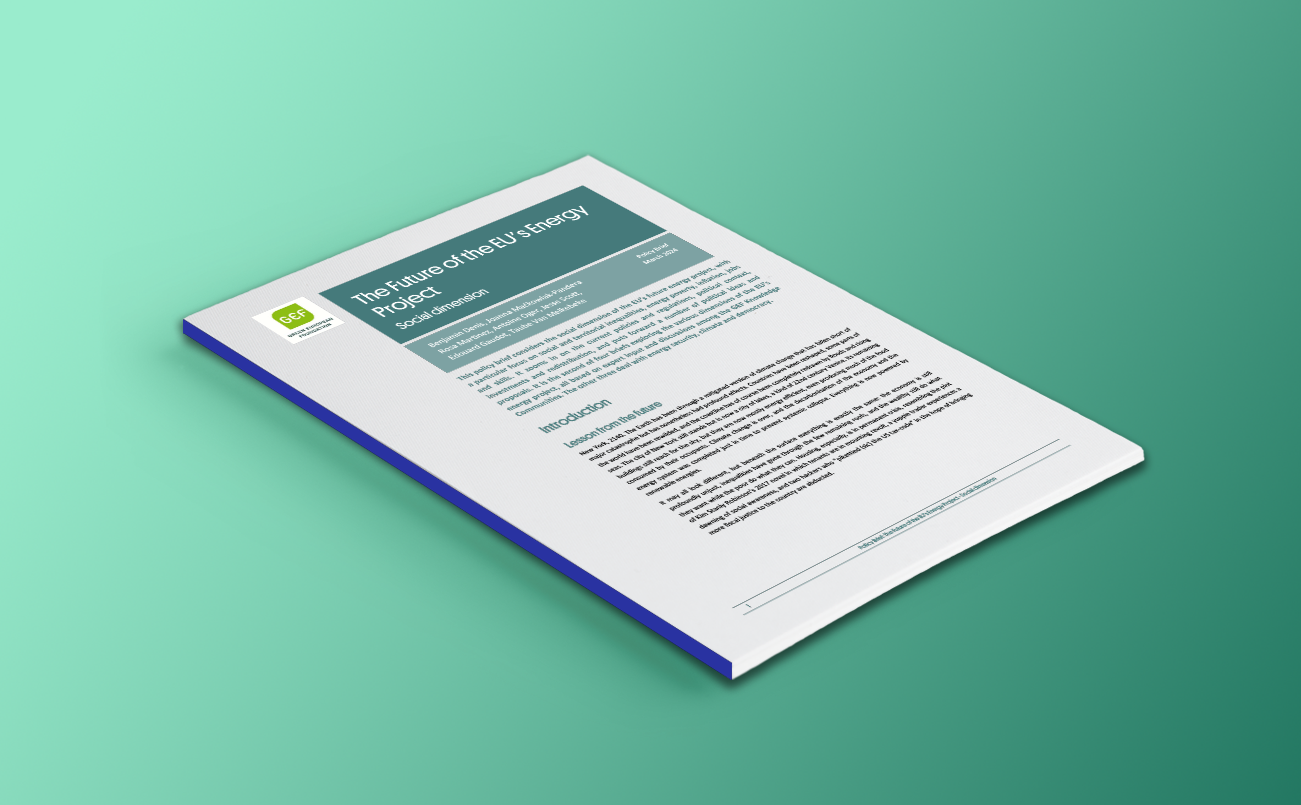
The Future of the EU’s Energy Project: Social dimension

By Uncategorized

About

This policy brief considers the social dimension of the EU’s future energy project, with a particular focus on social and territorial inequalities, energy poverty, inflation, jobs and skills.

It zooms in on the current policies and regulations, political context, investments and redistribution, and puts forward a number of political ideas and proposals. By shifting away from a consumption-driven approach, towards a planned, collective one, the authors argue, the EU can create real motivation for citizens to play an active part in the transition.

How?

a. Providing public measures and subsidies to fight energy poverty, while reducing overconsumption and maximising efficiency and sufficiency.

b. Creating new strategies and incentives for an inclusive transition on the labour market and schools.

c. Deploying the highest social and environmental conditionalities, at home and abroad.

d. Delivering the needed investments through a balanced combination of new money, new paradigm and new tax system.

This policy brief is part of the GEF Knowledge Communities. It is our second brief exploring the various dimensions of the EU’s energy project, all based on expert input and discussions. The other three deal with energy security, climate and democracy.


Contributors

Benjamin Denis, Core expert of this Knowledge Community, Senior Policy Advisor and Head of Industrial Policy Coordination at IndustriAll Europe.

Joanna Maćkowiak-Pandera, Core expert of this Knowledge Community, Founder and Head of Forum Energii.

Rosa Martinez, Core expert of this Knowledge Community, Green European Journal Board Member and State Secretary for Social Rights in Spain.

Antoine Oger, Core expert of this Knowledge Community and Research Director, Global Challenges and SDGs at the Institute for European Environmental Policy (IEEP).

Jesse Scott, Core expert of this Knowledge Community, Adjunct at Hertie School Berlin and Visiting Fellow at DIW Berlin.

Taube Van Melkebeke, Green European Foundation (GEF)’s Head of Policy and Knowledge Communities lead. For further information, contact her at taube.vanmelkebeke@gef.eu.


This policy brief has been realised by the Green European Foundation with the financial support of the European Parliament to the Green European Foundation. The European Parliament is not responsible for the content of this publication.

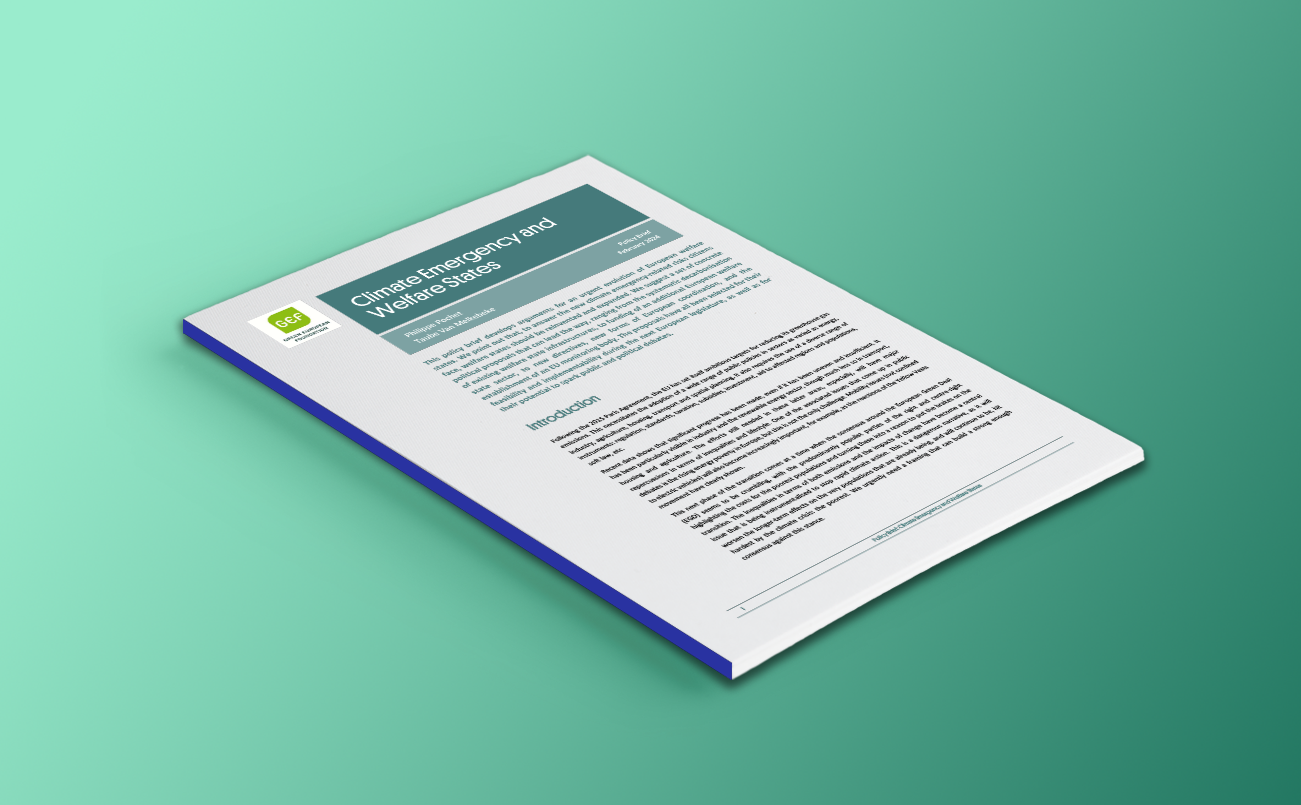
Climate Emergency and Welfare States

By Uncategorized

About

This policy brief develops arguments for an urgent evolution of European welfare states. We point out that, to answer the new climate emergency-related risks citizens face, welfare states should be reinvented and expanded. We suggest a set of concrete political proposals that can lead the way, ranging from the systematic decarbonisation of existing welfare state infrastructures to funding of an additional European welfare state sector, to new directives, new forms of European coordination, and the establishment of an EU monitoring body. The proposals have all been selected for their
feasibility and implementability during the next European legislature, as well as for their potential to spark public and political debates surrounding the intersection of the climate emergency and welfare states’ policy.

Contributors

  • Philippe Pochet, GEF fellow and core expert to this Knowledge Community. In the past, he held the position of Director of the Observatoire Social Européen (OSE) for over 15 years. From 2008 to 2023, he served as the General Director of the European Trade Union Institute (ETUI). Currently, he is a Professor at the Catholic University of Louvain and a Visiting Professor at the College of Europe in Bruges. He also holds the position of Affiliate Professor at Sant’Anna School of advanced studies, Pisa. Next to the topic of the Single Market, Philippe is also collaborating with GEF on Climate Emergency and Welfare States.
  • Taube Van Melkebeke, Head of Policy at the Green European Foundation (GEF). She leads the different Knowledge Communities of the foundation. For further information, contact her at taube.vanmelkebeke@gef.eu.


This policy brief has been realised by the Green European Foundation with the financial support of the European Parliament to the Green European Foundation. The European Parliament is not responsible for the content of this publication.

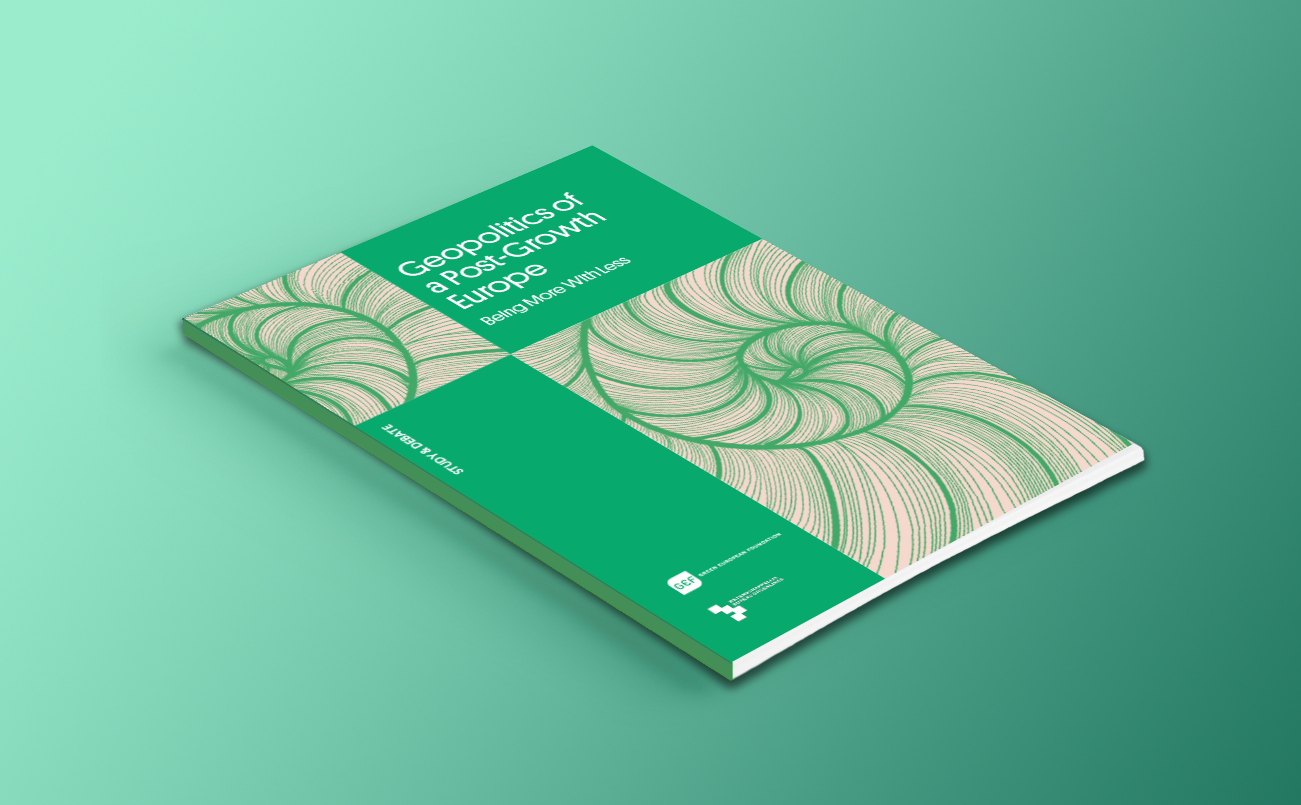
Geopolitics of a Post-Growth Europe

By Uncategorized

Context

As it stands, degrowth fails to resonate with experts in foreign and security policy. It is easy to see why. In geopolitics, many determinants of power – trade, aid, tech nology, defence – are closely linked to GDP. If they do not ignore planetary boundaries altogether, geopolitical pundits trumpet the ‘green growth’ narrative so as to reconcile ecological and geopolitical security. It is this very narrative that degrowthers aim to refute.

It is better to manage the end of growth through democratic deliberation than to have it imposed on us by ecological breakdown.


Objectives

It is unlikely that we will be able to defuse the climate time bomb, let alone other ecological threats, as long as our economy continues to grow. But what would the end of economic growth mean for geopolitics? Could a European Union that is the first to embrace post-growth still be a global actor? Would it be able to defend itself, its allies, democracy, human rights, and the international rule of law at a time when aggressive autocracies are invading or threatening their democratic neighbours? This report addresses uneasy questions that few have dared to ask.


Project Background

This report is produced by the Green European Foundation. It is part of the project Geopolitics of a Post-Growth Europe. The project is led by Wetenschappelijk Bureau GroenLinks (NL) and supported by BlueLink (BG), Center for Green Politics (RS), Etopia (BE), Fondation de l’Écologie Politique (FR), Green House Think Tank (UK), and Transición Verde (ES). Check out www.geopoliticspostgrowth.eu for more interviews, videos, and other project outputs.


Available Translations

Dutch

Spanish

Serbian

French

Bulgarian

Czech

Portuguese


This report has been realised by the Green European Foundation with the support of  Wetenschappelijk Bureau GroenLinks and the financial support of the European Parliament to the Green European Foundation. The European Parliament is not responsible for the content of this publication.

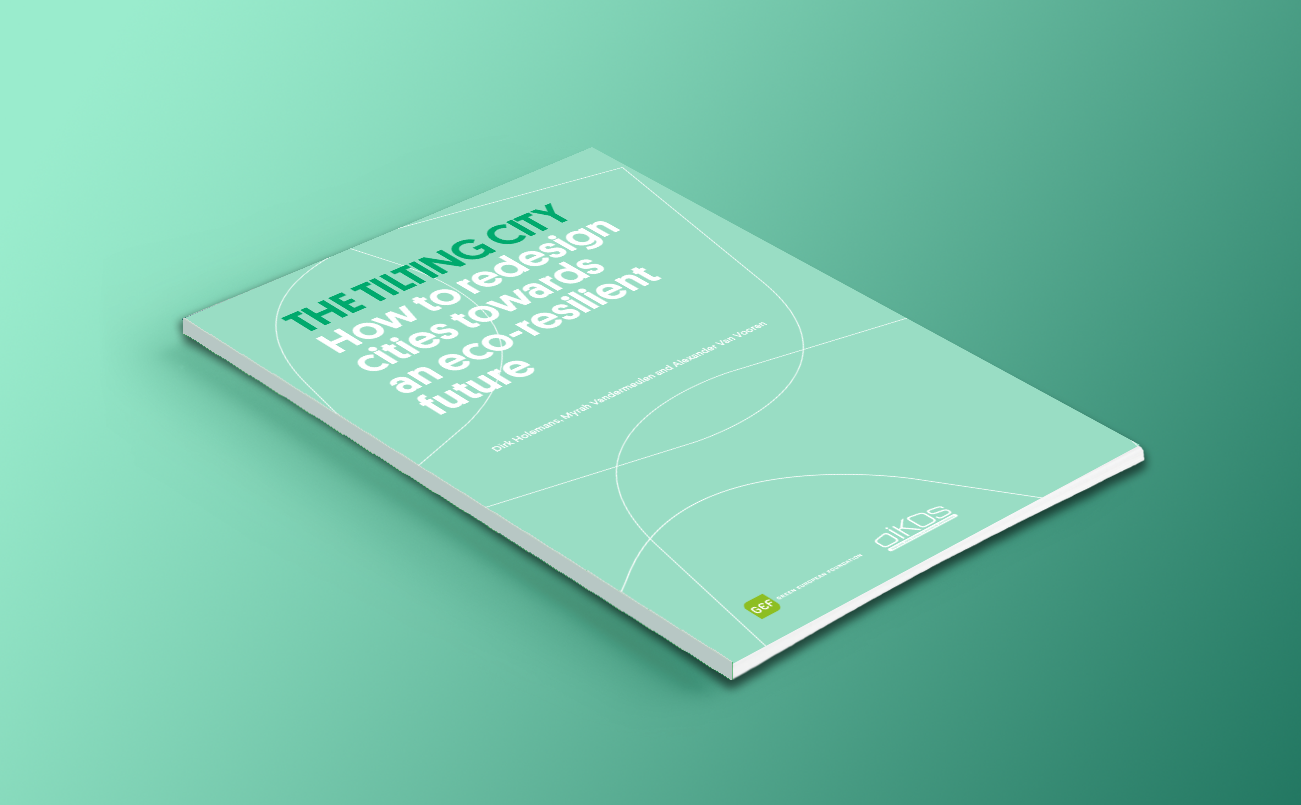
The Tilting City

By Uncategorized

Context

Three out of four Europeans live in a city. Therefore, cities are essential to lead the transformation to a socially and ecologically just society. This radical change is more urgent than ever, as IPCC reports remind us: already 3.5 billion people are highly vulnerable to climate impacts. Different cities suffer from diverse ecological impacts and will be differently affected by climate change. And within cities, certain groups are more exposed to the effects of air pollution, noise, and extreme temperatures than others. Without thoughtful politics and policies, the most vulnerable will suffer the consequences. In this context, ecological justice is vital. Taking inequalities into account and repairing the damage to these people’s lives but also holding those most responsible for the climate crisis to account.

‘’When imagining cities, we for instance cannot lose sight of the farmer in rural areas feeding urban mouths, or the homeless person at the city centre bus station.’’

Objectives

This publication aims to draw an image of what the city of the future could look like. The authors show alternatives to the current urban models and how they can be future-proof. This text will hopefully serve as a valuable source of information and bring up new thoughts among citizens activist, policymakers and everyone interested in exploring ethical and ecological ways of living in cities in the 21st century.


Project Background

This publication is part of Cities as a Place of Hope project of the Green European Foundation. With this project, we aim to create a strong communication network and solidarity network that will enable access to information and policies by compiling experiences and needs on sustainable and green city governments and related policies together with green associations in different cities in Europe. In this study, making the city’s actors effective and visible in city policies is one of our biggest goals.


Dowload

Available in Turkish

Available in Polish

Available in Greek


This report has been realised by the Green European Foundation with the support of  Oikos, Green Though Association and the financial support of the European Parliament to the Green European Foundation. The European Parliament is not responsible for the content of this publication.

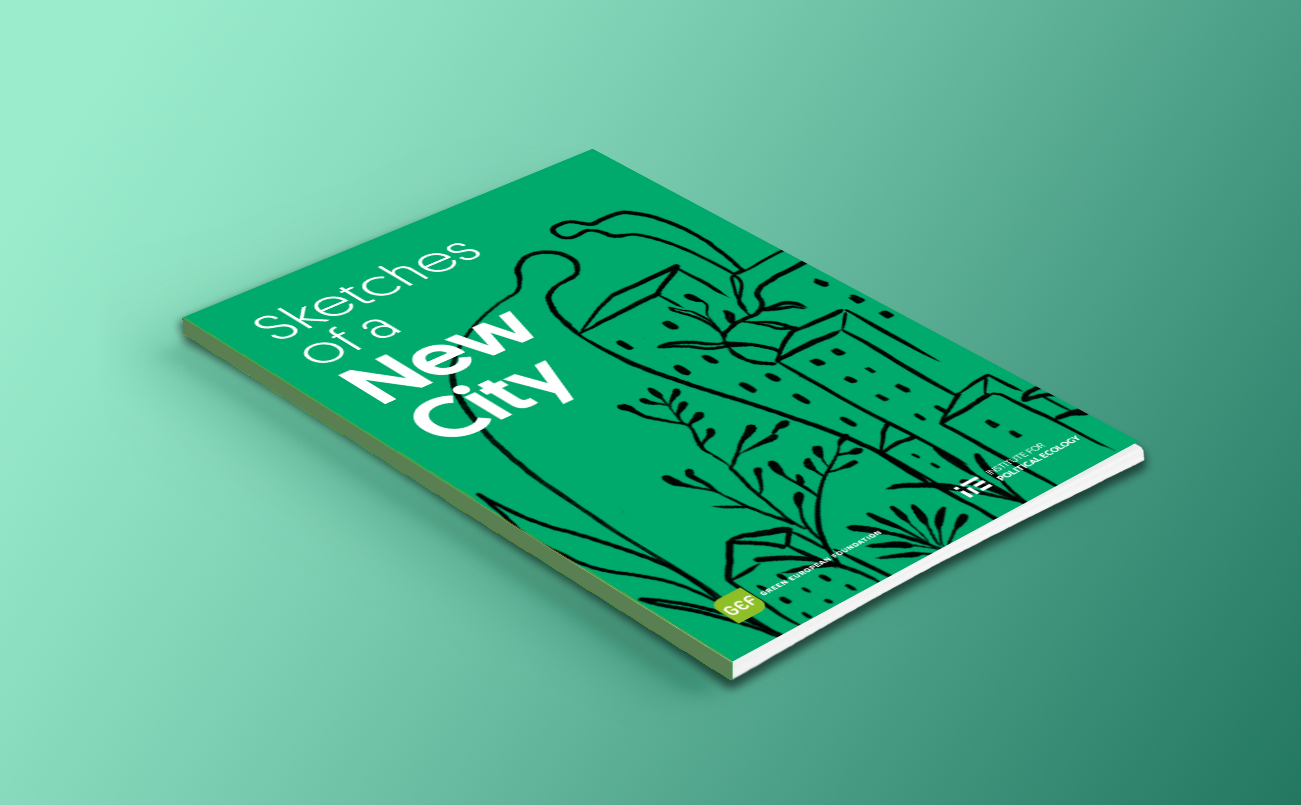
Sketches of a New City

By Uncategorized

Context

While no city is the same, one thing all have in common is the challenge of creating a society that is fit for the future. Some of the most present problems citizens living in cities are experiencing are the effects of climate change–such as rising heat or lack of water. On a political level, cities often lack opportunities for citizens to actively engage and be part of decision-making processes on citie’s future.

Far too often, big and ambitious projects end with failures. We want to start in the opposite way – with small sketches; with working material that can in time develop into something durable and resilient’’

Objectives

In this publication, researchers, scholars, practitioners and activists share their insights gained through the direct experience and empirical evidence on the daily struggle of key changemakers at the municipal level aiming to inspire and educate citizens all over the world.


Project Background

This publication is one of the results of IPE’s participation in the GEF transnational project “Cities as Places of Hope – Resilient Cities”, where we aimed to vividly illustrate the most recent developments in some European cities and trace the pathways through which they can develop resilience, increase the well-being of citizens, reach ecological sustainability, and achieve more social justice.

Available in

Translations

Available in Macedonian

Available in Greek


This report has been realised by the Green European Foundation with the support of the Institute for Political Ecology, and the financial support of the European Parliament to the Green European Foundation. The European Parliament is not responsible for the content of this publication.

El Lado Oscuro de lo Digital

By Uncategorized

Context

Currently, digital technology consumes 10% of the world’s electricity and contributes to 3-4% of the global greenhouse gas emissions at the increasing rate of over 9% per year. A country like France dedicates 8% of its electricity to digital consumption. A study of the semiconductor industry (2015) estimate that, at the current rate of growth of computing power, and given the gradual slowdown in gains in energy efficiency, digital technology could consume before 20703 the equivalent of all the world’s energy used in 2010.


This report has been realised by the Green European Foundation with the support of Transición Verde, Fondation de l’Écologie Politique, and the financial support of the European Parliament to the Green European Foundation. The European Parliament is not responsible for the content of this publication.

Regional Responses to Climate Change Through Regional Adaptations

By Uncategorized

Context

In its European Adaption to Climate Change, the EU presents the objective suggested to support 150 European regions and communities  working on climate resilience measures until 2023. It particularly takes into account the different ways that regions all over European are affected by Climate Change and how the European Union can support regions and local communities in the process of adjusting to the already existing and predicted effects of climate change on the daily lives of different communities.

The European Union should orient its climate change policy towards a policy mix that includes both Adaptation and Resilience to Climate Change. The former implies a more passive and reactive approach to mitigating the effects of Climate Change, while the latter indicates an active mitigation response.

Objectives

Based on the outcomes of the project Regional Responses to Climate Change,  this study offers insights on the implementation and response to the Regional Climate Change Adaptation Plans in the context of Greece and proposes a potential regional and local response to the predicted impacts of climate change .

Project Background

The “Regional Responses to Climate Change” project explores what a regional climate adaptation-resilience Plan would look like through a rethinking of policies for a new concept of infrastructure investments.

The creation of the publication has been possible thanks to the input from a large number of contributors, including: Panagiotis Panagos, Stavros Solomos, Demosthenes Sarigiannis, Rigas Tsiakiris, Panagiotis Vouros, Ilias Gianniris,  Elias Gianniris, Mirto Garis, Rigas Tsiakiris, Michael Bakas, Philippos Ganoulis, Nikos Poutsiakas and Costas Papakonstantinou.


This Publication is also available in Greek


This report has been realised by the Green European Foundation with the support of the Greek Green Institute, and the financial support of the European Parliament to the Green European Foundation. The European Parliament is not responsible for the content of this publication.

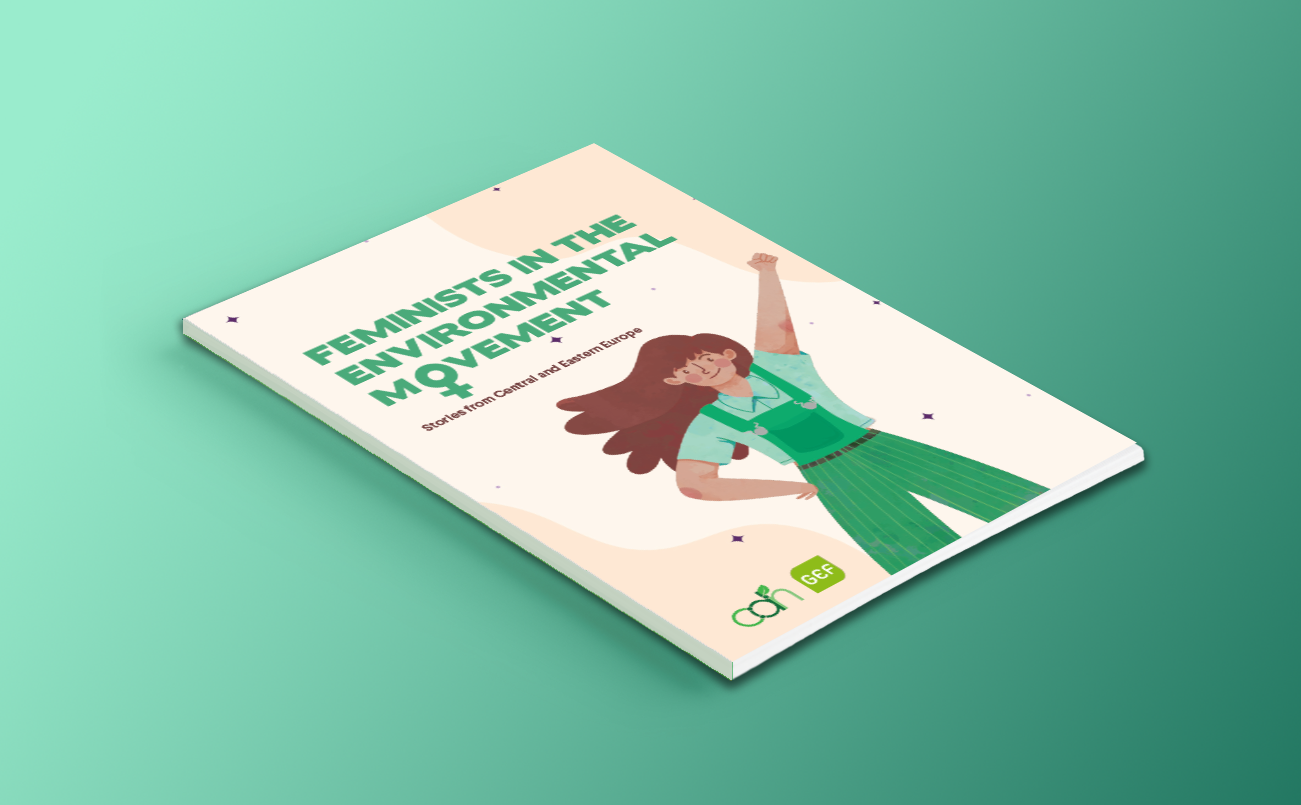
Feminists in the Environmental Movement

By Uncategorized

Context

Through an ecofeminist lense, this publication explores the connection between feminism, youth, and the environmental struggles in Central and Eastern Europe. As part of the Feminists in the Environmental Movement project, we have explored these concepts within urban areas, but the struggle in rural and de-urbanised areas remained under-examined. While green successes and support often concentrate in urban centres, engaging and mobilising rural communities is crucial to achieve a socially just green transition.


Objectives

This publication includes an extensive research on the lives of young female activists in rural and de-urbanised areas, the stories of their struggles, victories and hopes for the future. It aims to raise voices of people who are usually unheard in the European landscape. While reading the different articles, you will explore the lives of women in rural areas, their perspectives and tools to cope with the local issues, and the multiple forms of oppression they face.

Let’s stand in solidarity and truly “leave no one behind” in our path towards a just society!

Download

Turkish (Please note this translation is an abridged version of the original publication).


This publication has been produced by the Green European Foundation with the support of Cooperation and Development Network Eastern Eu-rope (CDN) and with the financial support of the European Parliament to the Green European Foundation.

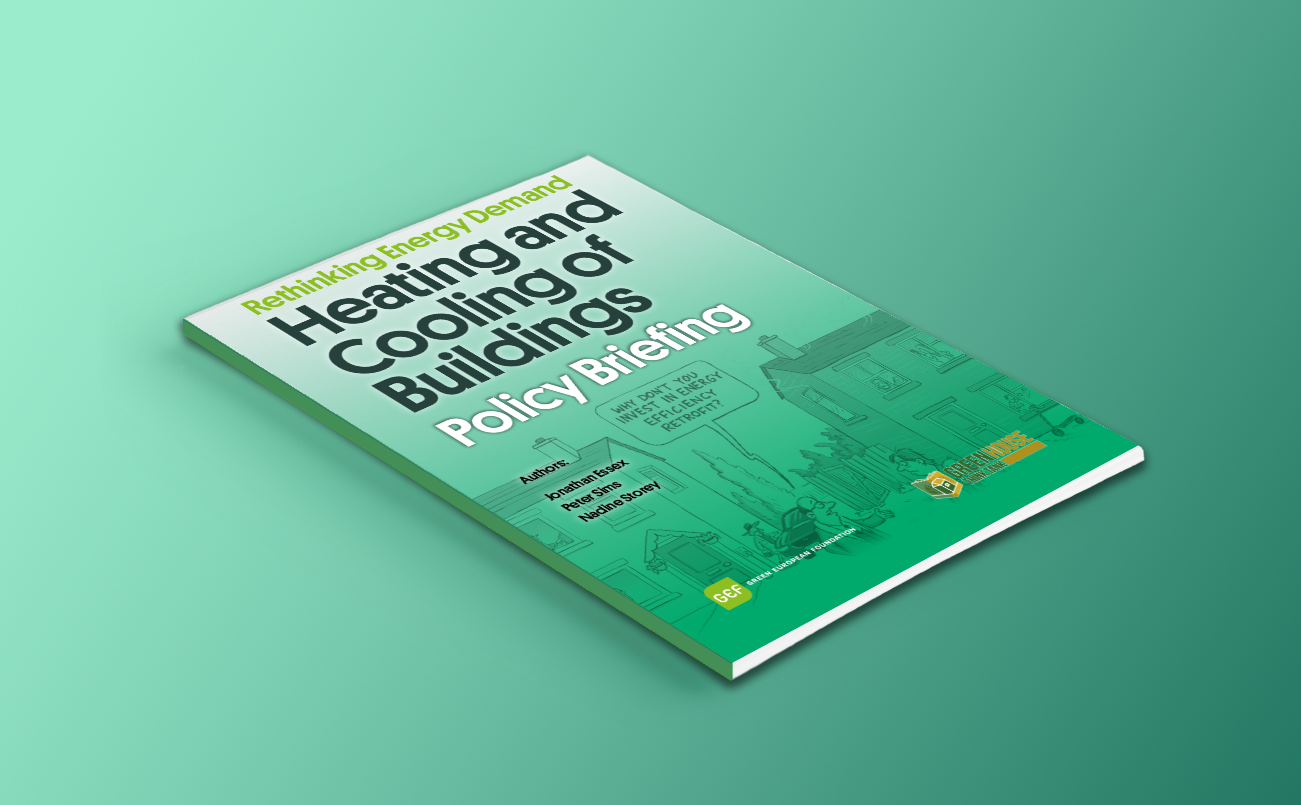
Rethinking Heating and Cooling

By Uncategorized

Context

Climate impacts became more apparent within Europe through the record high temperatures in the summer of 2022. This has converged with a cost-of-living crisis exacerbated by the war in Ukraine and consequent shortages of Russian gas and an unprecedented increase in energy prices. Whilst governments in some countries have shown imaginative thinking to deal with the immediate energy crisis, this thinking needs to be extended with a view to long-term changes of behaviour, practices and social norms. Change is essential to limit energy demand in the future as a critical response to the climate crisis.

Ensuring everyone has a living space that they can maintain at temperatures safe for human health should be a government priority.


Objectives

This publication argues for a broad rethink of the demand for heating and cooling buildings that goes beyond calls for widespread retrofit. It draws from the earlier ‘Rethinking Energy Demand’ report (October 2022) and the interviews conducted for that report with academics and thought-leaders across Europe. The earlier report considered the need and means to sufficiently reduce energy demand. This policy briefing invites policy makers to extend their thinking beyond the immediate crisis towards a longer-term strategy for delivering the human need for thermal comfort whilst eliminating carbon emissions. The briefing comprises 6 sections and offers 16 policy recommendations, across both efficiency and sufficiency measures.


Translations

Available in Spanish

Available in Greek


This publication has been realised by the Green European Foundation and Green House Think Tank with the financial support of the European Parliament. The European Parliament is not responsible for the content of this publication.

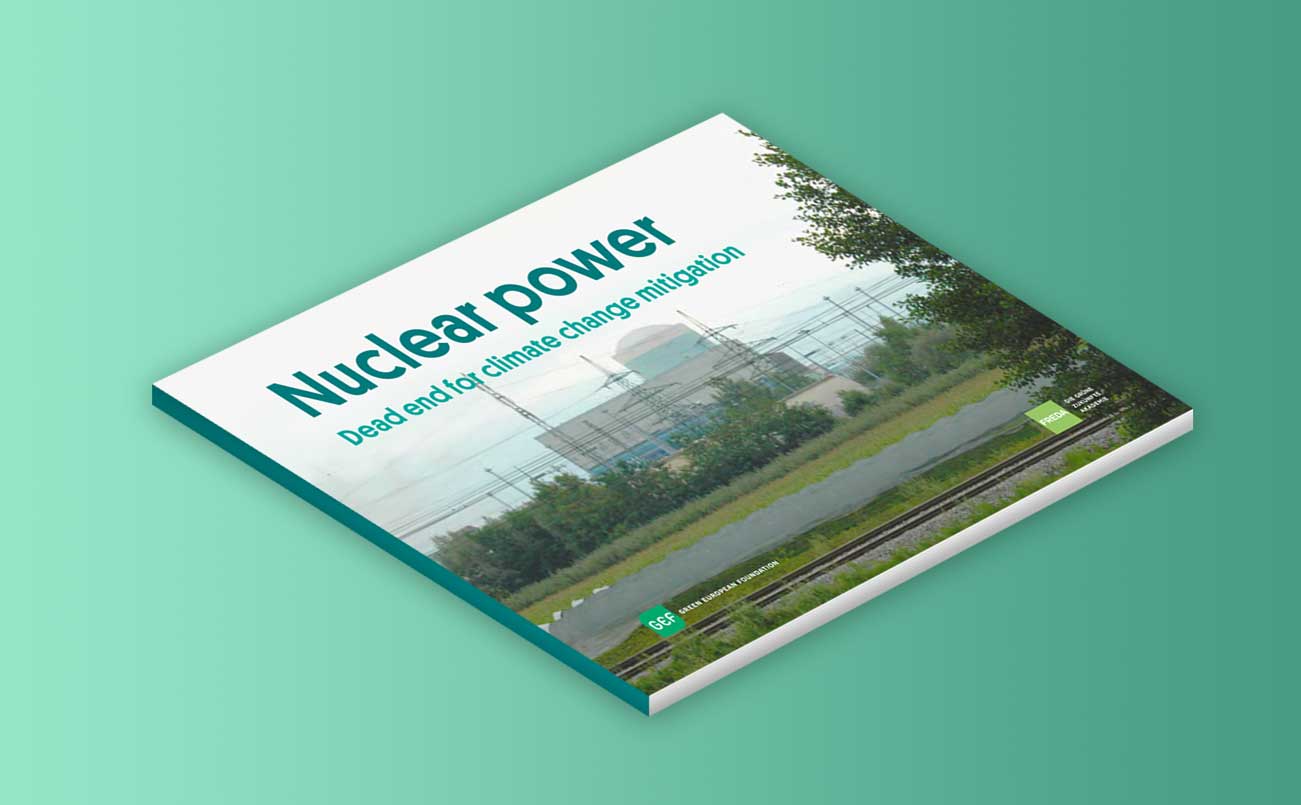
Nuclear Power

By Uncategorized

Context

The nuclear power lobby is stronger today than ever. The lobbyists have succeeded in creating an enormous disparity in the perception of what to believe and reality. The post-Chernobyl generation is increasingly falling prey to the fairy tale of modern, safe, cheap and CO2 neutral nuclear power. These arguments can be quickly refuted and often only serve to conceal the ulterior motive: to increase the stockpile of nuclear armaments. Nuclear power will most definitely not save the environment.

Objectives

This publications argues that nuclear power is not the solution to climate change including a critical analysis of the main ten misconceptions about “green” nuclear power. It has been written in close cooperation with Martin Litschauer, Member of the Austrian Parliament and Anti-nuclear Spokesman of the Austrian Greens, and Maria Niedertscheider, Expert Assistant, Austrian Federal Environmental Agency. Th purpose of the brochures is to serve as guidance for a broad European discussion and as a concise summary of the narrative on nuclear power as a supposedly bridge technology.

If we want to protect ourselves and save the environment, we have to use solar, wind and geothermal energy, because these are the fastest and safest ways to achieve the energy transition.

Translations

Available in Turkish

Available in Slovenian


This publication, originally published by FREDA, has been realised by the Green European Foundation and FREDA with the financial support of the European Parliament. The European Parliament is not responsible for the content of this publication.

Ecologia: La Revolució del Segle XXI

By Uncategorized

Context

‘Ecology as the revolution of the 21st century’ takes the contributions of experts and authors as well as previously published Green European Journal pieces, to provide an overview of the formative green visions for Europe. The publication language is Catalan.

La crisi climàtica és una emergència glo bal que tan sols podrem superar des dels grans acords internacionals que ens permetin gover nar les interdependències que genera la globalització.

“The climate crisis is a global emergency that can only be overcome from the great international agreements that allow us to govern the interdependencies generated by globalization.”

Objectives

This issue of the Nous Horizons Magazine features insightful reflections on the state of the green movement and its relationship with the world of work, adding a European and global perspective to contextualize what is happening in the world we live in. It also aims to provide the right tools for political environmentalism to become the political paradigm of the 21st century.


This publication has been realized with the support of Nous Horitzons and the financial support of the European Parliament. The European Parliament is not responsible for the content of this publication.

The Good Story – Green Narratives from the Balkans

By Uncategorized

Context

The Good Story gathers contributions from experts and activists who participated in the GEF Green Horizons Academy in Serbia. The publication explores the different approaches to how green narratives can reach a broader audience, in Serbian and English language

If there ever was an actor who could contest peripheral neoliberal capitalism and nationalism effectively in the past 30 years, this is the green actor. This is not because green politics is superior to other ones, but because no one expected it to occur and especially not at this level of organization and public support.


Objectives

What makes a good story? A compelling narrative, a powerful beginning, an interesting hook? The convincing and trustworthy messenger?

This text zooms in on eco-politic struggles faced in Serbia in the last few years. Serbia has been the field site of an unprecedented environmental mobilization. It explores Serbian activist movements, green populism and reflects on wider tensions at the heart of the Balkans’ ecopolitics and potential solutions for the future.


Download

Available in Greek


This report has been published by the Green Europe Foundation with the support of Polekol and with the financial support of the European Parliament to the Green European Foundation. The European Parliament is not responsible for the content of this report.

A guide to engaging aviation workers and trade unions

By Uncategorized

Context

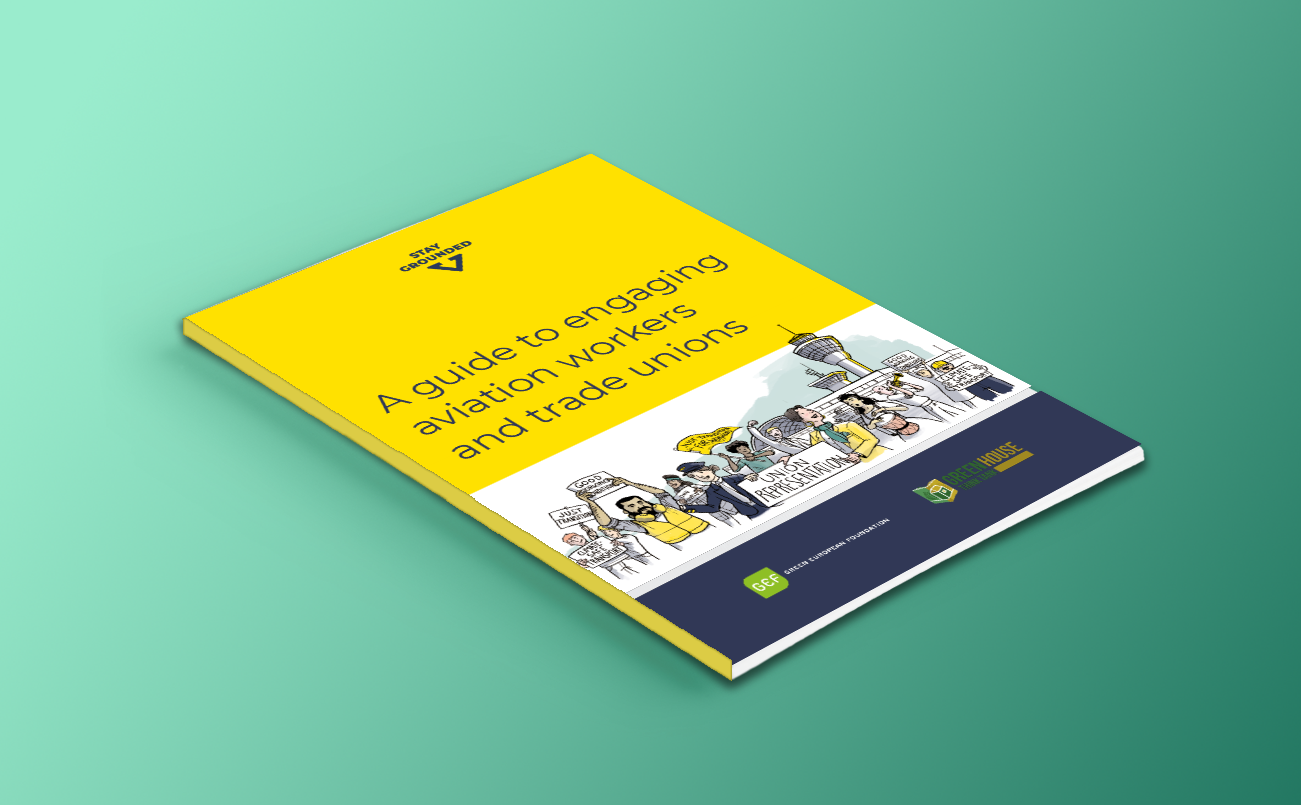
Climate campaigners are coalescing around an agenda of no expansion of airports and the need for a long-term reduction of aviation. However, not all of these campaigns have incorporated worker perspectives to better understand the impact on jobs and changes to local and national economies.

We don’t just want to get the industry back to where it was in 2018, but decarbonised. Because that wasn’t a good industry for workers. Transport had become too cheap, it was market driven. There is a need to embark on a huge transformation of the industry.

Objectives

This short guide explores how campaigns can connect better with aviation workers and the trade unions that represent them – to build mutual support, win those campaigns and advance a rapid and just transition for workers in the sector.

About the project

This publication is part of the project “Just Transition in the Aviation Sector” that explores how the concept of a just transition could look like when applied to the aviation sector in the UK. It focuses on the loss of jobs in the context of the COVID-19 pandemic as well as the potential of the green job creation. In this context, a case study of the Gatwick airport was conducted.  

Just Transition in the Aviation Sector explored the topic of the Aviation sector adaptation through several formats, including the development of infographics, events with an inclusive European dimension. As a part of the project, GEF implemented an online event called Green jobs and airport expansion campaigns, gathering experts and politicians to debate the topic in a panel format.  

The initial research and debates within the project scope culminated in this report.  

Download

Available in Spanish


This publication has been realized with the support of Green House Think Tank and the financial support of the European Parliament. The European Parliament is not responsible for the content of this publication.