EGAT Latvia: 2023-2024 edition

By

About the event

The youth organization “Protests” in cooperation with the Freedom and Solidarity Fund announces applications for the summer camp “Young Activists Academy” or JAA! It will be a great opportunity for young people to get inspired and prepare for active participation in civil society.

The camp will be held on 25-27 in August near Kandava, Latvia. It is organized as a part of “European Green Activists Training – Latvia”. “Young Activists Academy” will be a 3-day camp, during which we will introduce young people with little or no activism experience to various NGOs and movements, such as the Green Movement, as well as inspire them to actively participate in civil society. We will identify local problems and find ways how we can solve them and become heard at the political level as well. We will learn how the European Union and its institutions work and how you, as an individual, can be heard in it. We will identify  the threats to European democracy and how we can prevent them while also promoting an inclusive, feminist and green society.

Project “JAA” is organized by the “Freedom and Solidarity Fund” in cooperation with the youth organization “Protests”. The project is funded by the Green European Foundation through the “European Green Activists training” project.


Who can apply?

We are looking for young people between the ages of 15 and 30 who speak and understand the Latvian language. We will give preference to younger young people from the regions of Latvia and/or with less experience of activism, but we invite everyone who is interested in the topics raised to apply.


Practical information


The camp will be held in Latvian.

There is no fee to participate. The organizers will pay the travel and accommodation costs of the participants.

The application is open until August 14 at 23.59! Apply by clicking here.

After the summer camp, there will also be a follow-up event, where we will continue to develop and explore activism basing on the already built knowledge. Since this event is part of the “EGAT” project, the camp participants will have the opportunity to go to Brussels next March for a 3-day training organized by the European Green Fund.

In case of questions, contact the coordinator Marta Bogustova by email at marta.bogustova@hotmail.com.

The project is financed by the Green European Foundation within the framework of the “EGAT” project.


This EGAT programme is organised by Green European Foundation with the support of Protests and with the financial support of the European Parliament to the Green European Foundation.


EGAT Czech Republic (Akumulátor): ’23-’24 edition

By

About the event

Sign up for Accumulator and become one of 15 young activists! You don’t need a CV full of experience. What’s important is the motivation to change things around you .During this programme, you will explore different aspects of politics and activism with experts in green issues, including journalists, academics, experts, and politicians. We will awake your sense of initiative and support your skills in advocacy, teamwork, campaigning, and work with the media. Together we will go through a whole range of approaches and tools that will help participants do their bit to change the world for the better. It is important for us to connect theory and practice. Besides practical skills, we will focus on important cross-cutting themes such as climate change, education, feminism and more.

In addition, you will become a member of a wide alumni network, which includes all former participants who today are often engaged in activism, politics and other exciting projects. Together we organize a big alumni weekend every summer where we get together to share our experiences.

We are starting this year’s Accumulator with a weekend at the end of October 2023, in the spring of 2024 we will meet in Brussels with young people from Finland, Lithuania, Latvia, Spain, Poland and Croatia who are delving into similar programmes as the Accumulator.


Participation Requirements

  • You are between 18 – 24 years (recommended)
  • You live in the Czech Republic (but you do not have to have permanent residence in the Czech Republic or Czech citizenship)
  • You are willing to be proactive and participative
  • You have to participate in ALL phases of the training: please check details below.

If there is any obstacle (for example financial, or regarding health or language) that could prevent you from participating in the project, let us know and we will adjust the program and conditions so that you can still participate. The accumulator is an open and inclusive space and all young people are welcome to apply despite their background.

Apply HERE by August 27!


Cost

Our goal is that all selected applicants are able to participate in the Accumulator, regardless of financial possibilities. Nevertheless, we ask for a solidarity fee to be able to fund all the activities. Please consider what your personal financial contribution possibilities are for the realization of the Accumulator. You can let us know the amount of your contribution when filling out the application form HERE. Please note that the amount of the contribution you are able to provide won’t influence the selection process.


Program

The EGAT Akumulator consists of two weekend trainings and separate preparation for these trainings. It also includes a one-week study trip to Brussels, which is preceded by the EU for Beginners e-learning course and a preparatory meeting that will take place over a day the week before the visit to Brussels.

1. Accumulator, 20 – 22 October 2023, Veronici Centre, Hoštětín

SYSTEM ERROR: How to change it?
During the first weekend, we will get to know each other and decide how we want the entire Accumulator to work together. We will share our expectations, fears, experiences, and motivations. In short, we will try to create a safe environment for everyone to feel good and positive about the training.
We refer to the time in which we live in different ways. However, the common denominator is often the word “crisis”. We are talking about a climate, economic, global, energy crisis, but also a crisis of imagination. During the first weekend training, we will cover a little bit of all of the above. Through formal and non-formal education methods, we will try to think together about how individual crises are related to each other and try to examine problems at system level.

With a focus on deepening the ability to think systemically, we will try to understand the basic concepts that we will work with during the following weekends. We will talk, for example, about capitalism, but also globalization and colonialism.

At the end of the weekend, we should have a unified level of knowledge, clarified shared values and a deepened ability to think systems.

2. Accumulator, November 24-26, 2023, ČSOP Hostel, Vlašim

ENVIRONMENTAL MOVEMENT: From where and where?

From theory to practice. First, we will clarify the theoretical roots of political ecology, then we dive into activist political practice. Who are the green actors? What and who is involved in the environmental movement? How to become part of the change? We will solve all this during the second weekend together with specific actors from environmental organizations and platforms, for example Greenpeace, Fridays for Future or Re-set. In addition to activism, we will also explore the waters of politics with members of three political parties – Pirates, Greens and Future.

Finally, we will focus on creating campaigns. What to watch out for? What is the good practice of well-known environmental organizations?

3. Preparation for a study stay in Brussels, March 2024, one day (online or offline)

The main topic of the third weekend will be the European Union. The Impact Europe e-learning course will allow us not to have to deal with how the EU works all weekend, and we can then go straight to a critical discussion about its pros and cons and the relationship between its policies and the policies of the Czech Republic. We will talk about how political processes at the national and European level can be realistically influenced. At this meeting, which will take place online or offline, we will share practical information about the study trip to Brussels. At the same time, we will open here some of the topics that are dealt with at the European level by experts, MEPs and activists that we will meet in Brussels.

4. (BST – Brussels Study Trip) Study stay in Brussels, spring 2024

EUROPEAN GREEN ACTIVIST’S TRAINING – EGAT

Accumulator takes place in various forms simultaneously in Finland, Croatia, Spain, the Czech Republic, Poland, Lithuania and Latvia. Participants from these countries will meet for a one-week excursion in Brussels to share knowledge from individual trainings and take a look behind the scenes at the activities of the institutions of the European Union. We will visit the European Parliament and meet people who work in various positions in Brussels. Even with several members of the European Parliament.

But Brussels is not only about the EU, and we will have the chance to learn about local initiatives and how grassroots activism is done in a place where European politics intersects with Belgian politics.


Who will train me and how?

Non-formal education lecturers Zuzana Kašparová and Miriam Macurová will guide you through the training and excursion to Brussels. Both have been active in the field of alternative education for several years and educate young people to take an active approach to public affairs. They themselves are socially engaged in the topics that will be discussed at the trainings. Both were members of the non-profit educational organization Be International. Zuzana is dedicated to the feminist project Vyhonit dábla, she is the author of the program “Na zachodce” for CT, she is involved in the activist crip collective and lectures on a freelance basis, for example sex education or intercultural competence. Miriam works as a campaigner and expert on European climate policy at Greenpeace, where she is also part of the environmental education program. The program is thus created on the basis of real experiences from the public space.

The program itself is based on meetings with people from practice, i.e. politicians, journalists, experts and activists, who will introduce the participants to politics and public events based on their experience.

In addition to workshops and guest lectures, the program is based on informal education. His methods are based on working in groups with an emphasis on individual initiative. So what you get from the Accumulator depends on how much you put into the training. An important part of the educational process is the sharing of experiences and reflection.

In informal education, they learn by experiencing and trying new things, which not only leads to new information, but also to the acquisition of practical skills and thinking about values. It is not graded, it does not know the role of the teacher, it is voluntary and the participants are themselves responsible for what they learn.

Developing the ability to work in a group is essential for the Accumulator. Although everyone takes away newly acquired skills and knowledge, we believe that the ability to collaborate collectively is crucial when trying to change the world around us and when involving other people in future activities.


This EGAT programme is organised by Green European Foundation with the support of Institute of Active Citizenship and with the financial support of the European Parliament to the Green European Foundation.

 

Congress of Young Europeans 2023

By

About the event

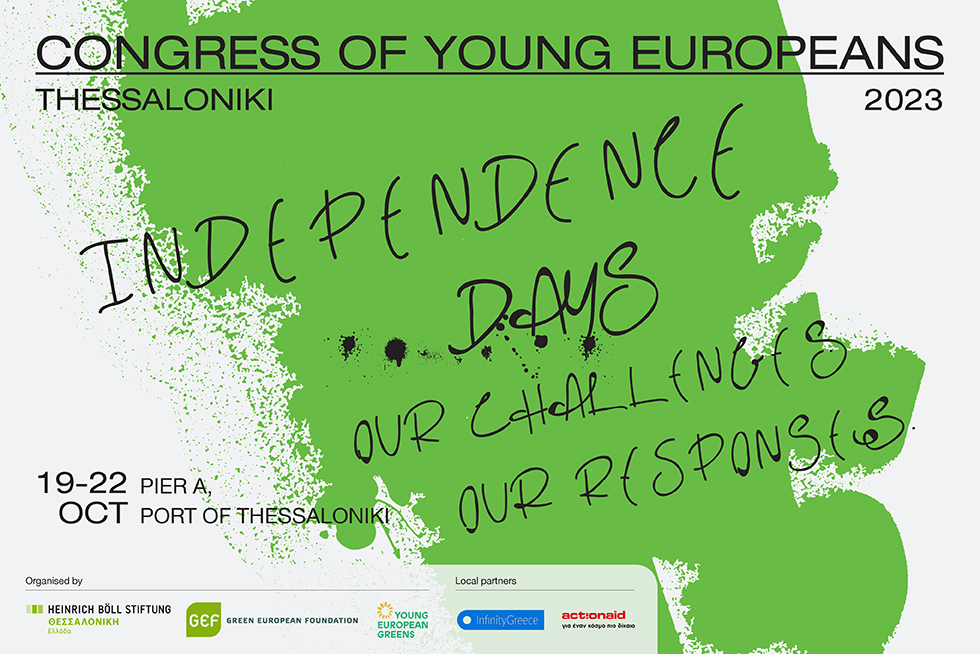
During this Congress, selected participants from all over Europe will have a chance to come together in Thessaloniki, a vibrant and culturally rich city to work together, voice their concerns and put forward their own solutions for a more just Europe, ahead of the 2024 European elections.

The main theme of this year’s Congress of Young Europeans is independent living a defining struggle and battle of this generation that ranges from chasing for basic care and mental health to affordable housing, from gender rights and to good working conditions, from equality all the way to political underrepresentation. A young person has the right to all of these things, to afford building a life for themselves, independently.

The Congress, entitled “Independence Days”, will focus on the role of youth in shaping their future in Europe. Selected participants will reflect on widespread reality for young people all over Europe, explore the interlinking challenges across different regions, and propose forward-thinking solutions that reflect young European’s needs in the political debate.

Participants will take part in hands-on workshops with high-level speakers discussing topics such as the cost of living, youth mobilization and resilience. Beyond the topical sessions, participants are invited to use this event as a platform to facilitate their own session, by presenting their own initiatives related to the topics.


How to apply

  • Are you already involved in European matters or do you want to get involved?
  • Do you think you deserve to build a life for yourself but cost of living and access to your rights are preventing you to?
  • Are you interested in sharing your visions, knowledge and ideas?
  • Are you younger than 30?

Then APPLY to the Congress of Young Europeans and become part of a young and innovative European network!

Fill in the application form here

The deadline to apply is 7 July 2023 EOD!


Practicalities

Date: 19 -22 October 2023

Location: Thessaloniki, Greece.

Language:  English

Format: In-person event

The organisers will cover the travel costs and accommodation for all selected participants of the Thessaloniki Congress of Young Europeans. The number of spots is limited to 60 participants from abroad and 40 local participants.


This event is organised by the Heinrich Böll Foundation – Thessaloniki Office, Young European Greens (FYEG) and the Green European Foundation (GEF) with the financial support of the European Parliament to Green European Foundation.

Diversity and Inclusion (DEI): A Starting Guide

By Uncategorized

Context

There is no quick fix to the dangers democratic systems are facing, but one thing is certain: building an open and inclusive society will take consolidated efforts to restore civic participation and dialogue which goes way beyond election day.

Diversity and inclusion start at the organisational level, by adopting adequate policies that helps attract and retain a diverse set of talent.


Objectives

With this short pocket-guide, you are invited to dive into the topic of diversity and inclusion, a mental framework which invites for self- and organisational- reflection. While not pursuing the ambition of an all-encompassing guide, it aims to pose the question: “Are you, your team and your organisation ready to engage in open, respectful, and inclusive dialogue with diverse groups in society?”


This publication has been realized with the financial support of the European Parliament and the Robert Bosch Stiftung. The European Parliament and the Robert Bosch Stiftung are not responsible for the content of this publication.

Green Political Activists Training (Balatonfenyves)

By

About the event

Are you interested in the environmental challenges faced in Hungary and in Europe? This summer camp will explore how to mobilise citizens and get organized to overcome these issues in an interactive way, and with the support of various experts.

As part of the training, participants will also have the opportunity to reflect on individual responsibilities, engage in green workshops and receive inputs and advice from EU actors especially tailored to them.

And last but not least, participants will also have time to network and meet other like-minded young green activists.

Project background

This event is part of the Green European Foundation’s Green Political Activist Training Project for which we put together a series of training courses and seminars aiming to help participants understand the concepts of political ecology and apply them to both local and European-level politics.

In this summer university, we will examine policies in place and policy proposals on various levels, such as local currents or the European Green Deal. Our goal is to prepare participants for both assessing and advocating policies in line with progressive green values.

The ultimate purpose of the training is to offer young green activists new tools and knowledge and an opportunity to network and get in contact with political actors and experts on multiple levels to come together as a political community. It is essential for us to help like-minded movements and actors connect to make the political ecosystem flourish.

Programme and Speakers

Thursday 8 June – Welcome to the summer school!

12.00 Arrival

13.00 – 13.30  Opening of the Green Summer University: Welcoming words by GEF and partners (online)

14.00-15.30  Workshops on green policies, getting to know each other

16.00 – 17.00  Sustainable Food production, food and self-sufficiency (hosts: Ferenc Tóth, Lili Forján)
Participants of the discussion: István Németh (organic farmer, cheese producer)

17.30-18.30  Food sovereignty in Europe Dr. Ágnes Kőváriné Bartha

19.00 Dinner

21.00 – 22.00  Campfire, Film Screening – A Just Transition


Friday 9 June – Living sustainable in a Europe under transition

8.00 Breakfast

09.00 – 10.30  Our Living Waters (host: Rita Csillag)
The state of Hungary’s and Europe’s wetlands: a brief historical overview, what is the present and what will the future hold. Participants of the discussion: environmental policy expert Dalma Dedák (WWF), landscape researcher Levente Viszló (ProVértes Public Foundation)

11.00-12.30  GET ORGANISED! Advocacy board game from and with the School of Public Life

13.00 Lunch

14.00-15.00  Workshops on green policies and netwroking

15.00 – 18.00  Sustainable Lifestyle (Host: Menta Móra)
The discussions will cover urban living and its social dimension, as well as the energy and waste aspects of the issue.

  1. Part 2: How can we ensure a sustainable food supply and grow our own food?

Guests:
Pártha das (Krishna Valley) Gábor Nagy (Waldorf)

  1. Section 2: How can we afford housing and living well with the environment?

Guests:
Zsolt Szegfalvi (Habitat for Humanity), Martin Takács (My Grandfather’s House)

18.00-19.00  Workshops on green policies, networking

19.00 Dinner

21.00 – 22.00  European Green “pub quiz” with Rita Csillag


Saturday 10 June – How to become a green activist

8.00 Breakfast

09.30 – 11.00  Political activism (host: Lili Forján)
Round table discussion on political activism. Our common successes, our common failures. Learning together. Participants of the discussion : Ádám Fischer (Vice-Mayor of Ercsi), Mihály Csernai (FreeSZFE, former President of the SZFE Student Union), a member of the Tanítanék Movement, Bence Járdány (green activist, photographer of GREENPEACE)

11.00-12.30  How can we promote European and Green Unity: Developing an Action plan

13.00 Lunch

14.00-15.30 workshops on green policies and networking

16.00 – 18.30  Have your say! EU Debate Theatre with Jakab Tóth (Partizan)
Who is responsible for the green switchover? Individual responsibility or the responsibility of decision-makers to set our future on a green path? Debate and play with all the camp participants.

19.00 Dinner

20.00 – 22.00 Networking


Sunday 11 June

8.00 Breakfast

09.00 – 10.30 Camp closing


Green Workshops running during the camp:


Making a compost toilet
with Martoni Szabó (Thursday, Friday, Saturday)

Action planning  (Thursday, Friday, Saturday)

Solar lighting making with Szilagyi Laszlo (Friday, Saturday)

Crafts – reusables with Forján Lili (Thursday, Friday, Saturday)
Children’s programmes with Krisztina Tóth (Thursday, Friday, Saturday)

Everyone is welcome!  The discussions will be non-scientific, all participants are free to join in! We count on your social activity in the GREEN SPACE and in the discussions!

Practicalities

This event will be held  in person. We have limited places, the registration follows a first come-first-served basis.

Date: 08-11 June 2023

Location: Balatonfenyvesi tábor

Language:  The event will be held in Hungarian.

Registration: Please register in advance here 

Facebook event


This event is organised by the Green European Foundation with the support of  Progressive Hungary Foundation and the financial support of the European Parliament to the Green European Foundation. The European Parliament is not responsible for the content of this event.

European Green Academy 2023

By

About the Event

Click here  to access the information about the event in polish or check our Facebook event.

Klliknij tutaj, aby zobaczyć więcej informacji po polsku lub sprawdź nasze wydarzenie na Facebooku.

After a successful first edition, the European Green Academy opens its doors for the second time this autumn! From 17-18 November 2023, the Green European Foundation together with Heinrich Böll Stiftung Warsaw, Strefa Zieleni, and Ostra Zielen will invite diverse green actors, activists, politicians, and academics from all over Europe to explore salient green issues and build bridges between national and European-level debates. 

In the context of the current polycrisis and looking ahead to 2024 as a pivotal year for Europe, this year the Academy will address three key themes:  Democratic Resilience, Peace & Security and the Social Dimension of the Green Deal.  

Via a diverse range of formats, including workshops, training, plenary debates, and networking activities, the European Green Academy seeks to equip participants with knowledge and skills, the ability to link national green ideas and debates to the European sphere, and to make new connections to further their involvement in the green movement. 

Read about last year’s edition here.


Key Themes

 Peace & Security

 Democratic Resilience

 Social dimension of the Green Deal

Livestreamed sessions


Programme

Rooms: Bruskela, Berlin, Rzym, Lizbona,  Madryt, Paryż


Friday 17 November


14:00-14:10 

OPENING

Foyer

14:00-15:00

CONNECT (EN & PL)

Foyer

15:00-15:30

OPENING KEYNOTE (EN & PL)

Bruksela + Berlin + Rzym 

15:30-17:00

PLENARY (EN & PL)

Democracy and Security: Avoiding a Tale of Two Europes (EN & PL)

Bruksela + Berlin + Rzym 


 17:15-18:45

PARALLEL SESSIONS

Green Visions on Peace and Security (EN & PL)


Bruksela

 Strategic Planning in Social Activism (EN)


Berlin

Implementation of the Doughnut Economics  in cities (EN)

Rzym

How to Build and Strengthen Civil Society (EN)


Lizbona + Madryt

19:00– 21:00

NETWORKING DINNER

Foyer 


Saturday 18 November


09:00-09:30

  CONNECT 

Bruksela + Berlin + Rzym 

09:30 – 11:00

PLENARY (EN)

Security and Democratic Resilience (Central and Eastern Europe)

Bruksela + Berlin + Rzym 

11:00-11:30

BREAK

11:30 – 13:00

PARALLEL SESSIONS

Digital Organising – to Win and Grow (EN)

Rzym

Pathways to Peace in Times of Crisis  (EN & PL)

Bruksela

The Gender Dimension of the Energy Transition (EN)

Lizbona + Madryt

13:00-14:30

LUNCH 


14:30 – 15:30

Public Speaking Training (PL)

Rzym

◉ Insider Perspectives on the Polish Elections  (EN & PL)

Bruksela + Berlin

15:45 – 17:15

PARALLEL SESSIONS

A Different Politics: Green Leadership and the 2024 EU Elections (EN)

Bruksela + Berlin

Migration Challenges : Current and Future Pathways for Policies and Practice (EN) 


Lizbona + Madryt 

Youth Visions on a Just Transition of European Labour Markets (EN)

 Rzym

17:30 – 18:30

CLOSING (EN & PL)

Bruksela + Berlin + Rzym 


Practicalities

Date: 17-18 November 2023

Location: Centrum Konferencyjne West Gate (Warsaw, Poland)

Language: English and Polish. 

Registration deadline: Please  note: Registrations are now closed. For any late registration requests, please contact alina.zmuda@gef.eu.

For questions or more information, contact alice.hubbard@gef.eu.


Solidarity Fee

Help us get activists from underrepresented backgrounds to the European Green Academy!

As not everyone can afford to attend the academy, we’ve put in place an optional solidarity fee for participants who have the means to contribute in solidarity with others. By paying the solidarity fee (30 EUR – 120 EUR), you’re supporting young activists from underrepresented backgrounds or those who can’t afford to travel to Warsaw for the Academy. Please note, if GEF sponsors your accommodation and/or travel, this fee is obligatory. Click here to pay a solidarity fee (please note that the previous link is not the official registration page; registrations at the bottom of this page).

Meet our key speakers

OPENING KEYNOTE:

  • Yamina Saheb, IPCC author, campaigner against the Energy Charter Treaty, and advocate of decolonising global governance
  • Hanna Machińska, Former Commissioner for Human Rights
  • Joanna Talewicz- President, the W Stronę Dialogu Foundation
  •  Melanie Vogel, Co-Chair, European Green Party  

PLENARY I

  • Gwendoline Delbos Corfield, MEP Greens/EFA
  • Sofia Oliynyk,Program Coordinator, Democracy Support and Human Security Program, Heinrich Böll Stiftung Kyiv
  • Michael Keating, Executive Director, European Institute of Peace
  • Luiza Bialasiewicz, Professor of European governance, University of Amsterdam
  • Christina Kessler, Executive Committee Member, Federation of Young European Greens
  • Laurent Standaert, Political Director of the Green European Foundation (moderator)

PLENARY II

  • Nicolae Ștefănuță, MEP Greens/EFA
  • Senada Šelo Šabić, Senior Research Fellow, Institute for Development and International Relations
  • Małgorzata Tracz,Member of Sejm,  Partia Zieloni
  • Agnieszka Bryc, Assistant Professor, Nicolaus Copernicus University
  • Yevheniia Bryhinets, Executive Committee MemberCooperation and Development Network
  • Adam Reichardt, Director of New Eastern Europe (moderator)

CLOSING KEYNOTE

  • Júlia Boada-Danés, Member of Spanish Parliament (Sumar)
  • Alice Stollmeyer, Executive Director, Defend Democracy 
  • Agata Meysner, President, Generation Climate Europe

Learn more about them here.


Acknowledgments

The following organisations sponsored the attendance of participants to the European Green Academy: European Green Party, International Bureau of Groenlinks, Heinrich-Böll-Stiftung Kyiv, Heinrich-Böll-Stiftung Warsaw, Westminster Foundation for Democracy.


This event is organised by the Green European Foundation with the support of the Fundacja Strefa Zieleni, Heinrich Böll Stiftung Warsaw and with the financial support of the European Parliament to the Green European Foundation. 


Ecopolis: Fair(er) Futures Festival (Brussels)

By

Context:

Hope is something you need to deserve,” writes Greta Thunberg in The Climate Book. That’s why ECOPOLIS 2023 takes on the challenge of igniting hopeful activism. How do you turn concern or anxiety about the climate crisis into commitment? How to find a middle ground between naiveté and defeatism?

About the event:

Ecopolis is the day to meet people who care about a sustainable future. Because ecological challenges know no national or linguistic borders, Ecopolis is diverse, international and interactive. Ecopolis invites Belgian and international authors to debate the transition towards a socio-ecological society. Inspiring books, documentaries and debates between writers, academics and civil society thinkers about ecology, economy and society are at the heart of Ecopolis

This year the festival brings together different actors from the political, cultural and social environment to discuss this years focus topic, cooperation for a fair – fairer future as core value. This means tackling the conflicts rooted by competition as basic organisational principle on the individual and economic level. Cooperation is understood as cooperation between movements and allyships, the cooperation between countries and the Global South and Global North, as well as the development of commons, such as housing and energy cooperatives.

Speakers

  • Kim Stanley Robinson, novelist
  • Stephanie Collingwoode Williams, activist in climate justice and anti-racist movements
  • Geert Buelens, poet
  • Jessica den Outer, author and activists for the Rights of Nature
  • Peter Bosmans

Programme:

The festival runs from 10:30 to 21:00, offering different parallel activities, such as panel discussions, workshops or thematic walks around the city. This years programme highlights three different themes, each shedding light on the ecological crisis in a different way.

The first one is Facts and/or fiction. Does knowing more about climate help us make the right decisions? Where can we gain this knowledge from? Can politics and our personal lives also play a role?  How can fiction help bring about our hope and a sense of responsibility? Are these questions on your mind too? In this programme item, you will take part in conversations, a walk and performances with a host of scientists and readers (you, for instance) and share inspiration.

In the series of activities under the umbrella of How to, you will get your hands dirty: come screen printing, pimp your clothes and cycle around in the city visiting places full of hope. Engage with real doers on energy sharing, fair fashion and housing cooperatives. Discover how to transform your own commitment into collective action in your daily life. The debate is open!

In the third theme named The Power of Change you will learn how history shows that a better society does not happen by itself and learn in different workshops wat are the deep conflicts and challenges we are facing today.  It comes from sustained action by committed people. It took decades of social struggles to bring about the welfare state. Today, many are pushing for a quality society for all.

Learn more about the schedule of the programme and speakers. 

Practicalities:

Date and Time: 18 November, 10:30 – 21:00

Location: Muntpunt, Pl. de la Monnaie 6, 1000 Bruxelles (some events, such as walks, happen at different locations, you can find them indicated in the programm)

Language:  The main languages of the event will be Dutch, English and French, with simultaneous interpretation provided EN<>NL<>FR for some sessions

Get your tickets here! 


This event is organised by the Green European Foundation with the support of Oikos and the financial support of the European Parliament to the Green European Foundation.


Political Ecology Days (Brussels)

By

About the event

This edition of the Politicla Ecology Days will be particularly focusing on the question of the reversal of inequalities and the innvational ideas on how to take care better of our world and society. We will therefore discuss how to repair and transform the earth, how to mend inequalities, investigate the relations between humans and non-humans and discuss  our visions of the economy, the world or justice. Repair can be conceived here as both “acknowledging”, “doing justice” or “taking care”. Transform as a movement which, starting among other things from what there is to repair, modifies the coordinates of the world-system.

During 4 days, you can discover more about green politics in 8 lectures, 12 workshops, Greens Talks and 1 documentary screening.


Some highlights of the pogramme:

12th October 2023

20:00-21:30: Une économie centrée sur le soin with Emmanuel Petit, Christine Bauhardt and Géraldine Thiry, moderated by  Dirk Holemans (Co-President Green European Foundation) (FR<>EN)

13 October 2023

9:30: La sobriété ou l’essentiel au quotidien with Geneviève Pruvost, Catherine Larrère, Nadia Leila Aissaoui, moderated by Claudine Drion (FR<>EN)

11:30: Justice restaurative environnementale & écologie judiciaire with Marine Calmet, Olivier de Schutter, moderated by Sophie Wustefeld (FR<>EN)

20:00: Une écologie des corps par-delà nature et culture with Myriam Bahaffou, Catriona Sandilands, Cy Lecerf Maulpoix, moderated by Julien Didier (FR<>EN)

 14 October 2023

14:00: Le Green Talk – 8 nanos-conferences with François Ost, Catherine Larrère, Erica Lippert and many more (FR)

18:30: Artistic performance: Désorceler la finance

15th October 2023 

10:30 – 15:30: School of love – processus artistique (artistic performance)

10:30 – 13:00: De la résilience intérieure (workshop, FR)

14:00 – 16:30: Créer des “mèmes” (internet) écologiques (workshop, FR)

You can find more details for the individual events and many more highlights and the complete programme on this website.


Speakers

  • Catherine Larrère, French philosopher
  • Geneviève Pruvost, sociologist of work and gender
  • Emmanuel Petit, professor of economics
  • Myriam Bahaffou, decolonial ecofeminist activist
  • Géraldine Thiry, professor of economics
  • Olivier De Schutter, former special rapporteur for the UN Human Rights Council

and many more!

Learn more about the schedule of the programme and speakers.


Practicalities:

Date and Time: 12-15 October, 9am – 6pm

Location: Tour et Taxis, Avenue du Port 86c/3002, Brussels

Language:  The main languages of the event will be French and English, with simultaneous interpretation provided for some sessions.

Registration: Please sign up here


This event is organised by the Green European Foundation with the support of Etopia and the financial support of the European Parliament to the Green European Foundation. 

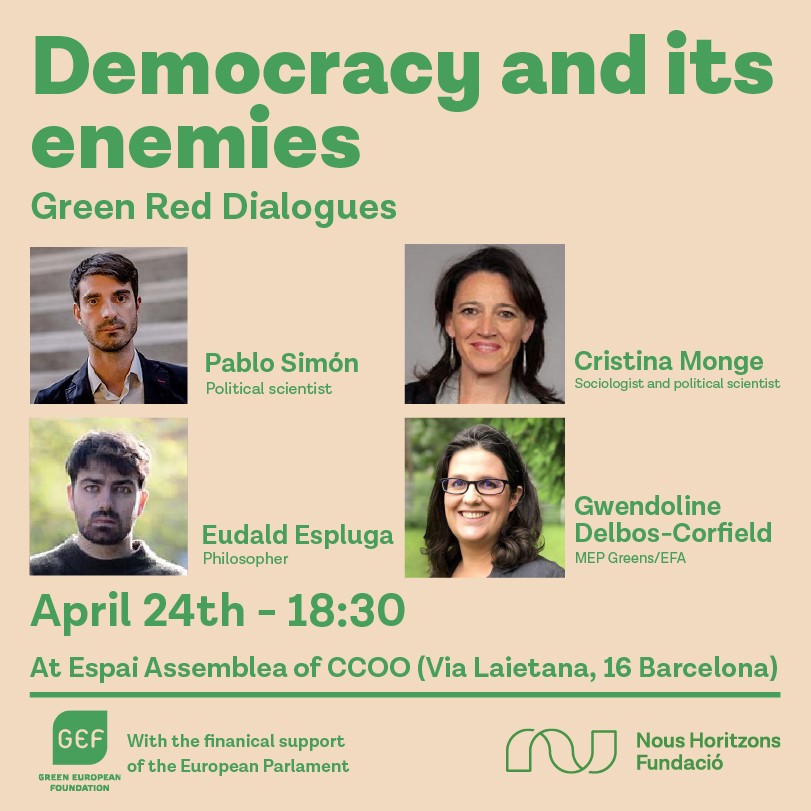
Democracy and its enemies

By

About the event

This debate will focus on the dangers that democracy in Europe is currently facing. We will explore how fake news, hate speech, and the discrediting of social movements, politics and organisations harm democratic processes.

The debate will focus on the influence these issues have on the younger generations and how young people experience messages such as climate change denial or lost hope in the face of the climate emergency or how unbridled capitalism delegitimise governments to favour of economic growth.

This debate is particularly relevant now that the pandemic and war in Ukraine produce a sense of unease, providing an opportunity for authoritarian views to become more widespread.

Project background

The event is the first one in a series of three debates, taking place in Barcelona and revolving around three pressing issues; the state of democracy, local policies for a fair and just transition, and Green Taxation.

Speakers

  • Pablo Simon, Political Scientist
  • Cristina Monge, Sociologist and Political Activist
  • Eudald Espluga, Philosopher
  • Gwendoline Delbos-Corfield, MEP Greens/EFA

Programme

6.30 p.m. Introduction of the speakers start of speakers’ interventions.

7.30 p.m. – 8 p.m. discussion with the audience

Practicalities

Date and Time: 24th April, 18:30

Location: Espai Assemblea of CCOO (Via Laietana, 16 Barcelona)

Language:  Catalan/Spanish and English

Registration: Please reserve your spot here


This event organised by the Green European Foundation with the support of Fundació Nous Horitzons and the financial support of the European Parliament to the Green European Foundation. The European Parliament is not responsible for the content of this event.

EGAT Hungary 22-23

By

About the event

The EcoTanoda EU+ program is a participatory series of educational, organizational and community development trainings.  We are looking for young people between 18 and 26 who have (minimum) an intermediate level of English, who are interested in European affairs but at the same time have a mindset that is close to sustainability and green politics.

Participants will take part in a 3-day training from November 11 to 13, 2022. The following session will be in January 2023 (a Saturday in Budapest) and finally, a study trip to Brussels during the spring of 2023 – all for free! Those who fill in the application form and receive a written confirmation after the application deadline are eligible. In case of over-application, the applicants will be pre-screened, due to the number limit .We can provide a place for 20 applicants.

Participants will learn about the history, principles, and challenges of the green movement from researchers, politicians, and NGO representatives. We will examine the Green political map and the main social, economic, and political actors involved in it. From a practical point of view, we examine what types of actions we need for ecopolitics to gain more space in the 21st century. We will heavily focus on Europe, the EU institutions, actors, history, and current affairs, which reflect the political composition of the European Parliament and the functioning and strategy of the European Commission. The other important aspect of the training is for the participants to get to know each other and share their knowledge experiences.


Programme

PLANNED TRAINING DATES IN HUNGARY:
November 11 to 13, 2022. Szeged, Hungary
January 2023 (Saturday), Budapest location

BRUSSELS STUDY TRIP (BST):
Active participants will also be invited to a 4 days long joint study trip to Brussels, which is expected to take place in March 2023.

Practicalities

PARTICIPATION FEE AND REIMBURSEMENT OF EXPENSES:
The training program in Hungary and Brussels is completely free.
We provide the return trip from and to Budapest for the 3-day training and the BST.
Travel to Budapest and travel to the airport is paid by the applicant.
 
INTERNATIONAL TEAM: 
The training is part of the international European Green Activist Training (EGAT) program and is organised by the Green European Foundation (GEF) in Brussels, with the financial support of the European Parliament to the Green European Foundation. Our partners on the study trip to Brussels will be the Finnish, Czech, Polish, Croatian, Spanish and Greek groups.

APPLICATION DEADLINE:  September 12, 2021 (Sunday) 24:00

Click here for the application

Please note: Due to the particular circumstances during the COVID-19 pandemic, all activities could potentially be subjected to changes depending on the epidemiological data and any restrictive measures and guidelines at that time. Some parts of the programme involving travel may take place online.


This project is organised by the Green European Foundation with the support of Ecopolis foundation and with the financial support of the European Parliament to the Green European Foundation.

Knowledge Community – Trade Unions and degrowth

By

About the Event

Taking place at the International Trade Union House, the roundtable meeting is part of the GEF Flagship Initiative – Knowledge Communities which focuses on the Social Dimensions of the Green Deal. Together with our Partners Research & Degrowth we have embarked on a journey to jointly identify alternative models that address the social dimension of the green transition.  

The meeting will be divided into two main sessions: Firstly, Nora Räthzel, Researcher from the Umeå University will present the broader concept of the Political Brief on the topic of Trade Unions and Degrowth . In the second session, the KC participants will have the opportunity to give their input, enrich and challenge some of the most controversial issues identified and provide space for more in-depth discussions.  

Context

The GEF Knowledge Community roundtable meeting is a side-event of the broader ‘’A Just Transition beyond growth?’’ conference, which will take place 8-9th December in the International Trade Union House in Brussels.  

The aim of the ETUI-ETUC-EEB-ULB-GEF conference is to build bridges between the trade union movement and the post- and de-growth community, andto situate a transformative just transition vision within the ‘beyond growth’ narrative. It should prompt reflection on how the (contested) concept of just transition and related policies, now a top priority in trade union agendas, fit – or can fit – with the futures proposed by post-growth scholars, and what just transition policies might look like in an alternative green deal for Europe that is not a ‘green growth’ strategy but a more radical societal and economic transformation. 

Programme

Friday, 9th November: International Trade Union House  

14:00 – 14:15 – Introduction and welcome words  

with Laurent Standaert, Political Director, Green European Foundation  

14:15 – 14:30 – Tour de table  

14:30 – 15:00 – Political Brief concept presentation  

with Nora Räthzel, Researcher, Umeå University  

15:00 – 16:30 – Moderated open discussion  

16:30 – end of Knowledge Community meeting  


Practicalities

Date and time: Friday, 9th December from 2pm-4:30pm

Location: Boulevard Roi Albert II 5, 1000 Brussels 

Registration: This event is invitation only  


This event is organised by the Green European Foundation with the support of Research & Degrowth and with the financial support of the European Parliament to the Green European Foundation. The European Parliament is not responsible for the content of this event. 


EGAT Poland 22-23

By

About the event

The European Green Activist Training (EGAT) is an international training program for young people (16-26 years old) culminating in a study visit to the European Parliament.  EGAT takes place between October 2022 and March 2023. During this time, participants will take part in 6 weeks of e-learning and 3 stationary meetings (in Warsaw), during which they will learn how the European Parliament works and how implement local social campaigns and projects. Finally, they will receive mentoring and support to implement their own projects and activities.

Participants profile

  • Young people between 16 and 26 years of age, who may or may not already have experience in activism.
  • Members of Fridays for Future movement, youth city councils, youth organizations and associations or young people active in informal youth groups.
  • People valuing issues such as: respect for the environment and planetary boundaries, human and animal rights, democracy and openness to others, respect for people and animals, regardless of their origin, religion, gender, sexual orientation or social status.
  • People who want to grow and change to the world around them.
  • Good knowledge of English language is desired.


Programme

What awaits the participants of EGAT?

1. Three stationary (or hybrid) meetings in Poland.
2. Participation in 6 weeks of e-learning courses on the functioning of European Parliament.
3. Support from mentors in the implementation of their own campaigns or local projects.
4. Participation in a study visit to the European Parliament in March 2023.

Calendar

  • 28 October- 12 December 2022 

During the meetings participants will get to know each other, establish new contacts and learn to plan actions and activities together. During e-learning, they will learn about the structure and functioning of the European Parliament and deepen their knowledge on policy issues. In case of a pandemic lockdown meetings might be organized online or in hybrid format. The offline meetings will take place on the following dates:

I) 28-30 October 2022.

II) 18-20 November 2022.

III) 9-11 December 2022.

  • December 2022 – February 2022 – implementation of local projects

Enriched with new knowledge, participants of EGAT will be able to start implementing their own ideas for action. In small teams (4-5 people) they will implement their small, local or online projects. They will receive the support of mentors to implement their ideas. Project implementation is not a mandatory element of the program, but participants will be strongly encouraged to implement their own projects.

March 2023 – visit to the European Parliament

Participants who complete all stages of the EGAT will take part in a visit to the European Parliament together with a hundred people from other countries, where similar trainings take place (Finland, Czech Republic, Croatia, Hungary, Spain, Greece). During 3 days of the study tour they will visit the Parliament, meet MEPs and take part in joint workshops with young activists from other countries. Participation in the a study visit is not obligatory. In case of a pandemic lockdown the visit might be organized online.


Practicalities

Cost

Participants have to bear only 10% of the cost of participation in the training, i.e. 200 PLN. The European Parliament, Green European Foundation and Strefa Zieleni Foundation will cover the costs of participation in three stationary meetings (including travel, accommodation and meals), as well as the cost of participation in a study visit to the European Parliament (travel, accommodation and meals).

In case of a difficult financial situation, please contact us (fundacja@strefazieleni.org). We want everyone to be able to participate in the program, regardless of their financial situation, therefore, it is possible to cover 100% of participation cost for persons who are not able to pay the participation fee.

Application

Please fill in this form no later than 12th October, 2022, 23:59. All accepted candidates will be informed about the results by 20th October.


This project is organised by the Green European Foundation with the support of Fundacja Strefa Zieleni and with the financial support of the European Parliament to the Green European Foundation.

EGAT Finland 22-23

By

About the event

If you are eager to learn about green politics and changemaking, this course is made for you! Prior experience or membership of the Young Greens is not needed – on the contrary, we want to get participants who could learn the most out of this course! We are looking for applicants from diverse backgrounds – youth aged 15-25 from all across Finland – and the most important thing we are looking for is motivation.

During the European Green Activist Training, you will be introduced to green values and activity from the local level to the national, EU and international level. As a course participant, you will hear from politicians and other professionals of the field, discover how politics are made, get a backstage pass to civil society organisations, and discuss changemaking from an individual’s perspective. This course will give you the knowledge, skills and support network you need to become a changemaker. You will find your own way to be an activist, gain new friends and valuable experience.

Programme

  • 1st meeting, 7.-8.10.2022: Welcome to the training!
    During the first meeting we will get to know each other and have an introduction to the Green Party and Young Greens. The meeting is organised in cooperation with the Green European Foundation and we will discuss green politics and activism at various levels – including local, national, and international levels.
  • 2nd meeting, 11- 13.11.2022: Peek from local level politics to Brussels

We will learn about local activism and how municipalities work and how the local level politics are connected to the European Union. We will get familiar with the structures of the European Union and the work of the parliament.This training is organised in cooperation with the Green European Foundation.

  • 3rd meeting, -21.1. 2023: Different kinds of changemakers from streets to the cabinets

During the third training session we will familiarise ourselves with different kinds of changemakers: those protesting on the streets and those making decisions in the cabinets. In addition, we will focus especially on environmental and climate politics as well as find out more about different NGOs and their work in different environmental fields. This training is organised in cooperation with the Green European Foundation.

  • 4th meeting, -25.2.2023: National elections ahead! What does the future of Green politics look like in Finland?

We will explore and discuss the future of Green politics in Finland by taking a look at the Green Party’s objectives for the upcoming years.

Practicalities

We aim to organise the training as physical meetings but we do follow closely the COVID-19 restrictions and recommendations by the health authorities. Due to the particular circumstances during the COVID-19 pandemic, all activities could potentially be subjected to changes depending on the epidemiological data and any restrictive measures and guidelines at that time. Some parts of the programme involving travel may take place online. The participant fee is 120€ in, and this fee will cover one meal and travel and accommodation for those coming from outside the Helsinki area. We are expecting a commitment to join all the pieces of training, but in case you are not able to attend some of the physical meetings, you can participate online.

In addition, there will be the traditional Brussels Study Trip in Spring 2023. The study trip will cost 150 euros per participant, which will cover all travel and accommodation expenses.

The application period ends on Sunday 18th September at midnight EEST. All applicants will be informed whether their application was successful by Sunday 25th September at the latest. Fill out the application here.

The course is organized by the Young Greens of Finland together with the Green Cultural Association Visio, MEP Heidi Hautala and the Green European Foundation with the financial support of the European Parliament to the Green European Foundation.

In case of questions or any further information please contact:

Iina Vahteri
Projects Officer, Green Youth and Students of Finland
iina.vahteri@vihreatnuoret.fi
+358542113577


This EGAT programme is organised by the Green European Foundation with the support of Visio and with the financial support of the European Parliament to the Green European Foundation.

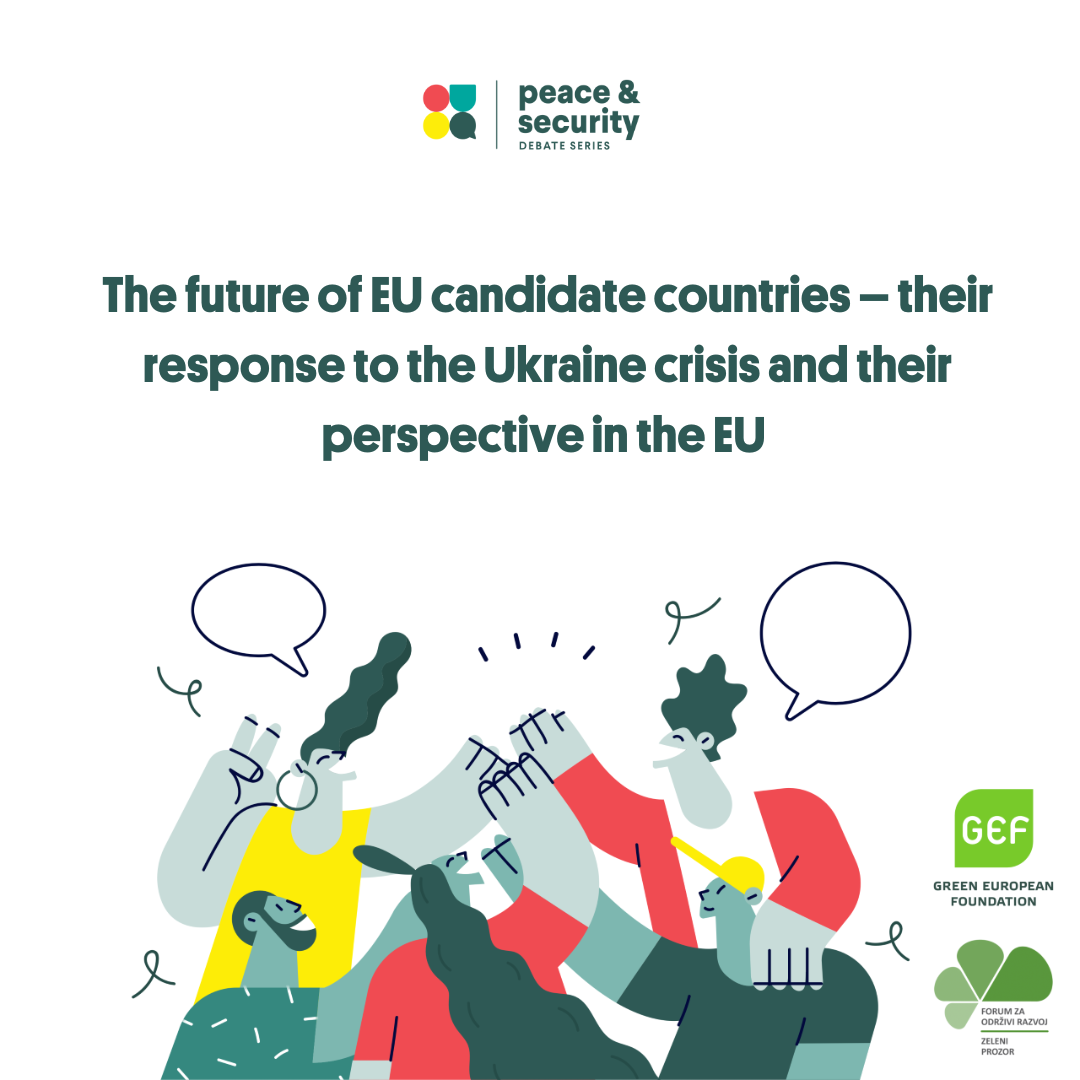
Peace and Security: The future of EU candidate countries

By

About the event

This online event is the third discussion of our Peace and Security Debate series. On this occasion, we will analyse how EU candidate countries have responded to the Russian invasion to Ukraine, more in particular whether their reaction were as expected and how their response affects their candidacy.

Project background

The goal of the Peace & Security Debate Series, organised by the Green European Foundation and Sustainable Development Forum Green Window, is to analyse different perspectives on the current crisis caused by the Russian invasion of Ukraine, and explore more generally the notion of peace and security in Europe.

Speakers

  • Ivan Novosel, House of Human Rights
  • Nataša Beširević, PhD, consultant on EU projects in the Western Balkan and Eastern Neighbourhood regions, evaluator on the Horizon Europe program
  • Gwendoline Delbos-Corfield, Member of the European Parliament, Greens/EFA

The discussion will be moderated  by Marko Popović, expert Adviser at the Ministry of Labour, Pension System, Family and Social Policy, who is also a founder and a member of Sustainable Development Forum Green Window.

Date and Time: December21st, 6pm-7:30pm CET

Location: Zoom

Language: This event will take place in Croatian.


This conference  is organised by the Green European Foundation with the support of  Forum Green Window and the financial support of the European parliament to the Green European Foundation. 

Debate series: Cybersecurity in the EU

By

About the event

This online event is the third discussion of our Peace and Security Debate series. On this occasion, we will analyse the role of cyber security in achieving and maintaining peace and security in the EU. What does cyber security mean? Why is it essential to maintain peace and security in the EU? What were the main events and incidents in 2022? What are the EU’s vision on this issue and future prospects?

Project background

The goal of the Peace & Security Debate Series, organised by the Green European Foundation and Sustainable Development Forum Green Window, is to analyse different perspectives on the current crisis caused by the Russian invasion of Ukraine, and explore more generally the notion of peace and security in Europe.

Speakers

  • Mirko Bilandžić, PhD, professor at The Faculty of Humanities and Social Sciences at the University of Zagreb
  • Zlatan Morić, head of the department for cyber security, Algebra University College
  • Markéta Gregorová, Member of the European Parliament, Greens/EFA

The discussion will be moderated by Kaja Pavlinić, president of Sustainable Development Forum Green Window. 

Practicalities

Date and Time: February 6th, 6pm-7:30pm CET

Location: Zoom

Registration Link: Sign up here.

Language: This event will take place in Croatian.


This conference  is organised by the Green European Foundation with the support of  Forum Green Window and the financial support of the European parliament to the Green European Foundation. 

Debate series: Security and Peace Forum (Zagreb)

By

About the event

The Conference represents the final event of the Peace and Security Debate Series project in Croatia. It aims to focus on the role of politics, civil society and the Green movement in securing peace and security as well as human and women rights as the main victim in establishing peace and security. We will also highlight the how disinformation and fake news influence the public image in the times of political conflict. We will have three panel discussions, followed by a networking reception. We invite all politically interested citizens to join us.

Project background

This conference represents a final event in the scope of the Peace and Security Debate Series project. The main objective is to explore different perspectives of peace and security on the level of the European Union. In the scope of the project, we have organized three online events, and this conference represents a final activity that will push the discourse on the topic even further.

Programme and speakers

09:30 – 10:00 Arrivals and registration

10:00 – 10:15 Opening of the conference

  • Kaja Pavlinić, president of Sustainable Development Forum Green Window
  • Vedran Horvat, Board of Directors of Green European Foundation
  • Gwendoline Delbos-Corfield, Member of the European Parliament, Greens/EFA

10:15-11:45 The role of politics, civil society and the Green movement in securing peace and security

  • Moderator: Marko Popović
  • Introductory keynote: Christina Kessler, Federation of Young European Greens – introductory keynote

Panel speakers

  • Vedran Horvat, Institute for Political Ecology
  • Marta Zorko, Faculty of Political Sciences, University of Zagreb
  • Representative of Croatian Parliament from Možemo! coalition (tbc)
  • Igor Vidačak, Faculty of Political Sciences, University of Zagreb

11:45 – 12:00 Coffee break

12:00 – 13:30 Human and women rights as the main victim in establishing peace and security

  • Moderator: Kaja Pavlinić, president of Sustainable Development Forum Green Window
  •  Introductory keynote: Mélanie Vogel, European Green Party

Panel speakers

  • Ana Gvozdić, Youth Initiative for Human Rights
  • Sanja Sarnavka, Solidarna
  • Lucija Azinović Rebić, Are You Syrious
  • Representative from B.a.B.e (TBC)

13:30 – 15:00 Lunch

15:00 – 16:30 Disinformation and fake news in the times of political conflict

  • Moderator: Kaja Pavlinić, president of Sustainable Development Forum Green Window
  • Introductory keynote: Konrad Bleyer-Simon, Centre for Media Pluralism and Media Freedom

Panel speakers

  •  Ivana Dragičević, N1
  • Hrvoje Krešić, N1
  • Radoslav Dejanović, Anthropos Metron and the author of the Guide for Media Literacy16

16:30 – 16:45 Closing

16:45 – 17:45 Networking with refreshments

Practicalities

Date and Time: February 25 from 09:30 to 17:45

Location: conference hall of the Timeout Heritage hotel in Zagreb (Ilica 16, 10 000 Zagreb). 

Language: Working language of the conference is Croatian, with the exception of some speakers who will join the event in hybrid format and will speak in English.

Registration:

  • Registration is open until February 23. You can register on the following link.
  • For all additional questions, you can contact the organizing team via info@zeleniprozor.hr 
  • Since we have very limited capacity (maximum of 25 participants), registration is obligatory, and all participants will receive a final confirmation of participation 24 hours after registering. In case you are not able to attend, please reach out to us so we can give this spot to someone else.

Additional information: Lunch and refreshments are covered for all participants, and we will additionally send certificates of participation.


This conference  is organised by the Green European Foundation with the support of  Forum Green Window and the financial support of the European parliament to the Green European Foundation. 

The Green movement’s vision for peace & security

By

Context

With a focus on the Eastern flank of Europe, the 2022-2023 debates series seeks to enrich green and political ecology discourse. The series aim to provide spaces to hear the voices of green actors, peace and security experts, as well as partners from different regions. The goal of the Peace & Security Debate Series project, which we are developing in cooperation with the Czech organisation Institute for Active Citizenship, is to analyse the different approached to the crisis caused by Russia’s invasion of Ukraine, as well as other topics related to peace and security at a European level.

About

The discussion during this roundtable will explore how the Czech green movement has approached issues such as security, foreign policy and pacifism and what positions it should advocate for in the future. This event will also touch upon the European Green Charter as a document that frames the basic principles of green politics and will consider improvements in security and pacifism in light of current circumstances.

Speakers

  • Janek Rovenský, Greenpeace CZ
  • AKárníková, Friends of Earth CZ
  • Hana Svačinková – Nesehnutí
  • Irena Hůlová, Amnesty CZ
  • Petr Kutílek – Green Party CZ
  • Josef Patočka – re-set.cz
  • Míla O’Sullivan, Centre for Global Political Economy, Charles University

Moderation by Adéla Jurečková, Head of Office, Heinrich Boell Stiftung Prague

Practicalities

Date and Time: December 12 from 16:00-17:30 CEST

Location: Heinrich Boell Stiftung Prague Office, Jugoslávská 567/16,120 00 Prague 2, Czech Republic

Registration:  This is a closed event


This event is organised by the Green European Foundation with the support of Institute for Active Citizenship and with the financial support of the European Parliament to the Green European Foundation. The Euroapean Parliament is not responsible for the content of this event.
Putting the New Back In: The Green Deal for a World in Crisis (Copenhagen)

By

About the event

In the face of multiple crises – geopolitical, climate and energy, but also the very erosion of Europe’s social fabric by its outdated economic model – what should the Greens bring to the table to ensure that the European Green Deal (EGD) switches to the next gear into a social EGD or EGD 2.0? When the time comes to act the Greens respond. Looking ahead to the 2030 and 2050 European project, how can Greens set the direction to overcome the challenges of a EGD that was designed in a pre-Covid and pre-conflict world, and one that fails to account for key dimensions of wellbeing or care? 

Speakers: 

  • Kira Peter Hansen, MEP & Vice President of Greens/EFA Group in the European Parliament 
  • Rosa Martínez Rodríguez, former Member of the Spanish Parliament
  • Dirk Holemans, Co-President of the Green European Foundation & Director of Oikos Thinktank 

Moderator: Jamie Kendrick, Editor-In-Chief, Green European Journal 


 Practicalities

Date and Time: Friday 2nd December, 1pm

Location: Christianhavn room at the CPH conference centre (Tietgensgade 65, DK-1704 København).

Audience: This session is open to all participants of the 6th Congress of the European Green Party.


This project is organised by the Green European Foundation with the financial support of the European Parliament to the Green European Foundation. The European Parliament is not responsible for the content of this event.
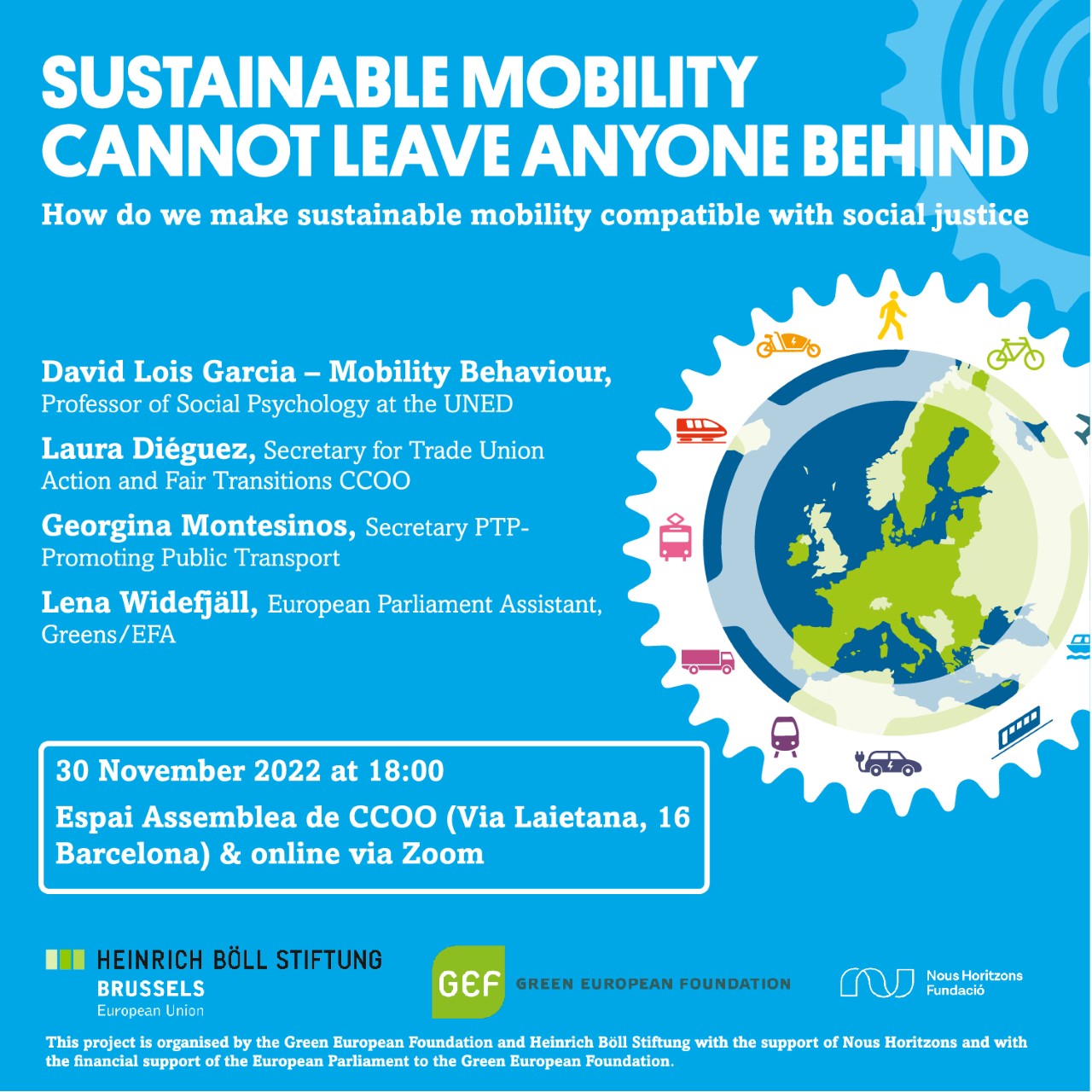
Sustainable Mobility Cannot Leave Anyone Behind

By

About the event

The EU is promoting policies and actions aimed at reducing pollution and improving air quality, especially in the transport sector and in large cities. In fact, the Court of Justice of the European Union has warned that failure by states to respond could lead to the withdrawal of funding from the EU budget. 

Urban tolls, low-emission zones and green taxation on car registrations are just some of the instruments that states, regions, and cities implement to make the polluter pays principle effective. But how can we mitigate the collateral effects of these measures on vulnerable groups such as workers dependent on private vehicles and those from lower socio-economic backgrounds? And how can we ensure that the ecological transition is just? 

To explore these important questions, join us for a lively debate bringing together experts, foundations, and organisations working on proposals for a just ecological transition.  

Speakers

  • David Lois, Mobility Behaviour, Professor of Social Psychology, Universidad Nacional de Educación a Distancia
  • Laura Dieguez, Secretary for trade union action and just transitions, Confederación Sindical de Comisiones Obreras 
  • Georgina Montesinos, Secretary of PTP (Promoció de Transport Públic)
  • Lena Widefjall, Parliamentary Assistant Greens/EFA

Moderator: Marc Rius: President, Nous Horitzons Foundation 

Practicalities

Date and Time: 30th November, 6pm-7:30pm CET

Location: This event will take place in person at the Headquarters of the Confederación Sindical de Comisiones Obreras in Barcelona and online via Zoom.  

LanguageThe main languages of the event will be Catalan and English, with simultaneous interpretation provided EN<>CAT.  

Registration: Please register in advance here!

Information in Catalan available here.


This project is organised by the Green European Foundation and Heinrich Böll Stiftung with the support of Fundació Nous Horitzons, and with the financial support of the European Parliament to the Green European Foundation.

Mobility in Rural Areas: An Unresolved Issue

By

Context

Rural depopulation is a challenge for Europe as it affects large areas of its territory, and Spain is no exception. This process has intensified in the last two decades. In Spain there are 6,827 municipalities with no more than 5,000 inhabitants, accounting for 12% of the total population. In the last decade, eight out of ten municipalities have lost their inhabitants, a total of 410,000 people. Ageing population, lack of basic services such as health, education, culture or transport, unemployment, and the shortage of housing are among the main challenges for staying or settling in a village.

One of the key factors in this situation, as we have already mentioned, is mobility. The absence of public transport means that dependence on the private car or on the solidarity of neighbours is fundamental. Going to the doctor, shopping, going to the bank or taking children to school can be a chore if you do not have a private car or are not able to use one. This is particularly serious for women and the elderly.

The bad situation of public transport in Spain, far from being reversed, has worsened in recent years. The conventional train, the least polluting transport system, has been progressively abandoned while large high-speed train lines have been promoted – after China we are the country with the most extensive high-speed train network in the world – a type of transport that is a minority, expensive, unprofitable, and inefficient, thus widening the inequality gap between geographies.

The search for realistic long-term solutions, adapted to each region and each community, which improve mobility in rural areas, is a social and environmental obligation and a lever to reverse the depopulation process by revitalising economic activity.

We are on the verge of a transition towards a low-carbon model of society, so it is urgent to work on strategies that make it compatible with the improvement of transport in the rural world.

About the event

We will hold this conference on rural mobility in El Burgo de Osma, a village in the province of Soria – the least densely populated province in Spain – to learn first-hand about the demands and proposals of its inhabitants on this issue. We will have examples of good practices and we will know what policies are being implemented in Spain and in the EU. We will be joined by the following speakers:

  • Juantxo López de Uralde, Member of the Spanish Parliament and Chair of the Committee on Ecological Transition and the Demographic Challenge
  • Marc Giménez, advisor on transport and tourism to the Greens/EFA Group in the European Parliament
  • Raquel Ramírez, El Colletero Association (Nalda – La Rioja)
  • Patxi Miranda, CEO of KUDEA Services
  • Moderator: Rosa M. Tristán, journalist


Practicalities

This is an in-person event taking place in El Burgo de Osma, Soria, Spain. It is open and free of charge, no prior registration is required.

The event will take place in Spanish. An event recording with subtitles in English will be made available following the event.

Audiovisual material

The event relates to the European Mobility Atlas, corresponding Spanish translation, and associated booklet, Present and Future of Mobility in Spain.


This project is organised by the Green European Foundation and Heinrich Böll Stiftung with the support of Transición Verde and El Hueco, and with the financial support of the European Parliament to the Green European Foundation.