Ecocide Conference (Istanbul)

By

About

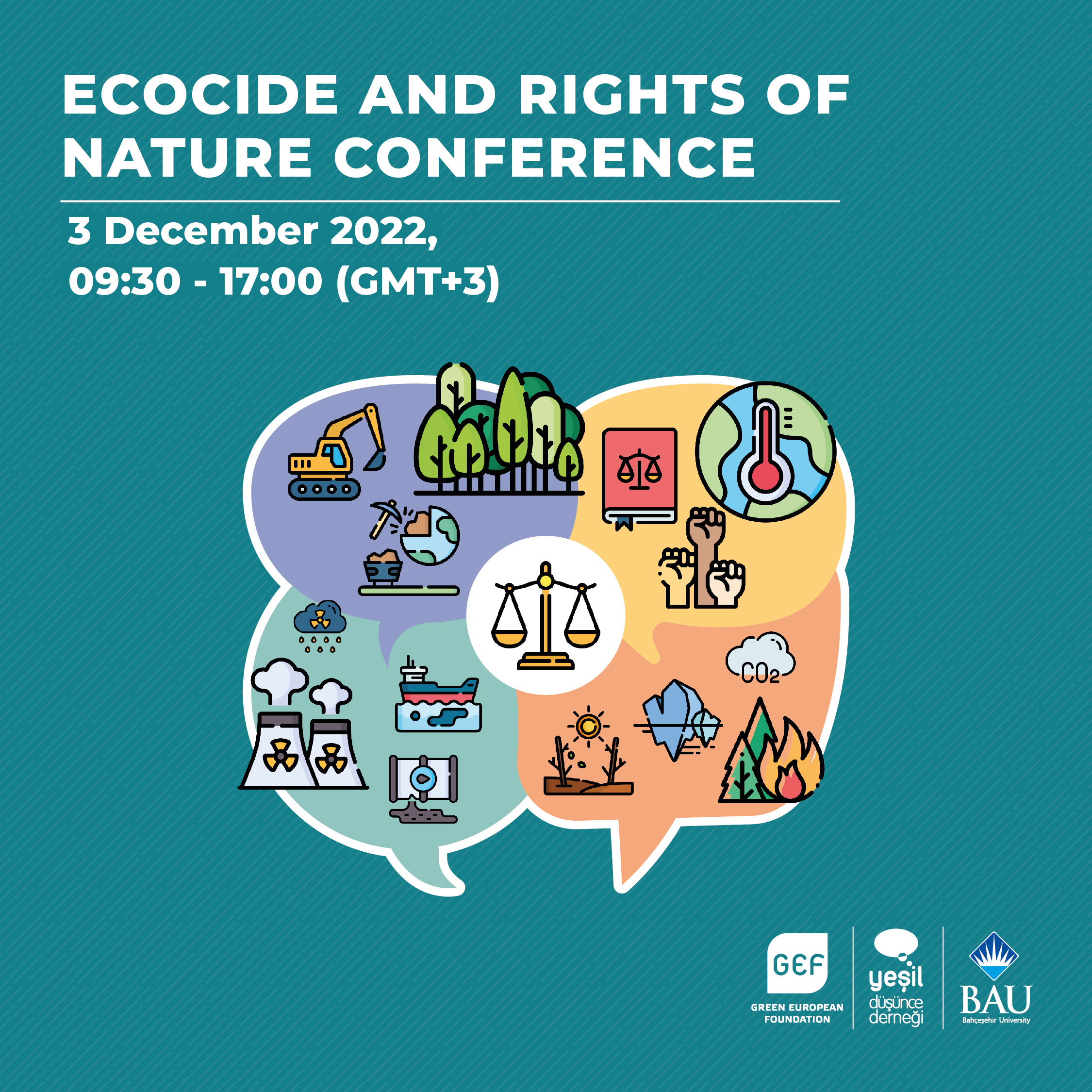
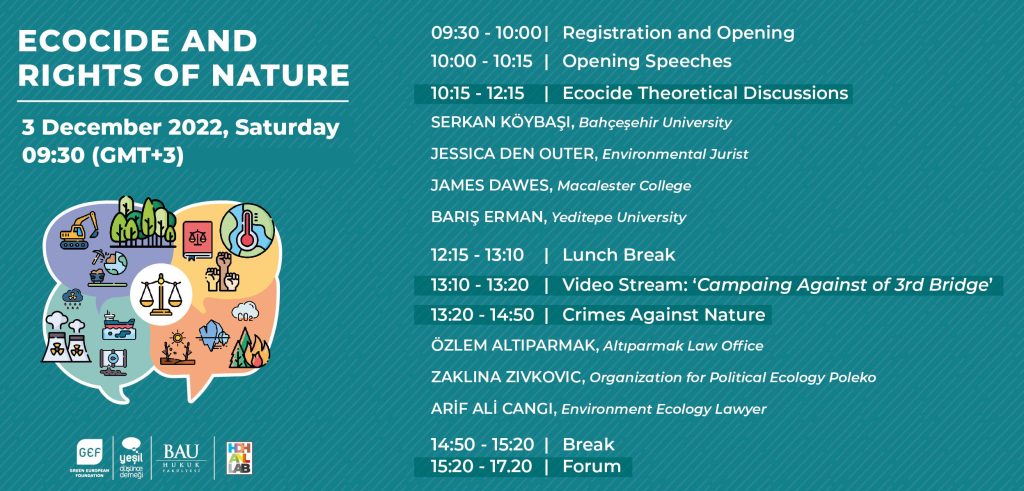
This conference will aim to revise and share the knowledge, experiences, and collective memory gathered so far through previous projects such as the ‘Ecological Constitution Initiative’ and ‘Nature Has Rights’. The ‘Ecocide and Rights of Nature’ conference will draw attention to the rights of nature, and will contribute to strengthen environmental protection monitoring and advocacy actions, with the intention to reinforce political discourse in nature conservation movements. The “Ecocide and Rights of Nature” conference will gather nature rights defenders, activists, academics, lawyers, and green actors fighting against ecocide from Turkey and Europe.


Programme


Practicalities

Date and Time: Saturday, 3 December 2022  from 09:30-17:00 CEST

Location: Bahçeşehir University, Beşiktaş.

Language: This conference will be in Turkish with  simultaneous translation to English.

Registration: Please register here.


This project is organised by the Green European Foundation with the support of  Green Thought Association with the financial support of the European Parliament to the Green European Foundation. The European Parliament is not responsible for the content of this event.

Peace & Security Debate Series: EU Responses to the War

By

Context

With a focus on the Eastern flank of Europe, the 2022-2023 debates series seeks to enrich green and political ecology ideas and actors and provide spaces to hear the voices of green actors, peace and security experts, as well as partners from the region. The goal of the Peace & Security Debate Series project, which we are developing in cooperation with the Croatian organisation Sustainable Development Forum Green Window , is to analyse the current crisis caused by Russia’s invasion of Ukraine, as well as other topics related to peace and security at a European level. The project comprises three online discussions and a one-day conference that will take place in February 2023.

About

The first discussion will focus on the causes of the war outbreak and the course of the conflict itself in the period from February to November 2022. Speakers will discuss the first reactions of the EU member states in the first weeks of the war and how they affected the internal relations between the member states and NATO. Likewise, they will compare the positions of Ukraine and Russia in the conflict and try to assess the consequences for both countries and whether a peaceful future is possible.

Speakers

  • Davor Boban: Faculty of Political Sciences, University of Zagreb
  • Đana Luša: Faculty of Political Sciences, University of Zagreb
  • Senada Šelo Šabić, dr.sc.: The Insitute for International Development and International Relations, Senior Research Associate
    Moderator : Marko Popović


Practicalities

Date and Time: November 17 from 18:00-19:30 CEST

Location: Online via Zoom & Facebook Livestream.

Registration: Please register here.


This event is organised by the Green European Foundation with the support of Green Window and with the financial support of the European Parliament to the Green European Foundation. The Euroapean Parliament is not responsible for the content of this event.

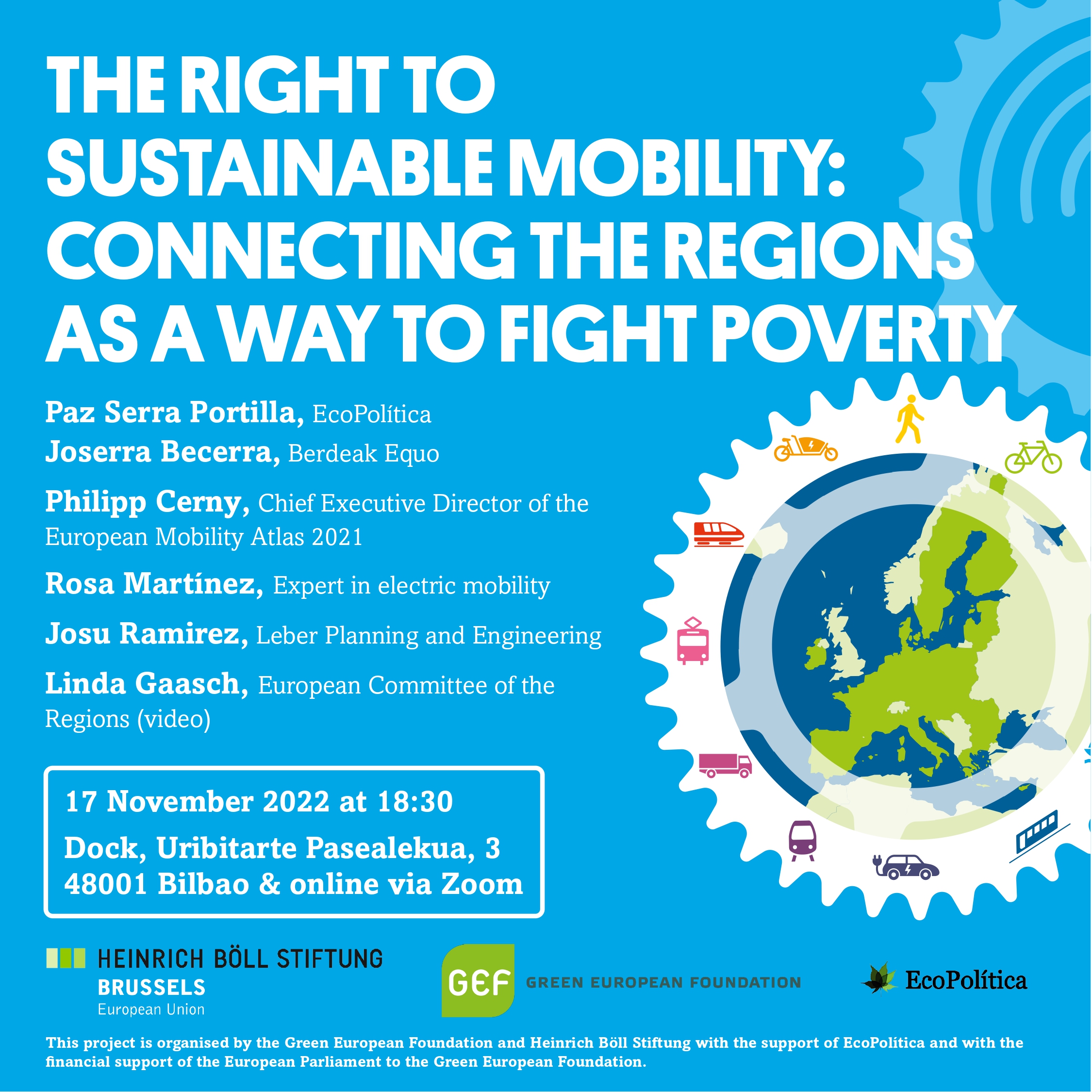
The Right to Sustainable Mobility: Connecting the Regions as a Way to Fight Poverty

By

Context

Mobility plays a fundamental role in people’s lives. The ease of movement not only favours the freedom to choose the place of residence and the exercise the right to work, but it is also essential to access basic public services such as education and health, as well as leisure and enjoyment of free time. It is, in short, a determining element of people’s well-being and their quality of life.

In this sense, the articulation of the subjective right to mobility in our societies, which guarantees all citizens equal conditions of access and use of mobility services, is becoming increasingly important. If mobility determines people’s quality of life, the impossibility of accessing sufficient mobility (due to physical or mental conditions, insufficient economic resources, or other factors) supposes not only a personal impediment, but also a breach of the constitutional principle of equality.

Throughout the 20th century, the economic system has linked this right with the use and enjoyment of the private car through an unprecedented cultural transformation. This has caused our towns and cities – and, ultimately, the geography in which we live – to be configured around the use and service of the private motor vehicle. No country in Europe has recognised the “right” to circulate and reach anywhere by car, and yet the car has usurped the routes traditionally used by pedestrians and other means of transport.

In fact, driving in a private car in a public space is a privilege rather than a right. Greenhouse gas emissions caused by automobiles, energy inefficiency, air and water pollution, noise, congestion of public space, accidents or the appropriation of the land are privileges associated with the enjoyment of the automobile, which are unaffordable and unsustainable for the planet, and harmful for people’s health and for society as a whole.

The war in Ukraine has accelerated the energy crisis caused by the progressive depletion of fossil fuels. However, the speed with which it has progressed has hit millions of people who use private vehicles for their daily commutes hard. According to official statistics from summer 2022, in Spain, 60% of drivers have limited the use of private vehicles, and 5% have stopped using them all together.

In this context, sustainable mobility is no longer simply a necessity to advance decarbonisation, it has now become the main alternative to tackle poverty linked to dependence on the private combustion car.

It is the obligation of local institutions to facilitate active mobility. Before the crisis, almost half of daily trips in the Basque Country were made on foot or by bicycle. However, facilitating the transfer of 40% of trips that are made by private vehicles requires adequate mobility planning at the municipal and regional levels to ensure minimum standards of safety, comfort, and accessibility. This situation turns non-motorised mobility into a high-risk exercise, instead of a routine habit.

On the other hand, public transport continues to be the main tool to guarantee everyone the right to move without distinction of physical, intellectual, economic capacity, or place of residence. In this sense, it is the obligation of local and regional authorities to act in a coordinated manner to ensure sufficient public transport coverage with minimum quality and sustainability standards, and with prices in line with the level of disposable income of users.

Lastly, we cannot forget the role that public policies will play in the coming decades, especially when it comes to reducing the demand for mobility, such as 15-minute city urban planning or land reuse policies. These will need to be combined with increased attention to rising property prices (which drive those with lower incomes to the periphery of cities), as well as addressing the social and cultural reconstruction of our way of life on a fairer and more sustainable basis.

Speakers

  • Paz Serra, EcoPolítica.
  • Joserra Becerra, Berdeak EQUO.
  • Philipp Cerny, Chief Executive Editor of the European Mobility Atlas 2021.
  • Rosa Martínez, Expert in electric mobility.
  • Josu Ramirez, Leber Planning and Engineering.
  • Linda Gaasch, European Committee of the Regions (video).

Practicalities

Date and Time:  Thursday 17 November, from 18:30 to 20:00 (CET).

Location: Hybrid event, Dock (Uribitarte Pasealekua, 3 Bilbao) and Zoom.

Language: The main language of the debate will be Spanish. Simultaneous interpretation will be provided ES<>EN.

The event is hybrid, open and free with prior registration through this form. Once registration has been completed, a confirmation email will be sent with the access details for joining the meeting.

Reading material

The event relates to the European Mobility Atlas, corresponding Spanish translation, and associated booklet, Present and Future of Mobility in Spain.


This project is organised by the Green European Foundation and Heinrich Boll Stiftung with the support of EcoPolítica and with the financial support of the European Parliament to the Green European Foundation.  

EGAT Croatia 22-23

By

About the event

The European Green Activists Training (EGAT) is a project organized by Green European Foundation in cooperation with Sustainable Development Forum Green Window. This project has been organised in Croatia for six years, over which the project has gathered more than 100 high school students, university students and young professionals from all parts of the country.

The aim of the project is to familiarise participants with green topics (climate change, biodiversity and environment protection, human rights and democracy, feminism, active citizenship…), green policies and sustainable development policies, as well as the EU institutions. Through various sessions and discussions involving representatives of international organizations and the European Union, the goal is to explore possibilities of active and professional involvement in building a greener and more just society.

Many previous participants remained active in the fields of sustainable development and green policies, while some even had the opportunity to pursue their career through internships or regular employment opportunities in the institutions of the EU.

Apart from Croatia, participating countries include Finland, Greece, Hungary, Catalonia, Poland and the Czech Republic.


Programme

  1. First national training session (Red Cross Lodge, Sljeme) – November 26-27 2022
  2. Second national training session (Red Cross Lodge, Sljeme) – December 10-11 2022
  3. Third national training session (Red Cross Lodge, Sljeme) – February 11-12 2023
  4. Brussels Study Trip – planned for March 2023 (exact date TBA)


Practicalities

Participants are required to participate in all meetings and national training sessions, as well as the study trip in Brussels.

Please apply via this form. All citizens from Croatia between 18-25 years of age are eligible to apply. We especially encourage applications from those who don’t have previous experience in topics.

After the selection process is finished, 20 participants will be selected.

The one-time participation fee amounts to 450 HRK (60 EUR), while all the other costs are covered (accommodation and lodging for all national training sessions, costs of Brussels Study Trip) by the organizer. For participants outside of Zagreb, travel costs for participation in national training sessions are also covered.

In case of the worsening of the epidemiological situation related to COVID-19 in Croatia and the introduction of more restrictive measures, national training sessions will be held online or in a hybrid format, depending on the actual situation and following recommendations of the Croatian Institute of Public Health. All measures recommended by the Croatian Institute of Public Health, if any, will be implemented in national training sessions. In case of severe worsening of the epidemiological situation at the level of the European Union, there is a possibility of the Brussels Study Trip being postponed or cancelled.

Applications are accepted until October 15 2022.
For all additional questions, please reach out to info@zeleniprozor.hr.

Handling of personal data, collected in the scope of this application, will be carried out in accordance to the legislation of the European Union (EU Directive 95/46/EC). For additional information, please visit https://gef.eu/privacy-policy/.


This project is organised by the Green European Foundation with the support of Sustainable Development Forum Green Window and with the financial support of the European Parliament to the Green European Foundation.
A Green New Deal for Leeds City Region

By Uncategorized

GALBA’s Vision for a Sustainable Local Economy (Group for Action on Leeds Bradford Airport)

Context

The Group for Action on Leeds Bradford Airport (GALBA) is a group of concerned citizens in West Yorkshire. They came together from a range of backgrounds and across the political spectrum to stop the proposed expansion of Leeds Bradford Airport (LBA), which they managed to do in 2022.  Learn more here.

Following the COP26 Climate Conference in Glasgow, the Group for Action on Leeds Bradford Airport (GALBA) launched their new report: ‘A Green New Deal for Leeds City Region: GALBA’s Vision for a Sustainable Local Economy’.

We believe that local jobs and our fragile climate are best safeguarded by investing in a new green economy that supports sustainability whilst making sure our communities are employed in secure, productive and meaningful work.

Objectives

This report sets out concerns about the claims being made by Leeds Bradford Airport (LBA) around job creation.  GALBA propose a more forward-looking, ambitious and achievable economy that reduces reliance on aviation and encourages investment in local communities, whilst addressing the other key challenges faced around transport, energy and food supply. “Our generation has seen the emergence of a human-created climate emergency. We must also be the generation to fix this, by making best use of our most precious resource–our people”.

Download

Also available in Spanish.


This report is published by the Green European Foundation with the support of Green House Think Tank and the financial support of the European Parliament. The European Parliament is not responsible for the content of this project.

EGAT Greece 22 – 23

By

About the event

During EGAT Greece, 20 participants aged 16-25 will have the chance to shape their activist figures through green values and with practical and theoritical guidance they will deepen their knowledge and understanding of issues related to democracy, ecology, sustainability, energy communities and just and democratic energy transition. They will get familiarised with the political decision-making processes on the national and European levels, understanding the severity of the imbalance of political representation and ultimately they will develop their skills so as to enact societal change, and promote more equal and sustainable societies. They will share space with politicians, activists, scientists and academics working in the front line trying to make positive change, and of course, they will meet with their like-minded peers who share the same preoccupation about the future and ideas of a better world.

THIS YEAR’S TOPICS

  • Energy & Renewables
  • EU, Democracy & Active Citizenship
  • Ecofeminism

Programme

First Training

Eco-camp Experience in rural area in Greece (TBA) October 28th – 30th

Second Training

Thessaloniki, Heinrich Böll Foundation December 3d – 4th

Brussels Study Trip

March / April, 2023 (exact dates TBA)


Practicalities

To APPLY, fill this application form by September 25th, 2022, 24:00 EET and give yourself the chance to drive social change through a unique learning experience. Please note that due to COVID-19 pandemic, all activities could potentially be subjected to changes. Some parts of the programme including the study travel could happen online.

Selection criteria

  • Aged between 16-25y.o., with plenty or with minimum experience in activism.
  • Belief in green values, respect for the natural environment, people and animals.
  • Passionate to learn and develop skills as a green activist in order to enact societal change.

Participation fees

Participation in EGAT Greece is free. All training materials, flights to and accommodation in Brussels are covered by funds deriving from the European Parliament, on condition that a participant has successfully completed the training programme in Greece. Unfortunately, we cannot cover transport and accommodation costs from other parts of Greece to the venues for attending the training workshops. If you really want to participate but are unable to cover these costs, please contact us so that we can see what solutions might be available.


Equal opportunity disclaimer

We would like to encourage young people aged 16-25 from every part of Greece to submit an application. We would particularly like to encourage participation from young people who belong to groups with marginal political representation, such as People with Disabilities, Roma Greeks, second generation immigrants and members of the LGBTQI+ community. Knowledge and experience in the above topics of the training is not a prerequisite.


This EGAT programme is organised by the Green European Foundation with the support of the Greek Green Institute and with the financial support of the European Parliament to the Green European Foundation.
EGAT Czech Republic Akumulátor

By

About the event

As part of EGAT you will take part in a three-weekend training session taking place in different locations of the Czech Republic, as well as an international study trip. The program will run from the first weekend of October 2021, until March 2022, when the trip to Brussels will take place alongside young activists from Finland, Hungary, Spain, Poland, Greece, and Croatia, who are part of similar trainings.

During this programme, you will explore different aspects of politics and activism with experts in the field, including journalists, academics, experts, and politicians. We will awake your sense of initiative and support your skills in advocacy, teamwork, campaigning, and work with the media. Together we will go through a whole range of approaches and tools that can change the world around. It is important for us to connect theory and practice. Besides practical skills, we will focus on important cross-cutting themes such as climate change, education, feminism and more.


Program

The training program consists of 2 national trainings, the online course EU for Beginners and the study tour in Brussels with a short preparatory meeting beforehand.

1st meeting: “Another world is possible!”

October 28th – 30th, Toulcův Dvůr, Prague area CZ

Welcome to the Akumulátor and EGAT, get engaged! Including practical workshops with external guests about the imagination and upcoming campaign on energy poverty in Czechia.

2nd meeting: “It’s all about campaigning!”

December 9th – 11st, Paleta Oucmanice, Pardubice area CZ

Critical approach to the (social) media content with journalist Vojtěch Boháč and campaigning strategies.

3rd meeting: “Why GRL PWR is not enough and is the future feminist?”

February  10th -12th, Kaprálův mlýn, Brno area CZ

Feminism, gender and intersectionality in the context of central and easter Europe. Among others including workshop about feminism in the climate movement, where we connect the climate crisis with feminist issues.

4th meeting: “Czechia + EU = ?” Towards the common Europe critically

TBC Half day online meeting before Brussels study tour

Brussels study tour: Spring 2023

Please note: Due to the particular circumstances during the COVID-19 pandemic, all activities could potentially be subjected to changes depending on the epidemiological data and any restrictive measures and guidelines at that time. Some parts of the programme involving travel may take place online.


Practicalities

This training is open to participants between age 15 and 23. You don’t need experience in activism or politics to apply, it is your motivation to make a change and impact that counts!

The sliding fee for the whole training is 5000 CZK (circa 200€). While writing your application, you can choose how much  you can afford to pay. Institute of active citizenship will cover the remaining sum. We don’t want anyone to be excluded because of the money and the amount of your contribution doesn’t play any role in the selection of the participants!

Apply through this application form until September 10th, the decisions will be informed by September 6rd. Altogether 15 participants will be selected for the course.

For more information in Czech click here.


This EGAT programme is organised by Green European Foundation with the support of Institute of Active Citizenship and with the financial support of the European Parliament to the Green European Foundation.


EGAT Catalonia 22-23

By

About the event

Would you like to participate in a training program for young European green activists?

As part of this programme you will:

  • Learn how European institutions work and how things can be changed from politics, to social justice,  as well as green and feminist values.
  • Meet other like-minded activists and share struggles and experiences.
  • Travel with us to Brussels to get to know the European institutions and participants from six other countries.

Programme

As part of this training, we’ll hold two seminars (Friday-Sunday) to talk about green policies and discuss the different tools that activists have to transform our climate reality. We will also have conversations with green politicians and experts who will bring in their insight. In small groups, you will get in-depth into the concepts and techniques to achieve significant change.

First seminar: November 11-13, 2022

Second seminar: December 9-11, 2022

Online meeting with activists from other countries: January 2023

Trip to Brussels: February 2023

Practicalities

Apply by filling this form

This activity has no economic cost for the participants.

Please note: Due to COVID-19 pandemic, all activities are subjected to changes. Some parts of the programme including the study travel could take place online.

For any questions contact us egat@noushoritzons.cat


This EGAT programme is organised by the Green European Foundation with the support of Nous Horitzons and with the financial support of the European Parliament to the Green European Foundation.
Eco Democracy Workshop (Çanakkale)

By

About the event:

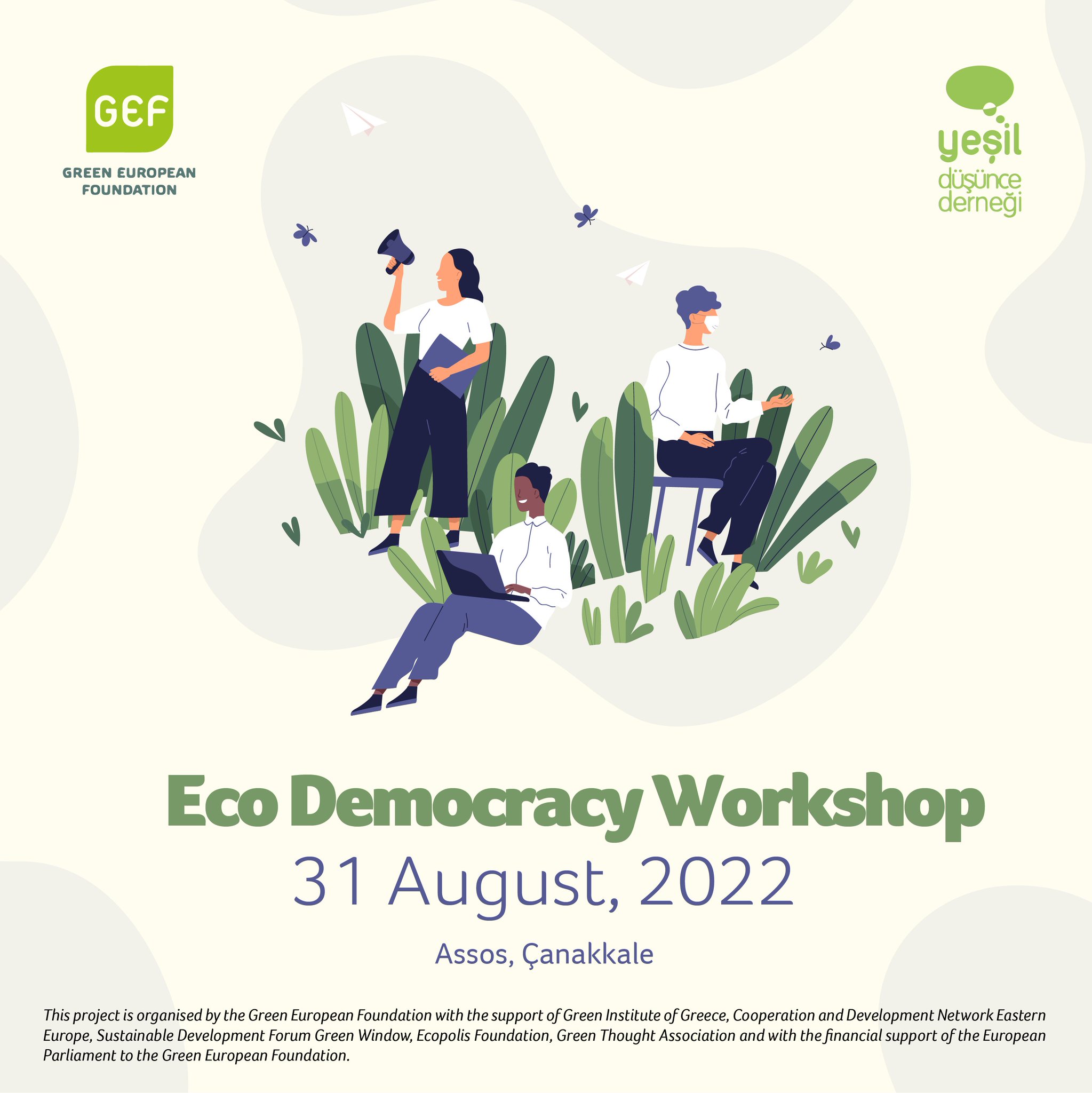
This is the second event as part of our 2022 Transnational Project The Future of Eastern Europe and Ecodemocracy. It will take place on August 31, in Sincap Camp. With this event, we aim to talk about climate justice and eco-democracy together and to increase the active participation of young activists in politics so that society and young people can take action in the face of ecological problems by developing their capacities.

If you are between the ages of 18 and 35, and you are part of the green movement or trying to explore new knowledge in this field and become part of the movement,  we are eager to receive your applications!

Context:

Unfortunately, discussions about authority and nationalism, especially in Eastern Europe, never fall off the agenda. Along with the pandemic, the crises we faced shook democracy all over the world.

The fact that administrations remain unresponsive in the face of these crises continues to deepen the problems we face in our daily lives. And climate justice cannot be raised when dealing with these problems. However, in fact it covers all the problems.


Speakers:

  • Cem Altıparmak, Altıparmak Hukuk Bürosu
  • Gülşah Tırış, Akdeniz University
  • Rudi Sayat Pulatyan, Young Greens of Turkey
  • Michalis Bakas, Leader of the Green Party in Lesbos, Greece 


Programme:

Date: 31th August, 2022

Time: 10.00-17.00 (local time)

Location: Sincap Camp, Sokakağzı mevkii no:77, 17862 Balabanlı/Ayvacık/Çanakkale, Türkiye


Practicalities:

Deadline for application: 30th of July

Applications are  now closed. 

This event is open for young people from all around Turkey. The language of the event will be in Turkish.


This event is organised by the Green European Foundation with the support of Green Thought Association and with the financial support of the European Parliament to the Green European Foundation. The European Parliament is not responsible for the content of this event.
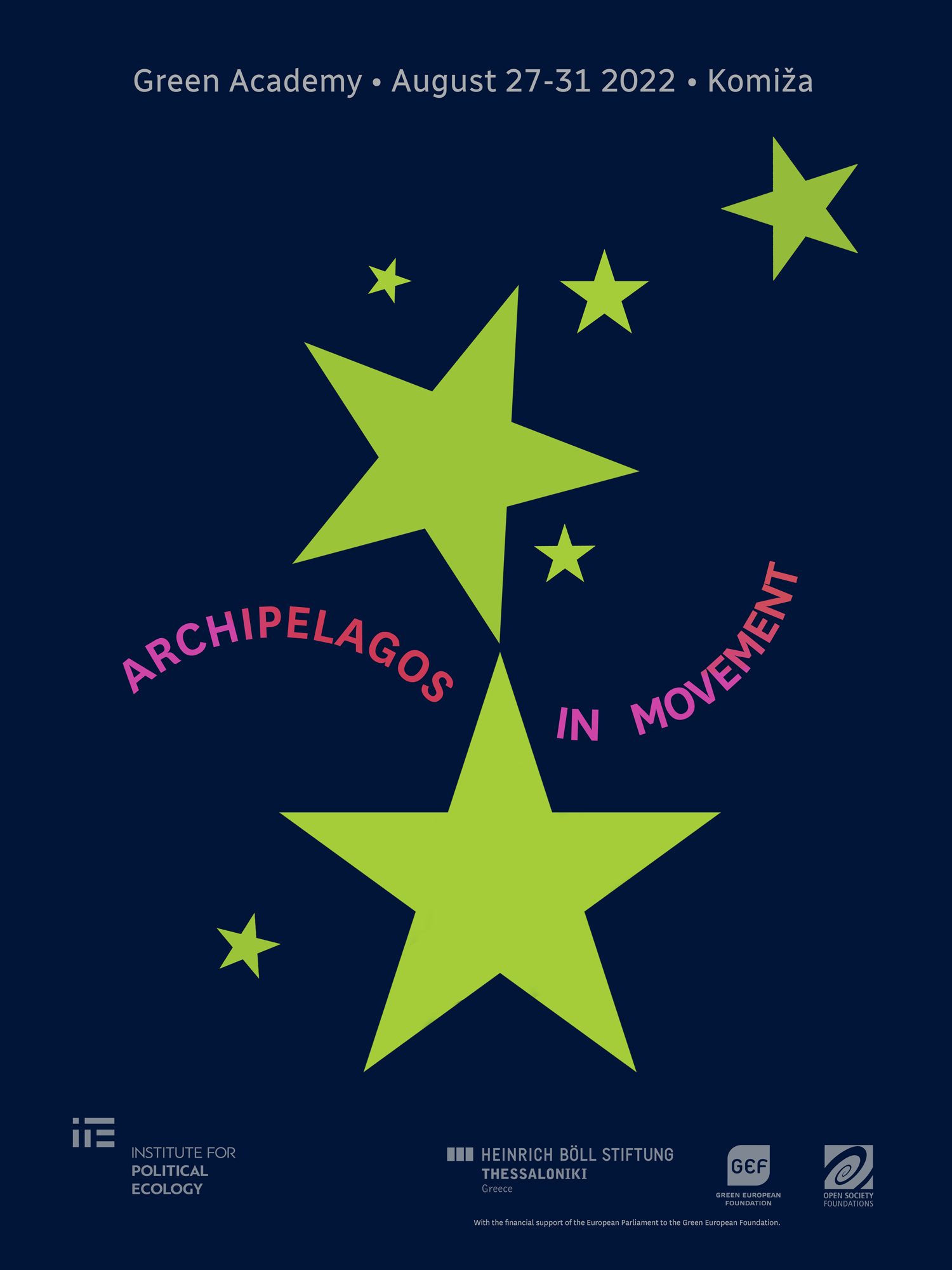
Green Academy: Archipelagos in Movement (Komiža)

By

About the event:

In the aftermath of the COVID-pandemic and surrounded with the devastating impacts of the war in Ukraine, we are moving forward with the second decade of the Green Academy, an effort to provide permanent discussion and a learning platform for progressive, green and left social forces in the Balkans, Europe and internationally.

While new energy and food crises are approaching quickly, the depth of the climate crisis and huge loss of biodiversity did not disappear. On the contrary, they are at its peak, continuing to challenge our maturity to create conditions for the good life of the generations to come. And yet, achievements and successes, bigger and smaller, of green and progressive political platforms in Croatia, Serbia, Montenegro and Slovenia demonstrate that the green wave is spreading through Eastern Europe and the Balkans – and that the protagonists that might be carriers of systemic change, though surrounded by hostile environments and worsening conditions, are gaining more and more recognition and power.

Our event is located on the island of Vis, in the midst of the Adriatic archipelagos, but in this 8th edition we explicitly focus on symbolic archipelagos of epistemological, cognitive, practical and political “islands of change” that exist across geographical but also institutional, disciplinary and practical territories and imaginaries. Placing our conversations and learnings in time of turbulences and global turmoil, we aim to create conditions to dive deeper into ideas, cases or models of transformative practices where more autonomy and/or innovation is being exercised, with the final goals of ensuring a just, secure, democratic and ecologically sustainable future. These emerging archipelagos spread across different division lines of class, gender, disciplines, sectors; as spaces of autonomy, emancipation and counter power to any oppressive, extractive, exclusive regime. It is the movement of these archipelagos that can open the door for paradigmatic shift and systemic change, which still appears to be very fragile.

This year, we will dive deeper into our imaginary of change and search for the ways of mutual empowerment. We will revisit our roles and reflect upon our strategies; learn from various experiences and dive deeper into ideas that are based on more autonomy, more self-organisation and internal knowledge-sharing. Before the next wave of expansion, our archipelagos need time to reflect on achievements and failures which occurred in our collective experience. Our program is inclined to be more open to initiative and self-organisation. Therefore, besides keynote lectures, panels and workshops, we will ensure sufficient time for participants to self-organize around certain topics and propose topics around which they want to initiate discussion (see Call for sessions).

Programme:

Confirmed speakers include: 

  • Dirk Holemans – co-president of the Green European Foundation, director of Oikos 
  • Danijela Dolenec – deputy mayor of the city of Zagreb, Možemo! 
  • Giorgos Kallis – ecological economist, Universitat Autònoma de Barcelona (UAB) 
  • Jagoda Munić – director at Friends of the Earth Europe 
  • Srećko Horvat – philosopher, DiEM25 

Check out the provisional programme via this link. 

Practicalities:

Dates and Time: 27th to 31st of August 2022. Registration starts at 18:00 on the 27th of August and the program starts at 20:00 with the opening session. During your stay at the Green Academy, the program will start at 9:30 and end at 22:30 (including 4 hours of lunch, sun, and sea break between 13:30 and 17:30).

Catering and Accommodation:  Participants will have paid accommodation in two-bed rooms, including breakfast and dinner in Hotel BiSevo, which is also the primary event venue.

Location and Travel: The Island of Vis is easily reached via a ferry line from Split, Croatia. Check www.jadrolinija.hr for timetables. Once you arrive on Vis, a bus to Komiza waits for you in front of the port. Check the bus timetable here.

Due to decreased funding in 2022, we are able to offer travel costs only to speakers. In cases of international travel, where more people travel together (car-sharing) or take public transport to reach the Green Academy, co-financing of travel costs (up to 50%) will be considered. Travel costs within Croatia will not be covered.

Call for Action:

Registration for this event is now closed.  


The Green Academy is organised by the Green European Foundation and Institute for Political Ecology, with the financial support of the European Parliament to the Green European Foundation.

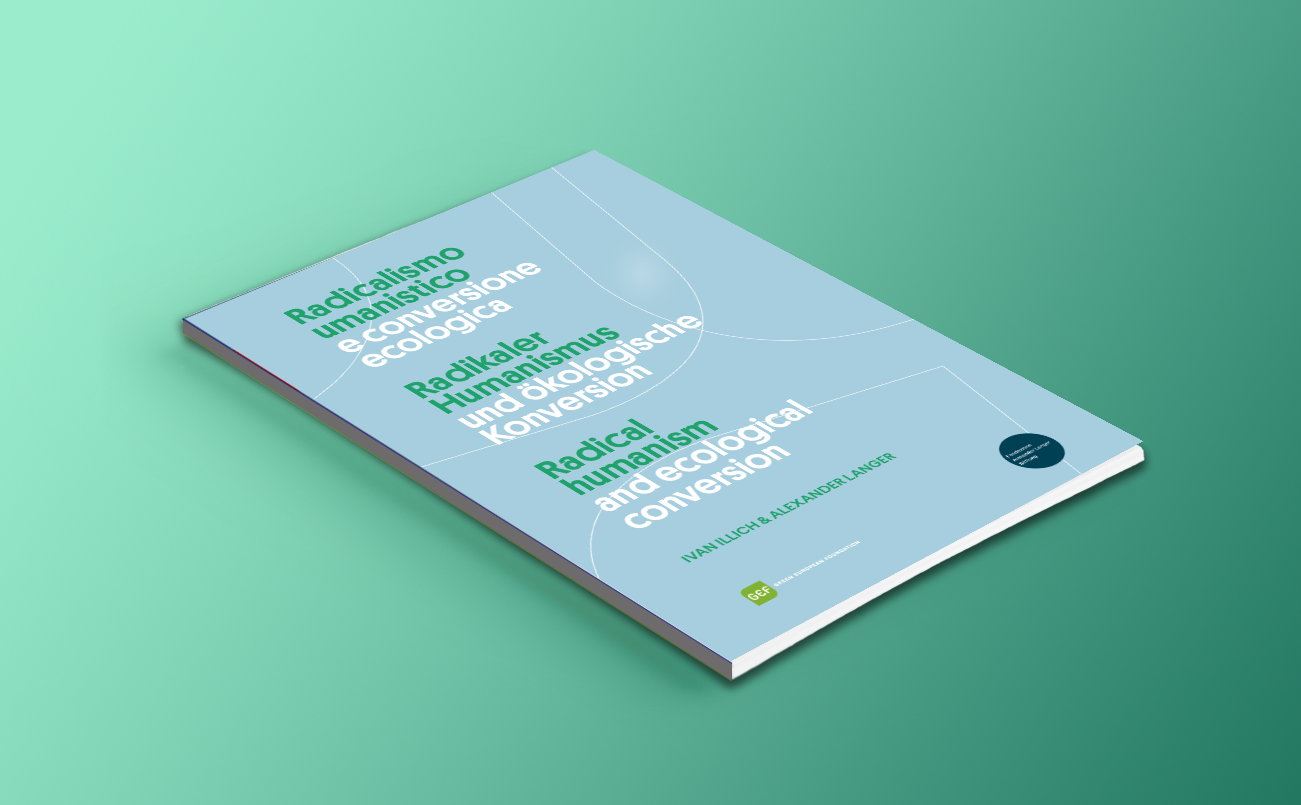
Radical Humanism and Ecological Conversion

By Uncategorized

Context

Is Europe ready for the ecological conversion that scientific evidence stresses on us?

Ivan Illich and Alexander Langer are influential interpreters of the economic critique of consumer society. Their work and practice offer many stimuli for reflection and action in the contemporary context.

Back in October 2021, we held a conference that offered the opportunity to compare Illich’s and Langer’s views and critical aspects. The conference aimed at fostering the translation of theoretical thinking into practical choices as they emerge from the different programs and practices of the Green political sphere, to design and develop new humanistic approaches and environmental strategies.
The reflections that emerged from the reports of the conference are of great relevance if read from a European perspective. They can, in fact, stimulate the current debate on the direction the Ecological Transition should take or in applying the resources of the “NextGenerationEU” funds.


Available Translations

Spanish


This publication has been realised with the support of the Alexander Langer Foundation and the financial support of the European Parliament to the Green European Foundation. The European Parliament is not responsible for the content of this publication.

European Green Academy

By

About the Event

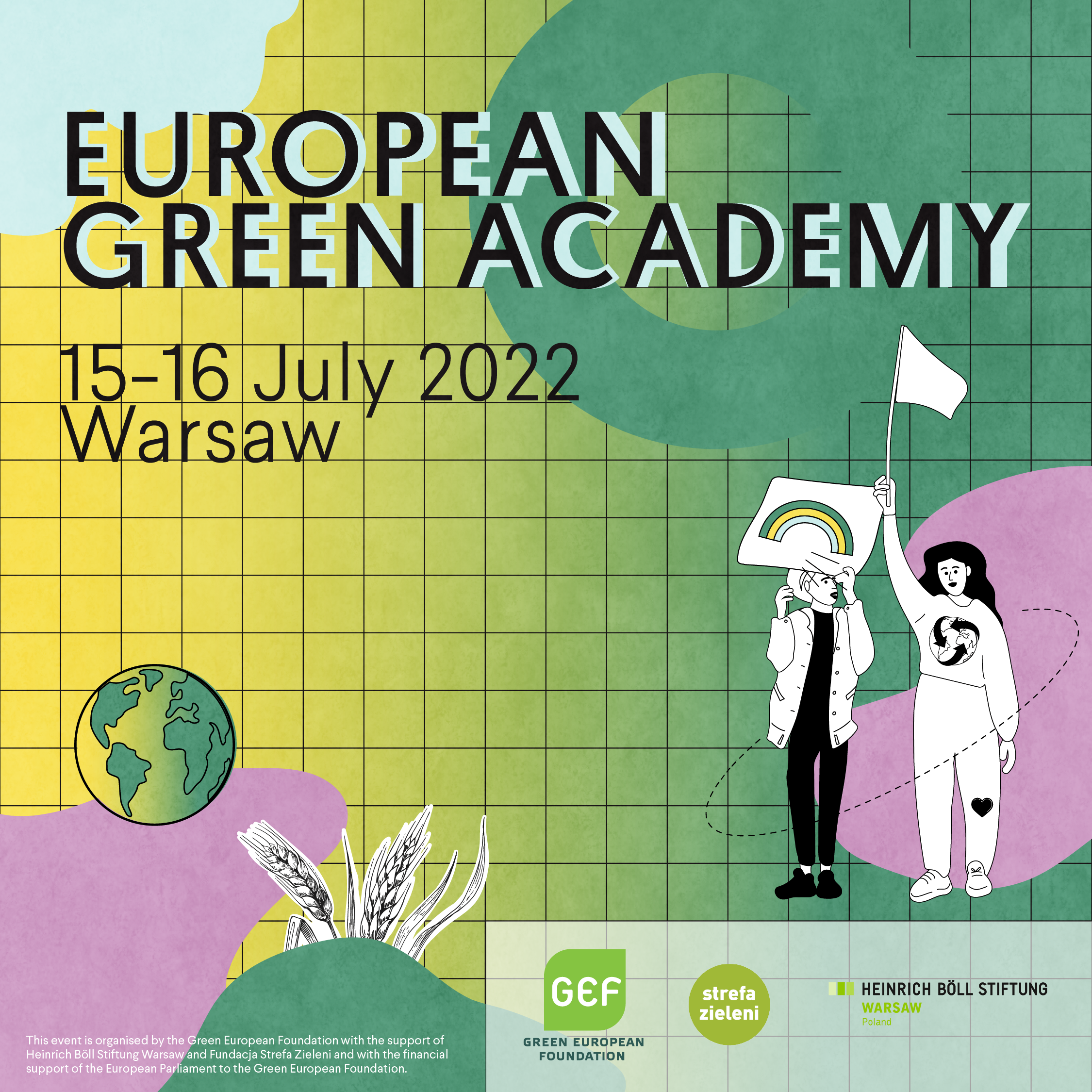
The European Green Academy opens its doors for the first time! On this occasion, the Green European Foundation, in cooperation with Strefa Zieleni and Heinrich Böll Stiftung Warsaw will invite diverse green actors, activists, politicians, and academics from all over Europe to further explore the political situation in Poland and build bridges and connections between national and European-level debates.

Topics and methods

The Academy will be the key meeting point for over 150 Green actors and interested citizens from Poland and across Europe to connect, debate, and build capacities. With this initiative, the organisers seek to promote an inspiring learning environment, facilitating skills building to collectively bring about a better future. With that in mind, the programme will delve into salient green issues via a diverse range of formats, including workshops, training, plenary debates and networking. The Academy will also serve as a space to strengthen connections between the Polish and European Green movements. The sessions will be split into four different streams:

The Green European Academy will be hosted by Agnieszka Lichnerowicz and Sebastian Wehrsig

Programme


FRIDAY 15 JULY


08:45 – 09:30

ARRIVAL AND REGISTRATIONS

09:30 – 11:00

STREAMS

Parallel 1

RoundtableConference Hall

Parallel 2

Doughnut Economy in Polish Cities: Utopia or Political Project?

[EN]

🕊

Refugees and Migration: Poland, Ukraine and the EU Perspective 

[EN]

Shared Energy, Efficient, and Sufficient Energy, [EN/PL] 

[EN]

LGBTIQA+ Rights in the Green Movement 


[PL] 

11:15 – 12:15

CONNECT

12:15-12:45

GROUP PHOTO

Roof Terrace

12:45 – 14:15

LUNCH

14:15 – 14:45

WELCOME [EN/PL]

Conference Hall 


14:45 – 16:15

PLENARY

Go Green Go Social: Challenges and Pathways for a Socially Just Transition in Poland and the EU [EN/PL]

16:15-16:45

BREAK

16:45 – 18:15

STREAMS


Conference HallRoundtableParallel 2Parallel 1
 

Right to Housing in Times of Instability

[EN/PL]
🕊

Just Transition in Rural Areas 

[PL/EN]

Deconstructing the Nuclear Industry Myth and Lobbying

[EN/PL]

Feminist Foreign Policy

[EN/PL] 

18:30 – 20:30

NETWORKING DINNER

Roof Terrace


SATURDAY 16 JULY 


09:30 – 10:00

◉ KEYNOTE

Conference Hall 

10:00– 11:30

◉ PLENARY

Peace and Security:  What do Polish and Ukrainian Perspectives Mean for the Debate on a Green European Vision for Security? [EN/PL]

Conference Hall 

11:30 – 11:45 

BREAK   

11:45 – 13:15

STREAMS

Conference Hall Parallel 1Roundtable

Parallel 2

Media Literacy to Strengthen Democracy in Eastern Europe

🕊

Food Security in Times of Crisis

[EN/PL]

Metals for the Energy Transition

[EN]

Reproductive Rights in Central and Eastern Europe

[EN/PL]

13:20 – 14:00

ENERGY SECURITY: A EUROPEAN PERSPECTIVE [EN & PL]

Conference Hall 

14:00 – 15:30

LUNCH

15:30 – 17:00

STREAMS

Parallel 1

Conference Hall

Parallel 2

Roundtable


Greens Reinvent the City

[EN]


🕊

Biodiversity & Conflict: the Environmental Cost of the War in Ukraine

[EN & PL]

Skills Training – Tiktok: Debunking Disinformation on Nuclear

[EN/PL]

Dare to Care or Ecofeminist Power of Change

[EN/PL] 

  17:00 – 19:00

📽 SCREENING AND DEBATE

Conference Hall 


Practicalities

Date: 15-16 July 2022

Location: Conference Hall at the Copernicus Science Centre (Centrum Nauki Kopernik), Warsaw, Poland

Language: English and Polish. 

Registrations are now closed.

For questions or more information, contact antoine.preel-dumas@gef.eu. 


This event is organised by the Green European Foundation with the support of the Fundacja Strefa Zieleni, Heinrich Böll Stiftung Warsaw and with the financial support of the European Parliament to the Green European Foundation. 
We are the future, but we are here NOW (Riga)

By

About the Event

Around 30 young people from Eastern Europe (Latvia, Poland, Balkans, South Caucasus, Ukraine and Belarus) will meet up to discuss the actions that can be taken in the ever-shrinking space for civil society in the Eastern part of our continent. We will look at the EU integration processes, the future of activism and politics and concentrate on 4 different skill-oriented tracks that are becoming more and more useful for the youth in Eastern Europe:

1. Creative Campaigning

2. Debates and public speaking

3. Movement organising

4. Non-Formal Education

The programme will be based on the principles of non-formal education and intercultural learning. We strive for an active and inclusive environment for direct communication and sharing of knowledge. The sessions will be balanced between theoretical inputs, work in small groups, workshops, discussions, training, and other interactive methods of non-formal learning.

Programme:

Arrival day

Day 1: Introductions, Team building, takaways from the 1st event, home evaluation groups

Day 2: Introductions to: Non formal education, creative campaigning, public speaking, non verbal communication, local actions planning, intercultural evening

Day 3: Introducions to: live and online events, urban performances, debates, non formal education methodologies, public speaking, free evening 

Day 4: Non formal education in local actions, working wiht trainers, public speaking, teambuilding, presentation, movie night

Day 5: Morning cicle, technicalities of reporting, local actions planning and presentations, evaluation, final party

Departure day

Speakers & trainers

  • Nika Tarasevich (she, Belarus/Georgia) teacher of art, expert on artivism and long time practitioner.
  • Luka Gudek (he, Croatia) CDN alumnus, master degree holder of Political science.
  • Hanna Filistovich (she, Belarus/Lithuania) seasoned activist and organiser, experienced with the movement organising in Belarus.
  • Maja Klimentic (she, Bosnia and Herzegovina/Czech Republic) CDN alumnus, she was a member of 10+ preparatory teams, Non-formal eduction expert and gender activist.

Practicalities

When: 8-12th May, 09:00-18:00 PM CEST

Time Zone: Eastern European Summer Time (EEST) / Coordinated Universal
Time (UTC) + 3

Location: Rija VEF Hotel, Brīvības 199c, Riga, Latvija, LV-1039 

Language: The main language of this activity will be English. But not being comfortable with interacting in English should not prevent you from applying. GEF & CDN strives to create an inclusive atmosphere at the events, where participants are encouraged to express themselves and ask for clarifications or translations from peers that speak the same language.


Additional Reading

Bulgaria’s Greens: From Street Protests to Government

How Green Independents Broke Through in North Macedonia

Extraction and Energy Transition in Serbia

Can Protests Steer Serbia Back Towards Democracy?

The War in Ukraine is Part of the Soviet Empire’s Unravelling

The Unfinished Business of Building Bosnia-Herzegovina

The Romanian Protest Wave: A Path to a New Political Era?
Belarus’s Struggle for Democracy


This event is organised by the Green European Foundation with the support of CDNEE and with the financial support of the European Parliament to the Green European Foundation and supported by the European Youth Foundation of Council of Europe. The European Parliament is not responsible for the content of this event.


Central and Eastern Europe Network of Green Foundations (Vienna)

By

Context:

In Eastern and Southern Europe, new climate movements and political ecology actors have emerged, and there is a recognizable and growing demand for green contents, ideas and connections. GEF is working on consolidating the greening of the public debate and political sphere in South and the East.

This will be done by bringing together green foundations, NGOs and think tanks working in the region to connect people and content, to facilitate synergies, and advance knowledge sharing political education. Specifically in Central and Eastern Europe, we aim to support the build-up of a self-sustaining community community of green political foundations (and equivalent actors).

Objectives:

  • Build mutual understanding on the political situation in the region.
  • Create safe spaces for sharing common challenges and best practices, as well as the exploration of opportunities for common work in the region.
  • Facilitate the co-creation of an autonomous network of Green political foundations and equivalent organisations from Central and Eastern Europe.

Speakers:

The event will be facilitated by the Green European Foundations Co-Directors, Ioana Banach and Laurent Standaert.

Programme:

Day 1: Political exchange

10h00-12h30 Arrival and setting the scene

14h00-15h30 Political discussion 1

16h00-17h30 Political discussion 2

17h30-21h00 Dinner with Green politicians and host organisation

Day 2: Community Building

8h30-10h30 Breakfast discussion

10h30-13h00 Pillars of CEE Network of Green Foundations

14h30-16h00 Governance and Next steps

Practicalities:

This is a closed event that will bring together representatives from the existing GEF partner organisations in the Central-Eastern Europe region.

You can learn more about GEF’s previous work with the partners in the Central and Eastern Europe region here.


This event is organised by the Green European Foundation in cooperation with FREDA – Die Akademie and with the financial support of the European Parliament to the Green European Foundation. The European Parliament is not responsible for the content of this event.
The Good Story – Green Narratives from the Balkans

By Uncategorized

Context

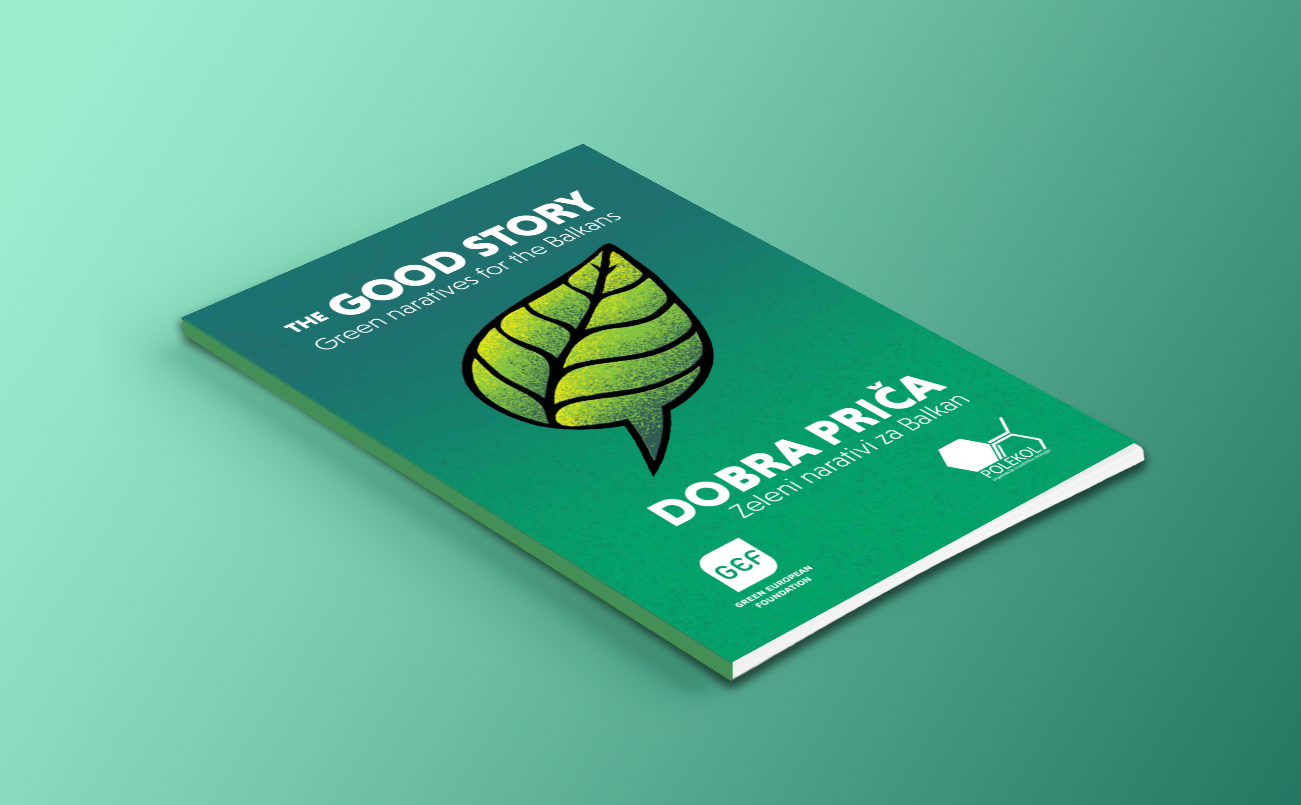
The Good Story gathers contributions from experts and activists who participated in the GEF Green Horizons Academy in Serbia. The publication explores the different approaches to how green narratives can reach a broader audience, in Serbian and English language

If there ever was an actor who could contest peripheral neoliberal capitalism and nationalism effectively in the past 30 years, this is the green actor. This is not because green politics is superior to other ones, but because no one expected it to occur and especially not at this level of organization and public support.


Objectives

What makes a good story? A compelling narrative, a powerful beginning, an interesting hook? The convincing and trustworthy messenger?

This text zooms in on eco-politic struggles faced in Serbia in the last few years. Serbia has been the field site of an unprecedented environmental mobilization. It explores Serbian activist movements, green populism and reflects on wider tensions at the heart of the Balkans’ ecopolitics and potential solutions for the future.


Download

Available in Greek


This report has been published by the Green Europe Foundation with the support of Polekol and with the financial support of the European Parliament to the Green European Foundation. The European Parliament is not responsible for the content of this report.
Green-Red Dialogues: Ukraine and Europe’s New Role in the World

By

About the Event

The devastating war in Ukraine is a humanitarian disaster, with horrific consequences for the country’s inhabitants and more lives lost every day. Europe has taken a leading role in the international response, not just because of proximity and the direct consequences that this unprecedented conflict is having for the continent, but also because it marks an undeniable turning point that demands a joint and transversal response.

This crisis, however, will require not just short-term, but also mid-to-long term action, and a shift in how Europe positions itself in various domains. There are economic, energy, geopolitical and other implications, and important choices to be made. Faced with all this, we need to create room for debate where we can bring green and left-wing perspectives to the questions and consequences we will have to face.

Anna Lührmann and Ernest Urtasun will try to give us answers from this perspective, a European vision that will draw different perspectives from both Germany and southern Europe.

Context

GEF’s Green Red Dialogues, organised with the support of Fundació Nous Horitzons, aim to tackle pressing issues of our time and the challenges Europe faces with an explicit social and green lens. In doing so, these debates connect the red and the green and highlight Southern European perspectives on crucial topics like energy, mobility, and security in the 21st century.

Speakers

  • Anna Lührmann – Minister of State for Europe and Climate of the German government 
  • Ernest Urtasun – Member of the European Parliament, Greens/EFA 

Practicalities

Date and Time: Monday, April 25th (18:00 – 19:00 CEST) 

Location: Online, via Zoom 

Language: English and Catalan, with simultaneous translation 

Registration: Please sign-up in advance via this link 

Further Reading

Since the war in Ukraine began, our independent publication, the Green European Journal has been publishing articles and interviews to look into the regional context and impacts, the role of media and civil society, and the energy and environmental dimension, as well as its implications for the future of the European Union. Here’s what the Journal has published so far.


This webinar is organised by the Green European Foundation, with the support of Fundacio Nous Horitzons and the financial support of the European Parliament to the Green European Foundation. 

Just Transition for All?

By

About the event

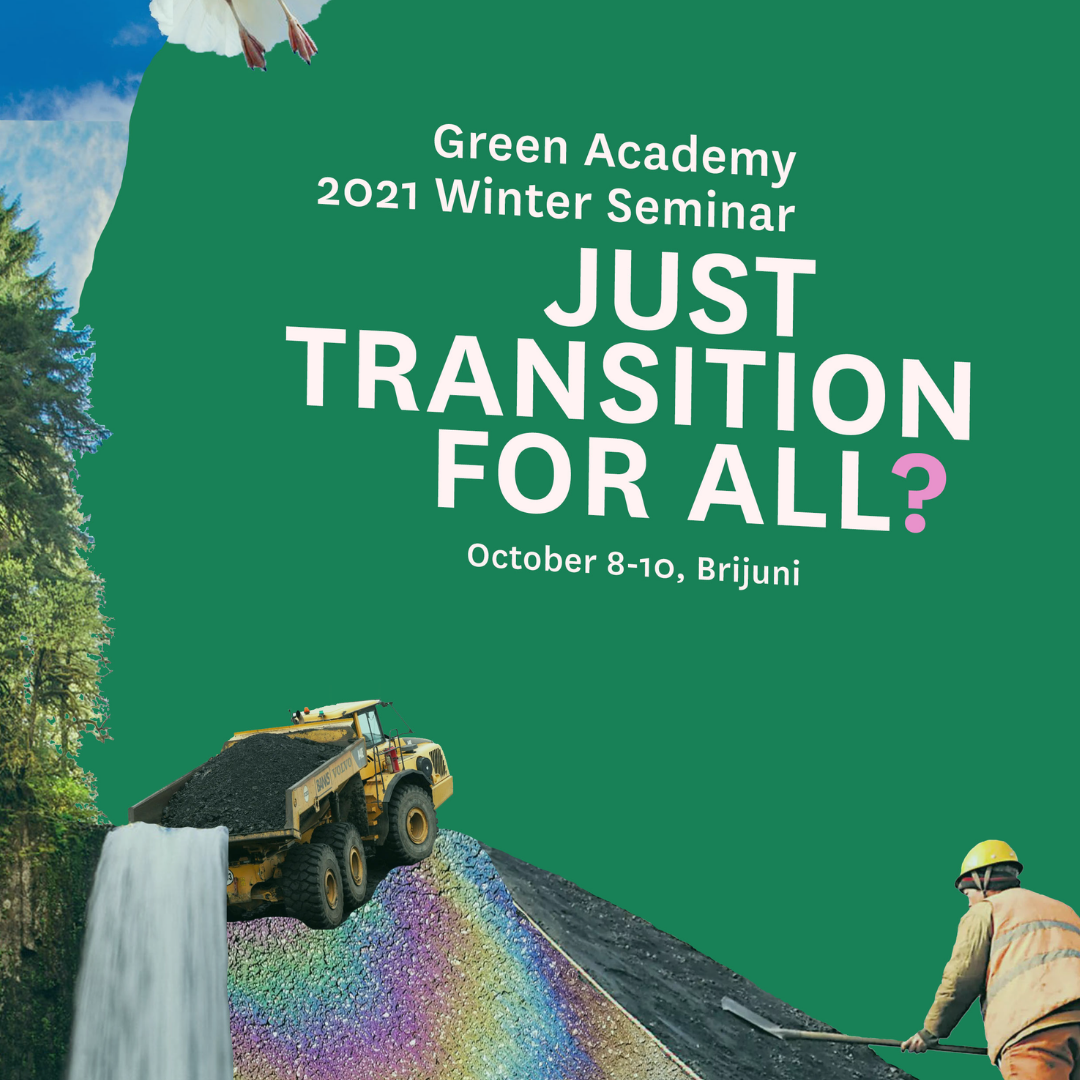
This three-day seminar will serve as a place to discuss opportunities and limits of just transition and explore its transformative potential.

 During the seminar, we will:

  • provide a first approach to the concept of just transition,
  • discuss the role of trade unions and workers,
  • discuss the transfer from extractive to regenerative economy,
  • explore just transition to a European and global level in solidarity,
  • Link it to recovery plans and European Green deal,
  • Explore opportunities for decent jobs,
  • discuss specific conditions of just transition at European semi periphery

Also, we will dive much deeper into just transition in the transport sector, where we will learn and discuss under which conditions sustainable mobility can become an example of just transition policies.

We see this seminar as one milestone in a systemic approach to concepts and practices of just transition in this part of Europe, and an important milestone in establishing epistemic communities in this field.


This project is organised by the Green European Foundation with the support of the Institute for Political Ecology in cooperation with the Heinrich Böll Foundation, Prague office, and the European Climate Initiative with the financial support of the European Parliament to the Green European Foundation. The European Parliament is not responsible for the content of this event.

The Potential of Railways

By

About the Event

The event is open to all those interested in mobility, especially members of organisations and platforms working on the issue, government officials, politicians and civil society associations.

Our aim is to publicise more sustainable alternatives when choosing a means of transport and to raise awareness of the need to change our mobility habits.

The events will be held via zoom and will have simultaneous translation from Spanish-English. Prior registration is required.

Context

This is the third event of the series of conferences entitled “The Future of European Mobility”

One of the key factors in the economic development in our global society has been the ease of mobility for people and goods due to the abundance of cheap oil. But we can already witness the consequences of this irrational mobility in the form of the climate crisis and air pollution.

In order to achieve Europe’s decarbonisation goals, the transport sector is a priority. That is why the German Heinrich Böll Foundation launched last year the European Mobility Atlas, a comprehensive analysis of the situation of the sector in Europe. The Green European Foundation and the Fundació Nous Horitzons have translated the Atlas into Spanish and, together with Transición Verde, have prepared a specific annex on the situation in Spain. For its launch, we have organised three online events on some modes of transport whose future is key to move towards low-emission mobility.

The last session of the series will focus on the railway. The most efficient means of motorised transport which, beyond the AVE (high-speed rail line), has been losing its condition as the backbone of the Spanish geography. Should it recover that condition? Can a large part of freight be transferred to the railway?

Speakers

  • Juantxo López de Uralde, national Deputy and president of the Commission for Ecological Transition and Demographic Challenge of the Spanish Congress.
  • José Luis Ordóñez, spokesperson of the State Coordination for a Public, Social and Sustainable Train.
  • Tilly Metz, MEP in the Greens/EFA group and member of the Committee on Transport and Tourism.
  • Manel Ferri , Spanish Sustainable Mobility Foundation)

Moderation: Lidia Ucher, environmental journalist.

Practicalities

Date ant Time: 8th February 18:00-19:30

Language: The events will be held in Spanish via zoom, and will have simultaneous translation in English.

Registration: Prior registration is required- Please register here.

The day before each session we will send a message to the registered persons with the access link.

The sessions will be recorded and made available on YouTube.


This event is organised by the Green European Foundation with the support of Transición Verde and Fundació Nous Horitzons, and with the financial support of the European Parliament to the Green European Foundation.
Cycling and new public space

By

About the Event

The event is open to all those interested in mobility, especially members of organisations and platforms working on the issue, government officials, politicians and civil society associations.

Our aim is to publicise more sustainable alternatives when choosing a means of transport and to raise awareness of the need to change our mobility habits.

The events will be held via zoom and will have simultaneous translation from Spanish-English. Prior registration is required.

Context

This is the second event of the series of conferences entitled “The Future of European Mobility”

One of the key factors in the economic development in our global society has been the ease of mobility for people and goods due to the abundance of cheap oil. But we can already witness the consequences of this irrational mobility in the form of the climate crisis and air pollution.

In order to achieve Europe’s decarbonisation goals, the transport sector is a priority. That is why the German Heinrich Böll Foundation launched last year the European Mobility Atlas, a comprehensive analysis of the situation of the sector in Europe. The Green European Foundation and the Fundació Nous Horitzons have translated the Atlas into Spanish and, together with Transición Verde, have prepared a specific annex on the situation in Spain. For its launch, we have organised three online events on some modes of transport whose future is key to move towards low-emission mobility.

This second session will focus on public space and urban mobility and, in particular, cycling. We will discuss the process of urban transformation in favour of the car and to the detriment of the use of public space as a space for coexistence; urban mobility strategies; and the transformative role of the bicycle.

Speakers

  •  Pilar Vega Pindado, geographer and expert in territorial and environmental planning. Professor at the Complutense University of Madrid. Consultant at gea21
  •  Laura Vergara, President of ConBici and Vice-President of Mujeres en Movimiento (Women on the Move).
  • Jaime Caballero, Councillor for Sustainable Urban Development at Logroño City Council.

Moderation: Raúl Gómez, director of Transición Verde Foundation.

Practicalities

Date ant Time: 8th February 18:00-19:30

Language: The events will be held in Spanish via zoom, and will have simultaneous translation in English.

Registration: Prior registration is required- Please register here.

The day before each session we will send a message to the registered persons with the access link.

The sessions will be recorded and made available on YouTube.


This event is organised by the Green European Foundation with the support of Transición Verde and Fundació Nous Horitzons, and with the financial support of the European Parliament to the Green European Foundation.
Public support and understanding among Slovenians for the European Green Recovery

By

About the Event:

The event will consist of a  2-hour long roundtable debate (1,5-hour debate and 30 min Q&A session)

Our expected outcome is to launch a public debate on the challenges and opportunities of the EU Recovery with a specific focus on Slovenian contribution to the plan. The debate is targeted at the general public in Slovenia, in particular, NGOs, environmental and political activists and local representatives.

Context

As part of the EU’s recovery and resilience facility for COVID-19, Slovenia is due to receive 1.8 million euros in grants and over 700 million euros in the form of loans. This public roundtable discussion aims to answer some of the following questions:

  • To what degree does the Slovene public support the planned recovery programme?
  • Which policies and individual programmes should be given priority?
  • Is the planned recovery spending aligned with the Paris agreement on climate change mitigation, adaptation and finance?
  • Is support for a Green recovery shared among different age groups of the population?
  • Which organisations, political parties or individuals enjoy public trust to see through the full implementation of the National Recovery Plan?

Speakers

  • Andraž Zorko, director of Valicon
  • Klemen Belhar, Institut za druzbeno ekologijo

Practicalities:

Programme:

09:00-09:20: Welcome and Introduction from Klemen Belhar, Institut za druzbeno ekologijo

09:20-10:00: Presentation followed by Q&A by expert Andraž Zorko, Director of Valicon

10:00-11:00: Roundtable debate amongst participants

11:00-11:30: Refreshments and networking


Please note that this event will take place in-person. The number of participants is limited to COVID-19 regulations. Slovenian COVID-19 rules will be applicable during the event.

Register here

You can help us advancing forward-looking green ideas to shape the Europe that we want! 

We rely on your generous contribution to continue putting together new, exciting Green Post-Corona Talks made extensively available in Slovenia as well as to the general European public! So, please consider making a donation today, by clicking on this link.


This event is organised by the Green European Foundation, with the support of Institut za druzbeno ekologijo and the financial support of the European Parliament to the Green European Foundation.