4eme Rencontres de Cluny (Cluny)

By

As ecological urgency grows and political support for the green transition comes under increasing pressure, what space remains for ecology in Europe? At the 2026 Rencontres des pensées de l’écologie in Cluny, GEF brings together political, academic and civil society voices to explore how Green and democratic forces can confront the far right and put ecology back at the heart of Europe’s political future. 

About the event

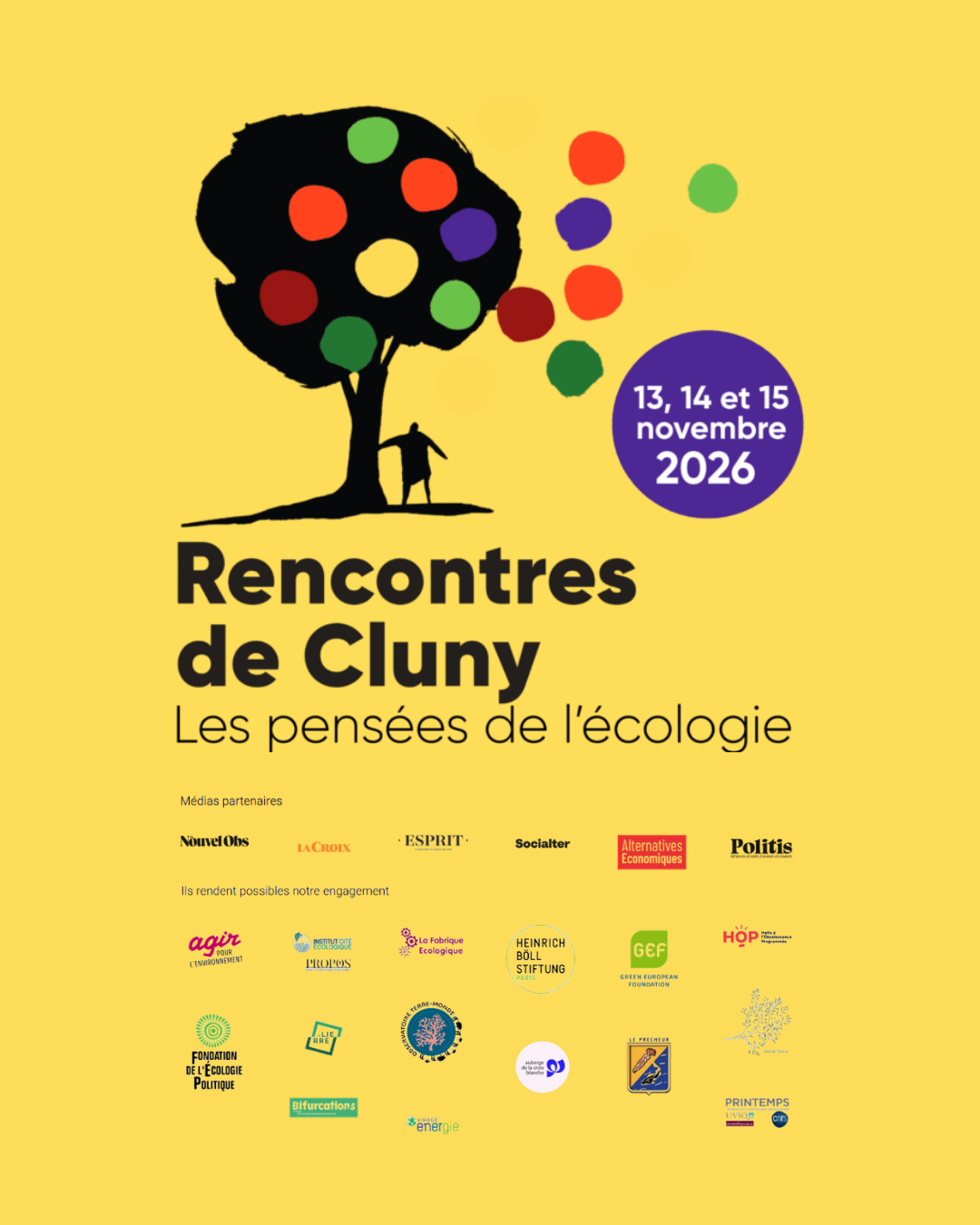
Les Rencontres des pensées de l’écologie return to Cluny from 13–15 November 2026, bringing together researchers, political representatives, activists and practitioners to confront some of the key debates and divisions shaping ecological thought and explore the foundations for a shared ecological project. Since their creation in 2022, the Rencontres have sought to move beyond traditional silos, creating a space for dialogue on the political, social and economic transformations needed to build ecologically sustainable and socially just societies. 

As part of the 2026 edition, the Green European Foundation will contribute to two European discussions on Friday 13 November. The first, 2026, annus horribilis pour l’écologie?, will examine the place of ecological issues in recent electoral choices and the apparent gap between the urgency of the climate crisis and its political salience, bringing together perspectives from France and Belgium. Later that evening, L’Europe bascule-t-elle inexorablement vers les réactionnaires? will broaden the conversation to Europe, exploring how democratic and ecological forces can respond to the rise of the far right and build credible pathways towards ecological and social transformation. Both sessions will bring European perspectives into the debates in Cluny and connect political experience, research and civil society expertise. 

Programme

Friday 13 November 2026 

14:00–16:00 | TR2: 2026, annus horribilis pour l’écologie? (FR) 

  • Jeanne Barseghian – French politician and member of Les Écologistes, former mayor of Strasbourg (2020-2026)
  • Simon Persico – Political scientist; Director, Sciences Po Grenoble
  • Zakia Khattabi – Former Belgian Minister for Climate and the Green Deal (2020–2025)
  • Hanna Sophie Mast – Deputy Chief of Staff to Federal Co-Chair Dr. Franziska Brantner, Bündnis 90 / Die Grünen
  • Moderation: Barnabe Binctin – Journalist, Basta Media

Quelle place ont occupé les enjeux écologiques dans les choix électoraux récents? Quelle coupure avec la perception de l’urgence climatique et quelle place pour l’écologie dans la campagne présidentielle?
[EN: To what extent have environmental issues influenced recent electoral choices? To what extent does this contrast with the perception of the climate emergency, and what role will environmental issues play in the presidential campaign?]

19:00–21:00 | TR7 – L’Europe bascule-t’elle inexorablement vers les réactionnaires? (FR)

  • Jens Althoff – Director, Heinrich Böll Stiftung, Warsaw Office
  • Faustine Bas-Defossez – Director for Nature, Health and Environment, European Environmental Bureau
  • Fabien Escalona – Journalist, Mediapart
  • Hanna Sophie Mast – Deputy Chief of Staff to Federal Co-Chair Dr. Franziska Brantner, Bündnis 90 / Die Grünen
  • Melanie Vogel – Member of the Senate of France and member of Les Écologistes (TBC)
  • Moderation: Benoit Monange – Co-President, Green European Foundation

Face à la montée de l’extrême droite en Europe, quelles stratégies et quels espoirs pour éviter le pire et proposer un chemin de démocratie et de transformation écologique et sociale?
[EN: In the face of the rise of the far right in Europe, what strategies and hopes are there for averting the worst and charting a course towards democracy and ecological and social transformation?]

Beyond the sessions: Green Letter Club interviews 

Alongside the programme GEF will contribute a series of video interviews, capturing the insights of leading political ecology thinkers and Green thought leaders present at the event. Produced in collaboration with the Green Letter Club, the interviews will serve to bring the fruits of the event to a wider European audience and will be published on YouTube with English subtitles as part of GEF’s Green European Observatory initiative. 

Practicalities

Date: 13–15 November 2026
GEF Talks session: Friday 13 November 2026
Location: Campus Arts et Métiers (ENSAM) – 13 Rue Porte de Paris, 71250 Cluny, France
Language: the programme of the entire event will be in French
Participation: Participant registration is required, via this link.

The full programme and further information are available on the Rencontres de Cluny website. 


The 4eme Rencontres de Cluny is organised by L’instant d’après and Fondation de l’Écologie Politique. GEF sessions and contributions are organised by the Green European Foundation, and with the financial support of the European Parliament to the Green European Foundation. 
Natural Allies: Environmental Protection for European Security (Vilnius)

By

What if nature is not only something to protect, but also part of what protects us? As Europe confronts geopolitical instability, climate breakdown, and growing societal pressures, this one–day conference explores how healthy ecosystems and resilient communities can strengthen Europe’s security infrastructure. 

About the event

Europe’s security challenges are ever more interconnected. Russia’s war against Ukraine has underlined the urgent need to strengthen defence and civil preparedness, while climate change, biodiversity loss and ecosystem degradation pose growing risks to critical infrastructure, public health, food and water security, and local communities. At a moment when Europe’s political focus is increasingly centred on military readiness, this conference asks how we can avoid creating a false choice between defence and resilience – and what it means to recognise environmental protection as part of a broader security agenda.  

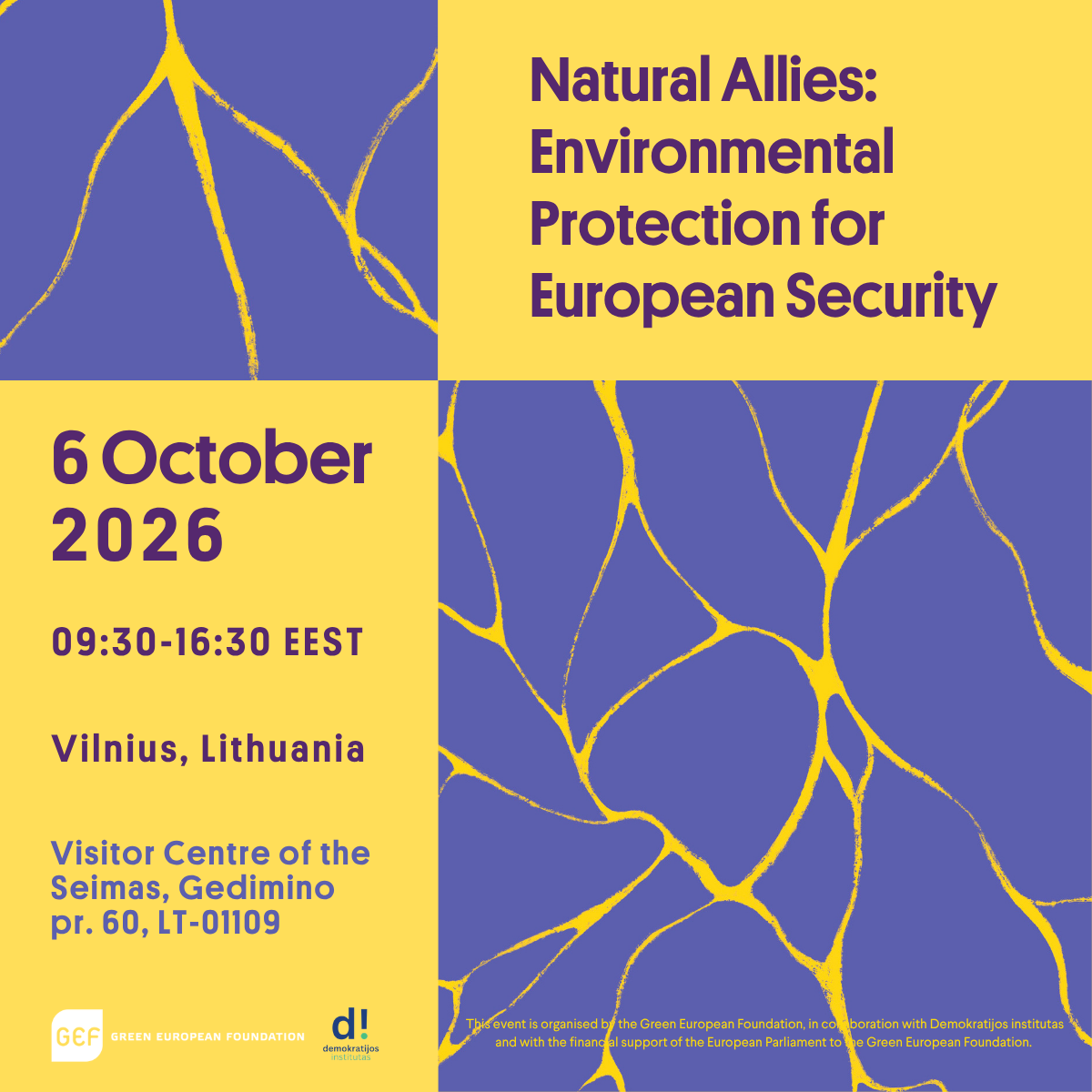
On Tuesday 6 October 2026, the Green European Foundation, in collaboration with the Demokratijos Institutas, will host a one-day conference in Vilnius to explore what it means to bring nature, defence and societal preparedness together in response to a rapidly changing security landscape. 

Taking GEF’s publication New Idealism for a Disrupted Europe  as starting point, this event will explore how we can broaden our understanding of security beyond military capabilities alone. How can ecological resilience strengthen societal preparedness? What role can healthy ecosystems play in protecting people and infrastructure? And how can Europe address defence, climate and societal resilience as interconnected challenges, rather than as separate policy areas? 

Programme

Tuesday 6 October 2026 

09:00–09:30 | Registration 

09:30-09:40 | Opening & Welcome

  • Benoit Monange – Co-President, Green European Foundation

09:40–11:00 | New Idealism: Rethinking Security for a Disrupted Europe  

  • Sofiia Shevchuk – researcher and EU policy consultant, Valia: co-author of New Idealism for a Disrupted Europe 
  • Sergey Lagodinsky (video-message)– Member of the European Parliament, Greens/EFA 

Comments by: 

  • Tomas Tomilinas – Member of the Lithuanian Parliament, Democrats for Lithuania 
  • Moderated by: Alice Hubbard, Head of Network Development, Green European Foundation

11:00–11:30 | Coffee break 

11:30–13:00 | Nature, Resilience and Defence: Examples from Europe’s Eastern Flank  

  • Introduction by: Algis Čaplikas – Lithuanian Chambers of Housing Management and Maintenance, former Minister
  • Nerijus Zableckis – Director, Foundation for Peatland Restoration and Conservation 
  • Aira Paliukėnaitė – Vice-Minister of Environment, Government of Lithuania 
  • Arina Bilai – Ukrainian political & climate activist; Board member, Rozviy
  • Dr. Michał Żmihorski (video message) — Deputy Director for Scientific Affairs of the Institute of Environmental Protection of the National Research Institute
  • Moderator: Domantas Tracevičius — Environmentalist and consumer rights advocate

13:00–14:30 | Networking lunch 

14:30–16:00 | From Resilience to Action 

  • Krista Mikkonen – Member of the Finnish Parliament, Former Minister of the Interior and Minister of the Environment 
  • Dorita Visalgienė – Chancellor, Ministry of Agriculture
  • Skirmantas Krunkaitis – Vice Minister of Health, Government of Lithuania
  • Dr. Judita Liukaitytė-Kukienė – University Lecturer, Vilnius University
  • Moderator: Richard Wouters – Research lead, Wetenschappelijk Instituut voor Solidariteit (WIS)

16:00–16:15 | Closing

  • Alice Hubbard — Head of Network Development, Green European Foundation
  • Arūnas Burinskas – Director, Democracy Institute

Practicalities

Date: Tuesday 6 October 2026, 09:00-16:30 
Location: Visitor Centre of the Seimas, Vilnius, Lithuania 
Language: English with simultaneous translation into Lithuanian
Catering: All food and refreshments provided during the event, including the coffee breaks and networking lunch, will be vegetarian and vegan.
Registration
:
The event is free and open to everyone who registers via this link. 


This event is organised by the Green European Foundation, in collaboration with Demokratijos institutas and with the financial support of the European Parliament to the Green European Foundation. 
GEF Talks at Edellä Forum (Helsinki)

By

What would it mean to approach the green transition not simply as a set of environmental policies, but as a broader reconstruction of our economies and societies? The Green European Foundation joins the Edellä Forum for a GEF Talks session, exploring bold visions for a green economy and ecological reconstruction, while unpacking the tensions, opportunities and challenges to reimagine prosperity in a drastically changing world. 

About the event

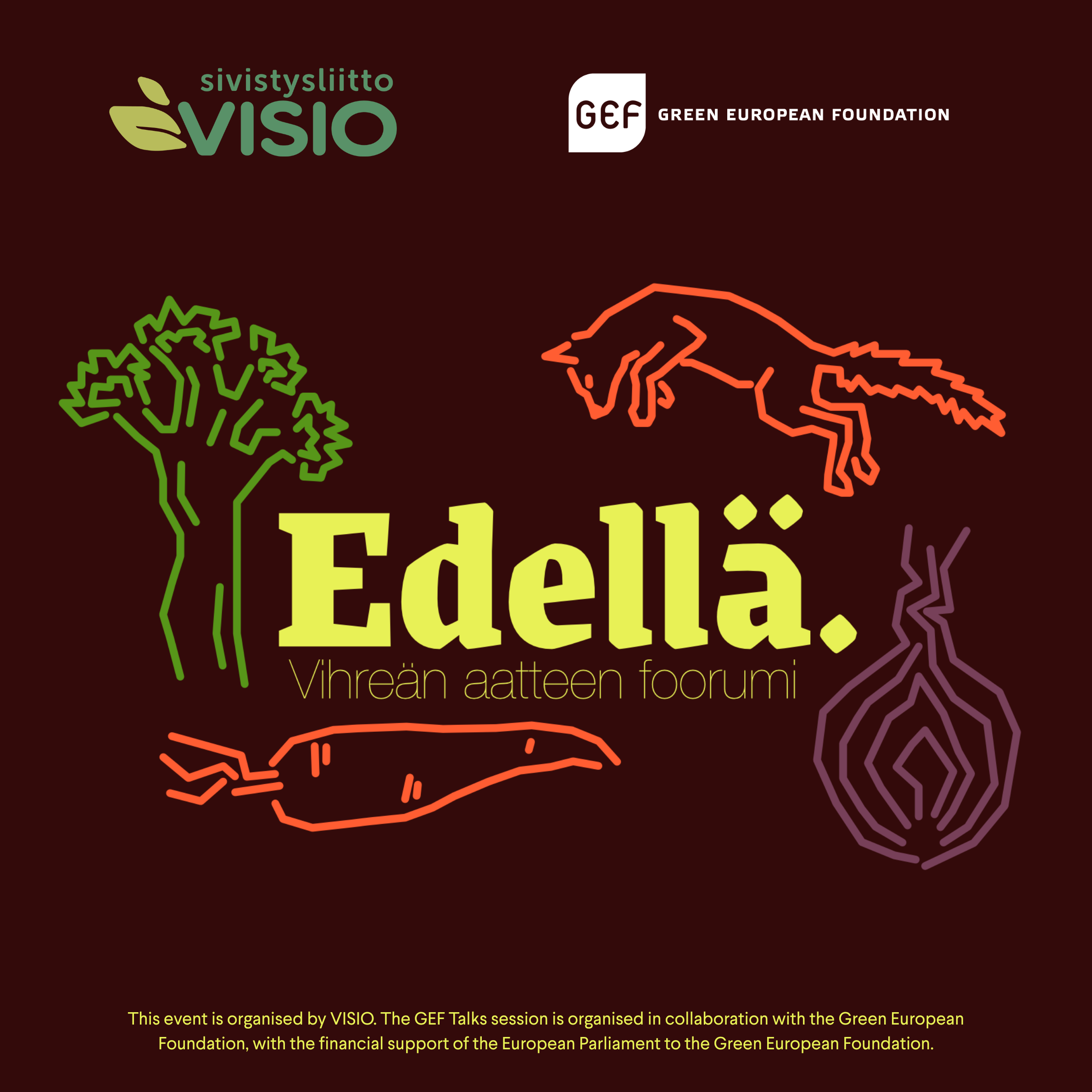
On 19 September 2026, the Green European Foundation joins Visio for the Edellä Forum in Helsinki. 

Edellä is a new forum dedicated to Green political thought, culture and social philosophy. Its name, meaning “forward”, draws on the history of the Finnish Green movement and reflects the forum’s ambition to look beyond day-to-day political debate. It offers a space to return to the roots of Green thinking, ask fundamental questions and critically reflect on the ideas and strategies needed to transform society. 

Through conversations bringing together researchers, writers, academics, activists, cultural figures and politicians, the forum will explore questions concerning the economy, welfare, equality, democracy, nature and the future of Green politics. Edellä seeks to create space for intellectual exchange, political imagination and an open discussion of the principles underpinning Green action. 

As part of the Saturday programme, the Green European Foundation will contribute a GEF Talk bringing a broader European dimension to the forum’s debates. 

Programme

Saturday 19 September 2026 

14:00–15:00 | GEF Talks – Reimagining Prosperity: Ecological reconstruction, Green politics, and the future of the economy (EN) 

  • Halliki Kreinin – Interdisciplinary sustainability researcher and lecturer at Tallinn University 
  • Atte Harjanne – Finnish Member of Parliament (Vihreä liitto)
  • Moderation: Riina Bhatia – PhD Researcher, Political ecology & political economy

This GEF Talks session will bring a leading sustainability researcher into conversation with a Finnish Green political representative to explore bold visions for a Green economy and ecological reconstruction, unpacking their transformative potential and political implications in an era of profound economic, social, and environmental change.  

What would it mean to reorganise our economies and societies around ecological limits and human wellbeing? Which institutions, alliances, and political constituencies would be needed to drive such transformation? And how can Greens connect ambitious ideas about prosperity, sustainability and economic transformation with the everyday concerns of citizens?  

Combining perspectives from research and political practice, the discussion will explore the key the tensions and opportunities facing the Green movement as it seeks to connect ecological reconstruction with questions of welfare, equality and economic security. It will also consider how Green politics can move beyond managing the transition and articulate a compelling vision for the societies and economies it wants to build. 

Practicalities

Date: 18–19 September 2026
GEF Talks session: Saturday 19 September 2026, 14:00–15:00
Location: Bar Typo room, Tekstin talo, Lintulahdenkatu 3, Helsinki, Finland
Language: The GEF Talks session will be held in English. The wider forum programme will mainly be in Finnish.
Participation: The event is free and open to everyone. No advance registration is required. 

The full programme and further information are available on the Edellä Forum website. 


The Edellä Forum is organised by VISIO. The GEF Talks session is organised by the Green European Foundation in collaboration with the VISIO, and with the financial support of the European Parliament to the Green European Foundation. 
GEF Talks at Green Academy (Komiža)

By

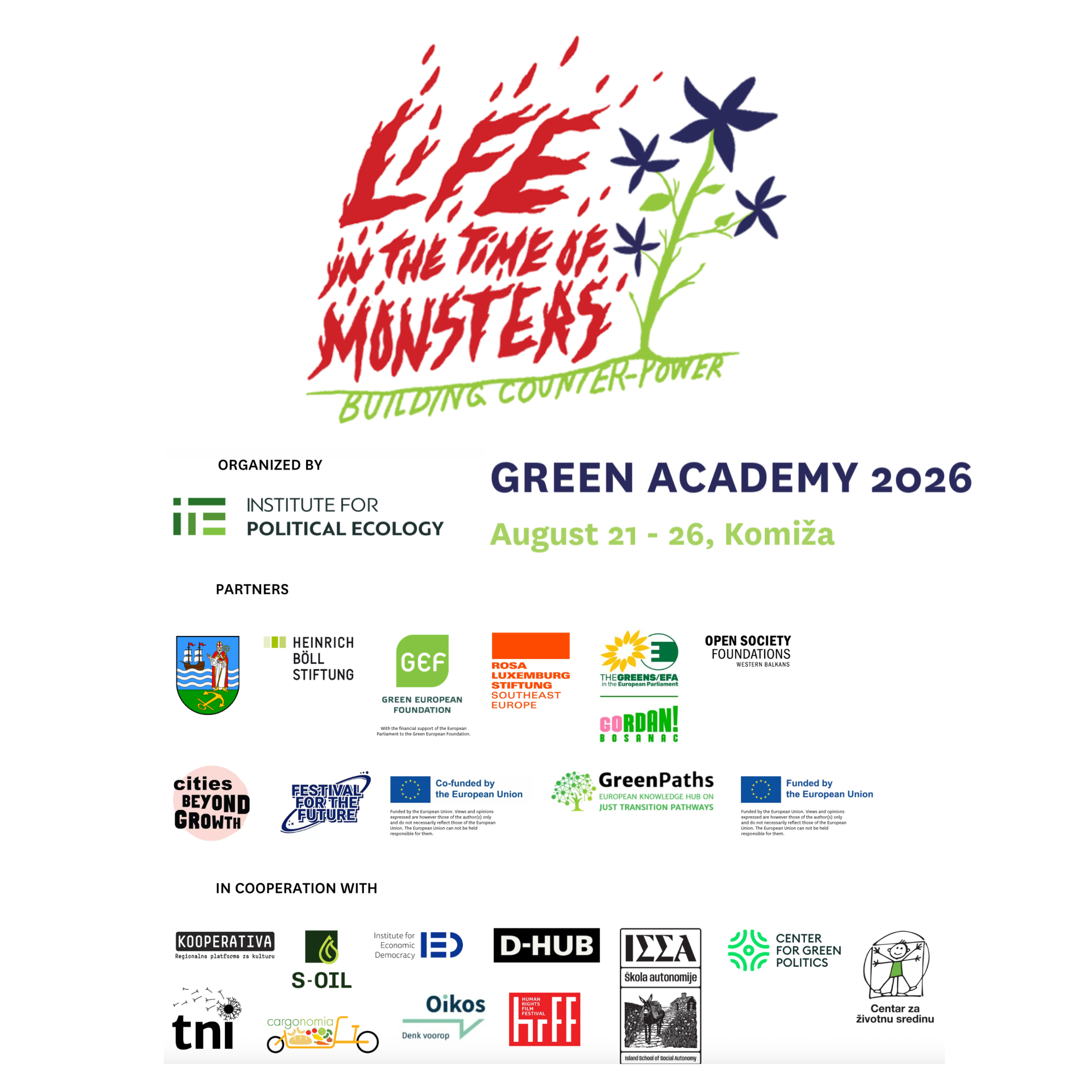
What does it mean to build counter-power in a time of monsters? As Europe faces growing insecurity, climate collapse, democratic backsliding and profound shifts in the global order, the Green European Foundation joins the 10th edition of the Green Academy with a series of GEF Talks exploring the political ideas and strategies needed to shape a Green response.

About the event

From 21–26 August 2026, the Green European Foundation joins the Institute for Political Ecology and partners for the 10th edition of the Green Academy, taking place on the island of Vis, Croatia, under the title “Life in the Time of Monsters: Building Counter-Power”.

Established in 2010, the Green Academy is an educational and discussion platform centred on political ecology, bringing together debates on degrowth and post-growth, the commons, ecological transition, municipalism and public services. Over the years, it has become an international meeting point where green and progressive scholars, practitioners, researchers, politicians and activists exchange knowledge, experiences and political strategies.

With this tenth edition, the Green Academy seeks to collectively explore green and left responses to a political moment characterised by growing insecurity, ongoing wars and conflicts, climate collapse and profound shifts in the global order. The Academy will provide a space to examine different strands of green-left political thought and action, and to explore how to build the forms of counter-power needed to inspire, empower and strengthen progressive politics across Europe.

Throughout the Academy, the Green European Foundation will contribute a series of GEF Talks and workshops that connect current Foundation projects with the Academy’s overarching themes. From demographic futures and Greens in government to Europe’s contested green transition, the rise of the far right and the relationship between technology and democracy, these sessions will bring together researchers, policymakers and Green actors from across Europe to exchange experiences, challenge assumptions and collectively reflect on the political strategies needed for the years ahead.

Programme

You can find the GEF Talks sessions below. The full Green Academy programme is available here on the Institute for Political Ecology’s website.

Friday 21 August 2026

21:00–23:00 | Opening Debate – Do Monsters Smell Flowers? (EN)

  • Inga Rademacher – Professor of International Political Economy, School of Policy and Global Affairs, City St. George’s University of London
  • Asad Rehman – Chief Executive, Friends of the Earth Europe
  • Meryem Almaci – Member, GEF Board and Member of Flemish Groen Party
  • Sabrina Fernandes – Brazilian writer, economist and climate activist

The official opening debate of the Green Academy explores how progressive movements can respond to today’s multiple crises while imagining new forms of political action and hope.

Saturday 22 August 2026

11:30–13:30 | GEF Talks – Lecture: The Far Right as an Economic Monster (EN)

  • Inga Rademacher – Professor of International Political Economy, School of Policy and Global Affairs, City St. George’s University of London

This workshop examines the economic narratives underpinning the contemporary far right and explores progressive alternatives capable of challenging them.

Sunday 23 August 2026

11:30–13:30 | GEF Talks – Greens in Government. A Participatory Session on Navigating  Power and Anchoring the Transition (EN)

  • Florent Marcellesi – Senior EU Consultant, former Member of the European Parliament and former co-chair of the Spanish Greens Equo

This interactive GEF Talk presents the framework and first insights of the Green European Foundation’s “Greens in Government” project. The project examines the institutional, organizational, and societal anchoring of Green participations in regional and national governments. Designed as a participatory session, this workshop brings together research perspectives and political experiences to focus on: the modalities of entry, renewal, or exit of governments by the Greens; the institutional and human imprint they leave on public administration; their ability to build trust, as well as long-term political and social legitimacy; the evolution of Green political identity, strategy, and internal dynamics under conditions of power; their ability to adapt and navigate external conditions and major political, social, and cultural trends during different election cycles. Participants will actively contribute to sharing practices and collective learning for Greens in power.

Monday 24 August 2026

10:00–11:30 | Keynote

  • Emma Holten – feminist debater, online humans rights activist and editor of Friktion magazine

11:30–13:30 | GEF Talks – Deal or No Deal: The Contested Futures of Europe’s Green Transition (EN)

  • Agata Meysner – Board member, Green European Foundation and Co-Founder, Generation Climate Europe
  • Sandra Bencic – Member of Parliament and co-leader, Možemo! 
  • Pablo Sanchez – Local and Regional Government Officer, European Public Services Union
  • Moderation: Jamie Kendrick – Head of Policy, Green European Foundation

Europe’s Green Deal has entered a new political phase. This panel explores the contested futures of Europe’s green transition; speakers will sketch out the contradictory trends defining the current movement and look ahead to key struggles for European green politics.

18:00–19:30 | GEF Talks – Beyond the Tech Race: Reimagining Europe’s Digital Future (EN)

  • Jan Philipp Albrecht – President, Heinrich Böll Stiftung
  • Renata Ávila Pinto – CEO, Open Knowledge Foundation
  • Moderation: Seden Anlar – Journalist, Climate Communicator

Tuesday 25 August 2026

11:30–13:30 | GEF Talks – Europe Is Ageing – Who Cares?  (EN)

Thinking with the Green European Journal‘s latest print edition, Life Lines.
  • Emma Holten – feminist debater, online humans rights activist and editor of Friktion magazine
  • Silvana Briones Piedrafita – Technical Advisor on Information, Office of the Spanish Minister of Social Rights, Consumer Affairs, and the 2030 Agenda
  • Jelena Miloš – Member of Parliament, Možemo!
  • Moderation: Alessio Giussani – Editor in chief, Green European Journal

Drawing on the latest edition of the Green European Journal, this roundtable examines demographic change, ageing societies, care, migration and intergenerational justice from a political ecology perspective.


Practicalities

Date: 21-26 August 2026

Location: Komiža, Vis island, Croatia

Language: English and Croatian

This is an invitation-only event with limited capacity. For more information please contact carlotta.geremia@gef.eu or lana@ipe.hr.


The GEF Talks sessions are organised by the Green European Foundation with the support of Institute for Political Ecology and with financial support of the European Parliament to the Green European Foundation. 
Post-growth Future(s): New Voices, Novel Visions

By Publications

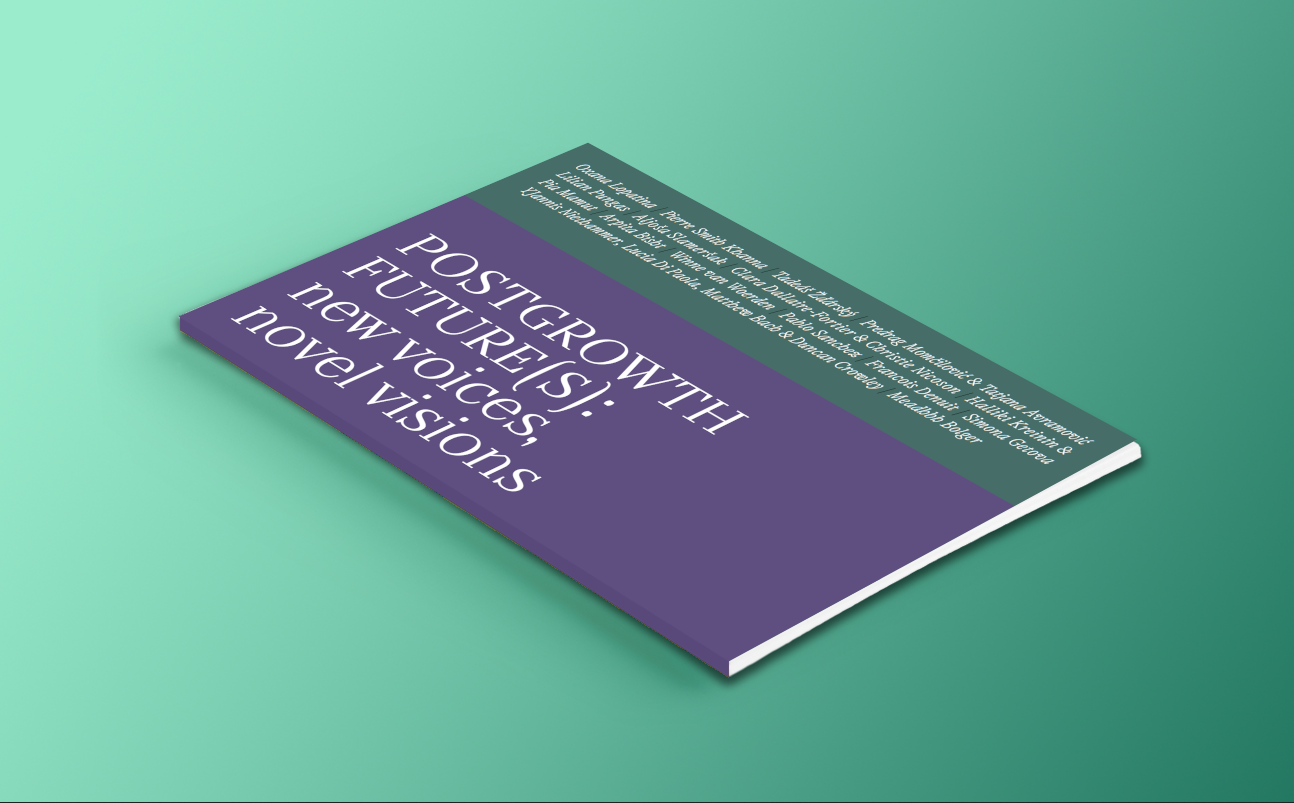
Growth is no longer a viable path, yet the idea of a post-growth society is still struggling to enter mainstream politics. Despite mounting ecological and social crises, policy discussions remain locked in outdated economic paradigms. However, recent years have marked a turning point, with post-growth thinking gaining momentum in European institutions, civil society, and academia.

The age of growth is behind us, but hardly anybody dares to admit it. […] In this publication, we say it loud and clear: growth is past tense. We need to engage now, without delay, in reimagining prosperity and wellbeing beyond growth

This publication brings together 20 authors from across Europe to explore what a future beyond growth could look like. Through diverse perspectives, it examines how post-growth ideas can reshape economic structures, social justice frameworks, and environmental policies. It also highlights how new voices (academics, activists, and policymakers) are translating these ideas into concrete political and policy action. By connecting emerging debates with real-world transformations, the publication contributes to strengthening the movement for a just and sustainable post-growth future.

This publication is part of the Green European Foundation’s work on post-growth in the scope of the project Post-Growth Future(s). It builds on discussions from key post-growth events, including the Beyond Growth Conference in Brussels and the International Degrowth Conference in Zagreb. The publication amplifies new ideas and connects them with the broader movement for systemic change.


This publication has been realized by the Green European Foundation with the support of  the Institute of Political Ecology and the Heinrich Böll Stiftung, as well as with the financial support of the European Parliament to the Green European Foundation. The European Parliament is not responsible for the content of this publication.

Green Academy: Stay with the Trouble! (Komiža)

By

About the event:

The Green Academy is a discussion and dialogue platform, established in 2010 as a space for advanced learning in political ecology. The 9th edition of Green Academy is entitled ”Stay with the Trouble,” and will feature a varied programme of keynotes, panels, workshops, and social activities. As part of the programme, GEF is hosting a series of Green Talks spotlighting our latest work on the wellbeing economy, adaptation, and building a resilient Europe beyond growth.

Project background:

If trends continue, the summer of 2024 is likely to be the hottest yet, with the daily reality of the climate crisis coming into even sharper focus for ever more citizens. Yet unlike five years ago, climate and biodiversity do not dominate the political headlines or European voter priorities, whether due to disillusionment, disinformation, or competing concerns like cost-of-living and (in)security.

More than ever, it is important to demonstrate how social and ecological justice go hand in hand, and to foster the bottom-up democracy to make that happen. Concepts and ideas like post-growth, the commons, and citizen assemblies may hold some of the answers, but need the right narratives and policy grounding to truly pierce the mainstream European debate. GEF has supported this endeavour for a long time, including as a partner of the 2023 Beyond Growth Conference in the European Parliament and the International Degrowth Conference that took place in Zagreb that same year.

As we get ready to enter a new EU cycle, with a reshuffled parliament and Commission, it is crucial to keep the momentum going and ensure that wellbeing and a prosperous Europe beyond growth remain on the agenda. The Green Academy provides a constructive yet convivial setting in which to learn, exchange and expand on this challenge, in line with GEF’s role as a hub for political education and laboratory for new ideas.

Programme and Speakers:

GEF’s Green Talks  are featured in specific slots throughout the programme. August 24th and August 28th are arrival and departure days.

Monday, 26/08 (12 – 13:30): Enough – Thriving Democracies for Tomorrow’s Europe

Panel discussion with Remy Bonny, Danijela Dolenec, Dirk Holemans, and Elze Vermaas (moderated by Alice Hubbard)

Tuesday, 27/08 (12 – 13:30): A Race Against the Clock? Time and Climate Adaptation

Panel discussion with Marc Martorell Escofet, Marie-Monique Franssen, and Katarina Kusic (moderated by Alessio Giussani)

Tuesday, 27/08 (17 – 19:00): Knowledge Community on the European Wellbeing Economy

Interactive workshop with Emma Bergeling and Antoine Oger (moderated by Sien Hasker and Laurent Standaert)

Practicalities:

Date and Time: 24-28 August

Location: Hotel Biševo – Komiža, Croatia

Language: English 

This is an invitation-only event with limited capacity. For more information please contact sien.hasker@gef.eu and/or lana@ipe.hr.   


This event is co-organised by the Green European Foundation with the support of the Institute for Political Ecology and with the financial support of the European Parliament to the Green European Foundation. The European Parliament is not responsible for the content of this event.
Citizen Assemblies in action (Brijuni)

By

About the event

In this study trip, participants will explore the broad definition of citizen assemblies and how they can contribute to a vivid and active democracy. Guests and experts from academic and practical backgrounds will share their expertise with the participants and enable an exchange of ideas and concepts.


Speakers

  • Igor Vidačak, Faculty of political sciences (Zagreb)
  • Gesa Maschowski (Bonn4Future Climate Forums)
  • Micheal O’ Cinneide(Galway)
  • Igor Bajok(Rijeka)
  • Damir Kapidžić, University of Political Sciences Sarajevo
  • Jovana Timotijević, Ministry of Space
  • Vujo Ilić, University of Belgrade

Programme

Saturday October 14

09:30 Igor Vidačak, Faculty of political sciences (Zagreb) -”Relevance, innovations and impact of deliberative citizen engagement models and methods”

10:30 Gesa Maschowski (Bonn)-”Bonn4Future Climate Forums” (online)

11:30 Coffee break

12:00 Micheal O’ Cinneide(Galway)-”Citizens’ Assembly on biodiversity loss in Ireland process and outcomes”

13:00 Igor Bajok(Rijeka)-”Citizens‘ Assembly in the making–case of city of Rijeka”

14:00 Lunch

15:00 Joint photo and free time for a walk in the Brijuni Nationalpark

17:00 Damir Kapidžić, University of Political Sciences(Sarajevo)-“Can Citizens ’Assemblies resolve democratic deficits in divided societies? The case of Mostar in Bosnia and Herzegovina”

18:00 Jovana Timotijević, Ministry of Space (Belgrade)-”Experimenting with deliberation in urban planning –case of four deliberative forums in Belgrade”

19:00 Vujo Ilić, University of Belgrade-”Deliberative mini-publics in Serbia and Southeastern Europe: Possibilities and limitations for empowering democracy”

20:00 Dinner


Sunday October 15

9:00 Plenary

10:00 Partners project meeting (internal)

12:00 Lunch


Practicalities

Date and Time: 14.10.2023 9:30 – 15.10.2023 13:00

Location: Brijuni, Croatia

Language:  The main language of the event will be English.


This event is organised by the Green European Foundation with  the support of Institute for Political Ecology and the financial support of the European parliament to the Green European Foundation.

Sketches of a New City

By Uncategorized

Context

While no city is the same, one thing all have in common is the challenge of creating a society that is fit for the future. Some of the most present problems citizens living in cities are experiencing are the effects of climate change–such as rising heat or lack of water. On a political level, cities often lack opportunities for citizens to actively engage and be part of decision-making processes on citie’s future.

Far too often, big and ambitious projects end with failures. We want to start in the opposite way – with small sketches; with working material that can in time develop into something durable and resilient’’

Objectives

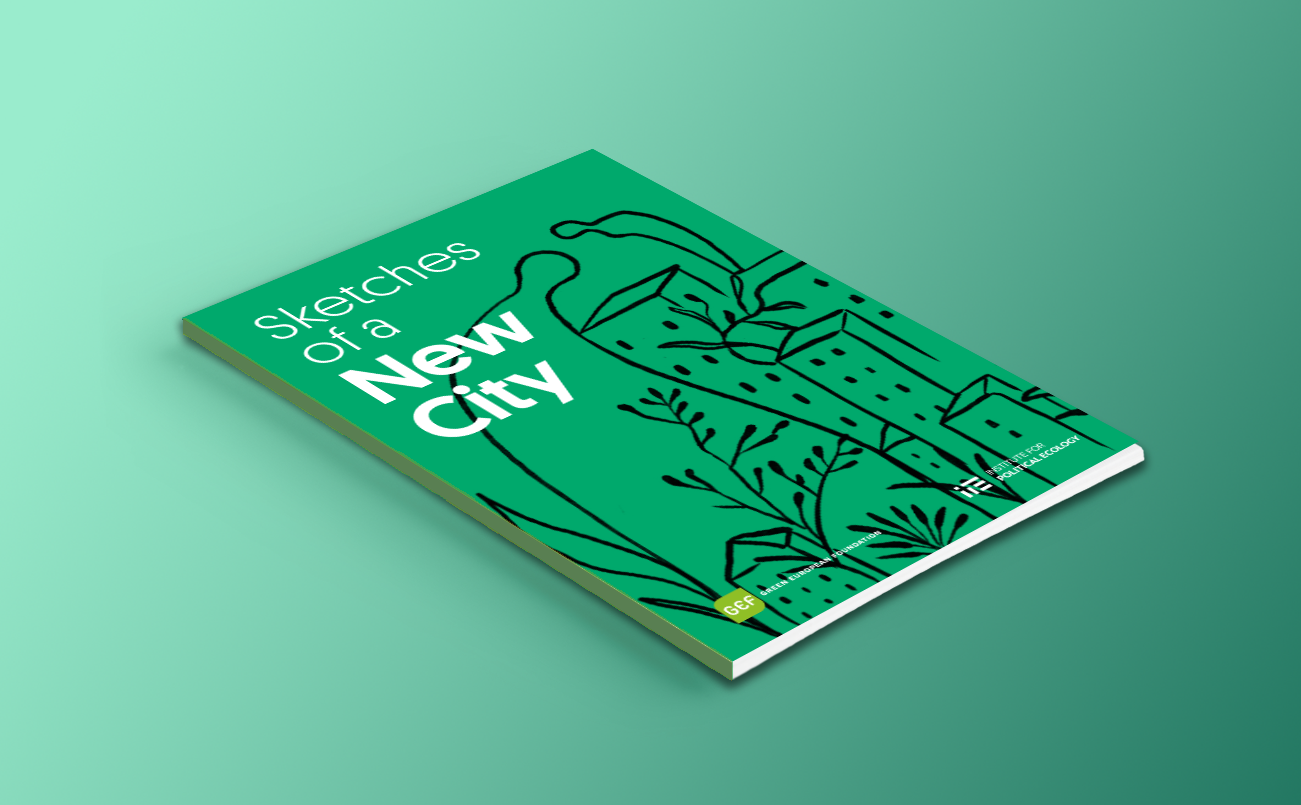
In this publication, researchers, scholars, practitioners and activists share their insights gained through the direct experience and empirical evidence on the daily struggle of key changemakers at the municipal level aiming to inspire and educate citizens all over the world.


Project Background

This publication is one of the results of IPE’s participation in the GEF transnational project “Cities as Places of Hope – Resilient Cities”, where we aimed to vividly illustrate the most recent developments in some European cities and trace the pathways through which they can develop resilience, increase the well-being of citizens, reach ecological sustainability, and achieve more social justice.

Available in

Translations

Available in Macedonian

Available in Greek


This report has been realised by the Green European Foundation with the support of the Institute for Political Ecology, and the financial support of the European Parliament to the Green European Foundation. The European Parliament is not responsible for the content of this publication.

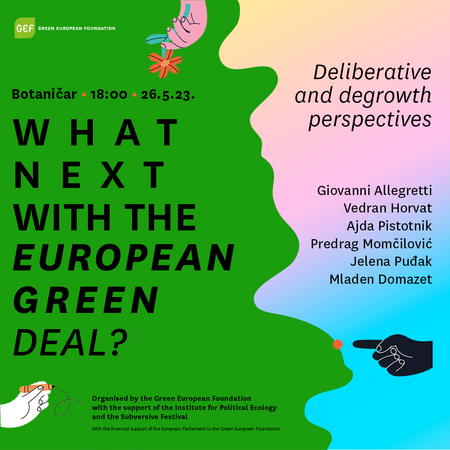
European Green Deal: Degrowth and Deliberative Perspectives

By

About the event

The European Green Deal (EGD) is an ambitious long-term program of the European Commission to implement a green and just transition in Europe. With EGD, we should become a climate neutral continent focused on the well-being of citizens and operating within ecological limits.

This ambitious plan is often threatened by financial interests which aim to implement it under the umbrella of green growth, in an authoritarian, technocratic and technology dependent manner. The social and democratic dimension of the Green Deal remains unclear, and the prosperity of citizens in such a narrative is still linked to the idea of indefinite economic growth. Therefore, as part of this event we will dive deeper into the debate related to deliberative democracy/civic participation from a degrwoth perspective -a concept that approaches the question of well-being as not dependent on economic growth. Discussants from Ljubljana, Zagreb and Belgrade will share with us insights on the reception of the concept of degrowth in the European semi-periphery, in the context of the European Green Deal.

Event aims to attract variety of stakeholders and bring them into discussion; scholars, researchers, activists, municipal politicians, intellectuals, trade unionists, cultural workers and all other citizens interested to discuss the future of well-being beyond the growth. It combines European perspective which will be brought by European key note speaker on deliberative and participatory democracy and green activists from the region to discuss development of narrative and idea of degrowth/postgrowth in the region.


Project background

This project is part of the Postgrowth Future(s) one partner project aiming  to draw attention to the topic of Degrowth as well as the forthcoming 9th International Degrowth Conference which will take place in August 2023 in Zagreb. With thematic focus on the European Green Deal it brings additional perspectives and angles to the discussion, originating from degrowth movement and deliberative practices.


Speakers

  • Giovanni Allegreti, University of Coimbra, Portugal
  • Vedran Horvat, Institute for Political Ecology/GEF
  • Jelena Puđak, Scientists for Climate, Croatia
  • Ajda Pistotnik, Policy Lab, Slovenia
  • Predrag Momčilović, Center for green politics, Serbia
  • Mladen Domazet, Institute for philosophy


Programme

18:00 Introduction and welcome – Vedran Horvat

18.10 Key not lecture – Giovanni Allegreti

18.40 Discussion

19.10 Public debate – Ajda Pistotnik

19.20 Public Debate – Predrag Momčilović

19.30 Public – Debate Jelena Puđak

19.40 – discussion

20.00 Conclusion and announcement


Practicalities

Date and Time: Friday 26th May 2023.

Location: Botaničar café, Marulićev trg, Zagreb

Registration:  No registration needed

Language: Croatian


This event is organised by the Green European Foundation with the support of  Institute for Political Ecology and the financial support of the European Parliament to the Green European Foundation

The Future of the City: What do Donuts have to do with it? (Zagreb)

By

Context

Our international speakers will give an introduction to doughnut economics, explain the concept of degrowth doughnut, and show why more and more European cities are adopting it.

This event is part of the Cities As Places of Hope project, organised by the Green European Foundation with the support of Oikos, the Institute for Political Ecology, Transición Verde, Nous Horitzons Fundacio, Sunrise, Green Thought Association and Wetenschappelijk Bureau GroenLinks, and with the financial support of the European Parliament to the Green European Foundation. The project, launched in 2019, has aimed at fostering progressive city networks to achieve a fairer, greener Europe. Its theme in 2022 is “Resilient cities”.
 

Speakers

–Dirk Holemans (Oikos, GEF Co-President) –Ajda Pistotnik (Policy Lab, Ljubljana)–Mladen Domazet (Institut za političku ekologiju, Zagreb)–Clara Dallaire-Fortier (PhD student, Lund University) – via Zoom–Tomislav Cik (Institut za društvena istraživanja, Zagreb)


Practicalities

Date and Time: 11th November, 18:00PM CET.

Location: MAMA Zagreb, Preradovićeva 18 10000 Zagreb, Croatia

Registration: Not required.

Language: This event will be in English language.


This event is organized by the Green European Foundation with the support of Insitute for Political Ecology and the financial support of the European Parliament to the Green European Foundation.

Stara Planina: Tourism and Natural Resources

By

Programme

Throughout the study tour, partners will be meeting local stakeholders and activists, from the tourism sector as well as the wider community. Particular attention will be paid to the issue of water, as the mountain range plays an important role in the region’s water flows, but developments over the past two decades have significantly impacted the landscape. The programme is provisional and subject to change. 

September 15th 

  • Arrivals in Belgrade and initial project exchanges 
  • Travel to Pirot in the evening 

September 16th 

  • Visit Temska village, with Milinka Nikolić (environmental activist and Serbian MP for Moramo) – history of the fight for river preservation 
  • Head to Topli Do to see waterfalls and exchange with local activists 
  • Spend the night in Topli Do 

September 17th 

  • Head to Dojkinci village for a sustainable farm visit 
  • Meet members of the first energy collective form Serbia, based in the Balkan Mountains 
  • Return to Belgrade in the evening 

September 18th 

  • Closing partner meeting, departure from Belgrade 

Practicalities

Date: 15-18 September 

Location: Stara Planina and Belgrade, Serbia 

This is a closed study trip for selected project partners. Learn more about the project here. 


This study trip is organised by the Green European Foundation with the support of PolEkol and the financial support of the European Parliament to the Green European Foundation. 

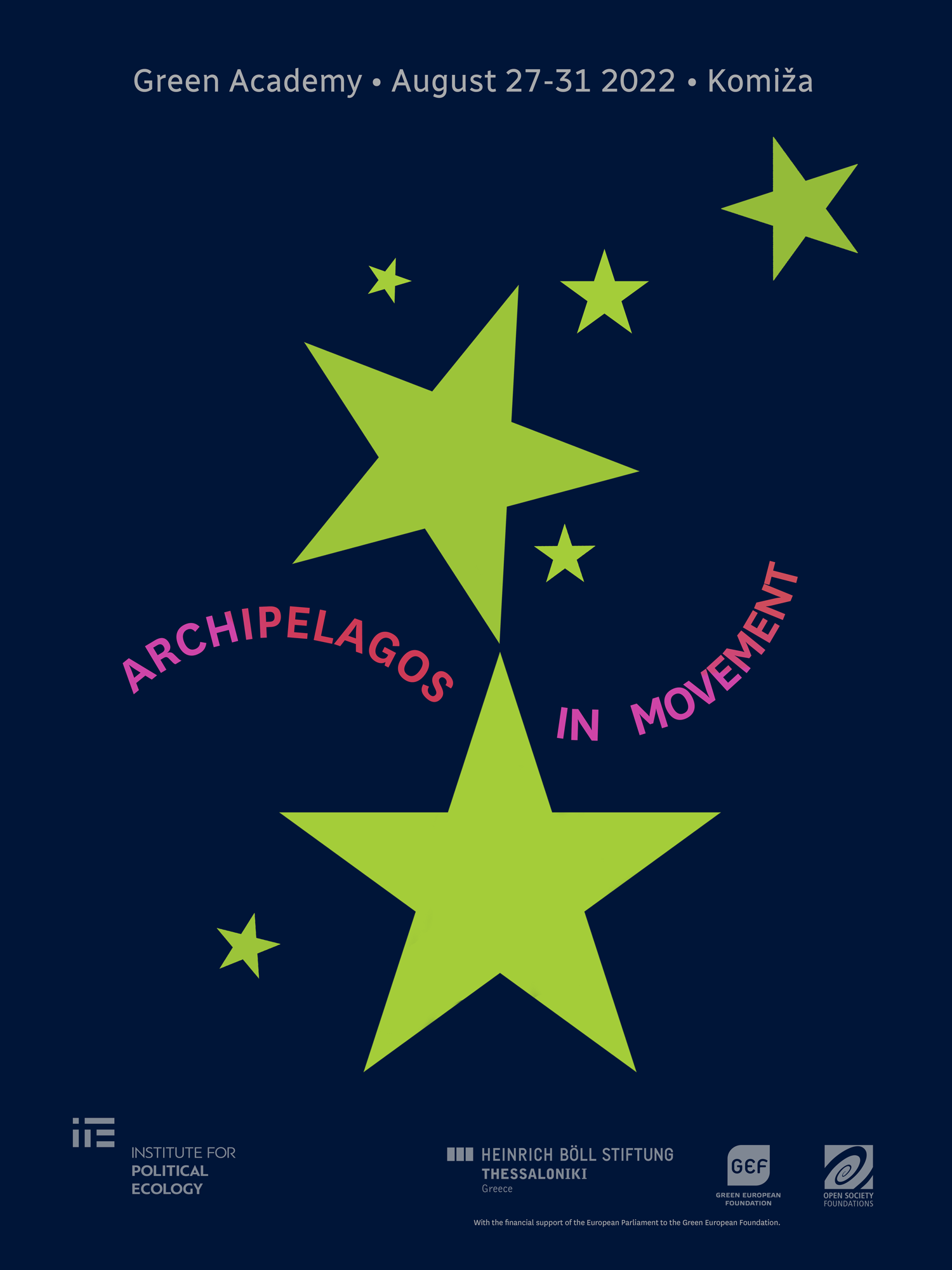
Green Academy: Archipelagos in Movement (Komiža)

By

About the event:

In the aftermath of the COVID-pandemic and surrounded with the devastating impacts of the war in Ukraine, we are moving forward with the second decade of the Green Academy, an effort to provide permanent discussion and a learning platform for progressive, green and left social forces in the Balkans, Europe and internationally.

While new energy and food crises are approaching quickly, the depth of the climate crisis and huge loss of biodiversity did not disappear. On the contrary, they are at its peak, continuing to challenge our maturity to create conditions for the good life of the generations to come. And yet, achievements and successes, bigger and smaller, of green and progressive political platforms in Croatia, Serbia, Montenegro and Slovenia demonstrate that the green wave is spreading through Eastern Europe and the Balkans – and that the protagonists that might be carriers of systemic change, though surrounded by hostile environments and worsening conditions, are gaining more and more recognition and power.

Our event is located on the island of Vis, in the midst of the Adriatic archipelagos, but in this 8th edition we explicitly focus on symbolic archipelagos of epistemological, cognitive, practical and political “islands of change” that exist across geographical but also institutional, disciplinary and practical territories and imaginaries. Placing our conversations and learnings in time of turbulences and global turmoil, we aim to create conditions to dive deeper into ideas, cases or models of transformative practices where more autonomy and/or innovation is being exercised, with the final goals of ensuring a just, secure, democratic and ecologically sustainable future. These emerging archipelagos spread across different division lines of class, gender, disciplines, sectors; as spaces of autonomy, emancipation and counter power to any oppressive, extractive, exclusive regime. It is the movement of these archipelagos that can open the door for paradigmatic shift and systemic change, which still appears to be very fragile.

This year, we will dive deeper into our imaginary of change and search for the ways of mutual empowerment. We will revisit our roles and reflect upon our strategies; learn from various experiences and dive deeper into ideas that are based on more autonomy, more self-organisation and internal knowledge-sharing. Before the next wave of expansion, our archipelagos need time to reflect on achievements and failures which occurred in our collective experience. Our program is inclined to be more open to initiative and self-organisation. Therefore, besides keynote lectures, panels and workshops, we will ensure sufficient time for participants to self-organize around certain topics and propose topics around which they want to initiate discussion (see Call for sessions).

Programme:

Confirmed speakers include: 

  • Dirk Holemans – co-president of the Green European Foundation, director of Oikos 
  • Danijela Dolenec – deputy mayor of the city of Zagreb, Možemo! 
  • Giorgos Kallis – ecological economist, Universitat Autònoma de Barcelona (UAB) 
  • Jagoda Munić – director at Friends of the Earth Europe 
  • Srećko Horvat – philosopher, DiEM25 

Check out the provisional programme via this link. 

Practicalities:

Dates and Time: 27th to 31st of August 2022. Registration starts at 18:00 on the 27th of August and the program starts at 20:00 with the opening session. During your stay at the Green Academy, the program will start at 9:30 and end at 22:30 (including 4 hours of lunch, sun, and sea break between 13:30 and 17:30).

Catering and Accommodation:  Participants will have paid accommodation in two-bed rooms, including breakfast and dinner in Hotel BiSevo, which is also the primary event venue.

Location and Travel: The Island of Vis is easily reached via a ferry line from Split, Croatia. Check www.jadrolinija.hr for timetables. Once you arrive on Vis, a bus to Komiza waits for you in front of the port. Check the bus timetable here.

Due to decreased funding in 2022, we are able to offer travel costs only to speakers. In cases of international travel, where more people travel together (car-sharing) or take public transport to reach the Green Academy, co-financing of travel costs (up to 50%) will be considered. Travel costs within Croatia will not be covered.

Call for Action:

Registration for this event is now closed.  


The Green Academy is organised by the Green European Foundation and Institute for Political Ecology, with the financial support of the European Parliament to the Green European Foundation.

North Macedonia: Mass Tourism Alternatives

By

Programme

Throughout the study tour, partners will be accompanied by a local expert in sustainable tourist practices as well as a video crew who will be filming and interviewing key case studies and stakeholders along the way. 

May 27th 

  • Arrivals in Skopje and initial project exchanges 

May 28th 

  • Morning departure from Skopje 
  • Visit of Mavrovo national park and Jance village – sustainable tourism practices and presentation on construction and building policies 
  • Arrival in Ohrid (UNESCO heritage), with dinner at nearby Kuratica village and presentation on alternative touristic offers 

May 29th 

  • Morning exploring Ohrid, partner meetings and stakeholder conversations 
  • Visit village of Dihovo – local tourism practices and slow food movement 
  • Arrival in Demir Kapija – winery tour and accommodation – and meeting with Vlado Srbinovski (Balkan Association of Alternative Tourism) 

May 30th 

  • Partner meetings, return to Skopje 

Practicalities

Date: 27-30 May 

Location: North Macedonia (Skopje and Lake Ohrid region) 

This is a closed study trip for selected project partners. Learn more about the project here. 


This study trip is organised by the Green European Foundation with the support of ASSED Sunrise and the financial support of the European Parliament to the Green European Foundation. 

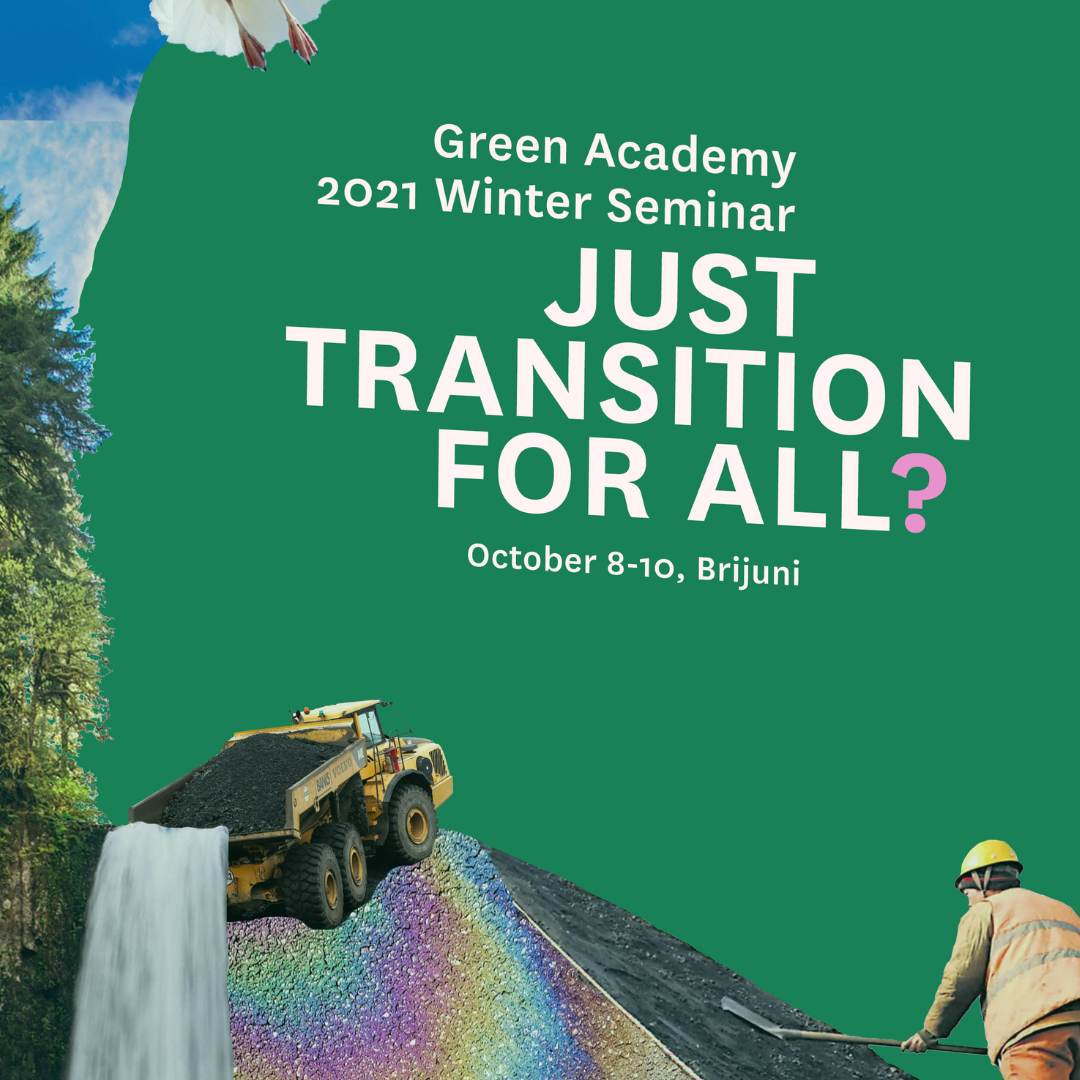
Just Transition for All?

By

About the event

This three-day seminar will serve as a place to discuss opportunities and limits of just transition and explore its transformative potential.

 During the seminar, we will:

  • provide a first approach to the concept of just transition,
  • discuss the role of trade unions and workers,
  • discuss the transfer from extractive to regenerative economy,
  • explore just transition to a European and global level in solidarity,
  • Link it to recovery plans and European Green deal,
  • Explore opportunities for decent jobs,
  • discuss specific conditions of just transition at European semi periphery

Also, we will dive much deeper into just transition in the transport sector, where we will learn and discuss under which conditions sustainable mobility can become an example of just transition policies.

We see this seminar as one milestone in a systemic approach to concepts and practices of just transition in this part of Europe, and an important milestone in establishing epistemic communities in this field.


This project is organised by the Green European Foundation with the support of the Institute for Political Ecology in cooperation with the Heinrich Böll Foundation, Prague office, and the European Climate Initiative with the financial support of the European Parliament to the Green European Foundation. The European Parliament is not responsible for the content of this event.

Barcelona: Proximity Tourism

By

Programme

January 21st

09:00 – 10:30  Introduction of the programme and the Metropolitan Area of Barcelona

11:00 – 12:30     Visit to Fundesplai Youth Hostel

12:30 – 13:30    Guided visit to “Eat, Act, and Impact” exhibition on New Food Systems

13:30 – 15:00    Lunch

15:00 – 16:00   Meeting with Association for Tourism and Gastronomy

16:00 – 17:00    Visit to Agriculture Park of Baix Llobregat

17:00 – …            Dinner and free time

January 22nd

09:30 – 11:30   Guided visit of Natural Park wetlands of Llobregat Delta

12:00 – 12:30    Visit to El Prat beach

12:30 – 13:30    Guided visit to CRAM (Recovery centre for sea animals and coastal birds)

14:00 – 15:30   Lunch

15:30 – 16:00    Closing

Practicalities

Date: 21-22 January

Location: El Prat, Barcelona Metropolitan Area, Spain

This is a closed study trip for selected project partners. Learn more about the project here.


This study trip is organised by the Green European Foundation with the support of Fundacio Nous Horitzons and the financial support of the European Parliament to the Green European Foundation

Rust: National Park Tourism

By

Programme

12 November

17:00 – 19:00    Arrivals

19:00 – 21:00    Traditional tavern dinner with regional cuisine

13 November

10:30 – 12:00    Ferry across Neusiedlersee

12:00 – 13:30    Lunch meeting with national park managing expert Alois Lang

13:30 – 14:30    Presentation on national park management and marketing (visitor centre)

14:30 – 16:30    Hands-on tour of the national park

18:00 – 20:00   Rust city tour with emphasis on tourism management and marketing

20:00 – 21:30   Dinner

14 November

10:30 – 12:00    Tour at sustainable vineyard – showcase of environmentally friendly farming techniques

12:30 – 13:00    Closing and departures

Practicalities

Date: 12-14 November, 2021

Location: Rust, Austria

This is a closed study trip for selected project partners. Learn more about the project here.


This study trip is organised by the Green European Foundation with the support of FREDA and the financial support of the European Parliament to the Green European Foundation.

Pula: Seasonal Tourism

By

Programme

13 October

16:00 – 17:00    Arrivals to Pula

17:00 – 18:30    Short sight-seeing tour of Pula

19:30 – 21:00    Dinner with hotel director

14 October

08:00 – 09:00 Breakfast meeting with Pula tourist board president

9:00 – 12:00     Visit to Arenaturist hotel

12:30 – 14:00    Lunch

14:00 – 15:00   Tour of community centre ROJC

15:00 – 17:00    Meeting with Dušica Radojčić from the Green-Left political platform / Pula city council

17:00 – 20:00   Project partners meeting: fiches, case studies, methodology, and lessons learned

20:00 – 21:30   Dinner

15 October

08:00 – 09:00 Breakfast

09:00 – 11:00   Project partners meeting: publication outline, policy recommendations, 2022 activities

11:30 – 15:00     Visit to Brijuni national park or local farm Kumparička

15:00 – 16:00   Closing and departures

Practicalities

Date: 13-15 October

Location: Pula, Croatia

This is a closed study trip for selected project partners. Learn more about the project here.


This study trip is organised by the Green European Foundation with the support of the Institute for Political Ecology and the financial support of the European Parliament to the Green European Foundation.

Turning Over a New Leaf (Zagreb)

By

About the event

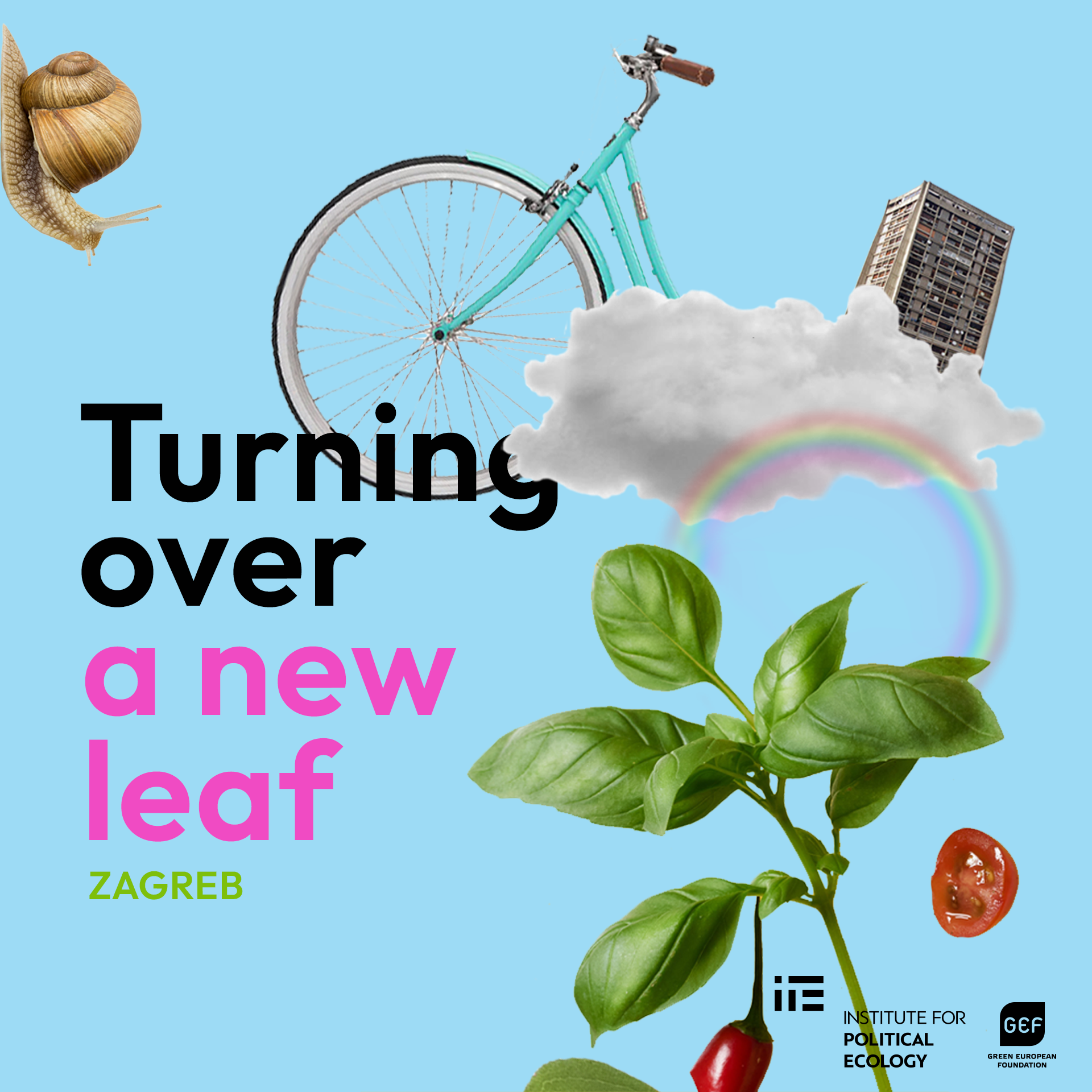
In the spring of 2021, Zagreb became a city of hope and elected a new green government. But this fresh energy is facing many old challenges (and some new ones). How can the city transform its deeply rooted issues, from housing to mobility, and make itself more resilient to climate change? Some changes are simple, but how do we really turn over a new leaf? This event will explore different transformative practices and potential pathways in an exchange with other green European cities. Inspiring videos of the Cities as Places of hope project will be presented to the audience.

Context

This event is part of the ‘Cities as Places of Hope’ series; a project launched in 2019 focussing on progressive city networks that are a key factor in the development of a positive narrative on the future of Europe. The project brings together partners from Spain (Fundación Transición Verde), Catalonia (Fundacio Nous Horitzons), Croatia (The Institute for Political Ecology-IPE) , Belgium (Oikos), North Macedonia (Sunrise), WBGL (Netherlands) and Turkey (Green Thought Association). This 2021 project aims to bring together progressive and transformative trans-local city networks, to connect them and facilitate their exchanges, ultimately contributing to a positive narrative for the future of Europe

Speakers

The speakers of the event will be protagonists with transformative stories from Zagreb, representatives of Green European cities and Project Partners.

  • Iva Marčetić – Pravo na grad
  • Sarah Baron Brljević
  • Svibor Jančić – Zagreb je naš!
  • Dražen Šimleša – ZMAG
  • Benjamin Badouard – Co-Président du groupe “Les écologistes” à la Métropole de Lyon chez Métropole de Lyon
  • Dirk Holemans – Co-President of the Green European Foundation, Oikos Think Tank

The conversation will be moderated by Vedran Horvat (Managing Director, IPE) and Lana Pukanić (IPE) and accompanied by project videos.


Practicalities

Date and time: Wednesday, December 1st from 18:00 PM CET

Audience: This event will take place in English

Event link: https://us02web.zoom.us/j/88469944631

*The event will take place on the ZOOM platform 

Follow our Facebook event: Zagreb: Turning over a New Leaf 


This event is organised by the Green European Foundation, with the support of Institute for Political Ecology and with the financial support of the European Parliament to the Green European Foundation. The European Parliament is not responsible for the content of this event.
 

Budapest Forum – Building Sustainable Democracies

By

The past decade witnessed the emergence of several high-profile international events in the CEE region. The upcoming Budapest Forum is similar in aspiration to its regional counterparts, with its first edition focusing on the role of cities and local initiatives in building livable and sustainable democracies. Within this context, the Budapest Forum will also serve as a hub for the Pact of Free Cities city network, bringing together mayors and civic leaders from around Europe and beyond. Ideally, participants will leave the conference not only inspired and eager to create positive change in their respective fields, but also as parts of a new and vibrant network connecting prominent local stakeholders and experts across disciplines. You can find more information on the programme and speakers here.

About the event

Date: 16th September 

Time: 12:30-13:30 PM CET

Despite the rise of authoritarian forces on national scenes, many European cities are pursuing a green-progressive vision. For the Green European Foundation, these cities are a substantial source of inspiration for developing a positive narrative on the future of Europe. In this event, we take you on a small tour highlighting a few frontrunner cities that show that a transformation towards a socio-ecological society is possible and happening.

*part of GEF’s Cities as Places of Hope project

This 2021 project aims to bring together progressive and transformative trans-local city networks, to connect them and facilitate their exchanges, ultimately contributing to a positive narrative for the future of Europe. In autumn the project will continue with an inspiring public event in each country with a title ‘Talking about a Green City’ bringing together the broader green family of activists, civil society, new urban actors and the broader public. 

Visit the Green European Foundation’s stand during the three days of the Forum and interact with our GEF Staff Members. 


Budapest Forum programme

To learn more about the full programme of the Forum click here <<<


Speakers:

Dirk Holemans – Oikos Think Tank, Co-President Green European Foundation

Lana Pukanić– Institute for Political Ecology IPE

*further speakers will be announced shortly


Practicalities:

Where: In person (Central European University) & online

Time and date: 16th September

12:30-13:30 PM CET

Audience: attendees of the Budapest Forum & online participants

Registrations: Registrations are now open <<<


This event is organised by the Green European Foundation with the support of City of Budapest, Political Capital Institute, CEU Democracy Institute and with the financial support of the European Parliament to the Green European Foundation. The European Parliament is not responsible for the content of this event.

Call for Author: Youth Chapter for the Just Transition Book

By

About the Event

The chapter will be published in the Book on Just Transition produced as part of the multiannual and multipartner project carried out by the Green European Foundation, led by Oikos and participated by green European partners. It will be divided in five parts: (1) Setting the stage, (2) European regions on their way, (3) Just transition and the EU Green Deal, (4) Frontrunners showing the way, and (5) Conclusions. The Youth Chapter will open part 4.

We are looking for someone who can bring a fresh perspective and nuanced insights into the following questions:

  • How do young people take the future into their own hands?
  • How are grassroots movements changing the narrative and convincing politicians to push for a socially just transition?
  • How are young activists from marginalised communities and minority groups impacted by climate change, and how are they fighting for climate justice?
  • Why are current EU programmes such as Next Generation EU not good enough?
  • How has the pandemic transformed the efforts of grassroots activists and changed their methods to create impact?

We are looking for one or two young authors with a passion for writing who are interested in the topic and committed to unpack the relation between the work of activists everywhere in Europe and the political advancement towards a more sustainable, welcoming and fairer Europe.


Context

About the chapter:

  • The content of the chapter should have a strong focus on the role of youth, grassroots and marginalised and minority groups in achieving a better and more just transition away from fossil fuels towards a socially and environmentally sustainable future
  • The chapter should have a clear sub-structure (contextual introduction, main body divided in sub-sections and topics, summarising conclusion) and can include various formats (analysis, essays, case studies and/or interviews)
  • The chapter should support analysis with figures and examples from at least three European countries (including at least one non-EU)
  • The chapter should consist of 4000 to 6000 words
  • The contribution should be written in English
  • The remuneration for the writing of the chapter is EUR 500

We accept both individual and joint applications of maximum two authors to co-write the chapter. If you decide to apply with someone please send in only one joint application.

The writer(s) applying should:

  • Be interested and passionate about tactics, methods and narratives used by grassroots movements across Europe to achieve a socially just transition
  • Be determined in expanding their knowledge on the topic by doing research, following the work or contacting activists
  • (Possibly) have previous experience in writing extensive pieces
  • Feel comfortable in writing long texts in English

Timeline:

  • Send your application by 2nd April at 23:59 CET
  • You will be informed of the decision at the latest by 7th April (all applicants will be informed)
  • Start writing!
  • A first draft of the chapter should be sent in by the 7th of May
  • Wait for the feedback and comments of the FYEG Executive Committee
  • The final version of the chapter should be sent in by the 31st of May


Practicalities

To apply:

Please send the following to project.manager@fyeg.org by 2nd April @ 23:59 CET:

  • Your pitch for the chapter: a description of what you would like to write about (between 300 and 400 words)
  • A short mention of the structure and format you plan to use
  • A proposal for a concise title
  • Your CV (or CVs if two authors are applying)