GEF at the Green Days: On the Way to COP26

By

About the Event: 

The past year has taught us painful but vital lessons about our relation to nature, the importance of often underfunded public services, and other topics which the Greens have been highlighting for years. Yet as the green wave continues rolling, and with pandemic lessons fresh on our mind, now is precisely the time to refocus attention on key challenges like the climate emergency and to ensure that green-minded activists and politicians are ready to take responsibility at all levels.       

The annual Green Days conference is an important moment of learning and exchange for the green movement in Poland and beyond. GEF is hosting several sessions at this event – tackling important topics on the road to COP26. We will address the question of rare-earth metals, a crucial but challenging aspect of the energy and digital transition. We will also ask ourselves what feminist climate and foreign policy looks like, heading to Glasgow, as well as dive into local and regional recovery plans. Finally, we will host a session on agriculture – a sector that is at times particularly hard to reach in our pursuit of a climate emergency economy.

Context: 

These seminars are being organised as part of the transnational projects Climate Emergency Economy, Metals for a Green and Digital EuropeFeminists in the Climate Movementand Cities as Places of HopeFor more information about each of these projects and the other partners involved, please check out their respective project pages on the GEF website.  

Speakers:

The extensive line up of speakers includes:

  • Michael Bloss (MEP, Greens/EFA)
  • Urszula Zielińska (Polish Green Party MP)
  • Iwona Reichardt (New Eastern Europe journal)
  • Tomasz Piątek (investigative journalist, expert on Russia)
  • Joanna Maria Stolarek (Director HBS Warsaw)
  • Thomas Simpson (Green Foundation Ireland)
  • Jakop Dalunde (MEP, Greens/EFA)
  • Jan Popczyk (Silesian University of Technology)
  • Elżbieta Anna Polak (President of the Region of Lubuskie)

And many more!

Programme:  

Friday, August 27th

11:30 – 13:00 “Agriculture friendly for climate, farmers, biodiversity, consumer health, animal welfare and future generations – utopia or necessity?”

15:00 – 16:30 ‘’Green Europe of regions and cities – recovery and climate challenges’’

  • With Jakop Dalunde (Greens/EFA MEP), Przemysław Słowik (Green local councillor from Szczecin), Ada Colaou (Mayor of Barcelona), Elżbieta Anna Polak (President of the Region of Lubuskie), Miłosława (Miłka) Stępień (Akcja Konin/ Bankwatch), and more!


Saturday, August 28th

9:30 – 11:00 “Europe and Poland in the new global geopolitics of recovery, climate and resources’’

  • With Michael Bloss (Greens/EFA MEP), Urszula Zielińska (Polish Green Party MP), Richard Wouters (Wetenschappelijk Bureau GroenLinks, Tomasz Piątek (investigative journalist, expert on Russia), Dariusz Szwed (Green Institute), Joanna Maria Stolarek (Director HBS Warsaw), Małgorzata Kopka (former international policy coordinator at HBS Warsaw), and more!

11:30 – 13:00 – Digital economy and artificial intelligence – ethics, responsibility, human rights

Host: Kim van Sparrentak (MEP, online)

With: Anna Adamowicz (Polish technology philosopher), Sarah Chander (EDRI, online, tbc.), Maciej Józefowicz (Partia Zieloni) oraz Karolina Iwańska (online or video,  Fundacja Panoptykon).

  • Lead by: Ioana Banach (Managing Director, Green European Foundation) and Kuba Bilski (Fundacja Strefa Zieleni Council/Partia Zieloni Council) 


16:15 – 17:15 “Women on the way to Glasgow – climate and feminist diplomacy and foreign policy”

  • With Iwona Reichardt (New Eastern Europe journal), Małgorzata Kopka (former international policy coordinator at the HBS Warsaw), and more!


16:00 – 18:30 ‘Metals for a Green and Digital Europe (workshop – activists and experts will work on regional insights for GEF’s Agenda for Action)

  • With Radosław Gawlik (EKO-UNIA/PZ), Urszula Zielińska (MP), Prof. Jan Popczyk (Silesian University of Technology), Dr. Krzysztof Dudek (Mining and Metallurgy Academy/PZ), Dariusz Szwed (Green Institute), Ewa Sufin-Jacquemart (Strefa Zieleni), and more!

Please note that this programme is provisional and subject to change. Some speakers will be joining online or via video message. You can access the full Green Days schedule – including more speakers and other sessions not organised by GEF – via this link.

Practicalities: 

The summer school will be taking place in person at the junction of three provinces: Wielkopolskie, Zachodniopomorskie and Lubuskie, in the Pestkownica settlement belonging to the Krzyż Wielkopolski commune, in the Drawska Great Forest – 200 km east of Berlin. Most sessions feature simultaneous translation in English and Polish.

There is no registration form in English. International participants and panellists who would like to take part in situ are asked to send the information to fundacja@strefazieleni.org with name(s) of participant(s), time and place of arrival/departure, and the relevant Covid-19 information (see details below).

Livestreaming will not be possible, but some sessions will be recorded in English and in Polish for later online viewing.

Transfers

We will have an autocar from the main rail station in Poznań (Poznań Główny) on the August 26th at 15:45 (we will wait however in any case for the arrival of the train from Warszawa, the planned arrival is 15:28). The same day at 22:00 we will organise a car transfer for a few persons. The nearest station is DOBIEGNIEW (25 km from the site) and we will organise transfers from/to there, case by case.

Price and Payment

The organisers offer all the conference logistics and the content, the participants pay the hotel, food and transport (except organised local transfers). The price of the full stay (2 nights with breakfast + 5 lunches/dinners) is 605 PLN (~ 140 EUR) that the participant will be able to pay directly on site if he/she needs an invoice, or pay by bank transfer before the event to Fundacja Strefa Zieleni, if he/she doesn’t need the invoice:

FUNDACJA STREFA ZIELENI, 01-822 Warszawa, ul. E. Schroegera 28, IBAN:   PL66 1020 1097 0000 7602 0237 0450  //  BIC/SWIFT:    BPKOPLPW, title: „Green Days + name(s) of participant(s)”.

COVID-19

Please inform us of the anticipated vaccination or testing status of each participant upon registration.

  • The participant will be vaccinated with two doses of the Covid-19 vaccine or one dose of the Johnson & Johnson vaccine
  • The participant will be vaccinated with one dose of the COVID-19 vaccine
  • The participant will not be vaccinated, but will have an up-to-date COVID-19 test (RT-PCR or antigens, done less than 72 hours before the arrival)
  • Other situation (please explain)

These summer school sessions are organised by the Green European Foundation, with the support of Strefa Zieleni and the financial support of the European Parliament to the Green European Foundation. 
Transforming into a sustainable city: the green adventure of Ghent

By

About the event:

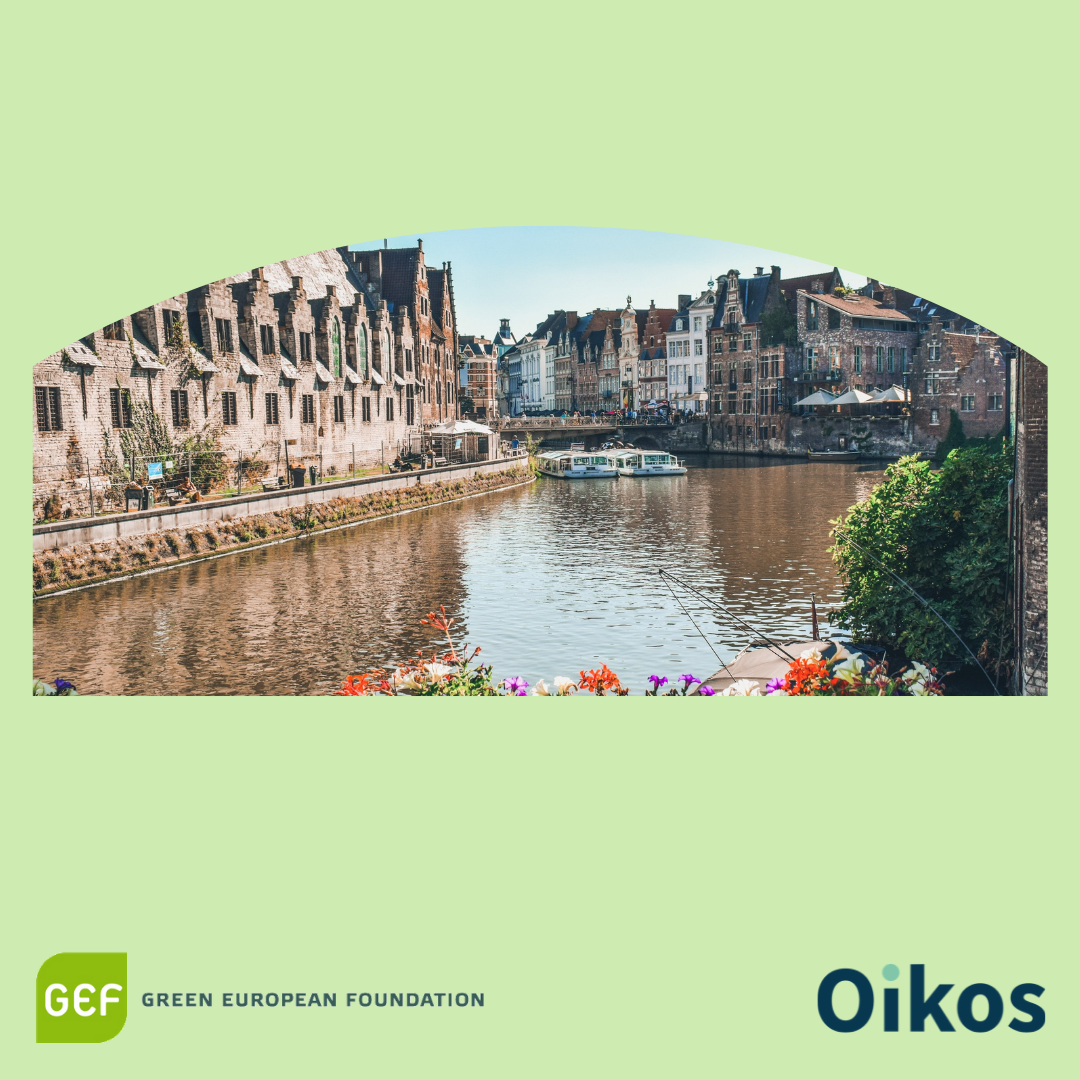
In the transformation into a socio-ecological society, frontrunner cities have become places of hope for implementing future-oriented policies and reconnecting with citizens. Moving beyond the experiment, they are implementing transitions such as the change from a car-based mobility system into one giving priority to bicycles and public transport, from a city full of concrete into a blue and green city that is a great place to stay and can cope with heat waves. This overall transformation enhances the quality of life for its inhabitants while taking responsibility for global challenges.

One of these inspiring cities is Ghent in Belgium. With the green party already strong in opposition, it entered city government in 2013. Since then, ambitious policies have been developed in fields such as mobility, energy, climate, food and housing. It shows that radical change is possible. For instance, a green mobility plan has led to a 17 per cent drop in car use while bicycle use has increased by more than 50 per cent. The city now also has a food policy and an ambitious social housing policy.
Green Vice-mayors Tine Heyse and Filip Watteeuw will talk about their ambitious policies, how they realize it and of course what their future plans are.

Part of the ‘Cities as Places of Hope’ series; a project launched in 2019 focusing on progressive city networks that are a key factor in the development of a positive narrative on the future of Europe. The project brings together partners from Spain, Croatia, Belgium, North Macedonia, Turkey and The Netherlands.


Practicalities:

Where: Online platform – ZOOM

Date and Time: Wednesday 30th June 17:00 – 18:30 PM CET

Audience: This event is an open digital seminar with the Cities as Places of Hope Project Partners, Local Councillors and the general public.

Registrations are now open: Preview – Online Survey Software | Qualtrics Survey Solutions <<<


This event is organised by the Green European Foundation with the support of Oikos Think Tank and with the financial support of the European parliament to the Green European Foundation.
Metals for a Green and Digital Europe (Poland)

By

Context

The energy transition and the development of renewable energy sources are not the only sustainable transformations that will require large amounts of metals. The electrification of transport, the digitalisation (with all telecommunications and computerization devices) and, more broadly, the increase in the demand for batteries will also demand a significant quantity of certain minerals.

The European Commission predicts that in order to achieve climate neutrality by 2050, the EU will need 60 times more lithium, 15 times more cobalt and 10 times more rare earth metals than today – for the energy transition alone. Considering that the EU currently depends 75 to 100% on metal imports, mainly from China, this has serious geopolitical ramifications.

The European Commission aims for the Union to be as independent as possible to find the means to implement the European Green Deal. Working towards (or returning to) a metal mining production system in the EU is a serious option to consider as environmental and social standards are much higher in the EU than in developing countries. But of course, the EU needs to start by developing the potential of the circular economy and recycling systems. Exploiting the accumulated mining and industrial waste containing metals, and developing and improving the collection of products containing metals, their recycling and recovery of raw materials, and perhaps finished alloys.

Does our current economic model based on constant growth -and thus consumption- offer a chance for such subversive reductions in greenhouse gas emissions as assumed by the European Green Deal? Are we not supposed to embrace a transformation of the economic model?

About the event


As for the situation in Poland, many questions remain unanswered:

  • What are the national needs when it comes to metals?
  •  What are the blocking elements in the demand for metals for the green and digital transformation?
  • Where are the red lines to watch out for and priorities to defend?
  • What are the positions on these issues?

This round table will provide as many answers as possible to these questions and explore paths for further analysis.


This project is organised by the Green European Foundation with the support of Fundacja Strefa Zieleni and with the financial support of the European Parliament to the Green European Foundation. The European Parliament is not responsible for the content of this event.
The Heat Waves Campaign

By

About the event:

Heatwaves are expected to increase in the coming years, posing a threat to people and ecosystems. This campaign will focus on providing city actors with an insight to create an environment for cooperation and contribute to the development of ambitious actions against heatwaves.

The “Heat Waves Campaign” will be broadcasted on digital platforms at the end of June 2021. During the 2-month campaign period, you will be able to follow our latest updates through infographics, blog posts, articles, social media channels, Instagram reels shares, and news programs of media channels in Turkey.

The first event will focus on local government actions, the steps they can take, and the policies they will implement regarding heatwaves in Turkey.


Program:

15 min – Ümit Şahin (Istanbul Policy Center) – The Importance of Heat Waves

15 min – Begüm Aydın (Boğaziçi University) – Actions that Local Governments Can Take
Against Heat Waves

15 min – Sevil Turan (Green Thought Association) – Information about the Heat Waves
Campaign

45 min – Open Discussion and Contributions


Practicalities:

Date and time: Thursday, June 24th from 17:00 PM CET (15:00 PM UTC)

Audience: This event will take place in Turkish

Registrations: You can register for the event via this link


This event is organised by the Green European Foundation, with the support of Green Thought Association and with the financial support of the European Parliament to the Green European Foundation.
Reforestation priorities for climate change mitigation: How the Recovery and Resilience Fund could be much more than “business as usual”?

By

About the Event: 

In order to tackle climate change and the need to rapidly absorb CO2 emissions, targeting carbon neutrality in 2050 (or even before), the EU set the ambitious goal of planting  3 billion trees  by 2030. A project that will be financed by the Recovery and Resilience Fund (RRF) within the frame of the European Green Deal. 

Is this goal feasible? Is it worth it according to other EU strategies, action plans, and spending programs (such as Common Agricultural Policy, the Fork to Farm Strategy, the new Biodiversity Strategy 2030, and the Threatened Species Action Plans, the new European Forestry Strategy? And if so, how could we tackle land degradation and desertification issues within EU member states?

Context: 

This event is part of the Green European Foundations project Deforestation and Climate Change with the support of FREDA and the Green Institute Greece.  It follows three events held in March on productive reforestation, climate change, desertification, erosion and the EU Recovery and Resilience Fund, and the joint event on Agroforestry & Productive reforestation held in May.  

Speakers:  

Moderated by: Vula Tsetsi, Secretary-General of the Greens/EFA Group, European Parliament  

Dr. Rigas Tsiakiris Forest Ecologist, Scientific Committee of the Green Institute Greece  

‘’Productive reforestations for living rural landscapes” 

Presentation of the results of the 4 previous events and the new booklet published by GEF-FREDA-GIG that summarizes the outcomes of the 3 webinars on “Productive reforestations” with concrete proposals and policy recommendations for RRF. 

Dr. Panagiotis Panagos, Scientific/Research Officer, European Commission, Joint Research Centre Directorate D – Sustainable Resources

“Priorities for soil protection policies in EU”

The EU’s commitment to Zero Land Degradation by 2030 (Land Degradation Neutrality) should be addressed effectively and efficiently in the EU policy agenda and Member States due to climate emergency, agricultural intensification and population growth. The EU proposes the new Green Deal which should address  specific and concrete  actions for tackling the risk of land degradation and desertification especially in Mediterranean countries.

Kelsey Perlman, Forest and Climate Campaigner at FERN

Kelsey has worked on land-use and transport issues in European and international climate negotiations, looking specifically at problems linked to international aviation. At Fern she focuses on EU forest and climate policies, the negative emissions debate, and all things linked to Land Use, Land Use Change and Forestry.

Matthias Schickhofer, Conservationist, book author, photographer

“Proforestation: Optimizing climate mitigation and biodiversity restoration potential of EU’s forests“

Dr. Thanasis Kizos Professor, Department of Geography, University of the Aegean

CAP payments & economic viability of traditional agroforestry systems in EU  – Video intervention


Practicalities: 

Where: Online platform – ZOOM  

Date and time: 29th June, 17:30 to 19:30 CET  

Audience: this webinar is open to the general public  

Registrations are now open <<<

*Registrations will close 29th June, 15:00 PM CET 


This event is organised by the Green European Foundation with the support of Greek Green Institute & FREDA – Die Grüne Zukunftsakademieand with the financial support of the European Parliament to the Green European Foundation. The European Parliament is not responsible for the content of this event.   

REACHING ZERO CARBON TRANSPORT: WHAT WILL IT TAKE?

By

About the Event: 

The UK and EU are planning investments in transport infrastructure – airports, seaports, new roads and railways – which will lock in future carbon emissions and make their ‘net zero’ targets impossible to meet. 

How can we achieve zero carbon emissions from transport of freight and passengers? What needs to change to make net zero carbon transport a reality? Where should public money be invested? And what obstacles are blocking this? 

Please join us to explore these questions – and share ideas on how we can redirect policy to make it fit for a climate emergency economy .


Context: 

This webinar is part of the project Climate Emergency Economy – organised by GEF with the support of Green House Think Tank, Wetenschappelijk Bureau GroenLinks, Green Foundation Ireland, and the Foundation for Environment and Agriculture. The project explores policies required in ‘hard-to-reach’ sectors for Europe to reach zero carbon. In 2021, activities are centred around three key pillars: agriculture, hydrogen, and transport infrastructure and trade.  


Speakers:  

  • Natalie Bennett – Green Party peer and former leader of the Green Party of England and Wales 
  • Prof. Julian Allwood – Professor of Engineering and the Environment at the University of Cambridge, and Head of the Use Less Group and UK FIRES 
  • Jonathan Essex, chartered engineer and environmentalist 
  • Andrew Murphy, Aviation Director, Transport & Environment 

Programme:  

19:00 – Welcome 

19:05 – Prof. Julian Allwood: The Big Picture (what needs to change in the transport of goods and people in order for us to meet real zero carbon in the UK and EU) 

19:30 – Jonathan Essex: key findings from upcoming GEF report on transport infrastructure investment 

19:40 – Andrew Murphy: the aviation perspective 

19:50 – Natalie Bennett: the political response 

20:00 – Moderated Q&A 

This programme is provisional and may be subject to change. There will be interactive audience polling throughout this event.  

Practicalities: 

This event will take place online on Monday, July 12th (19:00 – 20:30 CEST). 

Admission is free but please register in advance via this link. 


This event is organised by the Green European Foundation with the support of Green House Think Tank and with the financial support of the European Parliament to the Green European Foundation.  

Metals for a green and digital Europe

By

About the event:

This online roundtable is invitation-only. You can still contribute to this project by commenting on the online draft text: http://www.metalsforeurope.eu

Context:

While the energy from the sun and wind is nearly infinite, the resources we need to capture this energy are not. Solar panels, wind turbines, batteries, and power cables all contain metals. These have to be extracted from ores that are dug up from the ground. Some metals are rare or becoming depleted. Most mining is dirty business.

The climate crisis leaves us no choice but to make a swift transition from fossil fuels to renewable energies. Already, solar and wind power have entered the phase of exponential growth, as have electric vehicles and the batteries that power them. The European Union will need up to 18 times more lithium and 5 times more cobalt in 2030 than it consumes today in total, for electric car batteries and energy storage alone, according to the European Commission. By 2050, we would need almost 60 times more lithium and 15 times more cobalt.

The digital transition, a second spearhead of the EU, also relies on metals. Digitalisation can enhance our quality of life. But all digital technologies require energy and materials. Despite the ethereal metaphor of ‘the cloud’, the data economy has a heavy material footprint, which includes a wide array of metals. Gains in the energy and material efficiency of devices and networks are outpaced by the exponential growth of data use, which doubles every two to three years. European demand for rare earth metals for digital technologies, and for electric cars and wind turbines, could increase tenfold by 2050.

The EU is between 75 and 100 percent dependent on imports for most metals. This creates risks for Europe’s security of supply and for its strategic autonomy. It also raises the issue of climate justice since the greatest burdens of metal mining are falling on the Global South. Therefore, metals might well become the Achilles heel of the energy and digital transitions.

Should we make a more sparing use of joules and bytes to save metals? How do we stop valuable metals from ending up as waste? Can we procure those metals that we really need in a way that is equitable for developing countries and future generations? This project aims to develop an Agenda for Action at all political levels, which charts a course towards a responsible sourcing of metals for a green and digital Europe.

The roundtable will be moderated by Suzanne Kröger, former MP for GroenLinks, Netherlands.

Date and time: Friday 18 June, from 14:00 to 16:00 CEST

Audience: This roundtable is invitation-only.

Contact: Richard Wouters, rwouters (at) groenlinks.nl


This project is organised by the Green European Foundation with the support of Wetenschappelijk Bureau GroenLinks and with the financial support of the European Parliament to the Green European Foundation. The European Parliament is not responsible for the content of this event.
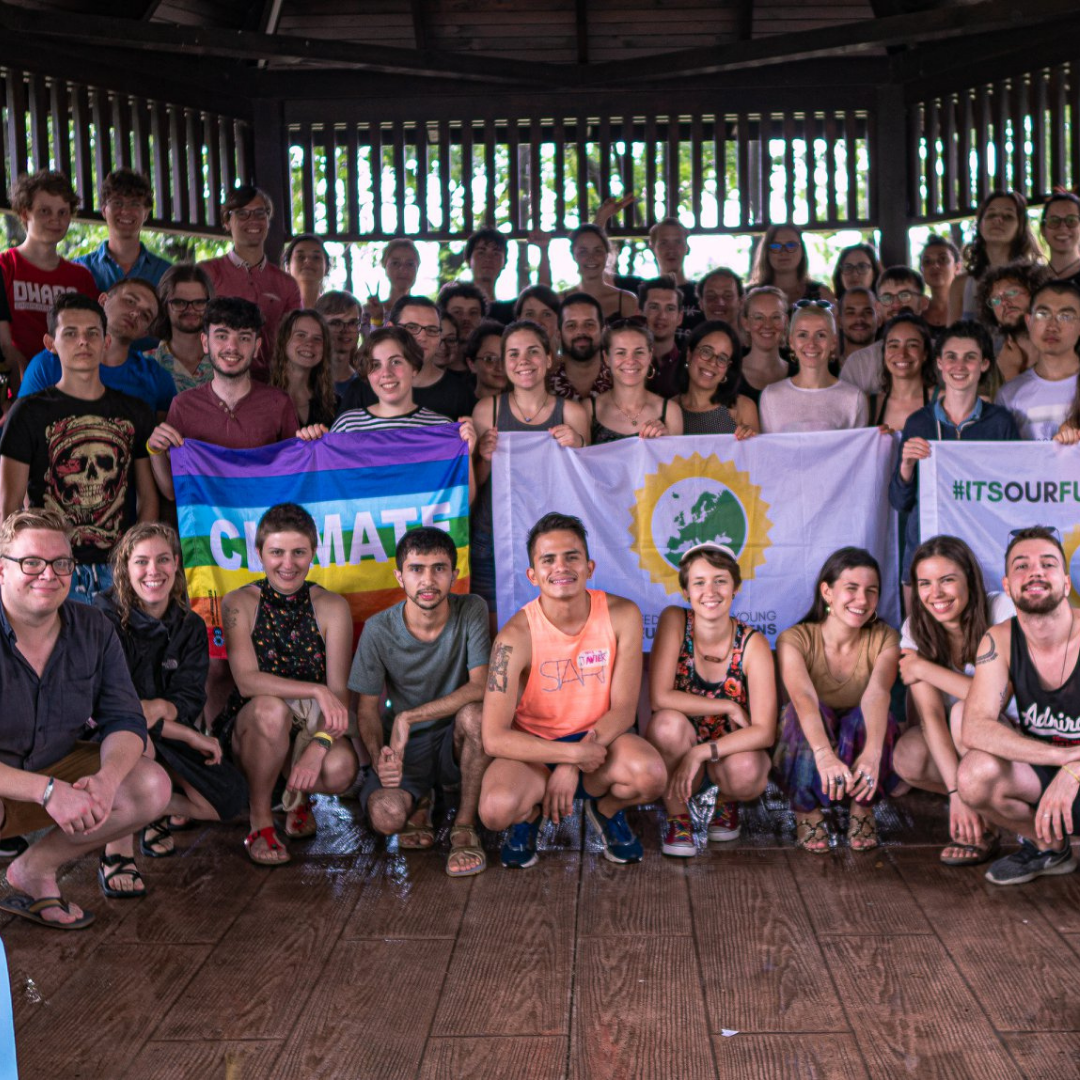
 

Be Brave Decentralised Summer Camps

By

About the Event:

The decentralised activities will respond to the following objectives:

  1. Explore the struggles with active participation for youth-led organisations, movements and informal groups in different parts of Europe;
  2. Promote and develop skills of community organising;
  3. Exchange successful online and offline tools to expand and improve youth participation in political decision-making, as well as increase participation in their organisation; and
  4. Develop young people’s skills to organise activities and/or campaigns in their local contexts.


About the decentralised summer camps: 

This event is open for candidates and full MOs, as well as groups that are either part of FYEG network or have previously worked with FYEG. Based on the feasibility of the action plan as well as a realistic assessment of the budget, the project’s Coordination Team in consultation with FYEG Executive Committee will select the four best activity proposals among the received applications.

The activity: The summer camp must be 5 days long (6 nights), gather between 20 and 40 young participants and can be either a national or regional activity.

– A national activity shall be organised by one Member Organisation and gather mainly participants from one country (possibility to invite a few international participants).

– A regional activity shall be organised by two or more Member Organisation based in neighbouring countries and can gather participants from these countries. Only one application should be submitted by the Host Organisation and should indicate the other participating Member Organisations.

Expected timeframe for project implementation: August 15th to October 10th 2021 with reporting to be finalised within one month after concluding the activity (i.e. at the latest by November 10th 2021)

Summer Camp Programme: To make sure we all have coordinated actions that are recognised as a joint effort of Young Greens all over Europe, we created a template programme to be implemented. Session outlines will be provided to local prep teams, describing methods to facilitate most sessions, while some slots are left free for the organisation of personalised sessions (i.e. invite local speakers and/or trainers, discuss local context and more). Ideas on the content for the customised sessions should be shared as part of the application.

Partners visibility: This granting programme is organised in collaboration with the FYEG, Greens/EFA Group in the European Parliament, Green European Foundation, EYF and CoE. Therefore, their logos should be visible on all the outcomes, materials and the venue. Live presence or virtual intervention of the Green European Foundation or of a member of the Greens/EFA Group in the European Parliament should be ensured. FYEG will support reaching out to these partners and coordination with them.

Training opportunity for organisers and Member Organisations: The local prep teams and participants of each decentralised summer camp will receive a fully-customised training held by professional national or international trainers to follow-up and implement the plans and strategies identified during the activity.


This years Summer Camps will be organised in five locations:

  • Ukraine: (regional Belarus, Poland, Latvia, Ukraine): 24-28th August
  • Georgia: 27th August to 2nd September
  • Scotland/ Ireland: 30th August to 5th September
  • Catalonia: 1st to 5th September
  • Greece: 22nd to 26th September


Programme:

Arrival day

Day 1: Introductions, Team Building, Democracy and our role in it, Session with Local Speakers

Day 2: Faces of Power, Workshops, Youth Participation Struggles, Reflection Groups

Day 3: Organizing vs. Mobilizing, Barriers to Organising, Community Organising Starter Kit I & II

Day 4: Online tools, Offline tools, Citizens’ Assemblies, Study Visit

Day 5: Co-operation in decision making, Offline tools II, Outputs and Participants’ Plans, Evaluation

Departure day


In case of any further questions, do not hesitate to contact project.manager@fyeg.org.


This summer camp is organised by the Green European Foundation with the support of the FYEG and with the financial support of the European Parliament to the Green European Foundation.
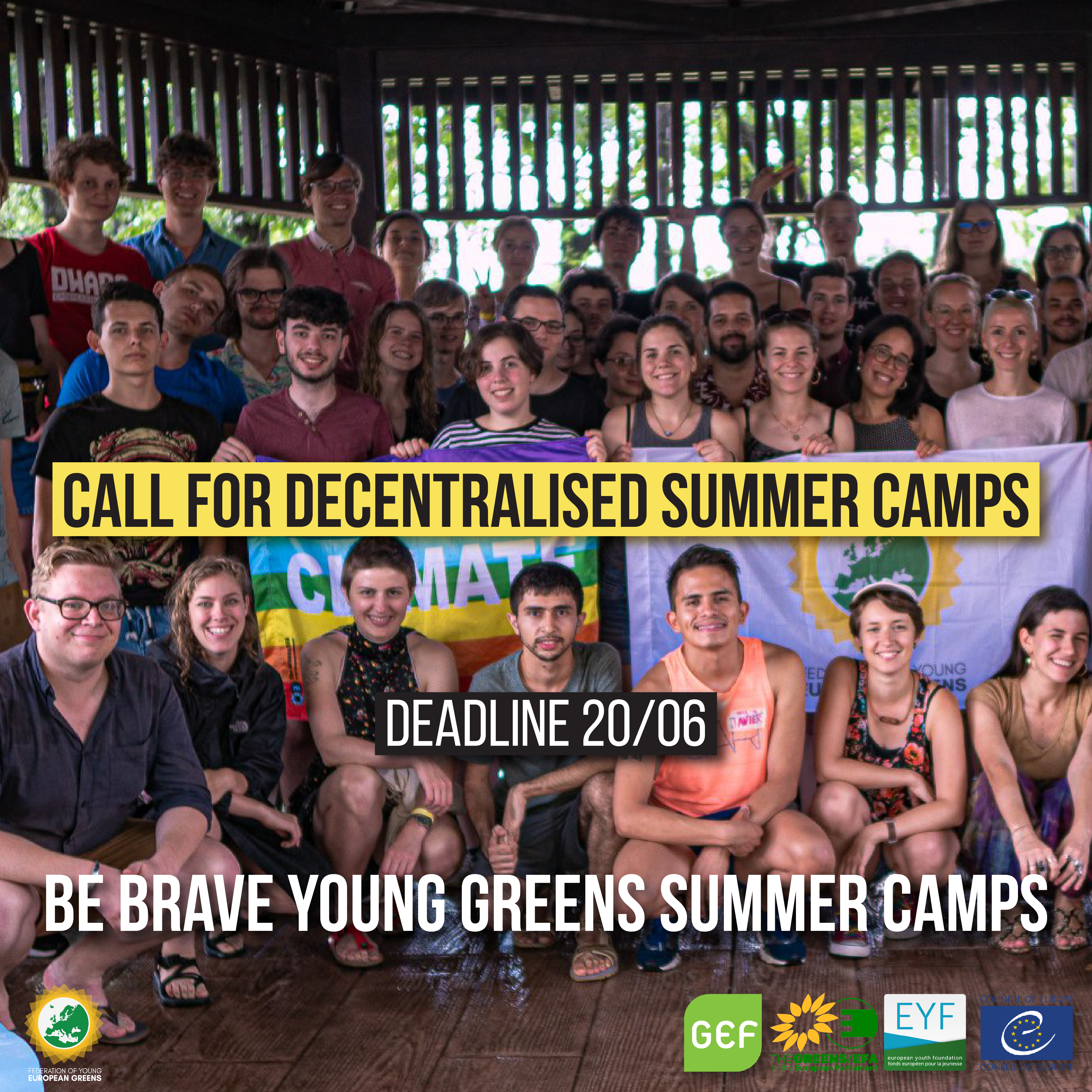
Open call: Be Brave Decentralised Summer Camps

By

About the Event:

This call is an invitation for FYEG Member Organisations (MOs) to submit applications to hold Decentralised Summer Camp on democracy and youth participation during August to October 2021. 

The decentralised activities will respond to the following objectives:

  1. Explore the struggles with active participation for youth-led organisations, movements and informal groups in different parts of Europe;
  2. Promote and develop skills of community organising;
  3. Exchange successful online and offline tools to expand and improve youth participation in political decision-making, as well as increase participation in their organisation; and
  4. Develop young people’s skills to organise activities and/or campaigns in their local contexts.


About the decentralised summer camps: 

Eligibility and selection: The call is open for candidates and full MOs, as well as groups that are either part of FYEG network or have previously worked with FYEG. Based on the feasibility of the action plan as well as a realistic assessment of the budget, the project’s Coordination Team in consultation with FYEG Executive Committee will select the four best activity proposals among the received applications.

The activity: The summer camp must be 5 days long (6 nights), gather between 20 and 40 young participants and can be either a national or regional activity.

– A national activity shall be organised by one Member Organisation and gather mainly participants from one country (possibility to invite a few international participants).

– A regional activity shall be organised by two or more Member Organisation based in neighbouring countries and can gather participants from these countries. Only one application should be submitted by the Host Organisation and should indicate the other participating Member Organisations.

Expected timeframe for project implementation: August 15th to October 10th 2021 with reporting to be finalised within one month after concluding the activity (i.e. at the latest by November 10th 2021)

Summer Camp Programme: To make sure we all have coordinated actions that are recognised as a joint effort of Young Greens all over Europe, we created a template programme to be implemented. Session outlines will be provided to local prep teams, describing methods to facilitate most sessions, while some slots are left free for the organisation of personalised sessions (i.e. invite local speakers and/or trainers, discuss local context and more). Ideas on the content for the customised sessions should be shared as part of the application.

Partners visibility: This granting programme is organised in collaboration with the FYEG, Greens/EFA Group in the European Parliament, GEF, EYF and CoE. Therefore, their logos should be visible on all the outcomes, materials and the venue. Live presence or virtual intervention of the Green European Foundation OR of a member of the Greens/EFA Group in the European Parliament should be ensured. FYEG will support reaching out to these partners and coordination with them.

Training opportunity for organisers and Member Organisations: The local prep teams and participants of each decentralised summer camp will receive a fully-customised training held by professional national or international trainers to follow-up and implement the plans and strategies identified during the activity.


About the application and reporting: 

Budget: Applicants can find a budget template HERE and should submit an updated version recalculated based on local prices, envisioned number of participants and other activity needs.

The activity’s budget should include the following costs:

  • Preparation: one live Prep Team meeting for 3 or 4 people including 2 nights accommodation, meals for 2 days, national travel and working space rental)
  • Implementation: one live national or regional summer camp for 20 to 40 participants, including the 3/4 members of the local Prep-team + 2 international participants (for FYEG’s coordination-team live presence) for a 5-day long activity (accommodation 6 nights, meals 5 days, travel), 5 days venue rental, 2 local speakers (all covered expenses + fees), material and visibility expenses
  • Follow-up: service providers’ fees to finalise activity (graphics, layoutting, designing etc.)

The total budget allocated to each activity/summer camp will take local costs and prices into account and will thus be decided upon on a case-by-case basis. Nonetheless, the total grant per project will be maximum EUR 15,000 and can of course include additional co-funding. Shifts in budget that are considered to add value to the activity can be accepted if justified in the application. The Coordination Team may come back with follow-up questions if the budget lines are not clear in the application.

Be mindful that, as any other source of income, this grant will also be considered as income for the calculation of the member organisation membership fee to FYEG.

Narrative and financial reporting: It is the responsibility of the applying organisation to collect and submit a full financial report listing all the costs (together with the corresponding proofs) within a month after the end of the activity. FYEG will process payments directly (for venue rental, accommodation, catering, trainer fees, to service providers etc.) whenever possible and will reimburse all other expenses within the activity’s approved budget upon the submission of the financial report and eligible proofs. Direct transfers of part of the grant might be possible where necessary and will be agreed upon on a project-by-project case.

Practicalities:

Deadline for application: June 20th, 2021 at Midnight CEST (successful applicants will be notified by June 31st at the latest).

How to apply: Open the APPLICATION FORM and the BUDGET and duplicate them: go to File / Make a Copy. Fill these application documents and forward them to project.manager@fyeg.org by the deadline June 20th, 2021 at Midnight CEST with Decentralised Summer Camp proposal in the subject. Organisations that have less experience with grant applications and reporting can be supported by FYEG Office in this process if necessary.

In case of any further questions, do not hesitate to contact project.manager@fyeg.org.


This summer camp is organised by the Green European Foundation with the support of the FYEG and with the financial support of the European Parliament to the Green European Foundation.
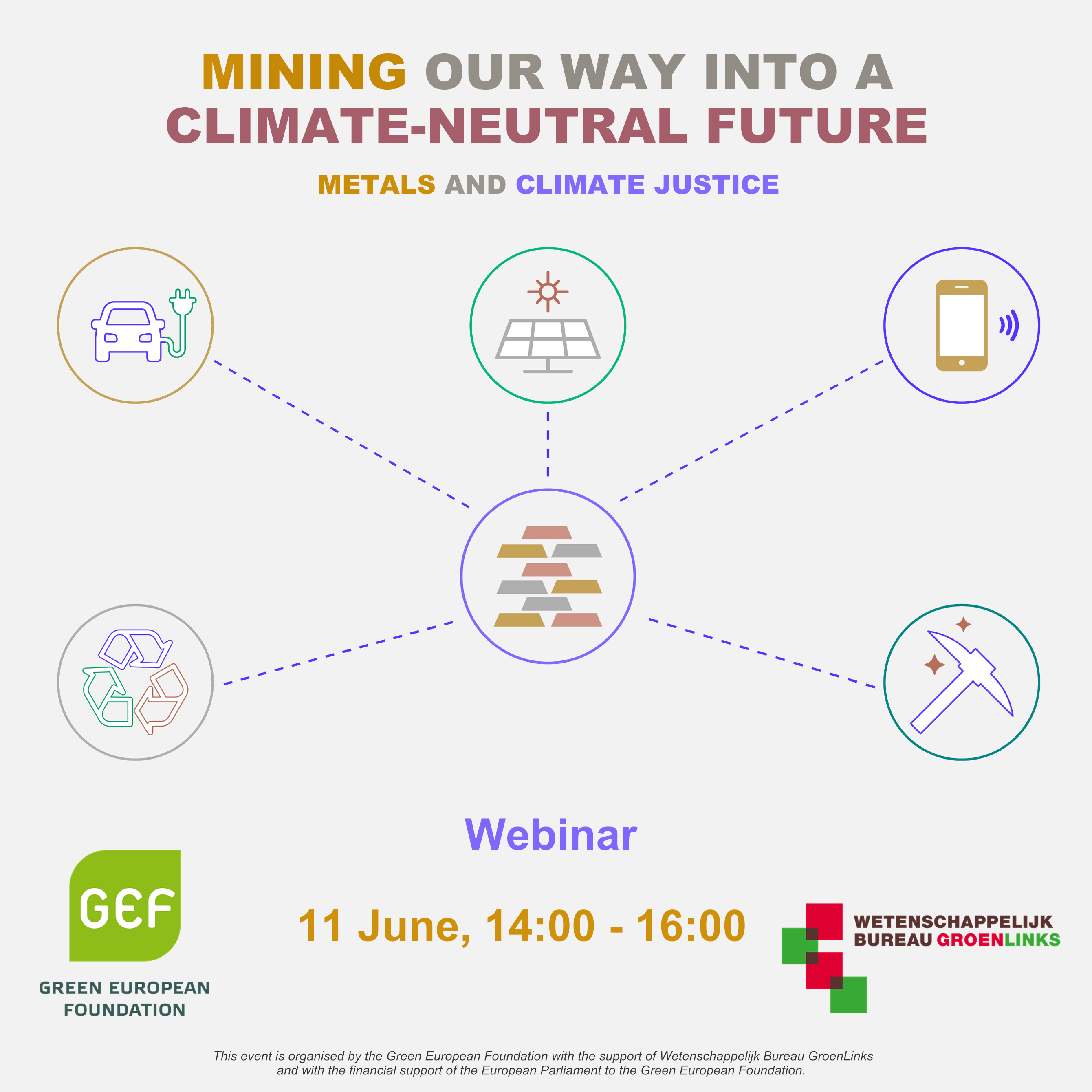
Mining our way into a climate-neutral future – Metals & climate justice

By

About the event:

This webinar is for you if you are interested in learning more about the international and intersectional approach to climate justice.

Context:

The wind turbines, solar panels and electric vehicles that Europe needs to become climate-neutral require plenty of metals. We usually take for granted that these metals will be available. However, they have to be dug up from the ground and some of them are scarce. The EU countries have largely outsourced metal mining to the Global South. This creates supply risks, but also a responsibility for the social and environmental abuses associated with mining in countries such as the Democratic Republic of Congo (cobalt), Chile (lithium) and China (rare earths).

Do local and indigenous communities in mining regions in the Global South pay the price for our green ambitions? Are women disproportionately affected? Where is the climate justice in that? Do the supply chain due diligence and the recycling initiatives that the EU is promoting represent a break with neo-colonial extractivism? What if developing countries decide to make their own cleantech instead of selling their raw materials to us?

We will tackle these questions in a webinar with experts and activists. The insights gathered at the webinar will be used for the upcoming GEF publication Metals for a green and digital Europe – an Agenda for Action. You can already contribute to this publication by commenting on the online draft: www.metalsforeurope.eu

Speakers include:

Jojo Nem Singh (@jnemsingh), Assistant Professor of International Development, International Institute of Social Studies, The Hague

Shivant Jhagroe, Assistant Professor of Public Administration, Leiden University

Benito Walker (@benito_wlkr), chair of Youth for Climate Netherlands

Richard Wouters (@richardwouters), Project leader ‘Metals for a green and digital Europe’ for the Green European Foundation & Weternschappelijk Bureau GroenLinks

Matlhogonolo Mochware – Provincial coordinator Northern Cape for Women Affected by Mining United in Action (WAMUA), South Africa

Nicola Soekoe – Paralegal and researcher at MACUA WAMUA Advice Office, South Africa

The webinar will be moderated by Kauthar Bouchallikht (@kauthar_), MP for GroenLinks, Netherlands.

Practicalities:

Date and time: Friday 11 June, from 14:00 to 16:00 CEST

Audience: This webinar will take place in English and is open to the general public.

Registrations: Click here

This event will be organised through the Zoom platform.


This project is organised by the Green European Foundation with the support of Wetenschappelijk Bureau GroenLinks and with the financial support of the European Parliament to the Green European Foundation. The European Parliament is not responsible for the content of this event.
Just Transition in Spain and Next Generation funds- Session 1

By

About the Event:

Transición Verde is working in Spain within the framework of the Prosoxi Alliance, an Observatory for a socially fair ecological transition, that aims to participate, as civil society stakeholders, in the design, evaluation and monitoring of the projects that are designed and implemented in Spain under the Next Generation EU Plan.


The objectives of the workshop are:

• To analyse national and international Just Transition experiences.

• Building evaluation and monitoring indicators for Just Transition in order to review and analyse the projects presented to NG.

• To improve the communication to society of everything related to Just Transition in order to encourage greater involvement of civil society in these policies.


With these sessions we intend to take advantage of the experience of the initiatives implemented by the Spanish Government through the Institute for Just Transition (mainly focused on the abandonment of the coal industry in Spain, guaranteeing a fair exit for the regions historically linked to this industry) to project it onto the transitions that will or must be entailed in some cases by the projects implemented within the framework of the Next Generation plans.


Spain has acquired international prominence in the application of Just Transition policies due to the aforementioned plans, which is why the GEF has decided to collaborate in promoting these sessions with the aim of analysing their approach and execution and also trying to draw lessons so that social actors in other countries, which will also benefit from the Next Generation EU Funds, can intervene to ensure that Just Transition is not displaced in those countries.


To do this, we have planned two working sessions which are detailed below. The organisations invited to participate will be the promoters and partners of the Prosoxi alliance, as well as GEF member foundations or partners that are currently working on Just Transition. Sessions will be held in Spanish and English (with simultaneous translation).


Organizations part of the GEF Just Transition Project:


Green European Foundation

Oikos (Belgium)

Institut for Political Ecology (Croatia)

Sunrise (Macedonia)

Networked (Serbia)

Visio (Finland)

Green House Think Tank (United Kingdom)

FYEG (Federation of Young European Greens)


Spanish organizations:


Transición Verde

Fundación Renovables

Retorna

Centro Ibérico de Restauración Fluvial

Fundación Nueva Cultura del Agua

Sociedad Española de Agricultura Ecológica

Foro Transiciones

Fundación Savia

Promoció del Transport Públic

Instituto Int. de Derecho y Medio Ambiente

Amigos de la Tierra

Ecologistas en Acción

Economistas frente a la crisis

Asociación Española de Operadores Públicos


Programme:

Tuesday 25th of May. From 10:30 to 12:00

JUST TRANSITION IN SPAIN. LESSONS TO LEARN

Guest organisations: ILO and Instituto para la Transición Justa (Ministry for Ecological Transition)


Speakers:

• Dirk Holemans, co-chair of GEF, Oikos thinktank – Lead partner at GEFs Just Transition project. He will briefly comment on the importance of Just Transition and the importance of it being taken into account in Next Generation projects.


• Joaquín Nieto, Director of the ILO in Spain, will frame the session with the situation of Just Transition initiatives at the international level.


• A representative of the Just Transition Institute, who will comment on the planning and development process and the current situation of the Just Transition plans addressed by this Institute.


The speeches by the guest speakers will be short (from 10 to 15 minutes) followed by a debate among the experts and the participants.


Practicalities:

When: 25th May 2021

This is a closed workshop.

Language: Spanish (simultaneous translation to English)


This event is organised by the Green European Foundation with the support of Transición Verde and with the financial support of the European Parliament to the Green European Foundation. The European Parliament is not responsible for the content of these workshops.
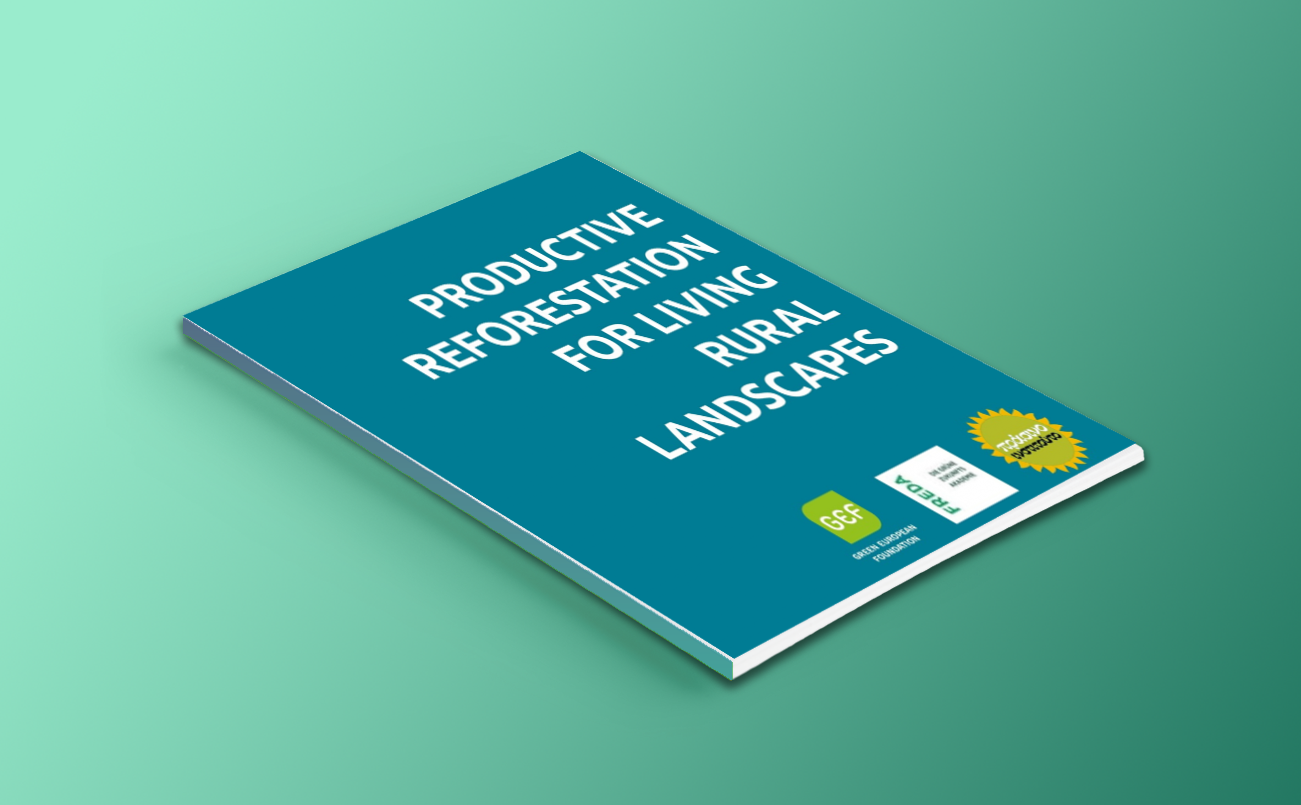
Productive reforestation for living rural landscapes

By Uncategorized

This publication is part of the Green European Foundation’s Deforestation and Climate Change project and it compiles best practice examples gathered during the three webinars organised in March 2021 by GEF and the Green Institute Greece focusing on productive reforestations for pasture, beehiving, recreation and forestry as a means to combat climate change.

Agroforestry and small-scale traditional farming systems as well as multi- functional forest landscapes survived in many rural areas in Europe (as in mountains and islands) that escaped the large scale agricultural transformation that has been supported by the EU Common Agricultural Policy (CAP). In order to make the agricultural landscapes of Europe more resilient to climate change, funds like the NextGenerationEU must be appropriated for only sustainable projects.

In this publication you will find concrete recommendations on how to address the effects of climate change and biodiversity loss through policy change in the agricultural and forestry sectors, with agroforestry systems as part of the solution.


Also available in Greek: PARAGOGIKES ANADASOSEIS


The Social and Environmental Requirements of a Climate Emergency Economy

By Uncategorized
The Social and Environmental Requirements of a Climate Emergency Economy argues that we need to dramatically reduce demand for resources, particularly in the transport, steel and construction sectors, and invest in jobs and livelihoods rather than infrastructure and material goods.
It also asserts that the transition to low-carbon must be built on consent and be equitable.
The report contains Recommendations, using the policy toolkit introduced in the Green House and GEF report, Trade and Investment Requirements for Zero Carbon.


Download

Available in Czech.


This work forms part of a wider project exploring what a ‘climate emergency economy’ would look like through a rethinking of trade, industry and infrastructure investment. The project involves Greenhouse Think Tank in the UK alongside Wetenshappelijk Bureau Groenlinks in the Netherlands and Green Foundation Ireland, and the Bulgarian Foundation of Environment and Agriculture.

Inside Climate Protection- FREDA Forum Talk

By

Context

Climate protection is a hot topic – but with our webinar, we want to approach it with a long-term outlook, by exploring how climate protection could be a driving economic factor in getting us out of the crisis.

We will be discussing questions like:

  • What effects on the economy, society and ecology will the climate protection measures submitted to RRF and the objectives of Austria`s new climate protection legislation have?
  • Outlook for 2030/2040: What are our current options that will help shape the future and permit us to take advantage of the coming upheavals to create a sustainable outlook for the transformation of society?
  • Feedback & concrete proposals: Strengths and potential weak spots – in which areas do we need to take action? At the national level, at the European level?

Practical Information:

Date and time: May 04, 2021, 19:00-20:30 (CET)

Language: This webinar will take place in German/English

Audience: This webinar is open to the general public.

Please note the event will be organised through the ZOOM platform, with YouTube live.
Simultanous translation with Zoom only.

Registration:  https://zoom.us/webinar/register/WN_XKgyH-odRpK39QTAu1HQFA

Transformation Towards Energy Democracy

By

About the Event:

With this event, we will discuss the need for a more democratic and inclusive society by addressing the state of democracy in the EU and the candidate countries with the economic alternatives and the urgency of climate change.

Context:

During the last four years, The Green European Foundation with the support of Sunrise has been leading the discussion on Energy Democracy in North Macedonia. With this 2021 event, we will continue elaborating on the European experiences in the energy sector and stimulating positive change in North Macedonia and the region. During this open Webinar, we will discuss energy transformation and set a path to a participatory, inclusive, and decentralized green economy through the promotion of the Energy Democracy concept. Together we will contribute to the debate and practices on the EU level with experiences and challenges from the Balkans.

Speakers:

  • Aleksandar Gjorgjievski, Sunrise, North Macedonia
  • Melani Furlan, Green Energy Cooperative in Zagreb, Croatia
  • Prof. Stefan Bouzarovski – Professor of Human Geography at the University of Manchester, where he directs the People and Energy Programme within the Manchester Urban Institute, UK
  • Stevan Vujasinović

    – Executive Director, RES Foundation, Serbia

Visual FacilitatorAlejandro Gil (Greenr Visual Interpreter)


Programme:

17:00 – 17:10 Introduction of the event

  • Aleksandar Gjorgjievski, Moderator and National Coordinator, (Sunrise, North Macedonia)

17:10-17:25 Energy

poverty in South-eastern Europe

  • Prof. Stefan Bouzarovski, University of Manchester (United Kingdom)

17:25-17:40 The role of citizens in the Energy Transition

  • MSc. Ing. Melani Furlan, Project Manager at ZEZ Croatia (Croatia)

17:40-17:55  Green Agenda for Decarbonizing the Western Balkans

  • Stevan Vujasinović, Executive Director at RES Foundation (Serbia)

17:55-18:30  Q&A and display of the Visual ArtAlejandro Gil (Greenr Visual Interpreter)


Practicalities:

Date and time: Tuesday, 18th May from 17:00 – 18:30 CET.

Audience: This webinar will take place in English with simultaneous translation to Macedonian and is open to the general public.

Registrations are now open. 

This event will be organised through the ZOOM platform.


This graphic recording from the event was designed by Alejandro Gil, one of our Greenr Visual Interpreters.


This event is organised by the Green European Foundation with the support of Sunrise and with the financial support of the European parliament to the Green European Foundation. The European Parliament is not responsible for the content of this event.


The European Green Deal and The Need for Metals

By

About the Event:

This webinar is for you if you are interested in the future of Europe’s metals industry and its legal/social/environmental implications.

Context:

The energy transition has been placed at the top of the European political agenda, with the digital transition closely following suit. But to successfully implement these two priorities, the EU needs to examine and adjust its supply and use of metals.

A renewable energy supply requires far more metals than a fossil one. As to the digital transition, another EU priority, it also relies on a wide array of metals.

It is for this reason that GEF and Wetenschappelijk Bureau GroenLinks will be leading this project, which will deliver a comprehensive Agenda for Action at all political levels, aimed at a sparing, circular use of metals and responsible sourcing of the virgin metals that we really need.

Speakers:

  • Raúl Gómez, Director, Transición Verde – Introduction to the GEF ”Metals for a green and digital Europe” project
  • Guillaume Pitron, Author of the book ”War of the metals”
  • Prof. Joanna Kulczycka from the Institute of Mineral Resources and Energy Management of the Polish Ministry of Defence and Energy and the International Panel on Resources (IRP)
  • Miriam Kenneth, Director CEO, The Green Economics Institute, UK, Global supply chains and the metal supply dependencies
  • Dr Krzysztof Dudek, Mining and Metallurgy Academy

Moderated by: Ewa Sufin-Jacquemart, (Fundacja Strefa Zieleni) & GEF Board member

Programme:

18:00 – 19:30 pm CET

The main goal of this webinar is to answer the following questions/issues:

– what are the optimal solutions concerning the problem of metals?

– what is the direction/are the directions where we should seek solutions that would satisfy both social and climatic interests?

– is the need for metals fully satiated by import, if yes who is the main source?

– the problem of mines in the EU

– global metal connections

– recycling of metals

Practicalities:

Date and time: Thursday, 27th May from 18:00 to 19:30 CET.

Audience: This webinar will take place in English and is open to the general public

Registrations: Click Here

Facebook event: Click Here

This event will be organised through the ZOOM platform.


This project is organised by the Green European Foundation with the support of Fundacja Strefa Zieleni and with the financial support of the European Parliament to the Green European Foundation. The European Parliament is not responsible for the content of this event.
Agroforestry & Ancient Forest protection

By

About the Event:

Agroforestry and small scale traditional farming systems as well as multi- functional forest landscapes survived in many rural areas in Europe (as in mountains and islands) that escaped the large scale agricultural transformation that has been supported by the EU Common Agricultural Policy (CAP). In order to make the agricultural landscapes of Europe more resilient to climate change, funds like the NextGenerationEU must be appropriated for only sustainable projects.

This event will gather experts in the fields of nature conservation, agriculture science & policy and will provide best practice examples from Greece and Romania.

A summary report / booklet produced based on the outcomes gathered in the previous three events organised by GEF and the Greek Green Institute will be presented. The focus of these previous webinars was mainly on productive reforestation in Greece and will show best practice examples from all over Europe.

Context:

This event is part of the Green European Foundations project Deforestation and Climate Change with the support of FREDA and the Green Institute Greece and it follows the three events held in March on productive reforestation, climate change, desertification, erosion and the EU Recovery and Resilience Fund.

The aim of the event is to explore the following questions:

● How applied agroforestry systems in practice could be supported by the EU Common Agricultural Policy?

● How to ensure that farmers, landowners living in less favourable areas benefit from the Recovery Fund?

● How could the EU found/support the multifunctional forestry bases not only on timber production but also on non timber products such as old growth local varieties of fruits and wild fruiting trees and berries as well as mushrooms?

● How to maintain the old multifunctional mountain landscapes and ecosystems that are abandoned by traditional agricultural activities?

Speakers:

Dagmar Tutschek – Chairwoman (FREDA), Board Member (Green European Foundation) – Introduction

Dr. Rigas Tsiakiris – Forest Ecologist,  Scientific Committee of the Green Institute Greece

  • Introduction to the GEF and Greek Green Institute’s Booklet on productive reforestation, presenting best practices

Martin Häusling – MEP, European Parliament

  • EU Common Agricultural Policy and traditional forms of agriculture

Matthias Schickhofer Conservationist, book author, photographer 

  • Integration of (strict) nature protection and small scale agriculture in the Carpathians

Michael Vrahnakis, Professor (Dept. Forestry & Wood Sciences & Design), University of Thessaly, Karditsa, Greece

  • The need to revitalize traditional silvoarable landscapes in the Mediterranean

Anastasia Pantera – Professor, Department of Forestry and Natural Environment Management, Agricultural University of Athens

  • Silvopastoral systems in time

Moderated by: Anna Deparnay-Grunenberg, Member of the Greens/EFA Group, European Parliament


Programme:


17:30 Technical check

18:00 Introduction Anna Deparnay-Grunenberg (Member of the Greens/EFA Group, European Parliament) & Dagmar Tutschek (FREDA)

18:10 Rigas Tsiakiris, Forest Ecologist,  Scientific Committee of the Green Institute Greece

Presenting findings of the first three events as part of the GEF Deforestation & Climate change projects on productive reforestation and best practices.

18:20 Martin Häusling, MEP, European Parliament 

Shortly before the decision on the common agricultural policy – where are we going? Sustainable farming methods. We need to shed light on traditional forms of agriculture in Europe. Currently almost 90% of the farmers have less than 10 hectares.  Austria as an example of what can be rebuilt with well-spent regional funds. What actually is sustainable forestry practice by definition?

18:35 Matthias Schickhofer, Conservationist, book author, photographer – Integration of (strict) nature protection and small scale agriculture in the Carpathians

Biodiversity-rich ecosystems are rare in the EU and continue to vanish. The biodiversity richness of landscapes correlates with the absence or the low degree of industrialization. This applies to agriculturally used areas as well as to forests. In the Carpathians (in particular in Romania), biodiversity-rich natural forests and a mosaic of ancient small-scale agriculture land have survived. Tragically, increased logging intensity is progressively threatening some of EU’s most valueable biodiversity hotspots (which led to a conflict between Romania and the EU). However, strict protection of natural ecosystems and low impact economic use (small scale farming, nature tourism etc.) do not have to be contradictions.

18:45 Michael Vrahnakis, Professor (Dept. Forestry & Wood Sciences & Design), University of Thessaly, Karditsa, Greece – The need to revitalize traditional silvoarable landscapes in the Mediterranean

Traditional silvoarable systems occupy a significant part of the Mediterranean landscapes, although they are either mis-operated or abandoned. It is important to revitalize these systems and to provide again to the society with a variety of ecosystem services. Land abandonment and restoration of traditional (and modern) small-scale agroforestry must be included in environmental policy agenda.

18:55 Anastasia Pantera, Professor, Department of Forestry and Natural Environment Management, Agricultural University of Athens – Silvopastoral systems in time (examples), work of science community

Silvopastoral systems are traditional agroforestry systems where livestock production is integrated with trees and shrubs.  Since their introduction to the Mediterranean region, livestock became part of the environment and co-evolved together over the centuries. Nowadays silvopastoral systems are threatened by the two extremes: overgrazing and abandonment. Sound management is urgently needed to support and preserve them as part of our natural environment heritage.

19:05 Questions by Anna Deparnay-Grunenberg, Member of the Greens/EFA Group, European Parliament

19:30 Questions by the audience / speakers (Open questions with voting)

20:00 End of the webinar 


Practicalities:

Where: Online platform – ZOOM

Date:  17th May

Time:  18:00 to 20:00 CET

Audience: This webinar is open to the general public

Registrations: Click Here

Language:  This webinar will be in English language with simultaneous translation to German.


This event is organised by the Green European Foundation with the support of FREDA – Die Grüne Zukunftsakademie & Greek Green Institute and with the financial support of the European Parliament to the Green European Foundation.The European Parliament is not responsible for the content of this event.

Mining operations taxed lightly in Finland

By Uncategorized

This publication is part of the Green European Foundation’s ‘Metals for a green and digital Europe’ transnational project, where we are spotlighting the needs of the EU to examine and adjust its supply and use of metals. The initiative for reforming the Finnish Mining Act started with the Finnish Parliament’s ratification of the EU-Canada Comprehensive Economic and Trade Agreement (CETA) in 2018. The proposal on the reform, originally intended to be submitted to Parliament in December 2020, has now been postponed by a year as the Ministry chose to include an instrument for the comparison of interests in the reform just as the working group was about to finish its work. Juho Heikkilä, student of Economics and Environmental Economics, explains the background of the reform, examines the content of the draft and offers suggestions for its improvement.

Which metals for a fair transition? 2/2

By

About the Event

Which metals for a fair transition?

During the months of May and June we will organise 2 webinars on this topic. While the first debate will focus on the aspects of extraction in the south (extractivism, working conditions, regulations, due diligence, etc.), this one will tackle the issues of consumption and production in Europe (reopening mines in Europe, lower consumption, circular economy, recycling, technology design, low tech…)

Our main guiding questions will be to:

  • Between the efforts for supply chain responsibility and the development of new technologies, can Europe ensure a fair supply of metals? Can we move beyond extractivism?
  • Can Europe make a more sparing, circular use of metals for its transitions? What would that mean for our lifestyles?


Context

Like all European countries, Belgium imports large quantities of rare metals such as cobalt, germanium, lithium and coltan through complex and opaque supply chains.

These metals are now the subject of particular attention in European policies. This is for at least two reasons which raise some rather contradictory issues and involve very different actors: it is in fact on the one hand to ensure a constant supply to support the growth of the development of renewable energies and digital technologies (solar panels, electric cars, wind turbines, smartphones, smart cities…) and on the other hand to make sure not to contribute to socially and ecologically objectionable forms of mining (work conditions sometimes close to slavery, child labour, destruction of ecosystems in producing countries… ). The Democratic Republic of Congo, with which Belgium has a tumultuous historical relationship, illustrates the current difficulties in reconciling these two issues. Between neo-colonialism and extractivism, Congo provides 60 per cent of the world’s cobalt and 40 per cent of coltan, but still remains one of the poorest countries in the world.

How can mining be technically and socially modernised to stop child labour and minimise environmental damage? How to deal with the limits of due diligence in Europe? What is being done today in European and Congolese policies to improve the conditions for metal extraction?

As far as demand is concerned, can the EU limit the need for imported virgin metals while ensuring a rapid energy transition and a responsible digital transition? For example, by stimulating the recycling and substitution of rare metals, re-opening mines within its borders or reducing the overconsumption of kilowatt hours and megabytes?


Speakers

Dr Peter Tom Jones, from KU Leuven (https://kuleuven.sim2.be/dr-peter-tom-jones/)

Romain Gelin (Research group for an alternative economic strategy- Gresea)

Géraldine Duquenne (Policy and advocacy officer at Justice et Paix)


Practicalities

Date and time: Thursday, 3rd June from 12:00 to 14:00 CET.

Audience: This webinar will take place in French and is open to the general public

Facebook Event: Available here

Registration: Click Here


The event will be organised through the ZOOM platform, with Facebook live, Etopia Radio and the local Brussels Radio station (tbc).


This project is organised by the Green European Foundation with the support of Etopia and with the financial support of the European Parliament to the Green European Foundation. The European Parliament is not responsible for the content of this event.
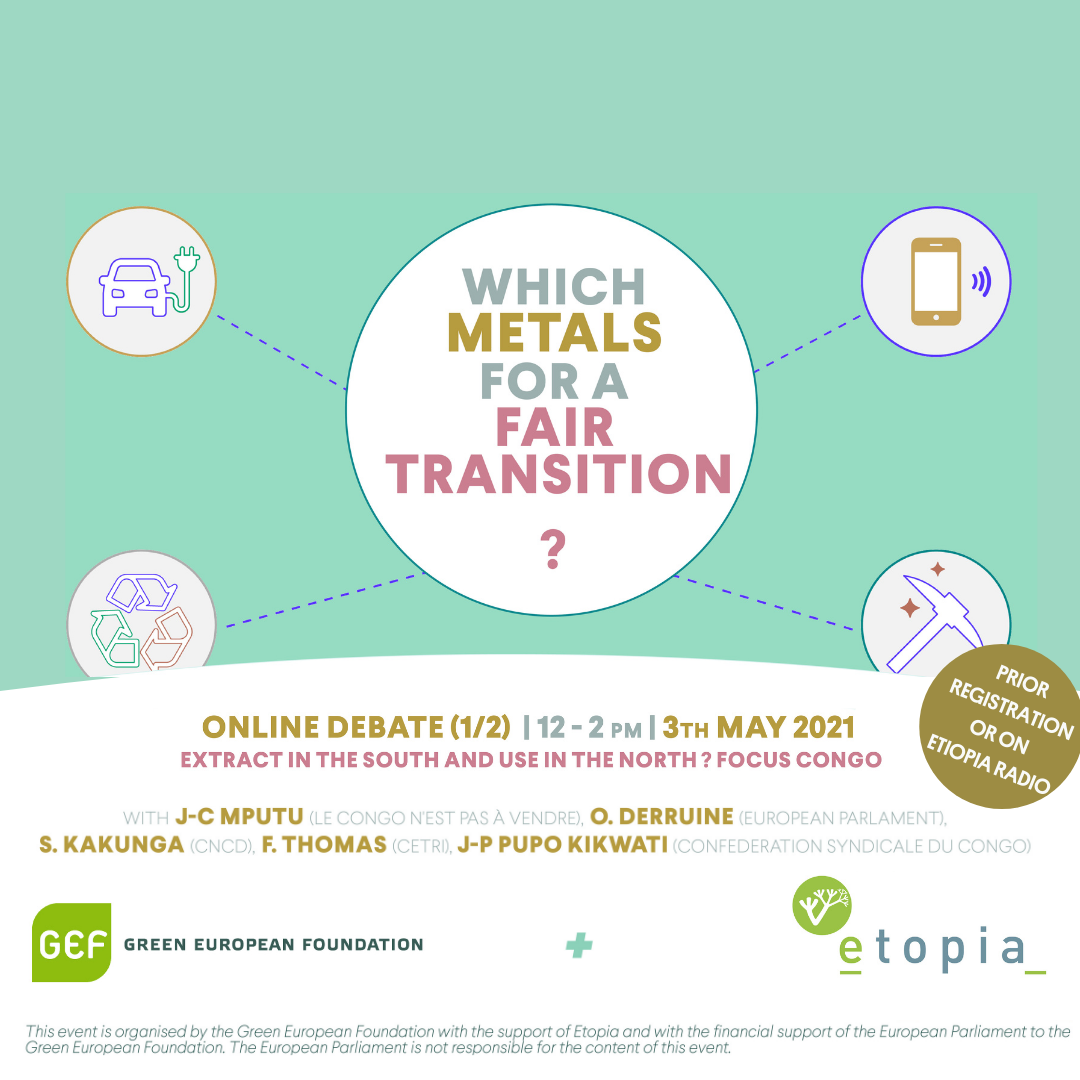
Which metals for a fair transition?

By

About the Event

Which metals for a fair transition?

During May and June, we will organise two webinars revolving around this topic. While the first debate will focus on the extraction aspects in the south (working conditions, regulations, due diligence…), the second will tackle consumption and production in Europe (reopening mines in Europe, lower consumption, circular economy, recycling, technology design, low tech…)

Our main guiding questions will be to:

  • Between the efforts for supply chain responsibility and the development of new technologies, can Europe ensure a fair supply of metals? Can we move beyond extractivism?
  • Can Europe make a more sparing, circular use of metals for its transitions? What would that mean for our lifestyles?

Context

Like all European countries, Belgium imports large quantities of rare metals such as cobalt, germanium, lithium, and coltan through complex and opaque supply chains.
These metals are now the subject of particular attention in European policies. This is for at least two reasons which raise some rather contradictory issues and involve very different actors: it is, on the one hand, to ensure a constant supply to support the growth of the development of renewable energies and digital technologies (solar panels, electric cars, wind turbines, smartphones, smart cities…) and on the other hand to make sure not to contribute to socially and ecologically objectionable forms of mining (work conditions sometimes close to slavery, child labour, destruction of ecosystems in producing countries… ).

The Democratic Republic of Congo, with which Belgium has a tumultuous historical relationship, illustrates the current difficulties in reconciling these two issues. Between neo-colonialism and extractivism, Congo provides 60% of the world’s cobalt and 40% of coltan, and yet remains one of the poorest countries in the world.

How can mining be technically and socially modernised to stop child labour and minimise environmental damage? How to deal with the limits of due diligence in Europe? What is being done today in European and Congolese policies to improve the conditions for metal extraction?
As far as demand is concerned, can the EU limit the need for imported virgin metals while ensuring a rapid energy transition and a responsible digital transition? For example, by stimulating the recycling and substitution of rare metals, re-opening mines within its borders, or reducing the overconsumption of kilowatt-hours and megabytes?


Speakers

– Olivier Derruine, Economist, Parliamentary Assistant to Saskia Bricmont MEP, European Parliament

– Jean-Claude Mputu, Congolese political scientist

– Sabine Kakunga, Central Africa Program Officer (CNCD-11.11.11)

– Frédéric Thomas, Doctor of political sciences, lecturer (CETRI)

-Jean Pierre PUPO KIKWATI, from the “Confédération Syndicale du Congo (CSC)


Practicalities

Date and time: Monday, 3rd May from 12:00 to 14:00 CET.

Audience: This webinar will take place in French and is open to the general public

Registration: Click here

Please note the event will be organised through the ZOOM platform, with Facebook live, Etopia Radio and the local Brussels Radio station.

Zoom Link: Here

RadioEtopia: Here

Facebook Event (FR): Here


This project is organised by the Green European Foundation with the support of Etopia and with the financial support of the European Parliament to the Green European Foundation. The European Parliament is not responsible for the content of this event.