Resilient Cities as Places of Hope (Mollet del Vallés)

By

Context

In 2022, the Cities as Places of Hope project aims to bring together progressive and transformative trans-local city networks, connect them and facilitate their exchanges, ultimately contributing to a positive narrative for the future of Europe. This year the project will continue with an inspiring public event in each partner country with the title ‘Resilient Cities’ bringing together the broader green family of activists, civil society, new urban actors and citizens.

Programme

09.30–10.00 Introduction of the event and the GEF’s Transnational Project Cities as Places of hope.

  • Sergi Alegre (FNH)

10.00–11.00 The challenge of air pollution.

  • Representative from Mollet del Vallés (tbc)

11.00–11.30 Coffee break.

11.30–12.30 The social challenge of energy.

  • Ismael Morales, Fundación Renovables
  • Encarni García, Councillor Viladecans

12.30–13.30 The challenge of the food system.

  • Joaquim Bartolomé, Councillor El Prat
  • Catalina Parpal, Fundació Catalana de l’Esplai

13.30 – 14.00 Final remarks.

  • Sergi Alegre (FNH)

Practicalities

Date and time: 15th October, 9:30-14:00 PM CET

Language: Catalan/ English

Location: Mollet del Vallés

Registrations: Registrations will be open shortly <<


This project is organised by the Green European Foundation with the support of Fundació Nous Horitzons and with the financial support of the European Parliament to the Green European Foundation. The European Parliament is not responsible for the content of this event.

Towards Sustainable Agriculture and Cleaner Energy in the NRRP

By

About the Event

The Green European Foundation, with the support of BlueLink, has been closely following the drafting and submission process of Bulgaria’s National Recovery and Resilience Plan, with an aim to highlight key areas for scrutiny and foster a public debate on this important EU initiative. 

This media event will feature some our key expert contributors, as they give their input on the NRRP and its different versions, focusing particularly on the key areas of agriculture, climate and energy, and circular economy. We will also present some comparative analyses based on studies of the NRRPs submitted by three other EU member states: Latvia, Portugal, and Slovakia.   

Speakers

  • Petko Kovachev – Green Policy Institute 
  • Gavrail Gavrailov – BlueLink 
  • Albena Simeonova – chairperson of the “bioproducts” organic farmers branch organisation 
  • Natalia Dimitrova – BlueLink 

Practicalities

Date and Time:  2nd December, 10 am

Location: Sofia (Bulgaria)

This is an invite-only media event. If you would like to join, please send an email to sien.hasker@gef.eu. The event will be in Bulgarian, and will also be streamed online. 


This media event is organised by the Green European Foundation, with the support of BlueLink and the financial support of the European Parliament to the Green European Foundation. 


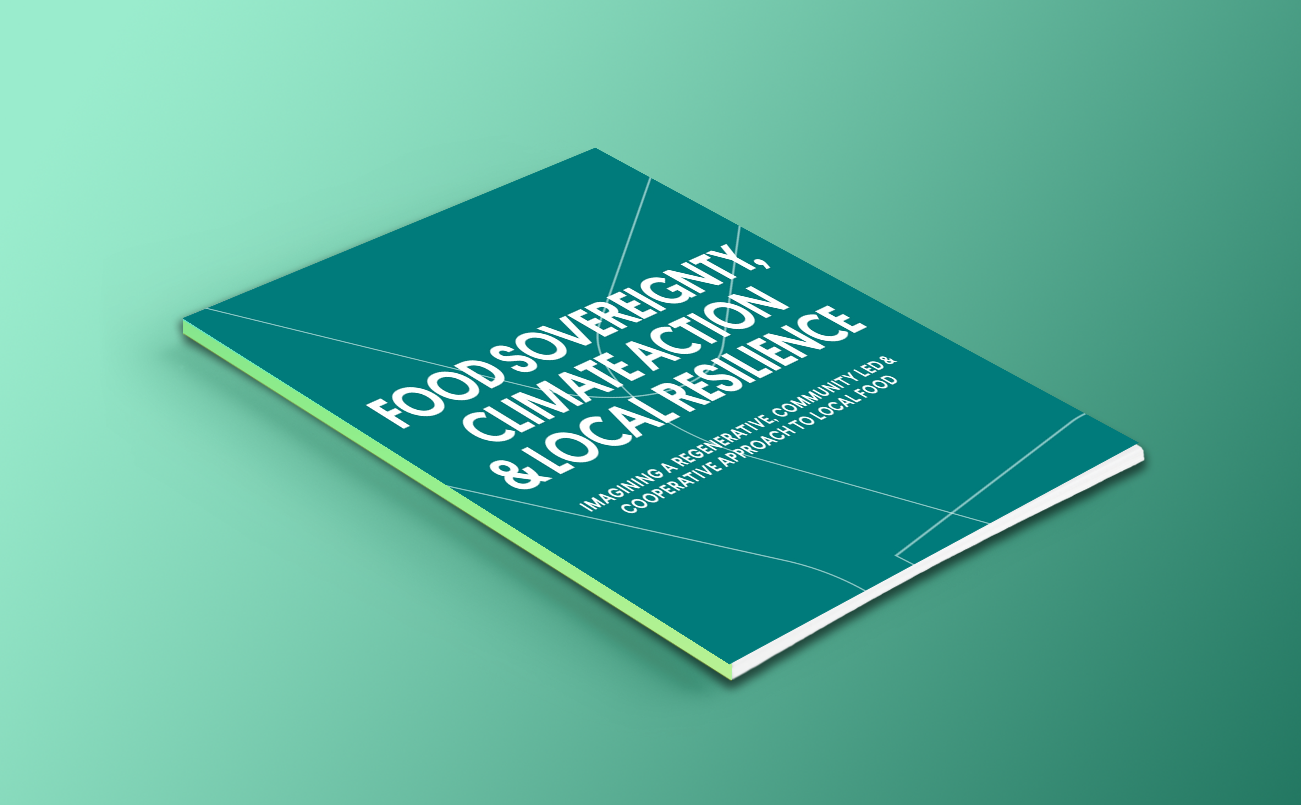
Food Sovereignty, Climate action and Local Resilience

By Uncategorized

Context

This pamphlet on Food Sovereignty, Climate Action and Local Resilience follows on from A Question of Scale: “Imagining a cooperative, community-led approach to regional resilience”. A framing paper in which we explored the potential of the Social and Solidarity Economy, Doughnut Economics, Just Transition, The Commons, Community Wealth Building, Federated co-ops as approaches to help us address the climate and ecological emergency.

The co-creation of this pamphlet began with a first draft distributed to local food, community and cooperative advocates. Then, they attended a webinar to discuss identify the blockers and enablers of this regenerative and community-led approach. Finally, we added the harvest of the session, along with links to initiatives in the field, and an infographic.

Challenging the global trade regime and the bilateral trade agreements which en-trench trade relations and which negatively affect peasant farmers on both sides is a vital part of the picture of Food Sovereignty and the global conversation that needs to be had about how to protect, encourage and support biodiverse, agroecological and small scale production not just in our backyard, but across the world.


This publication was produced as part of GEF’s Climate Emergency Economy project, exploring the challenge of such a climate emergency economy by focusing on “hard-to-decarbonise” sectors like transport, trade, industry, or agriculture.


Download

Also available in Polish.


This publication has been realised with the support of the Green Foundation Ireland, Cultivate and the financial support of the European Parliament to the Green European Foundation. The European Parliament is not responsible for the content of this publication.

Innovative Food Systems (Barcelona)

By

Context

In 2022 the Cities as Places of Hope project aims to bring together progressive and transformative trans-local city networks, connect them and facilitate their exchanges, ultimately contributing to a positive narrative for the future of Europe. This year the project will continue with an inspiring public event in each country with the title ‘Talking about a Green City’ bringing together the broader green family of activists, civil society, new urban actors and the general public. In Barcelona, the focus of the activities will be around sustainable food systems and food production.

Programme


Sunday 8th May

Arrival of participants


Monday 9th May

09:30 Meeting with Victor Tenez (Responsible for food policy of the Metropolitan Government of Barcelona)

11:00 Visit to Parc Agrari (Agricultural Park Consortium)

13:30 Lunch

14:30 Meeting with Oscar Teruelo (President of AGT Association of Gastronomy and Tourism)

16:30 Visit to Espigoladors

Fundació Espigoladors is a non-profit organisation that fights against food waste and losses while empowering people at risk of social exclusion in a transformative, participative, inclusive and sustainable way.

17:00 End of the day


Tuesday 10th May

09:30 Meeting with Lidón Martrat (head of food policies of Barcelona City)

11:30 Visit to exhibition “Eat, act and impact”

13:00 Lunch

14:00 Conclusions

15.00 End of the study visit


Wednesday 11th May

Departures


Practicalities

Date and time: 12th-14th May

Audience: Cities as Places of Hope Project Partners

Location: Calle Riu Anoia 44, 08820 El Prat de Llobregat, Catalonia.


Audio visual materials

Interview with Laura Calabuig – Fundesplai

Interview with Anna Cornudella – Fundació Espigoladors


This project is organised by the Green European Foundation with the support of Fundació Nous Horitzons and with the financial support of the European Parliament to the Green European Foundation. The European Parliament is not responsible for the content of this event.

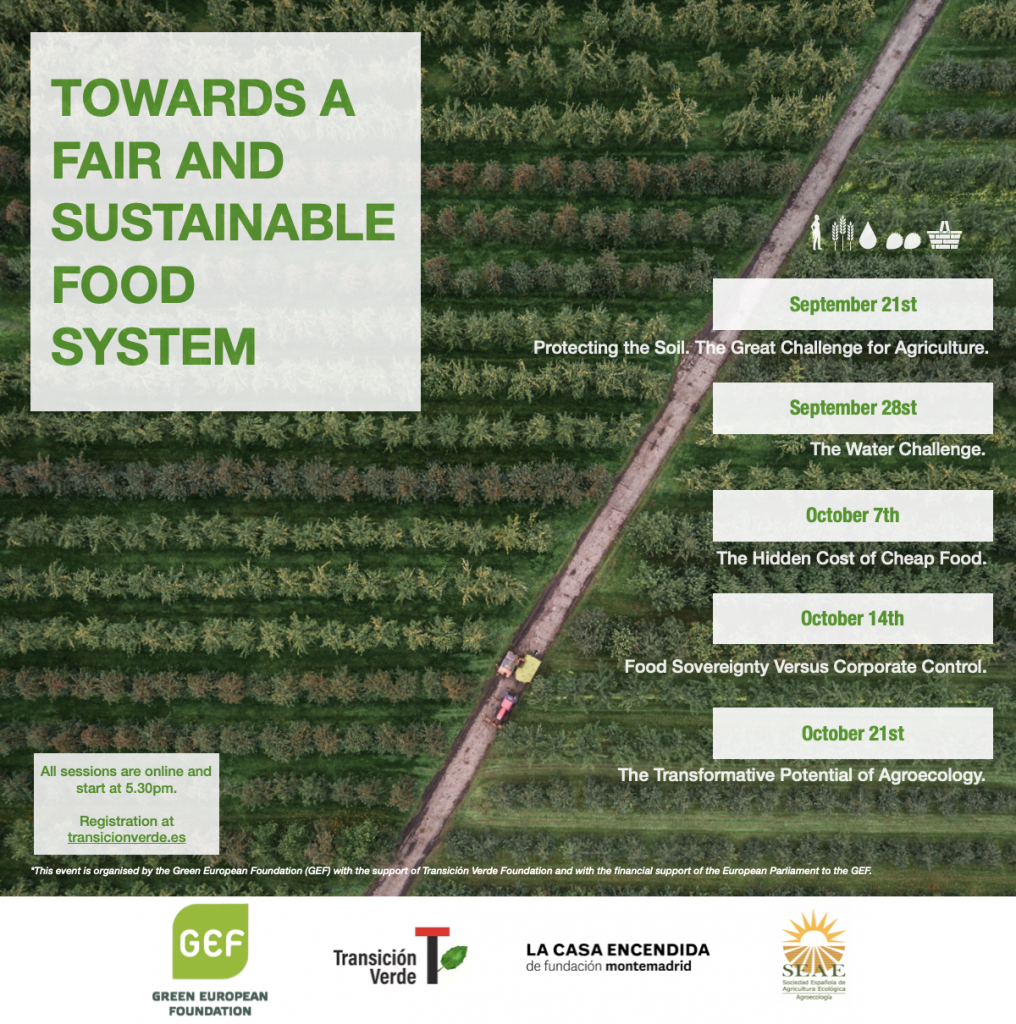
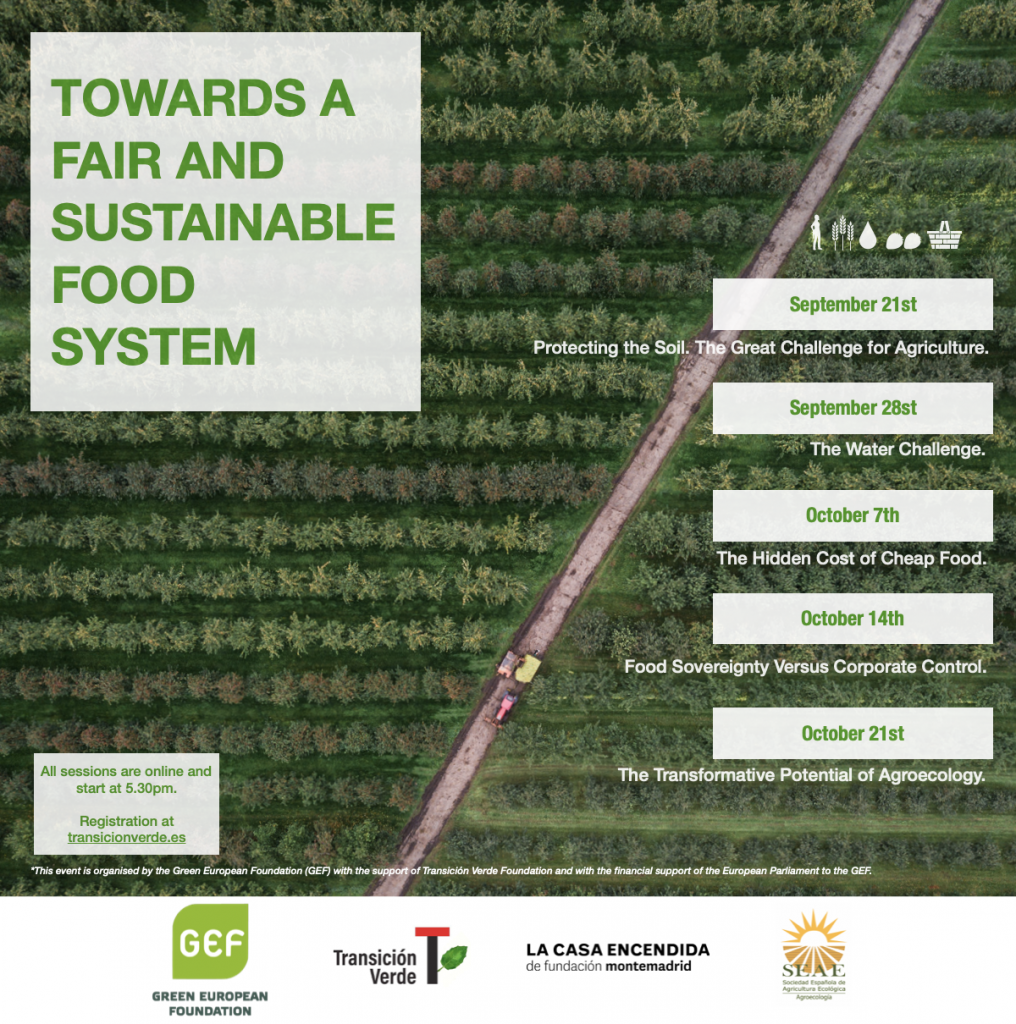
Towards a fair and sustainable food system: The Transformative Potential of Agroecology

By

About the event:

The food industry is one of the main factors behind biodiversity loss and the worsening of global inequalities. We aim to contribute to a better understanding of the food system as a tool for social change. It is vital to understand the different processes and exercise critical thinking, as actors in the agri-food system become aware, act, and demand change.

These project will be decided into sessions that will have a European focus, but also a global one, as global is the agri-food business and, above all, its impacts. The Common Agricultural Policy and the different European strategies and policies (From Farm to Fork) will be present throughout this series of roundtables in September/ October and with the speakers we will try to analyse their positive and negative aspects regarding the topics discussed.


Programme:

5. THE TRANSFORMATIVE POTENTIAL OF AGROECOLOGY

Agroecology is a way of farming that focuses on food production that makes the best use of nature’s goods and services while not damaging these resources. It is an in-depth transformative tool to develop sustainable agri-food systems, moving away from the industrial system.

Agroecology teaches us that there is another way of looking at the world, a more sustainable and fairer way to feed humanity, respecting the environment, and taking care of both producers and consumers.

Agroecological initiatives are on the rise as they favour soil regeneration, water protection, and safeguards biodiversity. It protects our health, promotes employment, fair wages, makes women’s work visible and valued, and revitalizes the rural economy.

However, the adjective “agroecological” can hide a distinct reality. Large agri-food companies have found in agroecology a new business opportunity, albeit one that promotes their vision based on profit and is far removed from its transformative component. They incorporate certain practices to mitigate some agricultural affects but avoid touching the pillars holding the current industrial system. In this session, we will further explore this issue. We will also look at the EU’s strategies and policies to promote agroecology. We will also learn about two agroecological experiences: the Ecocomedores in the Canary Islands and the projects of the El Colletero Association (

Speakers:
* Andrés Muñoz, Head of Food Sovereignty at Friends of the Earth specialising in
awareness raising and advocacy on Food Sovereignty.
* Aina Calafat
Head of international projects of the Spanish Society of Organic Agriculture and Agroecology. She
worked for almost 20 years as technical director of the Consell Balear de la Producció Agrària
Ecològica.
* Margarita Hernández
Technician at the Canary Islands Institute of Agri-food Quality (ICCA) and coordinator of the
Ecocomedores (eco canteens) programme.
* Raquel Ramírez
representative of El Colletero (Nalda – La Rioja), an association that promotes agroecology to
achieve sustainable development and equality.
Moderation:
* Helena Cifre
Coordinator of the Spanish Society of Organic Agriculture and Agroecology. Law graduate,
ecofeminist and expert in responsible consumption.

Practicalities:

Where: Online platform – ZOOM

Time and date: 21 October, 17:30-19:00 PM CET

Language: Simultaneous translation to English

Audience: these series of webinars are open for the general public

Registrations: Registrations are now open <<<


This event is organised by the Green European Foundation with the support of Transición Verde and with the financial support of the European Parliament to the Green European Foundation. The European Parliament is not responsible for the content of this event.

Towards a fair and sustainable food system: Food Sovereignty vs. Corporate Control

By

About the event:

The food industry is one of the main factors behind biodiversity loss and the worsening of global inequalities. We aim to contribute to a better understanding of the food system as a tool for social change. It is vital to understand the different processes and exercise critical thinking, as actors in the agri-food system become aware, act, and demand change.

These project will be decided into sessions that will have a European focus, but also a global one, as global is the agri-food business and, above all, its impacts. The Common Agricultural Policy and the different European strategies and policies (From Farm to Fork) will be present throughout this series of roundtables in September/ October and with the speakers we will try to analyse their positive and negative aspects regarding the topics discussed.


Programme:

4. FOOD SOVEREIGNTY VERSUS CORPORATE CONTROL

The logic of liberalism applied to agri-food markets has led to the accumulation of political and economic power by a small group of actors in critical sectors of the food chain.

Powerful agricultural companies dictate the rules for the functioning of the entire system. They exercise influence on policy-makers to boost policies that promote a productivity-based form of agriculture, neglecting any form of environmental responsibility or social justice.

Who’s in charge of making these decisions and in whose interests? How do these corporations exercise power? What is the EU doing to control this power and guarantee food sovereignty? Is food sovereignty compatible with free-market models as we know them today? Are there economic alternatives? In this session, we will try to delve deeper into the web of interests that are endangering food sovereignty and security.

Speakers:
* Vandana Shiva
one of the most influential women in the field of ecology and ecofeminism. PhD in Physics,
philosopher and writer, she has received numerous awards such as the Right Livelihood Award,
the UN Global 500 Award and the Sanctuary Wildlife Award..
* Sofía Monsalve
Secretary General of FIAN International where she coordinated the land and natural resources
programme for more than 15 years. She is also a member of the IPES-Food expert panel.
* Geneviève Savigny
Member of the European Economic and Social Committee. Former national secretary of the
Confédération paysanne (farmers’ confederation) and former member of the European
coordination committee of Via Campesina.
Moderation:
* Carolina García
Member of the Board of Trustees of Transición Verde. Journalist and political scientist, she is
currently communications coordinator at Alianza por la Solidaridad- ActionAid.

Practicalities:

Where: Online platform – ZOOM

Time and date: 14 October, 17:30-19:00 PM CET

Language: Simultaneous translation to English

Audience: these series of webinars are open for the general public

Registrations: Registrations are now open <<<


This event is organised by the Green European Foundation with the support of Transición Verde and with the financial support of the European Parliament to the Green European Foundation. The European Parliament is not responsible for the content of this event.

Towards a fair and sustainable food system: The Hidden Cost of Cheap Food

By

About the event:

The food industry is one of the main factors behind biodiversity loss and the worsening of global inequalities. We aim to contribute to a better understanding of the food system as a tool for social change. It is vital to understand the different processes and exercise critical thinking, as actors in the agri-food system become aware, act, and demand change.

These project will be decided into sessions that will have a European focus, but also a global one, as global is the agri-food business and, above all, its impacts. The Common Agricultural Policy and the different European strategies and policies (From Farm to Fork) will be present throughout this series of roundtables in September/ October and with the speakers we will try to analyse their positive and negative aspects regarding the topics discussed.


Programme:

3. THE HIDDEN COST OF CHEAP FOOD 

The EU is responsible for more than 10% of global deforestation. Global soy production -driven by a growing demand to provide food for large industrial meat farms- has more than doubled since 1997.
This rapid expansion is destroying some of the world’s most biodiverse ecosystems, such as the Amazon and the Cerrado and Gran Chaco forests in South America.

Aquaculture is the fastest-growing food sector in the world. Multinationals in the aquaculture sector present fish and shellfish farming as a cheap solution to the natural limits of fisheries. These fish, however, have to be fed on fishmeal and fish oil, most of which is made from wild-caught fish and crustaceans. Spain is the EU Country with the highest production, accounting for almost a quarter of the entire union.

The production of cheap food has profound environmental, social, and health impacts. In this session, we will focus on soy monoculture for livestock feed, industrial aquaculture, and animal suffering.

Speakers:
* Olga Kikou
European Affairs Manager at Compassion in World Farming. She was President of the Green Greek
Institute and a member of the Board of the Green European Foundation.
* Nazaret Castro
Journalist, PhD in Social Sciences and co-founder of Carro de Combate, a collective dedicated to
independent journalism, which investigates the origin of the products we consume.
* Natasha Hurley
Campaign Manager Changing Markets where she is currently running a campaign to eradicate the
use of wild-caught fish in aquaculture. She was formerly Climate Campaigner at EIA lobbying for a
global phase-out of hydrofluorocarbons (HFCs)
* Thomas Waitz
Co-chair of the European Green Party, MEP in the Greens/EFA Group. His work focuses on
sustainable agriculture, regional production and healthy food, the Common Agricultural Policy
and the reform of the animal transport directive.

Moderation:
* Lidia Ucher
Journalist specialising in social communication in the field of cooperation, the third sector and
ecology.

Practicalities:

Where: Online platform – ZOOM

Time and date: 7 October, 17:30-19:00 PM CET

Language: Simultaneous translation to English

Audience: these series of webinars are open for the general public

Registrations: Registrations are now open <<<


This event is organised by the Green European Foundation with the support of Transición Verde and with the financial support of the European Parliament to the Green European Foundation. The European Parliament is not responsible for the content of this event.

Towards a fair and sustainable food system: The Water Challenge

By

About the event:

The food industry is one of the main factors behind biodiversity loss and the worsening of global inequalities. We aim to contribute to a better understanding of the food system as a tool for social change. It is vital to understand the different processes and exercise critical thinking, as actors in the agri-food system become aware, act, and demand change.

These project will be decided into sessions that will have a European focus, but also a global one, as global is the agri-food business and, above all, its impacts. The Common Agricultural Policy and the different European strategies and policies (From Farm to Fork) will be present throughout this series of roundtables in September/ October and with the speakers we will try to analyse their positive and negative aspects regarding the topics discussed.


The Water Challenge Programme:

According to the FAO’s State of Food and Agriculture 2020 report, available freshwater resources per person have decreased by more than 20% in the last two decades.

1.2 billion people live in agricultural areas with severe water availability constraints. The agricultural sector and industrial livestock farming are largely responsible for this both through their high water
consumption and the pollution of aquifers they cause.

Climate change is affecting rainfall patterns and jeopardising food security in the most vulnerable areas of the planet. We can say that we are facing a global water crisis. Increasingly, the water transition and fair and sustainable management of water is essential.

In this debate, we will talk about the repercussions of the water crisis on food systems. We will focus on the impact of agriculture and the implications of the CAP on water resources. We will conclude by exploring the proposals from agroecology for the protection and management of these resources. As an example of the impact on aquatic ecosystems, we will look at the case of the Mar Menor (Spain).

Speakers:

* Pedro García
Director of Asociación de Naturalistas del Sureste (the Southeastern Naturalists’ Association). He
has been environmental technician in the local administration for more than 20 years
* Celsa Peiteado
Agricultural engineer and head of the Food Programme at WWF Spain where she coordinates
policy work for agroecological transition to Sustainable and Resilient Food Systems.
* Concha Fabeiro
President of the Spanish Society of Organic Agriculture and Agroecology (SEAE). Professor of
Plant Production at the University of Castilla-La Mancha.

Moderation:
* Julia Martínez
PhD in Biology and technical director of Fundación Nueva Cultura del Agua (Foundation for a New
Culture of Water


Practicalities:

Where: Online platform – ZOOM

Time and date:  28th September

17:30-19:00 PM CET

Language: Simultaneous translation to English

Audience: these series of webinars are open for the general public.

Registrations: Registrations are now open <<<


This event is organised by the Green European Foundation with the support of Transición Verde and with the financial support of the European Parliament to the Green European Foundation. The European Parliament is not responsible for the content of this event.

Towards a fair and sustainable food system- Protecting the soil: the great challenge for agriculture

By

About the event:

The food industry is one of the main factors behind biodiversity loss and the worsening of global inequalities. We aim to contribute to a better understanding of the food system as a tool for social change. It is vital to understand the different processes and exercise critical thinking, as actors in the agri-food system become aware, act, and demand change.

These project will be decided into sessions that will have a European focus, but also a global one, as global is the agri-food business and, above all, its impacts. The Common Agricultural Policy and the different European strategies and policies (From Farm to Fork) will be present throughout this series of roundtables in September/ October and with the speakers we will try to analyse their positive and negative aspects regarding the topics discussed.


Programme:

SESSIONS (from 17:30 to 19:00):

1. PROTECTING THE SOIL: THE GREAT CHALLENGE FOR AGRICULTURE (21 September)

Few people know about soil biodiversity. Life belowground is very varied, from genes and species and the communities they form to soil micro-habitats and larger landscapes.
Soil is largely forgotten when we talk about the environmental crisis, despite the fact that it is vital to feed humanity. Besides, it is a huge storehouse of carbon and our ally in the face of climate change.

Industrial agriculture in particular is degrading soils, contributing to their desertification and putting food security at serious risk. Proposals such as regenerative agriculture seek to favour their natural cycles and their recovery.

In the first session of this series of events, we will try to get to know and understand the functioning of this universe full of life that is hidden under our feet. We will explore how industrial agriculture is damaging it and
how we can regenerate life belowground so that soils can keep sustaining the world.

Speakers:

* Pilar Andrés
Senior Researcher at the Center for Ecological Research and Forest Applications (CREAF). She
has participated in the EU Soil Biodiversity Atlas (2016) and in the FAO report on the state of soil
biodiversity worldwide (2020).
* Ray Archuleta
Soil scientist and a soil conservationist, water quality specialist and conservation agronomist, with
30 years experience working for the Natural Resources Conservation Service. Ray is one of the
experts involved in the Netflix documentary “Kiss the ground”.
* Andrzej Nowakowski
Advisor on Agriculture and Rural Development for the Greens/EFA group in the European
Parliament where he is completing the CAP 2021 reform.
* Andrés Gómez
Agricultural engineer and educator accredited in holistic management by the Savory Institute. He
is the owner of Granja Zael, a young regenerative livestock and 100% grass-fed beef project in
Zael (Burgos).

Moderation:
* Dolores Raigón
Expert in organic production, Professor of Soil Science and Agricultural Chemistry. Vice-President
of the Spanish Society of Organic Agriculture and Agroecology (SEAE)


Practicalities:

Where: Online platform – ZOOM

Time and date: 17:30-19:00 PM CET

  • 21st September

Language: Simultaneous translation to English

Audience: these series of webinars are open for the general public

Registrations: Registrations are now open <<<


This event is organised by the Green European Foundation with the support of Transición Verde and with the financial support of the European Parliament to the Green European Foundation. The European Parliament is not responsible for the content of this event.

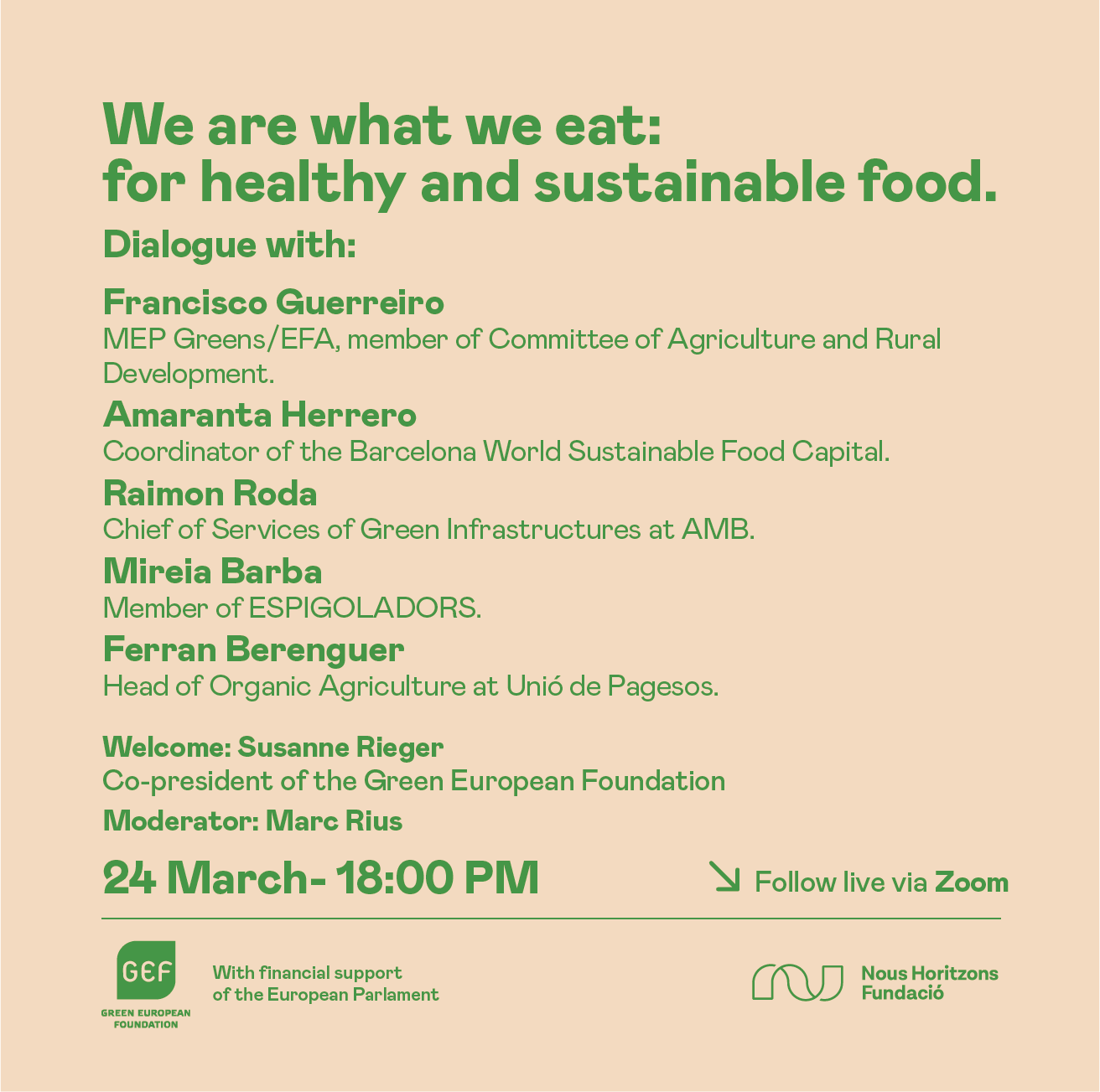
We are what we Eat: For Healthy and Sustainable Food

By

About the Event:

Our first Green-Red Dialogue of 2021 will tackle the sustainable production and consumption of food, from a multi-disciplinary approach. Because everything is fundamentally connected, from the mistreatment of animals and lack of respect for the vital cycles of nature to job insecurity in the countries that supply us. From landscape changes and deforestation to the air we breathe and consequences on our health.

The COVID-19 pandemic has forced us to slow down and reassess our consumption patterns, highlighting the importance of local trade and local production and making everyone a bit more aware of the risks involved. With the help of our speakers, we will explore these issues further, hoping to take advantage of this moment to consolidate some beneficial changes as we move beyond the crisis.

Context:

The Green-Red Dialogues began in 2020 as a way to reflect on current issues from explicitly green and social perspectives. The challenges we face as a result of the COVID-19 crisis are new and unpredictable. Today it is more urgent than ever to reverse the consequences of a capitalist system that not only brought forth the pandemic but has also caused irreparable cracks in our planet. A capitalist system that has been shown to foster social inequality and that assaults the Earth.

We cannot fall into fatalistic discourse and convey the message that all is lost and that, consequently, we cannot do much more. Instead, we must disseminate proposals and make the citizens of the European Union aware that another option is possible – that green policies are compatible with the economy, progress, and development.

With this in mind, the Green Red Dialogues return in 2021, once again providing the space for European policy makers, academics, activists, and citizens to address the challenges of today – combining current affairs and in-depth analysis to spark vibrant discussions about greener, more socially just solutions.

Speakers:

  • Francisco Guerreiro – MEP Greens/EFA, Vice-Chair of Committee on Agriculture and Rural Development
  • Amaranda Herrero – Coordinator of the Barcelona World Sustainable Food Capital
  • Raimon Roda – Chief of Services of Green Infrastructures at AMB
  • Mireia Barba – Member of ESPIGOLADORS
  • Ferran Berenguer – Head of Organic Agriculture at Unió de Pagesos

Welcome by Susanne Rieger, co-president of the Green European Foundation, and moderation by Marc Rius.

Practicalities:

Wednesday, March 24th (18:00 – 19:30)

The webinar is free and open to the general public. There will be simultaneous interpretation in Spanish and English.

Please register in advance via this link.

Desertification, erosion and productive reforestation

By

About the Event:

This event will focus on rural areas of the EU, the European Green Deal in the frame of the19th session of the Committee for the Review of the Implementation of the United Nations Convention to Combat Desertification..

Green European Foundation with the support of FREDA and the Green Institute Greece are opening the discussion for the new EU budget for “Recovery and Resilience” with the aim of enhancing the production of quality agricultural products, supporting local communities, mitigating the loss of biodiversity and the effects of the climate crisis.

Context:

This event is part of the Green European Foundations project Deforestation and Climate Change.

A total of three events will be organised based on the different aspects of the same topic. The aim is to derive guidelines for the type of expenditures for productive reforestations needed to meet Climate Change mitigation targets (e.g. resilience of Mediterranean anthropogenic forest ecosystem).


Speakers:

  • Soil and Desertification- The case of Greece
    • Dr. Christos Tsadilas – Agronomis, Soil scientist, f. Director of the Soil Mapping & Classification Institute ETHIAGE (now ELGO-DEMETER)
  • Geiospatial technology in the erosion and desertification research
    • Dr. Dionisios Kalivas – Professor at the Agricultural University of Athens
  • Sustainable Rangeland management against desertification: best practice applications
    • Dr. Vasilis Papanastasis – Forest – Rangeland Ecologist. F. Director of the Laboratory of Rangeland Ecology, Professor at the School of Forestry & Natural Environment, Aristotelian University of Thessaloniki
  • Autochthonous breeds of grazing animals: how could we regenerate our islands?
    • Dr. Yannis Kazoglou – Agronomist – Rangeland Ecologist, Assoc. Professor University of Thessaly & General Secretary of the Association of the Greek Shorthorn Cattle Breed
  • The 30 years of experience of the ‘Kallidendron’ method for the successful planting and growing of trees in desert and arid envirionments 
    • Dr. Spiros Karkabounas – Professor of Environmental Physiology, Medical Department, University of Ioannina
  • Landscape restoration in the Aegean: the example of Andros through the project – LIFE TERRACESCAPE 
    • Dr. Theodora Petanidou – Professor of Ecology & Ecogeography, Department of Geography, University of the Aegean


An honorary introductory greeting will be addressed by the emeritus professor of the Agriculture University of Athens, Dr. Nikolaos Giasoglou, f. Chairman of the National Commission for Combating Desertification, pioneer for the participation of Greece in the signing of the Convention for the Suppression of Desertification and the creation of the first National Plan for Combating Desertification (1999).

The event will be moderated by the Forest Ecologist Dr. Rigas Tsiakiris on behalf of the Scientific Committee of the Green Institute Greece

Programme:

Starting time: 18:00

Estimated end time: 20:30

Practicalities:

The webinar will be held through the ZOOM platform:

https://us02web.zoom.us/j/88244683827

Meeting ID: 882 4468 3827


This webinar is organised by the Green European Foundation with the support of Green Institute Greece and with the financial support of the European Parliament. The European Parliament is not responsible for the content of this webinar.

Reforestation for productive purposes: pasture, beehiving & recreation in Greece

By

About the Event:

This first online event aims to map the different aspects and initiatives on reforestation with trees for productive purposes, namely pasture, beehiving and recreation in Greece. Target groups are government officers, green-minded stakeholders, NGO’s, local-regional authorities and experts. There will be presentations on behalf of the speakers on various topics and a first attempt to derive comprehensive findings. These findings will feed the second, the third and last online event of this series.

Context:

This event is part of the Green European Foundations project Deforestation and Climate Change.

There are two more events to follow based on the different aspects of the same topic. The aim is to derive guidelines for the type of expenditures for productive reforestations needed to meet Climate Change mitigation targets (e.g. resilience of Mediterranean anthropogenic forest ecosystem).

Programme

  • Agroforestry in Greece: Good examples and perspectives
    •  Dr. Matzanas – Costas Forester-Rangeland specialist – Greek Agroforestry network (here)- School of Forestry, Aristotle University of Thessaloniki
  • Saving local traditional seed varieties, greening the table and the cultivations
    • Panagiotis Sainatoudis – Founder of the non-profit NGO PELITI: “Community of traditional seeds” (here) Citizens take actions:
  • Beekeeping and Forest Ecosystems: A mutual relationship
    • Dr. Sofia Gounari Agronomist – Chief researcher of the Beekeeping Laboratory- Instit. Of Med. Forest Ecosystems, Greek Agric. Org. “Demeter”
  • The value of local traditional varieties of fruit trees – perspectives of their use for agroforestry
    • Dr. Nikos Nikisianis = Biologist, collaborator of the project “Eco-variety”- “SYSTADA OE”
  • Small forest fruit trees and shrubs: The role of commercial plant nurseries in ex-situ conservation 
      • Dr. Eleni Maloupa Agronomist – Director of the Institute of Genetics Improvement and Phytogenetic Resources, Greek Agric. Org. “Demeter”

Practicalities:

The online event will be broadcasted via ZOOM – Launch Meeting – Zoom 

and

Live Streamed through the Green Institute Greece Facebook page: Πράσινο Ινστιτούτο (Green Institute Greece) | Facebook

Language:

This event will be in Greek language


This webinar is organised by the Green European Foundation with the support of Green Institute Greece and with the financial support of the European Parliament. The European Parliament is not responsible for the content of this webinar

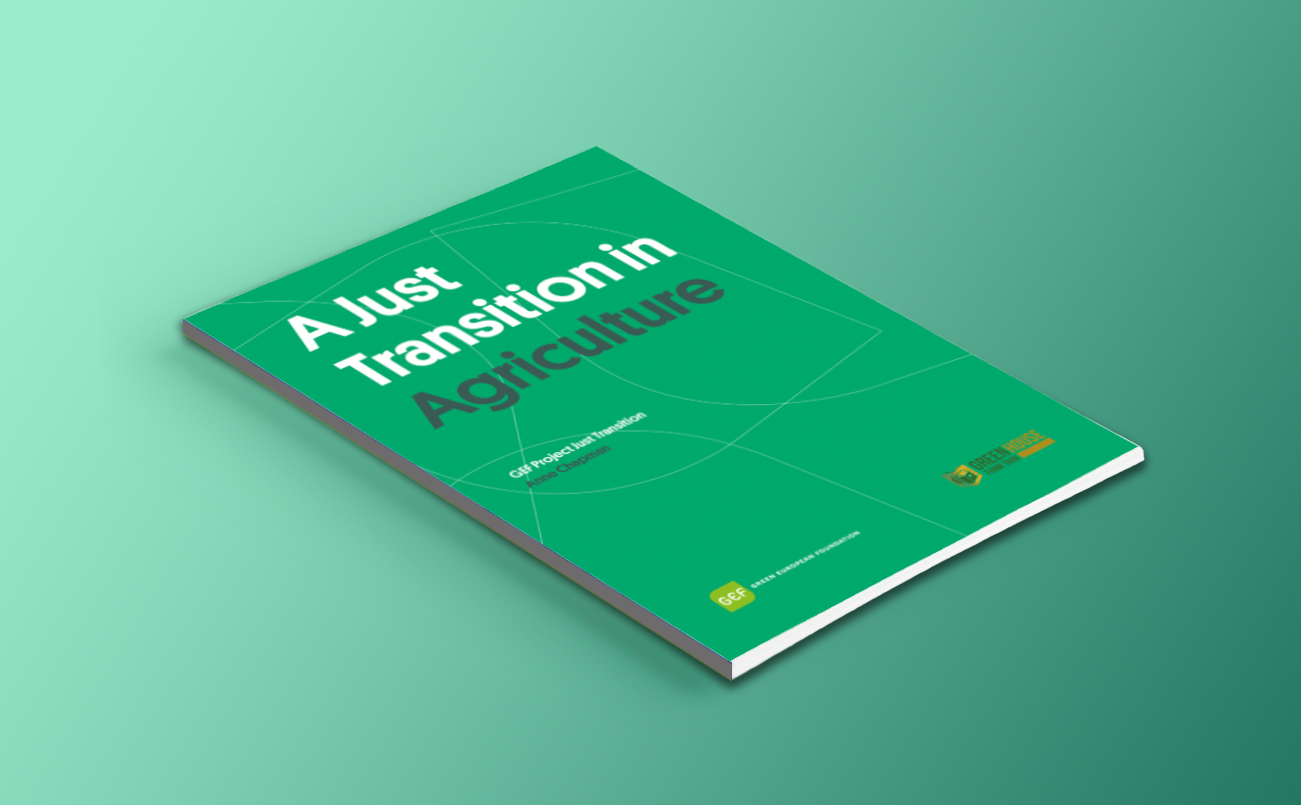
A Just Transition in Agriculture

By Uncategorized
This paper is part of the Green European Foundation’s Just Transition transnational project. The project looks into the question of transforming from an extractive to a regenerative economy in a just and equitable way in order to find the necessary support among the population. The project is focused on collecting and sharing insights on the development of future-proof politics and policies, developed in a sensitive way that keeps in mind local specificities. The project is, on behalf of GEF, coordinated by OIKOS (Belgium), who authored a framing paper, Climate, Jobs and Justice for a green and socially just transition, published in December 2020. The project partners are Green House Think Tank (UK), Institute for Political Ecology (Croatia); Sunrise (North-Macedonia), Transicion Verde (Spain), Federation of Young European Greens (FYEG) and Networked (Serbia). In 2020 these partners carried out various activities in their countries to increase awareness of the importance of a Just Transition. In 2021 they will collaborate on the production of a book showcasing the main challenges and opportunities around Just Transition, to be published in autumn 2021. This publication will feed into the broader scope of the project.


Download

Also available in Spanish.

A Question of Scale (Supply Chains and Local Economies)

By

Context:

The Green European Foundation, in cooperation with Green Foundation Ireland is organising the online conference as part of the Climate Emergency Economy project.  This work forms part of a wider project led by the GEF involving Green Foundation Ireland, Green House in the UK and  the Scientific Bureau Groenlinks in the Netherlands. The work of the project is to identify the key enablers and blockers in order to formulate strategies to stop those actors of the EU and global economy from blocking the transition to limit climate change to 1.5°C.  

About the Event:

A QUESTION OF SCALE: “Imagining a co-operative, community-led approach to regional resilience” (SCALE being the acronym for Supply Chains and Local Economies)

“A Question of Scale” is a conversation in the context of global vulnerabilities and challenges – climate, pandemic, risks to supply chain, jobs, etc – that will…

  • Identify ‘Blockers & Enablers’ to a cooperative, community-led approach to regional resilience;
  • Secure local supply chains and strengthen regional economies;
  • Outline the benefits of regional economies (especially, but not limited to, the agri-food sector);
  • Encourage cooperative effort in local production for local need;
  • Identify the potential for livelihoods in our regions (with a focus on the midlands).

Speakers:

  • Tommy Simpson (Green Foundation Ireland)
  • Dirk Holemans (Oikos, Co-President Green European Foundation)
  • Ciarán Cuffe MEP (Greens/EFA group, European Parliament) 
  • Stanka Becheva (Friends of the Earth Europe)
  • Peter Sims (Green House Think Tank)
  • Jonathan Essex (Green House Think Tank)
  • Oliver Moore (Cultivate; ARC2020)
  • Davie Philip (Cultivate)
  • Sinead Mercier (Philip Lee) 
  • Sean McCabe  (TASC)
  • Liam McGinley (Glencolmcille)

Programme:

13:30 – Welcome & introduction

13:45 – Context of SCALE -Supply Chains and Local Economies

13:55 – Sharing and listening exercise

14:15 – 14:35 Reflections

  • Supply Chains
  • Circular and Local Economies
  • Cooperative Approaches

14:45 Plenary

16:00 Keynote Reflection

16:30 End of event


Practicalities:

This event will be in English.

Time: BST (British Summer Time)

The event is invitation only and free of charge, however registration is required.

Registration link:  https://bit.ly/2GvptQU

For further information please contact: info@greenfoundationireland.ie


Acknowledgements:

This event is organised by the Green European Foundation with the support of Green Foundation Ireland and Cultivate with the financial support of the European Parliament to the Green European Foundation.

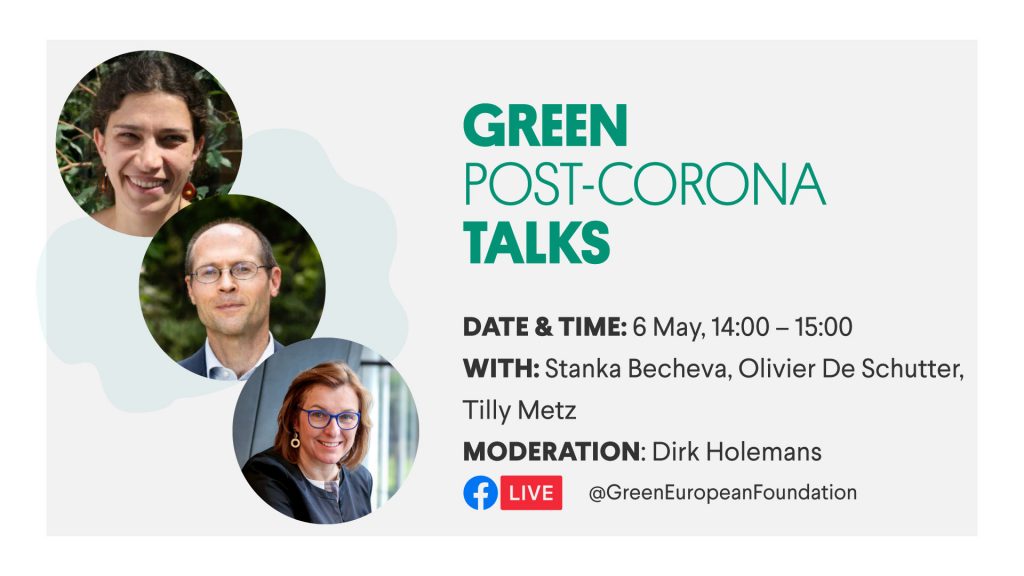
Green Post-Corona Talks with Stanka Becheva, Olivier De Schutter and Tilly Metz

By
The Green Post-Corona Talks with Stanka Becheva, Olivier De Schutter and Tilly Metz is another event from a series of participatory online talks with inspiring guests offering an analysis on what is at stake in this crisis and what positive ideas and concepts there are for a green post-corona vision.

Join our Facebook event to stay alert for the live stream.


About the event


The ongoing Covid-19 pandemic is having a grip on societies worldwide and will impact our lives long after the crisis is overcome. It is clear that we cannot continue with “business as usual,” but that we need to discuss positive ideas and concepts for a better, greener future and resilient societies now.

GEF is therefore hosting the Green Post-Corona Talks, a series of participatory online discussions with high-level experts, thinkers, and policy-makers, and the opportunity for participants to pose their most pressing questions to them live.

The talks will highlight what is currently at stake in the Corona crisis but also look beyond the period of the pandemic, and what possible solutions are already out there and can lend themselves to design the post-corona world.

The series will cover different themes from economy, over migration to gender, and bring in inspiring perspectives from all across Europe.

The project is implemented in cooperation with Oikos.


You can help us advancing forward-looking green ideas

to shape the Europe that we want! 


We rely on your generous contribution to continue putting together new, exciting Green Post-Corona Talks made extensively available to the general European public! So, please consider making a donation today, by clicking on this link.

Politics on the Plate – Visions and Demands for Urban Food of the Future (Vienna)

By

Event background

As part of its thematic priority on food and agriculture, the Green European Foundation wants to bring together different actors of the food system to find alternative solutions to our current food supply which has negative impacts not only on us humans but more so on our environment. Furthermore, GEF’s activities aim to highlight and to support alternative proposals to the Common Agricultural Policy of the European Union.

About the event

As part of a two-day symposium on urban agriculture with a particular focus on Vienna, GEF is organising, with the support of Grüne Bildungswerkstatt, a conference focusing on the political dimensions while fostering the exchange of best practices by inviting highlight projects from all over Europe to share their experiences with alternative urban food supply.

The objective is to get inspiration from each other as well as to formulate concrete recommendations for local politicians as well as citizens on how to ensure urban food supply of the future.

Programme

Friday, 18th October

10:00 Welcome and introduction – Rüdiger Maresch

10:30 – 12:30 European highlight projects of urban food policy

  • Dirk Holemans: Gent en Garde, Belgium
  • Emma Peyron: Copenhagen Food House, Denmark
  • tbc: Janet Sanz Cid: Barcelona, Catalonia-Spain

Q&A

12:30 – 13:15 Lunch break

13:15 – 14:45 Workshops: The political dimension of food

Workshop 1: Nutrition and social policies

  • Thomas Barborik: Food saving in Vienna
  • Melanie Oßberger, FIAN Austria: Human rights violation hunger – political causes, false solutions, and the right to food

Discussion in groups: How can the city contribute to improve the situation?

Workshop 2: Nutrition and environment

  • tbc, Global 2000: Environmental destruction through agriculture
  • Thomas Putzgruber, Verein RespekTiere: Insight the stables of the farmer next door

Discussion in groups: How can the city contribute to improve the situation?

Following the workshops, participants exchange in plenary and share input.

14:45 – 15:00 Coffee break

15:00 – 16:15 Panel debate: Urban food of the future – visions and demands for a modern food supply in Vienna

With: Felix Münster (Ernährungsrat Vienna), Marta Lopez Cifuentes, tbc, (University of Natural Resources and Life Sciences Vienna, department for sustainable agriculture), Martina Pluda (Vier Pfoten Austria), moderated by Dagmar Tutschek (Director Grüne Bildungswerkstatt)

17:00 – 19:00 Evening workshops

3 stations of interactive workshops, among others at the city farm Augarten

Saturday, 19th October

On Saturday, 19th October, the symposium is continued with at Nationalparkhaus Lobau in Vienna with a specific focus on the situation in Vienna, looking at the current food supply in Vienna and inspiring initiatives for alternative (self-)supply. The day will be completed with excursions that will bring participants together with urban farmers, beekeepers, food cooperatives and more. As of 20:00 the evening will be concluded with a joint dinner at Kleine Stadtfarm.


To register, please send an email to anmeldung@gbw.at

GEF at Brno Organic Food Fair (Brno)

By

Event Background

GEF will take part in this local organic food fair as part of its transnational project Fair and Healthy Food, which aims to bring together different actors within the food system to find alternative solutions and support positive changes to the Common Agricultural Policy of the European Union.

About the Event

This organic food festival is organised by NGOs local to Brno, who invite local organic farmers and environmental NGOs. You can find out more about the festival in general here. 

GEF will be present at the festival via its partner Institute for Active Citizenship holding a stall and offering information and resources to festival attendees, including local farmers, NGO representatives and Green politicians.

The festival will also be an opportunity to produce several promotional videos exploring how a local healthy food distribution system can be achieved.


Keep an eye on GEF’s social media for some exciting videos from this event! 

Fair and Healthy Food (Ohrid)

By

Event Background

The GEF transnational project Fair and Healthy Food aims to bring together different actors to find alternative solutions and positive changes to our current food systems. 

Alongside exploring examples of urban movements developing progressive food policies, the project will also examine how regional sustainable food systems can revitalise rural communities.

About the Event

This event, to be held by Ohrid lake in North Macedonia, is organised with the support of our project partner Sunrise, and will invite experts, green activists, academia and NGOs to discuss how we can achieve a fair and healthy food system.

Programme

Day 1

14:00 – 14:30   Introduction of the event and participants

  •  Aleksandar Gjorgjievski project coordinator Fair and Healthy Food
  • Liljana Popovska – Member of North Macedonian Parliament
  • Green perspective on Food production in North Macedonia and the Region

14:30 – 15:00   Presentation of the Fair and Healthy Food discussion paper

  • Aleksandar Gjorgjievski project coordinator

15:00 – 16:00   Debate on the EU Common agricultural policy and alternative solutions to the current food system

  • Ewa Sufin – Jacquemart – Strefa Zieleni – Poland
  • Biljana Mitreska – Slow food Macedonia
  • Zaklina Zivkovic – Networked, Serbia
  • Vasilka Stefanovska – President of Slow Food Vodno – Skopje

Presentation: Green Economy: Cooperative society

  • Lupcho Janevski – Director of Agency for promotion and support of
    tourism – Republic of North Macedonia

Day 2

11:00 – 11:30 Presentation: Local food production and traditional cooking

  • Vasilka Stefanovska – President of Slow Food Vodno – Skopje, North Macedonia

11:30 – 12:00 Presentation: Sustainable tourism perspectives

  • Lupcho Janevski – Director of Agency for promotion and support of tourism 

    – Republic of North Macedonia 

12:00 – 13:00 Panel discusion: Organic and Locally produced food in Macedonia and the EU

  • Moderator: Bojan Petrovski – Coordinator ASSED Sunrise – Skopje

13:00 – 14:00 Lunch

14:00 – 15:00 Conclusions and Closing of the event

Practicalities

The event will take place in conjunction with a workshop on energy democracy by GEF with the support of Sunrise.

The Facebook event for this event can be found here. 

Accomodation

Participants who require accommodation please contact Aleksandar Gjorgjievski aleksgo@gmail.com.

Registration

Registration for this event is required. Please register via the form found here. 

Registration deadline: 5 September 2019

Fair and Healthy Food

By Uncategorized

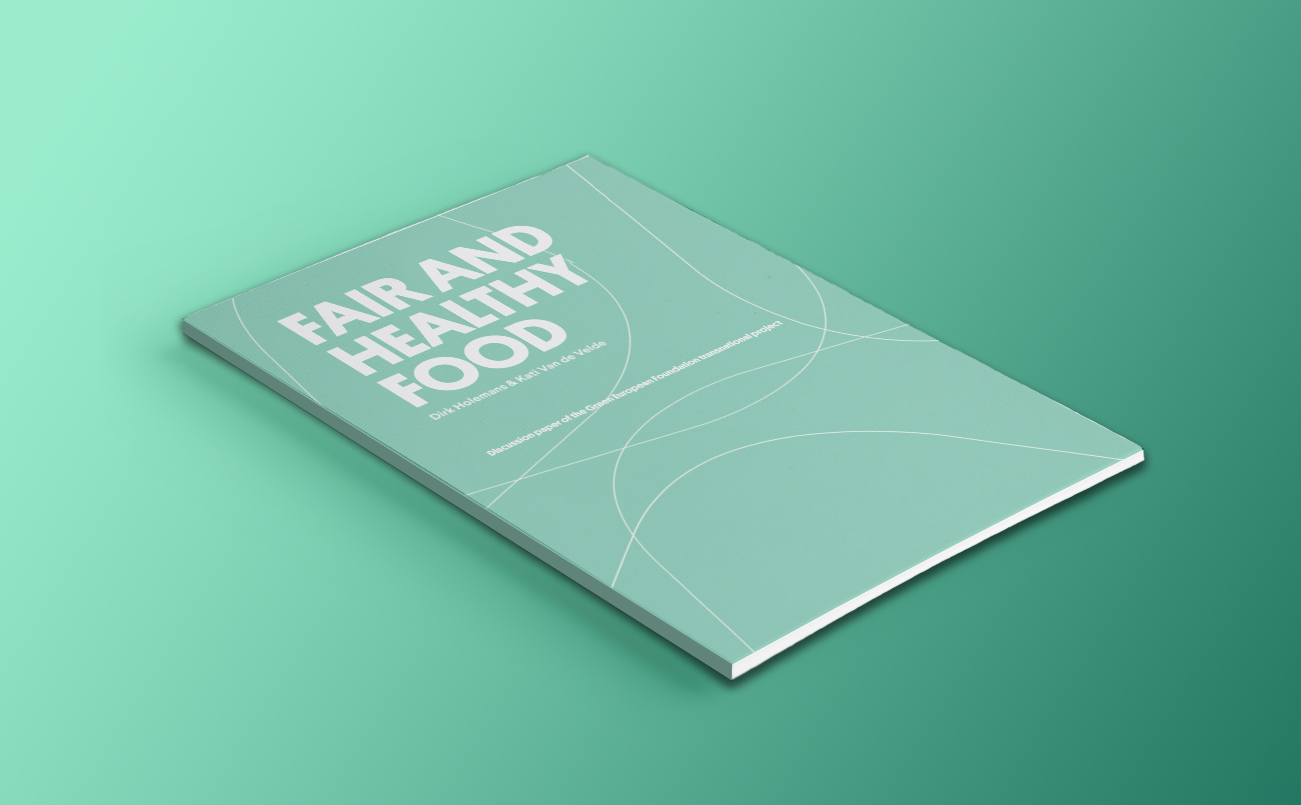
This discussion paper, written by Kati Van de Velde & Dirk Holemans from GEF partner Oikos, has been published as part of the GEF transnational project Fair and Healthy Food.

The paper explores the failings of the current agricultural and food system, and the possibilities for a transition to a sustainable and fair system, one which revaluates food as a human right, a public good and a commons.

Download the publication in Turkish and Serbian.

Food as a Commons (Cork)

By

Event Background

As part of the transnational project Fair and Healthy Food, GEF aims to reach different actors and bring them together to explore alternative solutions and reforms to the European Union’s Common Agricultural Policy and how to redesign food systems around agroecological principles.

Alongside exploring examples of cities developing their own outstanding food policies, the project will also examine how regional sustainable food systems can revitalise rural communities.

About the Event

Rising public concern around climate change and biodiversity loss has led to increasing attention on our food system as both a cause but also a potential contributing solution to environmental breakdown. While efforts are underway to reform European food and agricultural policies in order to better protect nature and rural livelihoods, growing numbers of people are becoming actively involved in reshaping food systems at local level.

Such efforts are demonstrating a creative resurgence of ideas and practices of how we can recover the multidimensional values of food as a public good rather than allow it to remain as a means for private corporate profit, and to help reduce our own personal environmental footprint and retrieve some control over our food supply.

The event proposes that food is not only a vital source of personal well-being but offers a route toward greater citizen engagement. Growing food in cities offers numerous benefits for the urban environment and community resilience and can improve availability of fresh, nourishing produce especially for those for whom access is restricted by income. Above all, it enables us to re-establish the central purpose of a food system: to produce food sustainably to feed people adequately.

This day-long event is an opportunity to pool ideas, share experiences and celebrate the power of community in growing, cooking and eating food.

You are encouraged to book early for this event as we will restrict numbers in order to facilitate an engaged, constructive and convivial experience.
Programme

09:15 – 09:30
Gather in the Lecture Room of Nano Nagle Place

09:30 – 11:00
Two keynote presentations will address new thinking that is helping us to redesign civic food systems led by Henk Renting, Researcher and Lecturer in Urban Food Systems at AERES University of Applied Sciences, Almere, the Netherlands and Orla O’Donovan, Lecturer at the School of Applied Social Studies, University College Cork. The session will be introduced and chaired by Colin Sage, Co-Founder and former Chair of the Cork Food Policy Council.

11:00 – 12:45
In order to enable full engagement by participants this session will be organised as a World Café, and convened by Klaus Harvey of Transition Town Kinsale. Coffee and nibbles will be available and there will be short presentations as inputs to deliberations from Food Historian Regina Sexton, GIS Expert Tomás Kelly and others.

12:45 – 13:30
Report back from table hosts, discussion and elaboration of final action points.

13:30 – 14:00
Walk to St. John’s Central College, Sawmill Street, Cork (a short 5 minute walk).

14:00 – 16:00
We will join the ‘street feast’ that is being hosted by La Cocina Pública, a Chilean theatre group that will be based in the Cork South Parish neighbourhood as part of the Cork Midsummer Festival. Please note that the registration fee will include lunch here.

Speakers

  • Henk Renting
    Researcher and Lecturer in Urban Food Systems,
    AERES University of Applied Sciences, Almere, The Netherlands
  • Orla O’Donovan
    Lecturer at the School of Applied Social Studies,
    University College Cork
  • Colin Sage
    Co-Founder and former Chair of the Cork Food Policy Council

La Cocina Pública / The Public Kitchen
Housed in a shipping container La Cocina Pública is a mobile kitchen that brings people together through theatre, food and dining.
Travelling from Chile through cities and neighbourhoods in Europe in search of local recipes, aromas, practices and customs, La Cocina Publica will work with Cork’s South Parish residents to share stories and food that will be enjoyed at delicious collective dining events – with Chilean and Cork artists, storytellers, singers and musicians providing you with memories and entertainment. Your ticket includes a meal, but to encourage a family-friendly atmosphere for all ages, no alcohol will be served at these events.

Tickets

This event costs €20 per person (plus booking fee), which covers entrance to all events on Saturday, including morning coffee as well as lunch during the Cocina Pública street feast.

Please secure your place by booking here – early booking is RECOMMENDED as numbers will be restricted in order to facilitate an engaged, constructive and convivial experience.