Mining for metals – can it be fair?

By

About the Event:

The energy transition has been placed at the top of the European political agenda, with the digital transition closely following suit. But to successfully implement these two priorities, the EU needs to examine and adjust its supply and use of metals.

Should we press mining companies to clean up their act and negotiate a fair trade in metals, or is time to nearshore the extraction of metal ores? Is it even possible for Europe or the UK to become self-sufficient in metals, by reviving metal mining within their borders and/or by drastically improving recycling from the urban mine? One thing is clear: the dilemmas around metals make it all the more urgent to rethink our consumption patterns, from mobility to data use.

This is the third of nine public webinars as part of the project ”Metals for a green and digital Europe” organised by GEF with the support of Wetenschappelijk Bureau GroenLinks (Lead partner), Green Economics Institute, Institute for Active Citizenship, Etopia, Transición Verde, Visio, Fundacja Strefa Zieleni.


Speakers:


Miriam Kennet (The Green Economics Institute, UK ) – Director CEO

Richard Wouters (Wetenschappelijk Bureau GroenLinks, NL) – Metals for a green and digital Europe  project leader

Francisco Ruiz and Mark Driver- (Mining in Chile)

Dr Freddie Tshibumbu Shamwana ( DRC)

Sophie Kwizera – Just Transition, Actionaid (NL)

Karen Alvarenga Windham-Bellord, (UK and Brazil) PhD Cantab,Natural Resrouces Law specialist, Doctor of Philosophy from the University of Cambridge

Agneta Granstroem Indigenous Sami and former MP, (Sweden)

Dr Liliana Poposkova-  Macedonia Former MP and specialist in Mining

Professor Peter Yang- USA and China- Renewable Energy. Case University

Michael Oghia from the Sustainable Digital Infrastructure Alliance.

Kim Than (University of Alberta, Canada)

Dr Enkhbaya Shagdar, Erina- (Japan) Senior Research Fellow and COP Climate Expert specialist in energy issues and sustainable development

Baroness Natalie Bennett- UK House of Lords

Coal Mining-Speaker- Ewa Sufin –

Professor Asia Mohammed IPBES (Sudan)


To be confirmed:

Dr Hend Ahmed Saldedin (Egypt) Steel Economics and mining and the environment.


Programme:


9.30-10.00 CEST Introduction

Presentation of the Green European Foundation’s transnational project Metals for a green and digital Europe by project leader Richard Wouters (Wetenschappelijk Bureau GroenLinks, NL).

10.00 -11.20 Session 1 – Mining in the Global South

A) Overview: The extraction of metal ores often causes major damage to nature and the environment, as well as human rights violations, conflicts and corruption.Examples include DRC and Chile. The mining of cobalt and coltan in the Democratic Republic of Congo (DRC) is a case at hand. Is a more responsible sourcing of metals from developing countries possible? Is the European Union on the right track by extending mandatory due diligence in supply chains?

Speaker: Sophie Kwizera – Just Transition, Actionaid (NL)Confirmed,

A) The situation in Africa and the DRC

Speaker: Dr Freddie Tshibumbu Shamwana ( DRC), Confirmed

B) Mining in Latin America

1)Mining in Chile- Speaker: Francisco Ruiz (Chile) Mining in Chile ,Confirmed

2) Stakeholder participation in dam safety plans in the mining sector-

Speaker: Karen Alvarenga Windham-Bellord, (UK and Brazil) PhD Cantab,Natural Resrouces Law specialist, Doctor of Philosophy from the University of Cambridge, . GEI Author and Editor. Confirmed-

She says”“The United Nations’ Awareness and Preparedness for Emergencies at Local Level (APELL) for the mining sector sets a 10-step plan for drafting and implementing actions with stakeholders’ participation at its centre. The APELL places special emphasis on representatives of local communities, making the plan more inclusive and effective in saving lives and the environment. This is because when people participate in the decision-making process from an early stage, they are more likely to implement what is planned. In times of emergency, knowledge of the plan and the will to follow it are crucial to save lives and minimize negative consequences of accidents.”

C) Discussion scene setting and Q and A (20minutes)

11.20-11.30 Short Break

11.30- 12.45 CEST Session 2 – Fair trade in metals: The Situation in Europe : Speaker Debate Panel.

Chair Professor Simon Mouatt, Co-Chair Ewa Sufin, Tech: Marlyn Hughes: Tech Miriam Kennet

The EU is eager to strengthen its industry for energy and digital technology, for

instance by building battery factories. If a developing country restricts the export of

metal ores in because it wants to make and export semi-finished metal products

instead, that might lead to a WTO complaint by the EU, as happened in the case of

Indonesia. Does the EU’s scramble for metal ores undermine the global South’s right

to earn more from their raw materials by building their own industry around it? What

would a fair trade arrangement look like?

A) -Mining in Europe: –

Cases

1) Dr Krzysztof Dudek a presentation on the mining of metals in Poland, especially copper. (Poland)

2) The just transition in Poland -Coal Mining-Speaker GEI UN COP Delegate Ewa Sufin -(Poland)

3) Mining conflicts in Norway- Hans Kare Flo- (Tekna-Technical Trade Union, Norway)


11.55-12.05 Mid session quick break


4) N Macedonia. Speaker: Liljana Popovska (N. Macedonia), Former MP and specialist in Mining, GEI Author.

5) Mining in Serbia: Zaklina Zivkovic, PolEkol (Serbia)

6) Indigenous Perspectives -Mining in Traditional SAMI areas in Sweden

Speaker- Agneta Granstroem Indigenous Sami Gov Councillor and Former MP (Sweden)

Q and A


12.45-13.00 Short Break


B) 13.00-13.15 Exploiting the urban mine

To what extent can a better recycling of metals reduce the need for virgin metals? At

present, it is the rarest metals that are worst recycled. How much research and what

kind of legislation do we need to fully exploit the urban mine? Can some metals that

are critical for green energy and digitalisation, such as the rare earths that we

currently source from China, be substituted by more common materials?

Speaker:

Dr Liljana Popovska-( N Macedonia )Former MP and specialist in Mining. ‘Liljana Popovska: Mining can not be in the neighbourhood of agriculture and tourism, definitely.’

13.00-13.30 CEST Lunch Break and Break Outs


13.30-14.20  Session 2d) Mining and The SDGs

The UN Sustainable Development Goals, impacts and ethics of mining -near shoring -can we justify bringing mining effects into the EU? If not- what is the alternative? (All speakers invited to be confirmed)

14.20-14.30 Short Break

14.30- 15.30 Session 3 –Contemporary Metal mining

A) 14.30-15.15 CEST : By importing most of their metals, both the European Union and the UK shift the burden of environmental damage to poorer countries. Mining in Europe would

probably be less destructive because of our environmental rules. Moreover,

perpetuating Europe’s dependence on metal imports, especially from China, creates

geopolitical risks. Is it time to revive metal mining within Europe’s borders? On what

conditions would that be acceptable to local communities and green activists, if at

all?

B) Sustainable digitalisation 15.10-15.30 20 minutes

Digital technologies can help us make a more sparing use of natural resources – from smart energy grids to sensors and algorithms that sort out metal scrap. However, not all forms of digitalisation are a blessing to the environment. The exploding use of data for online video, gaming, advertising, surveillance and training artificial intelligence requires more and more energy and metals. How can we put the digital transition on a sustainable path?


15.30- 15.45 – CEST Break


15.45 – 16.45  Session 4 –From Glasgow COP21 to Kunmin COP15 – 2021 a watershed year. The importance of mining and how to incorporate its future as a sustainable part of human activity.

At the end of 2021, the global community hopes to gather for the UN Biodiversity onference (COP15) in Kunming, China, and for the UN Climate Change Conference (COP26) in Glasgow, UK. If the coronavirus crisis has not driven home the urgency of protecting natural habitats and respecting planetary boundaries, then what will? However, whereas metal mining might be seen as a curse for biodiversity in Kunming, it may be seen as a blessing for climate solutions in Glasgow. Where metal mining takes place in the remaining habitats of wildlife, the risk of new zoonoses is lurking. But we cannot do without metals for carbon-free energy. How to reconcile the objectives of Kunming and Glasgow?

16.45 -17.00 CEST Break


17.00- 17.45 CEST Session 5–Concluding session- and next steps. Rethinking our hunger for metals

The dilemmas around metals prompt us to question a western way of life that is

consuming more and more kilowatt-hours and megabytes. Should we replace every

fossil fuel car with an electric one, or is it better to share cars and promote cycling?

Can our growing data consumption be justified and do we need an even more

versatile smartphone every two years? Are our politicians willing to confront these

questions, even if it might spook their voters?

Practicalities:

Date and time: Saturday, May 15th from 09:00 to 18:00 CET

Audience: This webinar will be in English and is open to the general public.

Registration: Click Here


Please note all times are Central European Time for this event.


This event is organised by the Green European Foundation with the support of  Green Economics Institute and with the financial support of the European Parliament to the Green European Foundation.

Climate Change, EU Recovery and Resilience Fund and Productive Reforestations

By

About the Event

This third concluding online event aims to map the different aspects and initiatives on productive reforestation, agro-climatic zoning and multi-functional landscapes in Greece. Target groups are government officers, green-minded stakeholders, NGO’s, local-regional authorities and experts. There will be presentations on behalf of the speakers on various topics and a first attempt to derive comprehensive findings. These findings together with the first two events will be compiled in a booklet at the end of the project with concrete recommendations for the forestry sector.


Context

This event is part of the Green European Foundations project Deforestation and Climate Change with the support of FREDA and the Green Institute Greece.


Speakers

  • Dr. Athanasios Kizos – Professor of Rural Geography, Department of Geography, University of the Aegean
  • Dr. Ioannis Xatzigeorgiou – Asssistant Professor of Agricultural University of Athens
  • Dr. Nikolaos Dalezios – Retired Professor of Agrometeorology – Remote Sensing, University of Thessaly
  • Dr. Despina Paetaridou – Forester – Environmentalist, Department of Forest Nurseries, Forest Genetic Resources and Reforestation, Ministry of Environment & Energy
  • Dr. Peristera Kourakli – Forester – Environmentalist,  Coordinator of National Forest Strategy Working Group,  Ministry of Environment & Energy
  • Dr. Petros Kakouros – Forester – Environmentalist, Member of the Editorial Committee of the magazine “ECOTOPIA”


Moderator

  • Dr. Rigas Tsiakiris – Forest Ecologist,  Scientific Committee of the Green Institute Greece


Practicalities

The webinar will be held through the ZOOM platform: https://us02web.zoom.us/j/82743911031?pwd=S1BFUERBT1NkSXRxd0xOOG4yRGFiZz09
Meeting ID: 827 4391 1031

This event will be in Greek language


This webinar is organised by the Green European Foundation with the support of Green Institute Greece and with the financial support of the European Parliament. The European Parliament is not responsible for the content of this webinar.

Call for Prep team: Be Brave Summer Festival

By

About the Event

Be Brave Summer Festival

The 6-day long, community-managed, outdoor summer festival will potentially bring together 300 Young Greens and representatives of youth green movements to look back at the challenges and learnings of this period of digital organising, as well as to undertake a journey of introspective reflection of our groups and movements to imagine a way forward for more inclusivity and resiliency.

Please note: the final number of participants and number of festival days will be decided at a later stage and both figures might consequently be reduced to comply with national and EU restrictions.

Context

With the general aim to pursue more inclusive and democratic interactions, processes and structures among youth-led groups and organisations, the event’s concrete objectives are to:

  1. Explore the struggles with active participation for youth-led organisations, movements and informal groups in different parts of Europe;
  2. Create space to reflect on the common culture of green youth organisations and movements, including elements of supremacy culture, patriarchal structures and canceling culture, as well as undergoing a process of collective imagination to envision how a society free of these elements looks like;
  3. Equip young people with tools to analyse and transform the organisational structures, participation methods and decision-making processes of their groups; and
  4. Promote and develop skills of community organising.

In order to achieve these objectives, we are looking for four young activists to join forces with the rest of the preparatory team composed of FYEG’s Project Manager, a member of FYEG Executive Committee, and a team member nominated by the host organisation. Prep-team members should speak English, be available during the preparation period, be responsible about fulfilling their tasks, have good organisational skills, be good team players, be committed to the aims of the project and FYEG’s values, and be familiar with non-formal education methods. They should also be dedicated to the successful implementation of the event.

Main responsibilities of the Prep-Team (PT):

  • Active participation in and commitment to the preparation work prior the event (mid-April – July 2021 // 1.5h weekly PT meeting + 2/3h of individual or couple work);
  • Participation in a live prep team meeting (30 April-3 May or 7-10 May // 2 full working days + travel // location TBD);
  • Preparation and facilitation of the programme of the festival: designing and preparing sessions based on non-formal education methodology, invitation and communication with speakers, trainers and partners in accordance with the project aims;
  • Collaborating with the Local Prep Team to implement community-management elements during the festival and for the establishment of a solidarity/sliding scale ticket;
  • Create and implement an Awareness strategy (including the formation of an awareness team to work full-time during the festival) to ensure the wellbeing and inclusion of all participants;
  • Full participation during the entire festival (6 days, tbc) and prep team meeting before and after (2 days before and 1 day after) in August 2021, exact dates tbd; Support the finalisation of the festival outputs;
  • In the unfortunate event that we can’t hold this activity in-real-life, the PT members should be interested and motivated to hold online activities
  • Helping with the reporting of the event (optional)

Being a prep-team member for the Young Greens Summer Festival would offer you:

  • Working in a lively, supportive and safe international environment;
  • Experience in managing youth projects – preparation, implementation, evaluation, follow-up and reporting;
  • Becoming familiar with the international Green family and various sides of FYEG’s work;
  • The chance to research and learn about best practices for improved inclusion and democratic process of youth organisations and movements;
  • The chance to develop your facilitation skills in group work and non-formal education;
  • The chance to help build, through the programme, long-lasting inclusion and democratising strategies and plans for FYEG, alongside the Executive Committee and the Democracy & Inclusion Working Group;
  • A lot of work and a lot of fun!

Methodology

The program will be based on the principles of non-formal education and intercultural learning. We strive for an active, inclusive and direct communication and transfer and sharing of knowledge. Sessions will be balanced between theoretical inputs, training, workshops, discussions, reflection, planning, committee work, brainstorming, collective imagination and other interactive methods of learning.


Practicalities

Accommodation, food, working space, travel and visa costs for the preparatory team will be fully covered within reasonable limits and within Europe. For selection of travel the condition is to combine the most economic and environmentally friendly way (lowest price + travel time + CO2 emissions).

If you are excited about bringing to life the first ever Young Greens Summer Festival and dig deeper into topics of democratic organising and inclusion methods, you should apply by filling in THIS FORMThe deadline for submitting online applications is March 29th at 23:59 CET.


Acknowledgements

The festival is organised by the FYEG in cooperation with the European Greens and it’s the second activity of the year-long Youth Rebuilds a Brave New Europe project supported by the European Youth Foundation of Council of Europe and the European Greens. One of the seminar workshops is organised by the Green European Foundation with the support of the FYEG and with the financial support of the European Parliament to the GEF.

Desertification, erosion and productive reforestation

By

About the Event:

This event will focus on rural areas of the EU, the European Green Deal in the frame of the19th session of the Committee for the Review of the Implementation of the United Nations Convention to Combat Desertification..

Green European Foundation with the support of FREDA and the Green Institute Greece are opening the discussion for the new EU budget for “Recovery and Resilience” with the aim of enhancing the production of quality agricultural products, supporting local communities, mitigating the loss of biodiversity and the effects of the climate crisis.

Context:

This event is part of the Green European Foundations project Deforestation and Climate Change.

A total of three events will be organised based on the different aspects of the same topic. The aim is to derive guidelines for the type of expenditures for productive reforestations needed to meet Climate Change mitigation targets (e.g. resilience of Mediterranean anthropogenic forest ecosystem).


Speakers:

  • Soil and Desertification- The case of Greece
    • Dr. Christos Tsadilas – Agronomis, Soil scientist, f. Director of the Soil Mapping & Classification Institute ETHIAGE (now ELGO-DEMETER)
  • Geiospatial technology in the erosion and desertification research
    • Dr. Dionisios Kalivas – Professor at the Agricultural University of Athens
  • Sustainable Rangeland management against desertification: best practice applications
    • Dr. Vasilis Papanastasis – Forest – Rangeland Ecologist. F. Director of the Laboratory of Rangeland Ecology, Professor at the School of Forestry & Natural Environment, Aristotelian University of Thessaloniki
  • Autochthonous breeds of grazing animals: how could we regenerate our islands?
    • Dr. Yannis Kazoglou – Agronomist – Rangeland Ecologist, Assoc. Professor University of Thessaly & General Secretary of the Association of the Greek Shorthorn Cattle Breed
  • The 30 years of experience of the ‘Kallidendron’ method for the successful planting and growing of trees in desert and arid envirionments 
    • Dr. Spiros Karkabounas – Professor of Environmental Physiology, Medical Department, University of Ioannina
  • Landscape restoration in the Aegean: the example of Andros through the project – LIFE TERRACESCAPE 
    • Dr. Theodora Petanidou – Professor of Ecology & Ecogeography, Department of Geography, University of the Aegean


An honorary introductory greeting will be addressed by the emeritus professor of the Agriculture University of Athens, Dr. Nikolaos Giasoglou, f. Chairman of the National Commission for Combating Desertification, pioneer for the participation of Greece in the signing of the Convention for the Suppression of Desertification and the creation of the first National Plan for Combating Desertification (1999).

The event will be moderated by the Forest Ecologist Dr. Rigas Tsiakiris on behalf of the Scientific Committee of the Green Institute Greece

Programme:

Starting time: 18:00

Estimated end time: 20:30

Practicalities:

The webinar will be held through the ZOOM platform:

https://us02web.zoom.us/j/88244683827

Meeting ID: 882 4468 3827


This webinar is organised by the Green European Foundation with the support of Green Institute Greece and with the financial support of the European Parliament. The European Parliament is not responsible for the content of this webinar.

Renewable Energy and Gender Equality

By

About the Event:

This meeting will welcome activists, energy NGO representatives, and other interested participants to explore renewable energy, energy transition, and its relation to gender equality. We will focus on developing a network to discuss policy recommendations around energy democracy and gender equality, and the difficulties faced by women in the energy field.

Context:

This is the first of five meetings as part of the Feminist Policies in Green Politics project, where we will delve into different policy areas to strengthen European feminist politics in energy, economics, climate policies, ecology and food & agriculture. Our goal is to identify the difficulties in these areas and compile empowering policy recommendations. Besides these meetings, the project also features a series of Green Feminist Talks – where we will hear more from inspiring activists and politicians across Europe.

Programme:

13:00 – 14:30 (CEST)
15:00 – 16:30 (Istanbul Time)

15:00 – 15:10 Opening
15:10 – 15:40 Network building and Presentations
15:40 – 16:25 Open discussion: problems & solutions
16.25 – 16.30 Closing

Short presentations by:

  • Kardelen Afrodit Adsal, Business Development Manager and advisory board of Turkish Women in Renewables and energy
  • Özge Doruk, Project Coordinator of Women of sun / Kazdağı Association for the Conservation of Natural and Cultural Heritage;
  • Gökçen Durutaş and Kenan Kahya, Foundation For the Support Of Women’s Work

Practicalities:

This online event will take place in Turkish, and is broadcast via ZOOM.

Registrations are open: https://forms.gle/4q3y3Fyt1AFHMYzM9


This webinar is organised by the Green European Foundation with the support Green Thought Association and with the financial support of the European Parliament. The European Parliament is not responsible for the content of this webinar.

Call for Host Organisation: Young Greens Summer Festival

By

Be Brave Summer Festival

It will soon be almost two years since Young Greens have gathered in-real-life internationally. In August 2021 we plan to invite 300 Young Greens and representatives of youth Green movements to a 6-day long, community-managed, outdoor summer festival to: look back at the challenges and learnings of this period of digital organising, as well as to undertake a journey of introspective reflection of our groups and movements to imagine a way forward for more inclusivity and resiliency.

IMPORTANT NOTE: the final number of participants and number of festival days will be decided at a later stage and both figures might consequently be reduced to comply with national and EU restrictions.


About the location and logistical set-up

In organising the first ever Young Greens Summer Festival, we firstly want to ensure the safety and inclusion of all participants. This event will be organised outdoors, with the following logistical requirements:

  • Enough space to host (1) three large open tent constructions (similar to the ones used at music festivals) where to host plenaries and workshops; (2) several smaller stands (Doctors without Borders style) where to hold the parallel sessions of the programme
  • An open space where participants can pitch their camping tents
  • Access to running water on the site and at least one dry area (building or container)
  • Road accessibility to the site for vehicles


About the Local Preparatory Team (LPT)

We are looking for 5 motivated Young Greens who will form the Local Preparatory Team and who will be working alongside FYEG’s Projects staff team and take part in the entire planning and organisational process.

The LPT’s responsibilities will be:

  • Research site/venue, meal and refreshment arrangement options, taking into consideration the logistics criteria identified in agreement with FYEG project staff and green organising partners
  • Coordinate the logistical preparation and implementation of the festival in accordance with the budget envisioned for the event
  • Prepare an infopack related to the event logistics, venue, local travel etc. together with the PT and FYEG office
  • Support with the establishment of a solidarity/sliding scale ticket system
  • Arrange all technical and logistical needs of the preparatory team (PT) and of participants before and during the event
  • Monitor and keep the FYEG office informed of relevant covid-related country developments for the periodic reassessment of the event’s logistics
  • Attend weekly coordination meetings (1h) with FYEG’s project staff (May to August)

The applying organisation should include the formation of the Local Prep Team in the application, and each member should provide their contact and self-identification details by filling in the form linked below.


Apply to host the first Young Greens Summer Festival

The local host organisation will have the following benefits:

  • To promote this activity at local/national level as its international activity in cooperation with FYEG;
  • To make use of presence of the international Young Greens to organise side activities during the event that will support the interest of their organisation;
  • To organise a media event and use the international presence of Young Greens;
  • To build capacities of its own members in organising events, fundraising, educational work and international cooperation.

If your organisation is interested in hosting the Young Greens Summer Festival, we kindly ask you to submit an application to help us decide on the best possible location. This application should contain:

  • A short statement on behalf of your organisation, expressing the interest to be the host of the Young Greens Summer Festival and the commitment to take part in the entire planning and organisational process (April to August).
  • An initial overview of the venue options. Can you think of suitable locations for hosting the festival? Think about: do you know any summer festivals organised in your country and if so, where are they hosted? Are there areas of land that are symbolically important to Greens (squatted land used for community activities and projects, threatened parks/forests that communities are trying to preserve, etc.). What is the road connectivity to the closest city/town/village of these sites like?
  • The formation of the Local Prep Team. Due to the scale and nature of the event, we are looking for 5 people to form the local prep team (LPT). Include their full names and contact emails in the application. Each individual LPT member should fill in this brief questionnaire with their contact details and self-identification information. Please consider that this is a long-term commitment as the preparations will require your LPT’s attention for the 4 months prior to the event.
  • An overview of the transportation options that the place offers: is it easily accessible by road, railway or airway? What are the average costs of travel from various regions of Europe?
  • If your organisation has any, please include any relevant experience with hosting a youth activity last year under Corona restrictions.


Practicalities

Please send all documents by 10th April at 23:59 CET by e-mail to project.manager@fyeg.org and milan@fyeg.org, and do not hesitate to contact us in case you have any questions.

The decision regarding the selected location will be communicated by the 20th April 2021. FYEG strives for regional balance in the organisation of its events, and that will be an important criteria during the selection – together with the quality of the application. The festival is the second activity of the year-long Youth Rebuilds a Brave New Europe supported by the European Youth Foundation of Council of Europe and organised in collaboration with the European Greens. One of the seminar workshops is organised by the Green European Foundation with the support of the FYEG and with the financial support of the European Parliament to the GEF.


A portion of this event is organised by the Green European Foundation with the support of the FYEG and with the financial support of the European Parliament to the Green European Foundation

Transformation Towards Energy Democracy

By

About the Event:

In this event we will underline the need for a more democratic and inclusive society by addressing the state of democracy within the EU and its candidate countries. As well as looking to economic alternatives and the urgency of climate change.

Context:

The Green European Foundation and Sunrise have in the previous three year period been pioneers on the topic of Energy Democracy in North Macedonia; with this 2020 event we will continue with the elaboration on the European experiences in the energy sector and stimulating positive changes in North Macedonia and the region. In this open Webinar we will discuss energy transformation and set a path to a participatory, inclusive and decentralised green economy through promotion of the Energy Democracy concept. Together we will contribute to the debates and practices on the EU level with experiences and challenges from the Balkans.

Speakers:

  • Aleksandar Gjorgjievski, Sunrise – North Macedonia
  • Dirk Holemans, Co-President of Green European Foundation, Oikos Think Tank
  • Maja Morachanin, green MP from the Macedonian Parliament
  • Stefan Bouzarovski , Professor of Human Geography at the University of Manchester,
  • Melani Furlan, Green Energy Cooperative in Zagreb, Croatia
  • Ervin Redjepagjikj El.Eng. – Energy expert


Programme:

18:00-18:10 Introduction

  • Aleksandar Gjorgjievski, moderator and National Coordinator

18:10-18:20 Citizen Energy: Making Energy Democracy Happen publication

  • Dirk Holemans, Co-President of Green European Foundation, Oikos Think Tank
 Introduction of Citizens Energy: Making Energy Democracy Happen Publication

18:20-18:30

  • Maja Morachanin green MP from the Macedonian Parliament

18:20-19:00 Session with speaker’s presentations on Energy Democracy


PRESENTATIONS:

  • Stefan Bouzarovski – Professor of Human Geography at the University of Manchester, where he directs the People and Energy Programme within the Manchester Urban Institute

Topic: Energy poverty in Southeastern Europe

  • Melani Furlan MSc El.Eng. – from the Green Energy Cooperative in Zagreb, Croatia

Topic: Community-led solarization for clean energy transition

  • Ervin Redjepagjikj El.Eng. – Energy expert

Topic: Opportunities and Challenges in Renewables in the region

19:00-19:30 Panel discussion and Q&A


Practicalities

Registrations are open: https://survey.co1.qualtrics.com/jfe/form/SV_38xXJJ4o46T3FYN 

The primary language will be Macedonian but simultaneous translation in English will be provided.

Acknowledgements:

This event is organised by the Green European Foundation with the support of Sunrise and with the financial support of the European parliament to the Green European Foundation

What can cities and regions do to tackle climate change?

By

Context:

In November, GEF is launching the Green Academy with the support of Institute for Active Citizenship.

The Academy will offer those interested in enforcing climate and other green policies, especially on the local and regional level, the opportunity to learn more about respective topics and practical solutions, discuss ideas and network across regions in Czechia.

GEF will implement a series of regular, maximum 90 minutes long, online participatory workshops and webinars with content devoted to one particular topic for each session.

3 dimensions of the topic will always be explored: the European, national and local one.

2 speakers will be invited to each of the workshops; presenting current developments in the topic at the European level (EP), explaining links to the Czech state politics and legislation and specific local projects that would serve as inspiration for specific activities at the local level. The seminars will take place every 4-6 weeks. Currently, four instalments until end-March are planned.

Thematically, the workshops will focus on climate-related policies, such as energy, waste management, Blue-green infrastructure, mobility, CC adaptation, degrowth etc.

About the event:

In the first webinar of the Green Academy series, we will look at reducing carbon emissions and promoting renewable energy sources from the perspective of local and regional authorities. We will focus on practical steps that cities or regions can take towards carbon neutrality and greater energy self-sufficiency.

Speakers:

  • Jana Drápalová – mayor of the Brno – Nový Lískovec district awarded this year the Josef Vavroušek Prize for the transformation of a panel housing estate into an energy-passive district
  • Miroslava Knotková – director of the Energy Agency of the Zlín Region, which has long been dedicated to the support of municipal projects focused on the use of renewable energy sources in municipalities

Registration:

The event is taking place on Zoom platform – you will receive access data by e-mail after registration here: https://forms.gle/qkB6eJurkQPomyS5A

The Green Academy is organised by the GEF – Green European Foundation with the support of Institute of Active Citizenship with the financial support of the European Parliament for the Green European Foundation.

Don’t Just Look in the Mirror, Look at the System

By

Context:

The Just Transition project has as its aim to inspire and inform citizens about the implications of a just transition to a highly sustainable economy, which involves more than technical measures. We need a new economic system that cares for people and the planet, in which all costs and benefits are fairly distributed. How do we sustainably transform our labour market? How do we make sure the transition to renewables is inclusive and equitable? These are some of the questions we try to answer.

About the Event:

In the last decades growing affluence has led to increased resource use and pollutant emissions. This puts a specific responsibility on the shoulder of affluent citizens. A global Just Transition is only possible if we say farewell to ecological gluttony. At the same time, it would wrong to translate this insight in the first place into individual responsibility. Just as you can’t eat healthy in a candy shop, our economies and cultures incite overconsumption and inhibit sustainable lifestyles. How to get rid of your car when there’s no good public transport, why would you change your diet when governments promote eating meat?

Without denying individual responsibility, the solution is found in collectives answers, structural changes of life provisioning systems that enable a good life for all within planetary boundaries.

Speakers:

Julia Steinberger, Professor of Societal Challenges of Climate Change at the University of Lausanne. She studies the relationships between the use of resources and performance of societies, researching how human well-begin can be realized within planetary boundaries. She is a Lead Author of the IPCC report.

Jaap Tielbeke, environmental editor of the Dutch progressive magazine De Groene Amsterdammer. He is also the author of the recent book ‘The Myth of the Green Consumer’ (in Dutch).

Practicalities:

Register your participation by emailing at info@oikos.be

—-

This event is organised by the Green European Foundation with the support of Oikos Think Tank and with the financial support of the European Parliament to the Green European Foundation.
Transformative pathways for tourism in post-pandemic Europe

By

About the Event:

This webinar will offer space for debate among various academic and political organisations across Europe on the sustainability of tourism and the influences the COVID-19 pandemic has had on this sector. This will be an opportunity to share experiences and be inspired by the practices of others. Some of the research findings from the project will be presented but also expanded to a broader debate with engaged scholars and researchers.

Context:

This event is part of the Green European Foundation’s Fair and Carbon Free Tourism transnational project. The project aims to identify and create conditions for collective action against the detrimental social and environmental impacts of tourism. In many countries, tourism is a generator of GDP and fully employed in a growth-oriented consumerist economy. However, there is an underestimated environmental and social impact of tourism.

The impacts of tourism-induced economic activities are often underestimated, and while social impacts are increasingly being considered in some of the tourist hubs of the project partners’ countries, for instance in Barcelona, Dubrovnik, Salzburg, or Ohrid, environmental impacts, in particular, are often not (yet) addressed.

Speakers:

  • Robert Fletcher, Waegeningen University
  • Filka Sekulova, University of Barcelona
  • Nikolina Rajković, Institute for Political Ecology
  • Claus Mersch, FREDA (tbc)

Moderated by: Vedran Horvat, Institute for Political Ecology

Programme:

17:00 – 17.10 Introduction: Vedran Horvat, IPE

17:10 – 17.25 Robert Fletcher, Waegeningen University

17:25 – 17:40 Filka Sekulova, University of Barcelona

17:40 – 17.55 Nikolina Rajković, Institute for Political Ecology

17.55 – 18.10 Claus Mersch, FREDA (tbc)

18:10 – 18.30 Discussion

Practicalities:

Monday, 7 December, 17:00-18:30

This is an online event, please join us here via Zoom.

The event will take place in English.

—-

This event is organised by the Green European Foundation with the support of the Institute for Political Ecology and with the financial support of the European Parliament to the Green European Foundation

Evergreen: Restoring Europe’s Forests

By

Context:

Destruction of primary and old growth forests is an issue not just in tropical forests but also on the European continent. The question of how to stop illegal logging and protect the remaining forests on national but also European levels calls for decisive and orchestrated action – as ecosystem loss and the climate crisis are closely interconnected and their worsening impacts are not blocked by any national boarder.

About the Event:

This is the launch of the Green European Foundation’s Deforestation Project, featuring stakeholders from all over Europe with a focus on Romania. We’ll be looking at solutions for saving our European forests, with breakout rooms and group discussions to tackle the issue together. Our goal is to use our collective knowledge and problem solving to face down the challenges.

Upcoming opinion pieces to feed into the conversation:

  1. The natural forests of Europe are vanishing: focal point Romania
  2. The EU Biodiversity Strategy 2030: Ecological change in the forest sector?
  3. Solutions for – forest protection and restoration

Speakers:

  • Thomas Waitz, MEP, European Parliament
  • Matthias Schickhofer, Conservationist, book author, photographer
  • Ioana Banach, Managing Director, Green European Foundation
  • Alexander von Bismarck, Executive Director, Environmental Investigation Agency
  • Catalina Radulescu, lawyer
  • Ewelina Tylec-Bakalarz, Client Earth
  • Luke Chamberlain, EuroNatur, Agent Green & EU Policy Director PFPI
  • Gabriel Paun, President of Agent Green
  • Susanne Winter, WWF Germany

Programme:

16:30 – 17:00 Arrivals and technical check-in

17:00 – 17:15  Event Opening

Moderator: Ioana Banach (Managing Director, Green European Foundation)

Dagmar Tutschek (FREDA)


17:15 – 18:00  Part I: Losing paradise – destroying Europe’s Forests

  1. What is the state of today’s forests in Europe?

Speaker: Matthias Schickhofer, Conservationist, book author, photographer


2.  Where is the problem?

    1. Who is driving illegal logging in old growth/ primary forests? Who are the beneficiaries? 

Speaker: Alexander von Bismarck, Executive Director, Environmental Investigation Agency

        2. What legal options are there and where are the   difficulties to enforce / strengthen legal protection of old growth forests?

Speaker: Catalina Radulescu, lawyer

        3. What is the role of forest management in the current “forest crisis”? How can ecologically destructive forest management and forest   protection be improved?

Speaker:  Gabriel Paun, President of Agent Green


 3. What is already being done to save the forests and where are the shortcomings?

  • EU Legislations

Speaker: Thomas Waitz, MEP, European Parliament


18:00 – 18:10  Break

18:10 – 18:45  Part II: Restoring Europe’s Forests

Breakout sessions split into 3 working groups – In this session we will deep-dive into solutions-oriented discussions.

Our three speakers will give a short intro to each parallel session, focusing on:

  1. What can be done on a European and local level?

Speaker: Ewelina Tylec-Bakalarz, Client Earth & Matthias Schickhofer,

Visual Facilitator: Alejandro Gil


2. Best-practice of forest management and restoration

Speaker: Susanne Winter, WWF Germany

Visual Facilitator: Anita Berner


3. The role of civil society in tackling the issue.

Speaker: Luke Chamberlain, EuroNatur, Agent Green & EU Policy Director PFPI

Visual Facilitator: Coline Robin


  • Each parallel session will include a Visual Facilitator

18:45 – 19:00 Plenary reporting – Session host and Visual recorders

19:00 – 19:05 Next steps and closing

Practicalities: 

Registrations are now closed. 

We will use the Zoom video conferencing platform. It is recommended to join the webinar via a PC. You do not need to install additional software. However, for the best user experience and full participation features, you can install the free Zoom Desktop App.


Language: the main language is English with simultaneous translation to German

This event is organised by the Green European Foundation with the support of FREDA – Die Grüne Zukunftsakademie and with the financial support of the European Parliament to the Green European Foundation.


Spatial statistics of European harvested forest area

Source: Ceccherini, G., Duveiller, G., Grassi, G. et al. Abrupt increase in harvested forest area over Europe after 2015. Nature 583, 72–77 (2020). https://doi.org/10.1038/s41586-020-2438-y 

Towards a Fair and Low Carbon Tourism: Perspectives from Spain

By

About the Event:

Tourism has positioned itself as one of the main engines of the Spanish economy, but the current crisis of COVID-19 – as the economic crisis of 2008 did before – has shown the fragility of the sector and has called into question the high dependence of the GDP on this activity. The pandemic should serve as an opportunity to seek alternatives to make tourism resilient to new economic, health and climate crises.

Tourism is also a sector that not only produces serious climatic and environmental impacts but these, in turn, affect it negatively. Water shortages, reduced climatic comfort, the loss of beaches or an increase in extreme weather events are some of the effects of global warming with direct consequences on tourism activity and which can seriously compromise its viability.

We should take advantage of the lessons learned during the pandemic to rethink a paradigm shift, a shift towards a fair, low-carbon tourism model that is prepared to face the major climate, economic and social challenges of our time and that is sustainable in the long term. Are we prepared for this?

Context:

This event is part of the Green European Foundation’s Fair and Carbon Free Tourism transnational project. This project aims to identify and create conditions for collective action against the detrimental social and environmental impacts of tourism. In many countries, tourism is a generator of GDP and fully employed in a growth oriented consumerist economy. However, there is an underestimated environmental and social impact of tourism.

Speakers:

  • Javier Benayas: Professor of Ecology at the Universidad Autónoma de Madrid (UAM) and member of the Advisory Council of the Spanish Network for Sustainable Development. Town Planning and Sustainability Councilor in Soto del Real (Madrid).
  • Karima Delli: French MEP from the Greens/EFA group. Chair of the Committee on Transport and Tourism. In 2016 she was appointed vice-chair of the Commission of Inquiry into the Measurement of Emissions from Cars (the so-called Dieselgate).
  • Aurora Pedro Bueno: Director of the New Green Transition Chair at the University of Valencia. Consultant for the World Tourism Organization (UNWTO) since the mid-1990s and author of several publications on Tourism topics.

Moderator: Rosa M. Tristán, environmental and scientific journalist with 30 years of professional experience in different media (El Mundo, El HuffPost, El País, Público, RNE, …).

Practicalities:

Thursday, 3 December, 18:00-19:30

This is an online event, please register in advance via this link.

Simultaneous Spanish-English translation will be available.

—-

This event is organised by the Green European Foundation with the support of Fundación Transición Verde and with the financial support of the European parliament to the Green European Foundation

Greening COP26: an Online Hub for Climate

By

CONTEXT

With the COVID-19 pandemic and particularly the economic recovery of this crisis dominating the public discourse, as well as the postponement of COP26 in Glasgow by a year to November 2021, the need to fight climate change has seemingly lost priority on the political agenda. Although the ongoing pandemic is closely linked to the destruction of our environment and biodiversity, initial declarations by the UK government and others, declaring 2020 as the “year of climate action” have clearly been downscaled which could have dramatic effects for our planet.

The following months will be crucial to ensure public awareness that urgent climate action is needed and that the recovery of our societies and economies must be a green recovery in all its aspects.

The Green European Foundation and the European Green Party are therefore organising “Greening COP26. An online hub for climate” to provide a space for the green ecosystem to keep up the momentum within the movement and to strengthen the connections that were already built – between green actors from different levels as well as between green actors and CSOs.

PROGRAMME

Day 1: Greening COP26 Kick off

Friday, 20 November, 14-17h CET

The first day of the online Green Climate Hub will be held on the day that would have been the original last day of COP26 with a concluding statement/agreement from governments. We will hence use the day to kick off this virtual hub for the green movement to come together and work towards Greening COP26. What are the priorities we will be setting? What do we expect as outcomes of COP26 and what do we realistically expect to happen?

  • 14h00-14h30 Opening of the Climate Hub

Dirk Holemans, GEF Co-President, and Thomas Waitz, EGP Co-Chair and Member of European Parliament

  • 14h30-17h00 Introduction to the hub functionalities and networking


Day 2: The Struggle for Climate Equality

Friday, 27 November, 10-13h CET

Although driven by natural and physical systems that are changing our planet, it is also clear that climate change will bring with it impacts on our social and economic systems as well as exacerbate already existing inequalities. In particular, the gap between the global North and South and the increased negative impacts already being felt by indigenous communities, women and people of color must be addressed. Existing problems, like migration, conflict and wealth inequality will be worsened by the impacts of climate change. Our global private and public finance systems are driving the climate crisis and investing our money in the wrong future. 

How can these problems be addressed? What do we need to consider in our fight for a sustainable and equitable future? How can or will the international climate discussions reflect these issues?

  • 10h00-11h00 Environmental (im)mobility: This workshop will explore the detrimental impacts of climate change and environmental degradation on the movement of people and will discuss different notions of climate migration with Dr Caroline Zickgraf, Deputy Director of the HUGO Observatory for Environment, Migration and Politics.
  • 11h00-12h00 The struggle for Amazonas: We are proud to feature a workshop by the Fridays For Future international youth team SOS Amazonia. In this workshop activists from the Fridays For Future movement give an overview of the situation in the Amazon, the effects the EU-Mercosur free trade agreement would have on it and the solutions that scientists propose to save this crucial ecosystem

Day 3: 5 years after Paris – Walking the Talk?

Friday, 11 December, as of 11h CET

So what is next for us? Marking the 5th anniversary of the Paris Agreement (on the 12th December 2020), and at the same time in the expectation that the European Council (on the 11th December) will make its final decision on the EU climate law, this day marks an important milestone of progress for global and European climate action thus far.

But we know that there is still much work left and time is running out. The impacts of climate change are already being felt, and as we continue to battle the corona crisis, it is more important than ever that we look towards building the sustainable and just future we want to see. Youth movements and activists have not only been leading the push for action now, but as the generation that will bear the brunt of the climate crisis, their vision of the future is more important than ever. We can build on the best practices, innovations, and visions that are already being fought for around the world. Greens, civil society, activists and others must come together to shape a better tomorrow.

  • 11h00-12h00 Networking
  • 12h00-13h30 Panel discussion: Five years after Paris – what’s next?

Speakers: Francois Gemenne, Timothée Parrique, Leonore Gewessler, Mina Tolu, Molly Scott Cato

Moderation: Lisa Tostado, hbs EU Head of International Climate, Energy and Agricultural Policy)

  • As of 14h00: sessions organised with MOCK COP and Glasgow Agreement


The hub will be hosted on GEF’s SpotMe platform. Sign up here.

Exploring Fair and Carbon Free Tourism

By

About the Event:

This international seminar will offer insight into the research conducted by 7 organizations across Europe on the sustainability of tourism and the influences the Corona pandemic had on this sector. This will be an opportunity to share experiences and be inspired by the practices of others.

The impacts of tourism-induced economic activities are often underestimated, and while social impacts are increasingly being considered in some of the tourist hubs of the project partners’ countries, for instance in Barcelona, Dubrovnik, Salzburg, or Ohrid, environmental impacts in particular are often not (yet) addressed.

Context:

This event is part of the Green European Foundation’s Fair and Carbon Free Tourism transnational project. This project aims to identify and create conditions for collective action against the detrimental social and environmental impacts of tourism. In many countries, tourism is a generator of GDP and fully employed in a growth oriented consumerist economy. However, there is an underestimated environmental and social impact of tourism.

Speakers:

  • Maja Morachanin, MP and Leader of the Macedonian Green Party (DOM)
  • Aleksandar Gjorgjievski, ASSED Sunrise – North Macedonia
  • Vedran Horvat, Institute for Political Ecology – Croatia
  • Sergi Alegre, Fundacio Nous Horizons, Barcelona – Spain
  • Zaklina Zivkovic, Networked – Serbia
  • Claus Mersch, FREDA – Austria
  • Ana Petrovska, ASSED Sunrise – North Macedonia

Programme:

11:00 – 11:10      Introduction of the event and participants; opening remarks by Maja Morachanin

11:10 – 11:25       Vedran Horvat – Project Leader of the GEF “Fair and Carbon Free Tourism” – IPE Croatia

11:25 – 11:35      Sergi Alegre – Sand and Sun Tourism in Catalonia: An Overview

11:35 – 11:45      Zaklina Zivkovic – Serbian Tourism Overview

11:45 – 11:55      Claus Mersch – Austrian Tourism Overview

11:55 – 12:05     Ana Petrovska – Responsible Tourism in Ohrid

12:05 – 12:30    Discussion and conclusions

Practicalities:

This online event is open to the general public. It will be taking place in English and Macedonian, with simultaneous translation.

Please register and join the Zoom webinar via this link.

—-

This event is organised by the Green European Foundation with the support of ASSED Sunrise and with the financial support of the European Parliament to the Green European Foundation

Possibilities for Fair, Sustainable and Carbon Free Tourism (Belgrade)

By

About the Event:

The outbreak of the COVID-19 virus significantly affected the number of tourists and overnight stays in Serbia, and tourism in Belgrade was particularly affected. The number of tourists in March 2020 in Belgrade decreased by 65.2% compared to March 2019, while in April 2020 the number of tourists decreased by 98.8% compared to April 2019; in May 2020, a reduced number of tourists was recorded compared to May 2019 with 95.7%.

The COVID-19 pandemic especially affected the number of foreign tourists who, due to the closure of state borders and prevention measures, did not come to Belgrade. After the mitigation of measures to fight the COVID-19 pandemic, an increase in the number of domestic tourists was noted in Serbia, but that recovery was limited in Belgrade, which was the main focal point of the infected in Serbia. In June 2020, the total number of tourists in Belgrade was 83.8% lower compared to June 2019, this trend continued in July with 88.2% and in August with 85.8% less tourists compared to the same months during 2019.

The almost complete shut down and uncertainty that emerged in the tourism and hospitality sector at the global and European level, as well as in Serbia and the city of Belgrade, left room for reflection on how to make the tourism sector more fair, sustainable and carbon neutral after the COVID-19 virus pandemic.

Context:

This event is part of the Green European Foundation’s Fair and Carbon Free Tourism transnational project. This project aims to identify and create conditions for collective action against the detrimental social and environmental impacts of tourism. In many countries, tourism is a generator of GDP and fully employed in a growth oriented consumerist economy. However, there is an underestimated environmental and social impact of tourism.

Programme:

  • 18:00-18:10 Introduction

Predrag Momčilović – Platform for Theory and Practice Zajedničko

  • 18:10-18:20 The project and the situation in Croatia

Nikolina Rajković – Institute for Political Ecology

  • 18:20-18:30 Presentation of research report about Fair and carbon free tourism in Belgrade

Nikoleta Petković and Elene Petrovska – Zajedničko

  • 18:30-20:00 Panel debate about possibilities for fair, sustainable and carbon free tourism in Belgrade

Natalija Stojmenović – Don’t Let Belgrade D(r)own

Miloš Baković Jadžić –Party of the Radical Left

Vladimir Pajić – Movement of Free Citizens

Moderation: Predrag Momčilović – Zajedničko

Practicalities:

When: Wednesday, 4th November (18:00 – 20:00 CET)

Where: Cultural center Grad, Braće Krsmanović 4, Belgrade

A live stream will also be provided via this link.

This event will be primarily in Serbian. No translation is foreseen. 

This event is organised by the Green European Foundation with the support of Zajedničko and with the financial support of the European Parliament to the Green European Foundation

Energy

Transformation Towards Energy Democracy

By

About the Event:

In this event we will underline the need for more democratic and inclusive society by addressing the state of democracy in the EU and candidate countries with the economic alternatives and the urgency of climate change.

Context:

The Green European Foundation and Sunrise have in the previous three year period been pioneers on the topic of Energy Democracy in North Macedonia; with this 2020 event we will continue with the elaboration on the European experiences in the energy sector and stimulating positive changes in North Macedonia and the region. In this open Webinar we will discuss energy transformation and set a path to a participatory, inclusive and decentralized green economy through promotion of the Energy Democracy concept. Together we will contribute to the debates and practices on the EU level with experiences and challenges from the Balkans.

Speakers:

  • Dirk Holemans, GEF Co-President, Oikos – Belgium
  • Aleksandar Gjorgjievski, Sunrise – North Macedonia
  • Miroslav Bogdanovski, MP in Macedonian Parliament
  • Kristina Ozdaklieska, Deputy Minister of Environment in North Macedonia

Programme:

18:20 Participants join the call

18:20-18:30 Introduction

  • Aleksandar Gjorgjievski, moderator and National Coordinator

18:30-19:10 Session with speaker’s presentations on Energy Democracy

  • Dirk Holemans, Energy Democracy
  • Miroslav Bogdanovski, Energy Democracy and the Fight against small hydro power plants
  • Hristina Odzakieska, Climate change and Energy

19:10-19:30 Panel discussion and Q&A

The primary language is Macedonian but simultaneous translation in English will be provided

Practicalities:

When: from 18:20 -19:30 CET:

  • Tuesday, 3rd November

Where: Online platform – ZOOM

Language: Macedonian with simultaneous English translation

Registrations are open: https://survey.co1.qualtrics.com/jfe/form/SV_djrYAunLjXKNq9D

—-

This event is organised by the Green European Foundation with the support of Sunrise and with the financial support of the European parliament to the Green European Foundation.

Sun and Sand Tourism: Proposals for a Sustainable Future

By

About the Event:

For over 50 years the coasts of the Mediterranean Sea have been under pressure from masses of people looking for Sun & Sand, with a huge environmental impact on the coast and elsewhere through hidden destruction.

For the first time in decades popular tourist destinations have received respite during the travel season, but at the expense of economic and social wellbeing of millions. So now what? This webinar will focus on how greening the sector can aid the recovery in these hard-hit areas.

Context:

This event is part of the Fair and Carbon Free Tourism project. This project aims to identify and create conditions for collective action against detrimental social and environmental impacts of tourism. These impacts of tourism-induced economic activities are often underestimated, and while social impacts are increasingly being considered in some of the tourist hubs of the project partners’ countries, for instance in Barcelona, Dubrovnik, Salzburg, or Ohrid, environmental impacts in particular are often not (yet) addressed.

Speakers:

  • Susanne Rieger – Co-chair of GEF
  • Sergi Alegre – Fundacio Nous Horitzons
  • Tilly Metz – MEP Greens/EFA, Committee of Transport and Tourism
  • Eugenia Pascual – Initiative for Catalonia Greens Girona
  • Neus Truyol – Councillor Mallorca city, Equo
  • Vedran Horvat – Director of Institute for Political Ecology, Croatia

Practicalities:

Please check back later for a detailed programme.

This event will be taking place online. Register in advance via this link.

—-

This event is organised by the Green European Foundation with the support of Nous Horitzons Fundació and with the financial support of the European parliament to the Green European Foundation

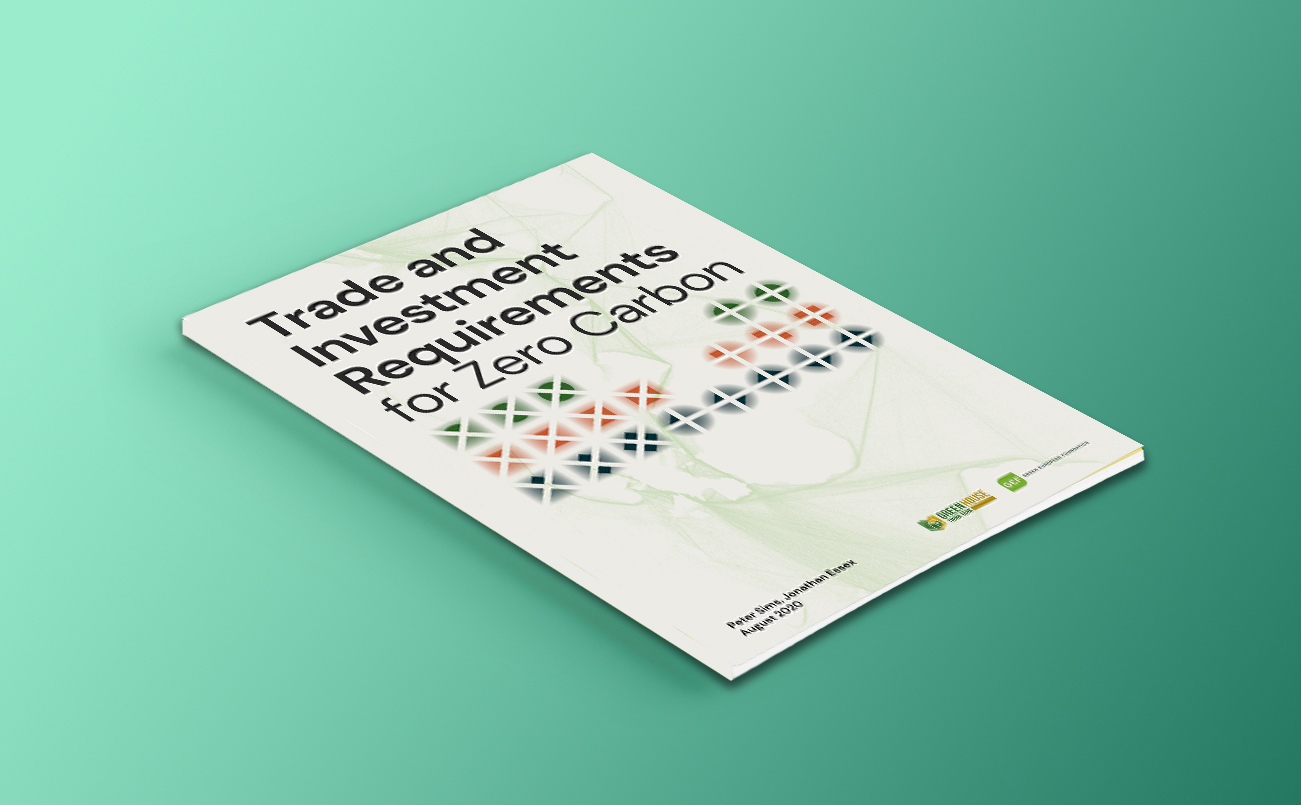
Trade and Investment Requirements for Zero Carbon

By Uncategorized

As moves are being made to introduce a Climate & Ecological Emergency Bill in the UK, and a new Trade Bill is progressing through parliament post-Brexit, it’s an important time to be considering the implications of zero carbon for global trade and investment decisions. This report proposes a much-needed toolkit to help policy makers face up to climate reality and address the wider environmental impacts and the imbalances of power and wealth that underlie our global trade.

Download the technical annex here.

A Question of Scale (Supply Chains and Local Economies)

By

Context:

The Green European Foundation, in cooperation with Green Foundation Ireland is organising the online conference as part of the Climate Emergency Economy project.  This work forms part of a wider project led by the GEF involving Green Foundation Ireland, Green House in the UK and  the Scientific Bureau Groenlinks in the Netherlands. The work of the project is to identify the key enablers and blockers in order to formulate strategies to stop those actors of the EU and global economy from blocking the transition to limit climate change to 1.5°C.  

About the Event:

A QUESTION OF SCALE: “Imagining a co-operative, community-led approach to regional resilience” (SCALE being the acronym for Supply Chains and Local Economies)

“A Question of Scale” is a conversation in the context of global vulnerabilities and challenges – climate, pandemic, risks to supply chain, jobs, etc – that will…

  • Identify ‘Blockers & Enablers’ to a cooperative, community-led approach to regional resilience;
  • Secure local supply chains and strengthen regional economies;
  • Outline the benefits of regional economies (especially, but not limited to, the agri-food sector);
  • Encourage cooperative effort in local production for local need;
  • Identify the potential for livelihoods in our regions (with a focus on the midlands).

Speakers:

  • Tommy Simpson (Green Foundation Ireland)
  • Dirk Holemans (Oikos, Co-President Green European Foundation)
  • Ciarán Cuffe MEP (Greens/EFA group, European Parliament) 
  • Stanka Becheva (Friends of the Earth Europe)
  • Peter Sims (Green House Think Tank)
  • Jonathan Essex (Green House Think Tank)
  • Oliver Moore (Cultivate; ARC2020)
  • Davie Philip (Cultivate)
  • Sinead Mercier (Philip Lee) 
  • Sean McCabe  (TASC)
  • Liam McGinley (Glencolmcille)

Programme:

13:30 – Welcome & introduction

13:45 – Context of SCALE -Supply Chains and Local Economies

13:55 – Sharing and listening exercise

14:15 – 14:35 Reflections

  • Supply Chains
  • Circular and Local Economies
  • Cooperative Approaches

14:45 Plenary

16:00 Keynote Reflection

16:30 End of event


Practicalities:

This event will be in English.

Time: BST (British Summer Time)

The event is invitation only and free of charge, however registration is required.

Registration link:  https://bit.ly/2GvptQU

For further information please contact: info@greenfoundationireland.ie


Acknowledgements:

This event is organised by the Green European Foundation with the support of Green Foundation Ireland and Cultivate with the financial support of the European Parliament to the Green European Foundation.
Achieving zero carbon trade, investment and industry (London)

By

Context:

The Green European Foundation, in cooperation with Green House Think Tank is organising the online conference as part of the Climate Emergency Economy project.  This work forms part of a wider project led by the GEF involving Green House in the UK, Scientific Bureau of Groenlinks in the Netherlands and Green Foundation Ireland.

This online conference follows successful events last year on Climate Jobs and a Just Transition and Climate Emergency – Raising Ambition.

About the Event:

Under the title “Achieving zero carbon trade, investment and industry” the Conference will focus on What needs to change for trade, investment and industry to meet the challenge of the climate emergency and exist within planetary boundaries?

A new report from the Green European Foundation and Green House Think Tank introduces a new toolkit to aid policy makers and campaigners to rethink trade.

The “Trade and Investment Requirements for Zero Carbon” Report is now available for download. (Technical Annex – Methodology)

What obstacles are blocking decarbonisation? What policies will enable the changes we need?

With speakers from the Netherlands and Ireland, a political panel discussion, break-out sessions and chances for networking, please join us to explore what a climate emergency economy could look like.

Speakers:

  • Natalie Bennett (Green Peer)
  • Saskia Bricmont (Belgian MEP and Member of the Committee on International Trade)
  • Anna Cavazzini (German MEP and Member of the Committee on International Trade)
  • Peter Sims (Green House Think Tank)
  • Jonathan Essex (Green House Think Tank)
  • Evert Nieuwenhuis (GroenLinks)
  • Tommy Simpson (Green Foundation Ireland)
  • Davie Philip (Cultivate)
  • Ellie Chowns (England and Wales Green Party)
  • Jean Blaylock (Global Justice Now)

Programme:

14:00 – Welcome & introduction

14:05 – Session 1a | Chair – Natalie Bennett

  • Trade story highlights
  • Introduction of the Blockers & Enablers toolkit
  • Group discussion

14:30 – Session 1b | Chair – Natalie Bennett

Decarbonising Industry – The Netherlands

  • Presentation
  • Pairs discussion

Re-localisation / Shortening the Supply Chain – Ireland

  • Presentation
  • Pairs discussion

14:50 – Session 1c | Chair – Natalie Bennett

Group discussion – Q&A from the audience

15:15 – Short break

15:30 – Session 2 | Chair – Natalie Bennett

Panelists:

  • Ellie Chowns, England and Wales Green Party International Spokesperson
  • Jean Blaylock, Campaigns and Policy Manager, Global Justice Now
  • Saskia Bricmont (Belgian MEP and Member of the Committee on International Trade)
  • Anna Cavazzini (German MEP and Member of the Committee on International Trade)

16:30 – End of event


Practicalities:

This event will kick off new work on trade, infrastructure and industry – and we’d love to have you there.

Time: BST (British Summer Time)

Registrations are now open


Acknowledgements:

This event is organised by the Green European Foundation with the support of Green House and with the financial support of the European parliament to the Green European Foundation.