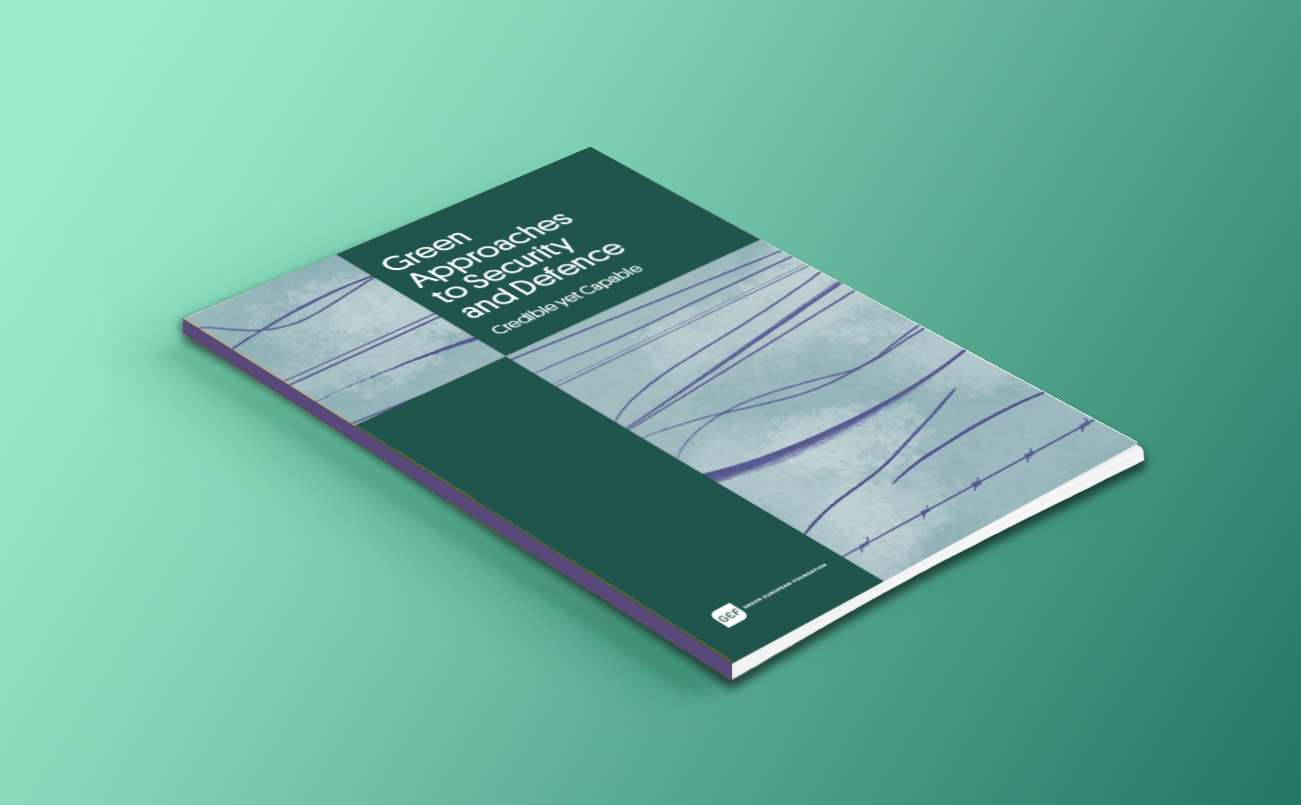
Green Approaches to Security and Defence

By Publications

In a shifting geopolitical landscape, Greens are grappling with the interplay between their traditional pacifist roots and the post-February 2022 security challenges. This report delves into their evolving stances on key defence issues, from EU military cooperation to disarmament, offering insights into the varied approaches adopted by Green parties from eight EU countries. Expert viewpoints featured throughout provide further feedback and inputs as to what a Green defence policy could (or should) look like. As Europe navigates turbulent waters, the report calls for renewed commitment to progressive and principled approaches to security and defence.

The report is structured into five chapters that address important EU military challenges. They portray a nuanced understanding of European security dynamics among Green parties, reflecting varying national contexts, strategic cultures, and historical perspectives. This report thus provides a clear mapping of green defence thinking across Europe, including points of convergence, gaps, and tensions. Complemented by the expert views, it gives a solid basis for further discussion within and beyond the Greens, to strengthen defence and security policy while maintaining a critical and progressive voice, even in uncertain times.

Chapter 1 delves into the complex institutional landscape of security and defence in Europe. It examines the debates surrounding the identity of the EU and looks at the respective roles of the EU and NATO as security providers.

Chapter 2 focuses on military expenditures and budget allocation. It discusses differing perspectives among Green parties on the use of GDP to set defence government budgets and on how these should be allocated.

Chapter 3 explores Green parties’ opinions on defence industrial policies broadly understood. It examines Green positions on grant programs put in place by the EU and shows diverging opinions on the allocation of public funds to industry.

Chapter 4 analyses positions on nuclear deterrence, disarmament, and arms control. Green parties generally continue to oppose the doctrine of nuclear deterrence, but the war in Ukraine has led some to revise their position on its effectiveness.

Chapter 5 delves into the intertwined concepts of civic militarism, civil protection and non-violence; their implications for military involvement in security as well as civilian participation to defence.


This report is a call to action for Green parties to embrace their role as catalysts for progressive security policies. By navigating the complexities of modern security with creativity, Greens can contribute to shaping a peace-oriented, sustainable, and common European security architecture.


About the authors

Agatha Verdebout is a researcher and deputy director at GRIP. Her main area of expertise is international peace and security law.

Anne Xuan Nguyen is a researcher at GRIP. Working more broadly on security and environmental issues, she specializes in conflict-related pollution and its remediation.


This report is also available in:

FrenchGreekGerman Polish


This study was conducted by the Green European Foundation with the support of Etopia , Cogito , Cooperation and Development Network Eastern Europe, and Sustainable Development Forum Green Window . The study was commissioned by GEF to the Groupe de recherche et d’information sur la paix et la sécurité (GRIP). It is published with the financial support of the European Parliament to the Green European Foundation. The views expressed in this publication are solely those of the authors and do not necessarily reflect the views of the European Parliament or the Green European Foundation.
Green Thinking on Defence and Security (Brussels)

By


About the event

This event will feature the launch of two brand-new GEF publications. We will discuss their content with the authors alongside two expert panels, leaving  ample time for questions and networking.  

LAUNCH: Credible yet Critical? Green Approaches to Defence (upcoming) – with GRIP

In a shifting geopolitical landscape, Greens are grappling with the interplay between their traditional pacifist roots and the post-February 2022 security challenges. This report delves into their evolving stances on key defence issues, from EU military cooperation to disarmament, offering insights into the varied approaches adopted by Green parties from eight EU countries. Expert viewpoints featured throughout provide further feedback and inputs as to what a Green defence policy could (or should) look like. As Europe navigates turbulent waters, the report calls for renewed commitment to progressive and principled approaches to security and defence.

LAUNCH: Geopolitics of a Post-Growth Europe

It is unlikely that we will be able to defuse the climate time bomb, let alone other ecological threats, as long as our economy continues to grow. But what would the end of economic growth mean for geopolitics? Could a European Union that is the first to embrace post-growth still be a global actor? Would it be able to defend itself, its allies, democracy, human rights, and the international rule of law at a time when aggressive autocracies are invading or threatening their democratic neighbours? By igniting a conversation between critics of economic growth and progressive thinkers on foreign and security policy, this report addresses uneasy questions that few have dared to ask.  


Project background

This event is part of the Green European Foundation’s thematic focus on geopolitics, peace, and security. In a complex, fractured, and volatile geopolitical environment, GEF works to bring together CSOs, activists, academics, and other experts for open and multi-faceted discussions on Europe’s security challenges. With a clear eye on the future, the foundation aims to cultivate green thinking and European policy proposals that address not just the crises of today, but can build resilience in a more just and sustainable world.  


Speakers

  • Agatha Verdebout – Groupe de recherche et d’information sur la paix et la sécurité 
  • Antoine Oger – Institute for European Environmental Policy
  • Laëtitia Sédou – European Network Against the Arms Trade 
  • Nicoletta Pirozzi – Istituto Affari Internazionali 
  • Olivia Lazard – Carnegie Europe
  • Richard Wouters – Wetenschappelijk Bureau GroenLinks
  • Roderick Kefferpütz – Heinrich-Böll-Stiftung EU

And more to be announced! 


Programme

15:00 – 15:15 Opening words 

15:15 – 16:30 Presentation and panel discussion on Green Visions on European Security  

16:30 – 16:45 Coffee break 

16:45 – 18:00 Presentation and panel discussion on Geopolitics of a Post-Growth Europe 

18:00 – 19:00 Closing remarks and networking drinks 


Practicalities

Date and Time: Wednesday, March 6th (15:00 – 19:00 CET)

Location: Press Club Brussels Europe

Language: English

Registration: This event is taking place in person with limited spots. Please register in advance via this link.

A coffee break and networking drinks will be provided.   


This launch event is organised by the Green European Foundation with the support of Wetenschappelijk Bureau GroenLinks and Etopia and with the financial support of the European Parliament to the Green European Foundation.   
Political Ecology Days (Brussels)

By

About the event

This edition of the Politicla Ecology Days will be particularly focusing on the question of the reversal of inequalities and the innvational ideas on how to take care better of our world and society. We will therefore discuss how to repair and transform the earth, how to mend inequalities, investigate the relations between humans and non-humans and discuss  our visions of the economy, the world or justice. Repair can be conceived here as both “acknowledging”, “doing justice” or “taking care”. Transform as a movement which, starting among other things from what there is to repair, modifies the coordinates of the world-system.

During 4 days, you can discover more about green politics in 8 lectures, 12 workshops, Greens Talks and 1 documentary screening.


Some highlights of the pogramme:

12th October 2023

20:00-21:30: Une économie centrée sur le soin with Emmanuel Petit, Christine Bauhardt and Géraldine Thiry, moderated by  Dirk Holemans (Co-President Green European Foundation) (FR<>EN)

13 October 2023

9:30: La sobriété ou l’essentiel au quotidien with Geneviève Pruvost, Catherine Larrère, Nadia Leila Aissaoui, moderated by Claudine Drion (FR<>EN)

11:30: Justice restaurative environnementale & écologie judiciaire with Marine Calmet, Olivier de Schutter, moderated by Sophie Wustefeld (FR<>EN)

20:00: Une écologie des corps par-delà nature et culture with Myriam Bahaffou, Catriona Sandilands, Cy Lecerf Maulpoix, moderated by Julien Didier (FR<>EN)

 14 October 2023

14:00: Le Green Talk – 8 nanos-conferences with François Ost, Catherine Larrère, Erica Lippert and many more (FR)

18:30: Artistic performance: Désorceler la finance

15th October 2023 

10:30 – 15:30: School of love – processus artistique (artistic performance)

10:30 – 13:00: De la résilience intérieure (workshop, FR)

14:00 – 16:30: Créer des “mèmes” (internet) écologiques (workshop, FR)

You can find more details for the individual events and many more highlights and the complete programme on this website.


Speakers

  • Catherine Larrère, French philosopher
  • Geneviève Pruvost, sociologist of work and gender
  • Emmanuel Petit, professor of economics
  • Myriam Bahaffou, decolonial ecofeminist activist
  • Géraldine Thiry, professor of economics
  • Olivier De Schutter, former special rapporteur for the UN Human Rights Council

and many more!

Learn more about the schedule of the programme and speakers.


Practicalities:

Date and Time: 12-15 October, 9am – 6pm

Location: Tour et Taxis, Avenue du Port 86c/3002, Brussels

Language:  The main languages of the event will be French and English, with simultaneous interpretation provided for some sessions.

Registration: Please sign up here


This event is organised by the Green European Foundation with the support of Etopia and the financial support of the European Parliament to the Green European Foundation. 
Rethinking Demand: Sufficiency Policies for a Post-Growth Society

By

About the event

Soaring energy prices are pushing European states to urgently implement energy saving measures in all sectors, as well as financial supports for the most exposed households and businesses. In France, President Macron did not hesitate to speak of “the end of abundance” and the implementation of a “great sobriety plan”. In Germany, particularly exposed to the closing of the Russian gas tap, the Federal State has implemented a series of energy saving measures. Among other things, large gas consumers are required to register and make themselves available in case of a shortage. In Belgium, the government has been refining its energy emergency plan for several months with data from large consumers and is considering ways to help the most vulnerable to pay their bills. 

Are European states ready for the advent of a post-growth society? Can the ecological project of a sober society now inspire public policies? Concretely, what does a post-growth economic policy look like? What indicators exist to assess these policies? These questions and more will be tackled in this cross-country dialogue. 

Context

This event is part of the GEF transnational project Climate Emergency Economy: Rethinking Demand. Building on several years of work exploring what it means to create an economy fit for the climate emergency, GEF and its partners are this year focusing on the crucial question of how to reduce demand for energy and materials. With the support of Green House Think Tank, Etopia, and Green Foundation Ireland, we are exploring how to frame rethinking demand politically, and articulate clear plans for demand reduction so green narratives are better grounded in reality and a shared vision of hope. 

Speakers

To discuss this pressing topic, we will be joined by a fantastic panel of experts: 

  • Yves Marignac – Négawatt, France 
  • Philippe Roman – ICHEC, Belgium 
  • Marula Tsagkari – TU Delft / R&D, Greece 
  • Lasse Thiele – Konzeptwerk, Germany 
  • Nadine Storey – Green House think tank, UK 
  • Leon Leuser – Wachstumswende, Germany 

The session will begin with a brief presentation of our Rethinking Energy Demand report, by co-author Nadine Storey (Green House think tank), followed by discussion with all our panelists.   

Practicalities

Date & Time: Wednesday, October 26th (12:00-14:00 CET) 

Location: Online, via Zoom. Please register in advance via this link 

Audience: Open to all registered participants. The event will be in English. 

 To continue the conversation on this topic, join us later that same day in Dublin or online at Rethinking Demand: Reality and Opportunities. Make sure to register, as particularly in person spots are limited! 


This event is organised by the Green European Foundation with the support of Etopia and the financial support of the European Parliament to the Green European Foundation. 
Rethinking Demand: Realities and Opportunities (Dublin/online)

By

About the event

The Green European Foundations is bringing together Green House Think Tank (UK), Etopia (Belgium) and Green Foundation Ireland at an event hosted with the Lord Mayor of Dublin Caroline Conroy. This event will launch our Rethinking Demand Framing Paper and explore the complexity of the actions needed to reduce our demand for energy as well as the politics involved in doing so.  

As the urgency of the need to limit emissions to prevent further climate harm grows, and the all-encompassing nature of achieving this dawns, the pivotal role of rethinking how our societies deliver wellbeing for all has become ever more critical. During this conference, sessions will explore how social and business practices, infrastructure, and our governance structures can be transformed to reduce the collective demand for energy and unlock a future without fossil fuels.

Context

This event is part of the GEF transnational project Climate Emergency Economy: Rethinking Demand. Building on several years of work exploring what it means to create an economy fit for the climate emergency, GEF and its partners are this year focusing on the crucial question of how to reduce demand for energy and materials. With the support of Green House Think Tank, Etopia, and Green Foundation Ireland, we will explore how to frame rethinking demand politically, and articulate clear plans for demand reduction so green narratives are better grounded in reality and a shared vision of hope. 

Programme

Please note that all times are indicated in IST/BST. For participants joining online from a CEST time zone, everything will be one hour later.

Our FULL PROGRAMME OF EVENTS is available here. Please see below a short overview:


14:00 Address by Dublin’s Lord Mayor Caroline Conroy.

Presentation and discussion of Green House Think Tank’s framing paper “Rethinking Energy Demand” by two of its authors, Jonathan Essex and Peter Sims.

Panel discussion facilitated by Michael Smith (Editor of The Village magazine) with keynote speaker John Gibbons (Environmental journalist and commentator) and Claire Downey (Rediscovery Centre), Davie Philip (Cultivate) and Rosalind Skillen (Keep Northern Ireland Beautiful).

“Circular Economy and Demand Reduction” with Minister Ossian Smyth.

17:00 Closing reflections and drinks reception.

Practicalities

Date and Time: Wednesday, October 26th from 14:00 – 17:30 IST (15:00 – 18:30 CEST) 

Location: In person at the Mansion House in Dublin, Ireland. Please note that you can also follow this event online, via Zoom. 

Audience: Open to all registered participants. The event will be in English. 

Registration: Whether you are joining in person or online, please register in advance via THIS LINK. Spots for in person attendees are limited, so if they fill up you may be placed on a waiting list. With any questions regarding registration, please contact info@greenfoundationireland.ie  

Related reading

For Energy Independence, the EU Must Think Bigger than Power

Energy Crisis: Keeping the Cost of Living Down While Protecting the Climate

Affordable, Sustainable Housing Can Bring the Green Deal Home

The Devil’s in the Data: How the Energy Crisis Could Reshape Ireland’s Economy

Alexander Langer’s Case for an Ecological Conversion


This event is organised by the Green European Foundation with the support of Green Foundation Ireland, Etopia, and Green House Think Tank and the financial support of the European Parliament to the Green European Foundation. 
Rethinking Demand: EU Roundtable

By

About the event

As Russia’s war in Ukraine puts pressure on energy supplies across Europe, governments are preparing for an uncertain winter, with concepts like rationing and controlled blackouts suddenly on the table. 

Yet the need to structurally rethink our demand for energy and other key goods is not new. Amid the multiple crises facing Europe and the world, not least the climate emergency, there is a continued failure to acknowledge the role of reducing demand in the rapid and fundamental change needed. Mainstream understanding of demand management focuses on improving efficiency and engaging consumers, which tends to reproduce existing consumption levels with marginally less energy and resource use.  This is insufficient to deliver the reduction in energy use needed as part of a rapid shift to zero carbon and to remain at 1.5°C warming. 

A better understanding of the realities of demand change is required, and exploring how to frame this difficult topic is critical to reaching climate targets and energy independence goals. This expert roundtable will bring together academics, politicians, activists and NGO/foundation representatives to discuss to what extent we need to reduce energy demand and how we can go about it in a just yet decisive manner. Results of this discussion will inform a framing paper to be published in the autumn. 

Context

This event is part of the GEF transnational project Climate Emergency Economy: Rethinking Demand. Building on several years of work exploring what it means to create an economy fit for the climate emergency, GEF and its partners are this year focusing on the crucial question of how to reduce demand for energy and materials. With the support of Green House Think Tank, Etopia, and Green Foundation Ireland, we will explore how to frame rethinking demand politically, and articulate clear plans for demand reduction so green narratives are better grounded in reality and a shared vision of hope. 

Programme

More details on the programme will follow. 

Practicalities

Date and Time: Thursday, 15th September (15:00 – 17:00 CEST)

Audience: This is a closed roundtable. For more information please contact sien.hasker@gef.eu 


This expert roundtable is organised by the Green European Foundation with the support of Green House Think Tank and the financial support of the European Parliament to the Green European Foundation. 
Energy Sobriety: Holy Grail of the Green Transition?

By

About the event:

Welcome to the Collaborative University a platform that consists of several sessions revolving around a specific theme. The registered participants meet on a few Saturdays during the year to work on the given subject, receive advice from experts in the field and visit relevant initiatives. The aim? To gain and exchange knowledge and to sharpen one’s critical mind…

Designed by our partner Etopia, GEF is hosting the third and final session of this series on the notion of energy sobriety–seeking to identify the reasons for but also the obstacles to reduce energy consumption in our society.

Participants will work in plenary and smaller groups, enjoying background reading and information, a collaborative space and participative methodology, and input from invited speakers and experts. Key insights from the day will be harvested in the form of podcast interviews and summary reflections for the general public.

Context

This event is part of the GEF transnational project Climate Emergency Economy: Rethinking Demand. Building on several years of work exploring what it means to create an economy fit for the climate emergency, GEF and its partners are this year focusing on the crucial question of how to reduce demand for energy and materials. With the support of Green House Think Tank, Etopia, and Green Foundation Ireland, we will explore how to frame rethinking demand politically, and articulate clear plans for demand reduction so green narratives are better grounded in reality and a shared vision of hope. 

Speakers

Mathilde Szuba – Political sociologist, Sciences Po Lille, Institut Momentum.

Luc Semal – Political scientist, Centre d’Écologie et des Sciences de la Conservation (CESCO), Institut Momentum.

Programme

The morning sessions will cover governance in the context of the end of energy abundance – possible consequences for institutions and potentially for the functioning of representative democracy as we know it. This is followed by lunch and group work in the afternoon.  

Practicalities

Date: June 4th (9:00 – 16:30) 

Location: Auberge de jeunesse Jacques Brel, Rue de la Sablonnière 30, Brussels 

Language: French 

Registrations for the collaborative university are now closed. If you wish to learn more, please email arnaud.deflorenne@etopia.be 


This session of the Collaborative University is organised by the Green European Foundation with the support of Etopia and with the financial support of the European Parliament to the Green European Foundation.  
Metals for a Green and Digital Europe- An Agenda for Action

By Uncategorized

Context

The climate crisis leaves us no choice but to make a swift transition from fossil fuels to renewable energies. However, while energy from renewable sources such as solar and wind is nearly infinite, the resources we need to capture it are not. Solar panels, wind turbines, batteries, and power cables all contain metals. Their various properties, including toughness and conductivity, make metals uniquely suitable for renewable energy technologies. But first they must be extracted from ores that are dug up from the ground. Because of its decentralised nature, a renewable energy system requires far larger quantities of metals than a fossil energy system.


The more energy we harvest from the skies above our heads, the deeper we will have to dig for the metals beneath our feet.


Objectives

Both the energy transition and the digital transition require large quantities of metals, such as lithium, cobalt, and rare earth. As a result, Europe must face up to various types of scarcity. This Agenda for Action sets out how we can achieve the sparing, circular use of metals and the responsible sourcing of the virgin metals that we really need.


Download

Available in Dutch

Available in Spanish

Available in Czech 

Available in French

Available in Polish

Available in Swedish

Available in Serbian

Available in Portuguese


This publication is part of the Metals for a Green and Digital Europe project. The project is led by Wetenschappelijk Bureau GroenLinks and supported by Fundacja Strefa Zieleni, Institut Aktivního Občanství, the Green Economics Institute, Etopia, Visio, and Transición Verde, with Cogito from Sweden providing additional expertise.

Ecopolis: Dare to Care

By

About the Event

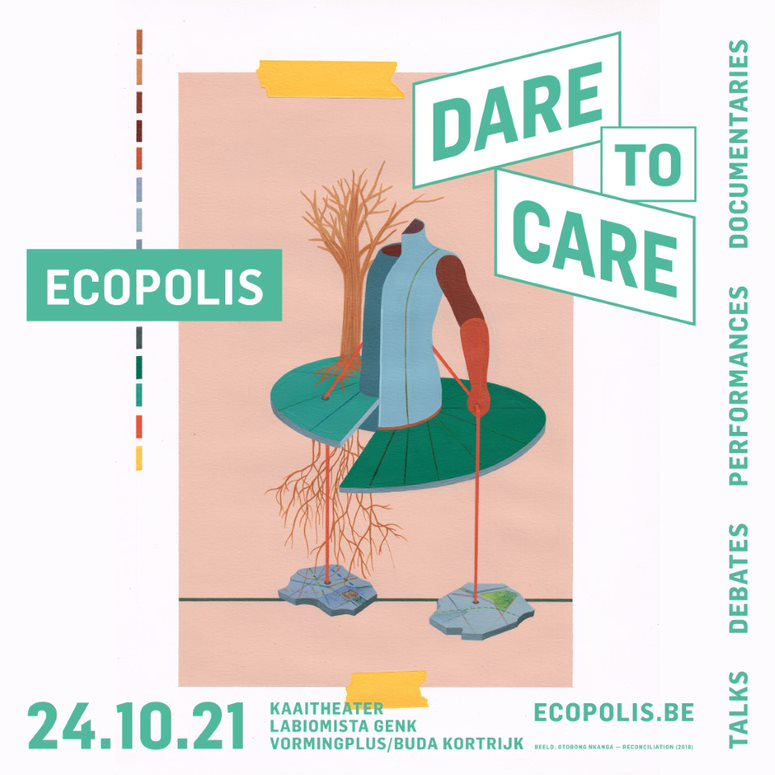
The global Covid-19 crisis brought healthcare into the spotlight. But care extends beyond the strictly medical: it includes everything we do to preserve and restore the world. The erosion of the welfare state, the plundering of the Global South and the crossing of planetary boundaries are worrying developments. And what about the connection between the exploitation of man and of nature?
What if tomorrow we found the courage to truly care for all people and other earthlings, for our unique living world? Seeing nature merely as raw material for plundering man, and man as merely driven by competition: can we put that behind us? Can care be a new starting point, based on connectedness and generosity? Can care, as an emancipatory principle, underpin politics and economics?
Ecopolis makes room for these questions, and many more, during a day of lectures, conversations, workshops, literature and performance. The analyses and proposals come together from many perspectives: alert carers and emancipated people in need of care, inspiring researchers and committed artists, fellow citizens who start from the local context and guests who bring in experiences and wisdom from indigenous cultures and the Global South.
Because ecological challenges know no national or linguistic borders, Ecopolis is diverse, international and interactive.


Context

Ecopolis is the perfect annual day to meet people who care about a sustainable future. Because ecological challenges know no national or linguistic borders, Ecopolis is diverse, international and interactive.

Ecopolis invites Belgian and international authors to debate the transition towards a socio-ecological society. Inspiring books, documentaries and debates between writers, academics and civil society thinkers about ecology, economy and society are at the heart of this event.

Speakers:

Jason Hickel – economic anthropologist and author of the recent book Less is More – How Degrowth Will Save the World 

Benedikte Zitouni – lecturer in Sociology and head of CESIR (Centre for Sociological Intervention and Research) at the University of Saint-Louis in Brussels, specialized in ecofeminist perspectives 

Mieke Vogels – Flemish Minister of Welfare, Health, Equal Opportunities and Development Cooperation from 1999 to 2003 

Els Hertogen – director of 11.11.11, the Flemish coalition of international solidarity groups 

Malcom Ferdinand  University College London, author of A Decolonial Ecology: Thinking from the Caribbean World 

Moya de Feyter – author and poet, and founder of the Dutch language branch of Poets for the Planet 

John Mussington – Barbuda Farming Co-Op and Barbuda Land Rights Committee 

Olave Nduwanje – author, legal scholar, and activist 

Sien Volders – award winning author of novels including Oogst (2020), which describes the harrowing fate of East European migrant workers in the agricultural sector in Italy  

You can see the full list via this link. 


Programme:  

Theatre Hall 

11:00 – 12:30 An economy that cares for people and the planet 

  • With Jason Hickel, Sien Volders, and Koen Schoors 

12:30 – 13:45 Care in the arts: how a choreographic practice can also become a care practice 

  • With Jija Sohn, Lucy Wilke, and Julia Reist (Lands of Concert) 

13:45 – 15:15 The care home of the future 

  • With Anne Berquin, Fed Ingram, Mieke Vogels, and Luc Van Gorp 

15:15 – 15:30 Essay by Carolina Maciel de França 

15:30 – 17:00 Chasing the idyll: neo-colonialism disguised as charity 

  • With Olave Nduwanje, John Mussington, Gaea Schoeters, Malcom Ferdinand, and Line Algoed 

17:00 – 18:00 Closing debate: towards a caring society 

  • With Benedikte Zitouni, Kopano Maroga, Carolina Maciel de França, Els Hertogen, and Lidia Paz 

Forum 

12:30 – 13:45 Health workers and the climate crisis 

14:00 – 15:30 Poetry room: the climate poets 

15:30 – 17:00 The Book Forum 

Living: Slow Discussions 

13:45 Curator: Philsan Osman 

15:30 Unequal care work: a daily struggle 

18:00 The Work that (Re)Connects: experimenting with collective grief circles 

For more details on the programme, please check here. 


Practicalities: 

Date: October 24th, 2021.  

Location: Kaaitheater, Square Sainctelette 20, 1000 Brussels 

Language: there will be simultaneously translation into English, French, and Dutch. 

Tickets: on sale via this link 

We operate a “pay what you can” principle with a suggested price of 10 EUR. If you are able to pay a higher price, this helps make it possible for others to pay less. Thank you for your solidarity! 

You can subscribe to the GEF newsletter here to stay informed of this and other upcoming events.  


This event is organised by the Green European Foundation, with the support of Oikos and with the financial support of the European Parliament to the Green European Foundation.
 

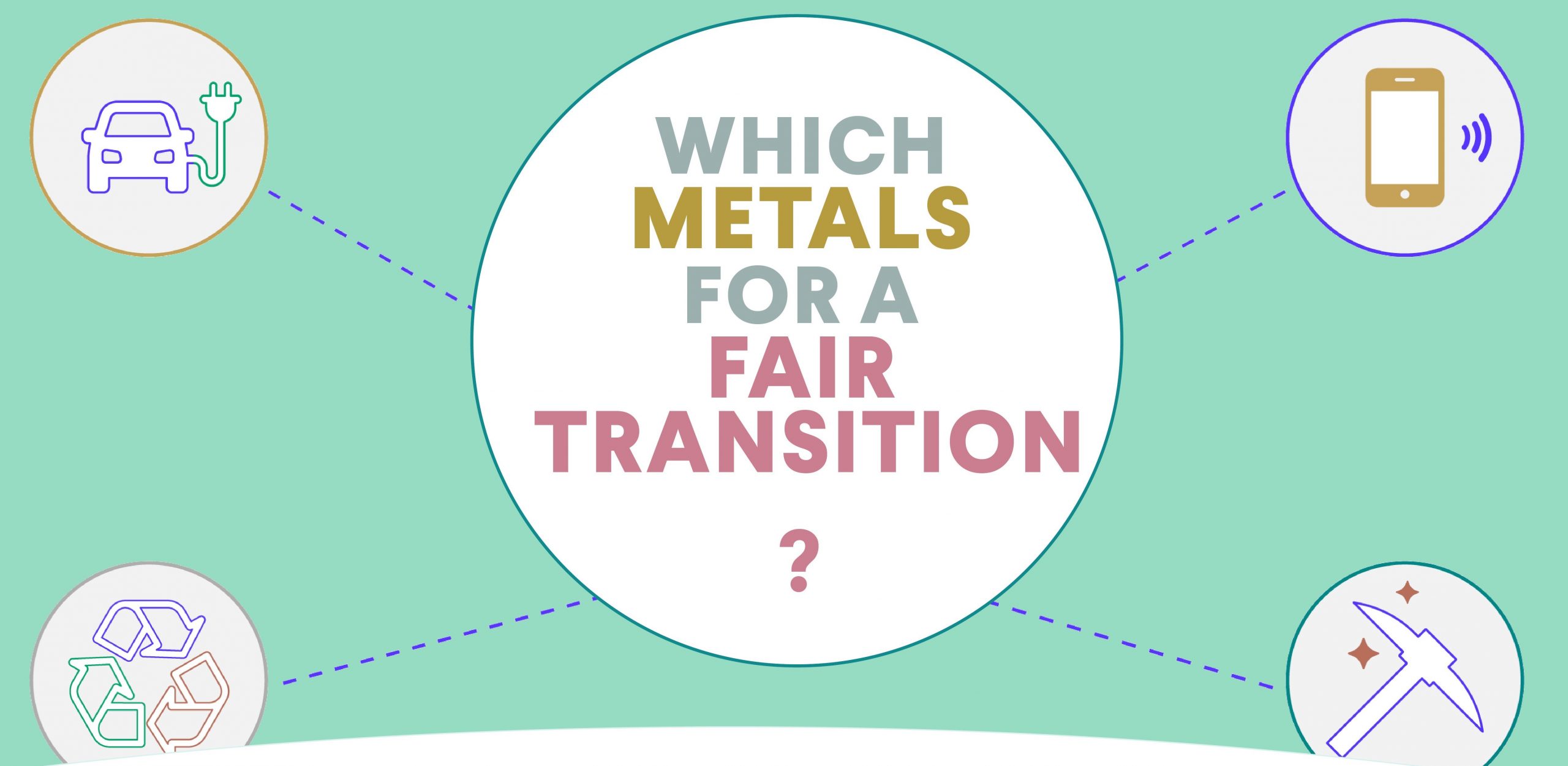
Which metals for a fair transition? 2/2

By

About the Event

Which metals for a fair transition?

During the months of May and June we will organise 2 webinars on this topic. While the first debate will focus on the aspects of extraction in the south (extractivism, working conditions, regulations, due diligence, etc.), this one will tackle the issues of consumption and production in Europe (reopening mines in Europe, lower consumption, circular economy, recycling, technology design, low tech…)

Our main guiding questions will be to:

  • Between the efforts for supply chain responsibility and the development of new technologies, can Europe ensure a fair supply of metals? Can we move beyond extractivism?
  • Can Europe make a more sparing, circular use of metals for its transitions? What would that mean for our lifestyles?


Context

Like all European countries, Belgium imports large quantities of rare metals such as cobalt, germanium, lithium and coltan through complex and opaque supply chains.

These metals are now the subject of particular attention in European policies. This is for at least two reasons which raise some rather contradictory issues and involve very different actors: it is in fact on the one hand to ensure a constant supply to support the growth of the development of renewable energies and digital technologies (solar panels, electric cars, wind turbines, smartphones, smart cities…) and on the other hand to make sure not to contribute to socially and ecologically objectionable forms of mining (work conditions sometimes close to slavery, child labour, destruction of ecosystems in producing countries… ). The Democratic Republic of Congo, with which Belgium has a tumultuous historical relationship, illustrates the current difficulties in reconciling these two issues. Between neo-colonialism and extractivism, Congo provides 60 per cent of the world’s cobalt and 40 per cent of coltan, but still remains one of the poorest countries in the world.

How can mining be technically and socially modernised to stop child labour and minimise environmental damage? How to deal with the limits of due diligence in Europe? What is being done today in European and Congolese policies to improve the conditions for metal extraction?

As far as demand is concerned, can the EU limit the need for imported virgin metals while ensuring a rapid energy transition and a responsible digital transition? For example, by stimulating the recycling and substitution of rare metals, re-opening mines within its borders or reducing the overconsumption of kilowatt hours and megabytes?


Speakers

Dr Peter Tom Jones, from KU Leuven (https://kuleuven.sim2.be/dr-peter-tom-jones/)

Romain Gelin (Research group for an alternative economic strategy- Gresea)

Géraldine Duquenne (Policy and advocacy officer at Justice et Paix)


Practicalities

Date and time: Thursday, 3rd June from 12:00 to 14:00 CET.

Audience: This webinar will take place in French and is open to the general public

Facebook Event: Available here

Registration: Click Here


The event will be organised through the ZOOM platform, with Facebook live, Etopia Radio and the local Brussels Radio station (tbc).


This project is organised by the Green European Foundation with the support of Etopia and with the financial support of the European Parliament to the Green European Foundation. The European Parliament is not responsible for the content of this event.

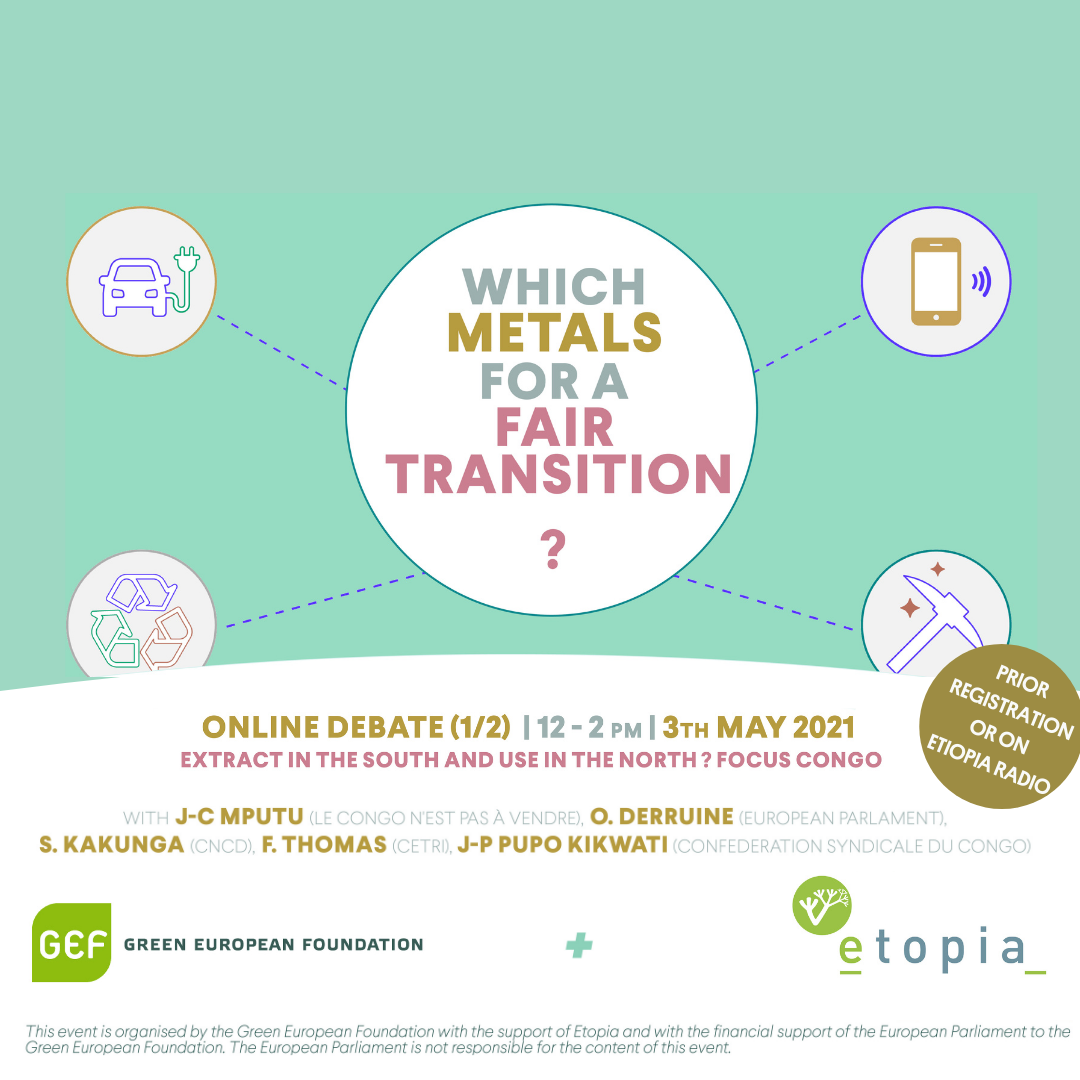
Which metals for a fair transition?

By

About the Event

Which metals for a fair transition?

During May and June, we will organise two webinars revolving around this topic. While the first debate will focus on the extraction aspects in the south (working conditions, regulations, due diligence…), the second will tackle consumption and production in Europe (reopening mines in Europe, lower consumption, circular economy, recycling, technology design, low tech…)

Our main guiding questions will be to:

  • Between the efforts for supply chain responsibility and the development of new technologies, can Europe ensure a fair supply of metals? Can we move beyond extractivism?
  • Can Europe make a more sparing, circular use of metals for its transitions? What would that mean for our lifestyles?

Context

Like all European countries, Belgium imports large quantities of rare metals such as cobalt, germanium, lithium, and coltan through complex and opaque supply chains.
These metals are now the subject of particular attention in European policies. This is for at least two reasons which raise some rather contradictory issues and involve very different actors: it is, on the one hand, to ensure a constant supply to support the growth of the development of renewable energies and digital technologies (solar panels, electric cars, wind turbines, smartphones, smart cities…) and on the other hand to make sure not to contribute to socially and ecologically objectionable forms of mining (work conditions sometimes close to slavery, child labour, destruction of ecosystems in producing countries… ).

The Democratic Republic of Congo, with which Belgium has a tumultuous historical relationship, illustrates the current difficulties in reconciling these two issues. Between neo-colonialism and extractivism, Congo provides 60% of the world’s cobalt and 40% of coltan, and yet remains one of the poorest countries in the world.

How can mining be technically and socially modernised to stop child labour and minimise environmental damage? How to deal with the limits of due diligence in Europe? What is being done today in European and Congolese policies to improve the conditions for metal extraction?
As far as demand is concerned, can the EU limit the need for imported virgin metals while ensuring a rapid energy transition and a responsible digital transition? For example, by stimulating the recycling and substitution of rare metals, re-opening mines within its borders, or reducing the overconsumption of kilowatt-hours and megabytes?


Speakers

– Olivier Derruine, Economist, Parliamentary Assistant to Saskia Bricmont MEP, European Parliament

– Jean-Claude Mputu, Congolese political scientist

– Sabine Kakunga, Central Africa Program Officer (CNCD-11.11.11)

– Frédéric Thomas, Doctor of political sciences, lecturer (CETRI)

-Jean Pierre PUPO KIKWATI, from the “Confédération Syndicale du Congo (CSC)


Practicalities

Date and time: Monday, 3rd May from 12:00 to 14:00 CET.

Audience: This webinar will take place in French and is open to the general public

Registration: Click here

Please note the event will be organised through the ZOOM platform, with Facebook live, Etopia Radio and the local Brussels Radio station.

Zoom Link: Here

RadioEtopia: Here

Facebook Event (FR): Here


This project is organised by the Green European Foundation with the support of Etopia and with the financial support of the European Parliament to the Green European Foundation. The European Parliament is not responsible for the content of this event.

A European Charter for Smart Cities: Applications at Local, Regional, Federal Level? (Liège)

By

About the Event:

In 2019, the Green European Foundation, with the support of its partner foundations Wetenschappelijk Bureau Groenlinks (Netherlands), Green Economics Institute (United Kingdom) and Institute for Active Citizenship (Czech Republic) created a Smart City Charter to assess and pilot technological innovations in cities. This event, with the support of Etopia, will promote, discuss, and build on the Charter further with regional experts and perspectives.

Speakers:

  • Richard Wouters, Wetenschappelijk Bureau Groenlinks
  • Pascal Hillewaert, green alderman for Ecolo
  • Veronica Cremasco, Walloon deputy for Ecolo
  • Carine Basile, COO of the Smart City Institute
  • Isabelle Rawart, Agence du numerique

The moderator is Quentin Le Bussy (municipal councilor Vert Ardent Liège).

Programme:

This event will cover:

  • The definition of ‘Smart City’ and presentation of the Charter
  • Local applications and the question of whether these bring real added value
  • The link to Wallonia’s Smart Region initiative

Practicalities:

When: Friday, August 28th from 14:00 to 15:30.

Where: The Francisco Ferrer Room in Cité Miroir (Liège, Belgium).

Language: French

Register via this event page. Please note that the event will be livestreamed via Facebook here.

Political Ecology Days (Brussels)

By

About the Event:

The first edition of the Political Ecology Days will assemble key actors and thinkers in the field of political ecology, and aims to repeat this once every two years for the next decade. Political ecology is at a crossroads, which means there is a need to put things back in perspective, update its founding principles, and create a new narrative that cuts through in practice and in people’s minds.

With over 20 sessions, including lectures, seminars and participative workshops, the Political Ecology Days will cover a range of topics within three central themes: (co)inhabiting the earth differently, becoming resilient and reinventing democracy.

This event was originally set to take place in March and was delayed due to the COVID-19 pandemic, but we are eager to welcome you to this adapted edition! 

Speakers:

Featured speakers and moderators include:

  • Benedetta De Marte, European Green Party
  • Dirk Holemans, Oikos
  • Dominique Bourg, University of Lausanne
  • Dominique Meda, University of Paris-Dauphine
  • Edgar Morin, philosopher and sociologist
  • Isabelle Stengers, Université libre de Bruxelles
  • Lucile Schmid, La Fabrique Ecologique
  • Michel Bauwens, P2P Foundation
  • Mohammed Taleb, philosopher
  • Monica Frassoni, European Green Party
  • Paul Lannoye, Ecolo

And many more! 

Programme:

The following sessions are organised by GEF. The primary language is French, but all workshops will be recorded and translated and subtitled versions will be made available afterwards.

Saturday, 24/10

  • 10:30 – 12:30 Environmentalism, Populism and the Far Right

Moderated by Michel Genet, with Florent Marcellesi and Reinhard Olschanski

  • 14:00 – 16:00 The Many Strands of Political Ecology

Moderated by Benedetta de Marte, with Dirk Holemans, Edouart Gaudot, and Monica Frassoni

Sunday, 25/10

  • 14:00 – 16:00 Green Talks

10 mini-talks of 8 minutes each, inspired by Three Minute Thesis and TEDx formats.

You can consult the full three-day programme here. 

Practicalities:

When? 23-25 October, 10:00-22:00

Where? Due to COVID-19 safety measures, this event has had to move entirely online. The Political Ecology Days will therefore be streamed live on Facebook.

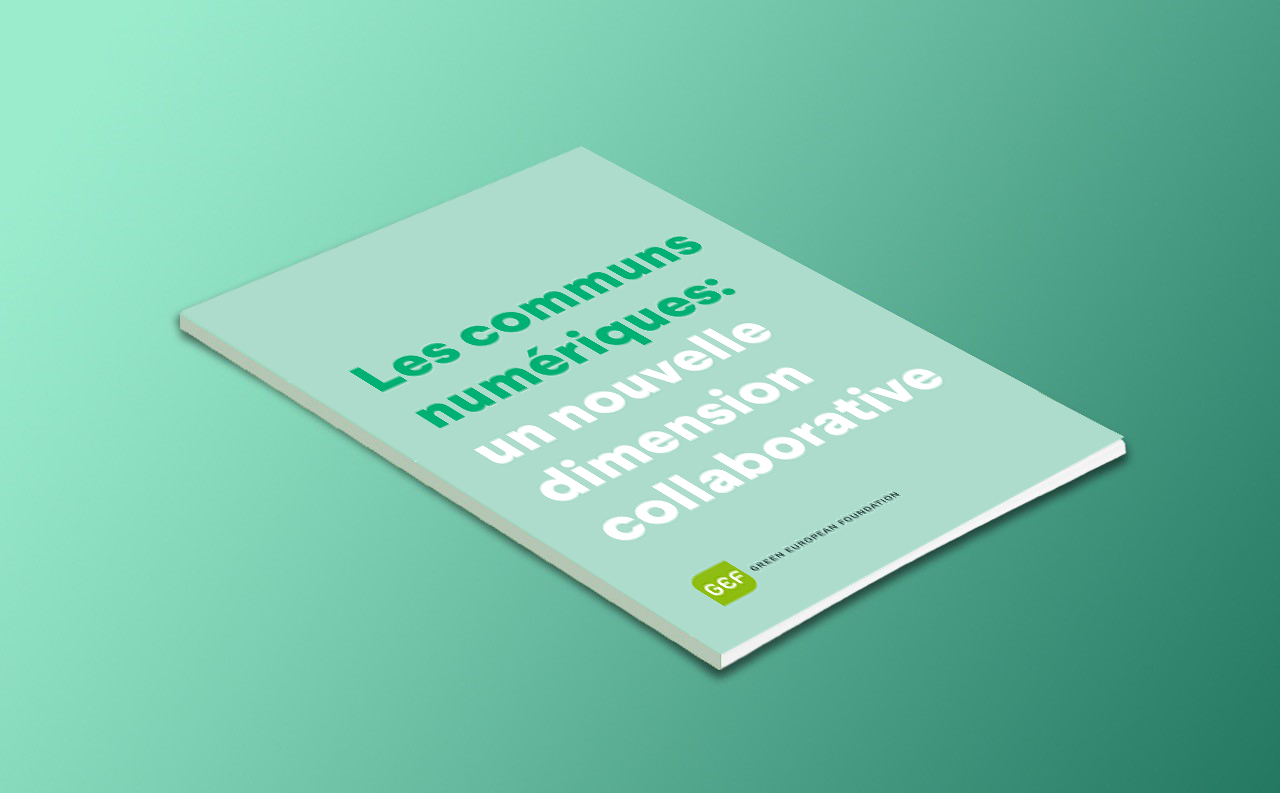
Digital Commons: A New Collaborative Dimension

By Uncategorized

Due to the digitisation of our societies, the way individuals act and interact in the private as well as the public sphere changes rapidly. Digital platforms and open source programmes as Commons can contribute to the transformation of our societies and will, wished for or not, change the modus operandi of our economy as well.

The approach of Governance of the Commons could be one solution against possible misuse and working towards a more just redistribution or a government that balances the interests of producers, workers and consumers better.

The objective of this short analysis is to address these aspects of remuneration and protection of digital tools.

“Blockchain & Commons” in Brussels

By

Context

The commons are driven by citizens’ initiatives, including an increasing amount of digital opportunities as well as new technologies which have the power to transform democracy. This topic will be addressed in the upcoming workshop in Brussels hosted together with Etopia. The event is a part of our ongoing project Reclaim the Commons which aims to explore the transformative power of the commons, whilst involving the Greens and a wider audience around this topic.

Workshop in Brussels

This event will provide insights into the use of blockchain as a technology that reinvents the way citizens think and organise their exchanges. Beyond the most famous example of Bitcoin, employment contracts, insurances, our culture, and much more could be deeply impacted by this change in interaction between users and creators.

Can this technology be used as new common to pave the way for a better collective data management?  What about the future of public data and their transparency? And what are the potential dangers that need to be averted?

These intriguing questions will be discussed during our workshop together with:

  • tbc, Blockchain France
  • Olivier Roucloux, Consultant at Fenoryx

Time & Venue

The workshop will be hosted on Thursday, 23 November 2017, from 11h00 to 12h20 in the premises of Etopia in Brussels (Place des Barricades 1, 4th floor).

Registration

Please sign up by sending an email to jonathan.piron@etopia.be.

“Digital Cooperative Platforms” in Brussels

By

Context

The commons are driven by citizens’ initiatives, including an increasing amount of digital opportunities as well as new technologies which have the power to transform democracy. This topic will be addressed in the upcoming workshop in Brussels hosted together with Etopia. The event is a part of our ongoing project Reclaim the Commons which aims to explore the transformative power of the commons, whilst involving the Greens and a wider audience around this topic.

Workshop in Brussels

This event will have a special focus on the role of digital platforms in the context of commons and their impact on the economy. Digital platforms are affecting the relationship between suppliers and customers, as well as forcing certain sectors to reposition themselves or even to disappear. Competition rules also become more harsh and pose many social problems, with the examples of Uber and AirBnB. Faced with these pressures, we observe new dynamics developing around the models of cooperative platforms. The contribution of the commons can represent a new element energising these structures, making them more flexible and more resilient. What are the models emerging in this way? And how do we organise these platforms?

Such relevant questions will be discussed by the following speakers:

  • Stéphane Boulanger from Febecoop (Brussels)
  • Jean-Philippe Lens  from Topino (Gembloux)
  • Alexandre Ségura & Kevin Poperl from Coopcycle (Paris)

Time & Venue

The workshop will be hosted on Thursday, 12 October 2017, from 11h00 to 13h00 in the premises of Etopia in Brussels (Place des Barricades 1, 4th floor).

Registration

Please sign up by sending an email to jonathan.piron@etopia.be.

“Expulsions” author Saskia Sassen to participate in a debate in Brussels

By

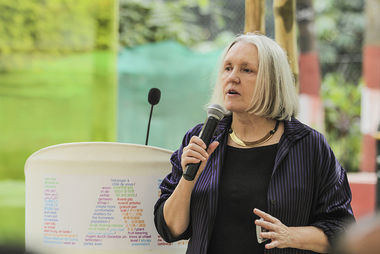
Saskia Sassen is professor of Sociology at Columbia University in New York. She is an expert on transnational migrations flows and a reference on globalisation. Her books have been translated into 12 languages and she is a member of the Club of Rome. Her criticism of growing inequality has earned her the label of the female “Piketty”.

The discussion was introduced by Gie Goris (Mo Magazine), with the participation of two special guests: Isabelle Ferreras (Sociologist at UCL, researcher at FRNRS, associate at “the labor and worklife program” of Harvard Law School) and Florent Marcellesi (Spokesperson for the Spanish Greens in the European Parliament, member of the European Parliament as of next October, and expert in international cooperation). The lecture was held in English, with translation to French and Flemish.

Sassen’s most recent book, “Expulsions: Brutality and Complexity in the Global Economy” describes how capitalism has entered a new phase that is increasingly brutal, even for those who may previously have felt shielded. The usual concepts of injustice and poverty are no longer sufficient to explain the current dislocation, both socio-economic and ecological, which is translated by a sharp rise in inequalities and unemployment, an increasing number of people in incarceration, as well as the accelerated destruction of land and water reserves. The time has come to recognise these tendencies as exclusions, or even as expulsions: from one’s livelihood, one’s home and even from the biosphere which renders life possible.

What Sassen attempted to demonstrate is the complexity generated by the combination of knowledge or technologies, used within the financial sphere as well as towards the destruction of the environment. This complexity contributes to an obscuring of the responsibilities in this situation.

Place: IHECS, Rue du Poinçon – 1000 BXL

Date: March 8th, 2016

“Commons and Resource Sharing” Workshop in Brussels

By

This workshop is a part of the Reclaim the Commons project, which in 2016 has a special focus on two themes – the relation between the commons and policy, and the impact of commons as a governance model on the public services. In the scope of this transnational project, the Green European Foundation and Etopia will implement three events in Belgium throughout this year, with this workshop as the first.

Themes of the Workshop:

From economic platforms to waste and energy management cooperatives, the question of communal structures is becoming more and more salient. Linked to the question of resource management, these new structures offer a range of new and innovative opportunities and projects. Trust between partners, savings made as well as original forms of co-management and coordination provide pathways to new alternatives.

What are the means and frameworks to be put in place? Towards which objectives? And how does the sharing of communal resources represent an ecological and social alternative. These are some of the questions we tackled during this event with our speakers.

Speakers:

  • The Gérard Fourré and Marc Moura from the Comptoir des ressources créatives and Dynamo;
  • Bertrand Merckx from Ecores.

Time and Location:

Date TBC, at the premises of Etopia in Brussels (Place des barricades, 1 – 4th floor).

“Commons and Public Partnership” Workshop in Brussels

By

This event is a part of our Reclaim the Commons project, which this year aspires to provide relevant insights to the relation between the commons and policy, and the impact of the commons as a governance model on the public services.

Themes of the Workshop:

How do we build relationships between the collective initiatives, which focus on the new transitions around the commons, and the public authorities? What places are the commons claiming and how are sharing and diversity perceived by the public authorities? And how to move forward by overcoming obstacles and building new models? These questions will be addressed during the workshop with the help of our speakers:

  • Jean-Claude Englebert, First alderman in charge of urban planning and communal properties in Forest, Brussels;
  • Loïc Géronnez, Commons Josaphat, Brussels.

Time and Location: Wednesday, the 29th of June, from 11h00 to 13h00, at the premises of Etopia in Brussels (Place des barricades, 1 – 4è étage).

Green Summer Gathering: Edition 2016 in Belgium

By

This year’s edition of Les Rencontres Ecologiques d’Eté (Green Summer Gathering) featured many insightful workshops, debates and lectures. Information about the programme and registration is available at Etopia’s website. During this occasion, the Green European Foundation contributed with two special debates about the present and future of the European Union.

The first debate was held on Saturday, the 27th of August, from 09h30 to 10h45. This roundtable addressed the “why EU” question: Why the EU? Is the EU dream over? Why should we keep working hard on it? Does it represent the best way to insure progress in Europe? Special inputs on these matters were provided by professor Tanguy de Wilde (University of Louvain).

Our second debate took place right after – between 10h45 and 12h00, and focused more on “how EU” question in relation to this year’s challenges, such as the situation in Greece, issues with refugee policies and Brexit. How do we re-dynamise the EU project and make it “popular” again? How to tackle and approach this? Should the priority be institutional (more democracy, more transparency)? Should it be economical? Should we create a different approach to some challenges, such as the refugee policies? And how to contain the influence of the lobbies in all this? The list of speakers included:

  • Philippe Pochet (European Trade Union Institute);
  • Jean Quatremer (Correspondant at Libe à Bxl);
  • Jean De munck (Professor of Sociology at UCL);
  • Vivien Pertusot (Head of IFRI);
  • Philippe Lamberts (Co-President of the Greens/EFA).

Both debates were held with simultaneous translation in French and English. More information about them can be found on this webpage.