Regional Responses to Climate Change Through Regional Adaptations

By Uncategorized

Context

In its European Adaption to Climate Change, the EU presents the objective suggested to support 150 European regions and communities  working on climate resilience measures until 2023. It particularly takes into account the different ways that regions all over European are affected by Climate Change and how the European Union can support regions and local communities in the process of adjusting to the already existing and predicted effects of climate change on the daily lives of different communities.

The European Union should orient its climate change policy towards a policy mix that includes both Adaptation and Resilience to Climate Change. The former implies a more passive and reactive approach to mitigating the effects of Climate Change, while the latter indicates an active mitigation response.

Objectives

Based on the outcomes of the project Regional Responses to Climate Change,  this study offers insights on the implementation and response to the Regional Climate Change Adaptation Plans in the context of Greece and proposes a potential regional and local response to the predicted impacts of climate change .

Project Background

The “Regional Responses to Climate Change” project explores what a regional climate adaptation-resilience Plan would look like through a rethinking of policies for a new concept of infrastructure investments.

The creation of the publication has been possible thanks to the input from a large number of contributors, including: Panagiotis Panagos, Stavros Solomos, Demosthenes Sarigiannis, Rigas Tsiakiris, Panagiotis Vouros, Ilias Gianniris,  Elias Gianniris, Mirto Garis, Rigas Tsiakiris, Michael Bakas, Philippos Ganoulis, Nikos Poutsiakas and Costas Papakonstantinou.


This Publication is also available in Greek


This report has been realised by the Green European Foundation with the support of the Greek Green Institute, and the financial support of the European Parliament to the Green European Foundation. The European Parliament is not responsible for the content of this publication.

The Future of Eastern Europe and Eco-Democracy

By Uncategorized

Context & Objectives

Democracy in Eastern Europe is hanging by a thread. Authoritarianism is growing and nationalist narratives are reopening old conflicts. The pandemic has exposed governments’ inefficiencies to react to any sort of crisis and contributed to heighten polarisation in an already polarised society. On the other side, hope is on the horizon as progressive movements are gaining relevance locally, and mobilisation around environmental issues is rapidly growing. In this context, this publication aims to explore how to leverage these small steps and use them to strengthen the Green movement in the region. This publication is part of the Transnational Project The Future of Eastern Europe and Eco democracy.

“At least two to three generations of humans have now lived through some of the fastest changes with regards to the climate crisis and species extinction. It is up to us to reinvent politics, disrupt the status quo and create a solid foundation not only for us but also for the continued existence of biodiversity on our planet…”


Download

Also available in Greek.

Also available in Turkish.


This publication has been published by the Green European Foundation with the support of Cooperation Development Networks Eastern Europe (CDNEE), Green Thought Association (Turkey), Sustainable Development Forum Green Window (Croatia), Green Institute (Greece) and Ecopolis Foundation (Hungary).

EGAT Study Trip 2023 (Brussels)

By

About the event

During the three-day study trip, participants will have the chance to explore various topics such as climate justice and lobbying in Brussels through engaging with professionals, politicians, NGOs and other activists operating in and around the European institutions, as well as with each other.

With a range of formal and non-formal training methods, including interactive workshops, the trip will be a valuable learning experience for young activists brought together by Green values and a motivation to enact change.

Project background

The European Green Activists Training (EGAT) consists of training sessions for young Green activists in various phases. These include the completion of the online course EU for Beginners, the participation in national training sessions in their respective countries on domestic politics, as well as on European politics and institutions. The final stage is the study trip, which brings all the participants from across Europe together in Brussels.

The EGAT project aims to Europeanise existing training programmes for Green activists in several European countries by incorporating more pan-European content and to make these programmes more cooperative by enabling young activists to meet and network.

Programme

Tuesday March 7 – Getting to know each other, the green movement and the green family

  • Welcome note
  • Getting to know each other and team building activities
  • Political Ecology in Europe: the roots, the values and the people
  • Preparing for the European Parliament visit
  • Activist Toolkit: Public Speaking

Wednesday March 8– Visit to European Parliament and Activism in practice

  • Official visits to the European Parliament with MEPs Heidi Hautala, Philippe Lambert, Sara Mathieu, Saskia Bricmont, and Ernest Urtasun
  • Visit to the House of European History
  • Topical session on gender rights with MEP Kira Marie Peter-Hansen & other speakers
  • Activism in Brussels- International Women’s Day march

Thursday March 9 – Lobby in the EU and visit to the European Parliament

  • Activist Toolkit: The Good Lobby
  • Activist Toolkit: tilt!
  • Official visits to the European Parliament with MEPs Jakob Dalunde, Kim Van Sparrentak, and Alexandra Geese
  • Visit to the House of European History
  • Topical session on Energy in Europe
  • Closing Dinner

This event is organised by the Green European Foundation with the financial support of the European Parliament to the Green European Foundation. The European Parliament is not responsible for the content of this event.

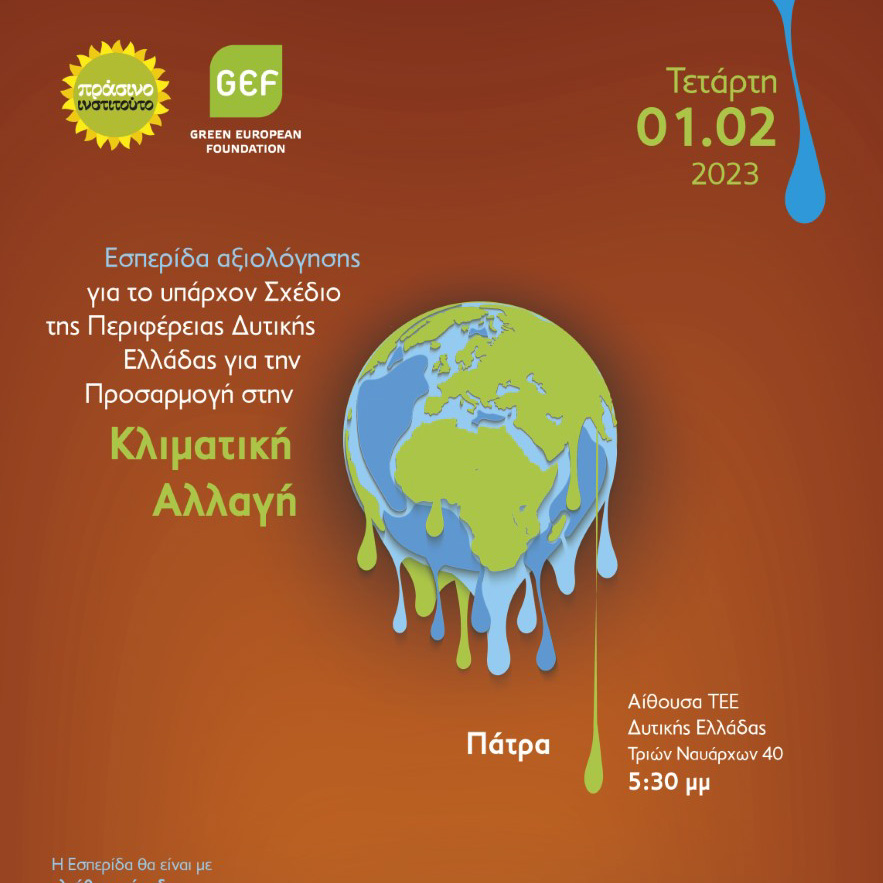
Evaluating the Plan for Adaptation to Climate Change in Western Greece ( Patras)

By

About the event

This seminar will mobilise the local society and the Regional Authorities, and inform rural and civil associations, regional representatives, students, municipalities and policy makers to discuss the existing Plan for Adaptation to Climate Change in Western Greece. The aim of the seminar will be to assess which policies need improvement and to consider the best ways to reach civil society. Very few people are aware of this Plan as it is, and one of the purposes of this event is to make it more visible.

Context

Local stakeholders should be the best actors in the efforts to adapt to Climatic Change, for that reason it is important to raise awareness among  EU, National administration, Regional authorities, actors and stakeholders about to the context planned and the actions needed to successfully adapt to Climate Change. With this project, GEF with the support of Green Institute Greece seeks to bring together academics, activists, and policymakers to engage local stakeholders on climate change prevention, mitigation, and restoration.

Speakers

  • Ilias Gianniris, President of the Green Institute, “Some Conclusions from the three previous Green Institute evenings on Regional Plans”.
  • Rigas Tsiakiris, forester, “Findings – inputs for the drafting of a PESPKA. The role of forestry and especially agroforestry and the European dimensions of the protection of wild flora and fauna”.
  • Stavros Solomos, Researcher C, Atmospheric Physics and Climatology Research Center of the Academy of Athens, “Assessment of Expected Climate Changes in Western Greece”.
  • Antonis Sakalis, Environmentalist MSc, Researcher ENVIROPLAN A.E., “Adaptation to Climate Change in the Region of Western Greece – The Regional Plan as a road map for the implementation of measures and actions”.
  • Kostas Papakonstantinou, Regional Councilor of Western Greece, “Combining adaptation to Climate Change with the need for Civil Protection in Western Greece”.
  • Vassilis Aivalis, President of Technical Chamber of Western Greece “Adaptation of Municipalities to Climate Change and the value of building within an urban fabric”.
  • Ecological Movement of Patras, “Planning with a positive perspective on the environment – From the level of the Region to the local level”.

Practicalities

Date and Time: February 1, 5:30 pm

Location: TEE Hall of Western Greece, Trion Navarchon 40, Patras, Greece

Registration: Participation is free. Registrations will occur at the venue.


This seminar is organised by the Green European Foundation, with the support of The Green Greek Institute, the Ecological Movement of Patras (NGO) and the Ecological Western Greece and the financial support of the European Parliament to the Green European Foundation.

Regional adaptations to Climate Change (Thessalyregion)

By

Context

The Green European Foundation with the support of the Green Institute Greece is implementing the project “Regional Adaptations to Climate Change” in 2022-23.

The aim of the project is to explore Adaptation plans of four Regions in Greece (North Aegean, Thessaly, Central Macedonia, Peloponnese), in relation to the existing Regional Climate Change Adaptation Plans for each Region (PESPKA).

During the next four months, the events will focus on one region at a time, with recommendations on how to improve adaptation plans and share best practies for other European countries facing similar climate impacts.

Program

17:15-17:30Arrival
17:30 Opening Chair: 

Nikos Poutsiakas (member of the network of green local-governments, partner of the Green Institute)

17:30-18:00Greetings
18:00-18:15Ilias Gianniris (President of the Green Institute, Conclusions from the Green Institute’s investigations on resilience and adaptation to climate change)


18:15- 18:30 Stavros Solomos (Researcher 3, Atmospheric Physics and Climatology Research Center of the Academy of Athens, Assessment of Expected Climate Changes in Thessaly)
18:30- 18:45 


Panagiotis Panagos (Research Officer at the European Commission, The soil and its value for adaptation to climate change in relation to the Thessaly PESPKA)
18:45-19:00 Mylopoulos Nikitas (Professor, Director of the Laboratory of Hydrology and Water Resources, Department of Civil Engineering, University of Thessaly, “Water scarcity is politics: the example of Thessaly”)
19:00-19:15 pm Antonis Skouloudis (Assistant Professor, Dept. of the Environment, University of the Aegean, Investigating the flood resilience capacity of small and medium-sized enterprises-Report on the case of Ianos in Thessaly”)
19:15-19:30 Konstantinos Vlachopoulos (Environmentalist, MSc, PhD Candidate in Population Ecology at the University of Thessaly, Effects of climate change on the biodiversity of Thessaly)
 

19:30-19:45

Argyropoulos Zisis (Chemist – Environmentalist “The climate future in Thessaly”)
 

19:45-20:00 

Vouros Panagiotis (Environmentalist, The Regional Plan for Adaptation to Climate Change (PESPKA) of Thessaly)
20:00-20:15 Questions
 

20:15-20:25

Break
 

20:25-21:00 

Round table with the participation of the speakers. Coordination: Nikos Poutsiakas

Evaluation of the Thessaly PeSPKA. Proposals – Implementation measures – Review. 

21:00-21:10Closing – The next steps:

Ilias Gianniris (president of the Green Institute) 

Practicalities

Where: Metropol Hotel, Roosevelt 14, Larissa

Date:  15th December

Time:  5:30 pm to 9:10 pm CET

Audience: This event is open to the general public

Attendance: This event will be livestreamed via the Zoom platform (meeting ID: 841 1605 0471)

Language:  This event will be in Greek language


This event is organised by the Green European Foundation with the support of Greek Green Institute and with the financial support of the European Parliament to the Green European Foundation. The European Parliament is not responsible for the content of this event.

Regional adaptations to Climate Change (Central Macedonia region)

By

Context

In 2022-23, The Green European Foundation with the support of the Green Institute Greece is implementing the project “Regional Adaptations to Climate Change”. The project aims to explore Adaptation plans for four Regions in Greece (North Aegean, Thessaly, Central Macedonia, and Peloponnese) in relation to their existing Regional Climate Change Adaptation Plans (PESPKA).

During the next four months, the events will focus on one region at a time, with recommendations on how to improve adaptation plans in the region and share best practices for other European countries facing similar climate impacts.

Program

5:15-5:30 Arrival
5:30 Opening Chair: Philippos Ganoulis, researcher, partner of the Green Institute, Argyris Ginoudis, partner of the Green Institute
5:30-6:00 Greetings
6:00-6:20 Ilias Gianniris, President of the Green Institute, Conclusions from the Green Institute’s investigations on resilience and adaptation to climate change
6:20- 6:40 Stavros Solomos, Researcher, Atmospheric Physics and Climatology Research Center of the Academy of Athens, Assessment of Expected Climate Changes in Central Macedonia
6:40- 7:00 Panagiotis Panagos, Research Officer at the European Commission, The soil and its value for adaptation to climate change in relation to the Central Macedonian PESSPKA
7:00-7:20 Dimosthenis Sarigiannis, Professor, AUTH, Department of Chemical Engineering – Environmental Engineering, Preparedness of organizations and citizens for Adaptation to Climate Change – Forecasts of the PeSPKA of Central Macedonia
7:20- 7:40 Philippos Ganoulis, researcher, Positive and weak points of the PeSPKA of Central Macedonia
7:40-8:00 questions
8:00-8:10 break
8:10- 8:50 Round table with the participation of the speakers. Coordination: Xenofon Zisis, Evaluation of the Central Macedonia PESPKA.- proposals- implementation measures- Revision
8:50-9:00 Ilias Gianniris, president of the Green Institute: The next steps.

Practicalities

Location: Hall of the Directorate of Urban Planning and Architectural Studies
of the Municipality of Thessaloniki

Date and Time:  5th December 5:30 pm to 9:00 pm CET

Audience: This event is open to the general public, hybrid

Participation: This event will be livestreamed via Zoom

Meeting ID: 863 4813 8848

Language:  This event will be in Greek language


This event is organised by the Green European Foundation with the support of Greek Green Institute and with the financial support of the European Parliament to the Green European Foundation.The European Parliament is not responsible for the content of this event.


Regional adaptations to Climate Change (North Aegean region)

By

Context

The Green European Foundation with the support of the Green Institute Greece is implementing the project “Regional Adaptations to Climate Change” in 2022-23. The aim of the project is to explore Adaptation plans of four Regions in Greece (North Aegean, Thessaly, Central Macedonia, Peloponnese), in relation to the existing Regional Climate Change Adaptation Plans for each Region (PESPKA).

During the next four months, the events will focus on one region at a time, with recommendations on how to improve adaptation plans in the region and share best practies for other European countries facing similar climate impacts.


Program

5:30pm Arrivals6:00pm Introductions by the Chair: Michalis Bakas, Environmentalist, MDE Environ. Policy and Management,6:00-6:10pm Greetings6:10- 6:25pm Stavros Solomos, Researcher, Atmospheric Physics and Climatology Research Center of the Academy of Athens, Assessment of Expected Climate Changes in the North Aegean6:25- 6:40 pm Eleni Briasoulis-Kapetanaki, Om. Professor, Department of Geography, University of the Aegean, The challenges of spatial planning to combat land degradation and desertification6:40- 6:55pm Panagiotis Panagos, Research Officer at the European Commission, Soil and its value for adaptation to climate change in relation to the North Aegean PESPKA6:55- 7:10 pm Giorgos Plakotaris, EYD Executive, Procedures and Provisions of PESPKA B Aegean – Next steps7:10- 7:25pm Theodora Petanidou, Professor, Department of Geography, Laboratory of Biogeography & Ecology, University of the Aegean, Why the preservation of the terraces is a priority in the North Aegean7:25- 7:40pm Athanasios Kizos, Professor, Rural Geography, Department of Geography, University of the Aegean, Preparedness of farmers, their organizations and citizens for Adaptation to Climate Change – Forecasts of the North Aegean PESPKA7:40-7:55pm Q&A7:55- 8:10pm break8:10- 9:00 pm Round table with the participation of the Speakers

Coordination: Ilias GiannirisEvaluation of the North Aegean PESPKA.- proposals and implementation measures9:00-9:10 pm Ilias Gianniris, president of the Green Institute Greece: Next steps.


Practicalities

Where: Chamber of Lesvos, P. Kountourgioti 71, Mitilini-Lesvos, 81100

Date:  22nd November

Time:  17:30 to 21:00 CET

Audience: This event is open to the general public

Registrations: Registrations will be open shortly

Language:  This event will be in Greek language


This event is organised by the Green European Foundation with the support of Greek Green Institute and with the financial support of the European Parliament to the Green European Foundation.The European Parliament is not responsible for the content of this event.


EGAT Croatia 22-23

By

About the event

The European Green Activists Training (EGAT) is a project organized by Green European Foundation in cooperation with Sustainable Development Forum Green Window. This project has been organised in Croatia for six years, over which the project has gathered more than 100 high school students, university students and young professionals from all parts of the country.

The aim of the project is to familiarise participants with green topics (climate change, biodiversity and environment protection, human rights and democracy, feminism, active citizenship…), green policies and sustainable development policies, as well as the EU institutions. Through various sessions and discussions involving representatives of international organizations and the European Union, the goal is to explore possibilities of active and professional involvement in building a greener and more just society.

Many previous participants remained active in the fields of sustainable development and green policies, while some even had the opportunity to pursue their career through internships or regular employment opportunities in the institutions of the EU.

Apart from Croatia, participating countries include Finland, Greece, Hungary, Catalonia, Poland and the Czech Republic.


Programme

  1. First national training session (Red Cross Lodge, Sljeme) – November 26-27 2022
  2. Second national training session (Red Cross Lodge, Sljeme) – December 10-11 2022
  3. Third national training session (Red Cross Lodge, Sljeme) – February 11-12 2023
  4. Brussels Study Trip – planned for March 2023 (exact date TBA)


Practicalities

Participants are required to participate in all meetings and national training sessions, as well as the study trip in Brussels.

Please apply via this form. All citizens from Croatia between 18-25 years of age are eligible to apply. We especially encourage applications from those who don’t have previous experience in topics.

After the selection process is finished, 20 participants will be selected.

The one-time participation fee amounts to 450 HRK (60 EUR), while all the other costs are covered (accommodation and lodging for all national training sessions, costs of Brussels Study Trip) by the organizer. For participants outside of Zagreb, travel costs for participation in national training sessions are also covered.

In case of the worsening of the epidemiological situation related to COVID-19 in Croatia and the introduction of more restrictive measures, national training sessions will be held online or in a hybrid format, depending on the actual situation and following recommendations of the Croatian Institute of Public Health. All measures recommended by the Croatian Institute of Public Health, if any, will be implemented in national training sessions. In case of severe worsening of the epidemiological situation at the level of the European Union, there is a possibility of the Brussels Study Trip being postponed or cancelled.

Applications are accepted until October 15 2022.
For all additional questions, please reach out to info@zeleniprozor.hr.

Handling of personal data, collected in the scope of this application, will be carried out in accordance to the legislation of the European Union (EU Directive 95/46/EC). For additional information, please visit https://gef.eu/privacy-policy/.


This project is organised by the Green European Foundation with the support of Sustainable Development Forum Green Window and with the financial support of the European Parliament to the Green European Foundation.

EGAT Greece 22 – 23

By

About the event

During EGAT Greece, 20 participants aged 16-25 will have the chance to shape their activist figures through green values and with practical and theoritical guidance they will deepen their knowledge and understanding of issues related to democracy, ecology, sustainability, energy communities and just and democratic energy transition. They will get familiarised with the political decision-making processes on the national and European levels, understanding the severity of the imbalance of political representation and ultimately they will develop their skills so as to enact societal change, and promote more equal and sustainable societies. They will share space with politicians, activists, scientists and academics working in the front line trying to make positive change, and of course, they will meet with their like-minded peers who share the same preoccupation about the future and ideas of a better world.

THIS YEAR’S TOPICS

  • Energy & Renewables
  • EU, Democracy & Active Citizenship
  • Ecofeminism

Programme

First Training

Eco-camp Experience in rural area in Greece (TBA) October 28th – 30th

Second Training

Thessaloniki, Heinrich Böll Foundation December 3d – 4th

Brussels Study Trip

March / April, 2023 (exact dates TBA)


Practicalities

To APPLY, fill this application form by September 25th, 2022, 24:00 EET and give yourself the chance to drive social change through a unique learning experience. Please note that due to COVID-19 pandemic, all activities could potentially be subjected to changes. Some parts of the programme including the study travel could happen online.

Selection criteria

  • Aged between 16-25y.o., with plenty or with minimum experience in activism.
  • Belief in green values, respect for the natural environment, people and animals.
  • Passionate to learn and develop skills as a green activist in order to enact societal change.

Participation fees

Participation in EGAT Greece is free. All training materials, flights to and accommodation in Brussels are covered by funds deriving from the European Parliament, on condition that a participant has successfully completed the training programme in Greece. Unfortunately, we cannot cover transport and accommodation costs from other parts of Greece to the venues for attending the training workshops. If you really want to participate but are unable to cover these costs, please contact us so that we can see what solutions might be available.


Equal opportunity disclaimer

We would like to encourage young people aged 16-25 from every part of Greece to submit an application. We would particularly like to encourage participation from young people who belong to groups with marginal political representation, such as People with Disabilities, Roma Greeks, second generation immigrants and members of the LGBTQI+ community. Knowledge and experience in the above topics of the training is not a prerequisite.


This EGAT programme is organised by the Green European Foundation with the support of the Greek Green Institute and with the financial support of the European Parliament to the Green European Foundation.

EGAT Study Trip 2022 (Brussels)

By

About the Event

During the five-day study trip, will have the chance to explore various topics such as climate justice and lobbying in Brussels through engaging with professionals, politicians, NGOs and other activists operating in and around the European institutions, as well as with each other.

With a range of formal and non-formal training methods, including interactive workshops, the trip will be a valuable learning experience for young activists brought together by Green values and a motivation to enact change.

Event Background

The European Green Activists Training (EGAT) consists of training sessions for young Green activists in various phases. These include the completion of the online course EU for Beginners, the participation in national training sessions in their respective countries on domestic politics, as well as on European politics and institutions. The final stage is the study trip, which brings all the participants from across Europe together in Brussels.

The EGAT project aims to Europeanise existing training programmes for Green activists in several European countries by incorporating more pan-European content and to make these programmes more cooperative by enabling young activists to meet and network.

Programme

Monday 30th May– Getting to know each other and working together!

  • Welcome note
  • Getting to know each other and team building activities

Tuesday 31st MayGreen movement from a political perspective

  • Green movement, history and values
  • Green family- GEF, EGP, FYEG
  • Political round-up
  • Preparing for the European Parliament visit

Wednesday 1st June– Activism, Culture and Community

  • Official visits to the European Parliament with MEPs Heidi Hautala, Alviina Alametsä, Ville Niinistö, Kira Marie Peter- Hansen, Jakop Dalunde, Alice Ban Kuhnke, Pär Holmgren & other speakers
  • Topical session on gender rights
  • Topical session on the ongoing energy crisis
  • EU careers human library and networking dinner

Thursday 2nd June – Lobby in the EU: the good and the bad

  • Activist Toolkit: Activism through media
  • Activist Toolkit: Public Speaking
  • Activist Toolkit: Activist burnout and well-being
  • Activist Toolkit: my activism
  • Closing Dinner

About previous editions:


This event is organised by the Green European Foundation with the financial support of the European Parliament to the Green European Foundation. The European Parliament is not responsible for the content of this event.

Sustainable Woodshop [Goldegg]

By

Context:

This event is part of the Green European Foundations project Deforestation and Climate Change with the support of FREDA and the Green Institute Greece and it follows the three events held in March 2021 on productive reforestation, climate change, desertification, erosion and the EU Recovery and Resilience Fund and one in May 2021 on Agroforestry & Ancient Forest Protection.

About the event

This event will gather experts in the fields of nature conservation, forestry policy and deforestation activists and will provide best practice examples from a Sustainable Woodshop – Thoma Holz – Gesund und nachhaltig wohnen mit Holz. During the event, our green partners will also present a report produced based on the outcomes gathered in the previous three events organised by GEF and the Greek Green Institute. The focus of these previous webinars was mainly on productive reforestation in Greece and will show best practice examples from all over Europe.

Programme


Wednesday 6th April

Arrival of participants until 12:00

A welcome snack will be provided

13:00 – 15:00 Thoma Tour – Thoma Holz – Gesund und nachhaltig wohnen mit Holz

15:30 – 18:00 Presentations of best practices and the Reforestation publication and exchange

18:30 – 19:30 Dinner

20:00  Film screening

Thursday 7th April

9:00 – 10:00 Networking Breakfast

10:30 – 11:30 Tour of Castle Goldegg

11:30 – 12:30 Lunch

Departures

Speakers

  • Dagmar Tutschek – Chairwoman (FREDA), Co-President (Green European Foundation) – Introduction
  • Rigas Tsiakiris, Forest Ecologist, Scientific Committee of the Green Institute Greece
  • Kalliopi Stara, Researcher, Department of Biological Applications and Technology, University of Ioannina
  • Matthias Schickhofer, Conservationist, book author, photographer
  • Bogdan Barbu, Environmental activist and Co-President of a newly formed green-minded party in Romania
  • Simon Heilig-Hofbauer, Salzburg Greens
  • Erwin Thoma, Chief Executive Officer, Ing. Erwin Thoma Holz GmbH; Entrepreneur; Author


Practicalities

Date and time: 6-7th April

Audience: Deforestation & Climate Change Project partners, GEF Partners, interested stakeholders

Venue & Accommodation: the event will take place at Thoma Holz and study visits will be organised to explore different sustainable woodshop best practices.

Registrations: Registrations are now open <<


Audio visual materials

Productive reforestation for living rural landscapes – Publication

In this publication you will find concrete recommendations on how to address the effects of climate change and biodiversity loss through policy change in the agricultural and forestry sectors, with agroforestry systems as part of the solution.


This project is organised by the Green European Foundation with the support of FREDA and Green Institute Greece with the financial support of the European Parliament to the Green European Foundation. The European Parliament is not responsible for the content of this event

The Future of Eastern Europe Conference (Riga)

By

About the event

We are pleased to announce the Conference on the Future of Eastern Europe organized on 6-7 June in Riga, Latvia. The conference will be organised by GEF with the support of Cooperation Development Networks Eastern Europe (CDNEE), Green Thought Association (Turkey), Sustainable Development Forum Green Window (Croatia), Green Institute (Greece) and Ecopolis Foundation (Hungary). The Conference aims to unite the voices of young green activists from Eastern Europe to talk about the future of the region, and the challenges and opportunities for an ecological and progressive turnaround.

Context

This is the first event as part of our 2022 Transnational Project The Future of Eastern Europe and Ecodemocracy. Democracy in Eastern Europe is hanging by a thread. Authoritarianism is growing and nationalist narratives are reopening old conflicts. The Pandemic has exposed governments’ inefficiencies to react to any sort of crisis and contributed to heighten polarisation in an already polarised society. On the other side, hope is on the horizon as progressive movements are taking over power at the local level, as well as at the rapidly growing mobilisation of public around environmental issues. How could we leverage these small steps and use them to strengthen the Green movement in the region?

Programme

DAY 1 – (6th June) Monday

10:00-10:15 Opening of the conference (Live Stream)

10:15-12:00 Eastern Europe as a region – a story of turbulent transformation (Live Stream)
Description:  For more than thirty years Eastern Europe is a region of independent nation-states. During this period there was the promise that after a long struggle democracy and well-being would be achieved. Looking at it today, it is clear that most Eastern European countries are far from democracy and the well-being of citizens.
In this session, we will try to analyse and reflect on the last decades of Eastern Europe, mainly focusing to find the roots of current problems and possible solutions by looking back at the recent history – what shaped the region, how the democratisation and transition took place.

Speakers:
Sonja Schiffers, Director of Heinrich-Boell Foundation, South Caucasus Office
Anastasiya Dorofeeva, Belarusian Green party, Belarusian anti-nuclear campaign, hub “Green foundations”

Moderator: Luka Gudek, Green European Foundation

12:00-13:30 Influence of Global Powers: Eastern Europe at the crossroads between democracy and autocracy (Live Stream)
Description: Discussing political dynamics and transformation of Eastern Europe cannot take place without paying attention to global powers and their involvement in the region. 
With this session we aim to map global powers: EU – China, Russia and US – and their interests; What role do they play in supporting democracy and progressive agenda or the opposite – encouraging and financing anti-democratic, right-wing and authoritarian forces. 

Speakers: 
Anton Cherepenko, the Free Hong Kong Center in Kyiv
Zarina Burkadze,  Associate Proffessor of Political Science, Ilia State University 
Raluca Besliu, Fundraising Manager, Green European Foundation and contributor of the Green European Journal focusing on Eastern European affairs
Teo Comet, TILT Coordinator at European Greens, Board Member at Green European Foundation 

Moderator: Giorgi Ptskialadze, Network Coordinator of CDN

15:30-17:00 War in Ukraine: Context, Present and the Effect on the region (Live Stream) 
DescriptionRussian aggression against Ukraine is continuing. Every day we are witnessing atrocities, war crimes and violations of international law from the Russian side, at the same time Ukraine is bravely defending its people, sovereignty, democracy and even Europe as a whole.
In this session, we will take a look at a few different aspects of the conflict: the context of the war, the historical roots of Russian aggression, the current events, as well as what greens should do to help Ukraine, and how the ongoing war affects countries in the region.

Facilitator: Katya Andrieieva, Executive Committee Member of CDN

17:30-19:00 Energy – a veto point and/or a chance for democracy? (Live Stream)
DescriptionThe energy we choose reflects the systems we support. In this session, we will discuss energy as the core factor for sustaining authoritarian regimes and the way the energy sector influences political dynamics. As well as we are going to focus on the possibility of democratisation through energy – decentralisation, renewables and the prospect of energy cooperatives in Eastern Europe

Speakers:

Manana Kochladze, Bankwatch Strategic Area Leader – Democratization and Human Rights

Yevheniia ZasiadkoHead of climate and transport department at Ecoaction – Centre for Environmental Initiatives

Workshop: Sandy-Kyriaki Fameliari, ElectaEnergy Cooperative

Moderator: Lusine Kosakyn, Executive Committee Member of CDN

DAY 2 – (7th June) Tuesday

10:00-11:30 Eco-Democracy as a new paradigm for Eastern Europe
DescriptionThe Workshop aims to add a philosophical, ethical and institutional dimension to the conversations on the Future of Eastern Europe happening at the Conference. It hopes to bring together the different voices and ideas from the wealth of participants and facilitate a meaningful discussion on how to put Ecology at the Centre of Democracy.

How can we make democracy more ecological? What kind of changes do we need to apply to our thinking about participation, institutions and decision-making to put ecology and the environment at the forefront of our political systems?

These are some of the questions that we’ll be asking and trying to answer at our Ecodemocracy Workshop!                              

Facilitators: Anna Maniadi and Dimitris Papageorgiou, Green Institute Greece            

12:00-13:30  Conflicts in Eastern Europe: the theory and beyond
Description
The session aims to provide participants with the basis of conflict theory and conflict resolution and analyze the conflicts in EE through case studies.  The session encompasses theoretical and practical parts that will be conducted through non-formal education methods. The objectives of the session are 1)to understand the concept of conflict (origin, causes, consequences), 2) to discuss the mechanisms of handling conflict, particularly, conflict resolution, and 3) to explore the conflicts that happened in EE in recent years, their consequences and current state.

15:30-17:00 Open Mic

17:30-19:30 Movements into politics: Green Wave in Eastern Europe (Live Stream)

Description: For the last decades, if you checked the electoral map of Europe intending to see how Green parties have been performing, you would see a clear pattern: Greens in the west and north do well – they get elected in national and regional parliaments, city councils, win mayorships and even participate in governing coalitions; while in the east – you would see a grey colour representing either absence of Green parties from the political landscape or lack of support and therefore relevance. However, in recent years the pattern is dissolving and becoming a blur, the Green wave spreading to the East.

During the panel, we will discuss the ongoing Green wave with newly established Green political parties across Eastern Europe with the aim to analyse current success, find the patterns and similarities, understand the importance of grassroots movements and civil society, map challenges, envision the future and their influence on the political landscape.
Speakers:
Justine Pantelejeva, Progresīvie, Latvia
Predrag Momčilović, Ne davimo Beograd, Serbia
Sopo Shubitidze, Mtsvaneebi, Georgia
Mozemo Croatia TBC
Stefan Vukmanovic, Ura Montenegro
Vesna TBC
Koray Doğan Urbarlı, Green Party Turkey

Practicalities

Date: 6-7th June

Time Zone: Eastern European Summer Time (EEST) / Coordinated Universal
Time (UTC) + 3

Location: Rija VEF Hotel, Brīvības 199c, Riga, Latvija, LV-1039 

Format: Hybrid format (some sessions will be Livestreamed)

Language: The main language of this activity will be English. But not being comfortable with interacting in English should not prevent you from applying. GEF & CDN strives to create an inclusive atmosphere at the events, where participants are encouraged to express themselves and ask for clarifications or translations from peers that speak the same language.

Costs: Anyone is welcome to take part in the conference with their own expenses. There is no participation fee.

In addition, CDN can cover the participation of a limited number of applications of young greens and activists from Eastern Europe (with a maximum age of 30). Meaning the cost of travel, and lodging (accommodation in multi-bed rooms, vegetarian/vegan food and refreshments).

In any case, take into consideration choosing the most economic and environmentally friendly means of travel (lowest price + travel time + CO2 emissions) and in case the trip would take less than 15 hours only travelling by land (train+bus) is reimbursed (IRPs §9.1).

Deadline: 20th of May (if applying for CDN to cover your participation.)

You will be informed by e-mail approximately 1 week after the deadline. Please add office@cdnee.org to your contacts, so that you do not receive our reply in the spam folder.

If you have any questions, do not hesitate to write us at office@cdnee.org

Registration: Registrations are now open! 

Additional Reading

Bulgaria’s Greens: From Street Protests to Government

How Green Independents Broke Through in North Macedonia

Extraction and Energy Transition in Serbia

Can Protests Steer Serbia Back Towards Democracy?

The War in Ukraine is Part of the Soviet Empire’s Unravelling

The Unfinished Business of Building Bosnia-Herzegovina

The Romanian Protest Wave: A Path to a New Political Era?
Belarus’s Struggle for Democracy


This event is organised by the Green European Foundation with the support of CDNEE and with the financial support of the European Parliament to the Green European Foundation. The European Parliament is not responsible for the content of this event
European Green Activist Training – Greece

By

About EGAT GREECE

EGAT Greece involves a series of training meetings in the context of the transnational European Green Activist Training programme.

During EGAT Greece, 20 participants aged 16-25 will have the chance to get informed about green values and to deepen their knowledge and understanding of issues related to democracy, ecology, sustainable agriculture and food activism. They will share space with politicians, activists, scientists and specialists working in the front line trying to effect positive change, and of course, meet with their peers who share
the same preoccupation about the future and ideas of a better world. Also, through interactive activities, they will learn more about political decision-making processes at the national and European level and develop useful skills as active citizens who will promote participatory democracy and the sustainability of our societies in the future.

The programme consists of online trainings on the Green Academy platform, 2 (two) two-day training workshops in Athens and a week-long educational visit to Brussels, where, along with other young activists from other countries EGAT trainings (Finland, Croatia, Poland, Hungary, Spain, Czech Republic), participants will have a first-hand experience of European institutions.

Programme

More information about the EGAT training programmes can be found here.

Details of the programme will be finalised soon. Please check again here.

1st Training Workshop
Athens, Saturday 17 & Sunday 18 September 2021, 9:00-18:00

  • Sustainable Agriculture, Food and Activism

2nd Training Workshop
Athens, Saturday 6 & Sunday 7 November 2021, 9:00-18:00

  • EU and Green Values: Participatory Democracy and Active Citizenship

Brussels Educational Visit

Winter 2022 (exact details TBA)


Participation

You can submit your application by filling out this online application form.

We would like to encourage young people aged 16-25 from every part of Greece to submit an application. We would particularly like to encourage participation from young people who belong to groups with marginal political representation, such as People with Disabilities, Roma Greeks, second generation immigrants and members of the LGBTQI+ community.

Knowledge and experience of the above issues is not a prerequisite. The selectioncriteria are a positive attitude, team-work, motivation for participation, consistency andthe desire to become and stay active in public affairs. For the Brussels visit, a good levelof English (B2) is important.

Final deadline for submissions: 31 July 2021


Additional Information

  • Due to the particular circumstances during the COVID-19 pandemic, all activities could potentially be subjected to changes depending on the epidemiological data and any restrictive measures and guidelines at that time. Some parts of the programme involving travel could happen online.
  • Participation on EGAT Greece is free. All training materials, flights to and accommodation in Brussels are covered by funds deriving from the European Parliament, on condition that a participant has successfully completed the training programme in Greece.
  • Unfortunately, we cannot cover transport and accommodation costs from other parts of Greece to Athens for attending the training workshops. If you really want to participate but are unable to cover these costs, please contact us so
    that we can see what solutions might be available.
    Additional Information

Please do not hesitate to contact us:

FB: GreenInstituteGreece
IG: greeninstitute_gr


This initiative is organised by the Green European Foundation with the support of Greek Green Institute and with the financial support of the European Parliament to the Green European Foundation.The European Parliament is not responsible for the content of this event.  

Reforestation priorities for climate change mitigation: How the Recovery and Resilience Fund could be much more than “business as usual”?

By

About the Event: 

In order to tackle climate change and the need to rapidly absorb CO2 emissions, targeting carbon neutrality in 2050 (or even before), the EU set the ambitious goal of planting  3 billion trees  by 2030. A project that will be financed by the Recovery and Resilience Fund (RRF) within the frame of the European Green Deal. 

Is this goal feasible? Is it worth it according to other EU strategies, action plans, and spending programs (such as Common Agricultural Policy, the Fork to Farm Strategy, the new Biodiversity Strategy 2030, and the Threatened Species Action Plans, the new European Forestry Strategy? And if so, how could we tackle land degradation and desertification issues within EU member states?

Context: 

This event is part of the Green European Foundations project Deforestation and Climate Change with the support of FREDA and the Green Institute Greece.  It follows three events held in March on productive reforestation, climate change, desertification, erosion and the EU Recovery and Resilience Fund, and the joint event on Agroforestry & Productive reforestation held in May.  

Speakers:  

Moderated by: Vula Tsetsi, Secretary-General of the Greens/EFA Group, European Parliament  

Dr. Rigas Tsiakiris Forest Ecologist, Scientific Committee of the Green Institute Greece  

‘’Productive reforestations for living rural landscapes” 

Presentation of the results of the 4 previous events and the new booklet published by GEF-FREDA-GIG that summarizes the outcomes of the 3 webinars on “Productive reforestations” with concrete proposals and policy recommendations for RRF. 

Dr. Panagiotis Panagos, Scientific/Research Officer, European Commission, Joint Research Centre Directorate D – Sustainable Resources

“Priorities for soil protection policies in EU”

The EU’s commitment to Zero Land Degradation by 2030 (Land Degradation Neutrality) should be addressed effectively and efficiently in the EU policy agenda and Member States due to climate emergency, agricultural intensification and population growth. The EU proposes the new Green Deal which should address  specific and concrete  actions for tackling the risk of land degradation and desertification especially in Mediterranean countries.

Kelsey Perlman, Forest and Climate Campaigner at FERN

Kelsey has worked on land-use and transport issues in European and international climate negotiations, looking specifically at problems linked to international aviation. At Fern she focuses on EU forest and climate policies, the negative emissions debate, and all things linked to Land Use, Land Use Change and Forestry.

Matthias Schickhofer, Conservationist, book author, photographer

“Proforestation: Optimizing climate mitigation and biodiversity restoration potential of EU’s forests“

Dr. Thanasis Kizos Professor, Department of Geography, University of the Aegean

CAP payments & economic viability of traditional agroforestry systems in EU  – Video intervention


Practicalities: 

Where: Online platform – ZOOM  

Date and time: 29th June, 17:30 to 19:30 CET  

Audience: this webinar is open to the general public  

Registrations are now open <<<

*Registrations will close 29th June, 15:00 PM CET 


This event is organised by the Green European Foundation with the support of Greek Green Institute & FREDA – Die Grüne Zukunftsakademieand with the financial support of the European Parliament to the Green European Foundation. The European Parliament is not responsible for the content of this event.   

Productive reforestation for living rural landscapes

By Uncategorized

This publication is part of the Green European Foundation’s Deforestation and Climate Change project and it compiles best practice examples gathered during the three webinars organised in March 2021 by GEF and the Green Institute Greece focusing on productive reforestations for pasture, beehiving, recreation and forestry as a means to combat climate change.

Agroforestry and small-scale traditional farming systems as well as multi- functional forest landscapes survived in many rural areas in Europe (as in mountains and islands) that escaped the large scale agricultural transformation that has been supported by the EU Common Agricultural Policy (CAP). In order to make the agricultural landscapes of Europe more resilient to climate change, funds like the NextGenerationEU must be appropriated for only sustainable projects.

In this publication you will find concrete recommendations on how to address the effects of climate change and biodiversity loss through policy change in the agricultural and forestry sectors, with agroforestry systems as part of the solution.


Also available in Greek: PARAGOGIKES ANADASOSEIS


Agroforestry & Ancient Forest protection

By

About the Event:

Agroforestry and small scale traditional farming systems as well as multi- functional forest landscapes survived in many rural areas in Europe (as in mountains and islands) that escaped the large scale agricultural transformation that has been supported by the EU Common Agricultural Policy (CAP). In order to make the agricultural landscapes of Europe more resilient to climate change, funds like the NextGenerationEU must be appropriated for only sustainable projects.

This event will gather experts in the fields of nature conservation, agriculture science & policy and will provide best practice examples from Greece and Romania.

A summary report / booklet produced based on the outcomes gathered in the previous three events organised by GEF and the Greek Green Institute will be presented. The focus of these previous webinars was mainly on productive reforestation in Greece and will show best practice examples from all over Europe.

Context:

This event is part of the Green European Foundations project Deforestation and Climate Change with the support of FREDA and the Green Institute Greece and it follows the three events held in March on productive reforestation, climate change, desertification, erosion and the EU Recovery and Resilience Fund.

The aim of the event is to explore the following questions:

● How applied agroforestry systems in practice could be supported by the EU Common Agricultural Policy?

● How to ensure that farmers, landowners living in less favourable areas benefit from the Recovery Fund?

● How could the EU found/support the multifunctional forestry bases not only on timber production but also on non timber products such as old growth local varieties of fruits and wild fruiting trees and berries as well as mushrooms?

● How to maintain the old multifunctional mountain landscapes and ecosystems that are abandoned by traditional agricultural activities?

Speakers:

Dagmar Tutschek – Chairwoman (FREDA), Board Member (Green European Foundation) – Introduction

Dr. Rigas Tsiakiris – Forest Ecologist,  Scientific Committee of the Green Institute Greece

  • Introduction to the GEF and Greek Green Institute’s Booklet on productive reforestation, presenting best practices

Martin Häusling – MEP, European Parliament

  • EU Common Agricultural Policy and traditional forms of agriculture

Matthias Schickhofer Conservationist, book author, photographer 

  • Integration of (strict) nature protection and small scale agriculture in the Carpathians

Michael Vrahnakis, Professor (Dept. Forestry & Wood Sciences & Design), University of Thessaly, Karditsa, Greece

  • The need to revitalize traditional silvoarable landscapes in the Mediterranean

Anastasia Pantera – Professor, Department of Forestry and Natural Environment Management, Agricultural University of Athens

  • Silvopastoral systems in time

Moderated by: Anna Deparnay-Grunenberg, Member of the Greens/EFA Group, European Parliament


Programme:


17:30 Technical check

18:00 Introduction Anna Deparnay-Grunenberg (Member of the Greens/EFA Group, European Parliament) & Dagmar Tutschek (FREDA)

18:10 Rigas Tsiakiris, Forest Ecologist,  Scientific Committee of the Green Institute Greece

Presenting findings of the first three events as part of the GEF Deforestation & Climate change projects on productive reforestation and best practices.

18:20 Martin Häusling, MEP, European Parliament 

Shortly before the decision on the common agricultural policy – where are we going? Sustainable farming methods. We need to shed light on traditional forms of agriculture in Europe. Currently almost 90% of the farmers have less than 10 hectares.  Austria as an example of what can be rebuilt with well-spent regional funds. What actually is sustainable forestry practice by definition?

18:35 Matthias Schickhofer, Conservationist, book author, photographer – Integration of (strict) nature protection and small scale agriculture in the Carpathians

Biodiversity-rich ecosystems are rare in the EU and continue to vanish. The biodiversity richness of landscapes correlates with the absence or the low degree of industrialization. This applies to agriculturally used areas as well as to forests. In the Carpathians (in particular in Romania), biodiversity-rich natural forests and a mosaic of ancient small-scale agriculture land have survived. Tragically, increased logging intensity is progressively threatening some of EU’s most valueable biodiversity hotspots (which led to a conflict between Romania and the EU). However, strict protection of natural ecosystems and low impact economic use (small scale farming, nature tourism etc.) do not have to be contradictions.

18:45 Michael Vrahnakis, Professor (Dept. Forestry & Wood Sciences & Design), University of Thessaly, Karditsa, Greece – The need to revitalize traditional silvoarable landscapes in the Mediterranean

Traditional silvoarable systems occupy a significant part of the Mediterranean landscapes, although they are either mis-operated or abandoned. It is important to revitalize these systems and to provide again to the society with a variety of ecosystem services. Land abandonment and restoration of traditional (and modern) small-scale agroforestry must be included in environmental policy agenda.

18:55 Anastasia Pantera, Professor, Department of Forestry and Natural Environment Management, Agricultural University of Athens – Silvopastoral systems in time (examples), work of science community

Silvopastoral systems are traditional agroforestry systems where livestock production is integrated with trees and shrubs.  Since their introduction to the Mediterranean region, livestock became part of the environment and co-evolved together over the centuries. Nowadays silvopastoral systems are threatened by the two extremes: overgrazing and abandonment. Sound management is urgently needed to support and preserve them as part of our natural environment heritage.

19:05 Questions by Anna Deparnay-Grunenberg, Member of the Greens/EFA Group, European Parliament

19:30 Questions by the audience / speakers (Open questions with voting)

20:00 End of the webinar 


Practicalities:

Where: Online platform – ZOOM

Date:  17th May

Time:  18:00 to 20:00 CET

Audience: This webinar is open to the general public

Registrations: Click Here

Language:  This webinar will be in English language with simultaneous translation to German.


This event is organised by the Green European Foundation with the support of FREDA – Die Grüne Zukunftsakademie & Greek Green Institute and with the financial support of the European Parliament to the Green European Foundation.The European Parliament is not responsible for the content of this event.

Climate Change, EU Recovery and Resilience Fund and Productive Reforestations

By

About the Event

This third concluding online event aims to map the different aspects and initiatives on productive reforestation, agro-climatic zoning and multi-functional landscapes in Greece. Target groups are government officers, green-minded stakeholders, NGO’s, local-regional authorities and experts. There will be presentations on behalf of the speakers on various topics and a first attempt to derive comprehensive findings. These findings together with the first two events will be compiled in a booklet at the end of the project with concrete recommendations for the forestry sector.


Context

This event is part of the Green European Foundations project Deforestation and Climate Change with the support of FREDA and the Green Institute Greece.


Speakers

  • Dr. Athanasios Kizos – Professor of Rural Geography, Department of Geography, University of the Aegean
  • Dr. Ioannis Xatzigeorgiou – Asssistant Professor of Agricultural University of Athens
  • Dr. Nikolaos Dalezios – Retired Professor of Agrometeorology – Remote Sensing, University of Thessaly
  • Dr. Despina Paetaridou – Forester – Environmentalist, Department of Forest Nurseries, Forest Genetic Resources and Reforestation, Ministry of Environment & Energy
  • Dr. Peristera Kourakli – Forester – Environmentalist,  Coordinator of National Forest Strategy Working Group,  Ministry of Environment & Energy
  • Dr. Petros Kakouros – Forester – Environmentalist, Member of the Editorial Committee of the magazine “ECOTOPIA”


Moderator

  • Dr. Rigas Tsiakiris – Forest Ecologist,  Scientific Committee of the Green Institute Greece


Practicalities

The webinar will be held through the ZOOM platform: https://us02web.zoom.us/j/82743911031?pwd=S1BFUERBT1NkSXRxd0xOOG4yRGFiZz09
Meeting ID: 827 4391 1031

This event will be in Greek language


This webinar is organised by the Green European Foundation with the support of Green Institute Greece and with the financial support of the European Parliament. The European Parliament is not responsible for the content of this webinar.

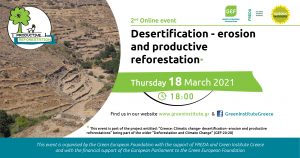
Desertification, erosion and productive reforestation

By

About the Event:

This event will focus on rural areas of the EU, the European Green Deal in the frame of the19th session of the Committee for the Review of the Implementation of the United Nations Convention to Combat Desertification..

Green European Foundation with the support of FREDA and the Green Institute Greece are opening the discussion for the new EU budget for “Recovery and Resilience” with the aim of enhancing the production of quality agricultural products, supporting local communities, mitigating the loss of biodiversity and the effects of the climate crisis.

Context:

This event is part of the Green European Foundations project Deforestation and Climate Change.

A total of three events will be organised based on the different aspects of the same topic. The aim is to derive guidelines for the type of expenditures for productive reforestations needed to meet Climate Change mitigation targets (e.g. resilience of Mediterranean anthropogenic forest ecosystem).


Speakers:

  • Soil and Desertification- The case of Greece
    • Dr. Christos Tsadilas – Agronomis, Soil scientist, f. Director of the Soil Mapping & Classification Institute ETHIAGE (now ELGO-DEMETER)
  • Geiospatial technology in the erosion and desertification research
    • Dr. Dionisios Kalivas – Professor at the Agricultural University of Athens
  • Sustainable Rangeland management against desertification: best practice applications
    • Dr. Vasilis Papanastasis – Forest – Rangeland Ecologist. F. Director of the Laboratory of Rangeland Ecology, Professor at the School of Forestry & Natural Environment, Aristotelian University of Thessaloniki
  • Autochthonous breeds of grazing animals: how could we regenerate our islands?
    • Dr. Yannis Kazoglou – Agronomist – Rangeland Ecologist, Assoc. Professor University of Thessaly & General Secretary of the Association of the Greek Shorthorn Cattle Breed
  • The 30 years of experience of the ‘Kallidendron’ method for the successful planting and growing of trees in desert and arid envirionments 
    • Dr. Spiros Karkabounas – Professor of Environmental Physiology, Medical Department, University of Ioannina
  • Landscape restoration in the Aegean: the example of Andros through the project – LIFE TERRACESCAPE 
    • Dr. Theodora Petanidou – Professor of Ecology & Ecogeography, Department of Geography, University of the Aegean


An honorary introductory greeting will be addressed by the emeritus professor of the Agriculture University of Athens, Dr. Nikolaos Giasoglou, f. Chairman of the National Commission for Combating Desertification, pioneer for the participation of Greece in the signing of the Convention for the Suppression of Desertification and the creation of the first National Plan for Combating Desertification (1999).

The event will be moderated by the Forest Ecologist Dr. Rigas Tsiakiris on behalf of the Scientific Committee of the Green Institute Greece

Programme:

Starting time: 18:00

Estimated end time: 20:30

Practicalities:

The webinar will be held through the ZOOM platform:

https://us02web.zoom.us/j/88244683827

Meeting ID: 882 4468 3827


This webinar is organised by the Green European Foundation with the support of Green Institute Greece and with the financial support of the European Parliament. The European Parliament is not responsible for the content of this webinar.

Reforestation for productive purposes: pasture, beehiving & recreation in Greece

By

About the Event:

This first online event aims to map the different aspects and initiatives on reforestation with trees for productive purposes, namely pasture, beehiving and recreation in Greece. Target groups are government officers, green-minded stakeholders, NGO’s, local-regional authorities and experts. There will be presentations on behalf of the speakers on various topics and a first attempt to derive comprehensive findings. These findings will feed the second, the third and last online event of this series.

Context:

This event is part of the Green European Foundations project Deforestation and Climate Change.

There are two more events to follow based on the different aspects of the same topic. The aim is to derive guidelines for the type of expenditures for productive reforestations needed to meet Climate Change mitigation targets (e.g. resilience of Mediterranean anthropogenic forest ecosystem).

Programme

  • Agroforestry in Greece: Good examples and perspectives
    •  Dr. Matzanas – Costas Forester-Rangeland specialist – Greek Agroforestry network (here)- School of Forestry, Aristotle University of Thessaloniki
  • Saving local traditional seed varieties, greening the table and the cultivations
    • Panagiotis Sainatoudis – Founder of the non-profit NGO PELITI: “Community of traditional seeds” (here) Citizens take actions:
  • Beekeeping and Forest Ecosystems: A mutual relationship
    • Dr. Sofia Gounari Agronomist – Chief researcher of the Beekeeping Laboratory- Instit. Of Med. Forest Ecosystems, Greek Agric. Org. “Demeter”
  • The value of local traditional varieties of fruit trees – perspectives of their use for agroforestry
    • Dr. Nikos Nikisianis = Biologist, collaborator of the project “Eco-variety”- “SYSTADA OE”
  • Small forest fruit trees and shrubs: The role of commercial plant nurseries in ex-situ conservation 
      • Dr. Eleni Maloupa Agronomist – Director of the Institute of Genetics Improvement and Phytogenetic Resources, Greek Agric. Org. “Demeter”

Practicalities:

The online event will be broadcasted via ZOOM – Launch Meeting – Zoom 

and

Live Streamed through the Green Institute Greece Facebook page: Πράσινο Ινστιτούτο (Green Institute Greece) | Facebook

Language:

This event will be in Greek language


This webinar is organised by the Green European Foundation with the support of Green Institute Greece and with the financial support of the European Parliament. The European Parliament is not responsible for the content of this webinar

European Green Perspectives on Basic Income

By Uncategorized

Throughout 2017 and 2018, the Green European Foundation transnational project Basic Income for all EU Citizens? focused on basic income and investigated the proposal’s potential in relation to employment, the recognition of work beyond paid work, and the gendered division of labour.

This collection of articles brings together experts on basic income from all across Europe, to debate and clarify different aspects of the topic and help develop proposals. The aim of the publication is to inspire the next steps in promoting the basic income discussion, one which encompasses some of the biggest challenges faced by society today.

In 2019, GEF will continue its work on basic income and contributing to transnational discussion with the project Basic Income – European Public Debate

Download

Available in Spanish